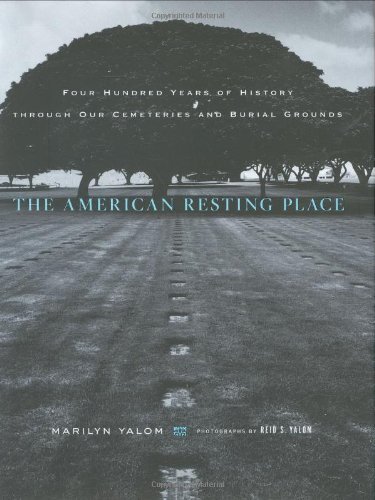
A sweeping history of America as seen through its gravestones, graveyards, and burial practices, stunningly illustrated with eighty black-and-white photographs
Cemeteries and burial grounds, as illuminated by an acclaimed cultural historian, are unique windows onto our religious, ethnic, and deeply human history as Americans. The dedicated mother-son team of Marilyn and Reid Yalom visited hundreds of cemeteries to create The American Resting Place, following a coast-to-coast trajectory that mirrors the vast historical pattern of American migration. Yalom’s incisive, often poignant exploration of gravestone inscriptions reveal changing ideas about death and personal identity, and demonstrate how class and gender play out in stone. Rich particulars include the story of one seventeenth-century Bostonian who amassed a thousand pairs of gloves in his funeral-going lifetime, the unique burial rites and funerary symbols found in today’s Native American cultures, and a “lost” Czech community brought uncannily to life in Chicago’s Bohemian National Columbarium.
From fascinating past to startling future--DVDs embedded in tombstones, "green" burials, and “the new aesthetic of death”--The American Resting Place is the definitive history of the American cemetery.
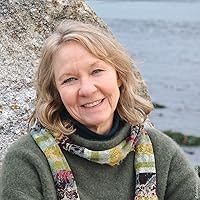
Marilyn Yalom grew up in Washington D.C. and was educated at Wellesley College, the Sorbonne, Harvard and Johns Hopkins. She has been a professor of French and comparative literature, director of an institute for research on women, a popular speaker on the lecture circuit, and the author of numerous books and articles on literature and women's history.
The definitive text on burial grounds in America, this provides a guidebook for all your cemetery quests. I honestly cannot rave about it enough. Yalom provides solid information, leavened with a touch of personal reflection inspired by the graveyards she visited. My only regret is that Reid Yalom's exquisite photographs are grouped at the front of the book, which necessitates a lot of flipping pages back and forth. Final thought: This is the cemetery book you need to get. It looks dry and intimidating, but I promise you it's anything but.
This review originally appeared in the Graveyard Rabbits online journal
Books about death by their very nature tend to come from deep within an author, and Marilyn Yalom's The American Resting Place is no exception. As for many of us, it is the lives represented in the burial places she visits, the lives of the dead, that draw her in. However, her interest is not merely personal: Yalom succeeds in representing American history and geographic expansion, conveyed through a sense of place, time and group identity. In a three year mother-son trip from New England through the South and onward to Hawaii Marilyn and Reid Yalom leave no doubt that burial grounds can be a significant tool in understanding sociological identity and change. Marilyn Yalom, a senior Scholar at Stanford’s Institute for Research on Women and Gender and the author of three prior books that link cultural ideas to historical processes (A History of the Breast (1998); A History of the Wife (2002); Birth of the Chess Queen (2004)), is quite practiced in well-done, readable histories. Reid Yalom is a San Francisco based fine art photographer whose first book of photographs, Colonial Noir: Photographs From Mexico, was published by Stanford University Press in the spring of 2004 and whose photographs have been exhibited at galleries in San Francisco and New York. As in Let us Now Praise Famous Men the “parallel narrative” of photographs does not merely support the story, they are truly an integral part of the work, a tale of images hand in hand with the portfolio of written impressions. The largest portion of the book is a selection of individual cemeteries that are both examples of the evolution of the social context and at the same time artistic expression of death. These sometimes iconic, sometimes closely held, burial places takes us through colonial practices, grave labeling, community identity and group cohesion in the graveyard and the process of the removal of death from American life. Later chapters reveal regional differences as well as the development of the art and culture of cemeteries, with a final chapter focusing on the patterns of change in how we build and experience cemeteries. This is quite a bit of material for one book; there are discussions of First Peoples burial practices; those of the Eastern Seaboard colonists’; Spanish Missions in both Texas and California, Nineteenth century urban cemeteries; Catholic grounds in Chicago, St Louis and New Orleans. There is even a chapter on military cemeteries. Despite this breadth, there are enough details that weave her argument together. African-Americans are not consigned to details about burials but acknowledged as agents in their own rights, such as in the stonecutting shops of Newport. The New York congregation of Shearith Israel’s cemetery (1682-1831) is used to show how much real estate can matter. At its height the burial ground covered all of Chatham Square. The city of New York ran streets through the cemetery in the early 19th century, and at midcentury extended the Bowery, moving over 200 graves. The writing is spare, yet in its own way creates vivid mental images of the places visited better than anything more florid would. In her discussion of the changing ethnic makeup of Chicago’s Mt Olive she tells us of “Crosses and Madonnas, photos of the deceased, and sentimental epitaphs enliven the mournful grounds. We stood silently before the tombstone… her epitaph says it all:
WE LOVE YOU SADGIRL 2001”
This clarity of prose is well echoed by Reid Yalom’s photographs. His touch, as in his images of the mausoleum at Hollywood Forever, can be almost abstract, while the image of the Charles Balmer stone in Bellefontaine of St Louis proves surprisingly intimate. And different from these in turn is the shot of the memorial to Dred Scott, journalistic and yet historic. Like many cemeteries I have visited, The American Resting Place is easy to wander through, but well worth the care of a slow, attentive visit.
Anyone who knows anything about American history will be bored to tears with this book, as Yalom dedicates a lot of space to retelling the beginnings of America instead of investigating the deeper, more interesting, and more on-topic history about cemeteries. But then again, Yalom is clearly not a historian. This is also apparent in the copious amounts of description in the book, which had the same effect as reading about a piece of art--imagine having a Picasso explained to you in words rather than just looking at the painting or sculpture itself. In addition, Yalom is much too concerned with inserting her own assertions and observations, even though the assertions seem questionable and are not backed up with any kind of research. Her observations and the insertion of her own emotions are frequently insulting to the reader--there is, for example, a part of the book in which she talks of the graves of members of the PA Institution for the Blind and says "there is something immensely moving about these stones, stones that members of the blind community could not have seen" !!! In other places, she points out the sadness of clearly sad anecdotes, as if the reader couldn't possibly have arrived at that emotion without Yalom's guidance. What little bit of the book that IS interesting is not elaborated upon, which means that this book raises more questions than it answers.
The only redeeming section of the book is the collection of photographs taken by her son, Reid. There should have been more photos to serve as replacements for Yalom's endless descriptions.
I recommend this to historians an genealogists alike. The most fascinating chapter is the one on Hawaii. The struggles for land and cultural respect between native Hawaiians, Americans, Chinese and Japanese is something few of us learn in school.
This book was not what I expected, but aside from that, it was good. It was interesting to read history about cemeteries I’d actually been to and people I know (Alexander Hamilton mentioned). BUT I wish I had learned more about the sociological construction of death and burial. It was lacking in that way.
An invaluable and comprehensive guide to American traditions in burials and resting places, this book covers a lot of information, and is easy to get through. Ms Yalom moves through chronologically, and therefore westward, from the inception of cemeteries in the East and the changing art on tombstones, and into the missions and stolen bones of the west. It's refreshing to set a book down and feel like I've not only learned a lot, but learn a lot that I can use in my daily life-- I'm surprised how often death and burial come up, and it's fun to recognize symbolism on tombstones I would have otherwise been oblivious to.
All of that being said, the writing quality is rather poor. Yalom shifts perspectives, from first to omniscient, from journalistic tones to poetic, from very personal to very empirical, often within the same paragraph. For as pleasant as it was to glean the pages for new insights into cemeteries I've frequented (or plan to), I wanted to do so with a red pen, correcting her grammar and making suggestions to alter her stylistic decisions in favor of clarity and continuity.
Some chapters were more interesting than others. I thoroughly enjoyed the parts on New Orleans, California, Who Owns the Bones?, National Military Cemeteries and Old and New Fashions in Death.
My favorite part was in the chapter relating to Old and New Fashions in Death. One of the new fashions is cemeteries as learning sites! Laurel Hill Cemetery in Philadelphia hosted some wild programs in 2007! Here are a few of their programs: Birding Amongst the Buried; Designing for the Dead: Art & Architecture; Dead White Republicans; Philanthropic Philadelphians; A Kids-Eye View of Laurel Hill; Classy Broads & Daring Dames; Gravediggers' Ball; Sinner, Scandals & Suicides; Dining with the Dead and Fall Fun with the Family.
I bought this book because, well, I had to buy a book about cemeteries. It didn't look that great, though, until I started reading. It's fascinating. She starts out with the history of cemeteries in the New England colonies. I'm sure I learned in school but was not paying attention and somehow missed that Rhode Island was founded as a place of religious tolerance. This meant that were early cemeteries there for Quakers, Jews, etc.
In later chapters she and her son travel all over the country visiting cemeteries and describing their unique features and local history. All of them are interesting, and I only wish that there were more pictures.
Well researched and documented, the book manages to cover several centuries of American history through the lens of burial practices. Sounds boring, but it isn't. It's fascinating. Yalom has a knack for delicious detail that makes this book a surprising page-turner. Dutch funeral customs, the origin of "Wall" Street, and hundreds of other forgotten aspects of an evolving American culture are deftly woven in a compelling narrative that only dims somewhat in the far-west chapters. There are in-text references to novels featuring the various cemeteries and a good chapter-by-chapter bibliography, making the book a goldmine for high school and undergraduate historical research.
Now this one I was a bit disappointed in. Some of the chapters, such as the one on CA, which I believe was titled "Missionaries, Miners and Moguls" was interesting, as was "New Orleans: Where it's Better to be Buried Above Ground." Full disclosure: the NO chapter was the reason I wanted to read the book. Some of the chapters, such as the one about Hawaii, went on for too long and got kinda boring. However, son Reid's photos, in delicious black and white, as they should be, are definitely worth a peek.
I visit cemeteries for fun, so I was excited to read this book. Overall, a good history on American cemeteries. I was upset that she kept referring to the famous Chicago Rosehill Cemetery as Roseland, but whatever. At the beginning of the book there were about sixty black and white photographs of the various places she visited. I had to keep going back and forth to see what she was writing about. For her readers she should have included the photos in the various chapters.
The author struggles with a few things (the explanation of how Arlington became a national cemetery is accurate but convoluted), but overall does a great job of tracing the evolution of marker styles and cemeteries in the United States. This is more complete than any book I've read on the subject and its one of my favorite topics.
I enjoyed the view of history through regional burial rites but I felt the photos didn't live up to the descriptions. Often the author would spend paragraphs describing a particular grave but there wouldn't be an accompanying picture.
I must have misunderstood the review that I read for this book, because I was expecting it to be mainly photos, and it is actually mostly text. I must admit, the only text I read was the intro...
A truly fascinating book. It didn't only focus on Christian burials only, but provided an intersectional look at burials and cemeteries. It brought out the stark difference between the rich and the poor, religion vs religion, and how different races fared in death as they had in life. It even brought region into it, covering from New England to Hawaii.
After reading it, I can definitely say that I still have Zero interest in a green burial and / or cremation. I also have Zero interest in memorial parks. Learning about the history of memorial parks and how it helps distance people from death was incredibly fascinating, and a little disheartening. The west as a whole has moved away from being with death, which is not necessarily healthy and feeds our fears of the unknown.
This was really quite the good overview, and I have a lot of recommendations to go on from here. The reason it lost a star is because of the picture formatting. The picture links were unusable and the book would have benefited from having the pictures interspersed with the text. Instead, they were all dumped in at 50% in. I think there might have been a mistake in formatting.
"When I am gone, remember me." If you have ever wandered through a cemetery, graveyard, or burial ground (yes, this book explains the difference between all three!), and wondered what the symbols at the top or the epitaphs at the bottom mean, or how the dates are written as you pass through the 18th, 19th, 20th, and 21st centuries, then this book is definitely for you. Not only are you able to decipher your own family tree, but why some people are remembered with weeping angels vs. joyful angels, or why there are stones on top of some, or how our veterans are buried. The book touches on the historical information on the darker chapters of American history - slavery, Japanese encampments in WWII, and Native American schools. There are several photos in the beginning of the book, which are then explained throughout the book. This isn't for those looking for a history lesson on America. It is however a fascinating history about death, and how the dead are remembered.
This is a fascinating book, exploring history, as the subtitle suggests, through cemeteries and burial grounds with a particular emphasis on these sites as markers of ethnic and religious diversity. Yalom (the author, although the photos by her son add immensely to the narrative, and I wish there had been more) treats her subject with respect and warmth and even, perhaps, a dash of humor here and there. It's a very interesting and enlightening book.
Always curious about a specific plot of just a few tombs left in NYC's Manhattan Chinatown
This is a well researched book. I'm always curious about the few remaining tombs between 2 low rise buildings in NYC's Manhattan Chinatown that's out in open looking out at the street. This book answered that question.