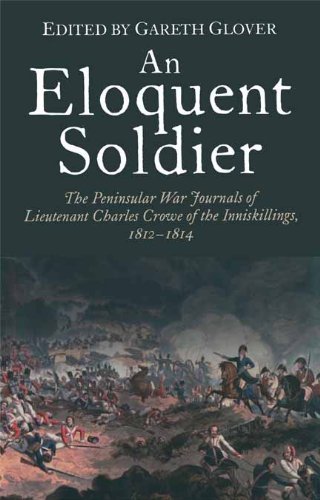
Lieutenant Charles Crowe's journal of the 27th Foot (Inniskillings) of the final campaign of Wellington's army is a rare work for many reasons. It is, perhaps surprisingly, the first memoir about this campaign from this famous regiment to be published.Crowe wrote a daily journal at the time, which practically guarantees the authenticity and accuracy of his account. But what makes it special is that Crowe was extremely well read and was an accomplished writer, so that when he wrote up his journal in 18423, he was able to embellish his basic journal, describing his thoughts, actions and words in beautiful detail. He thus turned his record of his short army career into a masterpiece of journalism. Clearly written purely for the enjoyment of his family, Crowe does not pull his he censures officers both junior and senior; he talks openly of the ravages of war, and the pillaging, raping and looting; the horrors of war, describing the deaths and horrific wounds of many in lurid detail, the cowardice and stupidity; and he also describes the mundane in detail nothing is passed over.Crowe is an invaluable source to military historians on many levels, and his journal will stand proudly deservedly in the pantheon of great military memoirs.
You may have forgotten about the Peninsular War. In the quarter century of European fighting that culminated in 1815, for most British and Irish people the battles that stick in the memory are Waterloo and Trafalgar. But this was an intercontinental conflict, with action in India, Egypt, the Caribbean and North America. Within Europe, Spain was particularly badly hit, with different governments and their sponsors battling it out over seven long years; proportionate to population, it was twice as bloody as the Spanish Civil War 130 years later.
Charles Crowe, the diarist whose memories I’m looking at, was born in 1785 in Suffolk, and joined the local militia in 1810, transferring to the regular army in 1811 and setting sail for the war in Spain in 1812, which is when the diary starts. In January 1813 he got transferred to the 3rd Battalion of the Inniskillings; Crowe as a Lieutenant was immediately put in command of one the companies of the battalion.
I was really reading his diary for the mentions of my great-great-great-uncle, Thomas Whyte, and there are about a dozen. When Crowe joins the 3rd Battalion, Whyte is the second in command and welcomes him to the team. It becomes apparent that since the commanding officer, Colonel John Maclean, is a Scot, Whyte has an important informal role as the most senior Irishman in a largely Irish battalion, and Crowe records him as intervening twice to defuse disciplinary issues before they escalate.
In July 1813 the French appear to have been beaten, and are clinging to Pamplona in the northeast of Spain. The British army masses for a showdown with the French forces led by Soult marching in from the North. As the 3rd Battalion prepares for battle, Crowe has dinner with Colonel Maclean and “our worthy little Captain Whyte”, which is literally the only indication we have of Thomas Whyte’s physical appearance.
On 19 July the Inniskillings are near the French border, and Whyte rides up to the pass to take “a peep at France”. A few days later the French come pouring in and Wellington orders his troops to fall back to the valley of Sorauren, north of Pamplona, to make a stand. As the battle starts on 28 July 1813, the Inniskillings find themselves in an exposed defensive position taking very heavy losses and with little support.
"I left my men to watch the path and hastened up to report the circumstance to Captain Whyte and stated that I could no longer defend the left of his position, for my company was annihilated. He thanked, and requested me to go and inform the colonel that he must have support instantly. I scrambled up the steep as quickly as possible and found the colonel anxiously watching all our proceedings. I briefly told my tale, he quietly replied, ‘Thank you, my good fellow. Thank you! I have seen what you have been doing. Go and tell Captain Whyte to do the best he can, for I cannot send him any assistance. Lord Wellington has ordered me not to part with another man, but that should the enemy appear on our ground, I am to give them a volley and charge with my three remaining companies.’"
"‘Oh! Ho!’ thought I, ‘This is very cheering intelligence truly! But we must fight it out!’ … Poor Whyte was not pleased with the result of my embassy, we were talking with Captain Butler about it and what we could do when an aide de camp galloped up with order for us to retire. Each of us most willingly went to muster as many of our men as we could. I could find only eight of the fifty three I had brought into the field!"
"…Poor Captain Whyte, proud of being second in command of the regiment had advanced on horseback, perchance, but for this circumstance the worthy fellow might have escaped. He was shot through the head as we retired!"
I guess the point that Grove is making is that on horseback, Thomas Whyte was more vulnerable (and clearly an officer and therefore a more obvious target for French snipers); if he had swallowed his pride and walked, he might have lived. Grove mourns
"the loss of Captain Whyte, the good officer, the brave soldier, the perfect gentleman, the warmhearted friend! No one was ever more beloved by all classes."
The battle continued for another two days and the British eventually won, so they would have recaptured the spot where Whyte was killed while retreating. There is no record of his place of burial – in fact I don’t know of any physical memorial to him anywhere – but it was probably on the battlefield.
As it turned out this was the last French offensive of the Peninsular War, and for the rest of the diary Grove plays his part in the invasion of France while increasingly suffering from poor health, which he attributes to aggravated sunstroke, though Glover thinks it was brucellosis contracted from infected milk. After Napoleon’s first surrender, the 3rd Battalion of the Inniskillings was merged with the 1st and sent to America, where they lost the Battle of Plattsburgh, but Grove was transferred to the 2nd Battalion, which had suffered very heavy losses at the Battle of Ordal in Catalonia in September 1813 and went to Ireland to help with recruitment to replenish their ranks. This meant that he missed the Battle of Waterloo, where the 1st Battalion (which now included the survivors of the 3rd Battalion), just back from America, lost two-thirds of their remaining men in the fighting around the farm of La Sainte Haye. If Thomas Whyte had not been killed two years earlier, he would probably have been killed at Waterloo.
After the war, Grove went home to Suffolk and seems to have lived a quiet life, marrying without children and eventually dying at 70 in 1855. Gareth Glover has done a great job of editing and explaining the two volumes of his memoirs, one held by the family and the other originally by the regimental museum in Enniskillen. He was also good enough to clear up a query by email, more than a decade after the book was published.
Fortunately for Glover (and us), Grove was a good writer and gives us some lovely descriptions of the landscape and vivid portrayals of the Portuguese, Spanish and French people who he encounters. He shows (and depicts his fellow soldiers as showing) a fannish devotion to Lord Wellington – not yet the Duke, a title he got in 1814. Every word he exchanges with the big boss is carefully noted and recorded.
I was also struck by how many women were involved with the army. Quite recently I read the memoir of Mother Ross, a genderqueer soldier from a century earlier who served under Marlborough as both a woman and a man; it’s clear from Grove that Wellington’s forces (and presumably the other side as well) depended on women as well as men, and some of the rank and file (especially what we would now call NCOs) travelled with their wives. One night in March 1814, seven of the soldiers’ wives were billeted together in the same house; and that evening, two of them gave birth.
Readers who are more interested in the Napoleonic Wars than me will get more out of this than I did, but I got what I wanted.