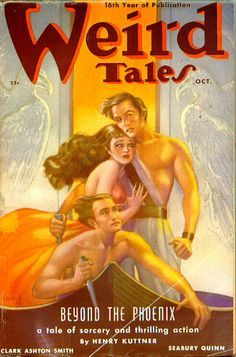
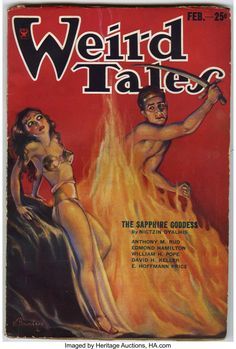
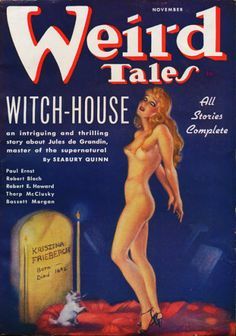
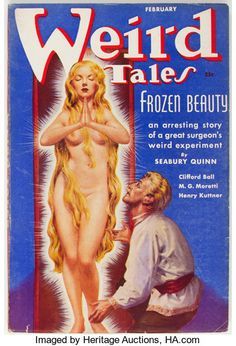
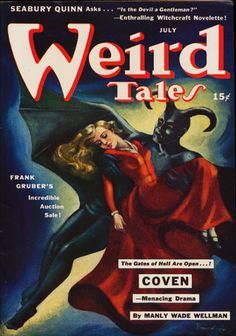
Questo volume costituisce la prima di una serie di antologie dedicate alla sterminata produzione di "WEIRD TALES", una rivista americana che è entrata nella leggenda per aver reso popolare la narrativa fantastica e di fantascienza, oltre ad aver fatto esordire sulle sue pagine autori del calibro di Bradbury, Howard, Lovecraft, Hamilton, Kuttner e tanti altri. In questa prima selezione di racconti, sono compresi gli anni che vanno dal 1923 al 1939, vale a dire la prima metà della vita della Rivista. Come potrete constatare, la scelta è ampia ed abbraccia sia autori molto noti che altri non ancora conosciuti dal pubblico italiano, tutti comunque estremamente validi. In particolare, è compreso II Ciclo di "Elak di Atlantide" di Henry Kuttner, presentato per la prima volta in Italia e che costituisce una brillante elaborazione di questo autore in tema di heroic fantasy. Nei prossimi volumi, verranno presi in esame gli ultimi quindici anni di vita della rivista, sino alla chiusura della testata. Peter Haining è indubbiamente uno dei maggiori esperti a livello mondiale di narrativa fantastica. L'introduzione a questo volume, oltre a fare una storia pressochè completa di "WEIRD TALES", esamina con criterio ed approfondimento quelli che furono i motivi per i quali la rivista ebbe un così grosso successo. Maggiormente proiettato verso l'horror e la Weird fantasy, in quest'ultimo settore Haining ha pubblicato diverse antologie, alcune delle quali sono state tradotte anche nel nostro Paese.
Peter Alexander Haining was an English journalist, author and anthologist who lived and worked in Suffolk. Born in Enfield, Middlesex, he began his career as a reporter in Essex and then moved to London where he worked on a trade magazine before joining the publishing house of New English Library.
Haining achieved the position of Editorial Director before becoming a full time writer in the early Seventies. He edited a large number of anthologies, predominantly of horror and fantasy short stories, wrote non-fiction books on a variety of topics from the Channel Tunnel to Sweeney Todd and also used the pen names "Ric Alexander" and "Richard Peyton" on a number of crime story anthologies. In the Seventies he wrote three novels, including The Hero (1973), which was optioned for filming.
In two controversial books, Haining argued that Sweeney Todd was a real historical figure who committed his crimes around 1800, was tried in December 1801, and was hanged in January 1802. However, other researchers who have tried to verify his citations find nothing in these sources to back Haining's claims. A check of the website Old Bailey at for "Associated Records 1674-1834" for an alleged trial in December 1801 and hanging of Sweeney Todd for January 1802 show no reference; in fact the only murder trial for this period is that of a Governor/Lt Col. Joseph Wall who was hanged 28 January 1802 for killing a Benjamin Armstrong 10 July 1782 in "Goree" Africa and the discharge of a Humphrey White in January 1802. Strong reservations have also been expressed regarding the reliability of another of Haining's influential non-fiction works, The Legend and Bizarre Crimes of Spring Heeled Jack. He wrote several reference books on Doctor Who, including the 20th anniversary special Doctor Who: A Celebration Two Decades Through Time and Space (1983), and also wrote the definitive study of Sherlock Holmes on the screen, The Television Sherlock Holmes (1991) and several other television tie-ins featuring famous literary characters, including Maigret, Poirot and James Bond. Peter Haining's most recent project was a series of World War Two stories based on extensive research and personal interviews: The Jail That Went To Sea (2003), The Mystery of Rommel's Gold (2004), Where The Eagle Landed (2004), The Chianti Raiders (2005) and The Banzai Hunters (2007).
He won the British Fantasy Awards Karl Edward Wagner Award in 2001.
I've had this book on my shelves as part of my permanent collection for several years. It's a great introduction to the pulp magazine Weird Tales and is presented in a facsimile approach where the presentation of the stories is basically how they were presented in the magazine. The size of the pages are the same and the stories are presented in two columns for reading. This actually makes the stories seem longer because a lot of words fit on each two-column 6" x 9" page. The paper for the book is also a cheaper pulp type paper which really gives it a feel for reading the old pulps from the early 20th century. There are also old advertisements, letters to the editor (The Eyrie), poems, and true experiences submitted by readers. Then there is a very good introduction by Haining giving a history of the magazine as well as information about some of its more famous authors including H.P. Lovecraft, Robert Bloch, Robert E. Howard, August Derleth, and Ray Bradbury among others.
As far as the stories go, I enjoyed most of them although some were to me a lot better than others. I tended to like the horror stories more than the fantasy offerings such as BEYOND THE PHOENIX by Henry Kuttner and HEART OF ATLANTAN by Nictzin Dyalhis which were both tales of Atlantis.
Some of the stories I enjoyed the most were: THE MAN WHO RETURNED by Edmond Hamilton from February 1934. This was about a man who had died and comes back to life a week later only to find that his wife has another lover, his son received his life insurance money to make ends meet, and his boss thought he was pretty worthless. Enough to make you want to return to your crypt! BLACK HOUND OF DEATH by Robert E. Howard from November 1936. This one was really a "weird" tale about a man who was transposed to a werewolf and is after the man who deserted him in Mongolia. There is also a psychotic black man involved in this tale that was pretty racist in its presentation and definitely not politically correct by today's standards. FROZEN BEAUTY by Seabury Quinn from February 1938. This tale involves Russian anarchists who are after a coffin containing a frozen woman who is thawed and returned to the living. This is one of Quinn's Jules de Grandin tales and was quite enjoyable. THE GARDEN OF ADOMPHA by Clark Ashton Smith from April 1938. This was one of the strangest stories in the collection about a garden where human body parts are grafted onto plants. Very eerie! THE BEASTS OF BARSAC by Robert Bloch from July 1942. This was a tale about a mad scientist in a European castle who is trying to transpose his traits to animals. This reminded me somewhat of H.G. Wells' ISLAND OF DR. MOREAU.
The stories included from H.P. Lovecraft and Ray Bradbury were not among my favorites. Overall, a good introduction to Weird Tales Magazine but for me some of this got a little tedious towards the end. Probably better to read these tales sparingly and spaced out over several weeks. I read this in about four days.
Peter Haining was famous editor he collected lots of Short stories in 100s of books & his collection books were famous for having out of print 'lost' or forgotten stories masterpieces that had been in magazines or old books with other stories that were ghastly but had one good one. There is nothing worse than buying a SS collection & finding 1 good story & 17 duds but Peter removed the duds & found the 1 good & one had 20-25 good he publish a collection this one of those. Taken from the famous magazine Wierd Tales the American strand of its day.The mag that first in late 1930s published H.P.Lovecraft the copies in 1980s were for sale at £36,000 so no Idea what would be now. This book is repudiation of that Magazine complete with adverts .
This is a wonderful idea: an anthology of stories from the legendary pulp Weird Tales, presented as facsimile reprints. And, in an attempt to make this book even more like the magazine that inspired it, it includes a sampling of non-story elements from the magazine: there’s a representative letters section, a smattering of poetry, one of Lee Brown Coye’s ‘weirdisms’ pages, a selection of ‘It Happened to Me’ readers experiences (surely a bit too literary to be genuine), and a few of the sort of ads seen in the magazine (‘Mem-O-Riter: paper and pencil in one!’, ‘Leopard Seat Covers to Fit All Automobiles!’, ‘Learn Facts About Colitis and Piles!’).
But of course the real draw is the fiction. Haining set himself quite a task in attempting to pick from the entire run of the magazine (1923 to 1954, though the 1920s are only represented by a reprint of Anthony M Rud’s ‘Ooze’, from a 1952 issue), taking in all the major authors, while not including stories which had been anthologised before. It’s this last factor that’s a pity, as this book was first issued in 1976, when there were a lot of supernatural/horror/weird anthologies about, and they probably had the best of Weird Tales’ fiction in them. As a result, this nice-looking book begins with some rather lame — or certainly not their best — fiction, even from recognisable names. So, we get Lovecraft’s “Beyond the Wall of Sleep” (which does at least have a Virgil Finlay illustration) and, from Robert E Howard, the lurid but forgettable “Black Hound of Death”. (The exception, for me, is Clark Ashton Smith’s “The Garden of Adompha”, which stands out as a very weird, poetic oasis of decadence amidst the likes of August Derleth’s awful “The Shuttered House”.)
Things improve in the second half, as the 1940s saw the likes of Manly Wade Wellman, Ray Bradbury, Fritz Leiber and Theodore Sturgeon submitting to the magazine — writers generally more literary in approach. Though, again, I don’t think you get the best of these writers here. It was Allison V Harding’s “Take the Z-Train” which, for me, was the surprise hit, as I hadn’t heard of it, or its author, before. A Twilight Zone-ish tale of a worn-down man’s trip on a peculiar subway train, it largely works, for me, because of its vagueness or restraint — something which can’t be said of Rud’s ‘Ooze’, the tale of a mammoth amoeba in the wilds of Alabama - which is more the sort of thing I think of when I think of Weird Tales. There’s a full list of contents at the Internet Speculative Fiction Database (http://www.isfdb.org/cgi-bin/pl.cgi?2...).
Peter Haining's 1990 "Weird Tales" anthology takes a different tack from two other similar anthologies that I've recently read. "Weird Tales: 32 Unearthed Terrors" (1988) had cherry-picked one story from each year of the celebrated magazine's 32-year run (1923-1954), while Marvin Kaye's "Weird Tales" collection of that same year had included not just stories from the publication's classic years, but from the five reincarnations dating from 1973-1987. Haining's collection, on the other hand, while dishing out half the page length of the earlier two, has the unique asset of being "facsimile reproductions of the actual pages of 'Weird Tales'"; that is to say, the pages in the book are photocopies from the pages of the original magazines from which the volume's 22 stories have been drawn. Thus, the pages are presented in two vertical columns of type, complete with letters from the readers ("The Eyrie"), wonderful illustrations, occasional weird poetry filler and priceless advertisements. Thus, at 263 pages, the book comes off as the biggest issue of "Weird Tales" ever to hit the newsstands; a fine representation of what "The Unique Magazine" was all about.
As would be expected, Haining has given us a fair sampling of the authors most closely associated with the classic pulp. H.P. Lovecraft's posthumous "Beyond the Wall of Sleep" may make you wonder about your own oneiric wanderings, while Robert E. Howard's "Black Hound of Death," incorporating both a psychotic black madman AND a half-canine madman, is as pulpy and un-PC as can be (wonderfully entertaining, though!). Seabury Quinn, who placed more stories in "Weird Tales" over the years than any other author (146!), is here represented by one of his 93 Jules de Grandin tales, "Frozen Beauty," which manages to conflate Communist agents, human corpsicles and, uh, cold-blooded killings into one effective stew. Henry Kuttner, a disciple of both Lovecraft and Howard, and who would achieve major fame in the sci-fi field in the '40s in collaboration with wife C.L. Moore, is represented here by one of his Elak of Atlantis fantasies, "Beyond the Phoenix"; a swift-moving and action-packed tale. August Derleth, a champion of Lovecraft and founder of Arkham House publishing, here gives us a fine, traditional haunted-house story, "The Shuttered House." Edmond Hamilton's classic and oft-anthologized (and for good reason!) "The Man Who Returned" is included, as well as Clark Ashton Smith's "The Garden of Adompha"; this Zothique tale, like all of Smith's best fantasy work, reads almost like prose poetry. Robert "Psycho" Bloch, another name closely associated with "Weird Tales," is here, too, with his mad-scientist story "The Beasts of Barsac" (from the July '44 "Weird Tales"; not July '42, as the book erroneously tells us). Algernon Blackwood, aka "The Ghost Man," is shown to good effect with "Roman Remains," a tale that would have fit very nicely into his classic collection from 1912, "Pan's Garden." And Ray Bradbury's "Bang! You're Dead!" shows us that war isn't necessarily hell, after all!
And then there are the lesser-known names, who were nevertheless extremely popular with "Weird Tales" readers decades ago. Alison V. Harding, whose "Damp Man" story had earlier impressed me greatly, here gives us "Take the Z Train," a tale that all NYC subway riders should enjoy. Mary Elizabeth Counselman turns in a lovely, eerie story of the old South in "The Shot Tower Ghost," while Nictzin Dyalhis (the Scottish author's real name) gives us the tragic fantasy "The Heart of Atlantan." Henry S. Whitehead's Haitian voodoo story, "The Passing of a God," is a genuinely creepy and yucky affair, while Manly Wade Wellman's "The Valley Was Still" finally tells us the real, devilish truth about how the South lost the Civil War. As you can see, the book is a generous offering of varied authors and story subjects, and I have not even mentioned the contributions by such luminaries as Theodore Sturgeon, Fritz Leiber, Eric Frank Russell and Anthony M. Rud (the latter's "Ooze," from "Weird Tales"' very first, March 1923 issue, is now considered a classic of sorts). In all, a wonderful collection of tales, in a very nice and pleasing presentation.
Oh...I would be remiss if I didn't mention how entertaining those cheezy advertisements can be for the modern-day reader! These ads only started to appear in the magazine in the late '30s, Haining tells us in his very informative introduction, but what a hoot they are! Just wait until you read the one from the March '48 issue; the one from the Rest-O-Rator Laboratory in Pomona, CA, for a "Therapeutic Vibrator" to release excess energy....
Haining's 1976 Weird Tales anthology, reprinted in 1990, features 'a facsimile selection from the world's greatest fantasy magazine.' This means that, in addition to the stories, we get the original formatting, illustrations, readers' letters ('The Eyrie'), It Happened to Me (tales of 'true' psychic experiences), adverts, poems, and Weirdisms (who knows?). In short, it's fantastic.
Haining's introduction provides a neat history of the unique magazine, as well as short biographies of the featured authors (apart from Anthony M. Rud for some reason) and illustrators. The stories are presented chronological order, starting in 1934 and heavily favouring 1938. Here we go...
Edmond Hamilton, "The Man Who Returned" (1934) A story about the perils of being presumed dead, where waking up in a coffin is the least of your worries. According to Haining's introduction, Hamilton frequently topped Weird Tales reader polls, and it's easy to see why from this gently humorous tale. A great start to the anthology. 4/5
Robert E. Howard, "Black Hound of Death" (1936) Savage murders along the trails of an isolated pine forest. An escaped and dangerous convict. And something else, something less than human. It's hard to rate a story that's engagingly written but marred by race and gender stereotypes. Of its time. 3/5
August W. Derleth, "The Shuttered House" (1937) A fairly routine haunted house tale. An easy read, but not particularly memorable. 2/5
Seabury Quinn, "Frozen Beauty" (1938) A murdered Russian physician; a ransacked house, and a mysterious, deathly-cold coffin. Previously I've enjoyed the exploits of Drs De Grandin and Trowbridge, but maybe the novelty is wearing off as everything in this novelette seemed a touch too convenient. This is the second tale in the anthology where the sole female character is beautiful, naked and immobile. The 30s must have been wild. 3/5
H. P. Lovecraft, "Beyond the Wall of Sleep " (1938) Though not presented as a reprint, this tale was originally published in Pine Cones (1919) and then again in The Fantasy Fan (1934) before arriving at Weird Tales. It tells the story of a criminally insane murderer who has fantastic, other-worldly visions in his sleep, and an intern at the mental hospital with a device that enables telepathic communication (naturally). Half-baked. 2/5
Clark Ashton Smith, "The Garden of Adompha" (1938) A palace garden where human limbs have been grafted onto plants. A secretive king and his court magician. Another story where the sole female character is 'pulchritudinous' (beautiful), 'nude' and 'supine'. I thought I wasn't going to like this one, but the ending was rather satisfying. 3/5
Henry Kuttner, "Beyond the Phoenix" (1938) An evil priest, a foul god, and the beautiful daughter of a slain king. No matter how many sword and sorcery tales I read, they still leave me cold. I must read Kuttner's The Graveyard Rats at some point, but sadly this Elak of Atlantis tale did nothing for me. 2/5
G. G. Pendarves, "The Black Monk" (1938) Accurately described as 'passable' in one of the reader letters included in the collection, The Black Monk is a half-decent idea that needed to be developed further before being committed to ink. Notable for being the first story by a female author (Gladys Trenery writing as G. G. Pendarves) in the anthology. 2/5
Henry S. Whitehead, "The Passing of a God" (1938) A white man in Haiti. Fingers wound with string and a growth the size of a man's head. First published by Weird Tales in 1931 and reprinted 7 years later, this tale neatly weaves medical science with local superstition. The description of the thing in the pickling jar was particularly effective. 'Those eyes - my God, Canevin, those eyes!' 3/5
Manly Wade Wellman, "The Valley Was Still" (1939) Scouts for the Confederate Army. A town condemned to silence. The mysterious fate of the 'damned Yankees'. This was terrific - eerie, weird and well-paced. One of those stories that's diminished, slightly, by the explanation presenting itself rather than being found, but otherwise an enjoyable read. 4/5
1940 was a year of significant change for Weird Tales, with Farnsworth Wright departing the magazine for health reasons and being replaced by Dorothy McIlwraith. McIlwraith ushered in the writers who would shape the magazine over the next decade, including Ray Bradbury, Robert Bloch, Margaret St. Clare and Fritz Lieber.
Nictzin Dyalhis, "Heart of Atlantan" (1940) My second Nictzin Dyalhis (real name) tale, although this one was fantasy and the other was sci-fi. Sadly, I didn't like this story of old gods and the lost city of Atlantis at all, which is a shame as it's the only story so far where the female characters have some agency. It hasn't aged well. 1/5
Fritz Lieber, "The Phantom Slayer" (1942) A man inherits his uncle's rented room and begins to dream of unsolved murders. Given the title, I was kind of hoping this would be a precursor to Ghostbusters. No such luck. Predictable, and a little too long. 2/5
Robert Bloch, "The Beasts of Barsac" (1942) A gothic castle. A mad scientist and his monstrous creations. This was an enjoyable (if daft) tale of a visiting doctor succumbing to fear and paranoia. 3/5
Ray Bradbury, "Bang! You’re Dead!" (1944) A child in a man’s body. Soldiers dying on the battlefields. It all becomes real when you stop playing. This was fantastic: weird and heart-wrenching. 4/5
Theodore Sturgeon, "Cellmate" (1947) What to make of the cellmate with tiny limbs and an oversized barrel chest? Another winner, and this one was full of surprises. 4/5
Algernon Blackwood, "Roman Remains" (1948) ...he had the brand of courage that goes with a total absence of imagination." The first of a trio of tales by British writers is a folk-horror gem by the ever-reliable author of The Wendigo and The Willows. A wartime retreat, impossible echoes, and the mysteries of Goat Valley. The scene where the protagonist wakes up in the glen and knows the landscape has changed but can't say how was creepy. Poor Nora. 5/5
Eric Frank Russell, "Displaced Person" (1948) Very short, very effective, and while I knew there was a twist coming, I didn't guess it. Neatly done. 4/5
H. Russell Wakefield, "From the Vasty Deep" (1949) Two actors, each jealous of the other's success. A joke that isn't funny. We're all haunted by our mistakes and guilt. Wakefield wove a neat theatrical thread through this tale of rivalry, and it just about worked. Good ending. 4/5
Mary Elizabeth Counselman, "The Shot Tower Ghost" (1949) My second Counselman story is the first of three stories in the anthology from the lady writers of Weird Tales. A practical joke with unexpected consequences. The shot tower, where lead shot was made for the Confederate Army, was never really haunted - was it? Another twist I didn't see coming. 4/5
Alison V. Harding, "Take The Z-Train" (1950) The tedium of the daily grind. The thrill of accidentally boarding the wrong train. The horrors that await. This fantastic story (but not the writing style) reminded me of Ramsey Campbell's railway tales. Deeply unsettling, without feeling forced. 4/5
Margaret St. Clair, "The Little Red Owl" (1951) The illustration, featuring a muscular man with the head of a falcon, suggested this would be a fantasy - and maybe it was, although it was also something darker. The tale of an uncle finding cruel ways to 'entertain' his niece and nephew. What was his motivation? And what was his goal? I'm not sure. 3/5
Anthony M. Rud, "Ooze" (1952) The final tale in the anthology is solid Weird Tales territory - a sci-fi horror mash-up set in the jungle of southern Alabama. Why did John Corliss Cranmer go insane? And what became of his son and daughter-in-law? This could have been great, but the introduction jumped around so much I had to read it a couple of times to figure out what was going on, and the characters were a little under-developed. 3/5
Another great read. As with every other Weird Tales anthology I've read (see below), the stories are of their time and the quality is uneven. Having said this, the imagination, the variety, and the sense of history unfolding - coupled with the added extras of letters, poems, adverts and illustrations, made this a treat.
This book raises the real feeling and atmosphere of "Weird Tales". Each story is accompanied by an illustration and here and there are ads from that time included. Although not every story is equally good, it remains unfortunate that there is nowadays no longer such a good old fashion "Unique Magazine", which conveys this atmosphere.
This was a great book.It was so much fun.I had heard of the magazine from all the ghost and horror anthologies that I have read and am very glad i picked this up at the library. The stories are weird and very entertaining.Definitely a must read for horror aficionados.
WEIRD TALES is a bumper collection of stories culled by popular anthologist Peter Haining from the pages of the classic pulp fiction magazine of the 1930s. Said tales are printed in facsimile which means that you also get the old adverts, artwork, and drawings included in the original pages, which is a godsend for those of us who love the pulp era and wish we were there to experience it the first time around. There are no less than 28 stories and poems collected here, a fine selection of the magazine's most popular authors and themes.
THE MAN WHO RETURNED is a story by Edmond Hamilton and a good way to start the collection. It's yet another version of the old "buried alive" theme but with the emphasis on physical action, it never bores or outstays its welcome. The reader feels like a spectactor, watching the action play out. BLACK HOUND OF DEATH is a tale by Robert E. Howard, an account of a night in a spooky old forest packed with tons of action and violence. A real find of a story, this, and an instant favourite. August Derleth's THE SHUTTERED HOUSE is a straightforward ghost story with no frills or action. It was written before Derleth's induction into the Cthulhu Mythos and suffers a little as a result. Seabury Quinn's FROZEN BEAUTY sees the author's famed psychic detective Jules de Grandin tackling the case of a girl who has been sleeping in suspended animation for two decades; it has an excellent climax although isn't nearly as horrible as some of the author's other work.
HAUNTING COLUMNS marks the return of Robert E. Howard, here contributing a sonnet about weird monoliths. Uncanny stuff. Lovecraft's BEYOND THE WALL OF SLEEP is next, about an asylum inmate with the power to travel to fantastic alien worlds in his dreams. It's too concise to do much with the concept, but the author would expand on such themes later in his career. Clark Ashton Smith's THE GARDEN OF ADOMPHA is about a wizard who creates an unspeakable garden filled with human body parts, full of detail and depravity and a familiar although well written twist ending. Henry Kuttner's BEYOND THE PHOENIX continues the fantasy theme with a Conan-style hero thwarting an evil priest's plans to dominate the world. The pace never flags for a moment.
Next up, THE BLACK MONK by G.G. Pendarves is all about a monkish spectre guarding a secret treasure. It's rather slight and predictable, but has some decent atmosphere to recommend it. THE PASSING OF A GOD sees Henry S. Whitehead delivering one of his most disturbing efforts, about a man in the West Indies suffering from a weird tumour in his stomach. The tale is literally stomach-churning and repulsive, and superbly written with it. THEY RUN AGAIN is a poem by Leah Bodine Drake about a medieval werewolf, and makes for pretty scary reading. Manly Wade Wellman's THE VALLEY WAS STILL is set during the American Civil War and tells of a strange, paralysing spell. The author's love of lore comes to the fore here and this splendid story is equally inventive and full of imagination. Nictzin Dyalhis's HEART OF ATLANTAN is a strange and unwieldy story detailing high fantasy, not a favourite but with some worthwhile elements.
THE PHANTOM SLAYER is a Fritz Leiber tale about a haunted apartment and ruthless serial killer. The scene-setting combined with the revelatory climax make it very impressive. Robert Bloch's THE BEASTS OF BARSAC is a bit old-fashioned and tame, although the author's typically impressive style means that it's not a total waste of time. Ray Bradbury's BANG! YOU'RE DEAD! is about a seemingly immortal American soldier and thoroughly witty and unusual. It explores how one's outlook on life can shape life itself, and it's extremely readable with it. Theodore Sturgeon contributes CELLMATE, an imaginatively horrific yarn set in a prison cell all about bodily horror and mutation. Lovecraft then contributes two poems: THE FAMILIARS is brief and slightly unpolished, while THE PIGEON-FLYERS covers the usual ground in just fourteen effective lines.
ROMAN REMAINS is a story by famous British horror author Algernon Blackwood, here exploring the mystery of Britain's ancient past. It's more lyrical and romantic than the author's usual fare, although not without merit. Eric Frank Russell's DISPLACED PERSON is an anecdotal piece about a man's meeting with a higher being. It's brief, and to the point. Clark Ashton Smith's TO THE CHIMERA is a sonnet full of quaint, old-fashioned prose, while H. Russell Wakefield's FROM THE VASTY DEEP is a hidden gem, in which a cruel joke leads to suicide. It's extremely psychological with lots of tense passages to make it an uncomfortable read.
THE SHOT TOWER GHOST sees Mary Elizabeth Counselman writing of a childish prank turned terrible. It's an excellent little ghost story with a great twist in the tale and plenty of spooky atmospherics. The same can't be said of Alison V. Harding's TAKE THE Z-TRAIN, an obtuse effort about a train leading goodness-knows-where. Margaret St. Clair's THE LITTLE RED OWL is a solid story in psychological disturbance as bedtime stories become all too real for one crazed mind, and it still feels rather controversial to this day. Finally, Anthony M. Rud's OOZE is about a scientist who creates a plate-sized amoeba that just keeps on growing. A clear inspiration on THE BLOB, it benefits from strong writing, visceral and viscous horror, and a high entertainment level.
This entire review has been hidden because of spoilers.
Four is high, but three stars just isn't enough for this. Story after story was thrilling with moments of pure horror and many if not all stories in this book are written so well. There is one fantasy story with an element of terror near the ending which I did not enjoy but the rest make up a great book of strange tales
El estatus de "Weird Tales" como una de las más importantes publicaciones periódicas de literatura fantástica y de terror es indudable y esta antología ofrece un panorama completo de casi veinte años de cuentos. Los autores incluyen nombres que han pasado la prueba del tiempo, hasta convertirse en clásicos del género y ser reconocidos (aunque sea de oídas) más allá de los aficionados y especialistas. H.P. Lovecraft (por supuesto), Algernon Blackwood, Robert E. Howard y Fritz Lieber comparten el libro con autores menos recordados. El libro también incluye a autores cuyas obras posteriores llegarían a ser adaptadas para el cine y la televisión, como Rayd Bradbury y Theodore Sturgeon. Entre los nombres menos conocidos se encuentran tres mujeres (Mary Elizabeth Counselman, Alison V. Harding y Margaret St. Clair), cuyo talento va más allá de una "cuota de género" y exploran matices que sus contrapartes masculinas habían pasado por alto. En cuanto a la temática, los cuentos abarcan desde relatos de misteriosas civilizaciones perdidas en el tiempo y en el espacio, criaturas demoniacas surgidas de la noche y el espacio exterior, relatos de crímenes sin explicación racional, atisbos de gótico sureño y de los aspectos más pesadillescos de las urbes modernas. Asimismo, se incluye una pequeña selección de poemas y "relatos verdaderos" publicados en las páginas de "Weird Tales".
Uno de los aspectos más destacados de la antología es su presentación facsimilar, incluyendo las ilustraciones originales, cuya naturaleza fantasmagórica acentuada por el riguroso blanco y negro acentúa y da vida a las atmósferas de los relatos. Un detalle curioso adicional son los anuncios variopintos incluidos en la revista a partir de la decada de 1940: ante la necesidad de mantener la revista a flote, algunos de estos anuncios (que incluyen desde cursos por correspondencia, hasta clubes de libros afines y productos que hoy etiqueteríamos como "milagrosos") abarcaban la mitad de la página, aunque no distraen demasiado de los relatos en cuestión.
En suma, esta antología de la revista "Weird Tales" es un tesoro altamente recomendable para todos los aficionados al género.
Kauhu- ja fantasianovellien legendaarinen julkaisu eli kulta-aikaansa 1920-luvulta 1950-luvulle (274 numeroa). Päätoimittaja Farnworth Wrightin kirjailijakaartiin kuuluivat mm. tässä antologiassa kirjailijat Ray Bradbury, Robert E. Howard, Seabury Quinn ja H.P Lowercraft.
Tässä loisteliaassa valikoimassa on yhteensä kolmekymmentä eri tavoin kauhuun, fantasiaan ja scifiin luokiteltavia outoja tarinoita. Yhteistä kaikille niille on erinomainen tarinankerronta ajalle ominaiseen tyyliin. Black hound of deathissa saatanalliset Mongolian munkit luovat ihmissuttakin pahemman olennon. The shuttered housessa talossa kuolleet vainajat hyökkäävät elävien ihmisten kimppuun anastamalla niiden kehon. The Garden of Adomphassa helvetistä tuotu tulipallo lämmittää ihmisistä ja kasveista risteytettyä puutarhaa. Passing of Godissa voodoojumala asettuu asumaan valkoisen miehen sisälle aivan konkreettisesti. Take the Z-trainissa tavallinen miekkonen astuu aavemetroon, jossa menneisyys saa ruumiit ja kasvot piinaavalla tavalla. Beyond the Wall of Sleepissä avaruusolento muuttaa metsäläisihmisen sisälle, ja siitä seuraa kauheuksia.
Monet tarinat ovat melko lyhyitä, mutta siinäkin ajassa useimmiten piinaavaa jännitystä on kehitelty erinomaisesti. Usein kertomukset on rakennettu siten, että joku ulkopuolinen haastattelee tapahtumiin osallista tai yrittää muutoin selvittää outojen sattumusten luonnetta pyrkien ymmärtämään niitä järjellä. Se ei kuitenkaan ole mahdollista, sillä tarinat ovat niin uskomattomia, kummallisia ja outoja – niin kuin antologian nimikin velvoittaa.
Varsinkin kummitus- ja paholaisnovelleissa tunnelma on niin piinaava, että kylmät väreet kulkivat pitkin selkää, eikä näitä voi suositella kevyeksi iltalukemiseksi, varsinkaan jos on yksin kotona ja sade piiskaa pimenevään ikkunaan.