

What do you think?

Le Passé Simple
Lors de sa parution en 1954, ce livre fit l'effet d'une véritable bombe, tant en France qu'au Maroc qui luttait pour son indépendance. Avec une rare violence, il projetait le roman maghrébin d'expression française vers des thèmes majeurs : poids de l'Islam, condition féminine dans la société arabe, identité culturelle, conflit des civilisations. Vilipendé au début, commenté par des générations de lecteurs, il est enseigné depuis quelques années dans les universités marocaines.
288 pages, Paperback
First published April 1, 1954
About the author
Driss Chraïbi
33 books112 followersDriss Chraïbi est un auteur marocain de langue française. Il a également fait des émissions radiophoniques pour France Culture. Driss Chraïbi est un écrivain qui est trop souvent réduit à son œuvre majeure Le Passé Simple, et à une seule analyse de ce livre : révolte contre le père sur fond d'autobiographie. Or, Driss Chraïbi aborde bien d'autres thèmes au cours d'une œuvre qui n'a cessé de se renouveler : colonialisme, racisme, condition de la femme, société de consommation, islam, Al Andalus, Tiers-Monde.
Né à El Jadida et élevé à Rabat puis Casablanca, Chraïbi vint à Paris en 1945 pour étudier la chimie, avant de se tourner vers la littérature et le journalisme. Il produit des émissions pour France Culture, fréquente des poètes, enseigne la littérature maghrébine à l'Université Laval de Québec et se consacre à l'écriture.
Il s'est fait connaître par ses deux premiers romans, Le Passé simple (1954) et Les Boucs (1955) d'une violence rare, et qui engendrèrent une grande polémique au Maroc, en lutte pour son indépendance.
Le Passé Simple, premier roman semi autobiographique, décrit la révolte d'un jeune homme entre la grande bourgeoisie marocaine et ces abus de pouvoir tel qu'incarné par son père, « le Seigneur » et la suprématie française dans un Maroc colonisé qui essentialise et restreint l'homme à ses origines. Le livre est organisé à la manière d'une réaction chimique, science que l'auteur étudia d'ailleurs en France. À travers la bataille introspective que se livre le protagoniste, Driss de nom, le lecteur assiste à une critique vive du décalage entre l'islam idéal révélé dans le Coran et la pratique hypocrite de l'islam par la classe bourgeoise d'un Maroc de 1950, de la condition de la femme musulmane en la personne de sa mère et de l'échec inévitable de l'intégration de marocain dans la société française. Ce dernier point sera renforcé en 1979 alors que Chraïbi publiera la suite de ce livre, Succession ouverte, où le même protagoniste, rendu malade par le caste que représente son statut et son identité d'immigré, se voit obligé de retourner à sa terre natale pour enterrer le Seigneur, feu son père. C'est une critique plus douce, presque mélancolique, cette fois que proposera Chraïbi, mettant en relief la nouvelle réalité française du protagoniste avec la reconquête d'un Maroc quitté il y a si longtemps.
Dans Les Boucs, Driss Chraïbi critique le rapport de la France avec ses immigrés, travailleurs exploités qu'il qualifie de « promus au sacrifice ». C'est le premier livre qui évoque dans un langage haché, cru, poignant, le sort fait par le pays des Lumières aux « Nord-Africains ».
Suivent deux romans épuisés aujourd'hui.
L'Âne, dans le contexte des indépendances africaines, prédit avant tout le monde leur échec, les dictatures, « ce socialisme de flics ».
La Foule, également épuisé, est une critique voilée du Général de Gaulle. Le héros est un imbécile qui arrive au pouvoir suprême car la foule l'acclame dès qu'il ouvre la bouche, à son grand étonnement.
Une page se tourne avec la mort de son père, Haj Fatmi Chraïbi, en 1957. L'écrivain, en exil en France, dépasse la révolte contre son père et établit un nouveau dialogue avec lui par-delà la tombe et l'océan. Ce sera Succession Ouverte. Un deuxième Passé Simple pose la question qui le hantera jusqu'à ses derniers jours : "Cet homme était mes tenants et mes aboutissants. Aurons-nous un jour un autre avenir que notre passé ?" Question qu'il étendra à l'ensemble du monde musulman.
[[]]كاتب مغربي معاصر، من أشهر رواد الأدب المغاربي المكتوب باللغة الفرنسية. ولد في 15 يوليو 1926 بمازاكان (ما يعرف اليوم بإسم الجديدة) وتوفي في 1 أبريل 2007. تابع دراسته في ثانوية اليوطي بالدار البيضاء،
Né à El Jadida et élevé à Rabat puis Casablanca, Chraïbi vint à Paris en 1945 pour étudier la chimie, avant de se tourner vers la littérature et le journalisme. Il produit des émissions pour France Culture, fréquente des poètes, enseigne la littérature maghrébine à l'Université Laval de Québec et se consacre à l'écriture.
Il s'est fait connaître par ses deux premiers romans, Le Passé simple (1954) et Les Boucs (1955) d'une violence rare, et qui engendrèrent une grande polémique au Maroc, en lutte pour son indépendance.
Le Passé Simple, premier roman semi autobiographique, décrit la révolte d'un jeune homme entre la grande bourgeoisie marocaine et ces abus de pouvoir tel qu'incarné par son père, « le Seigneur » et la suprématie française dans un Maroc colonisé qui essentialise et restreint l'homme à ses origines. Le livre est organisé à la manière d'une réaction chimique, science que l'auteur étudia d'ailleurs en France. À travers la bataille introspective que se livre le protagoniste, Driss de nom, le lecteur assiste à une critique vive du décalage entre l'islam idéal révélé dans le Coran et la pratique hypocrite de l'islam par la classe bourgeoise d'un Maroc de 1950, de la condition de la femme musulmane en la personne de sa mère et de l'échec inévitable de l'intégration de marocain dans la société française. Ce dernier point sera renforcé en 1979 alors que Chraïbi publiera la suite de ce livre, Succession ouverte, où le même protagoniste, rendu malade par le caste que représente son statut et son identité d'immigré, se voit obligé de retourner à sa terre natale pour enterrer le Seigneur, feu son père. C'est une critique plus douce, presque mélancolique, cette fois que proposera Chraïbi, mettant en relief la nouvelle réalité française du protagoniste avec la reconquête d'un Maroc quitté il y a si longtemps.
Dans Les Boucs, Driss Chraïbi critique le rapport de la France avec ses immigrés, travailleurs exploités qu'il qualifie de « promus au sacrifice ». C'est le premier livre qui évoque dans un langage haché, cru, poignant, le sort fait par le pays des Lumières aux « Nord-Africains ».
Suivent deux romans épuisés aujourd'hui.
L'Âne, dans le contexte des indépendances africaines, prédit avant tout le monde leur échec, les dictatures, « ce socialisme de flics ».
La Foule, également épuisé, est une critique voilée du Général de Gaulle. Le héros est un imbécile qui arrive au pouvoir suprême car la foule l'acclame dès qu'il ouvre la bouche, à son grand étonnement.
Une page se tourne avec la mort de son père, Haj Fatmi Chraïbi, en 1957. L'écrivain, en exil en France, dépasse la révolte contre son père et établit un nouveau dialogue avec lui par-delà la tombe et l'océan. Ce sera Succession Ouverte. Un deuxième Passé Simple pose la question qui le hantera jusqu'à ses derniers jours : "Cet homme était mes tenants et mes aboutissants. Aurons-nous un jour un autre avenir que notre passé ?" Question qu'il étendra à l'ensemble du monde musulman.
[[]]كاتب مغربي معاصر، من أشهر رواد الأدب المغاربي المكتوب باللغة الفرنسية. ولد في 15 يوليو 1926 بمازاكان (ما يعرف اليوم بإسم الجديدة) وتوفي في 1 أبريل 2007. تابع دراسته في ثانوية اليوطي بالدار البيضاء،
Ratings & Reviews
Friends & Following
Create a free account to discover what your friends think of this book!
Community Reviews
Displaying 1 - 30 of 50 reviews

February 7, 2022
A novel of Morocco published in 1954 when the country was in revolt again its French colonizers. The young man in the story has the same first name as its author, Driss, so that’s a clue that it is semi-autobiographical.
The young man is in revolt too, although he’s not an active participant in the rebellion or even in demonstrations. He wants the French gone. But he’s also in revolt against his father and his father’s religion. We know you can't have everything and we also know something that Driss doesn't know yet. Yes, the country will get its independence from France (1956), but it will also be run as a Muslim theocracy. A recurring theme is the French motto “Liberty, Equality, Fraternity” which is written on top of the blackboard of his classroom when he attends French school. He wonders how even one of these words applies to him.
The boy’s father is a wealthy tea merchant - a wholesaler. The family calls him the Lord. He’s brutal to his wife and children, all boys. How brutal? One reviewer in the introduction called him “one of the most terrifying fathers in literature.” Of the poor woman who is their mother: “She bit on a lace handkerchief and sobbed tearlessly, without a sound, as women do who have sobbed for forty years.”
The violence of his father seems to permeate the society. The primary school seems to mainly offer beatings. There's a lot of focus on the hypocrisy in regard to religion where male practitioners attend the mosque frequently and carry out their daily rituals of prayer, but regularly smoke, drink, and go to prostitutes. He tells us the Haj, the pilgrimage to Mecca, is an excuse for men to visit the Middle East and to ‘go to the fleshpots of Cairo and Damascus.’
The young boy also notes that sexual abuse of the boys is common by the teachers as well as the teachers allowing older boys to take advantage of younger ones.
Given all this trashing of religion, as well as the coarse language and references to sexuality and sexual abuse, you can easily see why this book was banned in Morocco (and I'm assuming in other Arab nations) and why it apparently caused a fervor when it was published. And speaking of sexuality, the narrator leaves us wondering about his own sexuality.
Despite the brutality directed toward his son, Driss’ father sees promise in the boy. He’s not the oldest, but he is the son that he selects to go to high school (a French school with mainly French boys). Even though the father is illiterate he knows that going this route can bring success to his son. The father views it, in effect, as going behind enemy lines to see how they operate. But French education is a double-edged sword. The father tells his son at times that he thinks his son acts as if he’s no longer an Arab.
The son eventually revolts and in a way that is so unbelievably ferocious that it is hard to believe that it is meant to be real, I kept waiting for “…and he awoke from his nightmare.” And then I thought maybe I should shelve this book under ‘fantasy.’ Perhaps ‘surrealism’ is appropriate.
After all this, I’ll ask an intriguing question if you read it: Does this book have a happy ending?
The author (1926-2007) lived in France and then in French Canada. He wrote a dozen or so novels of which this one is his best-known book in English.
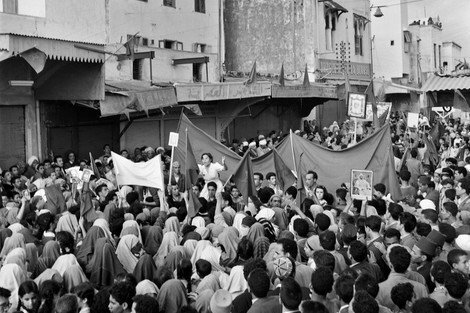
Top photo - Moroccans celebrate their independence from steemitimages.com
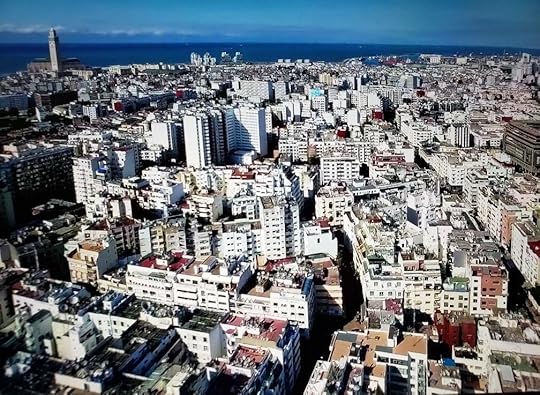
Modern-day Casablanca from pinterest.com
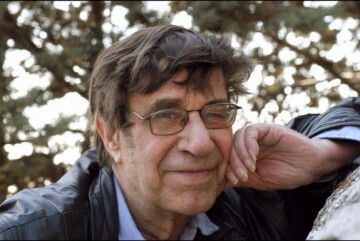
The author from lailalalami.com
[Edited 11/16/23, spoilers hidden]
The young man is in revolt too, although he’s not an active participant in the rebellion or even in demonstrations. He wants the French gone. But he’s also in revolt against his father and his father’s religion. We know you can't have everything and we also know something that Driss doesn't know yet. Yes, the country will get its independence from France (1956), but it will also be run as a Muslim theocracy. A recurring theme is the French motto “Liberty, Equality, Fraternity” which is written on top of the blackboard of his classroom when he attends French school. He wonders how even one of these words applies to him.
The boy’s father is a wealthy tea merchant - a wholesaler. The family calls him the Lord. He’s brutal to his wife and children, all boys. How brutal? One reviewer in the introduction called him “one of the most terrifying fathers in literature.” Of the poor woman who is their mother: “She bit on a lace handkerchief and sobbed tearlessly, without a sound, as women do who have sobbed for forty years.”
The violence of his father seems to permeate the society. The primary school seems to mainly offer beatings. There's a lot of focus on the hypocrisy in regard to religion where male practitioners attend the mosque frequently and carry out their daily rituals of prayer, but regularly smoke, drink, and go to prostitutes. He tells us the Haj, the pilgrimage to Mecca, is an excuse for men to visit the Middle East and to ‘go to the fleshpots of Cairo and Damascus.’
The young boy also notes that sexual abuse of the boys is common by the teachers as well as the teachers allowing older boys to take advantage of younger ones.
Given all this trashing of religion, as well as the coarse language and references to sexuality and sexual abuse, you can easily see why this book was banned in Morocco (and I'm assuming in other Arab nations) and why it apparently caused a fervor when it was published. And speaking of sexuality, the narrator leaves us wondering about his own sexuality.
Despite the brutality directed toward his son, Driss’ father sees promise in the boy. He’s not the oldest, but he is the son that he selects to go to high school (a French school with mainly French boys). Even though the father is illiterate he knows that going this route can bring success to his son. The father views it, in effect, as going behind enemy lines to see how they operate. But French education is a double-edged sword. The father tells his son at times that he thinks his son acts as if he’s no longer an Arab.
The son eventually revolts and in a way that is so unbelievably ferocious that it is hard to believe that it is meant to be real, I kept waiting for “…and he awoke from his nightmare.” And then I thought maybe I should shelve this book under ‘fantasy.’ Perhaps ‘surrealism’ is appropriate.
After all this, I’ll ask an intriguing question if you read it: Does this book have a happy ending?
The author (1926-2007) lived in France and then in French Canada. He wrote a dozen or so novels of which this one is his best-known book in English.
Top photo - Moroccans celebrate their independence from steemitimages.com
Modern-day Casablanca from pinterest.com
The author from lailalalami.com
[Edited 11/16/23, spoilers hidden]

February 17, 2020
What I did understand, in a metaphorically violent manner, was Driss' anger, confusion, and later clarity with regards to the matter at hand. The matter being whatever it was.
October 2, 2008
It was a difficult reading! You really need to think and re-think over some sentences to understand something :). Some statements shocked me. Especially the ones related to the definition of religion. He might be against religious believes, but to present religion in very disgusting way, why? I prefer to read logical arguments and well-founded critics rather than a disgusting and insulting descriptions.
October 8, 2013
Le passé simple !
Pas si simple que ça.
Ma première expérience avec la littérature marocaine d’expression française.
Pas très accessible dans premier abord.
J’ai dû le lire deux fois (or, je déteste ça) pour le cerner.
Les deux cultures du protagoniste du roman sont en balance à chaque fois !
Mais la culture hexagonale finit par prendre le dessus, puisque Driss s’en prend aux archaïsmes du Maroc.
A lire, à comprendre, et faites-vous votre propre idée.
Moi je lui ai donné un 4/5.
Pas si simple que ça.
Ma première expérience avec la littérature marocaine d’expression française.
Pas très accessible dans premier abord.
J’ai dû le lire deux fois (or, je déteste ça) pour le cerner.
Les deux cultures du protagoniste du roman sont en balance à chaque fois !
Mais la culture hexagonale finit par prendre le dessus, puisque Driss s’en prend aux archaïsmes du Maroc.
A lire, à comprendre, et faites-vous votre propre idée.
Moi je lui ai donné un 4/5.
April 21, 2020
This is an intense story. A stream of consciousness which embodies all the contradictions and convictions of a person struggling to create a cohesive identity. It lays bare the complexities of colonialism, religion, patriarchy, and life without settling for simplicity. There are no clean lines in this story, it exists in the muddled, ugly, and chaotic fractures of human relationships.

November 27, 2017
قال البطل إدريس، ملخصا تجربته قبل الرحيل إلى باريس، لم يغب عن بالي ولو غراما واحدا من ماضي. يمر أمامي بسيطا: لعبت وربحت.

June 12, 2020
Roman difficile et plutôt inaccessible, mais fascinant et violent à la fois. Le style est très approprié pour le sujet: la révolte d'un adolescent grandissant entre deux cultures, l'oppression de la tradition patriarchale et les illusions de l'occident. Avec fureur, exagérations et folie, l'auteur nous met dans la peau de Driss Ferdi, fils de haj richissime et très autoritaire, figure de Seigneur contre lequel il se soulève.
Au moment de finir sa lecture, je ne suis pas sûr d'avoir aimé ce livre.
Au moment de finir sa lecture, je ne suis pas sûr d'avoir aimé ce livre.

June 1, 2026
reading around the world one book at a time 2026: morocco
una delle letture più difficili di quest'anno, mi è davvero costato leggere questo romanzo e me lo sono portata dietro per così tanto tempo da provare risentimento ogni volta che lo prendevo in mano
mi piacerebbe rileggerlo più avanti (mooooolto più avanti) in italiano o in inglese perché una delle cose che mi ha dato difficoltà è stato il lessico, e la difficile interpretazione del tono sarcastico del narratore protagonista
il libro parla di temi estremamente importanti nel marocco di metà ventesimo secolo, e in quel poco che ho afferrato ho intravisto la ragione per cui è diventato ora un classico della letteratura marocchina, devo solo trovare il metodo di confermare quel che ho capito - questa è stata un'ardua lotta tra me e il mio livello di francese ;;;
un minuto di silenzio per la vita di merda della madre di driss
una delle letture più difficili di quest'anno, mi è davvero costato leggere questo romanzo e me lo sono portata dietro per così tanto tempo da provare risentimento ogni volta che lo prendevo in mano
mi piacerebbe rileggerlo più avanti (mooooolto più avanti) in italiano o in inglese perché una delle cose che mi ha dato difficoltà è stato il lessico, e la difficile interpretazione del tono sarcastico del narratore protagonista
il libro parla di temi estremamente importanti nel marocco di metà ventesimo secolo, e in quel poco che ho afferrato ho intravisto la ragione per cui è diventato ora un classico della letteratura marocchina, devo solo trovare il metodo di confermare quel che ho capito - questa è stata un'ardua lotta tra me e il mio livello di francese ;;;
un minuto di silenzio per la vita di merda della madre di driss
September 26, 2020
Livre très difficile à comprendre, surtout si c'est ta sélection pour lire à la plage.. J'ai arrêté au dernier chapitre parce que je n'en pouvais plus.

June 7, 2020
Well, I thought this a dreary read. Unpleasant even. The 3 stars are meant to be more neutral than a definite assignation of value because it's probable the novel's better than I think. I just didn't care for it.
The plot is one of a struggle within a Moroccan family between a tyrannical father and his rebellious son. I had trouble relating to the novel's Islamic backdrop of Koranic veneration within the family, which, filtered through the scream of the son's point of view produced an almost surreal clash. It became a dark, scrambled read.
To be honest, the prose is propulsive, powerful. But it describes ruin. I struggled to finish. It was quite a tussle between me and the novel. While the son was arguing with the father I was arguing with the book. Each day as I read the room here filled with smoke and there was banging in the corners as my desire to throw the novel aside grappled with my proud need to wade through the murk of Oedipal Islam to find some validity I could hold on to. But in the end I prevailed, yet lost since I never found anything I thought worthwhile.
The plot is one of a struggle within a Moroccan family between a tyrannical father and his rebellious son. I had trouble relating to the novel's Islamic backdrop of Koranic veneration within the family, which, filtered through the scream of the son's point of view produced an almost surreal clash. It became a dark, scrambled read.
To be honest, the prose is propulsive, powerful. But it describes ruin. I struggled to finish. It was quite a tussle between me and the novel. While the son was arguing with the father I was arguing with the book. Each day as I read the room here filled with smoke and there was banging in the corners as my desire to throw the novel aside grappled with my proud need to wade through the murk of Oedipal Islam to find some validity I could hold on to. But in the end I prevailed, yet lost since I never found anything I thought worthwhile.

September 7, 2024
Mid-20th century Morocco, a nation caught between its deep-rooted traditions and the tidal wave of modernity. Our guide through this tumultuous landscape? The young and rebellious Driss Ferdi. Through his eyes, Chraibi paints a vivid, often unsettling portrait of a society at a crossroads. But here's the kicker - our guy doesn't pull any punches. His prose is a beautiful paradox, both lyrical and brutally honest. He tackles taboo subjects such as religious upbringing and his own patricide head-on, poking a hornet's nest. It's provocative, it's controversial, but not so much since it was written and published in colonial tongue.
Fair warning: this isn't your typical beach read. The narrative can be as challenging as the themes it explores, but a worthy read nonetheless.
Fair warning: this isn't your typical beach read. The narrative can be as challenging as the themes it explores, but a worthy read nonetheless.
February 16, 2013
المغاربة بيكتبوا كويس

December 12, 2024
I struggled a lot with this book and I’m still not quite sure what to think about it. I had to re-read a lot to comprehend and it took me a while to get used to the “write-as-you-think” style.
I definitely understand why the book was banned in Morocco initially. I was intrigued (often shocked) about the harsh events and conversations taking place, and wondered to which extent they are exaggerated (as its a autobiographical novel). The blunt language as well as the absence of emotions, creates distance and makes some events even funny in their absurdity. A very unique book.
I definitely understand why the book was banned in Morocco initially. I was intrigued (often shocked) about the harsh events and conversations taking place, and wondered to which extent they are exaggerated (as its a autobiographical novel). The blunt language as well as the absence of emotions, creates distance and makes some events even funny in their absurdity. A very unique book.

April 27, 2025
Just didn't enjoy this at all - first NYRB Classic to miss for me
The prose is just not enjoyable to read - stream of consciousness style with deliberately oblique references, odd imagery, chopping back and forth from subject to subject. And the story itself wasn't interesting enough to make wading through it all worthwhile.
First Moroccan book for my 'read the world'
The prose is just not enjoyable to read - stream of consciousness style with deliberately oblique references, odd imagery, chopping back and forth from subject to subject. And the story itself wasn't interesting enough to make wading through it all worthwhile.
First Moroccan book for my 'read the world'

January 31, 2020
Scintillating, aggressive, and gripping, Driss Chraïbi narrates a powerful indictment of tradition and patriarchy in this rebellious, stylistically daring novel.


Read
August 14, 2026Read in two sittings bc I was GRIPPED and the workday in between was awful. Fathers and empires, am I right?
November 1, 2023
A confronting read but illustrious of the Makhzen and how deep colonisation in Morocco embeds into familial life. The portrayal of women as passive in colonial resistance however is not accurate historically, and the book lacks female characters
Read
July 26, 2019Le passé simple introduit le lecteur au coeur d'une famille marocaine dont le père se prend pour Dieu. Ce roman, organisé à la manière d'une réaction chimique, décrit la révolte de son fils Driss Ferdi, un personnage rebelle, entre les abus de pouvoir exercés par un père dictateur et une classe bourgeoise marocaine. C'est une critique vive du décalage entre l'islam révélé dans le Coran et la pratique hypocrite de l'islam au Maroc colonisé de 1950. C'est aussi une image, sans retouches sucrées, de la vie de la femme musulmane. Et un apprentissage de la liberté qui fait surgir à l'horizon la voix d'une nouvelle génération marocaine. Se conjuguer au passé simple dans le passé simple de Driss Chraibi, c'est se conjuguer au présent. Car, la pratique hypocrite de l'islam existe encore au Maroc et dans d'autres pays du monde.

March 20, 2016
استطاع الكاتب من خلال هذا المتن الروائي أن يصور فترة من فترات المغرب وبالضبط في منتصف القرن الماضي ، بمجمل تفاصيلها و قضاياها و توجهاتها و أوجاعها و أفكارها..عذرا ليس المغرب فقط بل كل بلدان الجنوب و العالم الثالث و التي يحضر فيها المقدس .. إدريس ذلك الشاب المتنور و الثائر على السلطة البطريركية .. سلطة تشرع و تحرم ما تشاء باسم الله و الدين و الأنبياء .. سلطة قتلت أخوه و دفعت أمه للإنتحار ..انتفض و لكن سرعان ما عاد للمهادنة لتحقيق مصلحته و هي الالتحاق بباريس للدراسة .
هناك تفاصيل تثقل كاهل الرواية لا حاجة لها ،و أحيانا غموض لا دلالة له ..
الماضي البسيط لم يكن بسيطا بالمرة .. إن كان كذلك لما تجاوز إشكاليات لا يزال يتخبط فيها ...
هناك تفاصيل تثقل كاهل الرواية لا حاجة لها ،و أحيانا غموض لا دلالة له ..
الماضي البسيط لم يكن بسيطا بالمرة .. إن كان كذلك لما تجاوز إشكاليات لا يزال يتخبط فيها ...
January 13, 2020
This was the January 2020 NY Book Classic selection for its book club. It was not an easy read. At times the narrator’s stream of consciousness was confusing as well as some of the conversations. While events of the story tie together, it is not always easy to understand what happened either. That this is a coming of age story is evident in the telling. I recognize that I had limitations in my understanding Maghreb and it’s history so many references were lost on me. The introduction was very helpful though. This is a sad and depressing story.
June 18, 2013
Les dernières 50 pages étaient les plus difficiles à lire
July 28, 2020
The book was a torrent, and I fell in love with its angry, puerile, sophisticated, scatological, sex obsessed, paranoid, and beautiful tone
November 14, 2023
Indigeste a mourir
November 18, 2024
No es para nada gore, pero la violencia se siente, pesada y amenazante, como en ninguna otra obra.

March 12, 2020
It is easy to see why this book is considered to be important. Part of that is due to circumstances of time and place, as the author was part of a cadre of Western-educated Moroccans who found their lyceum education simultaneously alienated them from mainstream French culture which looked down on them as colonials as well as from the traditional culture that rightly viewed them as being a corrupting influence in their society. Politically nationalist but indolent children of empire, such people have long written self-indulgent novels complaining about how hard life is that bemoan the harshness of education, the limited prospects of advancement, and their difficult relationships with more conservative parents. This book as all the staples of the sort of semi-autobiographical whinging that one can find in contemporary leftist youth perspectives, and it is therefore little surprise that the novel made the author a popular one even as it left him an exile from Morocco and predictably alienated him from his family there. If you like accounts of contemporary decadence and gross immorality, and think that sort of grim material makes for compelling literature, this book has plenty of grim material to rejoice in that fits the general theme of literature over the past century or so worldwide in its celebration of filth.
As far as novels go, it is relatively short at only 200 pages or so. The title is a handy key to understanding the meaning of the novel, such as it is, as it refers to a grammatical tense in French that signifies (usually in literature) something that is definitively over. Yet the author explores a past that is very much alive, and a great deal of the writing and thinking of recent decades is predicated on the reality that the past is never really gone but continues to shape things long afterward. This is admittedly not much to hang a novel on, and the plot explores the goings on of an obvious stand-in for the author also named Driss who is in the process of passing his qualifying tests to study at a French university while he casually insults his mother and drives her into despair and deals with his abusive and old-fashioned father who, contrary to his own best interests, wanted his son to have the best education even if that means being indoctrinated by French leftists as is often the case. Meanwhile the protagonist has some unpleasant encounters with prostitutes as well as a pedophile cleric and the seemingly inevitable clash between the protagonist and his father is avoided by the son running away to go to university in France.
It is clear that the author believes that telling his own thinly (if at all) disguised personal experiences of life as a privileged Moroccon child of nobility (his father is not called Lord for no reason, after all) who finds himself alienated by education from his culture as well as the imperial culture that desired to educate him but not fully respect him is worth reading by other people. He seems to think that the symbolic status of the protagonist as a picture of the educated colonial, the mother as the loving but rejected nation, and the father as the brutal and hypocritical traditional Muslim makes the novel rise above Maghreb pornographic gossip. It's unclear that the author really understands what he is about, though, as his novel is not particularly different except in matters of local color from a great deal many other similarly unpleasant and not very redeeming novels written from the same point of view of those whose education corrupted them and whose over-inflated sense of self-importance compelled them to write what does not edify at all and that reflects badly on both the vanity of the author and the lack of value of the education that he and so many others have received and suffered as a result of. There is no glory in being a corrupt and decadent elite of a post-colonial nation; it would be far better to be a semi-literate but decent and honorable peasant. But such honorable and decent people do not write novels like this, nor are their lives and works praised by other corrupt and decadent elites who think such a book as this one is worth reading and, more bizarrely, worth writing in the first place.
As far as novels go, it is relatively short at only 200 pages or so. The title is a handy key to understanding the meaning of the novel, such as it is, as it refers to a grammatical tense in French that signifies (usually in literature) something that is definitively over. Yet the author explores a past that is very much alive, and a great deal of the writing and thinking of recent decades is predicated on the reality that the past is never really gone but continues to shape things long afterward. This is admittedly not much to hang a novel on, and the plot explores the goings on of an obvious stand-in for the author also named Driss who is in the process of passing his qualifying tests to study at a French university while he casually insults his mother and drives her into despair and deals with his abusive and old-fashioned father who, contrary to his own best interests, wanted his son to have the best education even if that means being indoctrinated by French leftists as is often the case. Meanwhile the protagonist has some unpleasant encounters with prostitutes as well as a pedophile cleric and the seemingly inevitable clash between the protagonist and his father is avoided by the son running away to go to university in France.
It is clear that the author believes that telling his own thinly (if at all) disguised personal experiences of life as a privileged Moroccon child of nobility (his father is not called Lord for no reason, after all) who finds himself alienated by education from his culture as well as the imperial culture that desired to educate him but not fully respect him is worth reading by other people. He seems to think that the symbolic status of the protagonist as a picture of the educated colonial, the mother as the loving but rejected nation, and the father as the brutal and hypocritical traditional Muslim makes the novel rise above Maghreb pornographic gossip. It's unclear that the author really understands what he is about, though, as his novel is not particularly different except in matters of local color from a great deal many other similarly unpleasant and not very redeeming novels written from the same point of view of those whose education corrupted them and whose over-inflated sense of self-importance compelled them to write what does not edify at all and that reflects badly on both the vanity of the author and the lack of value of the education that he and so many others have received and suffered as a result of. There is no glory in being a corrupt and decadent elite of a post-colonial nation; it would be far better to be a semi-literate but decent and honorable peasant. But such honorable and decent people do not write novels like this, nor are their lives and works praised by other corrupt and decadent elites who think such a book as this one is worth reading and, more bizarrely, worth writing in the first place.

April 10, 2024
While a somewhat tough read due to the stream-of-consciousness style and often stilted sentences that leave you reading twice, wondering if you’ve missed an allegory or a metaphor, there is one certainty: this novel seethes with anger and bitterness.
Amidst active French colonialism of the state, Driss (the character, who shares a name with the author) lives under strict and abusive rule of his father (whom he sardonically calls Lord), but has a unique access to French education in contrast to his father and brothers, which leaves him with an unsteady foot in two worlds - the conservative Islamic society and the French ideals that offer more freedom but refuse to let him join as an equal. He also lives with his brothers, all targets as well as perpetrators of abuse, and a mother whom he loves but does not respect.
Chraïbi does not hold back in exposing the moral corruption and hypocrisy of a society that shelters pedophiles, prostitutes and those who visit them, predatory men, violent men, adulterers, and the performative who indulge in alcohol and tobacco. He laments the treatment of women as rights-less receptacles for babies, abused and locked away in the home, with no avenue for independence. He too acknowledges one’s inescapability of these societal confines, and
What is the “Simple Past?” My assumption is that it’s the time before the illusion of purity and his understanding of his own identity were shattered. Perhaps this past is before colonialism, though I don’t think so. It’s not the colonialism that has caused his people to behave as they do — it’s about him discovering it.
He stops just short of raising the question: did Morocco earn the colonization inflicted upon it?
Amidst active French colonialism of the state, Driss (the character, who shares a name with the author) lives under strict and abusive rule of his father (whom he sardonically calls Lord), but has a unique access to French education in contrast to his father and brothers, which leaves him with an unsteady foot in two worlds - the conservative Islamic society and the French ideals that offer more freedom but refuse to let him join as an equal. He also lives with his brothers, all targets as well as perpetrators of abuse, and a mother whom he loves but does not respect.
Chraïbi does not hold back in exposing the moral corruption and hypocrisy of a society that shelters pedophiles, prostitutes and those who visit them, predatory men, violent men, adulterers, and the performative who indulge in alcohol and tobacco. He laments the treatment of women as rights-less receptacles for babies, abused and locked away in the home, with no avenue for independence. He too acknowledges one’s inescapability of these societal confines, and
What is the “Simple Past?” My assumption is that it’s the time before the illusion of purity and his understanding of his own identity were shattered. Perhaps this past is before colonialism, though I don’t think so. It’s not the colonialism that has caused his people to behave as they do — it’s about him discovering it.
He stops just short of raising the question: did Morocco earn the colonization inflicted upon it?

June 13, 2024
Le passé simple n'est pas un simple passé. Une écriture audacieuse et très choquante pour une période assez compliquée des années cinquante et surtout au Maroc ! Relatant les évènements d'une histoire que chaque famille avait vécu pendant cette période-là. Le génie de Chraibi a été réellement manifesté dans cette oeuvre qu'à partir des thèmes évoqués, des évènements et des scènes entre parenthèses obscènes mais totalement vrais et le style d'écriture malicieux et cyclique toute phrase commence et finit dans le même verseau ce qui donne une sensation de vertige en lisant et qui nous rend en tant que lecteur a relire plusieurs fois la phrase afin de comprendre la signification.

February 18, 2021
I can see why this book got banned, as it tackles several important subjects, but the summary on the back of the book was far more promising than the book itself. Sorry, but this book was just plain boring—not to mention vaguely uncomfortable, what with the obsession with genitals and breasts. I pretty much started skimming so that I could get through the book more quickly—which may or may not have been a good idea due to the stream of consciousness narration—but hey, at least I'm done with the book now.

March 8, 2025
un roman au style particulièrement beau mais pas des plus simples
toutefois ne pas comprendre certains passages ne m'a pas empêchée de me laisser guider par driss chraïbi au cœur d'un Maroc sous le protectorat français
difficile de faire un résumé clair, celui de la quatrième de couverture s'en chargera mieux que moi. mais en abordant les thèmes du colonialisme, de l'identité nationale, de la religion et de la violence réservée aux femmes dans tout ce contexte, l'auteur nous capture dans des sujets encore résonnants aujourd'hui
#wow
toutefois ne pas comprendre certains passages ne m'a pas empêchée de me laisser guider par driss chraïbi au cœur d'un Maroc sous le protectorat français
difficile de faire un résumé clair, celui de la quatrième de couverture s'en chargera mieux que moi. mais en abordant les thèmes du colonialisme, de l'identité nationale, de la religion et de la violence réservée aux femmes dans tout ce contexte, l'auteur nous capture dans des sujets encore résonnants aujourd'hui
#wow
Displaying 1 - 30 of 50 reviews