

What do you think?

Spectacle: The Astonishing Life of Ota Benga
An award-winning journalist reveals a little-known and shameful episode in American history, when an African man was used as a human zoo exhibit—a shocking story of racial prejudice, science, and tragedy in the early years of the twentieth century in the tradition of The Immortal Life of Henrietta Lacks, Devil in the White City, and Medical Apartheid.
In 1904, Ota Benga, a young Congolese “pygmy”—a person of petite stature—arrived from central Africa and was featured in an anthropology exhibit at the St. Louis World’s Fair. Two years later, the New York Zoological Gardens displayed him in its Monkey House, caging the slight 103-pound, 4-foot 11-inch tall man with an orangutan. The attraction became an international sensation, drawing thousands of New Yorkers and commanding headlines from across the nation and Europe.
Spectacle explores the circumstances of Ota Benga’s captivity, the international controversy it inspired, and his efforts to adjust to American life. It also reveals why, decades later, the man most responsible for his exploitation would be hailed as his friend and savior, while those who truly fought for Ota have been banished to the shadows of history. Using primary historical documents, Pamela Newkirk traces Ota’s tragic life, from Africa to St. Louis to New York, and finally to Lynchburg, Virginia, where he lived out the remainder of his short life.
Illuminating this unimaginable event, Spectacle charts the evolution of science and race relations in New York City during the early years of the twentieth century, exploring this racially fraught era for Africa-Americans and the rising tide of political disenfranchisement and social scorn they endured, forty years after the end of the Civil War. Shocking and compelling Spectacle is a masterful work of social history that raises difficult questions about racial prejudice and discrimination that continue to haunt us today.
333 pages, Kindle Edition
First published June 2, 2015
Ratings & Reviews
Friends & Following
Create a free account to discover what your friends think of this book!
Community Reviews
Displaying 1 - 30 of 178 reviews

April 19, 2015
While a single volume cannot begin to right the grave injustice that so tragically marked Benga’s life, it can help untangle the web of egregious fallacies that mark our historical record and dishonor his memory.When we think of people in cages some things are likely to pop to mind. Maybe extreme fighters going at each other for money, on TV and in arenas. Maybe Rikers Island, or any the many establishments of local, state or federal incarceration that blanket the nation, holding millions of people behind bars. Fans of Kurt Vonnegut might recall Billy Pilgrim on Tralfamadore in a display with Montana Wildhack. But at the end of the 19th and beginning of the 20th century there was something other going on. It was a period in which western powers were drunk on celebrating Imperial gains in far off places.
Here in the USA, the Cincinnati Zoo invited 100 Sioux to live at their park for three months in 1896. In 1904, the Louisiana Purchase Exposition, a World’s Fair in Saint Louis, put on a show intended to outshine the 1893 White City success of the World's Columbian Exposition in Chicago, but instead of featuring architecture and industry, the focus here was on imperial dominance and the superiority of the successful race. It was termed a ”parade of evolutionary progress.” Hey folks, look at all these nifty places we took over. Conquered native peoples were often labeled as primitives, despite having ancient cultures of their own. Many were put on display in Saint Louis. These included Igorot from the Philippines, Tlingit from Alaska, and Apache from you-know-where. Geronimo himself was present, selling autographs.
Displaying people for fun and profit was hardly unique to the USA. There were many instances of what were euphemistically called “ethnological expositions” extant at the time. Representatives of non-Western cultures were put on public display in such Podunk, one-horse towns as Amsterdam (Surinam natives were displayed near the Rijksmuseum in 1883), London (Nubians), Paris (World’s Fairs in 1878 and 1889 featured Negro villages. Later French fairs displayed people in cages, sometimes in undressed states), Belgium, Moscow, Hamburg, Barcelona, Antwerp, Barcelona, and Warsaw. Human zoos, sorry, ethnographic expositions, were all the rage.
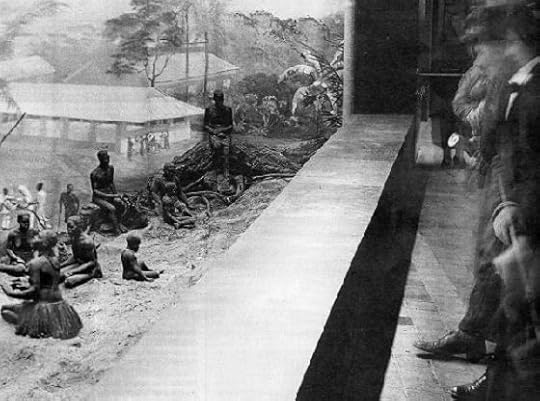
Watching the primitives at the St Louis Exposition
One of the big attractions at the Saint Louis Fair was a group of African pygmies. Among that group was a young Mbuti man who stood 4’11, had dark brown skin and whose teeth, as was customary in his culture, had been filed to points. His name was Mbye OtaBenga, and his journey in America was far from over. (His name went through various gyrations during his time in the USA, but for this review “Ota Benga” will be used)
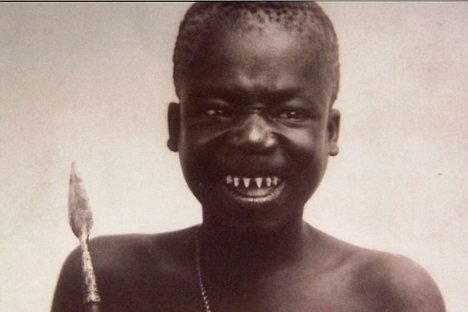
Ota Benga - from The Daily Mail
He was returned to Africa following the St Louis fair, but things did not go well for him there and he was brought back to the USA by the man who had brought him the first time, Samuel Verner. This time, after a stay at the American Museum of Natural History on Manhattan’s Upper West Side became problematic, Ota Benga’s next stop was the New York Zoological Garden, or the Bronx Zoo. In 1906, he was put on display in the monkey house, in an enclosure with an orangutan. He was accompanied by a chimp named Polly that Verner had also brought back from Africa. What happened here was of a cloth with outrageous activity that was extant across the Western world. The idea was that the pygmy represented a primitive stage in the advancement of the human race to the glorious advanced state of those then in charge.
Outrage ensued, although not nearly enough of it in high places. The NY Times basically wondered “What's the big deal?”
Author Pamela Newkirk, a journalist, National Press Club Award winner, and a director of undergraduate studies at New York University, uses the inhuman presentation of Benga as a springboard for a look at a variety of contemporary people and issues. She pays particular attention to Samuel Phillips Verner, the man who had brought Benga to America. Not exactly the most upstanding of citizens, Verner was a missionary (when convenient), businessman, diplomat, collector, adventurer, and whatever he needed to be to get what he wanted. He’s an interesting character, although far from a laudable one. We get to meet some of the people who were involved with the efforts to shut down the dehumanizing monkey house exhibition, and many of the people who tried to help Benga have a life in America. Her portrayal of Benga’s personal journey is particularly moving.

Pamela Newkirk - from NYU
Newkirk pays particular attention to Congo, which, at the time of Benga’s departure, was under the cruel yoke of King Leopold of Belgium. For a fuller look at that place and time I recommend Alan Hochschild’s horrifying depiction of institutionalized cruelty, King Leopold’s Ghost. But Newkirk’s description of Congo will give you some appreciation for the horrors of the age.
She also looks, through the lens of Benga’s public display, at the attitudes of some of the city’s leading lights. Who were the people who put Benga in the monkey house? What were their motivations? How did the black community in New York respond to this act? What role did the media play in the controversy?
Benga’s story of man’s inhumanity to man has provided source material for both fiction and non. The most well-known example is the character of Ngunda Oti in The Curious Case of Benjamin Button. Ota Benga: the Pygmy in the Zoo, another account of the events was published in 1992. The book was written by Verner’s grandson, Phillips Verner Bradford, so may take a kinder view of his forebear than does Newkirk, who gives us a picture of Verner as a scoundrel.
As someone with a garden variety exposure to black history, Spectacle fills in a few of the many gaps in that knowledge for me. I imagine that it will do the same for most of us who are of the Caucasian persuasion, and many who are not.
The story of Ota Benga is a sad one, a man treated like a beast, then struggling to find his place in the world. It shows us the cruelty of the time, but also offers a look at some of the positive forces at work in the early 20th century. There were people who stood up to the unspeakable exhibitors. There were people who tried to see that Benga was treated decently. Newkirk shows Benga’s attempts to chart his own destiny and reports on the people who tried to help him. This entails giving us a look at Weeksville in Brooklyn, and Lynchberg, Virginia, both places where being black was not the disadvantage it was in most of the USA.
The author strikes a balance between looking at Benga’s trial and the larger picture. You will learn a bit about the conduct of imperial rule in Africa in the early 20th century, the dramatic racism inherent in how non-Caucasians were perceived, the efforts to build black political and social strength, and plenty more. Sadly, over a century later, racism persists, despite the growth in our scientific understanding of the physical diversity of the one race we all belong to, homo sapiens. And, while we remain barbaric to one another across the world, at least we no longer put people on public display, labeling them as primitive because of their ethnic makeup. (Reality TV does that quite well, using other criteria) Pamela Newkirk’s Spectacle is an engaging and enraging read that will teach you some history and touch your heart.
Review first posted – 5/29/15
Publication date – 6/2/15


=============================EXTRA STUFF
Links to the author’s personal, Twitter and FB pages
A Washington Post by Ann Hornaday about the role her great-great uncle played in displaying Benga at the zoo - A Critical Connection to the Curious Case of Ota Benga
A 2006 NY Times article by Mitch Keller - The Scandal at the Zoo
A Lilliput Town was constructed in 1934 in Vienna, to be inhabited by midgets for the amusement of fairgoers.
The Human Zoo – Science’s Dirty Little Secret – a video including interviews with Verner’s grandson
April 8, 2016 - I came across this poem about Ota Benga this morning Ota Benga at Edankraal by Yusef Komunyakaa

December 15, 2021
Superior Is As Superior Does!
Poor, young Ota Benga had a lot of patience and grace. Considering how he was treated speaks volumes of his abductors.
Slave owners is a better term for them.
To take a man from his country fifty years after slaves are told they are now free and slavery is over, and bring him openly to America against his will, then force him to live like an animal with filthy apes is proof that slavery is an acceptable part of American culture.
And a reflection on the doers.
Whenever Ota refuses to go into the cage, his captives have a nerve to complain. Which tells you what a bunch of hypocritical Christians they are. Which is one of the reasons why today a lot of people have no trust or respect for Christianity.
Despite the horrific suffering and painful ordeal that the author shows Ota going through, she never lacks empathy for her subject matter and openly critiques the hypocrisy of the Christians and pseudo scientists who considers themselves experts on white supremacy.
But, fortunately, they make themselves look like the fools they really are.
Poor, young Ota Benga had a lot of patience and grace. Considering how he was treated speaks volumes of his abductors.
Slave owners is a better term for them.
To take a man from his country fifty years after slaves are told they are now free and slavery is over, and bring him openly to America against his will, then force him to live like an animal with filthy apes is proof that slavery is an acceptable part of American culture.
And a reflection on the doers.
Whenever Ota refuses to go into the cage, his captives have a nerve to complain. Which tells you what a bunch of hypocritical Christians they are. Which is one of the reasons why today a lot of people have no trust or respect for Christianity.
Despite the horrific suffering and painful ordeal that the author shows Ota going through, she never lacks empathy for her subject matter and openly critiques the hypocrisy of the Christians and pseudo scientists who considers themselves experts on white supremacy.
But, fortunately, they make themselves look like the fools they really are.

August 7, 2017
Spectacle: The Astonishing Life of Ota Benga by Pamela Newkirk is a horrible book to read but it is full of information about the subject. This has spoilers...
Ota Benja was taken by slavers after they killed his wife and two kids. Him and a handful of others from his village were taken for the 1904 St Louis Fair and later he was put in a cage with a chimp in NY, in a zoo in the Bronx. Here he was daily humiliated and taunted. A few black preachers started to put pressure on the owner and it took time but slowly the press started to help his plight. This book is great in going into the politics of the time, the social standing, who was in whose pocket, and the racial unrest at the time. If you are not a big history buff, this may not interest you but it did me. Big names, who was backing who, a sad situation that they let this man suffer for friendship and money. He is finally released and put in an orphanage even though he is an adult. He is taught English. He gets all he wants and asks for a job. He works at a tobacco factory for a while but he is depressed and can't go home due to WWI. He can't get away from what has been done to him. He doesn't look like anyone, he is only 4'11", 103 lbs, misses his family, his life has been nothing but abuse...and he kills himself. If that isn't enough, they make molds of his body and face and display it and they don't even give it his name. It is displayed as Pygmy. This is such a sad period in our history...I just wanted to cry for him all the way through the story. I ached and hurt for the injustice. The president of the US knew this too but his friends were friends of the NY zoo. So very sad.
Ota Benja was taken by slavers after they killed his wife and two kids. Him and a handful of others from his village were taken for the 1904 St Louis Fair and later he was put in a cage with a chimp in NY, in a zoo in the Bronx. Here he was daily humiliated and taunted. A few black preachers started to put pressure on the owner and it took time but slowly the press started to help his plight. This book is great in going into the politics of the time, the social standing, who was in whose pocket, and the racial unrest at the time. If you are not a big history buff, this may not interest you but it did me. Big names, who was backing who, a sad situation that they let this man suffer for friendship and money. He is finally released and put in an orphanage even though he is an adult. He is taught English. He gets all he wants and asks for a job. He works at a tobacco factory for a while but he is depressed and can't go home due to WWI. He can't get away from what has been done to him. He doesn't look like anyone, he is only 4'11", 103 lbs, misses his family, his life has been nothing but abuse...and he kills himself. If that isn't enough, they make molds of his body and face and display it and they don't even give it his name. It is displayed as Pygmy. This is such a sad period in our history...I just wanted to cry for him all the way through the story. I ached and hurt for the injustice. The president of the US knew this too but his friends were friends of the NY zoo. So very sad.

March 2, 2017
WOEFULLY OVER-RESEARCHED. CONFUSINGLY OVER-DETAILED.
“During the first year Howard’s farm added to its livestock six calves, seventy-five chickens, eleven ducks, and twenty hogs and harvested eight thousand cabbages. It planted thirty acres of potatoes, twelve acres of corn, and additional acres of turnips, carrots, and beets to feed the stock, wards, and staff. However, by the year’s end, because of a drought, the crops had not yielded as much as expected. Instead of the anticipated yield of four thousand to five thousand bushels of potatoes, the farm had produced only 2,200 bushels— and only half of that was marketable. Howard hoped to have better success with the new corn crops planted on twelve acres.” (p. 209)
Somewhere in this litany of names and numbers— annoyingly including meaningless street addresses—that Pamela Newkirk calls Spectacle: The Astonishing Life of Ota Benga there might be a moderately interesting story. Certainly nothing much astonishing, though, given the common history of the treatment of the colonized by the colonizers. Rather mostly anti-climatic.
Recommendation: For a much better, and better written, book on a similar theme, i.e. human oddities displayed like zoo animals in the early twentieth century, read The Lost Tribe of Coney Island: Headhunters, Luna Park, and the Man who Pulled Off the Spectacle of the Century, by Claire Prentice
“At the presumed summits of civilization, cruelty was cloaked in civility and a brooding darkness was hailed as light.” (p. 2).
HarperCollins. Kindle Edition, 248 pages.
“During the first year Howard’s farm added to its livestock six calves, seventy-five chickens, eleven ducks, and twenty hogs and harvested eight thousand cabbages. It planted thirty acres of potatoes, twelve acres of corn, and additional acres of turnips, carrots, and beets to feed the stock, wards, and staff. However, by the year’s end, because of a drought, the crops had not yielded as much as expected. Instead of the anticipated yield of four thousand to five thousand bushels of potatoes, the farm had produced only 2,200 bushels— and only half of that was marketable. Howard hoped to have better success with the new corn crops planted on twelve acres.” (p. 209)
Somewhere in this litany of names and numbers— annoyingly including meaningless street addresses—that Pamela Newkirk calls Spectacle: The Astonishing Life of Ota Benga there might be a moderately interesting story. Certainly nothing much astonishing, though, given the common history of the treatment of the colonized by the colonizers. Rather mostly anti-climatic.
Recommendation: For a much better, and better written, book on a similar theme, i.e. human oddities displayed like zoo animals in the early twentieth century, read The Lost Tribe of Coney Island: Headhunters, Luna Park, and the Man who Pulled Off the Spectacle of the Century, by Claire Prentice
“At the presumed summits of civilization, cruelty was cloaked in civility and a brooding darkness was hailed as light.” (p. 2).
HarperCollins. Kindle Edition, 248 pages.

July 19, 2016
I found it very mind-boggling to read about a human being that was taken from his native land and put on display at a zoo for all of the world to see like some caged animal. Even though the book is not solely about Benga, I learned so many more facts about other things from reading this book. This was a great history lesson.
My favorite line in this book... "Minik cried, you're a race of scientific criminals, I am glad enough to get away before they grab my brains and stuff them in a jar".
It's disturbing to know that people study other cultures and somehow want to change a person's way of life to suit your own. Its like invading someone's personal space. They actually called them savages when the real savages are the ones that go into these different environments and try to change them
My favorite line in this book... "Minik cried, you're a race of scientific criminals, I am glad enough to get away before they grab my brains and stuff them in a jar".
It's disturbing to know that people study other cultures and somehow want to change a person's way of life to suit your own. Its like invading someone's personal space. They actually called them savages when the real savages are the ones that go into these different environments and try to change them

August 16, 2015
Amazing History Lesson
Watching a late night television show about a year ago, I was intrigued when a cast member mentioned that a man had once been featured in the Bronx Zoo. When I got the opportunity to review this piece by Pamela Newkirk, I was extremely excited.
If you are a lover of history then you will love this book. It is filled with page after page of very detailed historical facts and quotes that the author carefully pieced together to give the reader a look into the early 1900’s and the atmosphere of racial divide. It very tediously details the life of a man by the name of Samuel Phillips Verner. He was the man responsible for the capture and the ultimate dehumanization of an African man by the name of Ota Benga.
The start of the book was very good and took the reader almost immediately inside the Bronx Zoo where Ota Benga lived and was displayed as any other animal. After chapter eleven though, the story takes a major turn and begins to more so detail the life of Benga’s overseer. There was a lot of detail about the people who were responsible for Benga more than there was about Ota Benga. There was very much detail about the atmosphere of the time period that this took place. There are countless records of trips to the Congo and England by men with a passion to capture other human beings for their self-gain.
I think that this story was honorable in the sense that I felt the sentiment of the author. She actually walked inside the place where Ota Benga was held. Her documentation of history is astounding. The drawback for me was that there weren’t a lot of known facts about Ota Benga himself and the title would lead you to believe that you are going to get a really full story about him. That is not the case, but in any event I did learn a great deal about the scientific world in the 1900’s and the white man’s desire to always prove that he is superior to other races. Some of the same entities that supported such nonsense are still in existence today and we unknowingly support them. This book has a way of making one realize that the early 1900’s is beginning to parallel 2015.
Reviewed by: Trenika
Watching a late night television show about a year ago, I was intrigued when a cast member mentioned that a man had once been featured in the Bronx Zoo. When I got the opportunity to review this piece by Pamela Newkirk, I was extremely excited.
If you are a lover of history then you will love this book. It is filled with page after page of very detailed historical facts and quotes that the author carefully pieced together to give the reader a look into the early 1900’s and the atmosphere of racial divide. It very tediously details the life of a man by the name of Samuel Phillips Verner. He was the man responsible for the capture and the ultimate dehumanization of an African man by the name of Ota Benga.
The start of the book was very good and took the reader almost immediately inside the Bronx Zoo where Ota Benga lived and was displayed as any other animal. After chapter eleven though, the story takes a major turn and begins to more so detail the life of Benga’s overseer. There was a lot of detail about the people who were responsible for Benga more than there was about Ota Benga. There was very much detail about the atmosphere of the time period that this took place. There are countless records of trips to the Congo and England by men with a passion to capture other human beings for their self-gain.
I think that this story was honorable in the sense that I felt the sentiment of the author. She actually walked inside the place where Ota Benga was held. Her documentation of history is astounding. The drawback for me was that there weren’t a lot of known facts about Ota Benga himself and the title would lead you to believe that you are going to get a really full story about him. That is not the case, but in any event I did learn a great deal about the scientific world in the 1900’s and the white man’s desire to always prove that he is superior to other races. Some of the same entities that supported such nonsense are still in existence today and we unknowingly support them. This book has a way of making one realize that the early 1900’s is beginning to parallel 2015.
Reviewed by: Trenika

May 16, 2020
While I cannot commend the actual writing of the book, if there ever were a case for America’s deep rooted and haunting racial depravity, this is it. Our society’s history of fetishization, animalization, desire, and development of freakery surrounding black bodies has never been more apparent than here. Slave markets reduced people to chattel; Ota was displayed as part of the monkey exhibit in the zoo - in captivity. When anyone, anyone, tries to say that racism in America is dead, that we’ve come a long way, that slavery was a long time ago, just hand them this book. The specific racism that America has cultivated was not only woven into the psychology fabric of our society in a way that is fundamental, it is nearly primal. Ota became sensationalized in a way that went far beyond any regional or historical economics that partially spawned the transatlantic slavery. He was treated with lust and as prey by a diaspora of people. That is something that is not only bred but inbred through generations. The horrors of this were almost too emotionally exhausting to read, but knowledge is justice and his story should be known.
December 29, 2015
Here is one of the classic cases of Man's Inhumanity Against Man. It may seem hard to believe that at the start of the 20th century men who called themselves scientists, learned or even brotherly to fellow men could be so barbaric as to treat a fellow man so cruelly. Whether or not these white men had next to no dealing with others of different pigmentation does not justify this brutality. The fact is humans had been trading goods, other beings (animal and non) with different groups for hundreds of years refutes the useless argument that white people never interacted with darker hued people and so treated them badly out of ignorance. The man known as Ota Benga and people of his homelands were treated badly not out of pure ignorance, no they were treated abominably out of willful arrogance and crass stupidity to further their own material gains. In this case it was men of faith that said Ota Benga was a human being, not a subspecies between ape and man. They recognised the pain and suffering in his face behind closed bars. They decried the inhumanity and yet were mocked by so called scientists and naturalists of allowing emotion to interfere with the advancement of knowledge. On the other hand readers of the 21st century may dismiss the 20th century thinking as a long time ago and pride themselves on how face humanity has come in Human Rights. Well 100 years ago isn't a very long time ago and the effects of this erroneous thinking has not been buried with the passage of time as Pamela Newkirk points out.
The book is very good, however, there is a pity at times that the book
focuses on Verner more than Ota Benga. Although what was able to focus on was heart rendering enough. There was no happy ending to the life Ota Benga had on this earth. Desperation, terror and abject misery drove him to take matters into his own hands. While he was forced to exist in America and others with good intentions sought to give him a quality of life, however, none of it was what he really needed. Once he left his homeland he could never go back home. He would always be lost/an outcast. It will never be known what happened to his family, but the assumption is either enslaved or murdered. Also made apparent from this book is to why he couldn't live in America as so many other captured and enslaved Africans had before him. His capture and enslavement was no for physical labour, only for an object of "science"-a quick rich scheme for a mentally unbalanced arrogant monied man. Always believing he would return to his family and his people Ota Benga clung futilely to the notion of a return. He kept his home firmly entrenched in his heart and could accept no other reality. The question remains then is there any justice for Ota Benga? Read the book and discover for yourselves the tragic life of Ota Benga.
The book is very good, however, there is a pity at times that the book
focuses on Verner more than Ota Benga. Although what was able to focus on was heart rendering enough. There was no happy ending to the life Ota Benga had on this earth. Desperation, terror and abject misery drove him to take matters into his own hands. While he was forced to exist in America and others with good intentions sought to give him a quality of life, however, none of it was what he really needed. Once he left his homeland he could never go back home. He would always be lost/an outcast. It will never be known what happened to his family, but the assumption is either enslaved or murdered. Also made apparent from this book is to why he couldn't live in America as so many other captured and enslaved Africans had before him. His capture and enslavement was no for physical labour, only for an object of "science"-a quick rich scheme for a mentally unbalanced arrogant monied man. Always believing he would return to his family and his people Ota Benga clung futilely to the notion of a return. He kept his home firmly entrenched in his heart and could accept no other reality. The question remains then is there any justice for Ota Benga? Read the book and discover for yourselves the tragic life of Ota Benga.

July 26, 2017
Such a heartbreaking story.

March 2, 2025
Such a sad tale in the history of this country. In a day when we are told that history is twisted, this is a story I heard of years ago, but now read. Powerful!
October 30, 2016
Recommended on the cover by the great James McBride whom I adore, the story behind Ota Benga's purposeful abduction from the Congo to be exhibited in the St. Louis world fair and later in the Bronx zoo as a real life African is thoroughly disturbing. The story of Ota Benga presents a real stain on American history in the time of exhibition for personal financial gain and for prestige. ohhhhhh wait... this type of history reinvention continues at frightfully disturbing costs. 1904 or 2016?

August 6, 2017
Though there is a bit too much meandering in the last third of the narrative, this is a profoundly heartbreaking true story of racism and human exploitation chillingly sanctioned by institutions of learning and public enlightenment.

July 9, 2016
Books like "Spectacle: The Astonishing Life of Ota Benga" are the reason I read historical accounts: to learn about atrocities committed by humanity that must be resisted in the future. I also appreciate seeing how history is rewritten, for better or for worse, by different actors.
The book covers the trials of the capture and display of a Congolese boy, Ota Benga, in the early 1900s. While many of the details about his life are highly disputed the author takes known facts: that there was a sign on the cage he was in at the zoo (yes, you read that sentence correctly), that different contemporary articles commented on his being in a cage, and his own words where they are noted, to show that he was taken against his will and treated as a scientific specimen instead of as a human. Throughout time though, those who captured him changed the narrative. They claimed he was at the whim of cannibals and they saved him. They claimed he wasn't on display at the zoo but was a monkey handler. They claimed he willingly came to the United States and didn't want to go back to the Congo. Reading these fabricated words from Verner and others involved in his trapping is infuriating but teaches us about how carefully we have to read history when it is so often produced by the powerful/victors.
The book, and it's conclusion, will shake you if you believe in human rights for all. Accordingly, I highly suggest it.
The book covers the trials of the capture and display of a Congolese boy, Ota Benga, in the early 1900s. While many of the details about his life are highly disputed the author takes known facts: that there was a sign on the cage he was in at the zoo (yes, you read that sentence correctly), that different contemporary articles commented on his being in a cage, and his own words where they are noted, to show that he was taken against his will and treated as a scientific specimen instead of as a human. Throughout time though, those who captured him changed the narrative. They claimed he was at the whim of cannibals and they saved him. They claimed he wasn't on display at the zoo but was a monkey handler. They claimed he willingly came to the United States and didn't want to go back to the Congo. Reading these fabricated words from Verner and others involved in his trapping is infuriating but teaches us about how carefully we have to read history when it is so often produced by the powerful/victors.
The book, and it's conclusion, will shake you if you believe in human rights for all. Accordingly, I highly suggest it.

October 1, 2017
When I lived in the metropolitan DC area one of the major summer events was the Smithsonian Folklife Festival. I remember that one of the features of that event was that it brought People from other parts of the world to display various cultures and talents. This process of putting people on display has been going on for a long time. Pygmies were brought from the Congo to the St. Louis worlds fair in the early 20th century. Ota Benga was among that group. Although we apparently do not even know what his actual name was. He was known by a number of names over the next dozen years and two separate trips to the United States before he committed suicide in Lynchburg Virginia in 1916.
The facts of the story are hard to pin down. There is very little documentation available. The book is hardly a clear portrait of the young man Who was apparently brought unwillingly across the ocean from the Congo. The story of the man who brought him is barely more clearly presented. The scientific community does not shine. The background of the era is presented in an interesting fashion. The tenor of the times in Lynchburg Virginia in the early 20th century is fascinating reading for me as a person who lives there in the early 20th century. But it mostly seems like pure speculation when it comes down to saying what the experience was of this young person who was uprooted from Africa. Accurate or believable observations of his life are almost totally absent.
The facts of the story are hard to pin down. There is very little documentation available. The book is hardly a clear portrait of the young man Who was apparently brought unwillingly across the ocean from the Congo. The story of the man who brought him is barely more clearly presented. The scientific community does not shine. The background of the era is presented in an interesting fashion. The tenor of the times in Lynchburg Virginia in the early 20th century is fascinating reading for me as a person who lives there in the early 20th century. But it mostly seems like pure speculation when it comes down to saying what the experience was of this young person who was uprooted from Africa. Accurate or believable observations of his life are almost totally absent.

June 7, 2015
I enjoyed this book a lot. I particularly appreciated how the author discussed the mental trauma and shame that Ota Benga likely suffered due to being exhibited in a zoo and living as a public spectacle. I also learned for the first time about Belgian King Leopold's brutal and sadistic reign over the Congo. What Ota Benga and his people went through is unimaginable.
There was a lot of context about Ota Benga's life and all the forces that pushed him towards his fate, but not a lot about the man himself, which was kind of disappointing. It's not really the fault of the author and I think she did the best she could with what is available. I still wish there was more about him. Also, I only finished it because of my own curiosity about his life. It wasn't well written enough that I would have finished it had it been about another subject; hence the three stars.
There was a lot of context about Ota Benga's life and all the forces that pushed him towards his fate, but not a lot about the man himself, which was kind of disappointing. It's not really the fault of the author and I think she did the best she could with what is available. I still wish there was more about him. Also, I only finished it because of my own curiosity about his life. It wasn't well written enough that I would have finished it had it been about another subject; hence the three stars.
July 22, 2017
I would love to give this a higher rating.
It has taken me a long time to read this book. While the first part was somewhat interesting, after that it became tedious. Additional information about towns and the life of the black man at that time wasn't simply stated. Many characters were introduced, including their life history or at least part of it. It did not add to the life story of Benga. The book was just boring but I wanted to finish it and find out what happened to him.
It has taken me a long time to read this book. While the first part was somewhat interesting, after that it became tedious. Additional information about towns and the life of the black man at that time wasn't simply stated. Many characters were introduced, including their life history or at least part of it. It did not add to the life story of Benga. The book was just boring but I wanted to finish it and find out what happened to him.

May 17, 2017
This book is overwhelming, even for me a history aficionado. Very little of this book is about Otabenga, most of it is about the people and events around him. I feel I know more about the men that 'negotiated' his presence at the zoo. I understand why and what the author was going for but this book missed it's mark with me.

June 28, 2018
**3.5 Stars**
If I were to rate this book after I read Part I, I would've given this book 5 stars. I was riveted by the knowledge that the Bronx Zoo had a human being on display in their Monkey House. I just cannot imagine. But then, the book takes a turn, towards tedium.....
Now I understand the concept of taking responsibility for what your reader does not /might not know, but there are places in this book where Ms Newkirk goes a bridge too far. Perhaps if she had delved deeper into the other unfortunate souls who were also taken from their homelands--the 2 African boys taken by Verner on his first trip, the Inuit taken by Admiral Peary, others from the St Louis Worlds Fair--or how the museums we have come to love, obtained their cherished artifacts through less than scrupulous means (read stole, pillaged, & plundered), Ms Newkirk could've had something special. But after Part I, we really don't learn much more about Otabenga, until his demise. He becomes part of the periphery. Even Verner gets lost in the shuffle at the end.
In the description, this book claims it is "in the tradition of The Immortal Life of Henrietta Lacks." Nope. Not even close. Ms Newkirk truly has passion about her subject, but it's painfully obvious, her editor did not. In the hands of a better editor, this could've been the book Otabenga deserved.
This is a story that needs to be told. It had such potential. While I am glad I read this book, I am left with the sinking feeling of what might have been.
If I were to rate this book after I read Part I, I would've given this book 5 stars. I was riveted by the knowledge that the Bronx Zoo had a human being on display in their Monkey House. I just cannot imagine. But then, the book takes a turn, towards tedium.....
Now I understand the concept of taking responsibility for what your reader does not /might not know, but there are places in this book where Ms Newkirk goes a bridge too far. Perhaps if she had delved deeper into the other unfortunate souls who were also taken from their homelands--the 2 African boys taken by Verner on his first trip, the Inuit taken by Admiral Peary, others from the St Louis Worlds Fair--or how the museums we have come to love, obtained their cherished artifacts through less than scrupulous means (read stole, pillaged, & plundered), Ms Newkirk could've had something special. But after Part I, we really don't learn much more about Otabenga, until his demise. He becomes part of the periphery. Even Verner gets lost in the shuffle at the end.
In the description, this book claims it is "in the tradition of The Immortal Life of Henrietta Lacks." Nope. Not even close. Ms Newkirk truly has passion about her subject, but it's painfully obvious, her editor did not. In the hands of a better editor, this could've been the book Otabenga deserved.
This is a story that needs to be told. It had such potential. While I am glad I read this book, I am left with the sinking feeling of what might have been.

April 11, 2017
When traveling back to Jersey, from Connecticut, depending on traffic I sometimes pass the Bronx Zoo. And each time I think, ‘they exhibited a Black man there…’
I had heard of the story but like most, didn’t really know the details. Me, knowing anything dealing with Black/White from that era, especially for profit, didn’t produce a good outcome for the Black, assumed the worse – and my assumption was right.
In 1904, Ota Benga was a Congolese pygmy who was brought to America against his will and displayed like an animal in a cage with an Orangutan. Exploited by his captor Samuel Phillips Verner who delivered him to William Temple Hornaday, the zoo’s director. In collusion with the media, for years they denied the extent of his captivity and even lied saying Ota could’ve left at anytime and enjoyed being housed with the Orangutan.
Eventually ‘freed,’ Ota was able to live with other Blacks in a Black community but his homesick-ness for the Congo led to him committing suicide at the age of 46.
It’s the exploit-ment for personal gain that is rampant through the relationship between Blacks and Whites in addition to an agenda supporting the fact that Blacks are subhuman to justify this mistreatment. Both were on full display in this book.
What hits home is that this took place in 1904, not that long ago. Although no one is still alive that can remember this incident, that was only 3 generations ago and those mindsets and ideals may still linger on…
I had heard of the story but like most, didn’t really know the details. Me, knowing anything dealing with Black/White from that era, especially for profit, didn’t produce a good outcome for the Black, assumed the worse – and my assumption was right.
In 1904, Ota Benga was a Congolese pygmy who was brought to America against his will and displayed like an animal in a cage with an Orangutan. Exploited by his captor Samuel Phillips Verner who delivered him to William Temple Hornaday, the zoo’s director. In collusion with the media, for years they denied the extent of his captivity and even lied saying Ota could’ve left at anytime and enjoyed being housed with the Orangutan.
Eventually ‘freed,’ Ota was able to live with other Blacks in a Black community but his homesick-ness for the Congo led to him committing suicide at the age of 46.
It’s the exploit-ment for personal gain that is rampant through the relationship between Blacks and Whites in addition to an agenda supporting the fact that Blacks are subhuman to justify this mistreatment. Both were on full display in this book.
What hits home is that this took place in 1904, not that long ago. Although no one is still alive that can remember this incident, that was only 3 generations ago and those mindsets and ideals may still linger on…

April 19, 2021
⭐️⭐️⭐️
Somewhat dry and factual, this is the story of Ota Benga, a native African from the Belgian Congo region who was brought into the United States for the purpose of an exhibition at the St. Louis World’s Fair in 1904. Apparently the anthropological societies of that era thought it would be cool to exhibit people from various cultures around the world for the fair visitors to see. The circumstances by which Ota Benga was obtained/ captured/bought(?) are not truly known. Later, in 1906, he was exhibited at the then “new” New York Zoological Gardens, housed inside the Monkey House along with the other primates on exhibit. There is a lot of conjecture in this book. The man who brought/bought him was Samuel Phillips Verner, a man of questionable reputation who had traveled in the Congo region for several years, first under the auspices of the Presbyterian Missionary Society and then for various American business entities hoping to make their fortunes raping the natural resources of the aforementioned area. The author tries to present Ota’s life from 1904 until his death but there are many conflicting accounts and I didn’t really know which to believe. Just an okay read - somewhere between 2.5 and 3 stars for me. (You know the book isn’t really grabbing you when you can go to sleep with only 15 pages left to go!)
Somewhat dry and factual, this is the story of Ota Benga, a native African from the Belgian Congo region who was brought into the United States for the purpose of an exhibition at the St. Louis World’s Fair in 1904. Apparently the anthropological societies of that era thought it would be cool to exhibit people from various cultures around the world for the fair visitors to see. The circumstances by which Ota Benga was obtained/ captured/bought(?) are not truly known. Later, in 1906, he was exhibited at the then “new” New York Zoological Gardens, housed inside the Monkey House along with the other primates on exhibit. There is a lot of conjecture in this book. The man who brought/bought him was Samuel Phillips Verner, a man of questionable reputation who had traveled in the Congo region for several years, first under the auspices of the Presbyterian Missionary Society and then for various American business entities hoping to make their fortunes raping the natural resources of the aforementioned area. The author tries to present Ota’s life from 1904 until his death but there are many conflicting accounts and I didn’t really know which to believe. Just an okay read - somewhere between 2.5 and 3 stars for me. (You know the book isn’t really grabbing you when you can go to sleep with only 15 pages left to go!)
July 18, 2018
3.5 Stars. "Spectacle" combines the elements of two books I have recently read, "King Leopold's Ghost" (which documents the horrors of the Belgium's brutal exploitation of the Congo) and "Three Generations, No Imbeciles" (which documented the horrors of eugenics, where prejudice was cloaked with a scientific veneer). "Spectacle" provides a thorough account of a shameful episode in American history that was almost immediately whitewashed: the exhibition of an African man in a cage in the Bronx Zoo. (Some of the whitewashing still appears in the Ota Benga Wikipedia entry, which does not seem to acknowledge some of the contemporaneous account of events contained in "Spectacle.")
While "Spectacle" exhibits remarkable and dogged research and is generally well-written, its organization and exposition frustrated me. "Spectacle" could have been 50 to 75 pages shorter and still have been equally devastating. I felt as though Newkirk went down tangents that led nowhere and bogged down the narrative. She also tended to add historical detail (typically obscure historical figures) that added nothing to the story. These are minor quibbles, though, for a generally excellent book.
While "Spectacle" exhibits remarkable and dogged research and is generally well-written, its organization and exposition frustrated me. "Spectacle" could have been 50 to 75 pages shorter and still have been equally devastating. I felt as though Newkirk went down tangents that led nowhere and bogged down the narrative. She also tended to add historical detail (typically obscure historical figures) that added nothing to the story. These are minor quibbles, though, for a generally excellent book.
June 30, 2015
What a painful story! To read this in the week of the Charleston Mother AME murders and church burnings, the debate about the Confederate flag, and news about the possible rise of the KKK was almost too much for me. To know that Ota Benga, a young Congalese man was captured and displayed, among other places, in the Bronx Zoo's Monkey House, housed with an orangutan, despite public outcry. To think how many people stared at him in complete disrespect and misunderstanding of his humanity.
Newkirk tells Benga's story in the context of the social and political systems at play in the USA soon after the turn of the century, and also shows differing scientific views, some of whom "studied primitive humans" and others, who fought to declare his equal humanity. I'd like to think that socially, politically, and scientifically, we are in a far different place than Americans in the early 1900s. But given recent events, I think we still have a long way to go.
Newkirk tells Benga's story in the context of the social and political systems at play in the USA soon after the turn of the century, and also shows differing scientific views, some of whom "studied primitive humans" and others, who fought to declare his equal humanity. I'd like to think that socially, politically, and scientifically, we are in a far different place than Americans in the early 1900s. But given recent events, I think we still have a long way to go.

February 7, 2017
Slavery of people and minds, religion dousing facts, racism disguised as science or economic needs, denial of documented history by institutions and politicians.
Sadly what transpired almost 100 years ago to the day continues to haunt our society and nation.
The inability to emancipate ourselves from mental slavery, our othering of people that are not white, our racism and prejudice pretending to serve a higher economic or patriotic cause, the Bronx zoo (which I shall never set foot on again) denying documented existential proof of its heresy.
An incredible upsetting story that unfortunately serves only to show how slowly mankind pays attention and learns its own history.
Sadly most of us just stand aside and look.
Sadly what transpired almost 100 years ago to the day continues to haunt our society and nation.
The inability to emancipate ourselves from mental slavery, our othering of people that are not white, our racism and prejudice pretending to serve a higher economic or patriotic cause, the Bronx zoo (which I shall never set foot on again) denying documented existential proof of its heresy.
An incredible upsetting story that unfortunately serves only to show how slowly mankind pays attention and learns its own history.
Sadly most of us just stand aside and look.
Read
November 21, 2016I am unable to rate this book. I stopped reading it after 1/3 of the book. The subject is very importamt and I am glad the author wrote the book about this horrifying part of history. I learned a lot about this period that I never knew about. I think I failed to finish it because of the disturbing nature of the subject and also because my mood stemming from this election. The subject matter reminds me of how far ignorant and dangerous people can get and that is too depressing for me right now. Also so e of the author's detils were detracting from the main subject and the book, for me, was not a comoelling read.

April 13, 2018
An important window into the rampant racism among the highly educated and scientific communities of early 20th century America. Alongside the story of Ota Benga, shocking and depressing even to someone as jaded as me, Newkirk convincingly exposes the man who brought him to the US, Samuel Verner, as a pathetic racist fraud and puts to rest the sanitized historical account according to which he was a friend of Benga's. Unfortunately, it seems like she ran out of relevant material in the latter part of the book, and it veers off into excessive details that have little to nothing to do with Benga.

October 18, 2018
Solid 3.5, pushing 4. The content was very good, but the author spent a lot of time detailing the history of people around Benga, rather than Benga himself. I’ve found this happens a lot in books that tell previously little-known histories as there just aren’t a lot of primary documents about these marginalized people. So, we end up learning about those around them with more of a paper trail.
Another thing I tried really hard to not let bother me was the audio book reader’s obvious disgust with several of the main actor’s actions. I can’t blame her, it really was that bad, but it was also obvious in her voice that she left work very angry every afternoon while recording this.
Another thing I tried really hard to not let bother me was the audio book reader’s obvious disgust with several of the main actor’s actions. I can’t blame her, it really was that bad, but it was also obvious in her voice that she left work very angry every afternoon while recording this.

September 24, 2015
I highly recommend this book for all readers above the age of thirteen. Although the author has an axe to grind, it's easy to see past that axe and glean important life- and historical-lessons from this book.
July 14, 2017
Too much detail. Could have been told in 100 pages.

September 5, 2022
This scholarly, very academic history, with its over 25 pages of footnotes and bibliography, was certainly very well sited. However, I wish it had focused more on the actual titular character of Ota Benga instead of what felt like the author's need to illustrate how evil 'the white devil' was in his exploitation of Africans both in the Congo and in the US. This certainly makes an excellent companion read for anyone who is interested in reading King Leopold's Ghost.

February 9, 2025
An interesting and sad story, reported with speculation and extraneous fillers. This could and should have been a long magazine article.
Displaying 1 - 30 of 178 reviews