Jump to ratings and reviews
Rate this book

El perfeccionista en la cocina

Rate this book
Julian Barnes, aficionado tardío a los fogones, cuenta en esta exquisita obra sus divertidas experiencias y aventuras entre sartenes y cazuelas. Quien haya cocinado alguna vez sabe que entre la receta que aparece en un libro de cocina y el plato que uno ha preparado se puede abrir un abismo: lo primero con que se topa el cocinero aficionado son, sobre todo, las dudas. ¿Cuán grande es una cebolla mediana? ¿Qué significa fuego medio? ¿Cuánto cabe en una pizca? Todo aquel para quien la cocina sea un hobby revivirá con este libro sus esforzados intentos, maldecirá los libros de cocina y sus ilustraciones a todo color, probará salsas y contemplará desolado un suflé despachurrado. Y repetirá agradecido la resignada consigna: esto no es un restaurante. Guarnecida con apetitosas ilustraciones, El perfeccionista en la cocina es una lectura desopilante que ninguno de los admiradores de Julian Barnes querrá perderse. Todo un placer.

115 pages, Kindle Edition

First published January 1, 2003

53 people are currently reading
1656 people want to read

About the author

Julian Barnes

173 books6,743 followers
Julian Patrick Barnes is an English writer. He won the Man Booker Prize in 2011 with The Sense of an Ending, having been shortlisted three times previously with Flaubert's Parrot, England, England, and Arthur & George. Barnes has also written crime fiction under the pseudonym Dan Kavanagh (having married Pat Kavanagh). In addition to novels, Barnes has published collections of essays and short stories.
In 2004 he became a Commandeur of L'Ordre des Arts et des Lettres. His honours also include the Somerset Maugham Award and the Geoffrey Faber Memorial Prize. He was awarded the 2021 Jerusalem Prize.

Ratings & Reviews

What do you think?
Rate this book

Friends & Following

Create a free account to discover what your friends think of this book!

Community Reviews

5 stars
416 (20%)
4 stars
800 (38%)
3 stars
644 (31%)
2 stars
165 (7%)
1 star
43 (2%)
Displaying 1 - 30 of 308 reviews
Profile Image for Ilse.
552 reviews4,438 followers
January 28, 2021
Cooking, a mundane or a frivolous subject? Neither for a self-proclaimed pedant cook as Julian Barnes, nor for me. Cooking (and writing about cooking) is a Serious Matter. Yet this quite hilarious collection of cooking columns which Barnes first published in The Guardian made me laugh out loud, perhaps ten times or more. For that reason alone, it is worth every star – or more – that can be given here, just because it is amusing and witty, winking complicitly at every domestic cook who isn’t or doesn’t feel a domestic god or goddess. Gracious self-mockery might keep one from ever aspiring such.

happy-thanksgiving-from-artbook-d-a-p-2-the-bottle-of-wine-picasso

Where would you situate yourself on the cooking spectrum, are you a casual cook intuitively improvising meals together with fluke ingredients (trouvailles which tempted you during unorganised shopping) or do you stick to following recipes exactly as written and to careful meal planning? I would like to think of myself as comfortably in between those two opposites, but no, I could as well admit it: I might not be a pedantic, meticulous cook but I am certainly not an adventurous one, mostly clinging rather firmly to the recipe and the shopping list, trusting gullibly the recipe’s flavours will deliver and please as having stood the test of the expert creator of the recipe.

No wonder that quite a few of Barnes frustrations and wrath on unreliable cookbooks have been mine too. I couldn’t but chuckle at Barnes’s confession of his pedantry as a cook 'Why should a cookbook be less precise than a manual of surgery? (always assuming, as one nervously does, that manuals of surgery are indeed precise. Perhaps some of them sound just like cookbooks: ‘Sling a gout of anaesthetic down the tube, hack a chunk off the patient, watch the blood drizzle, have a beer with your mates, sew up the cavity…’). Why should a word in a recipe be less important than a word in a novel? One can lead to physical indigestion, the other to mental.'

picasso-2

If you ever found yourself bewildered about a detail in a recipe likewise this might be a book for you: 'The Pedant approaches a new recipe, however straightforward, with old anxieties: words flash at him like stop-signs. Is this recipe framed in this imprecise way because there is a happy latitude - or rather, a scary freedom - for interpretation; or because the writer isn't capable of expressing him- or herself more accurately? It start with simple words. How big is a ‘lump’, how voluminous is a ‘slug’ or a ‘gout’, when does a ‘drizzle’ become rain? Is a ‘cup’ and rough-and-ready generic term or a precise American measure? Why tell us to add a ‘wineglass’ of something, when wineglasses come in so many sizes? Or how about this instruction from Richard Olney: ‘Throw in as many strawberries as you can hold piled up in joined hands.’ I mean, really. Are we meant to write to the late Mr Olney’s executors and ask how big his hands were? What if children made this jam, or circus giants?’

Tell me how you cook and I will tell you who you are. Once musing on cooking styles I became enmeshed into a silly discussion whether such approach of recipe allegiance is masculine or feminine. As I happen to be a woman, my cooking was labelled suspiciously masculine, lacking the feminine virtue of confidence and creative freedom in the kitchen (unsurprisingly this reader’s cooking style was in unfavourable contrast to the evidently unattainable norm of la mama’s cuisine for He For Whom She Cooked as la mama didn’t need to rely on cookbooks to create the most amazing meals– isn’t such a common story?). Et alors? Perhaps this is so, as I spend lots of time browsing cookbooks to select recipes but use them as a manual, not merely for inspiration. Nor do I read their introductions or pay much attention to the tone in which the authorial cook addresses the domestic cook. A cookbook ideally has a precise list of ingredients(please spare me ‘handful’s or ‘dollops’ and pictures with green olives on it when not mentioned in the list or the recipe! Compare that to the precise instruction of twisting the pepper mill 80 times for a Bayaldi meant for the staff’s lunch in a renowned restaurant) and a clear step by step explanation what to do with them - a bit like the instructions in an Ikea manual (but simpler and not leaving one with too many superfluous or missing screws or plugs).

No exotic equipment or techniques should be needed, a kitchen knife, oven, stove and pots & pans have to do. Neither do I have any ambition on creating fancy pieces worth art nouveau on the plate (though I like to bring a nice splash of colour on the plates). Indications of cooking times I learned are ever misguiding, so I know I have to wait to try a new recipe when there is enough time to do so and the hungry creatures in the house can be fed before they get so tired of waiting that they devour the cook. Never believe the recipe which promises a quick and easy meal in about half an hour (more often than not the recipe takes three such halves an hour). Not slavishly following the recipe is just as important as following it, so Barnes had me nodding approvingly at his ‘No, We Won’t Do That’ chapter (add 3 lemons? Are you crazy, Jamie? The food is supposed to make my family smile, not cringe!).

Such down-to-earthiness doesn’t mean that cooking leaves me indifferent, far from that. The emotional and psychological landscape of the kitchen, as Barnes tongue-in cheek amply illustrates, is vast and profound. And as a bookish person, cookbooks make up a great part of that landscape.

Like Barnes I was a late-onset cook (overindulged I was by others doing the job for me), but once I started I found myself overnight turning into nothing less than cookbook fanatic, almost neurotically with my nose in a cookbook every day. Though I stayed out of mother’s kitchen apart from washing the dishes, oddly enough her cooking habits and style seem to be transferred to her daughter thoroughly. In the meantime mother and daughter collected a number of cookbooks and recipes fit to cook a different meal each day for several lifetimes. I was amused that our cooking kindredness showed also when calling her for advice the moment my son wanted us to have the traditional Christmas Eve dish he would have to miss because of the lockdown. Both with the same cookbook (of some well-known British cook) open on our lap on the page of the recipe, we had following conversation:

Me: mum, do you entirely stick to that recipe?
Mum: yes, of course I do, I follow it from a to z!
Me: and five potatoes are enough?
Mum: no, of course not, that is far too little for four people and especially for your ever hungry children!
Me: and one carrot?
Mum: oh, I use three instead of one.
Me: what about the cheese?
Mum: change it into Parmesan, or it will be far too bland!
Me: One egg?
Mum: No, at least one egg per person, such makes four! And double the amount of cream! And add fresh parsley!
Me: So, right, you entirely follow the recipe…thank you very much, mum!

jug-bowl-lemon-1907-picassojpg

Barnes’s take on forgotten vegetables – parsnip, Jerusalem artichoke, salsify, beetroot - reminded me of the revolt of my teenagers against them: there is a reason why people tried to forget about them, mummy dearest, why don’t you try to forget about ever serving them again too?

Unacquainted with British cookery culture or writing, none of Barnes’s favourite cookery writers (Elizabeth David, Jane Grigson and Marcella Hazan) did ring a bell with me (nor did the French Edouard de Pomiane) despite the rather decadent number of cookbooks that I collected over thirty years. This did not spoil the fun in the slightest and perhaps this little delightful and delicious book will prompt me to eventually have a peek into those introductions I so far ignored. Why not treat our cookbooks like our other books and respect them like good friends, deserving our full attention and openness to the less evident aspects of their personality?
Profile Image for Petra X.
2,455 reviews35.7k followers
September 10, 2019
This is very tongue-in-cheek funny. It is written in an almost straight, pedantic even, way, but is slyly funny as Barnes puts himself and anything and anyone even slightly to do with cookery, down.

I haven't read a lot of Barnes, but his Booker-prize winning The Sense of an Ending is a favourite of mine. I see a lot of similarities in the writing, the writing from an attitude (in Sense of an Ending showing everything but hiding it in plain sight at the same time) and absolute attention to detail that made book so brilliant is transformed into humorous pedantry here.

The book deserves 4 stars really, but is getting 5 because Barnes' favourite cookery writers, Elizabeth David, Jane Grigson and Marcella Hazan are mine too. However, on the grounds of Good Taste (in literature if not the food we enjoy) his very, very favourite, absolute top of the tree, no. 1 cookery writer of all time is Edouard de Pomiane, who is also my no. 1 cookery writer of all time.

Edouard de Pomiane, who was a microbiologist emigre from Poland to France, and first-class writer, said that an excellent French meal cooked be cooked in 10 mins and using tinned peas and other prepared ingredients was not a sin! When my 1930 copy of his book fell apart, I inveigled an online friend who was visiting Paris to search the used bookstores for another copy for me. I treasured it so much and a reprint just didn't seem of the times for me.

So 10 stars Julian, and I'd love to come over to your place for dinner some time, just pm me here.
Profile Image for Diane Barnes.
1,615 reviews446 followers
October 27, 2015
What a perfect, hilarious, spot-on (as they would say in England) little book about trying to make sense of recipes and make a decent meal.
Just what I needed. I love Julian Barnes fiction, but if he decides to take up humor or stand up comedy, he would be just as brilliant at that. I laughed so hard a few times I had to quit reading to wipe the tears from my eyes.
Profile Image for Lisa.
625 reviews229 followers
June 6, 2024
The Pedant in the Kitchen is a delightful collection of essays on, well, cookery. Julian Barnes calls himself "a late-onset cook." As such, he hews exactly to recipes and rails humorously at impreciseness.

I am also a late-onset cook, though for different reasons. My mother would most likely have welcomed me in the kitchen. She had many gifts, and cooking was not one of them. I didn't realize how much I like food until I began to prepare my own. Like Barnes, I began by strictly following a recipe. That soon went by the wayside. "Oh I don't have parsley or basil but I do have garlic and lemon thyme as well as a lemon. Let me try that." Now when my husband says, "write that down so you can make it again," he gives it a name and I write down a list of ingredients.

A friend, obviously a fellow pedant to Barnes, flipping through my created recipe book informed me, "These are NOT recipes!" when wanting to duplicate my mango avocado salsa. I offered to make it with him; he vociferously declined, declaring "I need measurements!"

I applaud Barnes for his enthusiasm in the kitchen and for wanting to nourish She for Whom He Cooks as well as various and sundry friends, and most especially for entertaining me over this past week as I dipped in and out of this collection.

Publication 2003
Profile Image for Albert.
525 reviews63 followers
March 30, 2025
Like Julian Barnes, I am a late onset cook. I took on the cooking responsibilities in mid-life and found I enjoyed them. When I was a kid I used to help my mother with meal preparation when the opportunity arose. After leaving home, I explored this interest intermittently. When I met my future wife and we were going through that process of dividing household duties, I was the only one interested in cooking. I was excited by the challenge.

I am not the cook Julian Barnes is. I have never loved exploring cookbooks, browsing for new recipes. He is much more adventurous than me in the variety of recipes and types of cooking he will try, but he doesn’t vary from the recipes. I start with the recipe, but once comfortable with it, I will make a few alterations.

I thoroughly enjoyed this small volume of Julian Barnes’ experiences as a home cook. He is hilarious. I laughed. I chuckled. I commiserated. Numerous times, I said out loud, “I’ve been there.”

Now, I not only have more fiction by Julian Barnes to look forward to, but I also need to try more of his non-fiction.
Profile Image for Roula.
763 reviews216 followers
January 25, 2018
"...εφαγα καγκουρο σ'ενα φιλολογικο δειπνο στην Αυστραλια με τον Καζουο Ισιγκουρο, ο οποιος το παρηγγειλε με τις λεξεις "παντα μου αρεσε να τρωω το εθνικο συμβολο μιας χωρας"("στην Αγγλία τι τρωει δηλαδη?" μουγκρισε διπλα μου ενας ποιητης. "λιονταρι?")"
τωρα το μονο που θα θελα να ξερα ειναι ποιος ηταν αυτος ο ποιητης που συμπληρωνε αυτο το τρελο παρεακι..💙💙
Profile Image for Nikola Jankovic.
617 reviews150 followers
June 26, 2019
Barns je odličan pisac, to sam znao. Sad znam i da je duhovitiji nego što su bile duhovite dve njegove knjige koje sam dosad pročitao.

Ovo je skup razmišljanja (hm, eseja?) o kulinarstvu, pripremanju hrane i kuvarskim knjigama. Verovatno treba da te interesuju te stvari da bi ti se dopao Cepidlaka, ali mislim da nije presudno. Barns piše o tome kako bi voleo da kuva, ali pre svega koliko se Cepidlaka u njemu slepo drži recepata.

“Zašto nam govore da dodamo ‘vinsku čašu’ nečega, kada postoji toliko različitih veličina vinskih čaša? Ili, da se vratimo džemu, šta kažete na ovo kratko upustvo Ričarda Onlija: ‘Ubacite onoliko jagoda koliko možete da zahvatite spojenim šakama.’ Mislim, stvarno. Da li se od nas očekuje da pišemo baštinicima blagopočivšeg gospodina Olnija i pitamo ih koliko su velike bile njegove šake? Šta ako ovaj džem spremaju deca ili džinovi iz cirkusa?’

Koliko puta sam samo čitao knjigu sa sjajnom idejom, koja je loše napisana... ovde je obrnuto. Čovek piše o kuvarskim knjigama. Ali, ipak je bolje imati vrhunskog pisca sa prosečnom temom, nego obrnuto.

“Cepidlakin polet se retko kad razmahne kad krene da čita recept koji počinje sa: ‘Naložite svom mesaru da...’ ili ‘Telefonirajte prethodno svom prodavcu ribe i zatražite...’ Sada znam neke odlične mesare, trgovce ribom, prodavce zeleniša, iako ni na koga od njih ne pomišljam kao na ‘svoje’. Isto tako, ponekad naidjem na nepotrebno osornog mesara koji, kada mu oklevajući nesigurno predočite šta bi vam trebalo, dograbi nešto nervoznim rukama, pruži vam da pogledate na jedan nanosekund, izvije obrvu promrmljavši ‘Može?’, baci na vagu i skine sa nje pre nego što uspete da preusmerite pogled, izvikujući cenu koja bi, koliko se vi razumete, mogla da se stavi pod znak pitanja.’

Profile Image for Vesna.
239 reviews169 followers
May 16, 2021
Delightful, funny, personable and relatable to a fault for any pedant in the kitchen. I discovered that Barnes is my culinary soulmate when a dear GR friend Ilse brought this book to our attention. Her review followed by the lively commentary thread should be a must read for anyone reaching for this book. As all is said there, I would just limit my review to two highlights: a superb definition and a brilliant test for any cookbook owner, illustrated with the bookshelf of culinary texts which Barnes unapologetically adores.
Cooking is the transformation of uncertainty (the recipe) into certainty (the dish) via fuss.
Brilliant, the very essence, should be included in OED.

Here is the ultimate test for a cookbook aficionado aka obsessive:
How many cookbooks do you have?
(a) Not enough
(b) Just the right number
(c) Too many?
If you answered (b) you are disqualified for lying or complacency or not being interested in food or (scariest of all) having worked out everything perfectly. You score points for (a) and also for (c), but to score maximum points you need to have answered (a) and (c) in equal measure. (a) because there is always something new to be learned, someone coming along to make it all clearer, easier, more foolproof, more authentic; (c) because of the regular mistakes made when applying (a).
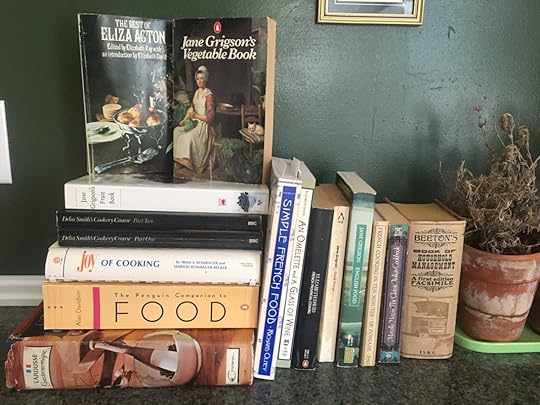
Proud to say that I passed the test! I scouted through my culinary books (too embarrassed to say how many), scattered throughout the house (I was delighted that Barnes also has them just about everywhere in his house), to find all the texts that Barnes reveres. From Mrs Beeton’s Book of Household Management (“our family kitchen Bible”) to his “favourite cookery text” Jane Grigson’s Vegetable Book. Here are his two culinary goddesses “I won’t hear a word against Jane Grigson, even from myself” and “I revere Elizabeth David”, and the third one, “one of the heroes of my kitchen, Edouard de Pomiane.”

Julian Barnes cookbook faves

My own Baker’s dozen of faves are listed here and, oh yes, The Pedant in the Kitchen is now firmly placed among them.

Only one disappointment - I was shocked not to see a ruler mentioned in his drawer of all kinds of gadgets, mandatory “equipment” in my kitchen to measure chopped/cut/sliced [fill in the blank] foodstuff, the very definition of… a pedant in the kitchen. :-)
Profile Image for Jaya.
486 reviews245 followers
March 5, 2017
I hoard recipes and cookbooks. I love to read anything and everything when it comes to food/cooking/eating etc and a decent cook albeit lazy (if I may say so for myself).
This book failed to tease any of the foodie instincts in me. I failed to connect with Barnes trials and tribulations in the kitchen. I am definitely pedantic bordering on psychotic when it comes to baking (iv discovered it to be an actual scientific process, no matter what people say) but a very casual and experimental cook otherwise.
I suppose I am a more confident cook than I thought myself to be.
Profile Image for Eylül Görmüş.
756 reviews4,687 followers
January 8, 2023
Julian Barnes'dan yemek tarifi almadık da demeyiz madem! Barnes'ın "Mutfaktaki Tarifbaz" kitabı nefis (bu sözcüğü daha doğru kullanamazdım herhalde). Elbette ki bu bir yemek tarifi kitabı değil, daha ziyade yemek tarifi kitaplarına dair bir kitap diyebiliriz. Kendisini bir "tarifbaz" olarak niteleyen Barnes, bu hafif ve neşeli kitabında yemek kültürüne ve özellikle evde yemek pişirme pratiklerine dair tatlı tatlı kafa yoruyor.

Bazı kısımlar müthiş komik, sesli kahkahalar eşliğinde okudum. Bir tarifi izleyerek yemek yaparken hepimizin yaşadığı soru ve sorunlarla (ne demek orta boy soğan? neye göre orta? bir avuç fıstık tam olarak kaç fıstık eder?) her zamanki muzip üslubuyla alay ediyor.

Elbette ki yazan Barnes olunca kitap sadece hafif ve neşeli olmuyor, yine derin entelektüel birikiminden faydalanarak harika tarihi anekdotlarla süslemiş metni. Sonuçta ortaya hakikaten leziz bir kitap çıkmış. (Bu kitaptan öğrendiğim bir tuhaflık: Kazuo Ishiguro'nun "Ulusal simgeyi yemek her zaman hoşuma gider" diyerek Avustralya'da kanguru eti yemesi... Yorumsuz aktarıyorum.)

Yazar, tarif takip ederken hissettiğimiz telaş ve endişe duygusuna odaklanıyor kitap boyunca ve şöyle de nefis bir tanım bırakıyor bize: "Yemek pişirmek gereksiz telaş aracılığıyla belirsizliğin (tarifin) kesinliğe (tabaktaki yemeğe) dönüştürülmesidir."

Bu arada Serdar Rifat Kırkoğlu dışında birinin çevirisiyle Barnes okumak ne zormuş ya. Maalesef oldukça kötü bir çeviri, daha da kötü bir redaksiyon söz konusu. Okuma ritmini bozan gereksiz dipnotlara emek harcamak yerine (risotto için, penne için, "marine etmek" için dipnot vardı yahu. Bu kitabı okumaya heves eden birisi herhalde risottonun ne olduğunu ve pennenin bir makarna cinsi olduğunu filan biliyordur!) keşke düşük cümleleri ve yazım hatalarını düzeltmeye zaman ayırsaymış çevirmen ve yayınevi. Belirtmeden edemeyeceğim.

Neyse, eğlenceli ve tatlı bir okumaydı yine de. Barnes ile biraz gülüştük diyebilirim, iyi geldi vallahi.
Profile Image for Teresa.
Author 9 books1,030 followers
December 23, 2019
For an appetizer (or should I say starter):

After a failed attempt to buy this book through an alibris.com seller, I found it through an abebooks.com seller at an incredibly low price, especially once I realized it was coming from the U.K. This is significant to me, firstly, because when I opened it to start reading it, after turning the end-page showing that "Mummy" had presented it with love to "Ben" on his engagement in 2010, I saw on the title page that it was signed by Barnes, thus adding even greater value to this minimal purchase! (I verified his signature via google images.) It was interesting to me, secondly, because Barnes himself writes of going to www.abebooks.com to find a copy of Cooking with Pomaine after reading about it in an Elizabeth David book.

Main course (sorry that the appetizer went on for so long and the main course will probably be too quick):

Despite not being familiar with most of the cookery (I'd say cookbook) writers; some of the cooking terms; and the names of a few root vegetables, I found this book hilarious.

For dessert (or should I say pudding):

While I am the opposite of a pedant in the kitchen (except for baking, which I don't do much of any longer), I am pedantic enough about other things (e.g.: being bothered by some proofreading misses in this slim volume) to be able to sympathize with Barnes's "issues." And as the saying goes: I'd read his grocery list.
Profile Image for Sanja.
76 reviews71 followers
September 15, 2017
Ne znam šta bih rekla osim da volim Barnsa do imbecilnosti, pa čak i kad piše o svojim omiljenim kuvarima, dinstanju šargarepe i, naravno, ljubavi prema svojoj ženi.

A, kao i sa seksom, politikom i religijom, stvari su isto stajale sa kuvanjem: kada sam konačno počeo da stičem lična saznanja o tome, bilo je prekasno da pitam roditelje.

Lekcija dva: odnos između profesionalnog i kućnog kuvara ima sličnosti sa polnim odnosom. Jedna strana je obično iskusnija od druge; a obe strane bi trebalo da imaju pravo da u bilo kom trenutku kažu: „Ne, to neću da radim.”

Jeo sam kengura na nekoj književnoj večeri u Australiji sa Kazuom Išiguroom, koji ga je naručio uz propratnu opasku: „Uvek volim da jedem državni grb.” („Šta li jede u Engleskoj?”, promrmljao je jedan pesnik koji je sedeo nedaleko od mene, „Lava?”)

Zamislite samo kako bi stvari izgledale kada biste zaista imali kuhinju iz svojih snova. Morali biste i da kuvate na podjednakom nivou. Zamislite dodatan pritisak koji bi vam se time nametnuo. A ako biste zabrljali s nekim jelom, ne biste mogli da imate odstupnicu svih onih pouzdanih starih izgovora.
Profile Image for Indrani Sen.
388 reviews64 followers
February 28, 2017
RECOMMEND VERY VERY HIGHLY.

In a long time a book has not spoken to me like this. Anyone who has cooked and been anxious about the end result will find full empathy here. The writer is tremendously funny, the British wit is in a gorgeous display, and superbly knowledgeable. A forever favorite and comfort read is discovered in this book. I will be re-reading this book a few more times. The book is treasure trove of anecdotes and quotable quotes.

Thank you Mr Barnes. I will try reading more books of yours, even though I hear the dreaded word "experimental" about them.
Profile Image for Netta.
185 reviews146 followers
November 20, 2017
Sheer joy – a hilarious piece of Barnes’s witty prose on how The Pedant and She For Whom He Cooks navigate their way through the endless sea of cookbooks and tricky recipes.
Profile Image for Girish.
1,156 reviews261 followers
October 19, 2018
Julian Barnes is not trying to be a masterchef, nor is he dismissive of cookbooks as a genre. Yes, he goes into a rant from time to time (that has you laughing), but don't we all? The Pedant in the Kitchen is one hilarious read!This is probably the only book in this genre and Barnes has got it spot on.

"Cooking is the transformation of uncertainty(the recipe) into certainty (the dish) via fuss" - And so Barnes launches into demystifying the fuss, through anecdotes and impeccable British Wit. Asks important questions on every cook's(who doesn't want to kill the guests) mind - critiquing the cookbooks for good measures. Doesn't hold back or generalize - declares love for Pomaine and ask you to chug Mr.B out the window!

Barnes also touches upon the social aspects of cooking for guests and mentions "She for whom the Pedant Cooks" several times. paints a picture of a helpless author who is taken to cooking cos he loves the uncertainty.

Warning: Don't read the book while drinking Hot coffee :)


Profile Image for Gorab.
843 reviews153 followers
February 27, 2017
Interesting and funny. Being a foodie, loved the initial discussions, and quite a few charming punches about cookbooks and recipes. However couldn't connect or relate to most of the stuff in the latter half.

My favorite quote :
"Perhaps, as well as cooking time and number of portions, recipes should also carry a Depression Probability rating."

What I enjoyed most was the sparking of discussions related to cooking among friends, getting to know the cooking preferences and related thoughts. Would like to try author's other works.
Profile Image for Azumi.
236 reviews179 followers
March 19, 2018
Me he sentido identificada con este libro, por aquello de que a mí en la cocina no me saques de platos sencillos, normales y de toda la vida, pero me gustan los libros de cocina y mirar recetas. Yo soy de aquellas personas que se alimentan con solo mirar las fotos de los platos a todo color y entonces me digo: vamos a probar a hacer esto y claro está muchas veces me sale un churro y nada que ver con la foto :D

Es un libro ameno, fácil de leer e ideal para oxigenarse de otras lecturas y se nota que Barnes está muy puesto en esto de la cocina.
Profile Image for TBV (on hiatus).
307 reviews70 followers
July 4, 2019
Ah Mr Barnes, I've said it before and I'll say it again... you definitely have a way with words! And could you by any chance also have a way with food, albeit a pedantic one?

You say: "Why should a word in a recipe be less important than a word in a novel? One can lead to physical indigestion, the other to mental.” Why indeed, and there is certainly no mental indigestion here. With erudition, a nifty turn of phrase and some quirky wit you turn this literary meal into a banquet of delights.

You even have me pegged: "Non-pedants frequently misunderstand pedants and are inclined to adopt an air of superiority. ‘Oh, I don’t follow recipes,’ they will say, as if cooking from a text were like making love with a sex-manual open at your elbow. Or: ‘I read recipes, but only to get ideas.’" Yes, that's right, I have a zillion cookbooks, but I don't use them. Any recipe attempted from any cookbook is sure to flop (could it be because I'm too impatient/lazy to measure/follow the rules?), so I guess and I invent. Should measuring be an absolute necessity, I call upon my husband who has a mathematical/chemistry bent. I haven't killed off any dinner guests yet...

There was much nodding and laughter whilst reading your book. Thank you for that pleasure!

###
P.S. Your tiroir des refusés seems to be a duplicate of my own!

Profile Image for Bart Moeyaert.
Author 107 books1,937 followers
April 5, 2018
In mijn donderdagse Throwback op mijn site had ik het vandaag al over principes, en hoe ze als het ware met secondenlijm aan je vastplakken. Het was leuk dat iemand via Instagram met een spreuk reageerde: ‘Principes zijn er om te eren en dan om ze af te leren. (Dank je wel, Barbara Deryckere.)

Het grappige is dat ik al een paar weken met het uitgelezen ‘The Pedant in the Kitchen’ van Julian Barnes in mijn hoofd zit. De man kun je niet betichten van schrijverij. Nee, integendeel, hij heeft mij met ‘Flaubert’s Parrot’ en ‘The Sense of an Ending’ verbaasd, en als ik een nieuwe titel van hem ontdek, dan gaat de lamp to read aan.

Toen ik nog niet zo lang geleden een weekendje in Londen was, en ik in Waterstones een mij onbekende paperback van Julian Barnes in handen kreeg, ging die lamp ook weer aan. Tot mijn verbazing bleken Barnes’ culinaire stukken voor The Guardian gebundeld. To read zei het lampje.

Ik hou van koken. Ik wil net als Barnes weten hoe een kookboekenschrijver de zaken aanpakt, en ik weet ondertussen — net als Barnes — dat recepten vaak niet duidelijk en zeker niet zaligmakend zijn. Waarmee ik bedoel dat ik erg genoten heb van The Pedant in the Kitchen.

Lees dit boek niet als je graag leest en nog nooit hebt gekookt. Stop een Dr. Oetker in de oven en lees iets anders. In alle andere gevallen: lees ook deze Barnes.
Profile Image for W.D. Clarke.
Author 3 books352 followers
June 29, 2022
A thoroughly enjoyable traipsing through be-aproned and somewhat stressed-out Julian Barnes's kitchen and cookbook collection and mind as he leafs through kitchen disasters and successes past and fillets his own quivering, ever-hopeful gastronomic soul. You probably kind of need to already know his other books to fully appreciate his self-skewering here as eternal culinary tyro-pedant, though (perhaps). I did get numerous superb cookery book purchase intentions from him, too...

3.5, rounded up, and raising a glass in appreciation that i have still more of this wonderful man's books to encounter.

Best phrase ever: "She For Whom the pedant cooks."

Most embarrassing moment: a randy admiral declares his love for SFH in the other room whilst the pedant ruins a second attempt at a chocolate sauce intended for some poor rabbit.

Most grateful for: no discussion whatsoever of Thomas Pynchon's General Pudding.
Profile Image for Amanda B.
655 reviews41 followers
August 25, 2019
3.5, rounded up to 4 🌟 because I laughed out loud more than once; must be my British sense of humour and collection of cookery books!
Profile Image for Ahtims.
1,673 reviews124 followers
March 18, 2017
Was a fantastic read.
I am not exactly a foodie or someone who's interested in cooking, though I love munching something while reading. Somehow, I love collecting recipes, and reading about food.
This book was suggested as a weekend group read by a friend and I eagerly joined in.
The writing as well as my interest in the book progressively improved, and there was never a boring moment.
Though I am not well versed with Western cooking, and am a vegetarian, I loved reading about the various food, recipes, preparation, the fallacies involved in cooking written precisely and acerbically.
I devoured the book in less than a couple of hours.
I would recommend this to all those who love reading about food and cooking.
Profile Image for Argos.
1,260 reviews492 followers
May 4, 2021
Ismarlama bir kitap değilse yazarın para kazanmak için yazdığı ticari bir kitap. Avrupa’da satılan çeşitli donmuş ürün, sos vb gıda maddeleri ile yemek kitaplarının reklamının yapıldığı bomboş (son harf Ş dir) bir kitap. Hem J. Barnes, hem çok severek gittiğim Çiya adına şansız bir kitap olmuş. Çeviri ve redaksiyon ise kitabın içeriğinden hallice. Yazık !!!
Profile Image for Patrycja.
24 reviews2 followers
May 18, 2017
Nie potrafię znaleźć żadnego powodu, dla którego ta książka powstała. Nie można jej odmówić tego, że jest przyjemna ale wciąż - dlaczego Julianie Barnesie?

Teksty Barnesa łączy to, że lubi gotować i z niewiadomych przyczyn wiąże to z - a nawet próbuje to tłumaczyć - swoim snobizmem. Nie mam nic przeciwko snobizmowi ale nie w takim wydaniu. Z tych krótkich notatek w ogóle nic nie wynika. Struktura każdego tekstu jest niejasna - w żadnym z nich Barnes nie prowadzi głównego wątku dlatego dygresje pojawiają się chaotycznie i nie zawsze mają swoje uzasadnienie. Historie kuchenne Barnesa miały wielki potencjał. Można było pociągnąć je w tyle fajnych kierunków! Rozwinąć szczątkowe refleksje pozakulinarne, które - też nie wiadomo dlaczego - pojawiają się i znikają. Barnes notorycznie wraca do rytuału czytania i korzystania z książek kucharskich, mniej i bardziej ulubionych - bardzo brakuje mi tutaj skupienia się wokół tych książek, zawiązania jakiejś (nie wiem jakiej, to nie ja jestem uznanym pisarzem!) głównej myśli, odesłania do lekkiego, zabawnego, ciekawego wniosku.

I - na Boga! - to takie irytujące kiedy on pisze o sobie "Pedant" i to jeszcze w trzeciej osobie! A swoją żonę nazywa "Ta, dla której". Nie winię tutaj tłumaczenia - akurat w tym przypadku.

A i wydanie pozostawia sobie wiele do życzenia. Dlaczego między tekstami pojawiają się grafiki, które wyglądają jak zrobione na szybko w pictocharcie? Nie wiemy co przyświecało tej zaskakującej decyzji. Barnes chce uchodzić za wielkiego estetę, którego absolutnym priorytetem jest odmierzenie dokładnej ilości suszonych porzeczek do fileta z łososia tak, żeby proporcje smaku, wyglądu potrawy i kanoniczna zgodność z przepisem zasadniczo osiągała platoński ideał. Polskie wydanie tej książki mu w tym nie pomaga.

Wracam do głównego pytania, które nurtuje mnie w związku z tą książką i pytam jeszcze raz - po co ona w ogóle jest? Problem nie do przeskoczenia jest taki, że ona wyszła w 2003 roku. Czternaście lat temu sposób mówienia o kuchni, mody kulinarne, funkcjonowanie gotowania w kulturze na różnych poziomach było zupełnie inne niż jest teraz. Więc po co jest ta książka?
Chyba tylko po to, żebym się wkurzała ;-)
Profile Image for Vanja Šušnjar Čanković.
372 reviews139 followers
January 5, 2018
A onda, zašto bi kuvar bio precizniji od priručnika za hirurgiju? (Pod večitom pretpostavkom, kojoj svi nervozno pribegavamo, da su hirurški priručnici zaista precizni. Možda neki od njih zvuče baš kao i kuvari: "Sunite koju kaplju anestetika u cevku, odrežite komadešku sa pacijenta, gledajte kako krv lagano curi, popijte pivo s drugarima, zašijte rez...")

Nikada ne kupujte knjigu o sokovima ako nemate sokovnik.

Otišao sam u ribarnicu u koju obično ulazim sa izvesnom zebnjom. Tu prodaju dobru robu, prihvataju vaš novac, ali često morate da istrpite ismevanje para tetoviranih komedijanata.
"Imate li plavu ribu?" upitao sam.
"Plavu ribu?" ponovio je prodavac kao da se ne radi o jednostavnoj rečenici vezanoj za ishranu. "Imamo belu ribu, ružičastu ribu, žutu ribu..." Dok je on razgledao tezgu u potrazi za novim nijansama sopstvene šaljivosti, ja sam se sav snuždio.
Kuvanje počinje kupovinom i premda sumnjam da ću se ikada upisati na kurs kuvanja, drage volje bih se prijavio za tečaj kupovanja.

Kada sam je pitao šta ima protiv morskog ježa, odgovorila je: "Ima ukus kao tople sline."

Jeo sam kengura na nekoj književnoj večeri u Australiji sa Kazuom Išiguroom, koji ga je naručio uz propratnu opasku: „Uvek volim da jedem državni grb.” („Šta li jede u Engleskoj?”, promrmljao je jedan pesnik koji je sedeo nedaleko od mene, „Lava?”)

Pomijan smatra da postoje tri vrste gostiju koje mogu da izvedu invaziju na vaš dom:
(1) Oni koje volite.
(2) Oni s kojima imate obavezu da se družite.
(3) Oni koje prezirete.
Za prilike gradirane na ovaj način, "treba pripremiti, prateći gornji redosled, izvrsnu večeru, banalni obed ili baš ništa, jer ćete u poslednjem slučaju kupiti neko gotovo, već pripremljeno jelo". Ovo je korisna distinkcija. Verovatno zvuči cicijaški i moralistički unapred određivati koliko volite vaše goste; ali, da li vas išta može više baciti u očaj od kuvanja za gnjavatore koje ne poštujete?

A ako ikad padnete u iskušenje da poverujete u automatsku povezanost između belančevina i agresivnosti, ne zaboravite da je Hitler bio vegetarijanac.
Profile Image for jrendocrine at least reading is good.
707 reviews54 followers
November 29, 2020
this is a series of columns that Barnes wrote for the Guardian Review - each piece accompanied by a really beautiful illustration (that get little love - had to look at the back flap to see that these were done by Joe Berger?)

It's getting 4 stars from me because it made me chuckle many times, and because it is so very English in tone. Because there are so many quips, and references to great English cookbooks that I've never heard of - so it's just like rumbling around someones English house amazed at all the STUFF that's there (or in that kitchen drawer that is the subject of one of the essays).

Nothing deep, but great writing, with words that just amuse (recherche anyone?) and fun. And, off to serve dinner to people I love which happens, alas, infrequently in 2020's pandemic times, makes me grateful that making food is, really, a good and reasonable thing.
Profile Image for Madhulika Liddle.
Author 22 books545 followers
March 15, 2021
The eponymous Pedant in the Kitchen is Julian Barnes, and in this collection of short essays (which were a column Barnes wrote originally for The Guardian) he writes of all the trials and pitfalls and woes of being a not-too-confident home cook. How a vague recipe instruction like ‘add a slug of this’ or ‘chop two medium that’ can throw a huge spanner in the works. How misleading food photographs in cookbooks can be. Why a tabletop mincer of moulded plastic may not be the best thing to hang on to for years. What sort of meal to cook for what sort of guest. And more.

I loved this book. It was hilarious, it was fun, and it was so relatable. I could empathize with much that the hapless Pedant (who isn’t, I think, really a pedant, after all; just a not-very-ept home cook who would like to do justice to his cooking) talks about. Barnes is deliciously funny in a very British way, and besides being funny, he’s also informative. He talks about some very interesting old recipe books (and writers of these, Mrs Beeton of course and others) and of interesting food. There were dishes I wanted to try out, and episodes that made me burst out laughing.

I had only one complaint. This was far too short. I’d happily have read the same length more.
Profile Image for Camèlia Rodríguez Balagué.
114 reviews20 followers
October 3, 2022
Amb les ganes que tinc de que arribi el fred i llegir i cuinar fotuda a casa lo millor que m'ha passat ha sigut aquest llibre sobre llibres de cuina. Té pinta de que m'estic fent gran però ara només vull grans volums de cuina casolana i una olla maca per enterrar estofats i el cap.
Displaying 1 - 30 of 308 reviews

Can't find what you're looking for?

Get help and learn more about the design.