

What do you think?

The Road to Mecca
A South African pastor and a young teacher from Cape Town battle over the fate of an eccentric elderly widow.The play won the 1988 New York Drama Critics Circle Award for Best Foreign Play.
89 pages, Kindle Edition
First published January 1, 1985
About the author
Athol Fugard
72 books142 followersAthol Fugard was a South African playwright, novelist, actor, and director widely regarded as South Africa's greatest playwright. Acclaimed in 1985 as "the greatest active playwright in the English-speaking world" by Time, he published more than thirty plays. He was best known for his political and penetrating plays opposing the system of apartheid, some of which have been adapted to film. His novel Tsotsi was adapted as a film of the same name, which won an Academy Award in 2005. It was directed by Gavin Hood.
Fugard also served as an adjunct professor of playwriting, acting and directing in the Department of Theatre and Dance at the University of California, San Diego.
Fugard received many awards, honours, and honorary degrees, including the Order of Ikhamanga in Silver from the government of South Africa in 2005 "for his excellent contribution and achievements in the theatre". He was also an Honorary Fellow of the Royal Society of Literature. Fugard was honoured in Cape Town with the opening in 2010 of the Fugard Theatre in District Six. He received a Tony Award for lifetime achievement in 2011.
Fugard also served as an adjunct professor of playwriting, acting and directing in the Department of Theatre and Dance at the University of California, San Diego.
Fugard received many awards, honours, and honorary degrees, including the Order of Ikhamanga in Silver from the government of South Africa in 2005 "for his excellent contribution and achievements in the theatre". He was also an Honorary Fellow of the Royal Society of Literature. Fugard was honoured in Cape Town with the opening in 2010 of the Fugard Theatre in District Six. He received a Tony Award for lifetime achievement in 2011.
Ratings & Reviews
Friends & Following
Create a free account to discover what your friends think of this book!
Community Reviews
Displaying 1 - 30 of 70 reviews

April 22, 2012
Helen, whose husband’s death has caused her to stave off various bouts of depression and battles with, to use her word, “darkness,” has recently re-discovered her gift for sculpture. Her back yard – which Helen calls her Mecca - is full of bright, colorful, life-sized figures of biblical wise men, birds, and anything else her imagination encourages her to make. One of Helen’s only remaining friends, Elsa, pays her a surprise visit from Cape Town. During their discussion, Helen mentions that the dominee at her local Church, Byleveld, has taken it upon himself to suggest to her that she should consider moving into a convalescent home. Byleveld claims to express concern for the Church, but also for others in New Bethesda who think that Helen has become a mad eccentric, tottering on senility. Even though Helen is unable to do some things for herself, she has a local woman come to her house a few times a week, and seems very capable of living alone. Elsa vehemently urges Helen to resist Byleveld’s “help,” and refuse his offer. He’s even gone so far as to fill out the paperwork for the home; all he needs is her signature.
The play consists of only three characters, but the balance, dynamism, and tension between them is beautiful and subtle. While Byleveld could easily come off as patriarchal and overbearing, Fugard leaves plenty of room for the reader to believe that he’s really doing what he thinks is in Helen’s best interests, even though we are not to mistake his interruption as anything other than heavy-handedness. He’s not the easy-to-hate bigot that would have been caricatural. In a number of ways, Elsa is more of a caricature, with her youthful idealism and cosmopolitan, rigorous rejection of Afrikaner tradition.
As all great drama does, this resonates on a number of levels. It’s a comment on aging and how sometimes we see aging as a necessary loss of personal volition and independence. The disagreements between Byleveld and Elsa embody many of the dualisms that South Africans were dealing with thirty years ago, and to some extent continue to deal with: the rural versus the urban, the religious versus the secular, and a conscious effort to crush artistic openness and personal freedom versus a volitional effort to let that openness, or eccentricity as Byleveld calls it, flourish and prosper.
It might strike some as interesting that, for a play written in apartheid South Africa, I haven’t mentioned race. It’s not a major theme, but its presence is as insidious as Byleveld’s. Elsa is worried about her privilege, especially how it might impinge upon the lives of others, in compelling and sincere ways. On the way to visit Helen, Elsa gave a ride to a young black woman with a child, and she is haunted by what might have happened to her after they parted. By the end of the play, Elsa and Helen have rebuilt the trust that was compromised by Helen being ambivalent about standing up to Byleveld.
Athol Fugard is South Africa’s most well-known playwright, perhaps best known for “Master Harold … and the Boys.” I’d never read anything by him when I found “The Road to Mecca” last weekend at a library book sale for fifty cents. And after reading this, I’m even more eager to read more by him than I was before.
Incidentally, Helen's character is based on the historical Helen Martins whose story is similar. Her former home, "The Owl House," is now a museum. Here are some photographs of it:
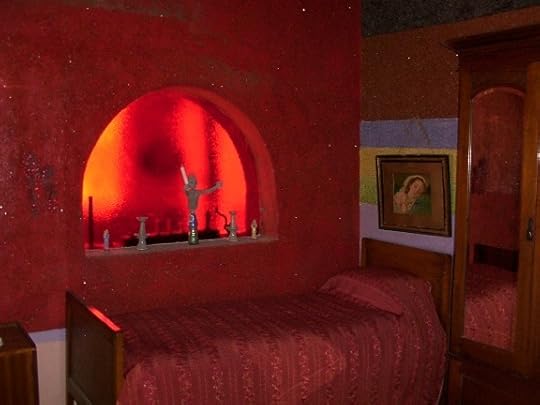
One of the interior rooms with crushed glass on the walls

Sculptures in the garden, most of which are facing East (toward Mecca)
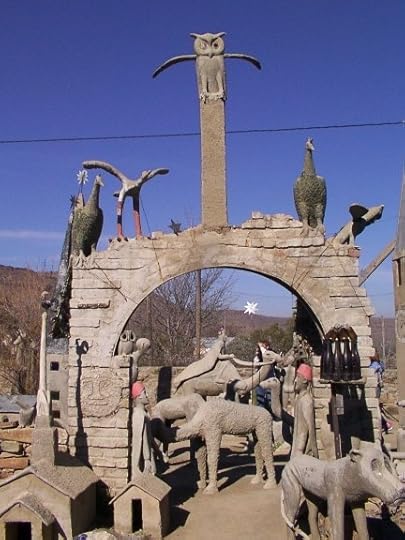
A large arch with an owl at the peak

A close-up of one of the sculptures
The play consists of only three characters, but the balance, dynamism, and tension between them is beautiful and subtle. While Byleveld could easily come off as patriarchal and overbearing, Fugard leaves plenty of room for the reader to believe that he’s really doing what he thinks is in Helen’s best interests, even though we are not to mistake his interruption as anything other than heavy-handedness. He’s not the easy-to-hate bigot that would have been caricatural. In a number of ways, Elsa is more of a caricature, with her youthful idealism and cosmopolitan, rigorous rejection of Afrikaner tradition.
As all great drama does, this resonates on a number of levels. It’s a comment on aging and how sometimes we see aging as a necessary loss of personal volition and independence. The disagreements between Byleveld and Elsa embody many of the dualisms that South Africans were dealing with thirty years ago, and to some extent continue to deal with: the rural versus the urban, the religious versus the secular, and a conscious effort to crush artistic openness and personal freedom versus a volitional effort to let that openness, or eccentricity as Byleveld calls it, flourish and prosper.
It might strike some as interesting that, for a play written in apartheid South Africa, I haven’t mentioned race. It’s not a major theme, but its presence is as insidious as Byleveld’s. Elsa is worried about her privilege, especially how it might impinge upon the lives of others, in compelling and sincere ways. On the way to visit Helen, Elsa gave a ride to a young black woman with a child, and she is haunted by what might have happened to her after they parted. By the end of the play, Elsa and Helen have rebuilt the trust that was compromised by Helen being ambivalent about standing up to Byleveld.
Athol Fugard is South Africa’s most well-known playwright, perhaps best known for “Master Harold … and the Boys.” I’d never read anything by him when I found “The Road to Mecca” last weekend at a library book sale for fifty cents. And after reading this, I’m even more eager to read more by him than I was before.
Incidentally, Helen's character is based on the historical Helen Martins whose story is similar. Her former home, "The Owl House," is now a museum. Here are some photographs of it:
One of the interior rooms with crushed glass on the walls
Sculptures in the garden, most of which are facing East (toward Mecca)
A large arch with an owl at the peak
A close-up of one of the sculptures
February 14, 2016
Powerful, moving play about (amongst other things) creativity, freedom and the courage to live according to your own vision. As well as the price that an individual all too often pays for daring to be different. Beautiful.
March 14, 2016
This is not a novel, it is a play script that involves 3 characters. Although the main character of the play was inspired by the real artist Helen Martins, the other two characters are fictional.
The main character is Miss Helen, an elderly widow, who lives in a tiny village called New Bethesda in the Karoo, South Africa. She is viewed by the local community as a crazy recluse, and spends her days creating sculptures and artwork that decorates her garden and house.
Elsa is a young woman from Cape Town, and is Miss Helen's friend. She is the only person Miss Helen truly trusts. The third character is Dominee Marius Byleveld, who is the pastor of a local church and is determined to get Miss Helen moved to a home for the aged.
There is a strong theme of religion and conflict in the play. The village is a very conservative Christian community that takes offense with Miss Helen's art. They view the statues of owls, mermaids, and pilgrims on camels (all facing east) as idolatry, because they can't reconcile it with their strict Christian beliefs. Unlike the community, Elsa supports Helen's creativity because she views it as Helen's vision for her life and her desire for light and beauty. In the play Miss Helen admits that she started the art to bring light into her darkness. Helen refers to it as her Mecca, because it's a symbol of spiritual fulfillment and freedom.
There is also an underlying theme of racism, although it's not overt it is mentioned a few times. This is of course because the play was written at a time (1980's) in which Apartheid and racial discrimination was a very serious issue.
It was a thought-provoking, good read, although it was written as a play and as such, I think I probably would have enjoyed it more if I was watching a performance instead of just reading it.
The main character is Miss Helen, an elderly widow, who lives in a tiny village called New Bethesda in the Karoo, South Africa. She is viewed by the local community as a crazy recluse, and spends her days creating sculptures and artwork that decorates her garden and house.
Elsa is a young woman from Cape Town, and is Miss Helen's friend. She is the only person Miss Helen truly trusts. The third character is Dominee Marius Byleveld, who is the pastor of a local church and is determined to get Miss Helen moved to a home for the aged.
There is a strong theme of religion and conflict in the play. The village is a very conservative Christian community that takes offense with Miss Helen's art. They view the statues of owls, mermaids, and pilgrims on camels (all facing east) as idolatry, because they can't reconcile it with their strict Christian beliefs. Unlike the community, Elsa supports Helen's creativity because she views it as Helen's vision for her life and her desire for light and beauty. In the play Miss Helen admits that she started the art to bring light into her darkness. Helen refers to it as her Mecca, because it's a symbol of spiritual fulfillment and freedom.
There is also an underlying theme of racism, although it's not overt it is mentioned a few times. This is of course because the play was written at a time (1980's) in which Apartheid and racial discrimination was a very serious issue.
It was a thought-provoking, good read, although it was written as a play and as such, I think I probably would have enjoyed it more if I was watching a performance instead of just reading it.

June 4, 2018
Friendship is expressed beautifully in this short play through a widowed artist coping with Darkness and her young teacher friend who happens to teach her a few lessons in courageously being herself. This is not at all what I expected when I started reading it, and I was pleasantly surprised to see how it ended ... and how I could envisage my own ending to the story. I discovered layers to Marius, whom I thought would be a one-dimensional character. Powerful and yet so simple.
July 28, 2014
Couldnt put the book down. The story is engrossing and so poetic. Athol Furgard is a literal genius forever and day!

May 2, 2025
A play on aging and also freedom: care and independence, tradition and creativity, patience and equity. The characters and their relationships are well drawn.

September 7, 2026
Read 2018: 3 stars

September 29, 2020
4.5 stars.
What a wonderful play. After reading his novel, Tsotsi, I thought I'd give his plays a try. I definitely wasn't disappointed. There's more compassion and feeling in this 1 and a half hour play than his entire novel. The eccentric older woman and her young teacher friend have a wonderfully complex relationship. When they are with each other they behave like children, but both have been dealing with personal crises which come to a head when the local vicar comes to assert his own agenda.
I can see why Fugard is known as the most prominent South African playwright - and will be reading his My Children! My Africa! next, as Master Harold is still in the post.
What a wonderful play. After reading his novel, Tsotsi, I thought I'd give his plays a try. I definitely wasn't disappointed. There's more compassion and feeling in this 1 and a half hour play than his entire novel. The eccentric older woman and her young teacher friend have a wonderfully complex relationship. When they are with each other they behave like children, but both have been dealing with personal crises which come to a head when the local vicar comes to assert his own agenda.
I can see why Fugard is known as the most prominent South African playwright - and will be reading his My Children! My Africa! next, as Master Harold is still in the post.

February 9, 2026
I'm not a frequent play reader, but this was referred to me by a friend, and I related to so many of the things it was grappling with: not feeling capable of seizing control over your own agency, and feeling torn in multiple directions by the most influential people in your life as a result ; creation as an act of resistance when you exist outside of the norm, and your self-expression threatens the comfort of others ; the fear of losing divine inspiration in an aging body and worrying that you will never feel the fulfillment of creative passion again.
the motif of a permeating darkness that creeps over your home and then insidiously gets inside of you especially struck a tender cord with me. this gave me so much to mull over, and in the end, I am left thinking so much about the woman who this work was inspired by, and wondering what she would think of it.
the motif of a permeating darkness that creeps over your home and then insidiously gets inside of you especially struck a tender cord with me. this gave me so much to mull over, and in the end, I am left thinking so much about the woman who this work was inspired by, and wondering what she would think of it.

October 29, 2022
I've been to The Owl House in Nieu Bethesda twice and each time left in awe of the person who conceived the artworks in that small rural town. The play recognise that there is a price to pay and how different people love different aspects of another human.
https://theowlhouse.co.za/helen-martins/
https://theowlhouse.co.za/helen-martins/

December 14, 2021
Went to see this play from a local community theater (did not read). It was absolutely stunning and many moments were very emotional and moving.

May 18, 2016
I mistook this for another book called The Road to Mecca, but since it was a play, I read it anyway. The story takes place in Nieu Bethesda, South Africa, and is about the final days of a South African folk artist named Helen Martins as she welcomes a friend from Cape Town, and they, along with the village pastor, discuss the possibility of her moving to a nursing home. The play has been performed on Broadway, I think, at a time when America was just becoming conscious of the issue of Apartheid. While the play is good, it was a bit boring and dated to me. I did, however, enjoy learning about Ms. Martins art, and did more research on her work. After her husband died, the people in her village claimed she went a bit crazy with her work, becoming more and more reclusive over time. She took her own life at an old age, but stipulated in her will that her house, which had become her masterpiece, her "Mecca," be designated as a museum. It was, and you can still visit it today. I believe she takes her place in the canon of "folk artists" of the 20th Century, along with Grandma Moses and Howard Fenster. The sculptures she created are graceful and lovely. It would be worth the trip to South Africa to see Owl House, especially if you like modern sculpture.

February 17, 2018
It must be noted that I do not actually enjoy reading playscripts; I would rather watch a performance in a theatre, or read a novel. Having said that, Fugard had me thoroughly invested in his story. His depiction of the three characters is subtle and beautiful. He manages to keep his characters, who could all easily fall into bland single tone representatives, interesting as he slowly reveals their past and their understandings of the world around them. Elsa is not just a bleeding heart, Helen not just an eccentric old woman, nor is Marius just a bigoted church pastor.
Fugard clearly and beautifully creates imagery in the words spoken by his characters, the karoo becomes its own character within the story and the imagery of Helen's Mecca celebrates her creations. Fugard touches upon race, gender and age issues. He uses his work to comment on religious intolerance and depression. His play is much more than a story about two women and a pastor. It is a story that asks us to look at ourselves and our role in the social environment we find ourselves in.
Needed for a University Module; bought at Bargain Books (Shelly Beach; KwaZulu Natal).
Fugard clearly and beautifully creates imagery in the words spoken by his characters, the karoo becomes its own character within the story and the imagery of Helen's Mecca celebrates her creations. Fugard touches upon race, gender and age issues. He uses his work to comment on religious intolerance and depression. His play is much more than a story about two women and a pastor. It is a story that asks us to look at ourselves and our role in the social environment we find ourselves in.
Needed for a University Module; bought at Bargain Books (Shelly Beach; KwaZulu Natal).

February 4, 2015
Another powerful play by Athol Fugard; two acts, three characters. This is about two women, a seventy year old widow from a small town and her young schoolteacher friend from Port Elizabeth. The third character is the widow's minister. The play deals with many different issues, more about personal choices and personal freedom than politics this time (except in the sense that everything is political.) I can't summarize it without spoilers. Despite the title, it is not about Moslems or even religion (very much)

September 7, 2010
A touching statement on the roles which faith and creativity play in the endurance of the human spirit. This was the second Fugard play that I read, and was once again astounded by his command of character and realistic dialogue. Through his telling of Helen's story (the seemingly 'crazy' yet wildly imaginative old woman at the center of the story)we are shown a remarkably important moment in the lives of several people.

December 23, 2012
This is a beautiful play. It was reccommended to me by Kat.
a friend of hers in Madison is doing the play there.
Basically, the story of one woman's search for enlightenment (Mecca) through her art. It's based on a true story. Helen did exist. She lived in South Africa and the playwright who bought a home in the town she lived in became fascinated with her story.
It's also a movie which Kathy Bates did in 1992. If I can find it I'm going to buy it.
a friend of hers in Madison is doing the play there.
Basically, the story of one woman's search for enlightenment (Mecca) through her art. It's based on a true story. Helen did exist. She lived in South Africa and the playwright who bought a home in the town she lived in became fascinated with her story.
It's also a movie which Kathy Bates did in 1992. If I can find it I'm going to buy it.

October 12, 2017
There is an ominous air to this story that drew me in and has stayed with me since I read it. Time gives an interesting perspective on the events in this play, one of hurry, uncertainty, worry and fear, but it also adds a powerful nature to the story and the reconciliation that happens at the end seems to have an air of healing. I really enjoyed reading good South African literature, it felt familiar and resonated inside my soul

November 5, 2012
Very short but moving play set in 1970s South Africa and centered around the struggles of one woman - Miss Helen - as she's pulled in two differing directions by the two closest people to her. It's man vs. woman, young vs. old, religious vs. secular with a world vision beyond her small town. I saw the play and cried - very moving.

May 30, 2014
A play that is mostly just two women that isn't about rape or men or stereotypical 2 women play things! My heart is rejoicing. This play is beautiful and touching and infuriating and boy was I invested! It has some really meaty roles to dig into. Women: 28 yr old character with amazing monologue prospects in here. Seriously! I think I might add this to the plays I want to direct list...

January 27, 2015
This was a very interesting play. I liked the fact that Miss Helen existed in real life. It gives the play a more believable and enjoyable feel to it.
Favourite Quotes:
"He came up with a postures of despair that would have made Michelangelo jealous." p. 30
"A true friendship should be able to accommodate a difference of opinion."p. 52
Favourite Quotes:
"He came up with a postures of despair that would have made Michelangelo jealous." p. 30
"A true friendship should be able to accommodate a difference of opinion."p. 52

October 11, 2021
I read many of Fugard's plays back in the eighties but not this one. When I finally found it, I lamented not having found it sooner. When I finished reading it, I thought, it came at just the right time. To all the Elsas and Helens and Mariuses out there, I hope you find it at the right time for you.

March 29, 2007
Ah, the unfortunately named Athol.

July 8, 2007
This is good. Read it. It is too long to explain so go to Amazon and read the summary and reviews.

November 22, 2008
This is a play. It was a different type of thing for me to read.l
April 1, 2009
I enjoyed this much more than i anticipated. I'm glad I chose to read it through once first before I have to dissect it for class. :)
August 10, 2011
enjoyed the journey to Nieu Bethesda with learners from Camps Bay in the wake of the teaching of this play.

June 3, 2012
A very interesting play. It starts off kind of slow, put picks up enough steam a couple of pages in that it becomes very good. I recomend it.
Read
July 21, 2012Favorite Play of all Time.

September 7, 2012
There aren't enough stars in the world for this.

May 14, 2014
This play quickly brings together some large themes- racial inequality, religious beliefs, female relationships - in a South African historical setting. It's a quick read but did not inspire me.
Displaying 1 - 30 of 70 reviews