

What do you think?
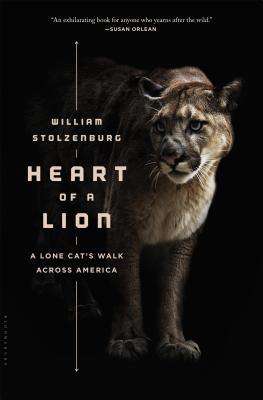
Heart of a Lion: A Lone Cat’s Walk Across America
Late one June night in 2011, a large animal collided with an SUV cruising down a Connecticut parkway. The creature appeared as something out of New England's forgotten past. Beside the road lay a 140-pound mountain lion.
Speculations ran wild, the wildest of which figured him a ghostly survivor from a bygone century when lions last roamed the eastern United States. But a more fantastic scenario of facts soon unfolded. The lion was three years old, with a DNA trail embarking from the Black Hills of South Dakota on a cross-country odyssey eventually passing within thirty miles of New York City. It was the farthest landbound trek ever recorded for a wild animal in America, by a barely weaned teenager venturing solo through hostile terrain.
William Stolzenburg retraces his two-year journey--from his embattled birthplace in the Black Hills, across the Great Plains and the Mississippi River, through Midwest metropolises and remote northern forests, to his tragic finale upon Connecticut's Gold Coast. Along the way, the lion traverses lands with people gunning for his kind, as well as those championing his cause.
Heart of a Lion is a story of one heroic creature pitting instinct against towering odds, coming home to a society deeply divided over his return. It is a testament to the resilience of nature, and a test of humanity's willingness to live again beside the ultimate symbol of wildness.
Speculations ran wild, the wildest of which figured him a ghostly survivor from a bygone century when lions last roamed the eastern United States. But a more fantastic scenario of facts soon unfolded. The lion was three years old, with a DNA trail embarking from the Black Hills of South Dakota on a cross-country odyssey eventually passing within thirty miles of New York City. It was the farthest landbound trek ever recorded for a wild animal in America, by a barely weaned teenager venturing solo through hostile terrain.
William Stolzenburg retraces his two-year journey--from his embattled birthplace in the Black Hills, across the Great Plains and the Mississippi River, through Midwest metropolises and remote northern forests, to his tragic finale upon Connecticut's Gold Coast. Along the way, the lion traverses lands with people gunning for his kind, as well as those championing his cause.
Heart of a Lion is a story of one heroic creature pitting instinct against towering odds, coming home to a society deeply divided over his return. It is a testament to the resilience of nature, and a test of humanity's willingness to live again beside the ultimate symbol of wildness.
256 pages, Hardcover
First published April 12, 2016
Ratings & Reviews
Friends & Following
Create a free account to discover what your friends think of this book!
Community Reviews
Displaying 1 - 30 of 93 reviews

December 11, 2019
There are significant insights in this book, if your mind is open enough to recognize them.
This is superbly written, journalistic style non-fiction, rendering a mountain lion's journey from the Black Hills of South Dakota to the Connecticut coast, but that's only the glue that holds this exceptional work together. Avoiding sensationalistic and preachy writing, this book is an engrossing, fully researched, well-balanced presentation of facts, complemented with juxtaposition of perspectives relative to predators. In other words, beyond immersive reading, this book has the potential to broaden understanding.
Oh, he details the ill-fated adventures of big cats and other predators, and addresses the reasons why they undertake such journeys, but additionally he shows rare insight into the minds of their adversaries such as:
"From the first teetering steps to the inimitable cocky stride in humanity’s six-million-year journey— from tree-dwelling, knuckle-walking offshoot of an African ape, to bipedal globe-trotting pedestrian of the world— had come uncounted sidetracks and detours through the bellies of big cats. Being hunted was a fact of early life that forever shaped the growing brains and bodies of the people who would come to be."
And their supporters such as:
"Whether eastward from the Rockies or northward from the Florida swamps, the exiled eastern cougar would need help coming home. The rewilders’ pleas for civility and compassion obviously weren’t cutting it. But their cause had lately embraced yet a more ecological rationale for why the East so needed its big cat back.
The murmur had been gathering from field sites and conference halls, formally surfacing in academic journals and publicized in mainstream media. Researchers from around the world were returning with disquieting reports of forests dying, coral reefs collapsing, pests and plagues irrupting. Beyond the bulldozers and the polluters and the usual cast of suspects, a more insidious factor had entered the equation. It was becoming ever more apparent that the extermination of the earth’s apex predators— the lions and wolves of the land, the great sharks and big fish of the sea, all so vehemently swept aside in humanity’s global swarming— had triggered a cascade of ecological consequences. Where the predators no longer hunted, their prey had run amok, amassing at freakish densities, crowding out competing species, denuding landscapes and seascapes as they went."
This together with chronicled transitions in thinking by involved individuals, exemplifies the potential of critical thinking. One example being Aldo Leopold's journey from advocating well managed stark forestlands, to recognizing the vibrancy and greater productivity of forestlands with a naturally occurring full complement of biodiversity.
This isn't a book a thoughtful person will soon forget. With the breadth of reasoning it encompasses, the reader will find themselves wondering how human potential will play out in a setting of self-destructive proclivities.
In our haste to overcome Nature have we gone too far, or is this simply evolving ecology? The author makes a fair case for both, leaving the reader to exercise critical thinking.
“The skill of writing is to create a context in which other people can think.” ~ Edwin Schlossberg
This is superbly written, journalistic style non-fiction, rendering a mountain lion's journey from the Black Hills of South Dakota to the Connecticut coast, but that's only the glue that holds this exceptional work together. Avoiding sensationalistic and preachy writing, this book is an engrossing, fully researched, well-balanced presentation of facts, complemented with juxtaposition of perspectives relative to predators. In other words, beyond immersive reading, this book has the potential to broaden understanding.
Oh, he details the ill-fated adventures of big cats and other predators, and addresses the reasons why they undertake such journeys, but additionally he shows rare insight into the minds of their adversaries such as:
"From the first teetering steps to the inimitable cocky stride in humanity’s six-million-year journey— from tree-dwelling, knuckle-walking offshoot of an African ape, to bipedal globe-trotting pedestrian of the world— had come uncounted sidetracks and detours through the bellies of big cats. Being hunted was a fact of early life that forever shaped the growing brains and bodies of the people who would come to be."
And their supporters such as:
"Whether eastward from the Rockies or northward from the Florida swamps, the exiled eastern cougar would need help coming home. The rewilders’ pleas for civility and compassion obviously weren’t cutting it. But their cause had lately embraced yet a more ecological rationale for why the East so needed its big cat back.
The murmur had been gathering from field sites and conference halls, formally surfacing in academic journals and publicized in mainstream media. Researchers from around the world were returning with disquieting reports of forests dying, coral reefs collapsing, pests and plagues irrupting. Beyond the bulldozers and the polluters and the usual cast of suspects, a more insidious factor had entered the equation. It was becoming ever more apparent that the extermination of the earth’s apex predators— the lions and wolves of the land, the great sharks and big fish of the sea, all so vehemently swept aside in humanity’s global swarming— had triggered a cascade of ecological consequences. Where the predators no longer hunted, their prey had run amok, amassing at freakish densities, crowding out competing species, denuding landscapes and seascapes as they went."
This together with chronicled transitions in thinking by involved individuals, exemplifies the potential of critical thinking. One example being Aldo Leopold's journey from advocating well managed stark forestlands, to recognizing the vibrancy and greater productivity of forestlands with a naturally occurring full complement of biodiversity.
This isn't a book a thoughtful person will soon forget. With the breadth of reasoning it encompasses, the reader will find themselves wondering how human potential will play out in a setting of self-destructive proclivities.
In our haste to overcome Nature have we gone too far, or is this simply evolving ecology? The author makes a fair case for both, leaving the reader to exercise critical thinking.
“The skill of writing is to create a context in which other people can think.” ~ Edwin Schlossberg

November 1, 2016
In late 2009, one mountain lion, born in the remote regions of the Black Hills of South Dakota, reaches the independent age of 2-3 years old, and sets out to find a mate. This book tells his story - the longest documented trek (2000+ miles!) of any land mammal in North America - tracing him through the deep woods and lakes of Minnesota, Wisconsin, Michigan, tiptoeing into western Ontario, and then down through the islands and seaways of the St. Lawrence, eventually drawing to a close in 2011 on the Merritt Parkway north of New York City, in the Connecticut suburbs.
(See: Claims of Mountain Lion Roaming in Connecticut Draws Groans... Until Saturday , NYT, June 12, 2011)
This cat's travel was tracked with DNA samples, remains from his hunts (bones of prey, blood and saliva samples, etc.), photographs from tripped wildlife cameras, tracks, confirmed sightings, and finally with the autopsy of the animal after its death in Connecticut (hit by a car near Milford, CT). His journey was so remarkable because it was a reclamation of lands where his ancestors had once roamed for millennia, one of the 'New World' apex predators, along with the bear and the wolf, who were systematically hunted and starved off the lands, pushing this animal that once was present in all the lower 48 to the western deserts, mountains, and steppes. (With the notable exception of the "Florida panthers" that still live in small numbers in the deep south of Florida in the swamps and forested waterways).
Stolzenburg tells this cat's (and a few others that also roamed like him, albeit not as far!) story, as well as tracing the history of ecology, and wildlife conservation. The dramatic shift away from "wiping out all the predators" to the understanding of the integral role that the mountain lion, and other macropredators play in this fine natural balance was also a part of Stolzenburg's other book Where the Wild Things Were: Life, Death, and Ecological Wreckage in a Land of Vanishing Predators, which I read years ago and have cited many times (read it!) I liked the in-depth look at mountain lions here, this amazing and misunderstood beast.
Recommended for anyone into wildlife and nature/ecology, as well as good storytelling.
ETA: Since I read this book earlier in the month, I have recommended it to about 10 people.
(See: Claims of Mountain Lion Roaming in Connecticut Draws Groans... Until Saturday , NYT, June 12, 2011)
This cat's travel was tracked with DNA samples, remains from his hunts (bones of prey, blood and saliva samples, etc.), photographs from tripped wildlife cameras, tracks, confirmed sightings, and finally with the autopsy of the animal after its death in Connecticut (hit by a car near Milford, CT). His journey was so remarkable because it was a reclamation of lands where his ancestors had once roamed for millennia, one of the 'New World' apex predators, along with the bear and the wolf, who were systematically hunted and starved off the lands, pushing this animal that once was present in all the lower 48 to the western deserts, mountains, and steppes. (With the notable exception of the "Florida panthers" that still live in small numbers in the deep south of Florida in the swamps and forested waterways).
Stolzenburg tells this cat's (and a few others that also roamed like him, albeit not as far!) story, as well as tracing the history of ecology, and wildlife conservation. The dramatic shift away from "wiping out all the predators" to the understanding of the integral role that the mountain lion, and other macropredators play in this fine natural balance was also a part of Stolzenburg's other book Where the Wild Things Were: Life, Death, and Ecological Wreckage in a Land of Vanishing Predators, which I read years ago and have cited many times (read it!) I liked the in-depth look at mountain lions here, this amazing and misunderstood beast.
Recommended for anyone into wildlife and nature/ecology, as well as good storytelling.
ETA: Since I read this book earlier in the month, I have recommended it to about 10 people.

August 9, 2016
This is a gorgeously written, factually tracked account of a male mountain lion's journey from the Black Hills to the coast of Connecticut - based in accurate science, with parallel accounts of other cats' journeys in their attempts to disperse and re-colonize their former range. It traces human attitudes towards big cats, both back in American history, and beyond, and clearly illuminates the insane degree of fear mongering that so often, still does, influence our perception and shapes our wildlife policies regarding re-wilding apex predatators.
I was impressed by the accuracy of the science, given I have followed this species' plight as a long time resident of Florida. The fact that the state of California has banned the hunting of these magnificent animals, and uses tranquillizers and not bullets, to remove them from populated areas - and the existence of the cougar living in Griffith Park in LA, this book is a clear call for the redefinition of policy concerning our only native big cat.
The story is beautifully told, clearly written, and cited with proper scholarship. An incredible journey and a call for more enlightened and compassionate policy. Highly recommended!
I was impressed by the accuracy of the science, given I have followed this species' plight as a long time resident of Florida. The fact that the state of California has banned the hunting of these magnificent animals, and uses tranquillizers and not bullets, to remove them from populated areas - and the existence of the cougar living in Griffith Park in LA, this book is a clear call for the redefinition of policy concerning our only native big cat.
The story is beautifully told, clearly written, and cited with proper scholarship. An incredible journey and a call for more enlightened and compassionate policy. Highly recommended!

August 31, 2018
Truth is stranger than fiction.
Here's the basics slightly edited: Late one June night in 2011, a large animal collides with an SUV cruising down Connecticut's scenic Merritt Parkway. The creature appears as something out of New England's forgotten past. Beside the road lay a 140-pound mountain lion.
Stolzenburg traces the mountain lion's 1,000+ trek from the Black Hills of South Dakota along with the history of hunting/protecting this majestic creature, that seems to have a history of avoiding humans, not killing them.
Made me think of two Disney classics: The Incredible Journey, where two dogs and a cat get separated from their family and find their way home, and Charlie, the Lonesome Cougar. Sad ending.
Here's the basics slightly edited: Late one June night in 2011, a large animal collides with an SUV cruising down Connecticut's scenic Merritt Parkway. The creature appears as something out of New England's forgotten past. Beside the road lay a 140-pound mountain lion.
Stolzenburg traces the mountain lion's 1,000+ trek from the Black Hills of South Dakota along with the history of hunting/protecting this majestic creature, that seems to have a history of avoiding humans, not killing them.
Made me think of two Disney classics: The Incredible Journey, where two dogs and a cat get separated from their family and find their way home, and Charlie, the Lonesome Cougar. Sad ending.
Read
June 23, 2017I saw this on the shelf of my local library.A beautiful front cover of a mountain lion made me pick it up. To be honest when reading this book I felt a sadness about the fact of the many people out there with guns that get enjoyment out of slaughtering beautiful noble creatures! Does anyone else after reading this come away with the feeling that it is always the wrong "animal" being shot?

October 3, 2018
I stumbled across Heart of Lion due to an amazon promotion, and almost didn't get it. I thought it was going to be a nonrepresentative book about a single animal, that it wouldn't have good information, and that might be boring. It was the glowing reviews that convinced me to give it a shot, which I am happy about now. Heart of Lion might be the story of one wild mountain lion's journey from the Black Hills of South Dakota to a small town in Connecticut, but his story involves much more than simply places visited and landmarks crossed. Stolzenburg does an excellent job of giving readers the background of mountain lions in North America, explaining the current ecological situation and why this one mountain lion's story is important and emblematic. He also does a wonderful job of presenting the facts of the mountain lions' survival as a species across the continent that is - largely - hostile to them and why large predators (including and especially mountain lions) play an important role in creating healthy and sustainable ecological systems. Most amazingly, Stolzenburg presents all of this in an interesting and realistic way. It would, I think, have been very easy to fall into the trap of saying 'nature will find a way' and that humans need not do anything, wandering youths will find their way back to the eastern US on their own. But, in light of the midwestern state's policies of shooting mountain lions on sight and the way the already small breeding populations there are steadily being hunted to extinction, this is not a realistic hope. Heart of a Lion is really a mission to educate the public on how mountain lions help to make our world one worth living in, convince people to hear the call of wildlife conservation, and to speak with others - particularly their local and state representatives - about the importance of large predators in preserving our wilderness areas. It is a wonderful, and definitely one that I would recommend (especially to those who argue for a de facto extermination of mountain lions or other large predators).

July 31, 2018
On a pitch black and below-zero mid-December evening I was just closing the door to our garage to walk the short distance to our front door when I heard a sound coming up from our 200' deep coulee that stopped me in my tracks. A low growl, an eerie moan, a cry.......I couldn't be sure what it was, but I knew it wasn't any of the wildlife that my husband and I frequently encountered living in the woods just north of Spring Valley, Wisconsin. I will never know for sure, but I like to think that it was the cougar who William Stolzenburg so magnificently describes in this book that was stealing across our landscape that frozen night. The Minneapolis Star-Tribune had run a story earlier that same week about a cougar on the move through the northern suburbs of the "Cities" (St. Paul/Mpls) so I knew that it was moving east and heading toward Wisconsin.
Our neighbor Barry Anderson, played a role in tracking this stunning animal, or apex predator as the author explains, as did a friend of mine in the Wisconsin Department of Natural Resources. It's not often that I pick up a book at the Library and encounter both people I know and the very familiar landscape within which I live!
Aside from following the cougar's whereabouts via various news outlets to his tragic end in Connecticut in 2011 I knew nothing of the farther-reaching story that Mr. Stolzenburg so meticulously researched and offers to us in this compelling and very disturbing book. At the center is a year-old male cougar heading east on a classically impossible journey of over a thousand miles, crossing multi-lane highways, huge rivers, suburban backyards, gun-sights and city-scapes in search of a mate. Along the way the author does an outstanding job explaining the cougar’s historic role in maintaining healthy populations of white-tailed deer and how their present day over-abundance has affected the health of our forests. It's also a tale of the science of DNA-tracking thanks to a clump of hair here, and a bit of scat there. Additionally it’s an exposé of the largely despicable practices employed to eradicate the cougar from a substantial chunk of our country.
While reading this odyssey I cheered for the cougar and his supporters, and I railed at the ignorance and shoot-to-kill mentalities that say it's perfectly okay to kill a treed cougar, or a cougar cowering under a porch, rather than tranquilizing it. I especially am disgusted with fear-mongering public officials and their backwards attitude toward living alongside these amazing animals. In the end I'm enormously grateful to the author for writing such a stellar book. May it open people's minds to an apex predator who rightfully belongs back on the landscape.
Our neighbor Barry Anderson, played a role in tracking this stunning animal, or apex predator as the author explains, as did a friend of mine in the Wisconsin Department of Natural Resources. It's not often that I pick up a book at the Library and encounter both people I know and the very familiar landscape within which I live!
Aside from following the cougar's whereabouts via various news outlets to his tragic end in Connecticut in 2011 I knew nothing of the farther-reaching story that Mr. Stolzenburg so meticulously researched and offers to us in this compelling and very disturbing book. At the center is a year-old male cougar heading east on a classically impossible journey of over a thousand miles, crossing multi-lane highways, huge rivers, suburban backyards, gun-sights and city-scapes in search of a mate. Along the way the author does an outstanding job explaining the cougar’s historic role in maintaining healthy populations of white-tailed deer and how their present day over-abundance has affected the health of our forests. It's also a tale of the science of DNA-tracking thanks to a clump of hair here, and a bit of scat there. Additionally it’s an exposé of the largely despicable practices employed to eradicate the cougar from a substantial chunk of our country.
While reading this odyssey I cheered for the cougar and his supporters, and I railed at the ignorance and shoot-to-kill mentalities that say it's perfectly okay to kill a treed cougar, or a cougar cowering under a porch, rather than tranquilizing it. I especially am disgusted with fear-mongering public officials and their backwards attitude toward living alongside these amazing animals. In the end I'm enormously grateful to the author for writing such a stellar book. May it open people's minds to an apex predator who rightfully belongs back on the landscape.

October 23, 2020
An excellent history of mountain lion-human relationships in the U.S. I enjoyed the book, but having read American Wolf, Coyote America, and several other similar books, I’ve learned that our relationships (as a society) with predators have been remarkably consistent...and deplorable. I’m starting to think that this type of book now only serves to remind me why I like wild animals better than many humans. Still, it’s a worthwhile book, and I do recommend it.

May 4, 2019
On a summer night in 2011, on a highway in Connecticut, a mountain lion was struck and killed. Once DNA testing was done on the wayward animal, it was discovered, that it came from the Black Hills of South Dakota. This excellent book traces the extraordinary path of this lion, along with the history of mountain lions in America. Hint: We LOVE killing all animals but we especially like killing predators. I highly recommend this very well-written book.

August 6, 2022
Our book clubbers really enjoyed this, even though it was frustrating at times thinking about our past and present relationship with predators. But amazing to read about this cat's journey.
September 22, 2018
This is the book you didn't know you wanted to read or needed to read. It tells the tragic tale of a young male mountain lion's record breaking trek across America, all in search of a mate. His daunting journey is made all the more dangerous as he runs the human gauntlet of civilization and human misplaced fear.
The story is told all while painting a vivid picture of the world that mountain lions find themselves in and their history of persecution; the depressing world of man's genocidal hunt of the mountain lion to near extinction and their irrational fear of the creature that has kept the species from possibly ever recovering. I never realized that my own unfounded fears of the cats, backed by nothing but urban legends, has helped to perpetuate the heartbreaking fight for survival of an otherwise peaceful and misunderstood animal. Of all predators in America they may be the one most valuable for saving our ecosystems and shepherding them back to health. Their nomadic and aloof nature would otherwise lead to next to zero encounters with humans and a peaceful cohabitation of this continent, and I hope this book can open readers eyes - as it did mine - to help protect and defend this beautiful and desperate animal.
Although the facts and science are excellently backed in this book, it is taken to the next level as the beautiful writing connects you to the inspirational souls of the mountain lions.
The story is told all while painting a vivid picture of the world that mountain lions find themselves in and their history of persecution; the depressing world of man's genocidal hunt of the mountain lion to near extinction and their irrational fear of the creature that has kept the species from possibly ever recovering. I never realized that my own unfounded fears of the cats, backed by nothing but urban legends, has helped to perpetuate the heartbreaking fight for survival of an otherwise peaceful and misunderstood animal. Of all predators in America they may be the one most valuable for saving our ecosystems and shepherding them back to health. Their nomadic and aloof nature would otherwise lead to next to zero encounters with humans and a peaceful cohabitation of this continent, and I hope this book can open readers eyes - as it did mine - to help protect and defend this beautiful and desperate animal.
Although the facts and science are excellently backed in this book, it is taken to the next level as the beautiful writing connects you to the inspirational souls of the mountain lions.

May 3, 2019
I read a lot of books about animals, and especially lately about how they intersect with people (in the cases of wolves, coyotes, and mountain lions, generally that intersection does not go well for the animal).
This is a good overview of mountain lions and their history in America, and is well-written, though nowhere near as moving as American Wolf (which is amazing and you should read it if you haven't already, although it WILL make you cry). It definitely made me appreciate mountain lions, and I'm glad that more research is being done these days into how apex predators effect their environments and help keep things in balance.
Definitely worth a read if you have an interest in large cats in the wild.
This is a good overview of mountain lions and their history in America, and is well-written, though nowhere near as moving as American Wolf (which is amazing and you should read it if you haven't already, although it WILL make you cry). It definitely made me appreciate mountain lions, and I'm glad that more research is being done these days into how apex predators effect their environments and help keep things in balance.
Definitely worth a read if you have an interest in large cats in the wild.

December 2, 2018
Using the story of a young male mountain lion who made his way from the Black Hills to Connecticut before being on the losing end of a battle one night with a vehicle on the highway, the author tells the story of big cats in the US. He tells how they were nearly eradicated and what harm to our environment has resulted from the lack of this predator. This book tells, in an engaging matter, an excellent and important truth.
July 18, 2016
A really good book, but also depressing as all hell. Unless you like the wanton destruction of wildlife.

August 6, 2022
This book was a difficult read at times due to the intimate relationship of hunter and hunted. That is, human and animal. It can be overwhelming to read of the willful ignorance of humans and the price our wildlife and habitat have to pay because of it. While much of this history took place prior to radio collar tracking and more intense study of Mountain Lion’s behavior, it is disheartening to see those antiquated ignorant ideals and priorities of eradicating certain species still exist in the form of policies and regulations.
Nevertheless, this cat’s story is one of hope and resilience. Despite everything humans have done to wipe them out, Mountain Lions persist. The wildlife-friendly policies of some states give me hope that good change can happen when people are open-minded to learn more about the species they seek to control, relying on natural history and science for information rather than hearsay or tall tales.
In terms of the book, it was quick and easy reading. I learned so much more about Mountain Lions and the “pioneer” cats who have adventured out of their home ranges to find something new. Definitely one I’ll think about for a while.
Nevertheless, this cat’s story is one of hope and resilience. Despite everything humans have done to wipe them out, Mountain Lions persist. The wildlife-friendly policies of some states give me hope that good change can happen when people are open-minded to learn more about the species they seek to control, relying on natural history and science for information rather than hearsay or tall tales.
In terms of the book, it was quick and easy reading. I learned so much more about Mountain Lions and the “pioneer” cats who have adventured out of their home ranges to find something new. Definitely one I’ll think about for a while.

April 19, 2023
I gave this 3 stars for the research and because I did learn a few things. That being said, this was not focused on me lion’s journey as the publisher’s blurb describes. It is disturbing in parts regarding the destruction of these animals simply for the crime of existing. Also, it was quite repetitive.

March 7, 2018
This book could have been 40 pages long. It was an interesting/sad story; however, the author tried to stretch it to make a book out of it and it got boring and repetitive very quick.

July 4, 2016
Heart of a Lion is the true story of the only mountain lion in the last century known to have made it past the gauntlet of hunters, prairie farmers, nervous city cops and a battalion of other potential enemies as it crossed six states and two countries in search of something it would ultimately never find. Another of its kind.
Throughout the journey, the lion finds few friends as it ventures East. His advocates have long given up hope he is actually there and their efforts to help and support him fall on deaf ears and closed minds. At first glance, the story seems laced with tragedy and there certainly is no lack of it. But whilst to say there is hope might seem going too far, there is at least a glimmer and some comfort in the realisation that to the West, the mountain lion has a brightening future if it heads towards it.
The narrative reads like an adventure novel. It paints a new portrait of America's largest resident cat, one that challenges the myth and unsubstantiated tabloid tales of a killer waiting to strike at every opportunity. In fact, the multiple opportunities the cat is presented to embrace or become the beast in the garden show the nobility and nonchalant character of the cat as he lifts tail and nose to the air to seek pastures new.
The journey is vividly described and you are taken every step of the way by Stolzenburg's beautiful, careful and gentle writing.
It's very difficult to read about legislators like Betty Olson of South Dakota and their single-handed campaigns of propaganda and hatred that may well end up decimating or even annihilating a local population of big cats without feeling frustrated and very sad. The biggest thing that I took away from this book was the wanton ignorance displayed by politicians and authorities in the face of hard evidence, painstaking scientific research and findings. As South Dakota and those to the East are allowed to kill kittens out of season and big cats on sight without justification or fear of reprimand, the mountain lion faces an uncertain future.
I wish that every hunter applying for a mountain lion license, every legislator asking for higher kill quotas in their district, and worst of all every gamekeeper masquerading as wildlife officers in so-called preserves that demand their areas cleared of lions, was made to read this book beforehand and then had to pass a test showing they's understood it.
This is one of the most persuasive, enthralling, stirring and saddening natural history books I have ever read. Now its your turn.
Throughout the journey, the lion finds few friends as it ventures East. His advocates have long given up hope he is actually there and their efforts to help and support him fall on deaf ears and closed minds. At first glance, the story seems laced with tragedy and there certainly is no lack of it. But whilst to say there is hope might seem going too far, there is at least a glimmer and some comfort in the realisation that to the West, the mountain lion has a brightening future if it heads towards it.
The narrative reads like an adventure novel. It paints a new portrait of America's largest resident cat, one that challenges the myth and unsubstantiated tabloid tales of a killer waiting to strike at every opportunity. In fact, the multiple opportunities the cat is presented to embrace or become the beast in the garden show the nobility and nonchalant character of the cat as he lifts tail and nose to the air to seek pastures new.
The journey is vividly described and you are taken every step of the way by Stolzenburg's beautiful, careful and gentle writing.
It's very difficult to read about legislators like Betty Olson of South Dakota and their single-handed campaigns of propaganda and hatred that may well end up decimating or even annihilating a local population of big cats without feeling frustrated and very sad. The biggest thing that I took away from this book was the wanton ignorance displayed by politicians and authorities in the face of hard evidence, painstaking scientific research and findings. As South Dakota and those to the East are allowed to kill kittens out of season and big cats on sight without justification or fear of reprimand, the mountain lion faces an uncertain future.
I wish that every hunter applying for a mountain lion license, every legislator asking for higher kill quotas in their district, and worst of all every gamekeeper masquerading as wildlife officers in so-called preserves that demand their areas cleared of lions, was made to read this book beforehand and then had to pass a test showing they's understood it.
This is one of the most persuasive, enthralling, stirring and saddening natural history books I have ever read. Now its your turn.
May 9, 2017
"Heart of a Lion" is a significant and timely book for wildlife conservationists, biologists, educators, animal and nature lovers as well as the uninformed reader who may wish to learn the real facts about this misunderstood, relentlessly persecuted apex predator and extraordinary animal. The cougar/mountain lion/panther/catamount (and many more names) is elusive AND bold---walks through backyards, sleeps in urban doorways--Protected only in California, and co-habiting with humans who share their territories, there is a great lesson to be learned from the extensive research in Stolzenburg's chronicle. The need to rewild our once-wild woods, mountains and terrains should be all inclusive: from the smallest migratory 3oz bird to the largest mammals. Humans are the ones who upset this balance and the over 1500 mile journey of a single, young male mountain lion in search of a mate proves the point that left to expand its range, it will.
The selfish, unabating pursuit of the lion out west, in its shrinking habitat needs to stop. The myths about the cats as indiscriminating, random killers is false. There are many other safer ways to protect herds of cattle etc. Inbreeding of the panther due to its reduced range will end the species' elimination as easily as bounty hunters' guns will kill them, if we don't learn to rethink about the fate of this critical animal.
"Heart of a Lion" is a tragic love story indeed. Stolzenburg has sent us an important message.
The selfish, unabating pursuit of the lion out west, in its shrinking habitat needs to stop. The myths about the cats as indiscriminating, random killers is false. There are many other safer ways to protect herds of cattle etc. Inbreeding of the panther due to its reduced range will end the species' elimination as easily as bounty hunters' guns will kill them, if we don't learn to rethink about the fate of this critical animal.
"Heart of a Lion" is a tragic love story indeed. Stolzenburg has sent us an important message.
July 3, 2016
I suppose the fact that I finished this book within a week means it deserves more than 3 stars, which I had originally intended to give it. Ostensibly about the mountain lion that walked across two thirds the length of the U.S.A, crossing seemingly insurmountable odds in his way to ultimately meet his end in New England, a straight line distance of two thousand odd miles! Of course, narrating this epic journey by itself would just be a magazine article, and the author adds the history of the species, it's biology, and most startling to my mind the history of its persecution from the earliest days of colonial expansion up to present times. Indeed this is an indictment of the sheer cruelty and intolerance of a nation supposedly enlightened of the need for wildlife conservation, where roaming cougars are shot on sight by all and sundry without repercussion, while the authorities positively howl for blood at the slightest whiff of the cat's presence. All the while backed by the 'expertise' of wildlife biologists in the employ of state agencies, who support ever increasing hunting quotas for these slow breeding apex predators. While U.S. based conservation NGOs such as The Nature Conservancy, Conservation International and WCS champion the need to save large carnivores around the world, Americans exterminate every trace of their own lions, bears and wolves back home. This is the NIMBY syndrome writ large and reeks of sheer hypocrisy. In this shooting gallery the state of California stands out as an exception, where shooting of cougars are banned and they thrive in close proximity to humans without serious conflict. One can only hope that more states would follow this enlightened mode of carnivore management.

January 23, 2017
An interesting read on the plight of the large predator cat in the United States. Stolzenburg did his research and the narrative trail is comprehensive.
Unfortunately for me, this is the second book I have read recently that had about enough factual data on the title subject matter (in this case the ONE cat's journey) for a magazine article, yet here it is as an entire book. Although Stolzenburg does track this ONE cat's journey, there is a lot of back history of the large cat species and parallel stories of other cats that all sort of end the same way...he made it so far and then was killed. He went hundreds of miles, and then was killed. He made it thousands of miles andthenwaskilled...you get it. Kudos to California, by the way. Too bad though that you have essentially fenced the cats in with massive freeway systems.
I hope Stolzenburg does raise awareness and some long deserved respect for the wild cat, because the long-held fear of mountain lions is real. I'm from the midwest. Last year one of my school mates was checking corn on his ATV. He was stopped, looking at something, and straightened up to find a mountain lion looking at him from a few rows over. It moved on before reacted, he Facebooked it and we, as his friends, did the collective *gasp, you were SO lucky*, and then I'm sure he went home, changed his shorts, and kept on working because, well, he's a farmer.
Unfortunately for me, this is the second book I have read recently that had about enough factual data on the title subject matter (in this case the ONE cat's journey) for a magazine article, yet here it is as an entire book. Although Stolzenburg does track this ONE cat's journey, there is a lot of back history of the large cat species and parallel stories of other cats that all sort of end the same way...he made it so far and then was killed. He went hundreds of miles, and then was killed. He made it thousands of miles andthenwaskilled...you get it. Kudos to California, by the way. Too bad though that you have essentially fenced the cats in with massive freeway systems.
I hope Stolzenburg does raise awareness and some long deserved respect for the wild cat, because the long-held fear of mountain lions is real. I'm from the midwest. Last year one of my school mates was checking corn on his ATV. He was stopped, looking at something, and straightened up to find a mountain lion looking at him from a few rows over. It moved on before reacted, he Facebooked it and we, as his friends, did the collective *gasp, you were SO lucky*, and then I'm sure he went home, changed his shorts, and kept on working because, well, he's a farmer.

April 29, 2016
Well. As an internet friend said once, this book could make you despair of humanity. Honestly, that's how it made me feel. I was disgusted by the wholesale slaughter of wildlife Stolzenburg documents in the early sections of the book, and I knew there was going to be a sad ending. But I pushed myself through, and, in the end, I'm glad I did. The Connecticut cougar, whatever else he was, was an exemplar of hope, drive, and determination. And, as the author points out, he walked well over a thousand miles, often in close proximity to people and their pets and livestock, without ever harming a soul.
Stolzenburg's prose is workmanlike, but clear, and the book is very informative. Having read it, I would love to see a serious effort to "rewild" the east and reintroduce the cougar. After all, my home state of Connecticut is now bear country. Cougars do more good in thinning deer herds, and are less dangerous to people, than bears. I very much doubt Connecticut could sustain a breeding population of cougars, and I grew up in a rural town. But New York and central/northern New England certainly could, and there is plenty of room in our woods for the occasional young visitor. If another adolescent cougar heads our way, I hope he'll meet a better fate. Recommended for most libraries, and for older teens as well as adults.
Stolzenburg's prose is workmanlike, but clear, and the book is very informative. Having read it, I would love to see a serious effort to "rewild" the east and reintroduce the cougar. After all, my home state of Connecticut is now bear country. Cougars do more good in thinning deer herds, and are less dangerous to people, than bears. I very much doubt Connecticut could sustain a breeding population of cougars, and I grew up in a rural town. But New York and central/northern New England certainly could, and there is plenty of room in our woods for the occasional young visitor. If another adolescent cougar heads our way, I hope he'll meet a better fate. Recommended for most libraries, and for older teens as well as adults.

October 11, 2019
A solid book about the mountain lion in the United States and the ecological role of a predator. This particular lion walked near two places I have lived, Saint Paul and Sault Ste Marie, and that is what kept me interested. I very much understand the situation where the whole community believes there are mountain lions and knows someone who has seen one (my mom is sure she did) while the DNR or other agency insists they are not around.
June 14, 2016
Great Read
This book taught me so much about mountain lions and the history of them. The author tells the story of a lion who walked across the country in a very entertaining way. This is non-fiction but sometimes feels like a novel, I would recommend it to anyone curious about mountain lions.
This book taught me so much about mountain lions and the history of them. The author tells the story of a lion who walked across the country in a very entertaining way. This is non-fiction but sometimes feels like a novel, I would recommend it to anyone curious about mountain lions.
August 4, 2016
Three stars is generous . . . I cannot believe this is the same author who wrote Where the Wild Things Were, which was both educational and riveting. This book by contrast is a hair-thin story, admittedly a very depressing one, stretched out tediously with tangents designed to make it a marketable length.

August 3, 2022
I liked the book although had some sections which were heartbreaking. It gave a good overview of how some animals are treated unjustly. I enjoyed following the mountain lion east and how they figured out where he was from etc.
March 11, 2017
3.5 I really wanted to love this book, informative but disorganized

January 1, 2019
I wanted to cry throughout this entire book. Sometimes I seriously hate humans.
That said, the writing was great.
That said, the writing was great.

August 22, 2018
This is the heroic and heartbreaking story of a 3-year-old, 140 lb male mountain lion who made a two year, 2000+ mile journey from the Black Hills of South Dakota only to meet his demise on a freeway in Greenwich, Connecticut in 2011. (No spoiler since that is revealed in the first few paragraphs of the book.) What's the sign of a good writer? When they reveal the end of the story on the first page but can still make you feel like you are immersed in a fast-paced mystery novel in the subsequent 250 pages.
Interspersed in the narrative of this particular lion's story is the history of the North American mountain lion. Stolzenburg takes us back 70 million years when their saber-tooth tiger ancestors roamed free in North America, then 14,000 years ago when humans coming across from Siberia to Alaska, and then to the first Europeans arriving in the New World. Throughout the history of human and lion coexistence, evidence of clashes were relatively rare.
With a few rare exceptions, that has been the case, yet the lore of the man-eating murderer stubbornly stuck. Stolzenburg recounts story after story - three hundred years worth - of lion hunts and massacres but that's not all...
As settlers moved westward, forests were cleared and by the mid-1800s approximately 80% of the eastern forest was gone. So were the bison, elk, and mountain lions. The Florida Everglades became the last bastion.
Eventually, a few lions made their way to the Black Hills of South Dakota where their numbers finally increased. From there, the lone male in this story ventured forth in search of a mate. Along the way, we learn some things about ecology, wildlife conservation, and the very important role mountain lions and other apex predators play in a balanced ecosystem.
This book is beautifully written and so very sad. It makes me despair at the ignorance of humanity. If only more people who educate themselves instead of relying on conspiracy theories and mythical lore.
(I also listened to the Audible version which was nicely narrated by Mike DelGaudio.)
The lion had not simply walked a long distance, in the Guinness Book fashion easily imagined by any human pedestrian with a few months' spare time and a supply chain of cool beverages and warm lodging along the way. This lone cat had threaded a gauntlet that would have given an elite force of Navy SEALs the night sweats. He had slinked and scampered across 500 glaring miles of naked prairie and industrial cropland, patrolled by a certain culture of guns and antipredator hatred that had already dropped dozens of his fellow pilgrims in their paths. He had slipped through the metropolises of millions, abuzz with four-wheeled predators and guarded by skittish cops armed with orders to shoot. He had forded many of the mightiest rivers east of the Rockies (the Missouri, Mississippi, St. Lawrence, Hudson) and the busiest of eight-lane freeways, some of them rumbling to more than a hundred thousand vehicles a day. Through ferocious heat, cold, rain, and snow, feeding himself on the fly in a foreign land, he made his way as far east as a land-bound animal could go, to be stopped only by the Atlantic Ocean and two tons of speeding steel.
Interspersed in the narrative of this particular lion's story is the history of the North American mountain lion. Stolzenburg takes us back 70 million years when their saber-tooth tiger ancestors roamed free in North America, then 14,000 years ago when humans coming across from Siberia to Alaska, and then to the first Europeans arriving in the New World. Throughout the history of human and lion coexistence, evidence of clashes were relatively rare.
Though the lion's chroniclers were hard-pressed to conjure solid evidence of human injury, any creature with such a hideous howl must surely be a devoted man-eater. The lion gained a reputation for chasing people, with the curious twist of hardly ever catching them.
With a few rare exceptions, that has been the case, yet the lore of the man-eating murderer stubbornly stuck. Stolzenburg recounts story after story - three hundred years worth - of lion hunts and massacres but that's not all...
There were many ways to kill the panther. Besides shooting, trapping, snaring, axing, knifing, or bludgeoning - all of which were commonly boasted of in the chronicles of panther slayers - there was a more roundabout method that never required touching the animal. The cat could be starved off the land.
As settlers moved westward, forests were cleared and by the mid-1800s approximately 80% of the eastern forest was gone. So were the bison, elk, and mountain lions. The Florida Everglades became the last bastion.
Over the years, cadres of scientists came forward to challenge the government's scorched-earth policy toward predators as an ill-conceived waste of lives and money. They questioned the economics of spending nearly $30 killing predators to avenge every dollar's worth of sheep supposedly lost to them. They asked why, when the occasional stock-raiding lion called for a surgical strike against the offender, the weapon invariably deployed was a sledgehammer to the entire race. Yet for decades, the predators' defenders were ignored, their damning reports buried in the government stacks.
Eventually, a few lions made their way to the Black Hills of South Dakota where their numbers finally increased. From there, the lone male in this story ventured forth in search of a mate. Along the way, we learn some things about ecology, wildlife conservation, and the very important role mountain lions and other apex predators play in a balanced ecosystem.
This book is beautifully written and so very sad. It makes me despair at the ignorance of humanity. If only more people who educate themselves instead of relying on conspiracy theories and mythical lore.
(I also listened to the Audible version which was nicely narrated by Mike DelGaudio.)

November 9, 2023
William Stolzenburg discusses mountain lion (Puma concolor) aka: puma, cougar, Florida panther, etc. dispersal and history in the continental United States. He details how time and again puma hunts occur with abandon whenever they are sighted, even when no one living in the area is injured. My favorite parts are when Stolzenburg touches upon the young puma from the book description, the history of big cat-human interactions, or puma biology and behavior.
Even though I find this topic interesting (my last name really is Puma, after all), I cannot rate this higher than 3 stars because there were multiple missed opportunities on the part of the author to tie individual facts to a larger picture or core message. The book description sets this up as using the 3 year old puma who left his home in the Black Hills of South Dakota to die in a vehicle collision on a Connecticut parkway, to then discuss the lived experience of American mountain lions overall. However, I learned a lot less about mountain lion upbringing, adult lives, or community relations than I expected to by reading this. Too much focus is put upon all the false reports and public hysteria surrounding rumored puma sightings. It really comes across like the author felt the need to include every bit of that information to justify the time it took to research that one particular topic. There's not enough structure or unique storytelling here. I got confused in the middle; is every sighting supposed to be about the Black Hills youth who dies in CT, or is he sometimes talking about that lion and sometimes talking about other lions in history?
Overall, this is an engaging premise that slacks in its execution. The book description gripped me with, "It was the farthest landbound trek ever recorded for a wild animal in America, by a barely weaned teenager venturing solo through hostile terrain". I wanted more prose and perspective like that. Merlin Tuttle does a fabulous homage to his subject in his "The Secret Lives of Bats", great service is done to wolves in "The Wisdom of Wolves" by Jim & Jamie Dutcher and "Wolf Nation" by Brenda Peterson, and overdue compassion is granted to coyotes in Dan Flores' "Coyote America". Stolzenburg might not have done the same for pumas in this book, but they are such fascinating neighbors that I'm sure I'll find a nonfiction book that does them justice out there someday somewhere.
Even though I find this topic interesting (my last name really is Puma, after all), I cannot rate this higher than 3 stars because there were multiple missed opportunities on the part of the author to tie individual facts to a larger picture or core message. The book description sets this up as using the 3 year old puma who left his home in the Black Hills of South Dakota to die in a vehicle collision on a Connecticut parkway, to then discuss the lived experience of American mountain lions overall. However, I learned a lot less about mountain lion upbringing, adult lives, or community relations than I expected to by reading this. Too much focus is put upon all the false reports and public hysteria surrounding rumored puma sightings. It really comes across like the author felt the need to include every bit of that information to justify the time it took to research that one particular topic. There's not enough structure or unique storytelling here. I got confused in the middle; is every sighting supposed to be about the Black Hills youth who dies in CT, or is he sometimes talking about that lion and sometimes talking about other lions in history?
Overall, this is an engaging premise that slacks in its execution. The book description gripped me with, "It was the farthest landbound trek ever recorded for a wild animal in America, by a barely weaned teenager venturing solo through hostile terrain". I wanted more prose and perspective like that. Merlin Tuttle does a fabulous homage to his subject in his "The Secret Lives of Bats", great service is done to wolves in "The Wisdom of Wolves" by Jim & Jamie Dutcher and "Wolf Nation" by Brenda Peterson, and overdue compassion is granted to coyotes in Dan Flores' "Coyote America". Stolzenburg might not have done the same for pumas in this book, but they are such fascinating neighbors that I'm sure I'll find a nonfiction book that does them justice out there someday somewhere.
Displaying 1 - 30 of 93 reviews