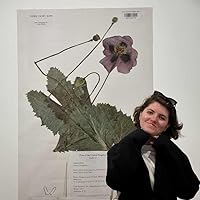
The poppies are wild, they are only beautiful and tall so long as you do not cut them, they are like the feral cat who purrs and rubs against your leg but will scratch you if you touch back. Love is letting the world be half-tamed. --from "Poppies" In this lush, intricately crafted collection, Jennifer Grotz explores how we can become strange to ourselves through escape, isolation, desire--and by leaving the window open. These poems are full of the sensory pleasures of the natural world and a slowed-down concept of time as Grotz records the wonders of travel, a sojourn at a French monastery, and the translation of thoughts into words, words into another language, language into this remarkable poetry. Window Left Open is a beautiful and resounding book, one that traces simultaneously the intimacy and the vastness of the world.
Such patience and witness in this book. I loved the moves between fine figures and truth claims. I loved "Poppies"--how it finds "the sadness everywhere present"--and "The Fog," and "Snowflakes," in which she writes:
"Sometimes the snowflakes glitter, it's more like tinkling//
than snow, it never strikes, and I want to be struck, that is/ I want to know what to do."
and later,
"like the woman talking to herself in an empty church/ eventually realizes she is praying, I walked home with eyes that melted snow."
I loved it. I read one of these poems in a daily poem email, looked her up on Goodreads, and ordered this book. I was not disappointed. More review later.
After adding books to owned books[shelf goodreads provides] I lost ratings and review. Will attempt to add the review. Books won on goodreads giveaways that is missing review due to this are books I have enjoyed. On a later date I will attempt to remember what I have written about them and will rewrite them.
Thanks to my son, Greg, for giving this volume to me for Christmas. (It was there, in plain sight, on my Amazon Wishlist, but my children all yawn at what's on that list. "It's so boring, Mom! All you want is books!" So it was nice to see them actually turn to it, boring or no.)
I subscribe to the poem-a-day email and newsletter that comes to me thanks to the Academy of American Poets. One day, Jennifer Grotz' "The Whole World is Gone" came across my desk, and I immediately put her on my Wishlist.
My favorite in this book is "Poppies." Here are a few lines from inside it:
The poppies are wild, they are only beautiful and tall so long as you do not cut them, they are like the feral cat who purrs and rubs against your leg but will scratch you if you touch back. Love is letting the world be half-tamed.
I still have problems with my own non-rhyming poems, always scuttling back to my safe and sound, tightly bound, structured and carefully rhymed pieces. Jennifer Grotz gives me hope and just a teardrop of inspiration. Which might be all it takes.
I was enjoying this right away, then got to the 4th poem and had to look up a word I wasn't 100% sure I was right about (denticulate), and then I enjoyed it more. The word fit perfectly in "Snowflakes", and the poem took me to an unexpected place, with an ending that stuck with me for days. There are surprises hidden in nature, if we only know where to look, and within ourselves, and Grotz knows where to look, both inside and outside herself. "The Whole World is Gone" mentions a prayer, but "Listening", "Edinburgh Meditation", and "Scorpion" are also prayer-like in their aspect, beseeching but not sentimental, questioning but not at all hopeless. Grotz' world is full of detail both beautiful and true, but her honesty and questioning keep this from being high-handed, and her loving eye for what surrounds her encourages us to take another look at what surrounds us and how we are impacted by, and also impact, our environment. A wonderful book that moves with attention and grace.
Poems about the natural world and the poet's place in it.
from The Whole World Is Gone: "What / I do along, loving him in my mind. Trying not to / let imagination win over reality. Hurtling through the night, / a passion so spent becomes a fact one observes. Not tempered, / just momentarily out of view by the body that perceives it. / So that if it desires, the mind can practice a prayer, / the one whose words begin: Deprive me."
from The Mountain: "No matter how long I looked, I couldn't see it all, / much less understand it. Yes, I believed / the mountain could be understood, / that it was at least my task to try."
from Cherries: "What might be universally beautiful is hard to imagine, / perhaps only the sunrise and sunset, / perhaps the moon. If on earth // it might be cherries, / loved by the fierce and tender, eaten / by birds and foxes, and what humans don't take / are claimed by little green worms."
I have found a kindred spirit in Grotz's poems, her writing attentive and constantly moving the way one might expect our thoughts to constantly evolve. Her poems are more "simplistic" to other poets I've encountered, or those who are a bit more known, but this made the collection more appealing and authentic. Grotz reminds us that it isn't necessarily big words or carefully placed references and snippets of other poems which makes a work good; my favourite piece in the collection, "Sundials", proves otherwise. I think I've found my go-to collection for days when I just feel like opening the window and appreciating the little things in the world without being overwhelmed by the large entirety of it - "Window Left Open" is splendid.