Jump to ratings and reviews
Rate this book

John's Wife

Rate this book
A satirical fable of small-town America centers on a builder's wife and the erotic power she exerts over her neighbors, transforming before their eyes and changing forever their notions of right and wrong. 25,000 first printing. Tour.

432 pages, Hardcover

First published January 1, 1996

6 people are currently reading
355 people want to read

About the author

Robert Coover

135 books378 followers
Robert Lowell Coover was an American novelist, short story writer, and T. B. Stowell Professor Emeritus in Literary Arts at Brown University. He is generally considered a writer of fabulation and metafiction. He became a proponent of electronic literature and was a founder of the Electronic Literature Organization.

Ratings & Reviews

What do you think?
Rate this book

Friends & Following

Create a free account to discover what your friends think of this book!

Community Reviews

5 stars
35 (27%)
4 stars
44 (34%)
3 stars
26 (20%)
2 stars
13 (10%)
1 star
10 (7%)
Displaying 1 - 17 of 17 reviews
Profile Image for Vit Babenco.
1,784 reviews5,791 followers
February 3, 2020
Smalltown life… Community manners and mores… Robert Coover is outright jeering so John’s Wife turns out to be much wickeder than adulterous Couples by John Updike and much weirder than suburban tales of John Cheever.
The attention of John’s wife, however momentary and enigmatic, was one of the laurels the town’s men competed for, while the women, contrarily, often felt threatened by John’s wife, yet protected by her at the same time.

John’s wife is literally invisible but she is always present at the background as a symbol of some obscure and distant virtues.
…though most men admired John, a model for all men, there were many among them who also feared him some, and even those who, resenting him for his usurpations, mistrustful of his success and power, would have been glad to see him fall, feeling the relief of a balance struck, as when gangsters or presidents die, or wars disturb the dull interminable peace.

John is a pillar of society… He is a mover and a shaker… The entire town turns around him… He is always full of triumphs and celebrations…
“The collective effervescence of these gatherings, is like that of cheap champagne – it goes straight to your head, dissolving moral boundaries and separating self from body neat as an alchemical reaction, then awakens you, bloated and headachy, to an earthbound morning utterly without consolation…”

Everything is fine but gradually reality starts merging with dreams and dreams start growing darker and darker until they finally turn into a ceaseless nightmare – an eerily fizzy comedy of horrors...
For what is town after all? “…city is the caldron, and we be the flesh.” Ezekiel 11:3
Profile Image for Nathan "N.R." Gaddis.
1,342 reviews1,653 followers
Read
November 3, 2015
And now, Coover Completionism!

Were I a talented writer with a developed bit of wit, I’d write a parody of one of those saccharine reviews that simply gushes about John’s Wife (know that her name is apostrophed) and you’d all rush out to tbr this wonder. But I’m not. So I’ll settle for exclaiming that John’s Wife ought to count more highly in the esteem of Coover readers ; it ought to count up there with The Public Burning, even if the fireworks are a tad more restrained. And Coover readers ought to count as the average reader, but alas. However, as I declaim how great is John’s Wife I’m fully aware that I’m tempted that direction a bit by the degree to which it is a more normalish=novel ; more normalish than the middleclass nightmare of Gerald’s Party (also apostrophed ; and both employing to fine effect the parentheticalization of subclause’d thoughts) and more realist than Pinocchio and nothing at all like the pyrotechnics of Lucky Pierre. What it is is a slightly more salty Coover than the Brunist-realist phase ; one sees here the overlap. Not that Coover was attempting that kind of middle=class Updikism (as Theroux’s An Adultery maybe kind of did) because you can’t put a Gargantua-ette (that would be a female Gargantua) into a bourgeois novel. But speaking of the bourgeois novel, it’s not really that, but more like the American Small Town Novel of which variety I’ve been reading several recently -- combine that setting (of the sort I grew up in several times ; I think there were at least three) with a large cast of characters and a floating PoV and you get a set of significant, unremarked upon novels which successfully avoid the First Person Terror (ie, PoV) and result in what is frequently derided as “PoMo” -- I mean of course Coover’s own Brunist novels and Evan Dara’s novels and Jeff Bursey’s novels (I know, he’s Canadian, but I said “American” and my America is large) ;; probably extends back to things like Sinclair Lewis ; and there’s at least an Indian version in Kanthapura.

At any rate, John’s Wife, well, it’s about us. Which might account for why it won’t be a novel for every reader ; we’re not pretty.


Pedanticity Warning!!!
______________
I’ve thought about chunking up Coover’s oeuvre. It’s not really a matter of chronology since the time of the writing too often does not coincide with its publication. For instance, The Adventures of Lucky Pierre: Director’s Cut was written over a period of forty years, published finally in 2002. Publication of The Public Burning (1977) was delayed several years due to legal sweaty=palms. A Political Fable (1980), was first published as “The Cat in the Hat for President” in New American Review in 1968. So instead, sort of a genre=chunking of his many books published, lo, these past 50 years.

I. The Brunist/Realist Books
Here, naturally, belong his two Brunist tales, The Origin of the Brunists (1966) and The Brunist Day of Wrath (2014). But I’d also place his popular The Universal Baseball Association, Inc., J. Henry Waugh, Prop. here since the depiction of Henry’s fall into his fictional world is more or less realistically portrayed. Naturally, as with all Fiction, these three are richly meta=phictional.


II. The Short Stuff :: Novellas and Short Stories
Quite, true, these could/should be divided in half, but in my book, they kind of do similar things, ie, produce perfect pieces (unless they fail, etc). The novellas almost seem like formal perfection and have been functioning quite well for introducing readers to Coover’s genius. Roughly in order of my esteem of them--correction :: I just can’t do that ::
Ghost Town
Spanking the Maid
Whatever Happened to Gloomy Gus of the Chicago Bears*
Briar Rose
Noir
A Political Fable*
Stepmother
The stories are strewn around. There’s the classics -- A Night at the Movies or, You Must Remember This (film and the movies saturate Coover’s writing) and Pricksongs and Descants. The fable stuff -- A Child Again. And In Bed One Night & Other Brief Encounters. The recent stuff, still uncollected, but listed (naturally against the rules) in the gr=db and available (often) free to read -- don’t miss “Going for a Beer”!!

* (to be read in conjunction with The Public Burning)

 photo IMG_0466_zpslqvurrbw.jpg


III. The Novels
Pretty much the Coovers no one reads. But should ::
Gerald’s Party -- in which the ‘I’ is apostrophized* (199 ratings  ·  22 reviews )
Pinocchio in Venice (161 ratings  ·  26 reviews )
The Adventures of Lucky Pierre: Director’s Cut -- really pretty much an unendurable masterpiece (52 ratings  ·  9 reviews )
John’s Wife -- in which ‘she’ is apostrophized* (84 ratings  ·  7 reviews )

All four are of the genre tour de force or something ; but readers with weak stomachs will have already avoided them and/or won’t have the patience to endure them. None of them are of that comfort=making kind of novel. All will seem perhaps on the long side for those who have loved the small doses of similar stuff in the shorter works. But I think it’s a pity more people do not read them ; they’re a great antidote to the extremely conservative nature our literary scene has taken on in recent years decades.

*to complete the apostrophe trilogy, we’ll draft Noir in which ‘you’ is apostrophized


IV. The Public Burning
Stands on its own, naturally. It consists of one part realist (see I. above) and one part insanity, a blend of The Novels & The Short Stuff.

And then some miscellaneous stuff only Completionists might be interested in -- A Theological Position (a collection of plays) and The Grand Hotels (of Joseph Cornell) (a kind of tribute, I think), for instance. And several extremely small print=runs of stuff collectors=only (see Friend Brian’s copy of Spanking the Maid). But I think that’s most of it, mostly.


But so, Coover is simply on a grand scale. Joyce. Faulkner. Gaddis. That kind of level. Pure/sheer American genius (I remind you of my inability to properly compose the saccharine that would be antidote to these bold claims). That he is not thoroughly known (although frequently you might find articles about his students and influencees dropping his name), that his name is not habitually lined up on that line of, for instance, Fitzgerald-O’Connor-Hemingway-Updike-Etc-Faulkner, says a whole lot more about our literary culture than it does about the value of Coover’s works. And, I’d really have to insist, if you were to ask, yes, Coover is more long=haul improve-with-age than might be the fading light of his fellow=master, John Barth. These Coover books (Donald Duck for President?!?!) will hold up very nicely these next several coming decades.
130 reviews226 followers
January 15, 2009
Alfonso's report on John's Wife at page 201:


Ok I'ma try to explain my case…

Why do I think this book is crap, Alfonso?

Look, I don't mind complicated plots. I don't mind reading 40 pages of a dude clipping his toenails as long as I, you know, find the character intresting. I don't mind having to deal with a 10 page long dramatis personae section, I don't mind family trees that will scare the living shit out of almost everyone I know, I don't mind reading 388 footnotes… but I need to honestly care for those character to put on with all that crap… feel a connection with the characters. I don't know...at least think they funny, cool or something… but this one. Oh god, this one!! It's just a bunch of stupid motherfuckers for whom I couldn't care less! Seriously, do I really want to know how some dude gets a better hard on when some dude he don't like is not around??? Or do I really want to read 2 pages on a senile dude expending days looking for the fucking gun that he is planning to use to blow up his head cuz he forgot where he hid it????
I feel like a whole town full of retards* decided to come to me and tell me about all the meaningless shit that happened in their lives and there is no cool breaking of the fourth wall or some shit here so I could at least entertain myself by imagining what would I do if I were the town's shrink. I'd act like I was Jack Kevorkian…. I'd start with the old dude… tell him about the Peanut Project… and how he could get himself one of those kick ass "exit bags" from Canada. Or since this book came out in 1997, I could prescribe some Nembutal to the dumb fuck and tell him exactly how to do it… or today, when after reading for few minutes, I did the dreaded "let me see how many pages of the crappy book I've read so far" and realized that it was only 10!!!! The horror!!! So I decided to spice things up by imagining how cool it would be if an outbreak of the T-virus started on that little small town and they all turned into zombies and me and Leon*2 were sent there to kick ass and kill zombies. And then I started to imagine how cool it would be to shoot all those stupid retards while screaming at them how annoyed I was with all their stupid bitching… then I started wondering if it was ok to fantasize about shooting fictional characters, and decided it was ok, cuz in my fantasy they were zombies and it's ok to kill zombies (they like Nazis or hippies…. You know nobody cares if you shoot a few). There is no law saying the contrary, and it's socially accepted. I mean zombie shootouts are in vogue!! Then I freaked out cuz I wasted like 10 minutes daydreaming about shooting zombies, decapitating zombies, throwing Molotov cocktails at zombies, and many other fun ways to kill zombies….


Well there you have Paper the reason why I don't like this book is simple… I just don't care about anybody in it….

*: for some reason song #34 of Anal Cunt's 3rd album started playing in my head while writing that sentence.
*2: if y'all don't know who Leon on… google it god damn it!!! every zombie fan should know who Leon is!!!


Alfonso’s report on Jonh’s Wife…. (Final)


Ok… I recently learned to abridge shit… so I’ma give this piece of crap a try:

Jonh’s Wife…………………….ABRIDGED!:


We open with some bull shit followed by more bull shit then some “plot” that makes no sense, then some stupid awkward, senseless transitions where you have to go back and re read again cuz you aint sure how if you was reading about a girl 2 sentences ago and now she has a penis? Them some more useless craps about characters that are completely unrelated to what you were thinking about the plot was, then something about some dude and a camera and some weird senseless philosophical shit that has something to do with aesthetics or something like that, then a lot of malls, construction companies, and I don’t know some weird rivalry between a weird girl and John and then he mention john’s wife and some different people want to fuck her or fuck her up and I don’t know I think it had something to do with love… then more shit, more awkward transitions, more bull shit, something to do with a crazy bitch and a retard and them hanging out and stealing food, and then some hunt and more shit more awkward transitions, guns a whale hunt, somebody masturbates with a shotgun, people die, a quick wrap it up copout maneuver and the end!
Profile Image for Mala.
158 reviews197 followers
April 25, 2016
And when the dust cleared, all that was left standing was the big front door, completely intact, columns, architrave, and all. Majestic. Inviting. But opening onto nothing. (284)

In John's Wife, Coover shows the need for mythical narratives to give meaning to our mundane lives. Even a back of beyond nameless "little prairie town" has to be given an updated mythology to stay relevant in the changing times; the origin tales of this pioneer town having grown stale from stasis. Coover gives the sly hint in the very opening paragraph of this book:
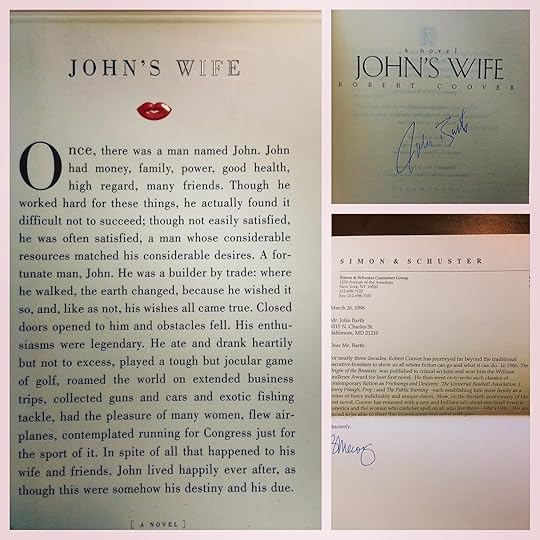
Once, there was a man named John. John had money, family, power, good health, high regard, many friends. Though he worked hard for these things, he actually found it difficult not to succeed; though not easily satisfied, he was often satisfied, a man whose considerable resources matched his considerable desires. A fortunate man, John. He was a builder by trade: where he walked, the earth changed, because he wished it so, and, like as not, his wishes all came true. Closed doors opened to him and obstacles fell. His enthusiasms were legendary. He ate and drank heartily but not to excess, played a tough but jocular game of golf, roamed the world on extended business trips, collected guns and cars and exotic fishing tackle, had the pleasure of many women, flew airplanes, contemplated running for Congress just for the sport of it. In spite of all that happened to his wife and friends, John lived happily ever after, as though this were somehow his destiny and his due.

Seems like we have stumbled upon a modern fairytale, doesn't it?
But we all know that fairy tales have their dark side too...
In its insistence upon stories & more stories, John's Wife reminded me of Gass' Israbestis Totts — his role here being taken by the town historian Ellsworth in his position as the editor of 'The Town Crier' which keeps track of every detail happening in the town, esp. as recounted in the column 'I Remember'. It's significant that as the town passes through its worst crisis, the paterfamilias of the town, i.e. John, is out of town, & the town rag is no longer available, but once they are back in action, the town finds its sustenance through them. As one character had presciently grasped : She sometimes had the weird feeling that John had brought to this town, not Waldo, but her, and no doubt others like her as well, not out of any sense of caring for an old flame (that was flattering herself), and not just to make her eat shit and feel the fool either, though she wouldn’t put it past him, but just because, a smalltowner to the bone, he’d started up these stories and wanted to keep them all around him, see how they all came out.

Almost makes me wonder why this book wasn't called John's Town?!
So what role does the enigmatic nameless John's wife play in the narrative? In the metafictional artist's track & the town photographer Gordon's obsessive search for the ideal (another record-keeper of the town's evolving history), we see the larger import of this eponymous figure in that the reader is also partaking in the town photographer's voyeurism & the artist's search for his muse is analogous to the townspeople curious relation to the elusive Mrs John. The closing paragraph of this book will make the readers consider her in a new light if they hadn't already.

As a complex narrative the book is operating on many levels — on a surface level it's a highly effective realistic satire of small town life: it is never a pretty sight when literature holds a mirror to life. Like Dutch's two-way mirrors in his highway motel where, He’d seen it all, Dutch had, over the dozen years since then, a seamless flow: Marriage nights, adulteries, group gropes. Old guys taking virgin blood. Young kids fumbling. Child sex, dog sex, toilet sex, you name it. Rapes and whippings, faggots and dykes. Gangbangs. Incest. But mostly forlorn meat-beaters, all alone. Melancholy places, highway motels. A lot of f***ing solitary sadness, Coover's book eviscerates the myth of small town wholesomeness by showing the rot within, and the ugliness we hide behind the facades of community, religion, love, marriage, friendship, progress, change, — you name it! It's a cauldron of seething passions. Honestly, I wouldn't want to live there.

John's Wife explores the nature of desire as mediated & perverted by the twin engines of power & sexuality and where they might lead us. What do you do when you already have a perfect life? Where do you go from there?! The book's tongue-in-cheek opening lines endowing John with a faux mythic allure, an allure, which then must be stripped away to lead to the bonfire of the vanities.

None escapes the writer's critical eye except one — the titular John's wife (and to some extent Pauline & Barnaby). And that is because Coover doesn't turn on the searchlight upon her; she remains the faithful Penelope to John's wandering (eye) Odysseus. "John and his wife, in fact, are the twin suns of the small town where this raucous and disturbing novel is set." A cynosure of all eyes, her presence as indispensable as a definiendum’s to a definition. The residents of this town may choose to love or hate her but she remains the one unsullied figure round whom their fantasies revolve. Seems we all need our illusions in life...

To those readers who see misogyny in the text, I'd like to remind them that here men fare even worse! & if misogyny exists in the text it's because it exists in the patriarchal society as depicted here where women can get the better of men only by being smarter & more ruthless. The seemingly fantastical plot involving Pauline while adding to the mythology of the town also gives a superb turn
But John's Wife is not about the battle of the sexes; rather it deplores the mindset where, if you are successful, you can get away with anything.This shows mainly in Coover's ambivalence towards John — he is a flawed mythic hero for these flawed times. There's a nostalgia for a simpler less hypocritical times but Coover astutely shows that evil practices continued even then: e.g., incest is not something that happens only to trailer-trash Pauline; it happened to a woman like Opal too.

In The Babysitter, Coover had explored America's sexual fascination with this type and, in Gerald's Party, the dark side of suburbia, here he lays bare the heartbreaks behind small town lives & ambitions - the bloated provincial crassitude of this bumpkin town. A town where almost everyone has got nasty secrets & midway point onwards things reach hysterical proportions or as they say shit hits the roof.

John's Wife is my favorite of Coover's PoV trilogy (the others being Noir and Gerald's Party). The omniscient narration moves so smoothly spread across shifting points of view, recounting all the tangled lives, mixing past & present times, & blending a zany surrealistic element into it, it makes you stand up & applaud. Coover in a realist mode may be hard to imagine (!) but this is really an ambitious & engaging work with just the right amount of humor, irony & detached amusement. There's pathos too for these f***ed up lives. Discovering someone's deepest disappointments & broken dreams is never an easy moment — & John's Wife is filled with such moments.
This is Coover's American Vanity Fair — America needs its success stories; no matter what the cost.
Profile Image for Tony.
1,030 reviews1,911 followers
August 12, 2015
Sexually crude, misogynistic to the point of (hopefully) caricature, with constantly, kaleidoscopically changing points of view in long, one to two page paragraphs, hard to follow for that, which I am hopefully recreating to some extent with a run-on sentence of my own; but back to Coover, who is supremely gifted and not a little twisted and in John's Wife has taken the residents of a small town and filleted them in what I can only describe as an updated version of Updike's Couples without the sexual timidity of the 60s and jazzed with the literary pyrotechnics of, say, Donald Antrim. I was annoyed, offended and highly entertained. I'll read more of his stuff.
Profile Image for Melanie.
88 reviews113 followers
September 17, 2007
One of the back-cover blurbs describes this novel as "kaleidoscopic," and when I read that I was like, "oh, I highly doubt that"...but it actually IS kaleidoscopic, a story that shifts POVs and spins in and out and around the interconnected lives of the inhabitants of a small town. At the center is John, a man who's admired, feared, loved, and despised, and the mysterious woman known only as John's wife. When it became apparent that Coover was going to refuse to give John's wife a name, I was a little annoyed--not another story about men projecting their desires and miseries onto a nameless, idealized woman!--but the annoyance fell away when his decision began to make sense, probably around the time that the narrative became slightly surreal and more than a little unsettling. It's a deeply strange story embedded in a deceptively simple suburban-angst package, but it's definitely worth reading, particularly for fans of Don DeLillo, Donald Barthelme, and maybe John Updike (although I don't actually care for Updike myself...)

Profile Image for Dan.
1,009 reviews136 followers
July 11, 2022
Nightmarish and hallucinatory. A convincing portrait of the (sometimes stultifying) realities and (often pornographic) fantasies of small town life. Employing a "cliffhanger" technique whereby he describes the events in one plotline, bringing it to a critical point, and then switching to another of the plotlines, Coover keeps multiple plotlines developing and interesecting through the book. Reading it was something like watching a juggler keep a dozen balls in motion all at once, but also like a memory test, as with each new page there seems to be another opportunity to try to remember where one has seen this or that character before.

Acquired Sept 6, 2001
Attic Books, London, Ontario
Profile Image for Smiley III.
Author 26 books67 followers
November 11, 2022
The deal was this: Through a dummy put in place by Maynard, Barnaby bought up controlling interest in another smaller building firm, an upstate industrial and commercial paving business with other attractive holdings, on paper, staking on this bold maneuver almost all he had, much more to sure than that down at the heels outfit, soon to be John's by default, was worth. Then, Barnaby still screened from view, Maynard approached John with a merger proposal king for forty-five percent of the new corporation, but "negotiating" easily down to thirty, giving John the illusion of continued control but Barnaby actually majority stock, once the masks came off. John still seeme reluctant, or else distracted, short on cash, he hinted, problems to be solved, Maynard coaxed Barnaby into sweetening the pot with an investment offer: three hundred thousand dollars was the figure they came up with. Too much maybe, looked too eager. Probably what made John suspicious, though just how that wily fuckhead read their elaborately veiled stratagems as easily as the goddamn funny pages, Maynard would never figure out. John's wife might have helped him somehow, Barnaby being a sentimental old coot who talked too much, but she didn't seem quite in the picture, not these days anyway. Probably, as Maynard put it to Dutch out at the Getaway Bar and Grill that wet and gloomy end of day, remembering all the Monopoly games he had lost as a kid, it was just genius, intuition, John's fucking gambler's luck, and Dutch with a grunt agreed. "Or else there was a leak somewhere." "Mm. Speaking of which," Dutch rumbled, tweaking his crotch and sliding down off his stool. "Have another one on the house while I'm gone." He nodded at his harkeep as he sidled away, and the woman down at the other end of the bar stubbed out her smoke and said: "Thanks, honey, don't mind if I do" Maynard's bibulous and bilious ex. She often came in this time of day to wait for her husband Stu to drop in from the car lot and join her for a friendly drink or two before their serious swilling began, main reason Maynard didn't stop in here more often. "Hey, Daph," he greeted her, hunched over his glass, tearing the wet napkin under it with the pointed end of his plastic swizzle stick, "what's your ass go for these days down at the used-cunt lot?" "More than you're worth, scumbag." "Hunh. You mean it's over priced like all the other junk your old man peddles." "Hey, you want me to punch that fatmouth sonuvabitch!" asked some swarthy young guy in greasy workclothes, sitting over in the shadows with a bottle of beer in his mitts. Maynard hadn't noticed him there before, didn't know who he was, though he'd seen him around town from time to time of late. One of his cousin's underpaid throwaway workers probably. "Nah, you better not, sweetie," Daphne said. lighting up again, blowing smoke out through her flared nostrils like rocket launchers. "That's the Nerd. Swing at him, you just get yourself all splattered in shit." "Jesus, what a nice fuckin' town this is," the guy muttered, and slumped back into the shadows, sucking at his beer.—pg. 118-119

Can you believe this paragraph?? — read this book!!!
254 reviews12 followers
November 17, 2008
Excellent book.. Of the charecters you meet, you acctualy KNOW John's wife the least (she rememains nameless). The novel kind of rotates around her much in the same way the moon rotates around earth. As the title charecter fades away, the charecters lives kind of spin out of control. Oddly Beautiful book.
366 reviews
April 25, 2022
I liked it, yet couldn't finish it. Read 50%, and it's certainly clever, and funny in parts. But with no chapters and little dialogue, it just became too much of an effort, a slog.
Profile Image for Kathi.
163 reviews3 followers
October 11, 2013
I had to read several times but wor4h it. I liked the complex characters. The misogyny was so typical of mid size suburbia of the Midwest even today. The women who had any sense were old and/or dead. And I still am pissed we never got her name. lol
85 reviews1 follower
August 30, 2015
Not sure I'd recommend this, though I thought it was good. Great combination of high and low art, with complex descriptions of utter depravity.
Profile Image for Heronimo Gieronymus.
489 reviews150 followers
April 27, 2017
Traipsing deep into Coover this year, a trek postponed far too long. Long been curious to dig into the big ones, having dallied w/ the smaller / lighter ones in the past. THE ORIGIN OF THE BRUNISTS, his debut, was a game-changer for me. It is a big and inarguably bold American novel pumped up w/ adrenal prose and engaged w/ the tradition (and not so much in the sense of playfully subverting or upending the fruits of the archive, a kind of eminently postmodern pursuit he is famous for pursing). JOHN'S WIFE is another biggy. The volume I own, w/ its relatively small print, is not nearly as large as my copy of THE ORIGIN OF THE BRUNISTS, but it is decidedly the bigger book in all significant respects. And if the earlier book struck me as one of the finest novels I have ever read, I have to say that JOHN'S WIFE, though a trickier work and an even more malevolent one, may be even better. It certainly provided more moment-to-moment literary pleasure. Reading it is like stepping into a room full of moustraps wherein every move you make sets a couple off. Or firecrackers. You may prefer to see the thing as a veritable Fourth of July (or Pioneer Day, to hew closer to the text) of volatile and rapacious literary pyrotechnic engineering, constantly popping off. It could also be said to resemble a giant and impossibly tangled ball of yarn, interlinking stories in close proximity all wound up in one another. This also might be the great American novel of the carnivalesque. It is an honest to goodness freakshow cavalcade, honest red-white-and-so-forth small town American values skewered and pissed upon and put through the goddamn wringer. It gets real outsized in that regard, going far beyond anything that might index real reality except perhaps to make a monster-sized (and there is a kind of impossible droll monster here) joke out of it. Definitely a novel Mikhail Bakhtin could, God rest his soul, get behind. And I can think of no American novel that so stridently keeps alive the (very European) spirit of Rabelais. And John's titular wife. A presence, surely, but also a structuring absence, and one of the most canny in the canon. I suppose it is important to mention that, especially considered in terms of the micopolitical age we live in, a lot of people will be utterly appalled by this novel (theoretically, as such people are unlikely to find there way to it). Many would call it misogynistic. And they would not be wrong. But what is the difference between the symptom on the one hand and the diagnostician on the other? Age old question, critic. If you can't delight in the puerile then stay away. And delight is what this is all about, naturally. This novel is a great big busy machine for pleasure.
Displaying 1 - 17 of 17 reviews

Can't find what you're looking for?

Get help and learn more about the design.