As well as being Germany's most important poet, Hans Magnus Enzensberger is a provocative cultural essayist and one of Europe's leading political thinkers. No British poet can match him in his range of interests and his moral passion. Enzensberger is a cultured, learned, widely knowledgeable man, but his poems wear their knowledge, learning and culture very lightly. Perfectly at ease in a variety of poetic forms, he presents us again and again with things that matter. This is intelligent and pointed poetry in the tradition of Brecht, humanely political and generously engaged. The poems have the ease and the lightness of real mastery. They are moral in their insistence that human life can be lived well or badly, that it is up to us to choose well and to act wisely. Enzensberger is now writing with an increasing awareness of mortality, yet addresses social and political dangers and evils with undiminished urgency. 'Hans Magnus Enzensberger is a poet of formidable intelligence and range. Like Brecht before him, he combines an intense political imagination with lyric gusto. The reader discovers in him both a satirist and a friend' - George Steiner. 'A voice of ferocious urbanity, laying bare the horrors of the modern German state and resignedly picking out stark cameos of the human condition' - Peter Forbes, Financial Times
Hans Magnus Enzensberger was a German author, poet, translator and editor. He had also written under the pseudonym Andreas Thalmayr.
Enzensberger was regarded as one of the literary founding figures of the Federal Republic of Germany and wrote more than 70 books. He was one of the leading authors in the Group 47, and influenced the 1968 West German student movement. He was awarded the Georg Büchner Prize and the Pour Le Mérite, among many others.
He wrote in a sarcastic, ironic tone in many of his poems. For example, the poem "Middle Class Blues" consists of various typicalities of middle class life, with the phrase "we can't complain" repeated several times, and concludes with "what are we waiting for?". Many of his poems also feature themes of civil unrest over economic- and class-based issues. Though primarily a poet and essayist, he also ventured into theatre, film, opera, radio drama, reportage and translation. He wrote novels and several books for children (including The Number Devil, an exploration of mathematics) and was co-author of a book for German as a foreign language, (Die Suche). He often wrote his poems and letters in lower case.
Enzensberger also invented and collaborated in the construction of a machine which automatically composes poems (Landsberger Poesieautomat). This was used during the 2006 Football World Cup to commentate on games.
Tumult, written in 2014, is an autobiographical reflection of his 1960s as a left-wing sympathizer in the Soviet Union and Cuba.
Enzensberger translated Adam Zagajewski, Lars Gustafsson, Pablo Neruda, W. H. Auden and César Vallejo. His own work has been translated into more than 40 languages.
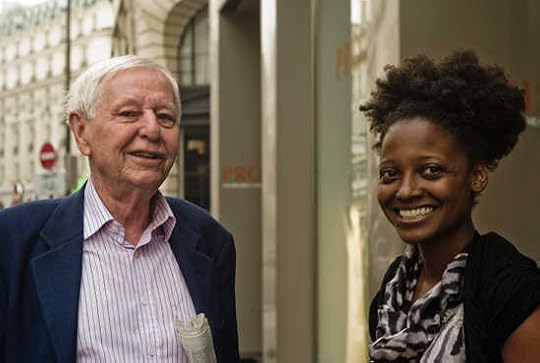
Hans Magnus Enzensberger with poet Tracy K. Smith ( who won a 2012 Pulitzer Prize for 'Life on Mars' ) in Paris, 2011.
Enzensberger is a contemporary German poet who has been awarded the following prizes: Erich-Maria-Remarque-Friedenspreis ( 1993 ); 2009 Griffin Poetry Prize Lifetime Recognition Award (2209); an honorary degree from Bard College in New York (2012). 12 from the poems included in this volume are from a 'A History of Clouds' (Geschichte der Wolken) I love his "style of linguistic spareness, and lyric precision, with more than a nibble of irony". "They are above mistakes. No one will be quick to claim that one of them is misshapen. Minute A minute-long shower sends down millions of sleet flakes. Every one is perfect. No two flashes of lightning alike. And all this without a brain!"
"Über Fehler sind sie erhaben. Daß eine von ihnen mißraten wäre, wird so leicht niemand behaupten. Was da in einer niederprasselt, sind Millionen von Graupeln; Jede einzelne ist perfekt. Kein Blitz, der dem andern gliche. Und das alles ohne Gehirn!"
Bird’s Eye View ‘Immune to dizziness like an old roofer, agile, not noticed much by those who have their feet on the ground of facts to conjure
without holding on, with a practiced grasp, when all goes well, high up to bring off an inconspicuous miracle,
yes, that, seen all in all, is a mug’s game, but here and there allows slanting glances downward, into smaller abysses, rooms...’
‘Schwindelfrei wie ein alter Dachdecker, behende, von denen, die auf dem Boden der Tatsachen bleiben, nicht weiter beachtet, zu zaubern freihändig, mit geübtem Griff, wenn alles gut geht, hoch oben ein unscheinbares Wunder zu vollbringen, ja, das ist, aufs Ganze gesehen, gewährt aber hie und da schräge Blicke nach unten, in kleinere Abgründe, Zimmer..’
One laughs is worried under the sky exposes my face and my hair makes words roll out of my mouth one who has money and fears and a passport one who quarrels and loves one moves one struggles
but not I I am the other who does not laugh who has no face to expose to the sky and no words in his mouth who is unacquainted with me with himself not I: the other: always the other who neither wins nor loses who is not worried who does not move
the other indifferent to himself of whom I know nothing of whom nobody knows who he is who does not move me that is I.
If I were rating the intelligence of these poems, I would be tempted to give five stars, but, at least in translation, the language was a bit too colloquial, lacked the kind of gravitas/sublimity/resonance that, for me, the best poems have. The flipside to that is that poems are pretty accessible and plainspoken, which to my mind are often a good thing. The poems offer some interesting meditations on the mystery and complexity of nature, the necessity of uncertainty, the possibility of human relationships beyond calculation and considerations of utility, and the way life is richer than all our attempts to say it, even as we have nothing to say except these attempts. Well worth reading.