(The English review is placed beneath the Russian one)
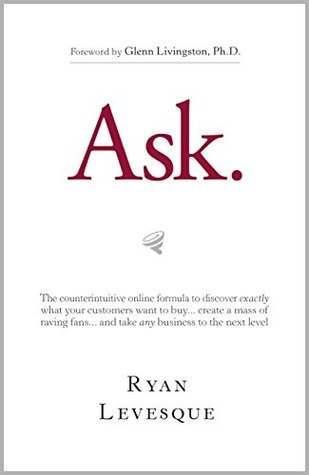
Странная книга. Книга странная даже с точки зрения просто бизнес-литературы, ибо половина книги посвящена автобиографии автора. Эта автобиография автора никак не связана с обсуждаемым вопросом, поэтому единственная причина, по которой автор включил её в свою книгу, это чтобы увеличить объём книги. Вторая проблема, это отсутствие ценной информации. Начало у книги, безусловно, очень интригующее, благодаря чему большинство читателей, преодолеют себя, и прочтут автобиографию автора.
Simply put, the Ask Formula is a system to ask intentionally-designed questions to help you figure out exactly what your customer wants—and the exact language to use to communicate with them. Then, with that information, it tells you how to personalize the messaging you use and products you introduce based on the answers to the questions you ask.
<…>
When it comes to asking questions, whether they’re a big corporation or a one person boutique, business owners are prone to making the same costly mistake: They try to just ask customers what they want.
<…>
There’s a famous quote that’s been attributed to Henry Ford: “If I had asked people what they wanted, they would have said ‘faster horses.’”
<…>
Because (here’s the big secret): People don’t know what they want.
<…>
People are really good at telling you what it is they don’t want.
<…>
Vague, general asking is one of the biggest mistakes people make when trying to find out what people want. It’s because people just don’t know how to answer. Steve Jobs was right. People often don’t know what will make their life better until they’ve seen it.
<…>
One of the biggest things I discovered was that I had been taking a “one size fits all” approach to my marketing. Their responses told me I needed to speak to different segments of the market quite differently.
<…>
The Ask Formula I discovered was stunningly simple: The secret to spectacular sales was all about asking the right questions, in the right way, at the right time.
Несмотря на такое многообещающее начало, дальше, когда автор перейдёт непосредственно к вопросу опроса клиентов, окажется что он ничего нового и не предлагает. Автор это пытается скрыть, но…это очевидно. Достаточно иметь среднюю сообразительность, чтобы задавать те вопросы, о которых и говорит автор. Иными словами, всё это самоочевидно.
This is the foundational survey on which everything else depends. Without this survey all the others fail. This survey collects open-ended data that you’ll use to better understand your market in a deep way, along with the natural consumer language your market uses.
<…>
So how does this work? If you have a list of customers (or prospective customers) whom you can reach by email, you simply run an open-ended survey sent by email, ask them what their single greatest challenge is (along with several additional questions), and use this information to really figure out who your customer is on a deep (and often more honest) level.
<…>
Let me use one of my own companies as another example and how I was surprised at what I learned.
<…>
That’s why I was puzzled and wondered why I wasn’t getting more people to join this group. So I decided to run one of my “Do You Hate Me?” surveys to my existing customer list, targeting those who were not members. I asked them honestly, “Why haven’t you joined my mastermind group yet?”
Это, конечно, гениально, что в итоге всё свелось к самой банальной фразе, вернее к вопросу: что вас не устраивает в нашей продукции? Как мне кажется, к пониманию важности этого вопроса можно прийти, не читая такую «важную» книгу.
По поводу исследования целевой аудитории автор тоже пишет не такие уж и революционные вещи, т.е. вещи которые понятны любому, кто ознакомился с любым университетским учебником по маркетингу.
For example, in one of the sports instructional markets I’m involved in, we discovered through the Deep Dive Survey that our hyper-responsive customers (the very most responsive) were 9.4 years older than we thought. On average, they were 64 years old, instead of 55 years old, which this client had been assuming virtually since the inception of their founding.
And by the way, this is an eight-figure business, which was already quite successful. But we used this information to take their sales and profits to the next level. And we did that in part, by fine-tuning their marketing.
For example, this helped us to know who our avatar (representational figure) was—for our online banner advertising. We chose aspirational images of men and women in their mid-sixties instead of their mid-fifties. This had a profound impact.
We fine-tuned our demographic, targeting on Google AdWords and Facebook ads to specifically target the 64-year-old ideal customer. Again, there were huge upticks in the profitability of our advertising.
На кого рассчитана такая книга? Точно не на тех читателей, кто знаком хотя бы с самыми основами маркетинга. Пересказ основ сегментации и маркетинговых исследований, дело хорошее, но лучше потратить время на полноценные учебные пособия по классическому маркетингу.
It's a strange book. It's strange even from the point of view of business literature, because half of the book is devoted to the author's autobiography. This autobiography has nothing to do with the subject under discussion, so the only reason the author included it in his book was to increase its length. The second problem is the lack of valuable information. The beginning of the book is certainly very intriguing, thanks to which most readers will overcome their reluctance and read the author's autobiography.
Simply put, the Ask Formula is a system to ask intentionally-designed questions to help you figure out exactly what your customer wants—and the exact language to use to communicate with them. Then, with that information, it tells you how to personalize the messaging you use and products you introduce based on the answers to the questions you ask.
<…>
When it comes to asking questions, whether they’re a big corporation or a one person boutique, business owners are prone to making the same costly mistake: They try to just ask customers what they want.
<…>
There’s a famous quote that’s been attributed to Henry Ford: “If I had asked people what they wanted, they would have said ‘faster horses.’”
<…>
Because (here’s the big secret): People don’t know what they want.
<…>
People are really good at telling you what it is they don’t want.
<…>
Vague, general asking is one of the biggest mistakes people make when trying to find out what people want. It’s because people just don’t know how to answer. Steve Jobs was right. People often don’t know what will make their life better until they’ve seen it.
<…>
One of the biggest things I discovered was that I had been taking a “one size fits all” approach to my marketing. Their responses told me I needed to speak to different segments of the market quite differently.
<…>
The Ask Formula I discovered was stunningly simple: The secret to spectacular sales was all about asking the right questions, in the right way, at the right time.
Despite such a promising start, when the author moves on to the question of customer surveys, it becomes clear that he is not offering anything new. The author tries to hide this, but... It's obvious. You only need to be moderately intelligent to ask the questions the author mentions. In other words, it's all self-evident.
This is the foundational survey on which everything else depends. Without this survey all the others fail. This survey collects open-ended data that you’ll use to better understand your market in a deep way, along with the natural consumer language your market uses.
<…>
So how does this work? If you have a list of customers (or prospective customers) whom you can reach by email, you simply run an open-ended survey sent by email, ask them what their single greatest challenge is (along with several additional questions), and use this information to really figure out who your customer is on a deep (and often more honest) level.
<…>
Let me use one of my own companies as another example and how I was surprised at what I learned.
<…>
That’s why I was puzzled and wondered why I wasn’t getting more people to join this group. So I decided to run one of my “Do You Hate Me?” surveys to my existing customer list, targeting those who were not members. I asked them honestly, “Why haven’t you joined my mastermind group yet?”
It is, of course, brilliant that in the end it all boiled down to the most banal phrase, or rather to the question: what don't you like about our products? It seems to me that you can understand the importance of this question without reading such an “important” book.
When it comes to researching the target audience, the author also writes nothing particularly revolutionary, i.e., things that are understandable to anyone who has read any university textbook on marketing.
For example, in one of the sports instructional markets I’m involved in, we discovered through the Deep Dive Survey that our hyper-responsive customers (the very most responsive) were 9.4 years older than we thought. On average, they were 64 years old, instead of 55 years old, which this client had been assuming virtually since the inception of their founding.
And by the way, this is an eight-figure business, which was already quite successful. But we used this information to take their sales and profits to the next level. And we did that in part, by fine-tuning their marketing.
For example, this helped us to know who our avatar (representational figure) was—for our online banner advertising. We chose aspirational images of men and women in their mid-sixties instead of their mid-fifties. This had a profound impact.
We fine-tuned our demographic, targeting on Google AdWords and Facebook ads to specifically target the 64-year-old ideal customer. Again, there were huge upticks in the profitability of our advertising.
Who is this book intended for? Certainly not readers who are familiar with even the basics of marketing. A summary of the fundamentals of segmentation and marketing research is a good thing, but it would be better to spend your time on comprehensive textbooks on classical marketing.