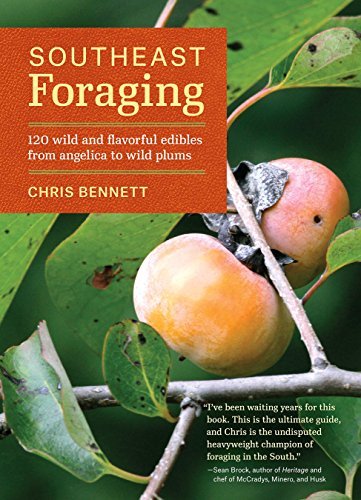
“This is the ultimate guide, and Chris is the undisputed heavyweight champion of foraging in the South.” —Sean Brock, author of Heritage and chef of McCradys, Minero, and Husk The Southeast offers a veritable feast for foragers, and with Chris Bennett as your trusted guide you will learn how to safely find and identify an abundance of delicious wild plants. The plant profiles in Southeast Foraging include clear, color photographs, identification tips, guidance on how to ethically harvest, and suggestions for eating and preserving. A handy seasonal planner details which plants are available during every season. Thorough, comprehensive, and safe, this is a must-have for foragers in Alabama, Arkansas, Florida, Georgia, Maryland, Kentucky, Louisiana, Mississippi, North Carolina, South Carolina, Tennessee, Virginia, and West Virginia.
Coach Bennett is a serious motivator and whimsical moustache curator. A beloved voice of Nike Run Club's popular app, he writes and runs in Portland, Oregon. You might run into him there - not far from a pepperoni pizza.
This book tells you everything you need to know about identifying wild edible plants in the SouthEastern United States. There is information about the types of plants that are ready for harvest at different seasons throughout the year. You can harvest wild plants in meadows, mountains, by riverbanks, or by the sea.
I love that there are beautiful photographs of each plant, so that you can easily identify them. You can see all the details of their leaves, blossoms, seeds, and fruit.
There is detailed information about when and how to gather these edibles, how to cook and eat them, and how to preserve them for later. There are also warnings about staying away from polluted areas that could contaminate the plants.
There are commonly recognizable fruits and berries, like crabapple, plums, gooseberry, and strawberries. Vegetables like wild onion, and tree nuts like hickory and hazelnut are all included. There are aromatic herbs that can be gathered, like field garlic, mustard, and wild ginger. And there are also more rare or less well-known plants like the pawpaw, orache, and sea purslane.
I love how this book is designed and organized! The photos are attractive and useful, and the information is reliable.
Disclaimer: I received a copy of this book from the publisher in exchange for a free and honest review. All the opinions stated here are my own true thoughts, and are not influenced by anyone.
While I agree that this is not a comprehensive field guide type of book, I found it embraceable and interesting, and the photos are great. I bought the Kindle edition, and I wound up reading/skimming the whole book right after I downloaded it. An almost 300-page book full of helpful info and photos that I can carry around on my phone for 1.99 is an absolute bargain.
I am working on a permaculture forest garden in my backyard, and I'm interested not only in identifying the weeds I am finding as I work but also in wild (and therefore likely well adapted) plants to add to the diversity I'm trying to establish. So many of the plants I have bought to plant here in Athens, Georgia, have died from drought, yet I can always count on the weeds. Surveying a variety of plants that actually grow in my area definitely beats an encyclopedia with much detailed but irrelevant (for me) material.
I especially appreciated the author sharing ways of preparing these edibles and which parts/methods he most and least cares for. I happen to dislike most mucilaginous plants when cooked, so I especially valued comments about this quality. I was able to get a sense of which of these edibles would be worth fooling with and which would not be worth the effort for me. This will help guide my choices for encouraging plantings, and if I need even more info about a particular plant, I can Google it.
This is a great book for someone a little familiar with foraging. The table of contents list plants in alphabetical order by commen name. The next section list which plant can be foraged during a specific season. The bulk of the book gives about 1 page devoted to each plant listed in the table of contents. There is usually one picture of the plant, how to identify it, when to gather it, how to gather it, how to eat it, how to preserve it, and a warning if it could be poisonous.
Being new to foraging I found the color photos somewhat difficult to use because there were usually more than just that one species of plant shown at the same time. This was distracting because I wasn't sure of which plant the author was referring to. It would have been helpful to have arrows pointing to specific sections of the plant being talked about. I would have also liked to have see author illustrations in addition to the photos. I also think the descriptions could have been a little more detailed.
For now I think this is more a intermediate beginners book.
I think this book is a good starter for folks interested in learning more about foraging. I appreciated that every plant discussed predictably had a section about how it can be identified, when to gather it, and how to use it. I do wish each of those sections was more consistently detailed--for some plants it was all laid out crystal clear, and for others instructions were a little more ambiguous. I would have also loved more in-depth information about toxic look-alikes. Side by side comparisons would have especially been nice. The pictures were generally helpful but sometimes they could be a little hard to see. For example, Bennett would talk about the leaves as a main identifying point but then the image wouldn't show a clear full leaf. But, overall, I learned a lot and was interested and engaged along the way.
While this book is an interesting primer on the topic of gathering edible plants in the wild, it should not be used as a comprehensive reference work. The problem is that many edible plants have poisonous look-alikes. This book does add warning paragraphs where applicable. But there are no photos or diagrams illustrating the differences between safe and unsafe plants. This matters because most people have not recieved an education on plant biology. If you understand plant biology well enough to know what a calyx is, then you might be OK. If not, leave it be until you do.
Picked it up from the library and loved it so much, I'm going to buy a copy. Full disclosure, I'm mostly using for landscaping ideas (blackberry, elderberry, goldenrod, hibiscus) in my new yard. I see people struggle with non-native, fussy landscaping that wilts in the heat of mid-summer. So while I am going to hunt around for black mustard to pull up on hikes, I'm mostly using it for domesticated reasons.
Really liked reading this book, my first of this kind. I also have a North American foraging book, but decided it might be easier to start with plants that are more local to me first instead of being overwhelmed with so many. Following this, the next foraging book I'll probably read covers edible plants from Maryland, DC, and Virginia. If you live in the Southeast and are interested in foraging, this is a great place to start. I liked the pictures and will keep this as a reference.
Too difficult to use as a foraging guide for middle Tennessee on a small iphone. Need better pictures and/ or descriptions of some of the plants to be safe. However, there was some really interesting methods of preparing and uses of plants for edibles and medicinal purposes. Will keep it in my library, just in case.
This book is a great introduction to foraging for beginners. It's very easy to navigate (unlike many other wild edible books I've come across) and has a decent description of each plant. I have found some inconsistencies in the identification of a couple plants, so I don't recommend this book as your only source.
Great book on edible wild plants in the southeast US. Definitely recommend to anyone who is in the region and has an interest in foraging. You've probably got several edible plants in your yard you didn't know about.
I bought the ebook first before investing in the printed copy. It was a great decision. I can expand the pictures to get a good look at the plant. I ordered the paperback too so I can use it while walking around the forest.
This book is very interesting. I would recommend using a second and third source before you eat anything listed in this book because the pictures and descriptions are not super clear.
Southeast Foraging: 120 Wild and Flavorful Edibles from Angelica to Wild Plums by Chris Bennett (Timber Press 2015) (581.632). Author Chris Bennett has cataloged a great number of both native and exotic foods which grow freely in the southeastern quadrant of the U.S. I was surprised to see that so many of the “weeds” and other undesirables which I freely rip from my home garden are in fact edible and useful. That doesn't mean that I'm going to allow them to grow in my yard though. After all, the best definition of a weed is simply “a plant that is growing where the gardener doesn't want it.” My rating: 7/10, finished 9/18/15.