'The BBC, to my mind at least, is the most powerful British institution of them all, for, as well as informing, educating and entertaining, it permeates and reflects our existences, infiltrates our imaginations, forms us in myriad ways.' Charlotte Higgins, the Guardian's chief culture writer, steps behind the polished doors of Broadcasting House and investigates the BBC. Based on her hugely popular essay series, this personal journey answers the questions that rage around this vulnerable, maddening and uniquely British institution. Questions such as, what does the BBC mean to us now? What are the threats to its continued existence? Is it worth fighting for? Higgins traces its origins, celebrating the early pioneering spirit and unearthing forgotten characters whose imprint can still be seen on the BBC today. She explores how it forged ideas of Britishness both at home and abroad. She shows how controversy is in its DNA and brings us right up to date through interviews with grandees and loyalists, embattled press officers and high profile dissenters, and she sheds new light on recent feuds and scandals. This is a deeply researched, lyrically written, intriguing portrait of an institution at the heart of Britain.
Charlotte Higgins is the author of three books on aspects of the ancient world. Under Another Sky: Journeys in Roman Britain (Vintage, 2014), was shortlisted for the Samuel Johnson prize for non-fiction, the Thwaites Wainwright prize for nature writing, the Dolman travel-writing prize and the Hessell-Tiltman history prize. In 2010, she won the Classical Association prize. Her most recent book Red Thread: On Mazes and Labyrinths (Cape, 2018) was BBC Radio 4 Book of the Week.
As chief culture writer of the Guardian, she contributes to the Long Read, culture and comment sections; and writes editorials, book reviews and essays. This New Noise, a book based on her nine-part series of reports on the BBC, was published by Guardian-Faber in 2015.
Higgins began her career in journalism on Vogue magazine in 1995 and moved to the Guardian in 1997, for which she has served as classical music editor and arts correspondent.
She has served as a judge for the Art Fund museums prize, the Contemporary Art Society award, and the Royal Philharmonic Society awards. As a broadcaster, she has appeared regularly on BBC Radios 3 and 4. She has also written for the New Yorker, the New Statesman and Prospect.
She is an associate member of the Centre for the Study of Greek and Roman Antiquity at Corpus Christi College, Oxford and is on the board of the Henry Barber Trust. She is a keen amateur violinist.
Description: 'The BBC, to my mind at least, is the most powerful British institution of them all, for, as well as informing, educating and entertaining, it permeates and reflects our existences, infiltrates our imaginations, forms us in myriad ways.' Charlotte Higgins, the Guardian's chief culture writer, steps behind the polished doors of Broadcasting House and investigates the BBC. Based on her hugely popular essay series, this personal journey answers the questions that rage around this vulnerable, maddening and uniquely British institution. Questions such as, what does the BBC mean to us now? What are the threats to its continued existence? Is it worth fighting for? Higgins traces its origins, celebrating the early pioneering spirit and unearthing forgotten characters whose imprint can still be seen on the BBC today. She explores how it forged ideas of Britishness both at home and abroad. She shows how controversy is in its DNA and brings us right up to date through interviews with grandees and loyalists, embattled press officers and high profile dissenters, and she sheds new light on recent feuds and scandals. This is a deeply researched, lyrically written, intriguing portrait of an institution at the heart of Britain.
Opening: Reith of the BBC: The manse on Lynedoch Street, Glasgow, is a handsome double-fronted house with nine steps up to its front door. It clings to the flank of its sandstone church, whose brace of tall, pencil-straight towers are linked by an elegant classical pediment.
John Reith: 1st Baron Reith, KT, GCVO, GBE, CB, TD, PC (20 July 1889 – 16 June 1971)
This New Noise – An Interesting History of the BBC
Charlotte Higgins is a culture writer at that well known liberal newspaper The Guardian, the ‘in-house’ newspaper of the masses at Broadcasting House, and over a year she had a number of essays published in said national paper of the chattering classes. This New Noise is an anthology of those published essays and brings her full circle in her examination of the BBC, and her broad brush approach taking in the history, present and future of the BBC.
There can be no more timely publication for This New Noise as the BBC charter is up for renewal, and the licence fee the funding model is being reviewed. As someone who has attended political conferences where the BBC have sent over 400 staff then had the tapes sent back to London for editing whereas the commercial rivals send about 20 staff do everything onsite and produce similar broadcasts the BBC is not my favourite broadcaster. Like many on the outside I see the BBC as over staffed, with too many middle and senior managers who in turn are overpaid out of the public purse. So can Higgins, from the metro chattering classes, the beating heart of Guardian readers and BBC luvvies change my mind?
Taking us on a history of the BBC is always a good reminder of why the BBC does have a special place in the heart of the nation as our national broadcaster on television and radio. Through interviews and various character sketches, this is a story of great men and women, but she is not afraid to point out the leadership from Reith to Lord Hall has been male led but that could change in the future.
While this look at the BBC is an objective view of those that have sat in the Director-General’s chair other characters do make an appearance throughout that book. What Higgins does find about her year long look at the BBC that it is akin to a City State, and what she has written is a portrait of the media giant from the tiny acorn to a mighty dominant oak in the British field of broadcasting. She certainly seems to have a lot of love and respect for the institution, not sure it actually deepens the debate about the future.
What This New Noise does do is slowly put together an intricate picture of the BBC now and then through some wonderful biographies of the people involved, the politics in the early days. How in the War years the BBC was taken to heart by the British public and it has grown from there.
Where the book is lost is in the modern era where a bureaucracy has built more layers than a lasagne and management speak are at the fore. This is the BBC the public is rallying against and I do not believe Higgins, The Guardian or the BBC leadership understands that as we see creativity stunted and people overpaid producing per television and radio.
This is an excellent book for the history and the colour of the BBC of old but like the Guardian and BBC for the modern era deeply out of touch with the public and the possible reader outside the chattering classes.
At 240 pages this was never going to be a comprehensive history of the BBC, and to be fair it doesn't even try. What it does (and does well) is sketch a number of vivid portraits of key figures in BBC history, from Reith to Birt and beyond, and outlines some of the organisations main strengths and weaknesses. It does a good job of indicating the complexity both of the organisation itself and the issues surrounding its existence. The chapter on its approach to news reporting, particularly recent scandals involving Jimmy Saville and Edward Snowden, is particularly strong. Higgins is an insightful and eloquent writer and while in the end she comes down in the firmly pro-BBC camp, she's clear-eyed about its failings and the room for improvement.
This book has a lot of potential, but sadly fails to live up to it. Higgins was commissioned in her day job as a journalist to spend a year researching the BBC - and this book shows how thoroughly she came to understand the corporation, with plenty of insights into how it operates. Unfortunately, what makes for good journalism does not necessarily make for a good book. This seems to be a collection of the essays she wrote for her paper, placed together with little added. As a result, there's a strange lack of purpose to this book; the chapters could be rearranged into almost any order without it damaging the reading experience, and there's no central argument. It was an enjoyable read, and I learned a reasonable amount from it, but it could have been so much better.
I really tried to engage with this book, and I'm not sure if it was the writing style or the confusing lack of structure that did it, but I did not enjoy it at all. There were some interesting sections, particularly at the beginning about the very earliest beginnings of the BBC, but as I was looking to better understand the modern beast as it is now, my interests were not well served. It's certainly not a terrible book, and perhaps I would have been better off with some existing knowledge to back up my reading, but overall I was pretty disappointed with this one.
An insightful and informative read about the BBC. I learnt about key staff members from the companies’ formative years, and discovered more about i: internal workings (and how those are perceived). Well-written and enjoyable!
Written in the run up to the current license fee settlement in 2016, so on the present state of things it’s a little dated, but it’s excellent on the foundation of the BBC and the creation of its culture. Until I read it, I don’t think I realised how influential its first days still are. Some great quotes in there too: “the BBC is an idea. You either believe in it or you don’t.”
Fascinating, well-researched and admirably balanced look at the BBC that both makes a compelling argument for why we need it and unflinchingly examines its shortcomings and failings. Important and timely.
The oddest thing about this book is that (inadvertently, I suspect) it left me rather positively predisposed towards John Birt. To be fair, i was in another place, figuratively and literally, when he was DG. Still...
A reasonably informative read, despite a rather unfocused aspect. Rich on anecdote, cautiously opinionated (yes, there is a contradiction there; what I mean to say is that the author has opinions, but puts them across very politely), tapers away a bit towards the end.
It should be noted that this clearly isn't (and wasn't intended to be) a history of the BBC, rather an assessment of its place in the British psyche. I don't think it quite gets there, not least because it tilts towards the historical perspective; the book hovers uncertainly over the most glaring of the BBC's current problems (bloat), and consequently isn't perhaps as sharp on the possible futures of Auntie as it could be. But this shouldn't put you off. It is short enough, and well-written enough, to serve as a conversation starter, rather than as a definitive statement about the (not so new) noise.
Some interesting bits in between the not so interesting. I liked reading about the various Director Generals and their differing approaches, but a lot of the time the book flitted all over the place.



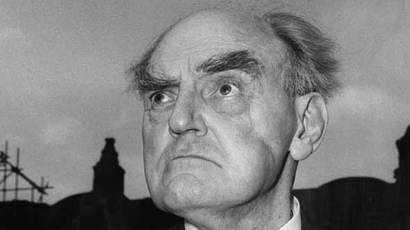 John Reith: 1st Baron Reith, KT, GCVO, GBE, CB, TD, PC (20 July 1889 – 16 June 1971)