

What do you think?

The Pacific War Trilogy #2
The Conquering Tide: War in the Pacific Islands, 1942–1944
The devastation of Pearl Harbor and the American victory at Midway were prelude to a greater challenge: rolling back the vast Japanese Pacific empire, island by island.
This masterful history encompasses the heart of the Pacific War—the period between mid-1942 and mid-1944—when parallel Allied counteroffensives north and south of the equator washed over Japan's far-flung island empire like a "conquering tide," concluding with Japan's irreversible strategic defeat in the Marianas. It was the largest, bloodiest, most costly, most technically innovative and logistically complicated amphibious war in history, and it fostered bitter interservice rivalries, leaving wounds that even victory could not heal.
Often overlooked, these are the years and fights that decided the Pacific War. Ian W. Toll's battle scenes—in the air, at sea, and in the jungles—are simply riveting. He also takes the reader into the wartime councils in Washington and Tokyo where politics and strategy often collided, and into the struggle to mobilize wartime production, which was the secret of Allied victory. Brilliantly researched, the narrative is propelled and colored by firsthand accounts—letters, diaries, debriefings, and memoirs—that are the raw material of the telling details, shrewd judgment, and penetrating insight of this magisterial history.
This volume—continuing the "marvelously readable dramatic narrative" (San Francisco Chronicle) of Pacific Crucible—marks the second installment of the Pacific War Trilogy, which will stand as the first history of the entire Pacific War to be published in at least twenty-five years.
682 pages, Kindle Edition
First published September 21, 2015
About the author
Ian W. Toll
10 books811 followersIan W. Toll, is the author of Pacific Crucible: War at Sea in the Pacific, 1941-1942 and Six Frigates: The Epic History of the Founding of the U.S. Navy, winner of the Samuel Eliot Morison Award and the William E. Colby Award. He lives in San Francisco and New York.
Ratings & Reviews
Friends & Following
Create a free account to discover what your friends think of this book!
Community Reviews
Displaying 1 - 30 of 605 reviews

May 25, 2016
“On October 29, [1943, Carl] Moore and the Fifth Fleet staff worked late into the night to complete the final product. The Galvanic operations plan ran to 324 pages and weighed three pounds. A platoon of marines was rounded up to perform the careful work of mimeographing, collating, and binding 300 copes. At 5:00 a.m., they were finished. Couriers began distributing copies to commands and ships throughout the Navy Yard. Copies were boarded on planes to be flown to New Zealand, Noumea, Efate, Funafuti, and Samoa. Moore, dog-tired and mentally shattered, wrote his wife on the morning of the thirtieth: ‘The heartbreaking struggle is over.’ But the real heartbreak, as he was to reflect many years later, awaited in Tarawa lagoon…”
- Ian Toll, The Conquering Tide: War in the Pacific Islands, 1942-1944
When I finished Ian Toll’s Pacific Crucible in 2013, I had only one wish: to win the lottery. Secondarily, I hoped that Toll would write a sequel. As it turns out, one of my wishes came true.
The Conquering Tide is the follow-up to Pacific Crucible. More than a mere sequel, it is actually the second in a proposed trilogy covering the Pacific Theater of Operations during World War II. Volume I covered 1941-42 and focused chiefly on the Battle of the Coral Sea and the Battle of Midway. Volume II covers the years from 1942 to 1944 and follows the United States as she shifts from a defensive to an offensive posture.
Like its predecessor, The Conquering Tide masterfully delivers on all levels, from strategic considerations to biographical sketches to battle narrative. It is a worthy follow-up in just about every respect. Moreover, unlike other series such as Martin’s A Song of Ice and Fire and Caro’s The Years of Lyndon Johnson, this one is actually on schedule for completion.
The Conquering Tide picks up directly where Pacific Crucible ends, in the wake of the great American victory at Midway. The Battle of Midway proved disastrous – though not fatal – to Japan. The Japanese Navy lost four aircraft carriers, nearly 300 planes, many of her best pilots, and the sense of invincible inevitability she had carried since Pearl Harbor. Despite its obvious importance, Midway was not the “turning point” that history has made it out to be. It was a defensive fight, dictated by Admiral Isoroku Yamamoto who conceived the vast design as a way of forcing America to the bargaining table.

A map of the Pacific Theater Area of Operations. A lot of blood was shed for specks you can barely see
The United States’ defensive alignment in the Pacific kept with President Roosevelt’s Europe-first principle. According to the President’s wishes, the fight against Germany received priority in men and materiel. That did not sit well with the U.S. Navy, which wanted a bigger role. Prodded by the steely, belligerent Admiral Ernest King (“direct to the point of obnoxiousness” and – in Eisenhower’s words – a “mental bully”), the United States began consolidating its forces to strike back.
The first blow would fall in the southern Solomon Islands, at a place no one had ever heard of called Guadalcanal. The location was chosen to deny the Japanese use of the Solomons, from which they could threaten Allied supply lines to Australia. The invasion of Guadalcanal gained impetus when the U.S. learned that the Japanese were building an airfield on the island. What followed was a protracted and wide-ranging fight, in the jungles, at sea, and in the air. For the Japanese, it became a south-of-the-equator Verdun; the more men they sank into it, the more valuable it became. For the Americans, it was a costly proving ground. Ashore, poorly supplied Marines were stretched to breaking. At sea, the Japanese skill in night fighting resulted in several stunning victories in battles reminiscent of the muzzle-to-muzzle slugfests of the 19th century.
The Guadalcanal Campaign is The Conquering Tide’s big set-piece, taking up the first several hundred pages (out of 542 pages of text). It is the most detailed of the campaigns that Toll covers. After Guadalcanal, MacArthur and Halsey mopped up in the Solomons while Nimitz unleashed his amphibious Central Pacific push against the Gilbert (where the battle for Tarawa took place), Marshall, and Marianas Islands. The Conquering Tide concludes with the bloody invasion of Saipan and the naval Battle of the Philippine Sea. Saipan is a fitting bookend, portending the fearsome island-fighting to come at places like Peleliu, Iwo Jima, and Okinawa.
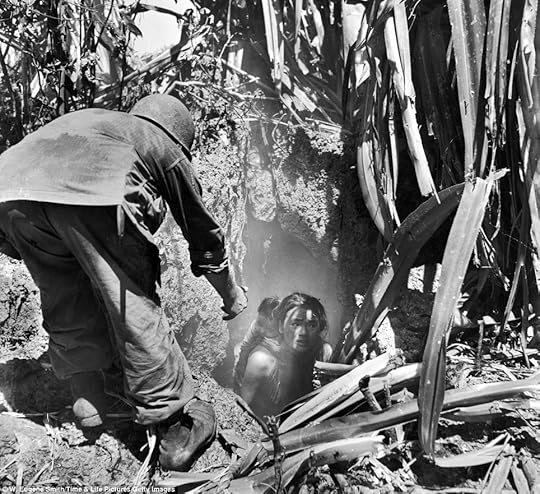
A civilian helped from her hiding place on the island of Saipan. Saipan cruelly prefigured the devastating slaughter at Okinawa
(Admission: I think I liked this a bit less than Pacific Crucible, and it's mostly because of the amount of time spent at Guadalcanal. A lot of this story felt already-told. Much of this ground has been well covered by very vivid writers, such as James Hornfischer in Neptune's Inferno).
More than just the tactics, Toll covers a seedier side to the war, the glory-hoarding, glory-hunting inter-service rivalry between the Army, the Navy, and the Army Air Force. The bitter squabbles of service roles is a major theme of Toll’s work. It’s not an unremarked upon feature in other histories. In Europe, for instance, much as been made of the rivalry between Bradley and Patton on one hand, and Bernard Montgomery on the other. Here, though, it is Americans bickering with Americans over who is going to win the laurels. MacArthur and the Army wanted to roll up the northern Solomons, recapture New Guinea, and finally return to the Philippines, where MacArthur had infamously promised to return. Nimitz wanted a thrust in the Central Pacific. Both eventually got their way, leading to the obvious questions regarding necessity. Did young men die because generals and admirals wanted bigger budgets, shinier medals on their chests, and promotions? The answer is yes. The military is like any other profession, filled with ambitious strivers seeking to achieve the most from their career. Unlike other jobs, though, decisions made by military men have lethal consequences. Of all the men Toll writes about, it is Admiral Nimitz who comes out looking the best. He is the Pacific counterpart to Eisenhower, a man not especially known for tactical brilliance, but of supreme temperament.
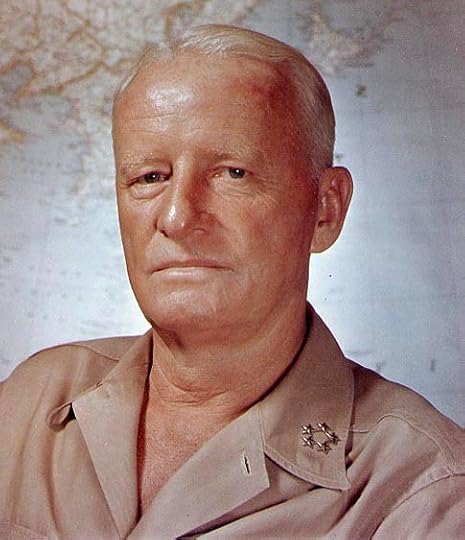
Admiral Nimitz. He liked to play horseshoes and looked funny in shorts
Toll is at his absolute best when he finds the stories within the stories. Throughout the book, he will give you a mini-arc about an individual or group of men that brings home the immediacy of war. For example, he starts the book with a gripping portrayal of coastal watchers in the Solomons. These men were able to both elude the Japanese soldiers hunting them, while also passing on vital intelligence to the Allies. In the middle of The Conquering Tide, Toll follows the crew of the submarine Wahoo as it embarks on an eventful war patrol. Did this journey by a solitary submarine win the war? No. But it is a white-knuckle ride that is fascinating to read, while also demonstrating the larger importance of submarines in the victory over Japan.
Beyond the battles (which he does extremely well) Toll does not neglect other aspects of the Pacific War. He does a great job contrasting U.S. armaments production and shipbuilding (assembly lines, technological innovation) with that of the Japanese (who, as Toll describes, had to use ox-teams to drag completed Zero fighter planes to embarkation points). Military history is often written as the story of small groups of heroic fighters. There is some truth to that, of course. But in World War II, it was logistics that ultimately won the day. That was never clearer than in the Pacific, where the U.S. Navy began multiplying like rabbits, while the Japanese fleet withered, some of her biggest vessels kept in harbor due to dwindling oil stocks.
Speaking of contrasts, Toll also gives us a comparison of ports-of-call. His descriptions of liberty in Brisbane or Melbourne verses San Francisco is pretty entertaining. The so-called Battle of Brisbane, a drunken riot between U.S. and Australian servicemen, is a humorous interlude in an otherwise grim war.
The Conquering Tide advertises itself as a comprehensive land-sea-air treatment. This is technically true. Toll does describe the various fights on land; however, this is done in a far more cursory fashion than the naval engagements. (I mean, how do you devote hundreds of pages to Guadalcanal without a single reference to the 7th Marine’s Chesty Puller?). This is definitely more a naval history than anything else. That’s not a critique, just an observation.
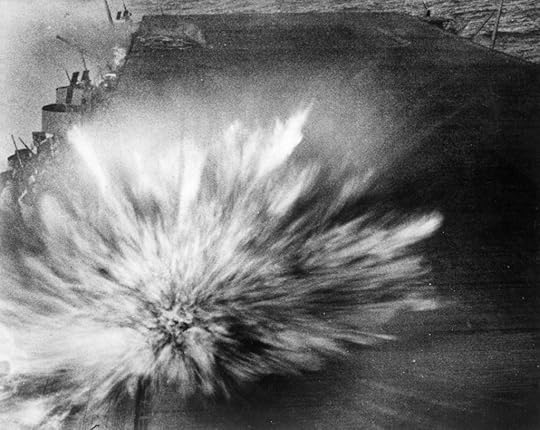
A bomb explodes on the USS Enterprise during the Battle of the Eastern Solomons
The only thing I really would have liked is chapter titles. I know, this seems like I’m reaching, but hear me out. The book is broken down into a prologue, and epilogue, and fourteen numbered chapters. That doesn’t give you any idea where the you are going, or where you have been. A good table of contents provides a roadmap for the reader. The Conquering Tide is pretty accessible, but it’s still telling a lengthy and complicated story that could have used such a framework.
Also, it's worth noting (at least for WWII buffs) that Toll is far more interested in narrative momentum than in analyzing/arguing various controversies. Toll doesn't neglect the tactical or moral debates that arose during the war, such as Admiral Fletcher's decision to move his carriers from Guadalcanal, the operation to assassinate Yamamoto, or Admiral Mitscher's celebrated move to turn on his lights to guide his airplanes home, but he doesn't give these disputes a very thorough airing. This is to the advantage of WWII newcomers, since some of these topics are insider baseball. Readers who've already consumed Samuel Eliot Morrison's 15 volume History of Naval Operations in World War II might wish for more depth.
It’s a little thing. When the bar is high, the little things matter.
Books about World War II exist in numbers rivaling the stars. The trouble isn’t finding a book to read on the subject, it’s finding a great one. It can be hard to know which titles stand apart. This is one.
Recently, Rick Atkinson finished his Liberation Trilogy covering the American Army in North Africa, Italy, and Europe. It’s uncontestable quality and readability will make it a standard reference for years to come. Toll is on the verge of doing the same thing for the Pacific Theater of Operations. I am confident that his final volume will complete a project that will stand in very good company.
- Ian Toll, The Conquering Tide: War in the Pacific Islands, 1942-1944
When I finished Ian Toll’s Pacific Crucible in 2013, I had only one wish: to win the lottery. Secondarily, I hoped that Toll would write a sequel. As it turns out, one of my wishes came true.
The Conquering Tide is the follow-up to Pacific Crucible. More than a mere sequel, it is actually the second in a proposed trilogy covering the Pacific Theater of Operations during World War II. Volume I covered 1941-42 and focused chiefly on the Battle of the Coral Sea and the Battle of Midway. Volume II covers the years from 1942 to 1944 and follows the United States as she shifts from a defensive to an offensive posture.
Like its predecessor, The Conquering Tide masterfully delivers on all levels, from strategic considerations to biographical sketches to battle narrative. It is a worthy follow-up in just about every respect. Moreover, unlike other series such as Martin’s A Song of Ice and Fire and Caro’s The Years of Lyndon Johnson, this one is actually on schedule for completion.
The Conquering Tide picks up directly where Pacific Crucible ends, in the wake of the great American victory at Midway. The Battle of Midway proved disastrous – though not fatal – to Japan. The Japanese Navy lost four aircraft carriers, nearly 300 planes, many of her best pilots, and the sense of invincible inevitability she had carried since Pearl Harbor. Despite its obvious importance, Midway was not the “turning point” that history has made it out to be. It was a defensive fight, dictated by Admiral Isoroku Yamamoto who conceived the vast design as a way of forcing America to the bargaining table.
A map of the Pacific Theater Area of Operations. A lot of blood was shed for specks you can barely see
The United States’ defensive alignment in the Pacific kept with President Roosevelt’s Europe-first principle. According to the President’s wishes, the fight against Germany received priority in men and materiel. That did not sit well with the U.S. Navy, which wanted a bigger role. Prodded by the steely, belligerent Admiral Ernest King (“direct to the point of obnoxiousness” and – in Eisenhower’s words – a “mental bully”), the United States began consolidating its forces to strike back.
The first blow would fall in the southern Solomon Islands, at a place no one had ever heard of called Guadalcanal. The location was chosen to deny the Japanese use of the Solomons, from which they could threaten Allied supply lines to Australia. The invasion of Guadalcanal gained impetus when the U.S. learned that the Japanese were building an airfield on the island. What followed was a protracted and wide-ranging fight, in the jungles, at sea, and in the air. For the Japanese, it became a south-of-the-equator Verdun; the more men they sank into it, the more valuable it became. For the Americans, it was a costly proving ground. Ashore, poorly supplied Marines were stretched to breaking. At sea, the Japanese skill in night fighting resulted in several stunning victories in battles reminiscent of the muzzle-to-muzzle slugfests of the 19th century.
The Guadalcanal Campaign is The Conquering Tide’s big set-piece, taking up the first several hundred pages (out of 542 pages of text). It is the most detailed of the campaigns that Toll covers. After Guadalcanal, MacArthur and Halsey mopped up in the Solomons while Nimitz unleashed his amphibious Central Pacific push against the Gilbert (where the battle for Tarawa took place), Marshall, and Marianas Islands. The Conquering Tide concludes with the bloody invasion of Saipan and the naval Battle of the Philippine Sea. Saipan is a fitting bookend, portending the fearsome island-fighting to come at places like Peleliu, Iwo Jima, and Okinawa.
A civilian helped from her hiding place on the island of Saipan. Saipan cruelly prefigured the devastating slaughter at Okinawa
(Admission: I think I liked this a bit less than Pacific Crucible, and it's mostly because of the amount of time spent at Guadalcanal. A lot of this story felt already-told. Much of this ground has been well covered by very vivid writers, such as James Hornfischer in Neptune's Inferno).
More than just the tactics, Toll covers a seedier side to the war, the glory-hoarding, glory-hunting inter-service rivalry between the Army, the Navy, and the Army Air Force. The bitter squabbles of service roles is a major theme of Toll’s work. It’s not an unremarked upon feature in other histories. In Europe, for instance, much as been made of the rivalry between Bradley and Patton on one hand, and Bernard Montgomery on the other. Here, though, it is Americans bickering with Americans over who is going to win the laurels. MacArthur and the Army wanted to roll up the northern Solomons, recapture New Guinea, and finally return to the Philippines, where MacArthur had infamously promised to return. Nimitz wanted a thrust in the Central Pacific. Both eventually got their way, leading to the obvious questions regarding necessity. Did young men die because generals and admirals wanted bigger budgets, shinier medals on their chests, and promotions? The answer is yes. The military is like any other profession, filled with ambitious strivers seeking to achieve the most from their career. Unlike other jobs, though, decisions made by military men have lethal consequences. Of all the men Toll writes about, it is Admiral Nimitz who comes out looking the best. He is the Pacific counterpart to Eisenhower, a man not especially known for tactical brilliance, but of supreme temperament.
Admiral Nimitz. He liked to play horseshoes and looked funny in shorts
Toll is at his absolute best when he finds the stories within the stories. Throughout the book, he will give you a mini-arc about an individual or group of men that brings home the immediacy of war. For example, he starts the book with a gripping portrayal of coastal watchers in the Solomons. These men were able to both elude the Japanese soldiers hunting them, while also passing on vital intelligence to the Allies. In the middle of The Conquering Tide, Toll follows the crew of the submarine Wahoo as it embarks on an eventful war patrol. Did this journey by a solitary submarine win the war? No. But it is a white-knuckle ride that is fascinating to read, while also demonstrating the larger importance of submarines in the victory over Japan.
Beyond the battles (which he does extremely well) Toll does not neglect other aspects of the Pacific War. He does a great job contrasting U.S. armaments production and shipbuilding (assembly lines, technological innovation) with that of the Japanese (who, as Toll describes, had to use ox-teams to drag completed Zero fighter planes to embarkation points). Military history is often written as the story of small groups of heroic fighters. There is some truth to that, of course. But in World War II, it was logistics that ultimately won the day. That was never clearer than in the Pacific, where the U.S. Navy began multiplying like rabbits, while the Japanese fleet withered, some of her biggest vessels kept in harbor due to dwindling oil stocks.
Speaking of contrasts, Toll also gives us a comparison of ports-of-call. His descriptions of liberty in Brisbane or Melbourne verses San Francisco is pretty entertaining. The so-called Battle of Brisbane, a drunken riot between U.S. and Australian servicemen, is a humorous interlude in an otherwise grim war.
The Conquering Tide advertises itself as a comprehensive land-sea-air treatment. This is technically true. Toll does describe the various fights on land; however, this is done in a far more cursory fashion than the naval engagements. (I mean, how do you devote hundreds of pages to Guadalcanal without a single reference to the 7th Marine’s Chesty Puller?). This is definitely more a naval history than anything else. That’s not a critique, just an observation.
A bomb explodes on the USS Enterprise during the Battle of the Eastern Solomons
The only thing I really would have liked is chapter titles. I know, this seems like I’m reaching, but hear me out. The book is broken down into a prologue, and epilogue, and fourteen numbered chapters. That doesn’t give you any idea where the you are going, or where you have been. A good table of contents provides a roadmap for the reader. The Conquering Tide is pretty accessible, but it’s still telling a lengthy and complicated story that could have used such a framework.
Also, it's worth noting (at least for WWII buffs) that Toll is far more interested in narrative momentum than in analyzing/arguing various controversies. Toll doesn't neglect the tactical or moral debates that arose during the war, such as Admiral Fletcher's decision to move his carriers from Guadalcanal, the operation to assassinate Yamamoto, or Admiral Mitscher's celebrated move to turn on his lights to guide his airplanes home, but he doesn't give these disputes a very thorough airing. This is to the advantage of WWII newcomers, since some of these topics are insider baseball. Readers who've already consumed Samuel Eliot Morrison's 15 volume History of Naval Operations in World War II might wish for more depth.
It’s a little thing. When the bar is high, the little things matter.
Books about World War II exist in numbers rivaling the stars. The trouble isn’t finding a book to read on the subject, it’s finding a great one. It can be hard to know which titles stand apart. This is one.
Recently, Rick Atkinson finished his Liberation Trilogy covering the American Army in North Africa, Italy, and Europe. It’s uncontestable quality and readability will make it a standard reference for years to come. Toll is on the verge of doing the same thing for the Pacific Theater of Operations. I am confident that his final volume will complete a project that will stand in very good company.

June 22, 2016
The Conquering Tide: War in the Pacific Islands, 1942-1944 is the second book in Ian W. Toll's trilogy covering the War in the Pacific. The first book Pacific Crucible: War at Sea in the Pacific, 1941-1942, covered the initial phase of war - Pearl Harbor to Midway, besides the prelude to the war. This book reviews the bulk of the Pacific campaign after Midway, during which Japan's position deteriorated from their peak ascendancy, with America reeling. The author covers the time from the beginning of the planning for the invasion of Guadalcanal in July of 1942 through to the fall of the Tojo Government after the U.S. takes the Mariana Islands in the summer of 1944. The Conquering Tide ends in 1944, leaving us expecting Toll's third volume to cover the end of the war, the planning for an invasion of Japan that never happened, the atomic bombs, and the war's aftermath.
Besides a detailed analysis of the various operations and battles, Toll does not neglect other aspects of the Pacific War. As in Pacific Crucible, he brings to life the main high-level decision-makers both American and Japanese; the leverage afforded by intelligence originated on the different islands; and the technological and strategicical advancements that give US crucial advantage:
Further on, Toll explains how the situation in Japan becomes ominous and how it affected the Japanese population. And he does it all extremely well. By nature accustomed to trusting and obeying their leaders, the Japanese people nonetheless were neither shortsighted nor passive, and while the military dictatorship strictly controlled the press and allowed only stories of glorious victories, later on of strategic withdrawals, then of "luring the enemy closer in order to destroy them once and for all" to be announced, the civilian population eventually realized that the war was not going well. As Japanese propaganda became increasingly detached from reality, it only undermined trust, especially as deprivations became more severe and civilians were told to eat less and work more, even while it was common knowledge that the army ran the black market and high-ranking officers lived with ostentatious extravangance.
But most of the book is about the military campaign, and while there is still plenty of ship-to-ship and air combat action, in the period between 1942 to 1944 we read about the bloody island hopping phase of the war, as American Marines and Japanese Imperial soldiers die by the thousands on tiny atolls none of them could name or locate on a map. Living conditions are terrible, the climate and native flora and fauna makes life miserable, and the fighting is horrible:
Besides a detailed analysis of the various operations and battles, Toll does not neglect other aspects of the Pacific War. As in Pacific Crucible, he brings to life the main high-level decision-makers both American and Japanese; the leverage afforded by intelligence originated on the different islands; and the technological and strategicical advancements that give US crucial advantage:
"By the fall of 1942, an American ship could land its first salvo on an unseen enemy without the benefit of searchlights or flares. That was a valuable technical advantage over the Japanese, and it largely offset the superior skill, training, and torpedo weaponry of the Japanese surface fleet."The author also covers the impact the war had both in the US and Japan, and he does not portray Japan as unconditionally evil or the U.S. as unquestionably the good-guys, just presents his account of what set these powers against each other and how they went at it. So we read how the political situation in Japan impact its own capacity to carry on successfully the war effort:
“The Guadalcanal campaign had exposed all of the internal rifts and rivalries that divided the Japanese military regime and paralyzed its ability to craft coherent strategies.”The American situation, on the other hand, enhanced with the passing of time after the first impact of Pearl Harbor. Dominance, among other circunstances, was supported through the fulfillment of its enormous industrial capacity.
Further on, Toll explains how the situation in Japan becomes ominous and how it affected the Japanese population. And he does it all extremely well. By nature accustomed to trusting and obeying their leaders, the Japanese people nonetheless were neither shortsighted nor passive, and while the military dictatorship strictly controlled the press and allowed only stories of glorious victories, later on of strategic withdrawals, then of "luring the enemy closer in order to destroy them once and for all" to be announced, the civilian population eventually realized that the war was not going well. As Japanese propaganda became increasingly detached from reality, it only undermined trust, especially as deprivations became more severe and civilians were told to eat less and work more, even while it was common knowledge that the army ran the black market and high-ranking officers lived with ostentatious extravangance.
But most of the book is about the military campaign, and while there is still plenty of ship-to-ship and air combat action, in the period between 1942 to 1944 we read about the bloody island hopping phase of the war, as American Marines and Japanese Imperial soldiers die by the thousands on tiny atolls none of them could name or locate on a map. Living conditions are terrible, the climate and native flora and fauna makes life miserable, and the fighting is horrible:
“Colonel Shoup, who wore a mask of dust and dirt like every other marine on the island, summed up the situation that afternoon: “Well, I think we’re winning, but the bastards have got a lot of bullets left. I think we’ll clean up tomorrow.” He was plainly exhausted, having slept not at all the previous night. He was still bleeding through his bandage. His report to General Julian Smith would enter Marine Corps lore: “Casualties many; percentage of dead not known; combat efficiency: We are winning.”Ultimately, conquering of the Marianas was essential to American objectives. And the Tinian island was to be the major airbase to the Twentieth Air Force, which would eventually operate more than 1,000 B-29 Superfortresses:
"Though Americans were slow to appreciate it, they had just won the decisive victory of the Pacific War. Capature of the Marianas and the accompanying ruin of the Japanese carrier airpower were final and irreversible blows to the hopes of the Japanese imperial project.”To conclude, I found The Conquering Tide an excellent overview of the middle two years of the War in the Pacific.

March 14, 2016
I read this book a few weeks ago while on vacation. I was accused of being anti-social because all I wanted to do was sit on the beach or by the pool and finish this book. Yes, I’m a little anti-social but the truth is I couldn’t put it down.
This is Part II of Ian Toll’s Pacific trilogy. Part II covers Guadalcanal to Guam. I enjoyed it more than Part I (The Pacific Crucible), because Part II covers the war instead of delving into page after page of background information about the decision makers from both sides such as Yamamoto, King, Nimitz, Roosevelt etc. Details about Yamamoto’s love for his geisha were taken care of in Part I. Part II is mostly action packed.
Even though I consider myself an avid reader of Military History and a student of the Pacific, I found that there was still much to be learned from Ian Toll about the war. For example, I realize that the situation was desperate on Guadalcanal. However, I did not realize that Admiral Ghormley had given permission to Vandergrift to surrender the 1st Marine Division if necessary. Ghormley was sacked in favor of Halsey not a moment too soon. I really enjoyed the chapters on Guadalcanal but I would strongly encourage reading Hornfischer’s Neptune’s inferno as a supplement to the naval battles. Toll covers a few of the naval engagements very well but for others he merely scratches the surface. Likewise, if you would like to read a supplement for the air campaign than I would recommend Lundstrom’s the First Team Part II, the Guadalcanal Campaign. Also, Frank’s classic is a must read for a comprehensive book on the battle. But still, Toll does a solid job without devouting an entire book to that battle.
After Guadalcanal, the Japanese high command and the Imperial family had hoped for a single miraculous victory so that the United States would agree to negotiate. They thought maybe they could hold onto the monarchy and some of their territory? What became clear to me was that after Guadalcanal the Japanese did not have a razor thin chance of successfully defending any of their territory. In my mind, the Japanese high command and Hirohito were responsible for the needless sacrifice of millions of Japanese in a lost cause.
Toll charges Emperor Hirohito as being complicit and culpable for his support of this bloody war. Toll said that after the war the emperor tried to pretend that he was just a figure head or a puppet. The emperor was in on the strategic decision making. Also, after the early victories, when Japan was still drunk with success, the emperor would appear sitting on his white horse in front of the imperial gates so the Japanese people could cheer for him. He loved it.
The other new piece of information for me was that the British seemed to be selfishly urging the U.S. to slow down their progress in the Pacific because they were not ready to participate. The British wanted to be involved so that they could be seen out front and alongside the Americans while reclaiming their empire. After the success at Guadalcanal the defeat Germany first plan seemed to be compromised a bit to the chagrin of the British. The British were urging caution to slow the US down and not because they thought that caution should be heeded or resources were needed for the European theatre but because the British weren’t ready to reclaim their empire. My thinking was first the British Empire cowardly surrendered Singapore without firing a shot and now this? What a disgrace.
At times the chapters read like vignettes. This is Toll’s style of writing and I happen to like it very much. For example there is a very interesting chapter about the submarine war (for more information about the sub war read Clay Blair’s Silent Victory) there are chapters about life on the West Coast, another about Australia, Washington D.C., and Pearl Harbor. Pearl Harbor was considered one of the worst duty stations. Some of the populated towns of Australia like Brisbane were the best. The latter was because of the “Shelia’s” that were throwing themselves at the Americans. Toll gives you a feel for all of these things and there still is plenty of pages dedicated to Tarawa, Kwajalein, Saipan, the Marianas Turkey Shoot, the raid on Truck, and Guam, all tied together like only a few authors can. I rank Toll right up there with Atkinson, Hornfischer, Foote, Kegan, Catton, Sides, and Sears.
By 44, the US Navy’s Brown Shoe officers (the aviators) have wrestled away control of the carriers from the Black Shoe officers (surface navy/Big Gun Club). The Hellcat is introduced, and it is a better plane in every respect to the Zero. The lessons of Tarawa were learned and applied to future battles…for example, at Kwajalein it is estimated that half of the Japanese combatants were killed by the pre-invasion bombardment. The problems with the USN torpedoes are fixed. Also, there will be no more timid US carrier demonstrations because there were always 9 or 10 carriers in theater. Any further resistance by the Japanese was just plain murder. While the resources of the Americans were increasing exponentially, Toll claims that the oxen used to pull new Zeros 20 miles to the nearest airport or shipping point were dropping dead from exhaustion and causing a bottleneck in the plant! That is how bad it was for the Japanese at this point and yet they fought on. Hirohito most rightfully should have been hanged for urging his military to hold out.
Lastly, I would like to just say a few words about Medal of Honor winner, Marine Lieutenant William D. Hawkins of Texas who was killed on Tarawa. Toll gives Lt. Hawkins his due. Hawkins single handedly knocked out several pill boxes and machine gun nests on Tarawa and he refused to be evacuated for his wounds. Instead, he commandeered a half track, gathered the remnants of his platoon and charged into the teeth of several more pill boxes and machine gun nests. Hawkins road that halftrack like a chariot using the .50 caliber machine gun as his lance. He "jousted" with several other machine guns before his luck finally ran out. The Marines of the 2nd division who witnessed that heroic act will never forget the image of Hawkins riding that halftrack to glory. Thanks to Toll, neither will the readers of this book.
The reason I read books like this in part, is to learn about men from the greatest generation that gave their last full measure of devotion for their brothers in arms. Their actions guaranteed basic rights like free speech and the right to bear arms. When you get to heaven, remember to thank Lieutenant Hawkins for his service.
I can’t wait for the third installment. Does anyone know when it will be released? Read the book.
This is Part II of Ian Toll’s Pacific trilogy. Part II covers Guadalcanal to Guam. I enjoyed it more than Part I (The Pacific Crucible), because Part II covers the war instead of delving into page after page of background information about the decision makers from both sides such as Yamamoto, King, Nimitz, Roosevelt etc. Details about Yamamoto’s love for his geisha were taken care of in Part I. Part II is mostly action packed.
Even though I consider myself an avid reader of Military History and a student of the Pacific, I found that there was still much to be learned from Ian Toll about the war. For example, I realize that the situation was desperate on Guadalcanal. However, I did not realize that Admiral Ghormley had given permission to Vandergrift to surrender the 1st Marine Division if necessary. Ghormley was sacked in favor of Halsey not a moment too soon. I really enjoyed the chapters on Guadalcanal but I would strongly encourage reading Hornfischer’s Neptune’s inferno as a supplement to the naval battles. Toll covers a few of the naval engagements very well but for others he merely scratches the surface. Likewise, if you would like to read a supplement for the air campaign than I would recommend Lundstrom’s the First Team Part II, the Guadalcanal Campaign. Also, Frank’s classic is a must read for a comprehensive book on the battle. But still, Toll does a solid job without devouting an entire book to that battle.
After Guadalcanal, the Japanese high command and the Imperial family had hoped for a single miraculous victory so that the United States would agree to negotiate. They thought maybe they could hold onto the monarchy and some of their territory? What became clear to me was that after Guadalcanal the Japanese did not have a razor thin chance of successfully defending any of their territory. In my mind, the Japanese high command and Hirohito were responsible for the needless sacrifice of millions of Japanese in a lost cause.
Toll charges Emperor Hirohito as being complicit and culpable for his support of this bloody war. Toll said that after the war the emperor tried to pretend that he was just a figure head or a puppet. The emperor was in on the strategic decision making. Also, after the early victories, when Japan was still drunk with success, the emperor would appear sitting on his white horse in front of the imperial gates so the Japanese people could cheer for him. He loved it.
The other new piece of information for me was that the British seemed to be selfishly urging the U.S. to slow down their progress in the Pacific because they were not ready to participate. The British wanted to be involved so that they could be seen out front and alongside the Americans while reclaiming their empire. After the success at Guadalcanal the defeat Germany first plan seemed to be compromised a bit to the chagrin of the British. The British were urging caution to slow the US down and not because they thought that caution should be heeded or resources were needed for the European theatre but because the British weren’t ready to reclaim their empire. My thinking was first the British Empire cowardly surrendered Singapore without firing a shot and now this? What a disgrace.
At times the chapters read like vignettes. This is Toll’s style of writing and I happen to like it very much. For example there is a very interesting chapter about the submarine war (for more information about the sub war read Clay Blair’s Silent Victory) there are chapters about life on the West Coast, another about Australia, Washington D.C., and Pearl Harbor. Pearl Harbor was considered one of the worst duty stations. Some of the populated towns of Australia like Brisbane were the best. The latter was because of the “Shelia’s” that were throwing themselves at the Americans. Toll gives you a feel for all of these things and there still is plenty of pages dedicated to Tarawa, Kwajalein, Saipan, the Marianas Turkey Shoot, the raid on Truck, and Guam, all tied together like only a few authors can. I rank Toll right up there with Atkinson, Hornfischer, Foote, Kegan, Catton, Sides, and Sears.
By 44, the US Navy’s Brown Shoe officers (the aviators) have wrestled away control of the carriers from the Black Shoe officers (surface navy/Big Gun Club). The Hellcat is introduced, and it is a better plane in every respect to the Zero. The lessons of Tarawa were learned and applied to future battles…for example, at Kwajalein it is estimated that half of the Japanese combatants were killed by the pre-invasion bombardment. The problems with the USN torpedoes are fixed. Also, there will be no more timid US carrier demonstrations because there were always 9 or 10 carriers in theater. Any further resistance by the Japanese was just plain murder. While the resources of the Americans were increasing exponentially, Toll claims that the oxen used to pull new Zeros 20 miles to the nearest airport or shipping point were dropping dead from exhaustion and causing a bottleneck in the plant! That is how bad it was for the Japanese at this point and yet they fought on. Hirohito most rightfully should have been hanged for urging his military to hold out.
Lastly, I would like to just say a few words about Medal of Honor winner, Marine Lieutenant William D. Hawkins of Texas who was killed on Tarawa. Toll gives Lt. Hawkins his due. Hawkins single handedly knocked out several pill boxes and machine gun nests on Tarawa and he refused to be evacuated for his wounds. Instead, he commandeered a half track, gathered the remnants of his platoon and charged into the teeth of several more pill boxes and machine gun nests. Hawkins road that halftrack like a chariot using the .50 caliber machine gun as his lance. He "jousted" with several other machine guns before his luck finally ran out. The Marines of the 2nd division who witnessed that heroic act will never forget the image of Hawkins riding that halftrack to glory. Thanks to Toll, neither will the readers of this book.
The reason I read books like this in part, is to learn about men from the greatest generation that gave their last full measure of devotion for their brothers in arms. Their actions guaranteed basic rights like free speech and the right to bear arms. When you get to heaven, remember to thank Lieutenant Hawkins for his service.
I can’t wait for the third installment. Does anyone know when it will be released? Read the book.

April 6, 2024
The second book of the Pacific War Trilogy is as good as the first, if not better. Picking up the tale right after the Battle of Midway in 1942, which is deftly covered in the first book, Toll delivers a high-quality blend of storytelling, analysis of strategic and tactical decisions, examination of war economies — and last but not least — descriptions of submarine, carrier, and aerial warfare. This series is my first reading of the Pacific War and it has been a very good starting point because it’s accessible, has broad scope and good depth, and also because Toll is nuanced in his approach.
I think you can dive into the trilogy even if you don’t know very much about this colossal (mostly) naval war which ultimately ended with the detonation of two atomic bombs and the surrender of Japan in 1945 which ended the hostilities and brought World War II to its end.
The biographies of major personalities and leaders that Toll has included, along with sober and fair analysis of the tough decisions that people at the top such as King, Nimitz and Yamamoto faced, make this second book (like the first) a delightful and informative read.
The Conquering Tide ends just after the second phase of the Battle of the Philippine Sea in mid-1944 which proved to be a lopsided American victory, especially in terms of lost aircraft and pilots. There was no real chance of success for Japan at this stage, but the Japanese military leaders, and its people to a certain extent, refused to accept their defeat and the war continued for more than a year with devastating loss of life for the Japanese army and population:
The writing is simple (and not high-flown), beautiful, and the books are extremely readable.
I’ve enjoyed the first two books a lot and will definitely read the last one with the eye-catching title which is the longest book in the trilogy and probably the most engaging.
I think you can dive into the trilogy even if you don’t know very much about this colossal (mostly) naval war which ultimately ended with the detonation of two atomic bombs and the surrender of Japan in 1945 which ended the hostilities and brought World War II to its end.
The biographies of major personalities and leaders that Toll has included, along with sober and fair analysis of the tough decisions that people at the top such as King, Nimitz and Yamamoto faced, make this second book (like the first) a delightful and informative read.
The Conquering Tide ends just after the second phase of the Battle of the Philippine Sea in mid-1944 which proved to be a lopsided American victory, especially in terms of lost aircraft and pilots. There was no real chance of success for Japan at this stage, but the Japanese military leaders, and its people to a certain extent, refused to accept their defeat and the war continued for more than a year with devastating loss of life for the Japanese army and population:
Malnourished and overworked, driven like a herd of beasts, instructed how to act and what to think, deprived of any sound basis for rational judgment, threatened with torture and prison at the first divergence from enforced norms, the Japanese people were powerless to alter the doomed course chosen by their leaders. Having long since surrendered whatever rights and freedoms they had once possessed, they were fated to share in the coming Götterdämmerung of 1945.
The writing is simple (and not high-flown), beautiful, and the books are extremely readable.
I’ve enjoyed the first two books a lot and will definitely read the last one with the eye-catching title which is the longest book in the trilogy and probably the most engaging.

March 21, 2025
An excellent work by Toll, covering the change in the Pacific War's momentum from Guadalcanal when the outcome was in the balance t0 1944 when it was swinging decisively against Japan.
Toll does a great job describing these events from the level of the trenches and the deckplates to the strategic level of the US President and the Joint Chiefs of Staff. I like that it gives much credit to an oft overlooked figure in World War 2 history, Fleet Admiral William D. Leahy, who was crucial as the first JCS Chairman in coordinating with the service branches a coherent strategy for prosecuting the two theater war against the Axis Powers.
Unlike other accounts of the Pacific War, to his credit, he also includes the history of the US submarine fleet in crippling the Japanese war effort.
I also like that Toll does a great job in enaging manner in describing the process by which US commanders developed the strategy for defeating Japan --- as well as their various disagreements and rivalries.
Overall, an outstanding work --- I highly recommend it for anyone desiring to know more about the Pacific War during WW2.
Toll does a great job describing these events from the level of the trenches and the deckplates to the strategic level of the US President and the Joint Chiefs of Staff. I like that it gives much credit to an oft overlooked figure in World War 2 history, Fleet Admiral William D. Leahy, who was crucial as the first JCS Chairman in coordinating with the service branches a coherent strategy for prosecuting the two theater war against the Axis Powers.
Unlike other accounts of the Pacific War, to his credit, he also includes the history of the US submarine fleet in crippling the Japanese war effort.
I also like that Toll does a great job in enaging manner in describing the process by which US commanders developed the strategy for defeating Japan --- as well as their various disagreements and rivalries.
Overall, an outstanding work --- I highly recommend it for anyone desiring to know more about the Pacific War during WW2.

December 16, 2023
Learned so much from the simple inclusion of first hand accounts from the Japanese side, from top government folks to civilian diarists in addition to the US. Toll's prose is perfect.

September 16, 2020
Ian W. Toll's The Conquering Tide picks up where Pacific Crucible left off and provides a gripping history of the central Pacific campaign.
In the decades before the raid on Pearl Harbor, the USA operated responses to Japan's agression in a series of "Orange" plans, which proposed a rapid counterattack westward across the central Pacific via the Gilbert, Marshall, Caroline, and Mariana Islands to the Philippines.
After the disaster of Pearl Harbor, the magnitude of the undertaking became even more clear, and General Douglas MacArthur, who had assumed command of Allied forces in Australia after escaping from the Philippines, suggested a different strategy. He passionately argued for a return to the Philippines through the southwest Pacific, but the U.S Navy obstinately adhered to a line of advance across the central Pacific.
Focusing on General Nimitz' theatre of war, Toll includes thorough characterizations of the Navy, Marine, and Air Force leaders. MacArthur's demands for sole leaderships as well as the bitter rivalries between the services' leaders throughout the war resulted in the division of the Pacific theatre between the Army and the Navy, greatly affecting communications and targets.
For example, all U.S submariners knew that operating in friendly waters meant virtual suicide – the U.S Navy frequently destroyed its own submarines, wrongly interpreting their singnals.
As Toll further narrates, although the Japanese had been defeated at the battles of the Coral Sea and Midway, the long arm of Japanese expansion reaching through the Solomon Islands still threatened the Allies from America's West Coast to Australia. Ernest J. King, commander in chief of the United States, was resolved not only to protect this line at all costs, but also to launch a counterattack that he hoped would exhaust Japanese resources and divert the enemy's attention from other areas of the Pacific.
Toll devotes a significant part of the book to the battle for Guadalcanal, which racked up terrible losses on both sides in men, ships, and planes. Shortly after the First Marine Division landed to retake the island, the Navy suffered one of its worst defeats in a clash with Japanese cruisers off Savo Island. Adm. King refused to retreat; meanwhile on the Japanese side, Vice Adm. Gunichi Mikawa was criticized for not attacking the American transports anchored offshore.
Toll compellingly narrates how the fighter and bomber squadrons and naval bombardments paved the way for amphibious landings during the whole battle. Several prolonged months later, Guadalcanal was firmly in American hands, and King's plan for a counteroffensive to suck in Japanese resources had been basically executed: by consuming so many cargo ships, Toll writes, the fight for Guadalcanal threatened to damage the enitire Japanese war economy, which relied primarily on the imported raw materials.
What makes Toll's book special is his skillful presentation of the both fronts. His wide view of the Pacific War is so enlightening because he reveals almost as much information about the Japanese leaders as about the American ones. As he discloses, the strategic conferences in Washington and Tokyo faced the same problems, such as the necessity to balance military needs with political realities. However, Japan was far less honest with its public: well into 1944, most Japanese civilians little of the war's progress save for the government's stories, which made all actions look as glorious victories.
After the victory at Guadalcanal, the increased U.S power was turned against the Gilbert Islands and what many believed would be an easy fight for the coral speck of Tarawa. As Toll shows, it proved anything but, and hard lessons were learned from wildly fluctuating tides, ineffective naval bombardments, and poor coordination with the air support.
Processing the lessons of Tarawa, however, Adm. Chester Nimitz, Commander in Chief of the Pacific Fleet, boldly decided to strike at the heart of the Marshall Islands. As a result, in less than three months time, his operations against the Marshall and Gilbert Islands ruined Japan's mid-Pacific barricade.
While the debate between the central Pacific line of advance and MacArthur's alternative raged on, King remained convinced that the three central Pacific islands in the Marianas held the key to victory. They were so situated that the sea lanes linking Japan to its supplies of natural resources in the East Indies could be interdicted and bases could be established for the new B-29 bombers to srike the Japanese home islands.
From that point on, Toll focuses on the conquest of the Marianas, which – he argues – was the pivotal point, the decisive victory of the Pacific War.
Toll's interspersing of personal tales of WWII with the official histories brings the action to life. He also provides a solid picture of the mindset of the Japanese: their fear of surrender, their rigidity in operational procedures, their rivalries which surpassed those of the Allies, and the adamant demands of Emperor Hirohito to fight to death.
Just as well-researched and engagingly written as the first volume, The Conquering Tide is a brilliant account of the second stage of the Pacific War and of how air and submarine power replaced the Navy's reliance on battleships.
In the decades before the raid on Pearl Harbor, the USA operated responses to Japan's agression in a series of "Orange" plans, which proposed a rapid counterattack westward across the central Pacific via the Gilbert, Marshall, Caroline, and Mariana Islands to the Philippines.
After the disaster of Pearl Harbor, the magnitude of the undertaking became even more clear, and General Douglas MacArthur, who had assumed command of Allied forces in Australia after escaping from the Philippines, suggested a different strategy. He passionately argued for a return to the Philippines through the southwest Pacific, but the U.S Navy obstinately adhered to a line of advance across the central Pacific.
Focusing on General Nimitz' theatre of war, Toll includes thorough characterizations of the Navy, Marine, and Air Force leaders. MacArthur's demands for sole leaderships as well as the bitter rivalries between the services' leaders throughout the war resulted in the division of the Pacific theatre between the Army and the Navy, greatly affecting communications and targets.
For example, all U.S submariners knew that operating in friendly waters meant virtual suicide – the U.S Navy frequently destroyed its own submarines, wrongly interpreting their singnals.
As Toll further narrates, although the Japanese had been defeated at the battles of the Coral Sea and Midway, the long arm of Japanese expansion reaching through the Solomon Islands still threatened the Allies from America's West Coast to Australia. Ernest J. King, commander in chief of the United States, was resolved not only to protect this line at all costs, but also to launch a counterattack that he hoped would exhaust Japanese resources and divert the enemy's attention from other areas of the Pacific.
Toll devotes a significant part of the book to the battle for Guadalcanal, which racked up terrible losses on both sides in men, ships, and planes. Shortly after the First Marine Division landed to retake the island, the Navy suffered one of its worst defeats in a clash with Japanese cruisers off Savo Island. Adm. King refused to retreat; meanwhile on the Japanese side, Vice Adm. Gunichi Mikawa was criticized for not attacking the American transports anchored offshore.
Toll compellingly narrates how the fighter and bomber squadrons and naval bombardments paved the way for amphibious landings during the whole battle. Several prolonged months later, Guadalcanal was firmly in American hands, and King's plan for a counteroffensive to suck in Japanese resources had been basically executed: by consuming so many cargo ships, Toll writes, the fight for Guadalcanal threatened to damage the enitire Japanese war economy, which relied primarily on the imported raw materials.
What makes Toll's book special is his skillful presentation of the both fronts. His wide view of the Pacific War is so enlightening because he reveals almost as much information about the Japanese leaders as about the American ones. As he discloses, the strategic conferences in Washington and Tokyo faced the same problems, such as the necessity to balance military needs with political realities. However, Japan was far less honest with its public: well into 1944, most Japanese civilians little of the war's progress save for the government's stories, which made all actions look as glorious victories.
After the victory at Guadalcanal, the increased U.S power was turned against the Gilbert Islands and what many believed would be an easy fight for the coral speck of Tarawa. As Toll shows, it proved anything but, and hard lessons were learned from wildly fluctuating tides, ineffective naval bombardments, and poor coordination with the air support.
Processing the lessons of Tarawa, however, Adm. Chester Nimitz, Commander in Chief of the Pacific Fleet, boldly decided to strike at the heart of the Marshall Islands. As a result, in less than three months time, his operations against the Marshall and Gilbert Islands ruined Japan's mid-Pacific barricade.
While the debate between the central Pacific line of advance and MacArthur's alternative raged on, King remained convinced that the three central Pacific islands in the Marianas held the key to victory. They were so situated that the sea lanes linking Japan to its supplies of natural resources in the East Indies could be interdicted and bases could be established for the new B-29 bombers to srike the Japanese home islands.
From that point on, Toll focuses on the conquest of the Marianas, which – he argues – was the pivotal point, the decisive victory of the Pacific War.
Toll's interspersing of personal tales of WWII with the official histories brings the action to life. He also provides a solid picture of the mindset of the Japanese: their fear of surrender, their rigidity in operational procedures, their rivalries which surpassed those of the Allies, and the adamant demands of Emperor Hirohito to fight to death.
Just as well-researched and engagingly written as the first volume, The Conquering Tide is a brilliant account of the second stage of the Pacific War and of how air and submarine power replaced the Navy's reliance on battleships.

November 18, 2018
This is a big book, well indexed and documented so that you can find any special topic that piques your interest and go on from Toll's more general recounting to more detailed material. The graphics ranging from battle maps to photos are well-chosen and very helpful.
Truth be told, I cannot recall whether I read my GR friend, Matt's, review of this book before I obtained it. https://www.goodreads.com/review/show...
I took a look at it as I was struggling with what I should write and the problem was solved: Read Matt's review. As usual, Matt is both entertaining and observant. He is a WW II junkie so he knows his stuff (as he does about WW I, etc.).
Let me only add that what made this book special to me was how delightfully detailed Toll writes about the personalities involved. And, I don't mean just the stories about the big names such as "Bull" Halsey. His nuanced description of the people of Australia covers why it was the favorite R&R location for Americans and why the Aussies took to the Yanks. Enjoy!
Truth be told, I cannot recall whether I read my GR friend, Matt's, review of this book before I obtained it. https://www.goodreads.com/review/show...
I took a look at it as I was struggling with what I should write and the problem was solved: Read Matt's review. As usual, Matt is both entertaining and observant. He is a WW II junkie so he knows his stuff (as he does about WW I, etc.).
Let me only add that what made this book special to me was how delightfully detailed Toll writes about the personalities involved. And, I don't mean just the stories about the big names such as "Bull" Halsey. His nuanced description of the people of Australia covers why it was the favorite R&R location for Americans and why the Aussies took to the Yanks. Enjoy!

December 25, 2021
A very good follow up to the first book of the trilogy! Once again, I praise the author on his ability to provide a chronological sequence of the events in the pacific war. While doing this, he presented some microcosmic events and facts that he felt were important to the reader, that helped us to understand this conflict.
He explained Guadalcanal, the internal rifts between the army and navy of both Japan and America; the battle for Tarawa, and then Guam and Saipan. So much is covered, and it is definitely worth reading.
Just to know how fanatical the Japanese were, and some of the propaganda they fed their own people is shocking and interesting.
I am glad I read this
He explained Guadalcanal, the internal rifts between the army and navy of both Japan and America; the battle for Tarawa, and then Guam and Saipan. So much is covered, and it is definitely worth reading.
Just to know how fanatical the Japanese were, and some of the propaganda they fed their own people is shocking and interesting.
I am glad I read this

February 22, 2015
Not as good as the first book in the trilogy, but well worth reading. Much of it felt like repeating old ground…uh…ocean. Still, a magnificently written history that reads like a novel. I look forward to the final installment.
But I had some beefs with Toll's narrative.
On the "did Fletcher pull the carriers out of Guadalcanal early" issue ("one of the livelier controversies of the Pacific War"), Toll makes a waive at a fair hearing, and repeats Samuel Elliot Morison's damning post-war discovery of the actual fuel state of each ship in the task force--showing Fletcher had well more than he either believed or was told.
On the other side, Toll explains that Fletcher's carriers could not have prevented the next evening's catastrophic Battle of Savo Island, and may not even have had sufficient time to launch air groups for a retribution strike on the retreating Japanese surface ships. And, yes, there were all those provisions never unloaded--though the boat tenders assigned were inadequate to do the job in 3, 4 or even 5 days; the beach plan was FUBAR from the start.
Yet, inexplicably, Toll fails seriously to explore the calculus of keeping the only two Pacific carriers in an essentially static state at "torpedo junction". This, as Fletcher, Nimitz and even Vandegrift knew, was unwise in the extreme. Other American ships soon would be slaughtered in the same spot. At that point in the war, flattops were more valuable than Jarheads; sorry about that. Omitting this discussion is the most serious flaw in Toll's book--and my initial beef.
In the end, though, Toll rightly concludes the carriers' departure schedule was so serious a tactical issue, it should have been decided in advance at a higher level--by the hapless Ghormley, if not by Nimitz himself. So, even were the carriers' withdraw precipitous (and I for one am not sure it was) it wasn't solely, or even mostly, Fletcher's fault.
Secondly, I found it odd that although Toll reported Captain Bode of Chicago was censored for his conduct in the Savo Island battle, I saw no mention in text or footnote of Bode's fate: shipped Stateside, shot himself in the temple and died immediately on April 19, 1943. Surely, this fact is relevant to the story, both on a personal level, and on the level of stress Captains of Heavy cruisers (and other surface ships) were under defending daily the slot from "the Tokyo express".
"No one event of the Guadalcanal campaign lifted morale so much as the arrival of those first planes…Vandegrift, overcome with emotion, took the hand of Major Dick Mange, commander of Marine Bombing 332, and said, 'Thank God you have come.'"
"More than any other major military commander of the Pacific War, Halsey wore his emotions on his sleeve. He wept openly, frequently, and without pretense."
AMAZING; I did not know this--from the man who erected signs outside his bases saying "Kill Japs, Kill Japs, Kill More Japs":
"Halsey (of all people) publicly criticized the decision to drop atomic bombs on Hiroshima and Nagasaki."
My third beef: Toll's analysis of the decision to kill Yamamoto is shockingly sloppy. He asserts the only two issues were (1) whether it was wrong to "assassinate" the opposing commander-in-chief in wartime; and (2) whether it was wise, on the grounds that -- since Midway -- Yamamoto had been lethargic and incompetent.
My understanding is that those two issues factored into the decision -- but the principal question was: would it give the "Ultra" game away? In other words, would the timing of the "hit" be so unlikely that the only explanation had to be that the Americans had cracked the Japanese codes--in which case the Japanese would change them, leaving the Allies blind. Only after careful consideration of this -- possibly most important of the three issues -- did CINPAC (Nimitz himself) decide the potential gain outweighed the risk.
Oh to be an American Sailor or Marine in Sydney or Melbourne:
"Girls no older than fifteen or sixteen commandeered boats and rowed out to American naval vessels anchored in Sydney Harbour. Some learned semaphore so they could get ahead of the competition by signaling incoming ships."
By comparison to Detroit aircraft assembly lines,
"[N]ewly manufactured Zeros were still being hauled away from the plant by teams of oxen.…Twenty oxen had died, and the remaining were verging on complete exhaustion.…Essential wartime deliveries of replacement aircraft thus hung on the fate of underfed beasts."
Zeros needed a complete maintenance overhaul after 150 flight hours. "By 1944, most front line fighters were shot down before they ever had a chance for a maintenance overhaul."
Don't neglect the photo section at the end. It includes an amazing pic of a basketball game in the forward elevator well of the jeep carrier USS Monterey. The ball is in mid-air at its zenith between two shirtless players contesting a rebound. The player on the left is identified as a ship's athletics officer, Lieutenant Gerald R. Ford--America's future 38th President.
But I had some beefs with Toll's narrative.
On the "did Fletcher pull the carriers out of Guadalcanal early" issue ("one of the livelier controversies of the Pacific War"), Toll makes a waive at a fair hearing, and repeats Samuel Elliot Morison's damning post-war discovery of the actual fuel state of each ship in the task force--showing Fletcher had well more than he either believed or was told.
On the other side, Toll explains that Fletcher's carriers could not have prevented the next evening's catastrophic Battle of Savo Island, and may not even have had sufficient time to launch air groups for a retribution strike on the retreating Japanese surface ships. And, yes, there were all those provisions never unloaded--though the boat tenders assigned were inadequate to do the job in 3, 4 or even 5 days; the beach plan was FUBAR from the start.
Yet, inexplicably, Toll fails seriously to explore the calculus of keeping the only two Pacific carriers in an essentially static state at "torpedo junction". This, as Fletcher, Nimitz and even Vandegrift knew, was unwise in the extreme. Other American ships soon would be slaughtered in the same spot. At that point in the war, flattops were more valuable than Jarheads; sorry about that. Omitting this discussion is the most serious flaw in Toll's book--and my initial beef.
In the end, though, Toll rightly concludes the carriers' departure schedule was so serious a tactical issue, it should have been decided in advance at a higher level--by the hapless Ghormley, if not by Nimitz himself. So, even were the carriers' withdraw precipitous (and I for one am not sure it was) it wasn't solely, or even mostly, Fletcher's fault.
Secondly, I found it odd that although Toll reported Captain Bode of Chicago was censored for his conduct in the Savo Island battle, I saw no mention in text or footnote of Bode's fate: shipped Stateside, shot himself in the temple and died immediately on April 19, 1943. Surely, this fact is relevant to the story, both on a personal level, and on the level of stress Captains of Heavy cruisers (and other surface ships) were under defending daily the slot from "the Tokyo express".
"No one event of the Guadalcanal campaign lifted morale so much as the arrival of those first planes…Vandegrift, overcome with emotion, took the hand of Major Dick Mange, commander of Marine Bombing 332, and said, 'Thank God you have come.'"
"More than any other major military commander of the Pacific War, Halsey wore his emotions on his sleeve. He wept openly, frequently, and without pretense."
AMAZING; I did not know this--from the man who erected signs outside his bases saying "Kill Japs, Kill Japs, Kill More Japs":
"Halsey (of all people) publicly criticized the decision to drop atomic bombs on Hiroshima and Nagasaki."
My third beef: Toll's analysis of the decision to kill Yamamoto is shockingly sloppy. He asserts the only two issues were (1) whether it was wrong to "assassinate" the opposing commander-in-chief in wartime; and (2) whether it was wise, on the grounds that -- since Midway -- Yamamoto had been lethargic and incompetent.
My understanding is that those two issues factored into the decision -- but the principal question was: would it give the "Ultra" game away? In other words, would the timing of the "hit" be so unlikely that the only explanation had to be that the Americans had cracked the Japanese codes--in which case the Japanese would change them, leaving the Allies blind. Only after careful consideration of this -- possibly most important of the three issues -- did CINPAC (Nimitz himself) decide the potential gain outweighed the risk.
Oh to be an American Sailor or Marine in Sydney or Melbourne:
"Girls no older than fifteen or sixteen commandeered boats and rowed out to American naval vessels anchored in Sydney Harbour. Some learned semaphore so they could get ahead of the competition by signaling incoming ships."
By comparison to Detroit aircraft assembly lines,
"[N]ewly manufactured Zeros were still being hauled away from the plant by teams of oxen.…Twenty oxen had died, and the remaining were verging on complete exhaustion.…Essential wartime deliveries of replacement aircraft thus hung on the fate of underfed beasts."
Zeros needed a complete maintenance overhaul after 150 flight hours. "By 1944, most front line fighters were shot down before they ever had a chance for a maintenance overhaul."
Don't neglect the photo section at the end. It includes an amazing pic of a basketball game in the forward elevator well of the jeep carrier USS Monterey. The ball is in mid-air at its zenith between two shirtless players contesting a rebound. The player on the left is identified as a ship's athletics officer, Lieutenant Gerald R. Ford--America's future 38th President.

May 6, 2015
In this second volume of a proposed trilogy of the World War Two in the Pacific, Mr. Toll gives the reader a well-researched, and for the most part well written look at the middle two years of the war. The author covers the time from the beginning of the planning for the invasion of Guadalcanal in July of 1942 through to the fall of the Tojo Government after the U.S. take the Mariana Islands in the summer of 1944.
Mr. Toll looks at all aspects of the war – the naval war, the air war and the island assaults by the Marines, assisted by Army forces. He also looks at the affect the war had on the home fronts, esp Japan. In telling the story of the war, the author brings to life many of the men who had to make and carry out the decisions made at the highest level.
In telling the story of the various commanders, Mr. Toll does a good job of comparing and contrasting their talents and abilities. This is especially true of Ghormley and Halsey at Guadalcanal. He also does a good job of telling the tensions between Spruance and his carrier commanders later in the war during the Mariana Islands campaign. To say the carrier commanders chafed at being told to support the people on taking islands and not go out searching for the Japanese carriers is an understatement.
In covering the Battle of the Philippine Sea, Mr. Toll looks at Adm Marc Mitscher’s famous decision to “Turn on the Lights” so his returning strike aircraft could find their way home. He makes a point of saying that this decision was not made on the spur of the moment and was well thought out, and at the time was not particularly controversial or thought to be very dangerous to the ships involved.
In addition to explaining the various battles that occurred and the strategy behind them, Mr. Toll contrasts the American and Japanese way of war. One of the ways he does this in explaining how the two Navies recruited and trained Naval Aviators. At the start of the war the Japanese were unquestionably the best naval aviators in the world. However due to the selectivity of their system, they did not have enough replacement pilots and were unable to quickly revamp their system to train more as the combat losses piled up during the Solomon Island campaign. The Americans on the other hand were able to rapidly expand their pilot acquisition programs and by 1944 totally out matched their Japanese counterparts.
The author also looks at how Japan managed the war on the home front. In looking at Japans industry he cites several examples of poor resource management. Probably the best is the Mitsubishi aircraft plant in Nagoya. The plant was not near an airfield and completed aircraft had to towed more than twenty miles by ox team to be accepted by the Navy. Mr. Toll also looks at how the civilian population was given war news and how they learned to read between the lines as the war dragged on.
The main problem I had was that sometimes the narrative doesn’t flow well. Mr. Toll will change subjects with not much of a segway. This was especially noticeable on his chapter on the U.S. Navy’s submarine campaign.
To sum up my feelings, this is not quite as good as the first book in the trilogy, but an excellent overview of the middle two years of the War in the Pacific never the less. However it does suffer a bit from a choppy narrative. A solid 4 star rating.
Mr. Toll looks at all aspects of the war – the naval war, the air war and the island assaults by the Marines, assisted by Army forces. He also looks at the affect the war had on the home fronts, esp Japan. In telling the story of the war, the author brings to life many of the men who had to make and carry out the decisions made at the highest level.
In telling the story of the various commanders, Mr. Toll does a good job of comparing and contrasting their talents and abilities. This is especially true of Ghormley and Halsey at Guadalcanal. He also does a good job of telling the tensions between Spruance and his carrier commanders later in the war during the Mariana Islands campaign. To say the carrier commanders chafed at being told to support the people on taking islands and not go out searching for the Japanese carriers is an understatement.
In covering the Battle of the Philippine Sea, Mr. Toll looks at Adm Marc Mitscher’s famous decision to “Turn on the Lights” so his returning strike aircraft could find their way home. He makes a point of saying that this decision was not made on the spur of the moment and was well thought out, and at the time was not particularly controversial or thought to be very dangerous to the ships involved.
In addition to explaining the various battles that occurred and the strategy behind them, Mr. Toll contrasts the American and Japanese way of war. One of the ways he does this in explaining how the two Navies recruited and trained Naval Aviators. At the start of the war the Japanese were unquestionably the best naval aviators in the world. However due to the selectivity of their system, they did not have enough replacement pilots and were unable to quickly revamp their system to train more as the combat losses piled up during the Solomon Island campaign. The Americans on the other hand were able to rapidly expand their pilot acquisition programs and by 1944 totally out matched their Japanese counterparts.
The author also looks at how Japan managed the war on the home front. In looking at Japans industry he cites several examples of poor resource management. Probably the best is the Mitsubishi aircraft plant in Nagoya. The plant was not near an airfield and completed aircraft had to towed more than twenty miles by ox team to be accepted by the Navy. Mr. Toll also looks at how the civilian population was given war news and how they learned to read between the lines as the war dragged on.
The main problem I had was that sometimes the narrative doesn’t flow well. Mr. Toll will change subjects with not much of a segway. This was especially noticeable on his chapter on the U.S. Navy’s submarine campaign.
To sum up my feelings, this is not quite as good as the first book in the trilogy, but an excellent overview of the middle two years of the War in the Pacific never the less. However it does suffer a bit from a choppy narrative. A solid 4 star rating.

August 22, 2022
In this second part of the Pacific War Trilogy, Ian W. Toll relates the politics and battles between the US and Japan in the period from mid-1942 to mid-1944. This is the period where the US starts to roll over the Japanese empire as a 'conquering tide' concluding with Japan's irreversible strategic defeat in the Marianas. Again, a good mix between high strategy and the boots on the ground where Ian W. Toll manage to captivate the reader - a masterpiece.

May 5, 2020
Ian Toll is one of my favorite Naval History authors. I've now read three of his book and they are all 5 star books.
This is the second book in a three part series on the Pacific Theater during World War 2. It starts off shortly after the Battle of Midway and ends shortly after the conquering of Saipan. In essence the meat of the Pacific Campaign.
I forget whom Toll is quoting, but anybody who served in the Pacific after 1944 experienced a different scenario than those who served there before hand. Between 1942 and 44, the Pacific was a meat grinder. The United States bore the brunt of the responsibility for containing Japan.
While Japan had been hurt at Midway and started fighting a defensive battle, the final results were not assured. There were several key battles that could have shifted the balance of power back to Japan.
One of those battles was the Battle of Savo Island.
The United States had started a major military campaign in Guadal Canal. This campaign would last for months and would establish Admiral King's strategy in the Pacific.
In the early days of the battle, a Japanese Admiral Mikawa lead a small fleet of 8 ships in a night time raid of the waters around Savo Island. The US had over 23 ships (including 6 heavy cruisers) in the area. Mikawa's ships slipped past the America patrol boats and surprised the American Fleet. As the Japanese had surprise and better night tactics, the Japanese inflicted heavy damages on the Americans. 4 of the 6 heavy cruisers were lost in one of the biggest battles of surface ships in the Pacific. The Japanese fleet escaped with minor damages.
What the Japanese didn't realize is that had they pressed the attack, then they could have sunk or destroyed a number landing ships that were heavily loaded with supplies. These supplies and ships arguably made the difference at Guadal Canal. Mikawa chose to withdraw because he feared the US Carrier Planes would be able to pursue and destroy his fleet. What Mikawa didn't know is that the US Carrier force was out of position and could not engage.
Had Mikawa destroyed the transports, King's strategy may have never been developed and a different approach might be been used.
There were other battles, but Guadal Canal was of particular interest to me. In part, because of General Alexander M Patch's involvement. I went to Alexander M Patch American High School, so when I see his name I pay attention.
This is the second book in a three part series on the Pacific Theater during World War 2. It starts off shortly after the Battle of Midway and ends shortly after the conquering of Saipan. In essence the meat of the Pacific Campaign.
I forget whom Toll is quoting, but anybody who served in the Pacific after 1944 experienced a different scenario than those who served there before hand. Between 1942 and 44, the Pacific was a meat grinder. The United States bore the brunt of the responsibility for containing Japan.
While Japan had been hurt at Midway and started fighting a defensive battle, the final results were not assured. There were several key battles that could have shifted the balance of power back to Japan.
One of those battles was the Battle of Savo Island.
The United States had started a major military campaign in Guadal Canal. This campaign would last for months and would establish Admiral King's strategy in the Pacific.
In the early days of the battle, a Japanese Admiral Mikawa lead a small fleet of 8 ships in a night time raid of the waters around Savo Island. The US had over 23 ships (including 6 heavy cruisers) in the area. Mikawa's ships slipped past the America patrol boats and surprised the American Fleet. As the Japanese had surprise and better night tactics, the Japanese inflicted heavy damages on the Americans. 4 of the 6 heavy cruisers were lost in one of the biggest battles of surface ships in the Pacific. The Japanese fleet escaped with minor damages.
What the Japanese didn't realize is that had they pressed the attack, then they could have sunk or destroyed a number landing ships that were heavily loaded with supplies. These supplies and ships arguably made the difference at Guadal Canal. Mikawa chose to withdraw because he feared the US Carrier Planes would be able to pursue and destroy his fleet. What Mikawa didn't know is that the US Carrier force was out of position and could not engage.
Had Mikawa destroyed the transports, King's strategy may have never been developed and a different approach might be been used.
There were other battles, but Guadal Canal was of particular interest to me. In part, because of General Alexander M Patch's involvement. I went to Alexander M Patch American High School, so when I see his name I pay attention.

February 6, 2022
The second volume in this epic trilogy, this volume serves its purpose well. The author details the Pacific front of WW2, including the Saipan and Marianas campaigns. What I really like about the series is the attention to detail the author embodies in the writing. I also liked the firsthand accounts that were included in the book. This volume fully lives up to its high Goodreads rating. An excellent volume.

September 22, 2015
The Conquering Tide is the second book in Ian Toll's epic non-fiction series covering the entire War in the Pacific. The first book Pacific Crucible, covered 1941 and 1942 - Pearl Harbor to Midway, plus the prelude to the war. This book covers the bulk of the Pacific campaign after Midway, during which Japan's position deteriorated from their peak ascendancy, with America reeling, the Dutch East Indies under Japanese control, and Commonwealth nations from India to Australia threatened by invasion, to the dire straights the Japanese inevitably found themselves in only a couple of years later, with attrition and America's vastly superior industrial might combining with frankly stupid and outmoded attitudes among the Japanese high command to bring about a defeat that Admiral Yamamoto foresaw from the beginning.
The Conquering Tide ends in 1944, leaving Toll's third volume to cover the end of the war, the planning for an invasion of Japan that never happened, the atomic bombs, and the aftermath.
This is one of those big multi-volume epics that may be daunting to someone who's not a historian, but I encourage anyone with any interest in World War II, and the Pacific War in particular, to tackle Ian Toll's entire series, of which only the first two books are out yet and this is the second. The first book had me preordering the second as soon as I finished it, and now I eagerly await the third. Large as they are, these books don't read like dense historical textbooks. They are energetic and detailed accounts of the men who fought the war on both sides, with the most attention given to the commanders, of course, but also describing battles in detail, from eyewitness accounts and after-action reports, so the reader gets a grand view of the entire campaign, but also zooms in to the torpedo-bombing of individual ships, and the wartime lives of Americans and Japanese.
The first book included a great deal of political background - what led Japan to its fateful (and catastrophic) decision to go to war with the U.S., and how the entire country went from rising modern nation to nationalist imperial power forswearing all the civilized principles they had previously subscribed to. Everyone knows, or should know, about Japanese atrocities committed during the war, a subject Toll refers to only in passing for the most part, but what was also mentioned in the first volume was that up until World War II, and during the Sino-Russian war in particular, the Japanese scrupulously adhered to international rules of war, and were known for treating their POWs with the utmost respect. So what happened?
There's less about Anglo-American politics in this book, the relationship between FDR and Churchill being largely covered in the first, but as the situation on the Japanese homefront becomes more dire, Toll describes how it affected the Japanese population. By nature accustomed to trusting and obeying their leaders, the Japanese people nonetheless were neither stupid nor passive sheep, and while the military dictatorship strictly controlled the press and allowed only stories of glorious victories, then "strategic withdrawals," then "luring the enemy closer in order to destroy them once and for all" to be broadcast, the civilian population eventually realized that the war was not going well. (The authorities also couldn't cover up all the bodies coming home, and while returning sailors, soldiers, and airmen were expected to keep their mouths shut, word got out.) As Japanese propaganda became increasingly detached from reality, it only undermined trust, especially as deprivations became more severe and civilians were told to eat less and work more, even while it was common knowledge that the army ran the black market and high-ranking officers were still enjoying fine dining and geishas.
But that's only part of the book - most of it is about the military campaign, and while there is still plenty of ship-to-ship and air combat action, in '42 to '44 we enter the bloody island-hopping phase of the war, and American Marines and Japanese Imperial soldiers die by the thousands on tiny atolls none of them could name or locate on a map. Their living conditions are terrible, the climate and native flora and fauna makes life miserable, and the fighting is horrific.
You can also see here the seeds of the eventual decision to use atomic bombs on Japan being planted. This is a debate that will probably never be settled (though I look forward to how Toll addresses it in the third book), but one of the primary justifications of the use of atomic weapons is the purported belief that Japan would never have surrendered otherwise, and that an invasion would have been even more horrifically costly, to both sides. After reading accounts of how Japanese soldiers threw themselves at the Americans in suicidal "Banzai" charges, how over and over again they chose to die rather than surrender (Japanese sailors whose ships had sunk would typically refuse rescue from American ships), how they had to be dug out of caves and bunkers the hard way, with bombs and flamethrowers, how they would booby-trap bodies or even call to American medics and then pull the pin on a grenade, and how even Japanese civilians threw themselves off cliffs after the battle of Saipan, mothers holding onto their babies, and were praised for their dedication and patriotism - it is easy to see how the U.S. came to that conclusion.
Japan never had a chance of winning the war - its fate was sealed on the morning of December 7, 1941. But one can imagine, in an alternate history, how they might have had a chance to end the war differently, perhaps with the negotiated peace that was their original plan. This volume and the one preceding it traces how and when things went wrong for Japan, leading to their inevitable utter capitulation. Several key battles, had they gone slightly differently, had luck favored one side a little more, or had commanders not made a few understandable errors, would have significantly altered the course of the war, at least in the short term. Japan was always fighting an enemy that simply had the power to replace ships and planes and men at a rate far greater than they could ever match, with American's production growing and her military technology ever improving even as Japan's resources dwindled, but with better intelligence, and better decisions, and better use of their forces, Japan would have been an even more difficult adversary to defeat than they were. The fighting spirit of the Japanese soldier was impressive, but over the course of the war they went from being despised, untrained savages held in contempt, in the beginning, to feared jungle ninjas with supernatural powers, until eventually the Americans realized they were just men, like themselves, capable of great bravery and fortitude but also capable of being demoralized, starved, and exhausted. In the end, it was the Japanese high command that did in the IJN and the IJA - with bad decision after bad decision (starting with attacking the U.S. in the first place, of course), like maintaining a cumbersome inter-service separation, and refusing to rotate their best pilots away from the front to let them recover, and telling overworked and underfed civilians to do calisthenics to keep up their spirits.
All of this is detailed in this book. There is no portrayal of Japan as monolithically evil or the U.S. as unambiguously the "good guys," just an account of what set these powers against each other and how they went at it.
ETA: Third book finally released!
The Conquering Tide ends in 1944, leaving Toll's third volume to cover the end of the war, the planning for an invasion of Japan that never happened, the atomic bombs, and the aftermath.
This is one of those big multi-volume epics that may be daunting to someone who's not a historian, but I encourage anyone with any interest in World War II, and the Pacific War in particular, to tackle Ian Toll's entire series, of which only the first two books are out yet and this is the second. The first book had me preordering the second as soon as I finished it, and now I eagerly await the third. Large as they are, these books don't read like dense historical textbooks. They are energetic and detailed accounts of the men who fought the war on both sides, with the most attention given to the commanders, of course, but also describing battles in detail, from eyewitness accounts and after-action reports, so the reader gets a grand view of the entire campaign, but also zooms in to the torpedo-bombing of individual ships, and the wartime lives of Americans and Japanese.
The first book included a great deal of political background - what led Japan to its fateful (and catastrophic) decision to go to war with the U.S., and how the entire country went from rising modern nation to nationalist imperial power forswearing all the civilized principles they had previously subscribed to. Everyone knows, or should know, about Japanese atrocities committed during the war, a subject Toll refers to only in passing for the most part, but what was also mentioned in the first volume was that up until World War II, and during the Sino-Russian war in particular, the Japanese scrupulously adhered to international rules of war, and were known for treating their POWs with the utmost respect. So what happened?
There's less about Anglo-American politics in this book, the relationship between FDR and Churchill being largely covered in the first, but as the situation on the Japanese homefront becomes more dire, Toll describes how it affected the Japanese population. By nature accustomed to trusting and obeying their leaders, the Japanese people nonetheless were neither stupid nor passive sheep, and while the military dictatorship strictly controlled the press and allowed only stories of glorious victories, then "strategic withdrawals," then "luring the enemy closer in order to destroy them once and for all" to be broadcast, the civilian population eventually realized that the war was not going well. (The authorities also couldn't cover up all the bodies coming home, and while returning sailors, soldiers, and airmen were expected to keep their mouths shut, word got out.) As Japanese propaganda became increasingly detached from reality, it only undermined trust, especially as deprivations became more severe and civilians were told to eat less and work more, even while it was common knowledge that the army ran the black market and high-ranking officers were still enjoying fine dining and geishas.
But that's only part of the book - most of it is about the military campaign, and while there is still plenty of ship-to-ship and air combat action, in '42 to '44 we enter the bloody island-hopping phase of the war, and American Marines and Japanese Imperial soldiers die by the thousands on tiny atolls none of them could name or locate on a map. Their living conditions are terrible, the climate and native flora and fauna makes life miserable, and the fighting is horrific.
You can also see here the seeds of the eventual decision to use atomic bombs on Japan being planted. This is a debate that will probably never be settled (though I look forward to how Toll addresses it in the third book), but one of the primary justifications of the use of atomic weapons is the purported belief that Japan would never have surrendered otherwise, and that an invasion would have been even more horrifically costly, to both sides. After reading accounts of how Japanese soldiers threw themselves at the Americans in suicidal "Banzai" charges, how over and over again they chose to die rather than surrender (Japanese sailors whose ships had sunk would typically refuse rescue from American ships), how they had to be dug out of caves and bunkers the hard way, with bombs and flamethrowers, how they would booby-trap bodies or even call to American medics and then pull the pin on a grenade, and how even Japanese civilians threw themselves off cliffs after the battle of Saipan, mothers holding onto their babies, and were praised for their dedication and patriotism - it is easy to see how the U.S. came to that conclusion.
Japan never had a chance of winning the war - its fate was sealed on the morning of December 7, 1941. But one can imagine, in an alternate history, how they might have had a chance to end the war differently, perhaps with the negotiated peace that was their original plan. This volume and the one preceding it traces how and when things went wrong for Japan, leading to their inevitable utter capitulation. Several key battles, had they gone slightly differently, had luck favored one side a little more, or had commanders not made a few understandable errors, would have significantly altered the course of the war, at least in the short term. Japan was always fighting an enemy that simply had the power to replace ships and planes and men at a rate far greater than they could ever match, with American's production growing and her military technology ever improving even as Japan's resources dwindled, but with better intelligence, and better decisions, and better use of their forces, Japan would have been an even more difficult adversary to defeat than they were. The fighting spirit of the Japanese soldier was impressive, but over the course of the war they went from being despised, untrained savages held in contempt, in the beginning, to feared jungle ninjas with supernatural powers, until eventually the Americans realized they were just men, like themselves, capable of great bravery and fortitude but also capable of being demoralized, starved, and exhausted. In the end, it was the Japanese high command that did in the IJN and the IJA - with bad decision after bad decision (starting with attacking the U.S. in the first place, of course), like maintaining a cumbersome inter-service separation, and refusing to rotate their best pilots away from the front to let them recover, and telling overworked and underfed civilians to do calisthenics to keep up their spirits.
All of this is detailed in this book. There is no portrayal of Japan as monolithically evil or the U.S. as unambiguously the "good guys," just an account of what set these powers against each other and how they went at it.
ETA: Third book finally released!

October 11, 2015
A thorough and absorbing history of WWII in the Pacific and Now I look forward to the third addition to this trilogy. I thought the author's first book was good but this one is even better. I was especially grateful for the relatively equal treatment given to both sides of this conflict as well as the political forces and personalities that affected the directions this war took. There is much more in this book than what happened on the battlefield though there is plenty of that. Appropriate attention is given to decisions made because of elections or the biases of political or military leaders. Such attention gives wars their real human quality and strips them of their historic nobility. War is a human failing and if you read this book carefully that can be seen.

June 20, 2025
The Conquering Tide is the second volume of Ian Toll’s Pacific War trilogy. It features the Pacific campaign during 1942 - 1944, just after the Battle of Midway, when the tide of war shifted decisively. The narrative includes major campaigns, such as Guadalcanal, Gilbert Islands Campaign, Marshall Islands Campaign, Marianas Campaign, and more. It covers the high-level strategic decisions as well as the details of specific people and battles.
It is well-researched, drawing from both American and Japanese sources. Toll includes the logistical aspects, America's shipbuilding explosion, and the role of industrial capacity in determining the war's outcome. The author is adept at portraying the personalities involved in military leadership and inter-service rivalries.
If I have a (minor) criticism it is that the primary focus is on American perspectives. While understandable, it sometimes leaves the other participants’ contributions less fully explored. While the book touches on the impact on local populations, I would have liked more. Overall, though, Toll excels at combining historical facts and storytelling in a way that “brings history to life.” I look forward to completing the trilogy.
It is well-researched, drawing from both American and Japanese sources. Toll includes the logistical aspects, America's shipbuilding explosion, and the role of industrial capacity in determining the war's outcome. The author is adept at portraying the personalities involved in military leadership and inter-service rivalries.
If I have a (minor) criticism it is that the primary focus is on American perspectives. While understandable, it sometimes leaves the other participants’ contributions less fully explored. While the book touches on the impact on local populations, I would have liked more. Overall, though, Toll excels at combining historical facts and storytelling in a way that “brings history to life.” I look forward to completing the trilogy.

November 14, 2019
I really enjoyed Pacific Crucible despite a few flaws, and sadly those flaws were magnified in The Conquering Tide. Here, the Japanese perspective makes up maybe 20% of the book, and as such Toll makes a lot of errors in discussing Japanese doctrine and details. Less so with the Americans, which makes it clear where his interests lie. Worse yet is the tendency to diminish events. In a 600 page book that covers the war from July 1942 to June 1944, the events of 1943 happen in around...20 pages. You can tell he wants to get to "the good stuff." That said, you still get good anecdotes, short biographies, discussions of strategy, and it is a good read all around.

April 3, 2023
Wow what a complex and well researched history book. Very involved but so well written it flows like a novel. If you want to take a deep dive into the Pacific war this is the book to do it. Very recommended
November 21, 2020
This was highly entertaining, if you can call it that when talking about such a gruesome subject. Once again, he presents a fantastic narrative of the war while taking great effort to explain things like logistics. His account of submarine warfare was absolutely fascinating.
The author goes to great lengths to dispel the myth of the Japanese fighting man, not that the bonsai spirit is in any way admirable. I really didn’t know that by 1943, the US was kicking the living shit out of the Japanese right and left, and that out war material advantage was absurd.
As one soldier put it, "The U.S. military doesn't solve a problem, it overwhelms it." What were the Japanese thinking? This is the second book in his Pacific Trilogy and the U.S. is basically on a turkey shoot. It would be interesting to know exactly how many Japanese soldiers and civilians committed suicide instead of letting themselves be taken as prisoners. What a creepy death cult they were.
In the epilogue, the author presents a good analysis if just how insane the Japanese leaders were in shoving the war down the throats of the people. It was a lot more Orwellian than I had ever imagined. I'm sure that he will pursue this further in the final book in the series.
The author goes to great lengths to dispel the myth of the Japanese fighting man, not that the bonsai spirit is in any way admirable. I really didn’t know that by 1943, the US was kicking the living shit out of the Japanese right and left, and that out war material advantage was absurd.
As one soldier put it, "The U.S. military doesn't solve a problem, it overwhelms it." What were the Japanese thinking? This is the second book in his Pacific Trilogy and the U.S. is basically on a turkey shoot. It would be interesting to know exactly how many Japanese soldiers and civilians committed suicide instead of letting themselves be taken as prisoners. What a creepy death cult they were.
In the epilogue, the author presents a good analysis if just how insane the Japanese leaders were in shoving the war down the throats of the people. It was a lot more Orwellian than I had ever imagined. I'm sure that he will pursue this further in the final book in the series.

April 27, 2021
I was so thoroughly impressed with the first volume of Ian Toll’s remarkable trilogy, that I moved quickly to read the second volume and purchased the third volume at the same time. Volume one covers the first six months of the Pacific War, from the attack on Pearl Harbor to the Battle of Midway in June 1942, an important American victory. The Conquering Tide covers the middle phase of the war in the southern and central Pacific from June 1942 to the summer of 1944.
While a major Japanese advance had been curbed by a strategic Allied victory at the battle of the Coral Sea and dealt a major defeat at the battle of Midway, Japanese expansion through the Solomon Islands still threatened the Allied lifeline from America’s West Coast and Hawaii to Australia. Although General Douglas MacArthur argued that American forces should focus on the Philippines and the southwest Pacific, Admiral Ernest J. King, Commander in Chief of the United States fleet and Chief of Naval Operations, was determined not only to protect the American lifeline against Japanese incursions but also to launch a counteroffensive he hoped would divert both Japanese resources and attention away from other parts of the Pacific.
Toll does much more than describe the major battles of this important two-year period, his history of the period provides mini-biographies of the most important figures – King, Nimitz, Halsey, Spruance, and others, but he also includes stories of the rank-and-file soldiers, sailors and airmen who carried out their strategy. The latter includes an Australian coast watcher who radios reports about enemy aircraft from his vantage point on Bougainville Island, as well as young American carrier pilots flying into swarms of Japanese Zeros.
Toll’s second volume starts with the campaign in the Solomon Islands, especially the battle for Guadalcanal, codenamed Operation Watchtower, in support of a campaign aimed at capturing or neutralizing the major Japanese base at Rabaul on the island of New Britain. After troops landed, the Navy suffered a defeat against Japanese cruisers off Savo Island. Toll includes a story about Admiral Halsey, who struggled to sleep during the naval bombardment, admitting his fear:
― “Soon after we turned in, an enemy destroyer somewhere near Savo Island began lobbing over shells, and our artillery started an argument with the Japs. It wasn’t the noise that kept me awake; it was the fright. I called myself yellow—and worse—and told myself, ‘Go to sleep, you damned coward!’ but it didn’t do any good; I couldn’t obey orders.”
― Ian W. Toll, The Conquering Tide: War in the Pacific Islands, 1942–1944
It took several months for the American to secure the island, but Admiral King’s strategy of a counteroffensive to draw off Japanese resources had been vindicated.
― “By consuming so many scarce cargo ships, the fight for Guadalcanal threatened to cripple the entire Japanese war economy, which could not function without raw materials imported into the home islands.”
― Ian W. Toll, The Conquering Tide: War in the Pacific Islands, 1942–1944
Once Guadalcanal was secure, the American amphibious forces turned their attention toward the Gilbert Islands and the small atoll of Tarawa, which the Americans thought could be taken easily. The island proved anything but easy to take, nevertheless the Americans learned valuable lessons about wildly fluctuating tides, ineffective naval bombardments, and the importance of coordination with air support. Learning the lessons of Tarawa, Admiral Chester Nimitz, commander in chief of the Pacific Fleet, chose an island-hopping strategy. He decided to leapfrog some of the islands in order to strike next at the Marshall Islands and take the principal atoll of Kwajalein. In a matter of months, the campaigns against the Gilbert and Marshall Islands “had kicked down Japan’s mid-Pacific barricade.”
― “In less than three months’ time, the costly lessons of Tarawa had been refined and integrated into amphibious planning and doctrine.”
― Ian W. Toll, The Conquering Tide: War in the Pacific Islands, 1942–1944
Toll concludes volume two with the decisive American victory in the campaign for the Mariana Islands, including the important battle for the island of Saipan. The first day of aerial combat, was known to the Americans as the “Great Marianas Turkey Shoot” for the disproportional losses inflicted on Japanese aircraft by American pilots and anti-aircraft gunners. American success in the Marianas was pivotal because these islands could be then used by B-29 bombers to strike the Japanese home islands.
― "Capture of the Marianas and the accompanying ruin of Japanese carrier airpower were final and irreversible blows to the hopes of the Japanese imperial project.”
― Ian W. Toll, The Conquering Tide: War in the Pacific Islands, 1942–1944
― "Though Americans were slow to appreciate it, they had just won the decisive victory of the Pacific War.”
― Ian W. Toll, The Conquering Tide: War in the Pacific Islands, 1942–1944
But if the preceding was all there was to Toll’s book, it would not deserve the five-star rating I have given it. There is so much more to the book. In one of the more fascinating passages, the author shows how preconceived notions and prejudices on both sides influenced planning and strategy, often leading to disastrous results. The Japanese, for example, assumed that the Americans were too soft and “too used to comfort” to be effective in battle. The Allies, on the other hand, assumed that the Japanese were technologically inferior and their personnel poorly trained.
― “Before December 1941, American and British aviation experts had arrogantly insisted that Japanese airplanes were poorly engineered knockoffs of Western technology, and Japanese pilots were laughably inept crash-test dummies.”
― Ian W. Toll, The Conquering Tide: War in the Pacific Islands, 1942–1944
On occasion, the combatants used the prejudices of their opponents to their advantage:
― "Playing cleverly on the hubris and racial chauvinism of their Western rivals, the Japanese had disguised the formidable power of their air fleets and airmen."
― Ian W. Toll, The Conquering Tide: War in the Pacific Islands, 1942–1944
In volume two, Toll makes it abundantly clear that the American military has undergone a remarkable transformation because of America’s immense industrial capacity. Left with few battleships and few carriers after Pearl Harbor, the American industrial complex provided the Americans with a force capable of striking across the Pacific at will. But Toll also shows the growth of the U.S. military as a tactical, organizational, and strategic power. The contribution of the long–distance American submarines was enormous. During the war, they accounted for more than fifty percent of all enemy ships sunk. But nothing underscored America’s enormous industrial capability better than the number of Essex-class fast carriers delivered to the Pacific fleet in 1943. Another major success story was the development of the Grumman F6f Hellcat, which was far superior to the Japanese Zero. Toll even describes the importance of the American bulldozer. In the Pacific, the Seabees cleared enough jungle with bulldozers to build more than 400 bases, 100 air strips, 700 acres of warehouses, housing for 1.5 million men, and storage tanks for 100 million gallons of gasoline. Toll also points out that Japanese industry relied heavily on a small number of highly skilled laborers. Consequently, they were not geared for mass production.
― “The Americans had developed the capability to project overwhelming force into the distant frontiers of the western Pacific, and no tactical masterstroke or blunder could reverse the increasingly lopsided balance of power between the two combatants.”
― Ian W. Toll, The Conquering Tide: War in the Pacific Islands, 1942–1944
Of the many valuable aspects of Toll’s book, none was appreciated more by this reader than the author’s determination to tell the story from the points of view of both the Americans and the Japanese. While the author is strong on the operational details of battle, he is no less skilled at presenting the history of the Pacific war from both sides. One small example of this is provided by Toll when he describes the feelings of an ordinary Japanese merchant seaman:
― "In the navy's hierarchy, recalled one veteran merchant mariner, he and his shipmates ‘were lower than military horses, less important than military dogs, even lower than military carrier pigeons.’”
― Ian W. Toll, The Conquering Tide: War in the Pacific Islands, 1942–1944
To conclude, Toll’s second volume of his Pacific War trilogy is a riveting and compelling read; it flows smoothly and quickly. The human stories and anecdotes set it apart from many other histories. It is a beautiful blend of narrative history and prose. No one has told the story of Pacific War better than Ian W. Toll.
While a major Japanese advance had been curbed by a strategic Allied victory at the battle of the Coral Sea and dealt a major defeat at the battle of Midway, Japanese expansion through the Solomon Islands still threatened the Allied lifeline from America’s West Coast and Hawaii to Australia. Although General Douglas MacArthur argued that American forces should focus on the Philippines and the southwest Pacific, Admiral Ernest J. King, Commander in Chief of the United States fleet and Chief of Naval Operations, was determined not only to protect the American lifeline against Japanese incursions but also to launch a counteroffensive he hoped would divert both Japanese resources and attention away from other parts of the Pacific.
Toll does much more than describe the major battles of this important two-year period, his history of the period provides mini-biographies of the most important figures – King, Nimitz, Halsey, Spruance, and others, but he also includes stories of the rank-and-file soldiers, sailors and airmen who carried out their strategy. The latter includes an Australian coast watcher who radios reports about enemy aircraft from his vantage point on Bougainville Island, as well as young American carrier pilots flying into swarms of Japanese Zeros.
Toll’s second volume starts with the campaign in the Solomon Islands, especially the battle for Guadalcanal, codenamed Operation Watchtower, in support of a campaign aimed at capturing or neutralizing the major Japanese base at Rabaul on the island of New Britain. After troops landed, the Navy suffered a defeat against Japanese cruisers off Savo Island. Toll includes a story about Admiral Halsey, who struggled to sleep during the naval bombardment, admitting his fear:
― “Soon after we turned in, an enemy destroyer somewhere near Savo Island began lobbing over shells, and our artillery started an argument with the Japs. It wasn’t the noise that kept me awake; it was the fright. I called myself yellow—and worse—and told myself, ‘Go to sleep, you damned coward!’ but it didn’t do any good; I couldn’t obey orders.”
― Ian W. Toll, The Conquering Tide: War in the Pacific Islands, 1942–1944
It took several months for the American to secure the island, but Admiral King’s strategy of a counteroffensive to draw off Japanese resources had been vindicated.
― “By consuming so many scarce cargo ships, the fight for Guadalcanal threatened to cripple the entire Japanese war economy, which could not function without raw materials imported into the home islands.”
― Ian W. Toll, The Conquering Tide: War in the Pacific Islands, 1942–1944
Once Guadalcanal was secure, the American amphibious forces turned their attention toward the Gilbert Islands and the small atoll of Tarawa, which the Americans thought could be taken easily. The island proved anything but easy to take, nevertheless the Americans learned valuable lessons about wildly fluctuating tides, ineffective naval bombardments, and the importance of coordination with air support. Learning the lessons of Tarawa, Admiral Chester Nimitz, commander in chief of the Pacific Fleet, chose an island-hopping strategy. He decided to leapfrog some of the islands in order to strike next at the Marshall Islands and take the principal atoll of Kwajalein. In a matter of months, the campaigns against the Gilbert and Marshall Islands “had kicked down Japan’s mid-Pacific barricade.”
― “In less than three months’ time, the costly lessons of Tarawa had been refined and integrated into amphibious planning and doctrine.”
― Ian W. Toll, The Conquering Tide: War in the Pacific Islands, 1942–1944
Toll concludes volume two with the decisive American victory in the campaign for the Mariana Islands, including the important battle for the island of Saipan. The first day of aerial combat, was known to the Americans as the “Great Marianas Turkey Shoot” for the disproportional losses inflicted on Japanese aircraft by American pilots and anti-aircraft gunners. American success in the Marianas was pivotal because these islands could be then used by B-29 bombers to strike the Japanese home islands.
― "Capture of the Marianas and the accompanying ruin of Japanese carrier airpower were final and irreversible blows to the hopes of the Japanese imperial project.”
― Ian W. Toll, The Conquering Tide: War in the Pacific Islands, 1942–1944
― "Though Americans were slow to appreciate it, they had just won the decisive victory of the Pacific War.”
― Ian W. Toll, The Conquering Tide: War in the Pacific Islands, 1942–1944
But if the preceding was all there was to Toll’s book, it would not deserve the five-star rating I have given it. There is so much more to the book. In one of the more fascinating passages, the author shows how preconceived notions and prejudices on both sides influenced planning and strategy, often leading to disastrous results. The Japanese, for example, assumed that the Americans were too soft and “too used to comfort” to be effective in battle. The Allies, on the other hand, assumed that the Japanese were technologically inferior and their personnel poorly trained.
― “Before December 1941, American and British aviation experts had arrogantly insisted that Japanese airplanes were poorly engineered knockoffs of Western technology, and Japanese pilots were laughably inept crash-test dummies.”
― Ian W. Toll, The Conquering Tide: War in the Pacific Islands, 1942–1944
On occasion, the combatants used the prejudices of their opponents to their advantage:
― "Playing cleverly on the hubris and racial chauvinism of their Western rivals, the Japanese had disguised the formidable power of their air fleets and airmen."
― Ian W. Toll, The Conquering Tide: War in the Pacific Islands, 1942–1944
In volume two, Toll makes it abundantly clear that the American military has undergone a remarkable transformation because of America’s immense industrial capacity. Left with few battleships and few carriers after Pearl Harbor, the American industrial complex provided the Americans with a force capable of striking across the Pacific at will. But Toll also shows the growth of the U.S. military as a tactical, organizational, and strategic power. The contribution of the long–distance American submarines was enormous. During the war, they accounted for more than fifty percent of all enemy ships sunk. But nothing underscored America’s enormous industrial capability better than the number of Essex-class fast carriers delivered to the Pacific fleet in 1943. Another major success story was the development of the Grumman F6f Hellcat, which was far superior to the Japanese Zero. Toll even describes the importance of the American bulldozer. In the Pacific, the Seabees cleared enough jungle with bulldozers to build more than 400 bases, 100 air strips, 700 acres of warehouses, housing for 1.5 million men, and storage tanks for 100 million gallons of gasoline. Toll also points out that Japanese industry relied heavily on a small number of highly skilled laborers. Consequently, they were not geared for mass production.
― “The Americans had developed the capability to project overwhelming force into the distant frontiers of the western Pacific, and no tactical masterstroke or blunder could reverse the increasingly lopsided balance of power between the two combatants.”
― Ian W. Toll, The Conquering Tide: War in the Pacific Islands, 1942–1944
Of the many valuable aspects of Toll’s book, none was appreciated more by this reader than the author’s determination to tell the story from the points of view of both the Americans and the Japanese. While the author is strong on the operational details of battle, he is no less skilled at presenting the history of the Pacific war from both sides. One small example of this is provided by Toll when he describes the feelings of an ordinary Japanese merchant seaman:
― "In the navy's hierarchy, recalled one veteran merchant mariner, he and his shipmates ‘were lower than military horses, less important than military dogs, even lower than military carrier pigeons.’”
― Ian W. Toll, The Conquering Tide: War in the Pacific Islands, 1942–1944
To conclude, Toll’s second volume of his Pacific War trilogy is a riveting and compelling read; it flows smoothly and quickly. The human stories and anecdotes set it apart from many other histories. It is a beautiful blend of narrative history and prose. No one has told the story of Pacific War better than Ian W. Toll.

November 30, 2015
The Conquering Tide is the second volume of Ian Toll's non-fiction account of WWII in the Pacific Theater. This has been an enlightening experience for me, having previously been focused on the European Theater. In my own defense, I think much more has been written on the war in Europe. Toll has a great way of seeing the war from many angles; through the eyes of the American leaders and the American people, then through the eyes of the Japanese leaders, Japanese people, as well as the Japanese press. Insight is presented about the righteous push of Emperor Hirohito and the more rational reservations of Prime Minister Tojo. This is truly a graphic and unvarnished look at War. Although I found much of the aeronautical and naval technicalities rather stultifying, I look forward to the third volume of Ian Toll's Pacific War trilogy.

December 19, 2015
Second installment from Mr. Ian Toll's WWII in the Pacific trilogy. Very much enjoy his writing and the all encompassing story he tells. Focusing primarily on the military actions, but also taking time to describe the leaders in some detail and the impacts of war on the home front. Looking forward to the publication of the final volume

February 26, 2022
Part two of a three-volume set on the Pacific War, with the naval war and island campaigns between the United States and Japan as a principal focus. This volume stretches from the Guadalcanal campaign in 1942 to the Battle of the Philippine Sea and the Battle of Leyte Gulf in late 1944.
The positives of this book are the same as the last volume - a ready description of the major set-piece battles as well as a generous incorporation of oral histories. Also appreciated is a description of the home fronts: mass production ramping up in the United States, Australians groaning at the surge of American personnel, President Roosevelt bouncing between micromanaging individual ships and juggling the demands of his senior staff, and the increasingly isolated Japanese home front, which soon found itself completely cut off from the events of the war itself due to a jingoistic and highly censored press.
The positives of this book are the same as the last volume - a ready description of the major set-piece battles as well as a generous incorporation of oral histories. Also appreciated is a description of the home fronts: mass production ramping up in the United States, Australians groaning at the surge of American personnel, President Roosevelt bouncing between micromanaging individual ships and juggling the demands of his senior staff, and the increasingly isolated Japanese home front, which soon found itself completely cut off from the events of the war itself due to a jingoistic and highly censored press.

February 6, 2022
Just too detailed for an effective narrative nor were the maps particularly enlightening. The positive is that a lot of the information is new and the level of research was impressive.
3.5 stars
3.5 stars

January 27, 2018
The second volume of Ian Toll’s Pacific War trilogy opens in the aftermath of the battle of Midway. With the destruction of the core of Japan’s Kido Butai, Ernest King, the admiral in charge of U.S. naval operations, sought to go on the offensive by striking at Japan’s defensive perimeter in the South Pacific. His target was the Solomons and the Bismarck Archipelago, which he wanted seized with a series of amphibious landings – and he gave his subordinate, Chester Nimitz, the commander-in-chief of the Pacific Fleet, just five weeks to launch it.
Staging what was the largest amphibious assault in a generation with little more than a month’s preparation was ambitious to say the least. And that ambition bordered on foolhardiness when the larger situation was taken into account. The United States lacked bases in the region capable of supporting such operations. Moreover, while the Imperial Japanese Navy had lost four aircraft carriers and dozens of veteran carrier aviators at Midway, they still possessed more carriers than United States Navy, as well as their intact surface naval fleet. From his command in Australia, Douglas MacArthur – admittedly not a disinterested party – counseled postponement. Yet on August 7, American and Australian forces landed on the recently-occupied islands of Guadalcanal, Tulagi, and Gavutu-Tanambogo in the South Solomons, clearing them of their handful of defenders and opening a campaign that would last for the next six months.
During that time both sides committed enormous resources. Toll recounts the campaign in full, from the naval battles waged in the waters off of the islands to the fighting on land. Both sides fought under considerable constraints: the Americans fighting with what they could spare from their war in Europe, the Japanese supporting operations from bases at extreme distances. Though the U.S. Navy suffered heavily at the hands of the Japanese, including the loss of two carriers, the Americans’ possession of Henderson Field gave them an advantage the Japanese proved unable to overcome, forcing their withdrawal from Guadalcanal in February 1942. With their departure, the United States and Australia continued their inexorable march through the islands to the north, debilitating Japanese strength as they went.
This contributed to the pivot that underlies Toll’s description of events. For the first half of the book, the war in the Pacific that he describes is fought between two roughly equal opponents, with nether having a clear advantage. As 1943 wore on, though, this began to change, as the weight of American mobilization began to appear. New ships, including several Essex-class aircraft carriers, were commissioned into service. Aboard them were new planes that were superior to their Japanese counterparts, flown by pilots produced in far greater numbers than their opponents could match. At the same time, the bugs were worked out of existing weapons systems, most notably the Mark 14 torpedo, and new tactics developed that improved their effectiveness. By the start of 1944, these advantages began to tell, as the Japanese found their island defenses and logistical network debilitated by a steady series of attacks on the sea and in the air.
As 1943 drew to a close, the U.S. had launched a new offensive in the central Pacific, one that would establish bases needed for the advance westward. As they approached the Marianas in June 1944, the Japanese decided to confront them in a decisive battle. The plan was to conduct a series of airstrikes shuttled between Japanese carriers and airfields on Guam, followed by a surface battle that would wipe out the survivors. While the force assembled was the largest the Imperial Japanese Navy had ever committed, it was still outnumbered by the Americans’ Task Force 58. Moreover, the numbers told only part of the story, as the quality of the aircrews was far from those of the elite pilots flying from Japan’s carriers at the start of the war. As Toll notes, pessimism pervaded the fleet, yet the alternative – surrender – was unthinkable.
The confrontation that followed in the Philippine Sea proved devastating for the Japanese, a battle so one-sided that it was branded “the Great Marianas Turkey Shoot.” With it the tone of the rest of the war in the Pacific was set, as American forces gradually wrested islands from Japanese defenders determined to fight to the death. Toll’s book offers an engagingly-written narrative, which he recounts with both drama and insight. While the book is not without its flaws – there is little discussion of either the Pacific campaigns in the context of overall Allied strategy or of MacArthur’s campaigns in New Guinea, and the repetition of details points to the need for sharper editing than the book received – the book stands out in a crowded field for the scope of its coverage and the skill with which its author recounts events.
Staging what was the largest amphibious assault in a generation with little more than a month’s preparation was ambitious to say the least. And that ambition bordered on foolhardiness when the larger situation was taken into account. The United States lacked bases in the region capable of supporting such operations. Moreover, while the Imperial Japanese Navy had lost four aircraft carriers and dozens of veteran carrier aviators at Midway, they still possessed more carriers than United States Navy, as well as their intact surface naval fleet. From his command in Australia, Douglas MacArthur – admittedly not a disinterested party – counseled postponement. Yet on August 7, American and Australian forces landed on the recently-occupied islands of Guadalcanal, Tulagi, and Gavutu-Tanambogo in the South Solomons, clearing them of their handful of defenders and opening a campaign that would last for the next six months.
During that time both sides committed enormous resources. Toll recounts the campaign in full, from the naval battles waged in the waters off of the islands to the fighting on land. Both sides fought under considerable constraints: the Americans fighting with what they could spare from their war in Europe, the Japanese supporting operations from bases at extreme distances. Though the U.S. Navy suffered heavily at the hands of the Japanese, including the loss of two carriers, the Americans’ possession of Henderson Field gave them an advantage the Japanese proved unable to overcome, forcing their withdrawal from Guadalcanal in February 1942. With their departure, the United States and Australia continued their inexorable march through the islands to the north, debilitating Japanese strength as they went.
This contributed to the pivot that underlies Toll’s description of events. For the first half of the book, the war in the Pacific that he describes is fought between two roughly equal opponents, with nether having a clear advantage. As 1943 wore on, though, this began to change, as the weight of American mobilization began to appear. New ships, including several Essex-class aircraft carriers, were commissioned into service. Aboard them were new planes that were superior to their Japanese counterparts, flown by pilots produced in far greater numbers than their opponents could match. At the same time, the bugs were worked out of existing weapons systems, most notably the Mark 14 torpedo, and new tactics developed that improved their effectiveness. By the start of 1944, these advantages began to tell, as the Japanese found their island defenses and logistical network debilitated by a steady series of attacks on the sea and in the air.
As 1943 drew to a close, the U.S. had launched a new offensive in the central Pacific, one that would establish bases needed for the advance westward. As they approached the Marianas in June 1944, the Japanese decided to confront them in a decisive battle. The plan was to conduct a series of airstrikes shuttled between Japanese carriers and airfields on Guam, followed by a surface battle that would wipe out the survivors. While the force assembled was the largest the Imperial Japanese Navy had ever committed, it was still outnumbered by the Americans’ Task Force 58. Moreover, the numbers told only part of the story, as the quality of the aircrews was far from those of the elite pilots flying from Japan’s carriers at the start of the war. As Toll notes, pessimism pervaded the fleet, yet the alternative – surrender – was unthinkable.
The confrontation that followed in the Philippine Sea proved devastating for the Japanese, a battle so one-sided that it was branded “the Great Marianas Turkey Shoot.” With it the tone of the rest of the war in the Pacific was set, as American forces gradually wrested islands from Japanese defenders determined to fight to the death. Toll’s book offers an engagingly-written narrative, which he recounts with both drama and insight. While the book is not without its flaws – there is little discussion of either the Pacific campaigns in the context of overall Allied strategy or of MacArthur’s campaigns in New Guinea, and the repetition of details points to the need for sharper editing than the book received – the book stands out in a crowded field for the scope of its coverage and the skill with which its author recounts events.

May 7, 2020
The last book had a major advantage in that it was covering a limited period of time with a clear beginning, clear ending, and a lot of eventful stuff in the middle. This book is a lot slower. It starts off bringing us back up to speed, works its way through Guadalcanal and the last real contested naval campaigns, all the way through the natural conclusion of the Great Marianas Turkey Shoot. For most of the book there is no driving narrative. It's just a gradual advance merged with a lot of details about life in the navy.
The book is still mainly naval in focus but its breadth is larger. It's much more ambitious in terms of coverage. Among other things it covers the land war, leavetime in Australia, the homefront, manufacturing, the recovery of Pearl's battleships, and more. That said, while I wouldn't call the land battles underemphasized they're not nearly so clear tactically as the naval campaigns. They're important, and he emphasizes that, but they aren't his focus.
The last book was clear about Japan's strategic and tactical failings. But this one focuses on an even more debilitating problem. And it wasn't anything to do with the way they fought their battles, but with their structure. The Japanese willfully believed that every personnel problem could be solved through superior willpower and consequently burned out all their best soldiers quickly with no plan to replace them.
The pilot problem is indicative of the whole because it's so extreme. At the beginning of the war the Japanese airforce was the best in the world, but it got that way by driving out the good and keeping only the extraordinary. And after two years of war (more in Manchuria) about 99% of those elite pilots were dead. Why? Because the Japanese refused to rotate them and kept them in permanent readiness until they died. Because the admirals made no attempt to recover crashed pilots. Because a series of military disasters meant that the carriers kept dying.
And since there was such pressing need for new pilots, they couldn't even send the veterans back to train new ones. Which meant that every Japanese pilot in the last half of the war received minimal training by someone with no combat experience and was then stuffed in a cockpit to match his flimsy Zero up against American plans that were could now match it in speed and maneuverability but take a hell of a lot more damage. The result? Absolute slaughter. In the last book going up against Zeros was a nightmare experience in which few pilots survived. Now the Americans destroyed thirty Japanese aircraft for every plane lost. And most Americans shot down were recovered while noneof the Japanese were.
It wasn't a tactically stupid plan on the Japanese part. They'd pulled off similar battles before. But they'd burned their air forces to ashes and now had nobody left to replace them. It's a sensible place to end the book, but it's really necessary to understand how outmatched the Japanese were to understand the use of kamikaze just four months later. But that's for the next book...
The middle volume in any trilogy is tricky. Without a clear beginning or end the narrative gets bogged down. As a work of literature I felt that the book never achieved the same level of engagement as the first one did. And I thought that, perhaps, the final battle could have used more buildup than it received. Kinda like Midway in the last one, although I know that was a lot more planned out than this was. A little foreshadowing of what was to come could have given this book a clearer structure than it has.
But ultimately this isn't just a work of literature: it's a history book. It has to stick to the facts and, frankly, the Pacific Theater is a confusing mess. The Japanese defeat had a number of major engagements, but it was mainly a story of gradually diminishing ability to supply or replace their ships lost through attrition. And it's not easy to provide order to all these isolated campaigns. This book does the clearest job I've seen of making the tactical and strategic decisions make sense. If I enjoyed the book less than the last one, it's still among the finest ever written about that theater of operations. Highly recommended.
The book is still mainly naval in focus but its breadth is larger. It's much more ambitious in terms of coverage. Among other things it covers the land war, leavetime in Australia, the homefront, manufacturing, the recovery of Pearl's battleships, and more. That said, while I wouldn't call the land battles underemphasized they're not nearly so clear tactically as the naval campaigns. They're important, and he emphasizes that, but they aren't his focus.
The last book was clear about Japan's strategic and tactical failings. But this one focuses on an even more debilitating problem. And it wasn't anything to do with the way they fought their battles, but with their structure. The Japanese willfully believed that every personnel problem could be solved through superior willpower and consequently burned out all their best soldiers quickly with no plan to replace them.
The pilot problem is indicative of the whole because it's so extreme. At the beginning of the war the Japanese airforce was the best in the world, but it got that way by driving out the good and keeping only the extraordinary. And after two years of war (more in Manchuria) about 99% of those elite pilots were dead. Why? Because the Japanese refused to rotate them and kept them in permanent readiness until they died. Because the admirals made no attempt to recover crashed pilots. Because a series of military disasters meant that the carriers kept dying.
And since there was such pressing need for new pilots, they couldn't even send the veterans back to train new ones. Which meant that every Japanese pilot in the last half of the war received minimal training by someone with no combat experience and was then stuffed in a cockpit to match his flimsy Zero up against American plans that were could now match it in speed and maneuverability but take a hell of a lot more damage. The result? Absolute slaughter. In the last book going up against Zeros was a nightmare experience in which few pilots survived. Now the Americans destroyed thirty Japanese aircraft for every plane lost. And most Americans shot down were recovered while noneof the Japanese were.
It wasn't a tactically stupid plan on the Japanese part. They'd pulled off similar battles before. But they'd burned their air forces to ashes and now had nobody left to replace them. It's a sensible place to end the book, but it's really necessary to understand how outmatched the Japanese were to understand the use of kamikaze just four months later. But that's for the next book...
The middle volume in any trilogy is tricky. Without a clear beginning or end the narrative gets bogged down. As a work of literature I felt that the book never achieved the same level of engagement as the first one did. And I thought that, perhaps, the final battle could have used more buildup than it received. Kinda like Midway in the last one, although I know that was a lot more planned out than this was. A little foreshadowing of what was to come could have given this book a clearer structure than it has.
But ultimately this isn't just a work of literature: it's a history book. It has to stick to the facts and, frankly, the Pacific Theater is a confusing mess. The Japanese defeat had a number of major engagements, but it was mainly a story of gradually diminishing ability to supply or replace their ships lost through attrition. And it's not easy to provide order to all these isolated campaigns. This book does the clearest job I've seen of making the tactical and strategic decisions make sense. If I enjoyed the book less than the last one, it's still among the finest ever written about that theater of operations. Highly recommended.

June 3, 2017
Bottom Line First: Ian Toll’s The Conquering Tide, Vol II of his War in the Pacific Trilogy is a major improvement on Vol I. Built around a clear narrative he covers the events in the Central Pacific drive from Guadalcanal through all the aspects of the conquest of the Marianas. Added to the historic facts is a great deal of background and analysis of American and allied decision making and the growing fantasy driving Japanese decision making. Toll takes sides over which of the decisions and leaders fit his view of war in the Central Pacific and leaves open some of the other controversies. The result may not be entirely balanced but I respect the confidence that allows a serious scholar to make and defend opinions. Recommendation: Highly and without reserve. Particularly good for the general reader, one with little prior background and a serious scholar looking to go deeper than just who landed where.
I had re-read Vol 1 of Lan Toll’s War in the Pacific Trilogy https://www.amazon.com/Pacific-Crucib... and felt that it had little to add to the many books about the opening months of the Pacific Theater of Operations. The lack of insight into Japan’s war effort and the lack of a position on Roosevelt and possible awareness of Japan’s intentions were obvious blanks in the book. Volume II does not have these problems.
Tool takes sides and takes risks. He like Adm Nimitz and is not so sure about Adm King. He prefers Marine Gen. ‘Howling Mad’ Smith but is open to the possibility that the Army had reasons for its technique for land warfare. He is certain that Guadalcanal was the key to a short war in the Pacific and has little good to say about Gen MacArthur.
The center argument Toll almost rules on is the proper employment of Air Craft Carriers. The Brown Shoe Navy, the fliers, believed all of their own success stories. The Back Shoe Navy held out for grand gun battles. In practice, the issue was complex. What was the mission for that particular engagement and what risks could best be covered at possible worst cost? Or maybe the absolute dominance of American industrial production rendered moot all risk calculations. Assuming that a slightly longer and slightly more deadly war was an acceptable choice.
There is almost nothing in this volume about the Southern Pacific Theater of Operations, but Toll may get back to Halsey and MacArthur in Volume III.
Toll takes the time to consider the realities and the hopes of Japanese decision making. He rejects the classic assumptions about the passivity of the Japanese Emperor. Toll helps his readers to better understand the limits Japanese culture made upon the ability of the general public to have opinions other than “death before dishonor”. Even as it was becoming clear that Japan was facing both.
While it may seem that I have given away much, there is much more in this 500+ page history. Referring to his role as a historian, teller of facts and events, he has done a superior job. Rarely have I read similar books that do a better job or laying out the fleet, air and island actions as sequenced and related events. Fleet and Carrier actions do not happen in chapters separate from island campaigns. The three are related and that is how Toll relates the events.
I had re-read Vol 1 of Lan Toll’s War in the Pacific Trilogy https://www.amazon.com/Pacific-Crucib... and felt that it had little to add to the many books about the opening months of the Pacific Theater of Operations. The lack of insight into Japan’s war effort and the lack of a position on Roosevelt and possible awareness of Japan’s intentions were obvious blanks in the book. Volume II does not have these problems.
Tool takes sides and takes risks. He like Adm Nimitz and is not so sure about Adm King. He prefers Marine Gen. ‘Howling Mad’ Smith but is open to the possibility that the Army had reasons for its technique for land warfare. He is certain that Guadalcanal was the key to a short war in the Pacific and has little good to say about Gen MacArthur.
The center argument Toll almost rules on is the proper employment of Air Craft Carriers. The Brown Shoe Navy, the fliers, believed all of their own success stories. The Back Shoe Navy held out for grand gun battles. In practice, the issue was complex. What was the mission for that particular engagement and what risks could best be covered at possible worst cost? Or maybe the absolute dominance of American industrial production rendered moot all risk calculations. Assuming that a slightly longer and slightly more deadly war was an acceptable choice.
There is almost nothing in this volume about the Southern Pacific Theater of Operations, but Toll may get back to Halsey and MacArthur in Volume III.
Toll takes the time to consider the realities and the hopes of Japanese decision making. He rejects the classic assumptions about the passivity of the Japanese Emperor. Toll helps his readers to better understand the limits Japanese culture made upon the ability of the general public to have opinions other than “death before dishonor”. Even as it was becoming clear that Japan was facing both.
While it may seem that I have given away much, there is much more in this 500+ page history. Referring to his role as a historian, teller of facts and events, he has done a superior job. Rarely have I read similar books that do a better job or laying out the fleet, air and island actions as sequenced and related events. Fleet and Carrier actions do not happen in chapters separate from island campaigns. The three are related and that is how Toll relates the events.

March 20, 2024
“The Conquering Tide” by Ian Toll is an excellent continuation of Toll’s Pacific War trilogy of narrative history books. The author covers the often overlooked middle period of the War in the Pacific, from the Battle of Guadalcanal through the Invasion of the Mariana Islands, that consisted of two years of bloody “island-hopping” by the Navy, Marines, and Army to push the Japanese military back into the western pacific. The end result is a beautiful and grueling retelling of that campaign.
The book, much like the marines, gets bogged down at Guadalcanal in the first half and centers around that military campaign. After the approximate midway point, the book does open up more and branch into multiple aspects of the war which I enjoyed more. The chapter telling the story of the submarine USS Wahoo and its eccentric skipper Lt. Cmdr. “Mush” Morton was a particular standout. The book excels the most, in my view, when it goes beyond the battlefield and puts the war into context with the home fronts of both Japan and America.
It was eye opening how so much of this story was as much a struggle between the branches of the U.S. Military to cooperate in a coordinated offensive campaign and between the Pacific and European Allied commands as it was against Japan. Indeed, as Toll illustrates, the war was won for the USA years before it was over and that only the nihilistic militarism of the Japanese government prolonged the conflict and ensured many more deaths than was necessary.
In this volume, the fanaticism of the Imperial Japanese military truly comes into focus. The atrocities committed by the Japanese military upon its own civilian population at Saipan were devastating to read. As the war progresses more and more in the Allies’ favor, the suicidal fanaticism of the Imperial Japanese death cult grows in kind. Knowing what is yet to come in the final volume of the trilogy, I’m both looking forward to Toll’s excellent historical authorship and dreading the details of the brutal, last year of the Pacific War.
The book, much like the marines, gets bogged down at Guadalcanal in the first half and centers around that military campaign. After the approximate midway point, the book does open up more and branch into multiple aspects of the war which I enjoyed more. The chapter telling the story of the submarine USS Wahoo and its eccentric skipper Lt. Cmdr. “Mush” Morton was a particular standout. The book excels the most, in my view, when it goes beyond the battlefield and puts the war into context with the home fronts of both Japan and America.
It was eye opening how so much of this story was as much a struggle between the branches of the U.S. Military to cooperate in a coordinated offensive campaign and between the Pacific and European Allied commands as it was against Japan. Indeed, as Toll illustrates, the war was won for the USA years before it was over and that only the nihilistic militarism of the Japanese government prolonged the conflict and ensured many more deaths than was necessary.
In this volume, the fanaticism of the Imperial Japanese military truly comes into focus. The atrocities committed by the Japanese military upon its own civilian population at Saipan were devastating to read. As the war progresses more and more in the Allies’ favor, the suicidal fanaticism of the Imperial Japanese death cult grows in kind. Knowing what is yet to come in the final volume of the trilogy, I’m both looking forward to Toll’s excellent historical authorship and dreading the details of the brutal, last year of the Pacific War.

April 1, 2018
Although I have read a great deal about the Pacific Theater over the years, I can't remember one that I have enjoyed as much as this one. Toll's style is eminently readable and actually downright enjoyable. I feel like I know the primary figures in the theater much better than I previously did. After reading this, I realized that I didn't know as much as I thought I did about the campaigns in the Carolines and the Marianas. I will be very likely to read anything Ian Toll decides to write in the future.
Displaying 1 - 30 of 605 reviews