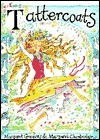
Ragged Tattercoats lived in the kitchen of her grandfather's castle. She had hardly any friends and no freedom. Although she loved to dance, she was not allowed to go to the ball. The author has also written Charlie, Emma and Alberic and The Mice of Nibbling Village.
Born 1914. Margaret Greaves was educated at St. Hugh's College, Oxford, and taught English in schools and at St. Mary's College of Education, Cheltenham. She died in June 1995
A fairy tale with close links to Cinderella, Tatterscoat’s is the grandchild of the king banished to the kitchen for looking like her mother. Her only friend is the geese boy. As in most fairly tales Tattercoat meets the prince and they fall in love and she is magical transformed into a princess. A great book to use to compare with the story of Cinderella with a year 2 class or above.
‘Tattercoats’ retold by Margaret Greaves and illustrated by Margaret Chamberlain
‘Tattercoats’ retold by Margaret Greaves and illustrated by Margaret Chamberlain is the story of young girl called ‘Tattercoats’ who is neglected by her grandfather but she manages to stay cheerful despite her lack of care. Both she and her grandfather are invited to a ball, where a neighbouring prince will choose a bride, but her grumpy and sulky grandfather does not allow her to go. She befriends a goose boy who helps to cheer her up and while they are walking in the country she meets the prince. They instantly fall in love. The story finishes rather predictably with Tattercoats being chosen as the princes’ chosen bride and her tattered clothes are magically transformed into a golden dress and of course everyone lives happily ever after.
The two main characters in the book are the grandfather and the young girl. The characters are very stereotypical in the way they are presented in the book with the girl being depicted as a poor innocent victim and the grandfather being portrayed as the cruel, sad and angry old man. Other characters in the book are only briefly mentioned and are not well developed. The ‘retold’ story itself is too similar to that of other stories such as Cinderella and The Sleeping Beauty and contains similar concepts such as ‘Midnight came and the prince must chose his bride’. The illustrations are on every page and many pages have no words. The story and the simple drawings contain no references to other groups with all the characters and people seen as white. Although they depict the key moments in the story and are at times detailed they only add to the stereotypical and Eurocentric nature of the book.
This book would be most suitable for KS1. However I would not use this book as part of my future career. Although it is nicely presented and simply illustrated it does not present any values or concepts that I would wish to include in curriculum planning at KS1. There are no real issues, morals or ideas for children. The ‘Patchwork Quilt’ that I previously reviewed discussed many ideas and issues, such as recycling, old & new, family values and death all of which could be easily developed in the classroom environment. In my opinion the book presents itself as an over romanticised, unbelievable, copy of a the kind of stereotypical girl’s book that has no real place in a classroom today.
‘Tattercoats’ tells the story of a young girl who, because of neglection, her thin body and shabby clothes, is known to all only by her nickname, ‘Tattercoats’. With no parents, the girl must live with her cold-hearted grandfather. She is banished into the castle kitchen because he resents her youthful beauty. One day, the castle is summoned to a grand ball by the king, who wishes for his son to choose his bride. Typically, the prince falls in love with Tattercoats and, at the stroke of midnight, she transforms into a golden princess. They marry, have children, and the grandfather is joyous again. They all live happily ever after… of course.
There are some positive ways that this story could be used in a Key Stage 1 classroom: the teacher could discuss with the children feelings of isolation and neglect, and the impact of this on Tattercoats (e.g. not being given food or clothes; no one knew her name). Children can also talk about the importance of friendship, i.e. between Tattercoats and her friend the Goose boy, who is initially her only source of happiness.
I would not, however, choose to use this book in the primary classroom, nor would I recommend parents read it to their children. This is because the book does not send a realistic message to young girls who, presumably, are the target audience of this Cinderella-style tale. The young girl is presented as the typical female victim who is saved when the prince chooses her for his bride. Not only does this give the male character control in this situation but it also completely romanticises Tattercoats’ situation. The magical ending is unbelievable and the stereotypical and-so-she-transformed-into-a-beautiful-princess routine is not suitable in a modern day classroom.
(This is another retold story of Cinderella). Tattercoats lives with her old grandfather in a castle. The prince asks everyone in the kingdom for a ball. Of course Tattercoats isn't allowed to go, but some how she makes its to there.
Tattercoats is a folktale similar to Cinderella without the fairy godmother. I thought this book was a little vague and needed more "meat". This might be good for a younger audience that can't sit through long stories. The pictures have plenty of color and are intriguing.
This is a retold version of Cinderella story. Its about Tattercoats who lives with her old grandfather in a castle. The prince asks everyone in the kingdom for a ball, but Tattercoats isn't allowed to go. With the help of her friend she is able to make it to the ball where she finds love.