For anyone who could use a little help motivating a toddler to give up their beloved binky, this charming book celebrates the important milestone of giving up a pacifier as an exciting step towards becoming a big kid.
Babies use a binky. Do big kids? No! Big kids say, "Bye-bye, binky!"
Every child's life is filled with milestones. Some happen easily; others need a little extra support. Artist and mom Maria van Lieshout has been there. Drawing upon her own experiences, she has created an engaging series of books that are just right for children on the brink of major changes and the caregivers who encourage them.
EMPOWERING THE YOUNGEST With simple text and cute illustrations, this sweet book encourages toddlers to get excited about becoming a big kid.
EXPERIENCED Born and raised in Holland, Maria van Lieshout now lives in the San Francisco Bay Area with her husband and young son. A full-time children's book author and illustrator, Maria has written and illustrated twelve children's books to date, including the Big Kid Power series, Hopper and Wilson , Bloom! , Flight 1-2-3 , and more.
PART OF AN ESSENTIAL Big Kid Power is a collection of four books including Bye-Bye Binky , I Use the Potty, No More Tantrums, and I Sleep in a Big Bed . This series of books is ideal for toddlers facing important milestones along the road to becoming a big kid.
Maria was born and raised in the Netherlands, and studied Visual Communications at George Washington University in DC. Maria's historical graphic novel Song of a Blackbird, about a female artist in the Amsterdam resistance during WWII, was awarded the Michael Printz Award Honor and it was longlisted for the National Book Award. www.vanlieshoutstudio.com for more information.
"BIG KIDS DON'T NEED A BINKY." or so says the big girl in this cheery orange book by Maria van Lieshout.
BYE-BYE BINKY is actually the second book from Ms. Lieshout this year. The first was on that other area that can vex both big and small -- potty training. Like I USE THE POTTY this book approaches the topic from a celebratory and positive theme. You aren't so much leaving the binky and diapers behind, as you are moving on to bigger and better things.
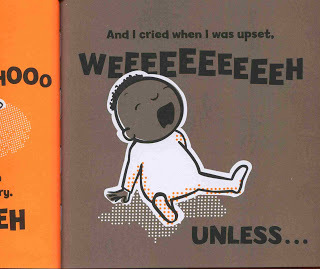
BYE-BYE BINKY begins with a baby crying. Our narrator then talks about the many reasons why she --and other babies-- cry. When they're hungry, upset, tired... and the solution to that was The Binky. She admits that she loved her binky but quickly adds that she doesn't have it anymore.
At this point we have a divergence from the approach Lieshout took in the potty book. In that latter case the book spent time pointing out 'What Big Kids Do'. In this book though the author addresses the comfort that a binkie provides, and she has her character give suggestions for what other children can do when they think they need comforting and ... the binky. (Which our extended family calls a 'dow'.)
All of these suggestions really boil down to a theme that many parents and caregivers are busy promoting anyway. That is that children should "use their words". So instead of crying, our heroine suggests kids ask for a hug, or a snack. Or if those things aren't quite right they can snuggle with what Dr. Brazelton calls a lovey.
So two elements working for us in this book. Growing up and being like BIG kids, and Using Our Words.
SUMMARY A bright and colorful book, I am so glad that the main character isn't white. I know when my first born was at the leave-the-binky stage I had a difficult time making sure that there were plenty of diversity presented in the books we shared. Fortunately authors and publishers have worked to fix this problem.
I thought the concept of being a Big Kid wasn't as thoroughly emphasized as in Lieshout's potty book. And I was disappointed that there wasn't as much humor either.
Still, this is a useful book that could very well be used in almost any sort of anti-binky campaign.
Digital illustrations accompany brief text as youngsters learn how to let go of their favorite blanket. Although I like the idea of helping young ones grow up with confidence and transition from needing a binky for comfort to more mature actions such as needing a hug, I'm not so sure I like the idea that letting go of the comfort object as part of maturing is the way to go. I would imagine the main character in this small board book would still feel as though she's missing her comfort object. It isn't as easy to let go as the book seems to indicate. Still, the idea behind the Big Kid Power is a good one.
Who wears afro puffs and a delightfully "mod" dress in orange and white? The charming, and "grown up" girl from Bye Bye Binky. All kids want to be big kids, and this book helps show them how. You'll love it.
Nothing mind blowing, but a good, short choice for encouraging a kid or supporting an effort to ditch the binky. I like that it offered other ways to soothe your emotions instead of just 'you're a big kid now, get over it.'
I like the concept of this book and the illustrations. The only thing I didn't like was how the girl gave her binky away to another baby. That's gross. I know this is just a story, but I didn't like that. I wouldn't want my kid thinking that's an okay thing to do.
Bye-Bye Binky is all about getting kids to stop using the binky. When she was a baby, she would get tired, hungry, unhappy, or cannot sleep. Her parents would give her a binky. And it worked. She calmed down and, if tired, went to sleep with less difficulty. Then the no-more-binky day arrived. It was time for this big kid—and her parents—to let go of this safety blanket and learn to find comfort in other ways. As a big kid, she can now ask for hugs, cuddle her stuffed animal, snuggle the dog, or ask for something to eat when hungry. The binky goes to another baby. Why? Because SHE IS A BIG KID!
This type of book is not new. Authors have been writing about growing up and all that entails, but this series gives the power to the child. As the narrator, and he or she proudly . . .
Great book to help a little one deal with the transition to life without a pacifier. I liked the short, simple text as well as in the inclusion of a main character who is not Caucasian. The Big Kid Power series was developed to help encourage children as they near the brink of major changes and milestones.