I loved the descriptive language, clever dialogue and the intriguing twists and turns of the story. I was engaged by the thoughtful social commentary and felt that the author encouraged me to think beyond the obvious.
One of my favorite descriptions is the scene at the Soviet Club, which Lord Peter Wimsey describes as reming him of "mission teas." He reasons that it may be because "all the members looked as though they cherished a purpose in life, and that the staff seemed rather sketchily trained and strongly in evidence." Then, he muses that it is a democratic establishment and the staff cannot be expected to put on the airs and graces of a club in the posh West End of London, which added another layer of complexity and opportunity for thinking about the class system.
As Wimsey moves to the dining room he observes that "the resemblance to a mission tea was increased by the exceedingly heated atmosphere, the babel of conversation, and the curious inequalities of the cutlery."
Then, there is the delicious description of the dining arrangements. Wimsey and his guest sit at "a rather crumbly table near the serving-hatch" where Wimsey is shoe horned into a tight spot "next to a very large, curly-haired man in a velvet coat, who was earnestly conversing with a thin, eager young woman in a Russian blouse, Venetian beads, a Hungarian shawl, and a Spanish comb, looking like a personification of the United Front of the 'Internationale.'"
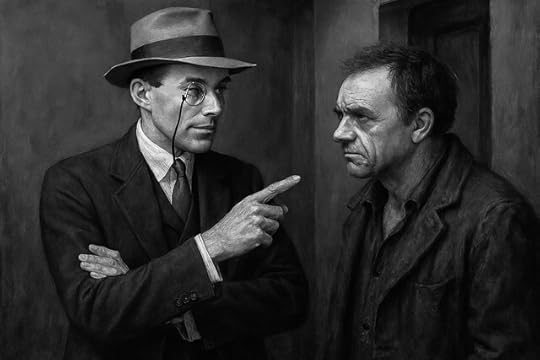
One example of clever dialogue is Wimsey's interview with the surly farmer, Mr. Grindthorpe where Wimsey displays and exhausts his considerable wits and communication skills.
Then, one of the most entertaining passages is when Wimsey's mother, described as a "wily old bird" sweeps in, takes charge, accuses her ailing daughter of "naughtiness and hysterics," sorts everything out and gives them all a dressing down for lacking common sense.
When Wimsey tries to give his mother credit for her detective skills, she replies tartly, "My dear child you can give it a long name you like but I am an old-fashioned woman and I call it 'mother wit' and it is so rare for a man to have, that you write a book about it & call it Sherlock Holmes."
Finally, just when Wimsey is feeling powerful at possessing some exclusive knowledge, the author brings him down a peg or two. At an opportune time, he shares this bad news with malicious delight only to discover that his audience was already fully aware and he is not going to get the reaction he wanted. He muses, "Few things are more irritating than to discover after you have been at great pains to spare a person some painful intelligence that he has known it all along and is not so much affected by it as he probably should be."
I truly enjoyed the dramatic narration by Ian Carmichael who played the part of Lord Peter Wimsey in the television dramatizations of the 1970s.





 Lord Peter while still insouciant is no longer Bertie Wooster playing at detectives. His is a well rounded character who lives a life filled with varied interests as well as his work as an amateur sleuth.


