

What do you think?

The Omega Men #1-12
The Omega Men: The End is Here
Broadcast across the universe, the Omega Men reveal a beaten and restrained Kyle Rayner. They make their intentions clear as they kill the former White Lantern. Now the universe is on watch and the hunt for the Omega Men begins. The line between good and evil is blurred in this part of the galaxy, and you do not know who to trust. Please Omega.
Collecting: Omega Men 1-12
Collecting: Omega Men 1-12
288 pages, Paperback
First published August 24, 2016
Ratings & Reviews
Friends & Following
Create a free account to discover what your friends think of this book!
Community Reviews
Displaying 1 - 30 of 353 reviews

May 30, 2020
Space Terrorists! Boo.
But aren't we all terrorists to someone? Yay.
Also, Rayner is (to me) the blandest of the Lanterns.

This was a weird go-nowhere sort of story about the corruption of religion, the evils of capitalism, and the horrors of waging revolution and losing your soul.
The short version is that no one is the bad guy and everyone is the bad guy.

The longer version is that Kyle gets forcibly recruited into a terrorist organization that calls themselves The Omega Men (<--a religious reference to one of their gods), and ends up doing spoilery stuff with them after they supposedly cut his throat on live space tv.

It's pretty thinly veiled to mirror real-world happenings. And the point King ultimately makes is that to overthrow a cruel government the leaders of the insurgency end up becoming exactly what they fought against in the first place. History repeats itself over and over again.

Not every story needs to be uplifting, but this one kind of makes you feel as though there is really no point in bothering to try and change things for the better.
Which is and isn't true.
The fight to make things better will never end, simply because the personality type of the people who want to be in charge just lends itself to corruption. Plus, there will always be greedy selfish people. So even if things change for the better, once those better people are in control, they either become corrupted or are overthrown by someone who is corrupt.
And the cycle starts again.
That doesn't mean you need to roll over and take evil shit because it's meaningless to fight.
It just means you need to understand that there's never going to be a point that you won't need to stand up and be willing to push back against injustice.
But aren't we all terrorists to someone? Yay.
Also, Rayner is (to me) the blandest of the Lanterns.
This was a weird go-nowhere sort of story about the corruption of religion, the evils of capitalism, and the horrors of waging revolution and losing your soul.
The short version is that no one is the bad guy and everyone is the bad guy.
The longer version is that Kyle gets forcibly recruited into a terrorist organization that calls themselves The Omega Men (<--a religious reference to one of their gods), and ends up doing spoilery stuff with them after they supposedly cut his throat on live space tv.
It's pretty thinly veiled to mirror real-world happenings. And the point King ultimately makes is that to overthrow a cruel government the leaders of the insurgency end up becoming exactly what they fought against in the first place. History repeats itself over and over again.
Not every story needs to be uplifting, but this one kind of makes you feel as though there is really no point in bothering to try and change things for the better.
Which is and isn't true.
The fight to make things better will never end, simply because the personality type of the people who want to be in charge just lends itself to corruption. Plus, there will always be greedy selfish people. So even if things change for the better, once those better people are in control, they either become corrupted or are overthrown by someone who is corrupt.
And the cycle starts again.
That doesn't mean you need to roll over and take evil shit because it's meaningless to fight.
It just means you need to understand that there's never going to be a point that you won't need to stand up and be willing to push back against injustice.

November 11, 2016
A diatribe about the horrors of war disguised as space opera. The characterization of Kyle Raynor in this book completely takes me out of the story. All of a sudden Kyle is Catholic and Hispanic ... and a dummy. The rest of the Omega Men are all one-note characters with no redeeming qualities. There's no one to root for in the book. The plot just seems like a tool used to beat Tom King's message across your face with. I found this book to be a complete waste of time.

May 31, 2019
“If this life is not a real fight, in which something is eternally gained for the universe by success, it is no better than a game of private theatricals from which one may withdraw at will. But it feels like a real fight”—William James, The Will to Believe
The Omega Men is a comic emanating out of the Green Lantern universe, I learned along the way of reading this. I knew very little about them, nor did I truthfully know much about Green Lantern, either. Oh, I’ve read some of the comics, including a few episodes of a tv series when I was kid, saw a movie or two. But it took me a little while for me to even get what was going on. This is what I have come to expect from Tom King, though; he invites you into a world with little exposition and makes you work to find things out. And given his work with Batman, The Vision, The Sheriff of Babylon, I guessed he would do something interesting here, and he does. It is by now commonplace to hear mentioned that King worked with the CIA in Iraq and he writes about that in his fictional works, more directly in Sheriff, and possibly more allegorically here in Omega Men.
Omega Men is a dark commentary on war and maybe particularly he is thinking of Iraq as one site for his ideas. You might expect a CIA guy (maybe this says something about me and my views of CIA guys) to take a simple view of the question of the difference between a terrorist and a freedom fighter, but you would be wrong. His view is darker and more complex than that.
“The 'sentimentalist fallacy' is to shed tears over abstract justice and generosity, beauty, etc., and never to know these qualities when you meet them in the street, because there the circumstances make them vulgar”--William James
Green/White Lantern Kyle Rayner finds himself in the middle of a conflict in the Vega system. He has gotten kidnapped by a rogue group, the Omega Men, from whose perspective the story opens. Kyle doesn’t have his power ring, but he decides he has to help (and peacefully, non-violently, if possible?) resolve this interplanetary conflict between the Omega Men and The Citadel. In the process, we see there are no saints, to put it mildly. And the resolution is not easy or simple
The art by Barnaby Bagenda and the coloring by Romulo Fajardo is pretty amazing, and when I looked around to see what else they had done I learned from others that he is honoring here (and in conversation with) the work of Dave Gibbons and John Higgins (coloring) on Watchmen. And see that subtitle, which echoes a theme from Moore’s work: The End is Near? The nine panel arrangement Bagenda uses is the same as Gibbons used. And then I began to see that the color work of Fajardo is an important thematic dimension of Omega Men, just as it had been in Watchmen.
While Omega Men is not a comic quite at the level of Watchmen, you can see Moore’s influence, through King’s elliptical storytelling style, his dark cynicism about the state of the world, and his grounding of the work in political philosophy and religious/spiritual ideas.
“. . . when a religion has become an orthodoxy, its day of inwardness is over: the spring is dry; the faithful live at second hand exclusively and stone the prophets in their turn”—James
Moore opens chapters with quotations from a wide range of sources. But who but Moore or King would use throughout a comic book series epigraphs from American Pragmatist philosopher William James?! In a comic! (William, just fyi, the author of such works as Pragmatism, and The Varieties of Religious Experience, was the brother of novelist Henry James).
Omega Men is dark and multi-layered and “difficult,” using the medium of comics to explore the legacies of colonialism in the Middle East. 4.5 out of 5, but I might even like it better, the more I know what the heck they are doing here.
A free sneak preview:
https://www.dccomics.com/comics/the-o...
The Omega Men is a comic emanating out of the Green Lantern universe, I learned along the way of reading this. I knew very little about them, nor did I truthfully know much about Green Lantern, either. Oh, I’ve read some of the comics, including a few episodes of a tv series when I was kid, saw a movie or two. But it took me a little while for me to even get what was going on. This is what I have come to expect from Tom King, though; he invites you into a world with little exposition and makes you work to find things out. And given his work with Batman, The Vision, The Sheriff of Babylon, I guessed he would do something interesting here, and he does. It is by now commonplace to hear mentioned that King worked with the CIA in Iraq and he writes about that in his fictional works, more directly in Sheriff, and possibly more allegorically here in Omega Men.
Omega Men is a dark commentary on war and maybe particularly he is thinking of Iraq as one site for his ideas. You might expect a CIA guy (maybe this says something about me and my views of CIA guys) to take a simple view of the question of the difference between a terrorist and a freedom fighter, but you would be wrong. His view is darker and more complex than that.
“The 'sentimentalist fallacy' is to shed tears over abstract justice and generosity, beauty, etc., and never to know these qualities when you meet them in the street, because there the circumstances make them vulgar”--William James
Green/White Lantern Kyle Rayner finds himself in the middle of a conflict in the Vega system. He has gotten kidnapped by a rogue group, the Omega Men, from whose perspective the story opens. Kyle doesn’t have his power ring, but he decides he has to help (and peacefully, non-violently, if possible?) resolve this interplanetary conflict between the Omega Men and The Citadel. In the process, we see there are no saints, to put it mildly. And the resolution is not easy or simple
The art by Barnaby Bagenda and the coloring by Romulo Fajardo is pretty amazing, and when I looked around to see what else they had done I learned from others that he is honoring here (and in conversation with) the work of Dave Gibbons and John Higgins (coloring) on Watchmen. And see that subtitle, which echoes a theme from Moore’s work: The End is Near? The nine panel arrangement Bagenda uses is the same as Gibbons used. And then I began to see that the color work of Fajardo is an important thematic dimension of Omega Men, just as it had been in Watchmen.
While Omega Men is not a comic quite at the level of Watchmen, you can see Moore’s influence, through King’s elliptical storytelling style, his dark cynicism about the state of the world, and his grounding of the work in political philosophy and religious/spiritual ideas.
“. . . when a religion has become an orthodoxy, its day of inwardness is over: the spring is dry; the faithful live at second hand exclusively and stone the prophets in their turn”—James
Moore opens chapters with quotations from a wide range of sources. But who but Moore or King would use throughout a comic book series epigraphs from American Pragmatist philosopher William James?! In a comic! (William, just fyi, the author of such works as Pragmatism, and The Varieties of Religious Experience, was the brother of novelist Henry James).
Omega Men is dark and multi-layered and “difficult,” using the medium of comics to explore the legacies of colonialism in the Middle East. 4.5 out of 5, but I might even like it better, the more I know what the heck they are doing here.
A free sneak preview:
https://www.dccomics.com/comics/the-o...

September 3, 2016
One of My Favourite Superhero Comics of the Year!
The Omega Men has a bold prologue that perfectly establishes the tone for the entire series. A low-quality camera records the pontification of a zealot, Primus, the purported leader of the titular band of insurgents as he walks around a hooded man strapped to a chair. The man is revealed to be the White Lantern, Kyle Rayner, and his throat is summarily opened by one of the Omega Men. The scene has its desired effect: shock, to be sure, but also the drawing of an immediate parallel between this comic and terrorist execution videos.
So, as I'm sure some people have already noted, this is pretty much the Iraqi War in space feat. aliens. But you'd be remiss to ignore the series for that seemingly silly concept, when in fact this is a much more adult comic than I would have expected from a collection whose cover boasts a flying space man. [Sidenote: the covers from this series are really eye-catching designs.] This is a dark comic, one that doesn't shy away from its inspiring conflict, and slowly unveils a story about radicalization, insurgency, and consequentialism.
But, you know, there's also space battles.
And they're good looking space fights to boot! Tom King's extensive planning and world building of the Vega System and its six planets make the book come to life. He's crafted a science fiction world where the different cultures and races are established nicely in a few panels. Of course, this is due in no small part to Barnaby Bagenda, who handles the art duties for 10 of the 12 issues in this collection. I'm not familiar with any of Bagenda's earlier work, but his style reminds me a bit of early Jerome Opena (think Fear Agent-era). The colourists also do a bang-up job here: making sure that the vibrant hues of different planets help to differentiate them, keeping the series maintain consistency despite the fill-in artists, and making for an especially unique corner of the DC universe.
Oh, that's another thing! This is the least tied to continuity comic I've read from modern DC in a long time. Sure, Kyle Rayner is the White Lantern, but knowing anything more than that won't help or hinder your reading of this graphic novel. This book is about the Omega Men, which is an exceedingly audacious move for a mainstream comic that seemingly kills its only named character in the prologue.
Of course, Kyle Rayner isn't dead (that's revealed before the first issue's end, so I don't consider that a spoiler), but what King does with him in the series is powerful and shows a commitment to character development rarely seen in these big-two stories. I'm sure some DC fanboys will complain about a lack of consistency in the White Lantern power level or some such piffle, but for the rest of the world, you can go into this with as little or as much prior knowledge of the DC universe as you like.
In fact, I'd go so far as to recommend this to anyone who is a sci-fi fan, as the additional DC stuff is just gravy. This comic, by virtue of this new sector of space, is able to operate on its own throughout the entirety of the 12 issue series. That's another great thing: you can buy this one volume and read the entire run. I have a lot of love for convoluted, continuity-heavy superhero comics, but this is not one of them.
I'm loving Tom King's comic output so far. The first volume of Vision impressed me greatly (which you can read about here) and The Omega Men is the most enjoyment I've gotten out of a DC collection in ages (Snyder & Capullo's Batman I read in floppies). I'll be on the lookout for more from King in the future.
In summary, The Omega Men is self-contained, fun, adult, and one of the best comics I've read this year.
The Omega Men has a bold prologue that perfectly establishes the tone for the entire series. A low-quality camera records the pontification of a zealot, Primus, the purported leader of the titular band of insurgents as he walks around a hooded man strapped to a chair. The man is revealed to be the White Lantern, Kyle Rayner, and his throat is summarily opened by one of the Omega Men. The scene has its desired effect: shock, to be sure, but also the drawing of an immediate parallel between this comic and terrorist execution videos.
So, as I'm sure some people have already noted, this is pretty much the Iraqi War in space feat. aliens. But you'd be remiss to ignore the series for that seemingly silly concept, when in fact this is a much more adult comic than I would have expected from a collection whose cover boasts a flying space man. [Sidenote: the covers from this series are really eye-catching designs.] This is a dark comic, one that doesn't shy away from its inspiring conflict, and slowly unveils a story about radicalization, insurgency, and consequentialism.
But, you know, there's also space battles.
And they're good looking space fights to boot! Tom King's extensive planning and world building of the Vega System and its six planets make the book come to life. He's crafted a science fiction world where the different cultures and races are established nicely in a few panels. Of course, this is due in no small part to Barnaby Bagenda, who handles the art duties for 10 of the 12 issues in this collection. I'm not familiar with any of Bagenda's earlier work, but his style reminds me a bit of early Jerome Opena (think Fear Agent-era). The colourists also do a bang-up job here: making sure that the vibrant hues of different planets help to differentiate them, keeping the series maintain consistency despite the fill-in artists, and making for an especially unique corner of the DC universe.
Oh, that's another thing! This is the least tied to continuity comic I've read from modern DC in a long time. Sure, Kyle Rayner is the White Lantern, but knowing anything more than that won't help or hinder your reading of this graphic novel. This book is about the Omega Men, which is an exceedingly audacious move for a mainstream comic that seemingly kills its only named character in the prologue.
Of course, Kyle Rayner isn't dead (that's revealed before the first issue's end, so I don't consider that a spoiler), but what King does with him in the series is powerful and shows a commitment to character development rarely seen in these big-two stories. I'm sure some DC fanboys will complain about a lack of consistency in the White Lantern power level or some such piffle, but for the rest of the world, you can go into this with as little or as much prior knowledge of the DC universe as you like.
In fact, I'd go so far as to recommend this to anyone who is a sci-fi fan, as the additional DC stuff is just gravy. This comic, by virtue of this new sector of space, is able to operate on its own throughout the entirety of the 12 issue series. That's another great thing: you can buy this one volume and read the entire run. I have a lot of love for convoluted, continuity-heavy superhero comics, but this is not one of them.
I'm loving Tom King's comic output so far. The first volume of Vision impressed me greatly (which you can read about here) and The Omega Men is the most enjoyment I've gotten out of a DC collection in ages (Snyder & Capullo's Batman I read in floppies). I'll be on the lookout for more from King in the future.
In summary, The Omega Men is self-contained, fun, adult, and one of the best comics I've read this year.

October 11, 2016
Tom King and Barnaby Bagenda’s The Omega Men: The End Is Here is basically the Second Iraq War... in Spaaaaaaaace!
Kyle Rayner, the Lego-domino-mask-wearing Green Lantern-turned-White Lantern (Go, Go Power Rangers!), is captured by the Omega Men (al-Qaeda or ISIS as they’re known today) to topple the Citadel (America), a heavily-religious foreign power with a massive military that invades a planet for their natural resources, occupies it, and covers up some horrible atrocities they committed. The Omega Men’s mission is to kill the Viceroy (head of the Citadel/President of America) and reveal their war crimes to everyone. At least that’s my interpretation of it – you could also look at it as a critique of the Catholic Church and its child sex scandal cover-ups, especially as the Viceroy wears Pope-ish robes. And it’s worth mentioning that Tom King was a CIA operative in Iraq in 2003 who’s written about his experiences less obliquely in his Vertigo series, The Sheriff of Babylon.
Taking the perspective of the terrorists is an interesting choice, the grandly dark tone is immediately gripping and the setup is certainly intriguing. It feels a bit like King/DC trying to do a 21st century Watchmen-esque story. The superheroes are very serious, the subject matter is grim and most of the book is presented in the Watchmen nine panel grid format. Unfortunately the book turns out to be kinda boring and not very good!
The hostage video opening mirrors the kind that al-Qaeda used to make when they captured US soldiers except it’s Rayner who’s been caught and the Omega Men are threatening to execute him. And this is where King’s stodgy writing kicks in as it always seems to.
Why did they make that video - for whose benefit? It broadcasts to everyone who watches it that they’re terrorists and happy to kill any Lanterns they find so where was the Green (or any colour) Lantern response? And why make themselves more prominent outlaws? To let everyone know Rayner’s dead? Why? And people find out he’s not anyway when he starts appearing with the Omega Men!
Also, I thought Rayner was dead before this series? When did he come back to life? When did he become super-Christian? To be fair I don’t read a lot of Green Lantern stuff but the last one I read was only a couple years ago. Ah, it doesn’t matter, superheroes die and come back to life all the time. Why did he have to surrender his ring? Sure, it makes for a dramatic reappearance later on when he gets it back and, BOOM, the White Lantern rides again, but the whole thing felt so contrived.
Possibly most importantly, why did the Omega Men need Rayner at all? Why did they make a big show of “killing” him and then spend so much time tricking him into becoming one of them? I know he’s a Lantern and their rings are hella powerful but once the book’s last quarter turns into mindless fighting, it really doesn’t look like they needed him at all. I don’t think there’s a single key scene where they needed this guy but everyone says he’s central to the whole story.
I’ve never come across Barnaby Bagenda’s art before but I was blown away with how good it was. He really makes you feel like this is a space opera/Star Wars-ian story with his amazing alien designs and epic vision for King’s story. The art is consistently impressive and if DC/Marvel aren’t chasing this guy for an exclusive contract, they’re idiots.
Despite the art, The Omega Men failed to engage me. The characters are pretty much all brain-dead, the story is a garbled mess of semi-formed ideas and bizarre plot points, none of which were interesting, and it’s far too long at 12 issues - if you’re anything like me you’re gonna be relieved when the end is here! It’s another bad Tom King book - this dude is really overrated!
Kyle Rayner, the Lego-domino-mask-wearing Green Lantern-turned-White Lantern (Go, Go Power Rangers!), is captured by the Omega Men (al-Qaeda or ISIS as they’re known today) to topple the Citadel (America), a heavily-religious foreign power with a massive military that invades a planet for their natural resources, occupies it, and covers up some horrible atrocities they committed. The Omega Men’s mission is to kill the Viceroy (head of the Citadel/President of America) and reveal their war crimes to everyone. At least that’s my interpretation of it – you could also look at it as a critique of the Catholic Church and its child sex scandal cover-ups, especially as the Viceroy wears Pope-ish robes. And it’s worth mentioning that Tom King was a CIA operative in Iraq in 2003 who’s written about his experiences less obliquely in his Vertigo series, The Sheriff of Babylon.
Taking the perspective of the terrorists is an interesting choice, the grandly dark tone is immediately gripping and the setup is certainly intriguing. It feels a bit like King/DC trying to do a 21st century Watchmen-esque story. The superheroes are very serious, the subject matter is grim and most of the book is presented in the Watchmen nine panel grid format. Unfortunately the book turns out to be kinda boring and not very good!
The hostage video opening mirrors the kind that al-Qaeda used to make when they captured US soldiers except it’s Rayner who’s been caught and the Omega Men are threatening to execute him. And this is where King’s stodgy writing kicks in as it always seems to.
Why did they make that video - for whose benefit? It broadcasts to everyone who watches it that they’re terrorists and happy to kill any Lanterns they find so where was the Green (or any colour) Lantern response? And why make themselves more prominent outlaws? To let everyone know Rayner’s dead? Why? And people find out he’s not anyway when he starts appearing with the Omega Men!
Also, I thought Rayner was dead before this series? When did he come back to life? When did he become super-Christian? To be fair I don’t read a lot of Green Lantern stuff but the last one I read was only a couple years ago. Ah, it doesn’t matter, superheroes die and come back to life all the time. Why did he have to surrender his ring? Sure, it makes for a dramatic reappearance later on when he gets it back and, BOOM, the White Lantern rides again, but the whole thing felt so contrived.
Possibly most importantly, why did the Omega Men need Rayner at all? Why did they make a big show of “killing” him and then spend so much time tricking him into becoming one of them? I know he’s a Lantern and their rings are hella powerful but once the book’s last quarter turns into mindless fighting, it really doesn’t look like they needed him at all. I don’t think there’s a single key scene where they needed this guy but everyone says he’s central to the whole story.
I’ve never come across Barnaby Bagenda’s art before but I was blown away with how good it was. He really makes you feel like this is a space opera/Star Wars-ian story with his amazing alien designs and epic vision for King’s story. The art is consistently impressive and if DC/Marvel aren’t chasing this guy for an exclusive contract, they’re idiots.
Despite the art, The Omega Men failed to engage me. The characters are pretty much all brain-dead, the story is a garbled mess of semi-formed ideas and bizarre plot points, none of which were interesting, and it’s far too long at 12 issues - if you’re anything like me you’re gonna be relieved when the end is here! It’s another bad Tom King book - this dude is really overrated!
September 19, 2016
Alas, I did not enjoy this as I thought I would. Shock! Horror!
I know most people will enjoy this, but it just didn't strike a chord with me. I had a expectations and they were no where close to what I expected.
This is a political thriller, I don't want to read about planetary politics. I don't enjoy all the conniving, the back stabbing, the manipulation, the death, the planning. All of it builds up to more death. An endless cycle of fighting.
In short the story totally bored the shit out of me, forever expecting something to change. All the other reviews said it was a slow burner. It's still bloody burning!
The one thing I can say that's good about this, is the glorious artwork. The action isn't depicted very well, but the character design and the colouring is top notch, and who doesn't love the front cover of this book?!
I had great expectations of Tom King, I will have to try again.
One other last thing....what's with the bible bashing? Since when was Kyle Rayner a Christian? I must have missed that one?! Meh!
I know most people will enjoy this, but it just didn't strike a chord with me. I had a expectations and they were no where close to what I expected.
This is a political thriller, I don't want to read about planetary politics. I don't enjoy all the conniving, the back stabbing, the manipulation, the death, the planning. All of it builds up to more death. An endless cycle of fighting.
In short the story totally bored the shit out of me, forever expecting something to change. All the other reviews said it was a slow burner. It's still bloody burning!
The one thing I can say that's good about this, is the glorious artwork. The action isn't depicted very well, but the character design and the colouring is top notch, and who doesn't love the front cover of this book?!
I had great expectations of Tom King, I will have to try again.
One other last thing....what's with the bible bashing? Since when was Kyle Rayner a Christian? I must have missed that one?! Meh!

November 2, 2022
8'5/10 ⭐⭐⭐⭐⭐
Tom King guioniza esta space opera con su personal estilo en la distribución de viñetas. Es habitual ver una página dividida en nueve viñetas del mismo tamaño creando una secuencia de imágenes, como si se tratasen de fotogramas de un vídeo, dando una narrativa detallada e inmersiva. ¡Espectacular! Me encanta su estilo. Mientras que en otros cómics parecen ahorrarse viñetas en este es todo lo contrario. Un diez para la narrativa, distribución de viñetas y transiciones.
De diez también los personajes, se sienten muy frescos dentro del universo D.C. y con mucho carisma.
En cuanto al dibujo de Barnaby Bagenda, es muy acertado, haciendo el cómic agradable a la vista. Lástima de ese número a cargo de Toby Cypress, que con un estilo tan diferente, ensombrece el resultado final.
Y del argumento me ha recordado a Dune, pero sintiéndose original y sin ser tan profundo.
Muy recomendable.
Tom King guioniza esta space opera con su personal estilo en la distribución de viñetas. Es habitual ver una página dividida en nueve viñetas del mismo tamaño creando una secuencia de imágenes, como si se tratasen de fotogramas de un vídeo, dando una narrativa detallada e inmersiva. ¡Espectacular! Me encanta su estilo. Mientras que en otros cómics parecen ahorrarse viñetas en este es todo lo contrario. Un diez para la narrativa, distribución de viñetas y transiciones.
De diez también los personajes, se sienten muy frescos dentro del universo D.C. y con mucho carisma.
En cuanto al dibujo de Barnaby Bagenda, es muy acertado, haciendo el cómic agradable a la vista. Lástima de ese número a cargo de Toby Cypress, que con un estilo tan diferente, ensombrece el resultado final.
Y del argumento me ha recordado a Dune, pero sintiéndose original y sin ser tan profundo.
Muy recomendable.

September 27, 2016
This is...well, this is a weird one.
This was the book that DC cancelled after 6 issues, despite promising that it was going to see out its full 12. And if it were me, I wouldn't have been that worried, had I been reading it monthly. The first half of this book is alright; it builds up the Vega system, a criminally ignored region of space that the Green Lantern Corps is not allowed to enter, as Kyle Rayner attempts to go in and broker a peace between the Citadel, the ruling class, and the Omega Men, a group of terrorists who want to free the people from the oppression that the Citadel inflicts.
We get hints of a larger plan, but nothing overt, and then the way issue 6 ends, it's almost like a series finale, if a very depressing one.
But then the second six issues are astoundingly good; all the work that the first six put in pays off a hundred-fold, as the Omega Men and Kyle unleash their plan, and things go from bad to worse. The horrors of war are on full display, and just when you think you've worked out how this is all going to end (it's a superhero comic, after all), it in fact backpedals and side-slides into something totally different, that will have you thinking for a very long time.
The artwork is primarily handled by Barnaby Bagenda, whose work is solid, and he excels at the varied locales that Kyle and the Omega Men visit; the real star of the show though is colourist Romulo Fajardo Jr, whose etheral palettes and sheens create a truly alien viewpoint that enhances every page, to the point where guest colourist Hi-Fi cannot compete. There's also a fill-in by Toby Cypress, whose figure work isn't great, but it's mostly a flashback issue that fills in Kyle Rayner's history for those who don't know it, so it's easy to skim over when re-reading.
Omega Men is a strange animal, but it's one that's well worth sticking with to see the genius of Tom King on full display.
This was the book that DC cancelled after 6 issues, despite promising that it was going to see out its full 12. And if it were me, I wouldn't have been that worried, had I been reading it monthly. The first half of this book is alright; it builds up the Vega system, a criminally ignored region of space that the Green Lantern Corps is not allowed to enter, as Kyle Rayner attempts to go in and broker a peace between the Citadel, the ruling class, and the Omega Men, a group of terrorists who want to free the people from the oppression that the Citadel inflicts.
We get hints of a larger plan, but nothing overt, and then the way issue 6 ends, it's almost like a series finale, if a very depressing one.
But then the second six issues are astoundingly good; all the work that the first six put in pays off a hundred-fold, as the Omega Men and Kyle unleash their plan, and things go from bad to worse. The horrors of war are on full display, and just when you think you've worked out how this is all going to end (it's a superhero comic, after all), it in fact backpedals and side-slides into something totally different, that will have you thinking for a very long time.
The artwork is primarily handled by Barnaby Bagenda, whose work is solid, and he excels at the varied locales that Kyle and the Omega Men visit; the real star of the show though is colourist Romulo Fajardo Jr, whose etheral palettes and sheens create a truly alien viewpoint that enhances every page, to the point where guest colourist Hi-Fi cannot compete. There's also a fill-in by Toby Cypress, whose figure work isn't great, but it's mostly a flashback issue that fills in Kyle Rayner's history for those who don't know it, so it's easy to skim over when re-reading.
Omega Men is a strange animal, but it's one that's well worth sticking with to see the genius of Tom King on full display.

November 4, 2017
Tom King's Omega Men is excellent! It's so well written and dark that it doesn't feel like a story set in the DC universe. But it is.
Kyle Rayner, the White Lantern, has gone to settle a conflict between the Citadel and the Omega Men. The Citadel is a Imperial group of planets that have taken over the six planets that comprise the Vegas system. Ostensibly the Citadel is benign. But, as with most who claim such things, that is not true. Their ruthless behavior and genocidal acts have caused a backlash. That backlash is the Omega Men. A group of terrorists (or freedom fighters, as some see them) that try to inflict damage on the Citadel forces. I shall not spoil any of this excellent sci-fi adventure.
The individual motivations of each of the Omega Men differs, but they have all come together to destroy the Citadel. Kyle Rayner is instrumental to their goals. This story is truly epic in its scope. The setting is far darker and more violent than the standard DC fare. The characters lack a certain "too good" elan and sometimes come off as bad as the people they are fighting. The story is also complicated and entertaining. Tom King does a great job of bringing political drama to outer space.
The artwork is also very well done. But it is the writing that did it for me. This is a great story, with many people making sacrifices and the scope of the entire set of events is vast. The Omega Men themselves are a very cool bunch. I respect their ruthless behavior and they are each a unique look and representative of the various species ground under the heel of the Citadel. The idea of Stellarium as being a compound that can prevent planets like Krypton from exploding make it VERY valuable and rare. Thus the Citadel's motives also come under scrutiny.
Dark, grimy, violent and complex. These words best describe this truly interesting tale. I highly recommend this to anyone who enjoys good sci-fi and action. I was very impressed and hope to see more titles like the Omega Men in the near future.
Kyle Rayner, the White Lantern, has gone to settle a conflict between the Citadel and the Omega Men. The Citadel is a Imperial group of planets that have taken over the six planets that comprise the Vegas system. Ostensibly the Citadel is benign. But, as with most who claim such things, that is not true. Their ruthless behavior and genocidal acts have caused a backlash. That backlash is the Omega Men. A group of terrorists (or freedom fighters, as some see them) that try to inflict damage on the Citadel forces. I shall not spoil any of this excellent sci-fi adventure.
The individual motivations of each of the Omega Men differs, but they have all come together to destroy the Citadel. Kyle Rayner is instrumental to their goals. This story is truly epic in its scope. The setting is far darker and more violent than the standard DC fare. The characters lack a certain "too good" elan and sometimes come off as bad as the people they are fighting. The story is also complicated and entertaining. Tom King does a great job of bringing political drama to outer space.
The artwork is also very well done. But it is the writing that did it for me. This is a great story, with many people making sacrifices and the scope of the entire set of events is vast. The Omega Men themselves are a very cool bunch. I respect their ruthless behavior and they are each a unique look and representative of the various species ground under the heel of the Citadel. The idea of Stellarium as being a compound that can prevent planets like Krypton from exploding make it VERY valuable and rare. Thus the Citadel's motives also come under scrutiny.
Dark, grimy, violent and complex. These words best describe this truly interesting tale. I highly recommend this to anyone who enjoys good sci-fi and action. I was very impressed and hope to see more titles like the Omega Men in the near future.
May 29, 2016
2026 - Rereading this and damn is it great still. The narration is heavy but the ending, especially the final few pages, still stuck with me ten years later. What a great look into war and death.
2016 Review - I hate space stories.
Well, hate is a strong word. I don't find them interesting for the most part.
So I heard a lot of good things about Omega Men and I figured I'd give it a try. I liked Red Rising book series, Enders Games, Mass Effect video games. So I figured I'd try it out.
This is one depressing ass series. I've never read anything related to Green Lateran, and maybe that wasn't the best idea, cause first few issues I was lost. Luckily the story picks up rather fast and by issue 4 or 5 I was in to it pretty quickly. The Omega Men isn't really trying to tell a story of good vs evil. It's very in the middle, and picking sides is silly to do.
Sure there is a very sick individual who likes to kill a mass amount of people, but our group of Omega Men do some horrific shit too. Very much like the best stories out there it makes you think past just the simple story of who wins and who loses.
Before the last issue I was on the fence if I should give this a 3 or a 4. I went with a 4 thanks to the final issue, which I could see would divide people. If you want a simple answer in the end, wrapping up with a little red bow, you'll be disappointed. This story wraps up with you having to question everything about what's right and wrong. Who's to blame, who's right, and why we do this.
That's what makes this story pretty special, it makes you think once you're finished. The only negatives for me is I found it confusing at the start and sometimes a bit dialog heavy at moments where the art could speak for it. But overall, very much worth reading.
Also the art is fantastic.
Okay I'll shut up, go read it now!
2016 Review - I hate space stories.
Well, hate is a strong word. I don't find them interesting for the most part.
So I heard a lot of good things about Omega Men and I figured I'd give it a try. I liked Red Rising book series, Enders Games, Mass Effect video games. So I figured I'd try it out.
This is one depressing ass series. I've never read anything related to Green Lateran, and maybe that wasn't the best idea, cause first few issues I was lost. Luckily the story picks up rather fast and by issue 4 or 5 I was in to it pretty quickly. The Omega Men isn't really trying to tell a story of good vs evil. It's very in the middle, and picking sides is silly to do.
Sure there is a very sick individual who likes to kill a mass amount of people, but our group of Omega Men do some horrific shit too. Very much like the best stories out there it makes you think past just the simple story of who wins and who loses.
Before the last issue I was on the fence if I should give this a 3 or a 4. I went with a 4 thanks to the final issue, which I could see would divide people. If you want a simple answer in the end, wrapping up with a little red bow, you'll be disappointed. This story wraps up with you having to question everything about what's right and wrong. Who's to blame, who's right, and why we do this.
That's what makes this story pretty special, it makes you think once you're finished. The only negatives for me is I found it confusing at the start and sometimes a bit dialog heavy at moments where the art could speak for it. But overall, very much worth reading.
Also the art is fantastic.
Okay I'll shut up, go read it now!
read-in-a-different-collection
May 30, 2020

August 11, 2017
MURKY FACTIONS WARRING AMONG THE STARS
As a premise, The Omega Men looked enticing in its seemingly earnest attempt to place a serious, more philosophically minded political thriller/war narrative - with (perhaps not too subtle) allusions to the spectres of terrorism and fundamentalist religiosity in our current reality - in the confines of the DC universe. At least, that's what it was marketed as.
The final result leaves much to be desired however, the main reason being that the whole thing is mired in what can only be described by me as an irksome drabness. There is no real spark or freshness to be discerned here. Now, surely these are not nouns you would ever want to see being associated with what is supposed to be a sprawling, high-octane space epic like this.
What does keep its head - ever so slightly - above water is the gorgeous cartooning by the accomplished Barnaby Bagenda, who is greatly supported by the tasteful colouring work. Honestly, without the art to make it worthwhile wading through, actually finishing the thing would have been a Herculean task for this poor reviewer. Admittedly, this might sound a bit hyperbolic (it's not that bad, after all), but close enough.

The issues with this book go beyond mere deficiences in plot (exceedingly average, not well-thought out, contrived), characterisation (not nearly enough and when it does take place too on the nose, no-one to invest in) and pacing (frantic, no room to breathe) though.
From the very get-go, King is desperately trying to echo/emulate/imitate(?) Alan Moore's Watchmen, which is glaringly obvious judging from its adoption of a "dark", "gritty" tone (here taken to unnecessary, sometimes laughable excess), its reinterpretation of old characters (originally created by Marv Wolfman and Joe Staton) and even its page lay-out (the nine-panel grid).
This preoccupation with Moore's deconstructionist masterpiece goes so far that he even deems it fit to forcefully insert the white-lettered quote on black background in the final panel of each issue, mining exclusively from the works of American philosopher William James. Why such a heavy emphasis on James, you ask? As for the relevance, I haven't the foggiest idea, since the quotes aren't specific to each issue, and could easily be employed in every other one. Perhaps King just happened to have a collection of James' works lying around, and decided on using it out of sheer convenience or out of a need to lend his work more gravitas.
What's more lamentable than anything, is that there is a germ of something potentially great residing in this jumbled mess. The concept of a band of morally gray rebels arrayed against an Empire (which isn't wholly evil, as that more famous fictional Empire is) has infinite potential, and the universe in which the events take place could provide plenty of solid, multi-layered tales in this tone if it just was better fleshed out. The putting together, the crafting of a believable world, let alone a star system or a universe takes time and patience, after all. You don't just shoot your wad right away without properly having set it all up.
Perhaps with a different writer at the helm, or with it being conceived as a long-running series of 40-60 issues (instead of a 12-issue miniseries), this could all have been salvageable. As it stands now though, The Omega Men remains an ambitious, and for this reason sadly an equally frustrating, misfire.
As a premise, The Omega Men looked enticing in its seemingly earnest attempt to place a serious, more philosophically minded political thriller/war narrative - with (perhaps not too subtle) allusions to the spectres of terrorism and fundamentalist religiosity in our current reality - in the confines of the DC universe. At least, that's what it was marketed as.
The final result leaves much to be desired however, the main reason being that the whole thing is mired in what can only be described by me as an irksome drabness. There is no real spark or freshness to be discerned here. Now, surely these are not nouns you would ever want to see being associated with what is supposed to be a sprawling, high-octane space epic like this.
What does keep its head - ever so slightly - above water is the gorgeous cartooning by the accomplished Barnaby Bagenda, who is greatly supported by the tasteful colouring work. Honestly, without the art to make it worthwhile wading through, actually finishing the thing would have been a Herculean task for this poor reviewer. Admittedly, this might sound a bit hyperbolic (it's not that bad, after all), but close enough.
The issues with this book go beyond mere deficiences in plot (exceedingly average, not well-thought out, contrived), characterisation (not nearly enough and when it does take place too on the nose, no-one to invest in) and pacing (frantic, no room to breathe) though.
From the very get-go, King is desperately trying to echo/emulate/imitate(?) Alan Moore's Watchmen, which is glaringly obvious judging from its adoption of a "dark", "gritty" tone (here taken to unnecessary, sometimes laughable excess), its reinterpretation of old characters (originally created by Marv Wolfman and Joe Staton) and even its page lay-out (the nine-panel grid).
This preoccupation with Moore's deconstructionist masterpiece goes so far that he even deems it fit to forcefully insert the white-lettered quote on black background in the final panel of each issue, mining exclusively from the works of American philosopher William James. Why such a heavy emphasis on James, you ask? As for the relevance, I haven't the foggiest idea, since the quotes aren't specific to each issue, and could easily be employed in every other one. Perhaps King just happened to have a collection of James' works lying around, and decided on using it out of sheer convenience or out of a need to lend his work more gravitas.
What's more lamentable than anything, is that there is a germ of something potentially great residing in this jumbled mess. The concept of a band of morally gray rebels arrayed against an Empire (which isn't wholly evil, as that more famous fictional Empire is) has infinite potential, and the universe in which the events take place could provide plenty of solid, multi-layered tales in this tone if it just was better fleshed out. The putting together, the crafting of a believable world, let alone a star system or a universe takes time and patience, after all. You don't just shoot your wad right away without properly having set it all up.
Perhaps with a different writer at the helm, or with it being conceived as a long-running series of 40-60 issues (instead of a 12-issue miniseries), this could all have been salvageable. As it stands now though, The Omega Men remains an ambitious, and for this reason sadly an equally frustrating, misfire.

November 30, 2020
This, unfortunately, was another book that was a chore to get through. After reading the first 3 issues, I literally had no idea what the hell was going on. The middle of the book actually started making some sense and I thought, well maybe this thing will turn around and end up being good. Nope. The last few issues went off the rails. The characters were kind of one dimensional and I felt no attachment to them. No real development. Also the panel layout was boring and basic as hell. This hurt as I had high hopes for this book. I sat down with excitement and a big smile on my face as I cracked this book open only to be met with disappointment. Dammit man.

February 3, 2018
Before he became one of the best Batman writers in comics, Tom King was formerly an ex-CIA officer, of which his experience inspired works such as The Sheriff of Babylon, a graphic and compelling depiction of the Second Iraq War, a subject that also inspired King's twelve-issue cosmic adventure about a group of space terrorists.
Created by Marv Wolfman and Joe Staton, the Omega Men were conceived in the pages of Green Lantern in the early eighties and would occasionally pop up here and there in various titles. In this revamp by King and artist Barnaby Bagenda, the eponymous group is seen as terrorists and murderers on live television, but are actually freedom fighters against the Citadel with its power and influence over the Vega Star System.
Throughout the series, the allegory of the Iraq War is apparent throughout, most notably the initial eight pages showcasing the "execution" of the White Lantern Kyle Rayner at the hands of the Omega Men. However, at the end of the first issue, it is revealed that Rayner is still alive without the assistance of his Power Ring and now as a hostage, where does his true alliance lie within this cosmic war?
No doubt that King was influenced by Watchmen and using similar techniques from that masterpiece such as the traditional nine-panel grid, as well as using the conventions of a space opera to reflect our modern politics. Although it deals with mature thematic complexity the storytelling here isn’t as simple enough to fully engage with the characters as there are so many of them thrown into the mix.
Told through the terrorists' perspective, King is obviously questioning of what is good and what is evil, something that he explored brilliantly in The Sheriff of Babylon, as here this idea is presented in the multiple meaning of both Alpha and Omega, such as how one starts a war and how the other ends it. Although there are flashes of backstory to understand what is motivating each of the Omega Men, they are doing pretty horrendous stuff for most of the comic that it's hard to engage with them, whilst all this other stuff such as intergalactic politics just gets a bit boring.
Throughout these twelve issues that almost entirely told in the grid of nine panels, Barnaby Bagenda knows how to draw a fantastical space romp showcasing a wide variety of alien races and other worlds, all of which primarily coloured by Romulo Fajardo Jr. Although some of the artwork falters with the sudden change of the colourists, whilst issue #4 drawn by guest artist Toby Cypress, whose work is pretty good, does break away from the artistic direction of the book.
Despite the initial promise from Tom King's Watchmen-esque ideas and Barnaby Bagenda's stunning space-fantasy artwork, The Omega Men: The End is Here tries to do too much, which although ambitious, is ultimately squandered by its own baggage. By the time you finish the comic, you'll be glad the end is here.
Created by Marv Wolfman and Joe Staton, the Omega Men were conceived in the pages of Green Lantern in the early eighties and would occasionally pop up here and there in various titles. In this revamp by King and artist Barnaby Bagenda, the eponymous group is seen as terrorists and murderers on live television, but are actually freedom fighters against the Citadel with its power and influence over the Vega Star System.
Throughout the series, the allegory of the Iraq War is apparent throughout, most notably the initial eight pages showcasing the "execution" of the White Lantern Kyle Rayner at the hands of the Omega Men. However, at the end of the first issue, it is revealed that Rayner is still alive without the assistance of his Power Ring and now as a hostage, where does his true alliance lie within this cosmic war?
No doubt that King was influenced by Watchmen and using similar techniques from that masterpiece such as the traditional nine-panel grid, as well as using the conventions of a space opera to reflect our modern politics. Although it deals with mature thematic complexity the storytelling here isn’t as simple enough to fully engage with the characters as there are so many of them thrown into the mix.
Told through the terrorists' perspective, King is obviously questioning of what is good and what is evil, something that he explored brilliantly in The Sheriff of Babylon, as here this idea is presented in the multiple meaning of both Alpha and Omega, such as how one starts a war and how the other ends it. Although there are flashes of backstory to understand what is motivating each of the Omega Men, they are doing pretty horrendous stuff for most of the comic that it's hard to engage with them, whilst all this other stuff such as intergalactic politics just gets a bit boring.
Throughout these twelve issues that almost entirely told in the grid of nine panels, Barnaby Bagenda knows how to draw a fantastical space romp showcasing a wide variety of alien races and other worlds, all of which primarily coloured by Romulo Fajardo Jr. Although some of the artwork falters with the sudden change of the colourists, whilst issue #4 drawn by guest artist Toby Cypress, whose work is pretty good, does break away from the artistic direction of the book.
Despite the initial promise from Tom King's Watchmen-esque ideas and Barnaby Bagenda's stunning space-fantasy artwork, The Omega Men: The End is Here tries to do too much, which although ambitious, is ultimately squandered by its own baggage. By the time you finish the comic, you'll be glad the end is here.

September 5, 2018
I didn't know anything about the Omega Men before picking this up. I saw a green lantern on the cover, so I read it. Well, it wasn't very good. It's full of lots of clunky exposition, a plot that barely makes sense, characters that you have no reason to care about, and a story that loses steam a few issues before the end.
Also, putting Kyle Rayner in this was kind of a waste. He was so out of character that they could have used anyone. For example, he was running around speaking Spanish and was more religious than your Italian grandmother. The only "Kyle Rayner" thing he did was draw a picture once.
Some of the art was good, but I was wishing I hadn't started this by about the halfway mark.
Also, putting Kyle Rayner in this was kind of a waste. He was so out of character that they could have used anyone. For example, he was running around speaking Spanish and was more religious than your Italian grandmother. The only "Kyle Rayner" thing he did was draw a picture once.
Some of the art was good, but I was wishing I hadn't started this by about the halfway mark.

September 1, 2016
One of the sad realities you realize while reading history is that most revolutions end in failure. The rebels either fail to defeat their oppressors, or in the process of defeating those oppressors, they become that which they reviled. To win a war, you must do monstrous things. So can you win a war without becoming a monster? That's the question Kyle Rayner finds himself facing in this book.
Tom King has taken the tropes of space opera and injected them with the reality of the world we live in. The result is a sobering, powerful graphic novel that asks the big questions and doesn't blink when the answers come back.
Barnaby Bagenda's art is also fantastic, though the coloring of Romulo Fajardo, Jr. and his team really takes it to the next level. This is a special series and I'm glad DC allowed the entire story to be told. I have a feeling this will be one of those books that didn't sell well in its time, but its reputation will continue to grow into the future.
Tom King has taken the tropes of space opera and injected them with the reality of the world we live in. The result is a sobering, powerful graphic novel that asks the big questions and doesn't blink when the answers come back.
Barnaby Bagenda's art is also fantastic, though the coloring of Romulo Fajardo, Jr. and his team really takes it to the next level. This is a special series and I'm glad DC allowed the entire story to be told. I have a feeling this will be one of those books that didn't sell well in its time, but its reputation will continue to grow into the future.

September 7, 2016
My God, Tom King, is there anything you can't write? Also, Bagenda's art is excellent. I can't recommend this book enough.

February 6, 2018
Intellectually challenging and stimulating, but emotionally draining with its bleak exploration of the fine line between revolution and terrorism.

January 15, 2019
Love, revenge, manipulation, planning, corruption and genocide - this story has it all. Kyle Rayner is pivotal to the Omega Men, but the reason is only revealed close to half-way through the story. Thankfully there is little reference to his previous history, so the story is effectively standalone. The ending isn't clear-cut. The epic struggle that leads to it is as bloody as you can expect a galaxy-wide war to be, but it's not the war to end all wars. More conflict is on the horizon.
Kyle Raynor is retrived by a band known as the Omega Men. They kill 39 guards during the escape, which demands the execution of 3900 locals. A cold negotiation happens between the planet governor and his viceroy regarding the number. Kyle wants to stop them, but the Omega Men slip away off the planet on a stolen ship with Kyle held prisoner. They kidnap Brahmin princess Kalista and throw her in the same brig. She is in reality a member of the Omega Men and must now manipulate Kyle into trusting her. Kyle is needed for something they call a bomb, but he must first jin their cause willingly.
Kyle Raynor is retrived by a band known as the Omega Men. They kill 39 guards during the escape, which demands the execution of 3900 locals. A cold negotiation happens between the planet governor and his viceroy regarding the number. Kyle wants to stop them, but the Omega Men slip away off the planet on a stolen ship with Kyle held prisoner. They kidnap Brahmin princess Kalista and throw her in the same brig. She is in reality a member of the Omega Men and must now manipulate Kyle into trusting her. Kyle is needed for something they call a bomb, but he must first jin their cause willingly.

July 6, 2019
“Everyone is savage. Everyone is civilized.”
A cynic’s dark commentary of war, genocide, and colonialism. A convoluted tale of obscure misfits who exact revenge upon a galactic government while committing the same atrocities. And dark commentary is fine—read: Watchmen. The trouble is, there’s no one to root for, no heroes, no comic relief, no aha, no lesson, no humanity, none. While painfully slow, thinly characterized, and with Tom King’s repetitive narration, it’s clear why this series was almost cancelled. And I was just bored. Apart from the artwork.
The Omega Men themselves are deceptive, hypocritical, one-dimensional killers who incite no sympathy. They talk about love and nonviolence but one eighty and kill just the same. “Terrorists or freedom fighters?!?” Both, I guess. But there’s no innocence, joy, or love. It’s a brood fest. Meanwhile a powerless Kyle Rayner is dragged along like an idiot rag-doll hostage turned kool-aid drinking, slaughterhouse Christian Crusader. What happened to “no evil shall escape my sight” Kyle?
And to what end? What was all the hype about? I’m really not sure. I guess humanity is doomed and good night.
A cynic’s dark commentary of war, genocide, and colonialism. A convoluted tale of obscure misfits who exact revenge upon a galactic government while committing the same atrocities. And dark commentary is fine—read: Watchmen. The trouble is, there’s no one to root for, no heroes, no comic relief, no aha, no lesson, no humanity, none. While painfully slow, thinly characterized, and with Tom King’s repetitive narration, it’s clear why this series was almost cancelled. And I was just bored. Apart from the artwork.
The Omega Men themselves are deceptive, hypocritical, one-dimensional killers who incite no sympathy. They talk about love and nonviolence but one eighty and kill just the same. “Terrorists or freedom fighters?!?” Both, I guess. But there’s no innocence, joy, or love. It’s a brood fest. Meanwhile a powerless Kyle Rayner is dragged along like an idiot rag-doll hostage turned kool-aid drinking, slaughterhouse Christian Crusader. What happened to “no evil shall escape my sight” Kyle?
And to what end? What was all the hype about? I’m really not sure. I guess humanity is doomed and good night.

September 18, 2016
The Omega Men is a challenging book. It's hard to get into and hard to understand. I'm pretty sure it's going to benefit from a second read.
However, as you get into the book, it's increasingly obvious that it's pretty brilliant. It's a very non-traditional narrative, with interesting storytelling, clever crosscuts, great flashbacks, and more.
It's also an interesting take on the Omega Men, that really reinvents them in a clever and worthwhile way, in a way that the Nu52 generally failed to do, for all its claims of innovation. This is a harsh new Omega Men whose rebellion is more serious than ever and who actually get a 12-issue story with a beginning, middle, and end. The characters are great and their story is great.
Overall, a comic well worth reading (and reading again to understand its full depth).
However, as you get into the book, it's increasingly obvious that it's pretty brilliant. It's a very non-traditional narrative, with interesting storytelling, clever crosscuts, great flashbacks, and more.
It's also an interesting take on the Omega Men, that really reinvents them in a clever and worthwhile way, in a way that the Nu52 generally failed to do, for all its claims of innovation. This is a harsh new Omega Men whose rebellion is more serious than ever and who actually get a 12-issue story with a beginning, middle, and end. The characters are great and their story is great.
Overall, a comic well worth reading (and reading again to understand its full depth).

September 27, 2016
3.5 stars

Quite enjoyable space-epic here. The story maintains a decent pace through the first six issues but really gains steam in the last six. The art is very good throughout, minus the one or two issues with a different artist.

I have to admit that I had never heard of The Omega Men before reading this, although my limited exposure to Kyle Rayner beforehand did provide a solid foundation of understanding. If you're a fan of intergallactic wars and cosmis power struggles this is worth a look.

Quite enjoyable space-epic here. The story maintains a decent pace through the first six issues but really gains steam in the last six. The art is very good throughout, minus the one or two issues with a different artist.
I have to admit that I had never heard of The Omega Men before reading this, although my limited exposure to Kyle Rayner beforehand did provide a solid foundation of understanding. If you're a fan of intergallactic wars and cosmis power struggles this is worth a look.

August 12, 2020
Not quite as amazing as his Vision book. A little confusing at first and slightly thought provoking.

May 27, 2016
It's such a shame that so few people read this book while the individual issues were being published. I hope it finds a strong following in this format! A complex story driven by characters with moralities across the spectrum. Not a traditional comic, especially for coming from a traditional comic book publisher.

October 24, 2016
I remember reading the editorial reviews for this series before it was cancelled and after reading it I can see why it was so highly praised.
Omega Men is unlike most comics on the market as it challenges the reader to think. Reminiscent of the classic Watchmen, this book is full of allegory and heavy questions about the nature of abuse of power.
Highly recommended reading.
Omega Men is unlike most comics on the market as it challenges the reader to think. Reminiscent of the classic Watchmen, this book is full of allegory and heavy questions about the nature of abuse of power.
Highly recommended reading.

February 28, 2019
So I did end up liking this in the end, though I don't share in some other people's love for it. It took me a while to get into because I didn't know who anyone was and it was hard to like any of the characters (though they're pretty much terrorists so I guess that's the point?). But it picked up in the second half, but I still think Kings Batman is my favourite work by him.

August 12, 2022
For the most part, you know what to expect from a Marvel or DC book these days (unnecessary conflict! bad guy plots! punching! punching but in the multiverse!!!), but every once in a while they'll put out something that will surprise you. It's exponentially more likely to be surprising if it involves old characters that no one knows or cares about, giving the creator pretty much free reign to do whatever they want with them; the kind of freedom that doesn't exist with say Batman or Wonder Woman or Spider-Man.
Such is the case with The Omega Men, a ragtag group of alien freedom fighters created in the 1980s that pretty much no one outside of diehards has ever heard of before. Picture a more serious Guardians of the Galaxy, and you'll have a basic idea.
So writer Tom King comes along and says, I don't really care about the DC Universe or people in capes fighting or whatever, I'm just gonna tell a story I want to tell, and ok fine, it just so happens to use some forgotten-about DC characters, but who really cares. And the result is pretty great.
Tom King is an ex-CIA officer that worked in counterterrorism after 9-11, and he uses a lot of his experience to basically tell a huge allegory about modern warfare. In a world (or alien planetary system in this case) where "good" and "bad" are meaningless terms, where rebels and freedom fighters end up having to be just as bad if not worse to overthrow the established ruling empires, where is there room for morality in war? King challenges the trope of "plucky group of resistance fighters overthrows the evil empire" by suggesting that even if the cause is "good" or just (or even religious), the death and destruction created by both sides is going to be the same. Who then is truly "good"? If the resistance takes over from the empire and has to be just as cruel to maintain power, did that make their cause "worth it"? Is a truly peaceful resolution to large-scale conflict even possible, or just naïveté?
These are all very good questions, and using those questions to drive this story results in a very bleak and often depressing comic book. King very effectively shows the horrors of war and its effect on both sides, and it gets pretty emotional. Some readers have complained that the allegory is "on-the-nose" to a lot of modern Middle East conflict, but I mean, so what? That doesn't make it bad, or any less effective. If anything, it's refreshing to see powered people in costumes fighting to make an actual real-world point for once.
The only recognizable person in this book is a green lantern (Kyle Rayner), but King clearly doesn't care about his previous DC appearances or general characterization and basically just uses him as an audience surrogate (which I'm fine with). The Omega Men themselves are fairly interesting folks, and we learn a good deal about them and the circumstances they grew up in.
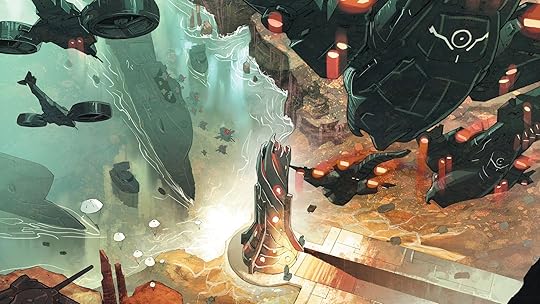
The art is a true highlight as well, and it's fun that King trusted a complete comic book novice to draw this. Barnaby Bagenda is not only a fun name, but an extremely talented artist who did a great job utilizing a 9-panel grid for most of the book (likely under a lot of instruction from King). The colorist (Romulo Fajardo Jr.) deserves a lot of credit as well, using a painterly style that really provides a foreboding atmosphere. There is one issue where a guest colorist had to fill in, and it is.....noticeable. Any way, here's some images that show some of Bagenda and Fajardo Jr.'s fine work:

This isn't necessarily fun or light reading, but it's been stuck in my head since I finished, and I'd recommend it to anyone who is willing to be engaged with these kinds of warfare-related questions. None of it is new or revolutionary by any stretch, but it is expertly executed and extremely refreshing coming from a superhero publisher.
Such is the case with The Omega Men, a ragtag group of alien freedom fighters created in the 1980s that pretty much no one outside of diehards has ever heard of before. Picture a more serious Guardians of the Galaxy, and you'll have a basic idea.
So writer Tom King comes along and says, I don't really care about the DC Universe or people in capes fighting or whatever, I'm just gonna tell a story I want to tell, and ok fine, it just so happens to use some forgotten-about DC characters, but who really cares. And the result is pretty great.
Tom King is an ex-CIA officer that worked in counterterrorism after 9-11, and he uses a lot of his experience to basically tell a huge allegory about modern warfare. In a world (or alien planetary system in this case) where "good" and "bad" are meaningless terms, where rebels and freedom fighters end up having to be just as bad if not worse to overthrow the established ruling empires, where is there room for morality in war? King challenges the trope of "plucky group of resistance fighters overthrows the evil empire" by suggesting that even if the cause is "good" or just (or even religious), the death and destruction created by both sides is going to be the same. Who then is truly "good"? If the resistance takes over from the empire and has to be just as cruel to maintain power, did that make their cause "worth it"? Is a truly peaceful resolution to large-scale conflict even possible, or just naïveté?
These are all very good questions, and using those questions to drive this story results in a very bleak and often depressing comic book. King very effectively shows the horrors of war and its effect on both sides, and it gets pretty emotional. Some readers have complained that the allegory is "on-the-nose" to a lot of modern Middle East conflict, but I mean, so what? That doesn't make it bad, or any less effective. If anything, it's refreshing to see powered people in costumes fighting to make an actual real-world point for once.
The only recognizable person in this book is a green lantern (Kyle Rayner), but King clearly doesn't care about his previous DC appearances or general characterization and basically just uses him as an audience surrogate (which I'm fine with). The Omega Men themselves are fairly interesting folks, and we learn a good deal about them and the circumstances they grew up in.
The art is a true highlight as well, and it's fun that King trusted a complete comic book novice to draw this. Barnaby Bagenda is not only a fun name, but an extremely talented artist who did a great job utilizing a 9-panel grid for most of the book (likely under a lot of instruction from King). The colorist (Romulo Fajardo Jr.) deserves a lot of credit as well, using a painterly style that really provides a foreboding atmosphere. There is one issue where a guest colorist had to fill in, and it is.....noticeable. Any way, here's some images that show some of Bagenda and Fajardo Jr.'s fine work:
This isn't necessarily fun or light reading, but it's been stuck in my head since I finished, and I'd recommend it to anyone who is willing to be engaged with these kinds of warfare-related questions. None of it is new or revolutionary by any stretch, but it is expertly executed and extremely refreshing coming from a superhero publisher.

July 5, 2020
When I pick a comic to read, I am not expecting layered socio political commentary within the panels. But ever so rarely comes a superhero book that does not shy away from adding some of that commentary to spice things up. The Omega Men is one such book and the real world parallels to this story is not veiled in any way. This is clearly about the western intervention in Middle Eastern geopolitics starting from the final decades of the 20th Century. Tom King's attempt here is to not create a retelling of the events while casting with superheroes and setting it in alien planets. It's about the moral dilema of it all.
The author drives home that point that some people's revolutionaries are other people's terrorists. Kyle Rayner's struggles with morality and his role in the whole saga is captured quite wonderfully, though it does take a couple of issues to get going. The Omega Men themselves are shaped to be interesting characters coming from different view points, uniting for a common cause. I liked how the book gives enough attention to the back story of these characters so that they dont feel like throwaways created just for the sake of this story. The art is quite gorgeous for the most part, despite the slightly cartoonish feel. The 9 panel template is put to good use for the majority of this book.
I did feel that the second half of the book is stronger than the first, and it does take a bit of time for the characters to be fleshed out, and for the gravity of the plot to be realised. I was a bit ticked off by the revelations of the characters' futures in the final few pages. Some of the conclusions felt a bit sudden and off character. But it does flow into the main subject of the comic in terms of morality, power and horrors of war.
This one is a very good comic book and has a lot going for it beneath the main superhero story. I'd gladly recommend this to any one considering that there is no barrier of entry in terms of prerequisite knowledge of the DC universe.
The author drives home that point that some people's revolutionaries are other people's terrorists. Kyle Rayner's struggles with morality and his role in the whole saga is captured quite wonderfully, though it does take a couple of issues to get going. The Omega Men themselves are shaped to be interesting characters coming from different view points, uniting for a common cause. I liked how the book gives enough attention to the back story of these characters so that they dont feel like throwaways created just for the sake of this story. The art is quite gorgeous for the most part, despite the slightly cartoonish feel. The 9 panel template is put to good use for the majority of this book.
I did feel that the second half of the book is stronger than the first, and it does take a bit of time for the characters to be fleshed out, and for the gravity of the plot to be realised. I was a bit ticked off by the revelations of the characters' futures in the final few pages. Some of the conclusions felt a bit sudden and off character. But it does flow into the main subject of the comic in terms of morality, power and horrors of war.
This one is a very good comic book and has a lot going for it beneath the main superhero story. I'd gladly recommend this to any one considering that there is no barrier of entry in terms of prerequisite knowledge of the DC universe.

March 23, 2017
4,5*
Very good plot, muddled and violent, a story from the point of view of so-called terrorists against oppression.
In order to bring down the Citadel, indisputably a cold-hearted tyranny that literally killed billions, the Omega Men kidnap Kyle Rayner, White Lantern. They need to win him over for their final plan.
Obviously, you're only seen as a terrorist from the others' side. From yours, you're a resistant. But if your resistant actions are as hard and cruel as your opponent? If killing carloads of civilians is part of your plan, what does that make you?
Tom King, former CIA operator in Irak, clearly used his own experience to write this somber, bloody and finally depressing story where all the characters swim in very muddy waters.
For in the end nothing's as clear-cut as we'd wish it to be. All is very, very gray and the idea of good or bad guy is as irrelevant as it is big-sounding.
King totally impressed me here. For someone who's not been in the comic business from an early age he sure masters the intrinsic narrative codes like any old-timer.
He clearly knows how to use the space offered by the page to tell his story. To build up tension, emotions, action.
I won't say he reinvented the wheel, the book is clearly based on Alan Moore's Watchmen, but again he brilliantly used the possibilities of the medium to tell his story.
King also writes some excellent dialogues and hard-hitting punchlines that enhance the impact of his storytelling.
On the visual side Barnaby Bagenda (pencils) and Romulo Fajardo (colors) do a pretty impressive job.
Very good plot, muddled and violent, a story from the point of view of so-called terrorists against oppression.
In order to bring down the Citadel, indisputably a cold-hearted tyranny that literally killed billions, the Omega Men kidnap Kyle Rayner, White Lantern. They need to win him over for their final plan.
Obviously, you're only seen as a terrorist from the others' side. From yours, you're a resistant. But if your resistant actions are as hard and cruel as your opponent? If killing carloads of civilians is part of your plan, what does that make you?
Tom King, former CIA operator in Irak, clearly used his own experience to write this somber, bloody and finally depressing story where all the characters swim in very muddy waters.
For in the end nothing's as clear-cut as we'd wish it to be. All is very, very gray and the idea of good or bad guy is as irrelevant as it is big-sounding.
King totally impressed me here. For someone who's not been in the comic business from an early age he sure masters the intrinsic narrative codes like any old-timer.
He clearly knows how to use the space offered by the page to tell his story. To build up tension, emotions, action.
I won't say he reinvented the wheel, the book is clearly based on Alan Moore's Watchmen, but again he brilliantly used the possibilities of the medium to tell his story.
King also writes some excellent dialogues and hard-hitting punchlines that enhance the impact of his storytelling.
On the visual side Barnaby Bagenda (pencils) and Romulo Fajardo (colors) do a pretty impressive job.

February 28, 2017
Tom King deserves every bit of attention he's been getting in recent years. This Omega Men volume was a truly fascinating piece of sci-fi, from well-crafted and intriguing characters, to a storyline of disparate threads that came together masterfully by the end. Existential questions are everywhere, and as with any good fiction of this kind, there are no easy answers.
Displaying 1 - 30 of 353 reviews