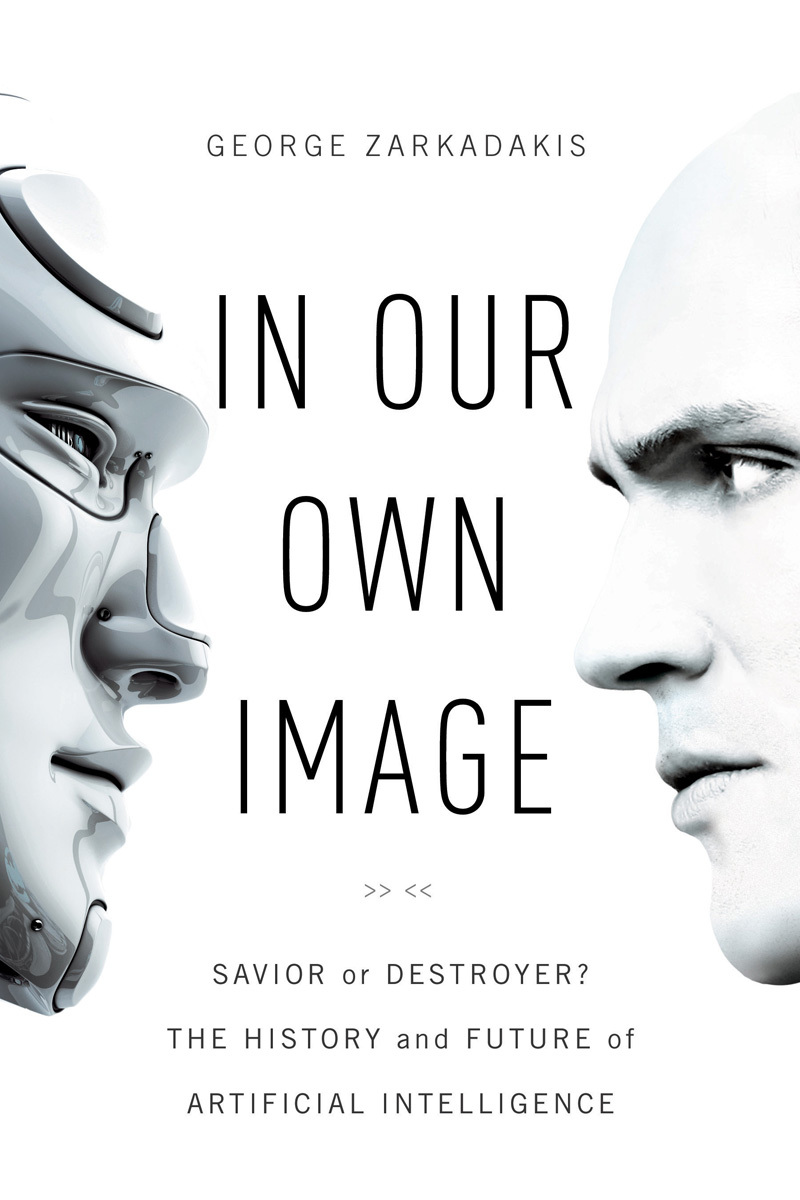
A timely and important book that explores the history and future, as well as the societal and ethical implications, of Artificial Intelligence as we approach the cusp of a fourth industrial revolution Zarkadakis explores one of humankind's oldest love-hate relationships―our ties with artificial intelligence, or AI. He traces AI's origins in ancient myth, through literary classics like Frankenstein, to today's sci-fi blockbusters, arguing that a fascination with AI is hardwired into the human psyche. He explains AI's history, technology, and potential; its manifestations in intelligent machines; its connections to neurology and consciousness, as well as―perhaps most tellingly―what AI reveals about us as human beings. In Our Own Image argues that we are on the brink of a fourth industrial revolution―poised to enter the age of Artificial Intelligence as science fiction becomes science fact. Ultimately, Zarkadakis observes, the fate of AI has profound implications for the future of science and humanity itself.
I started reading In Our Own Image: Savior or Destroyer? The History and Future of Artificial Intelligence by George Zarkadakis with the naive idea that he would definitively answer the question "Will robots destroy the human race?" Instead he's done something even better. He's given a comprehensive history of mathematics, philosophy, psychology, computer science, and Artificial Intelligence. He's explained how our evolution as a species is directly related to the possibility (and the success) of the creation of AI. I'm always amazed when reading scientific nonfiction to discover just how much of the history I already know (Turing! Aristotle!) and how much I am woefully ignorant of (Godel and so much more). AI has been in the works for years. Scientists have approached it from a variety of standpoints and for a multitude of purposes. One of the biggest hurdles facing the scientific community is whether or not consciousness is programmable in a computer. A machine can be "intelligent" but does it exhibit intelligence in the same way as humans? Can a machine understand the true meaning of the questions that it answers through the logic programs installed in its hardware? No one really knows. Is it possible to map the human brain and recreate this mechanically inside of an android? Probably. Is humanity ready for machines that look like us, act like us (to an extent), but are more efficient and intelligent than us? Doubtful. As you know, I love a good end notes and this book has a truly excellent one. I learned the difference between ontology and epistemology, that there's something called the Ig Nobel Prize, and that writers are simply "empty vessels" waiting to be filled by texts. This book asks more questions than it answers and I think that's the point. Humans are unique because we have the capacity to ask questions and to be curious. If you're looking for a thought provoking book on a truly fascinating (and still terrifying) topic then this one will definitely fit the bill.
A book right up my alley: a perfect marriage of technology and philosophy with a generous dash of history. It touches upon our fascination with replication of life, that stretches all the away back to 40,000 ago; summarizes some of the greatest thinkers' theories on mind and consciousness, and how it would apply to thinking machines; and looks ahead at what might lie ahead for us in pursuit of AI. There was so much I wanted to annotate, so I am going to purchase my own copy and read it once again at some point in the near future. Definitely a keeper for a personal library.
I like it. Sometimes it can get dizzying with technicalities and terminologies, but overall it is enlightening on AI subject. Note: this was written before ChatGPT rise to fame.
An absolute masterpiece. I wish I hadn't listened to the audiobook. I have to go back and buy a written copy because it is so dense.
Zarkadakis presents artificial intelligence not as a sudden phenomenon, but as the culmination of centuries of myth, philosophy, and storytelling. He weaves together everything from ancient fables to Enlightenment thought to modern tech, showing how we’ve been slowly — and perhaps inevitably — marching toward this moment.
I was afraid of AI before this book but now I feel more than ever that we have to take a collective hand at shaping it. I will refer to this book again and again as we move into this monumental revolution!
When discussing computers and AI it was very good. The discussion on the philosophy of mind was pretty good. The emergence of autocatalytic systems was interesting. The reaches into political philosophy and economics were, well, reaches.
There is much more history rendered in this book regarding the development of computing, logic, philosophy, and human anatomy versus AI as implied by the title. That is by design as all these disciplines are elements of AI allowing for a better grasp of the challenges obtaining functional artificial intelligence and what that implies. He delves deeply into the various interpretations of consciousness as the ultimate holy grail. This in theory is the ‘ghost in the machine’ once global AI’s potential is fully realized.
I felt the author did a very credible job with this approach while falling a bit short once he focused on the final stretch and actual AI and his conclusions. He does an expert job taking such vast and complex topics yet distilling them in an effective, entertaining manner. Highly recommended for anyone wanting to delve into what may be the most important subject mankind faces for generations to come.
This book really got me thinking about the way society views Artificial Intelligence and the technological advances that are being made to bring us closer to this idea. It states that people have a fascination with AI because of an early influence through art or movies, maybe even just the idea of creating something that can do and say whatever we want it to. But the one thing we want most in an AI is for it to "feel" or "think" the way we do. To create something that is like us that can have emotion and depth like a human. I found this the most interesting concept in the book because the author states that for something to have these qualities it must have conscience. I don't necessarily have the same beliefs as the author but this got me thinking on a higher more spiritual level.
Overall this book was informative but imaginative.
Great book that mixes philosophy, quantum mechanics, history, pop culture analysis and speaks on every field with authority and style. I came away thinking the author is not particularly convinced that AI is possible, but that perhaps AI will take a different form than our idea of consciousness. But the analysis isn't necessarily "anti-AI," just professing a healthy skepticism that the idea of machine consciousness may be much more complicated than we believe.
Very conflicted read. I was really excited by the premise of the book and the author, by their setting out to figure out our fascination with artificial intelligence/life by looking at the history of these concepts in literature, philosophy etc. But it did not deliver. I found some takes to be rather naive and oversimplifying, for example: "Loneliness and the inability to feel love usually lead to depression, suicide even." - this sentence destroyed me a little (maybe I am too sensitive), but there is an abysmal lack of depth (pun intended I guess?), a shallow oversimplification that illustrates almost nothing but shrouds so much. I'm not really an expert in anything, but even so the writing felt very dilettantish - like sitting with a friend in a café and them rambling about some interesting idea they read about: nice and intriguing enough for a coffee chat, but somehow I expected a bit more depth of analysis when the ideas are then gathered together in a book. About half-way through the book it got worse, when thermodynamics came into the discussion. It was claimed (maybe it is just an editing issue?) that "[...] say we heat up a container filled with gas - gas molecules start speeding around unpredictably. The order to the system increases, and entropy decreases." - unless there are some other assumptions about the system which were not mentioned, this is just wrong. In such a situation order decreases, disorder goes up and so does entropy. But I know first-hand how challenging wrapping one's head around thermodynamics is, a never-ending quest really, so I forgave this slip. However, a few pages later it is claimed that using EEG (electroencephalography) and MEG (magnetoencephalograohy) in conjunction with fMRI (functional magnetic resonance imaging) "researchers can correlate what happens at the level of a single neuron". (!!!) But these methods on their own only measure average activities of groups of neurons, they do not have neuron-level resolution, and as such the statement should be either changed or there should be an explanation regarding how the neuron-level resolution can be achieved (inference models? data coming from intracranial electrodes?). I know very little of these methods, but enough to feel like that statement is quite misleading, especially for someone completely new to the topic. I lost the little faith I had at this point, and skimmed-read the second half of the book. What also depresses me about this is the quote on the cover of the book: "Timely and important" by Jim Al-Khalili. I already have "Life on the edge" by Jim Al-Khalili on my shelf, but I am now already wary of whatever claims might be made there as well.
I can't decide on the ratio between this book being just badly written vs actually wrong. I wrote this review because if someone else had written something like this I probably wouldn't have picked this book up, which I wish I hadn't.
(later edit a few hours later): The positives include the philosophical bits, the duality of mind vs matter discussions, discussing how empiricism enabled science to shed light on so much of our reality and the like. But even though I enjoyed these parts, I did so with a grain of salt because I don’t have a background in philosophy, so I can’t really tell if something is off or not, like I was able to for other parts of the book. (or maybe I expect too much thoroughness/rigour from a popular science book and need to chill).
Not quite what I expected, a very interesting read. I thought this would mainly be a book about the current state of AI with a focus on tech, but I was pleasantly surprised to find out that Zarkadakis spends a huge portion of the text to discuss more philosophical questions.
What is consciousness, what does it mean to be alive, what has humanity already tried to simulate it and are they realistic approximations? The author tries to answer these questions and more in a very pleasant way. A purely computer science focused book would also have been interesting for me personally, but the angle that he took definitely bumped it up a notch.
A satisfactory book on an intriguing subject, although I can't resist pointing out a particular recurring error: apparently, there's something called the "Plank length".
A tour of our first attempts at artificial intelligence from the ancient Greeks to the future possibilities with neuromorphic engineering and autopoiesis.
At first glance, Zarkadakis's book is a history of artificial intelligence.
But underneath, it is really a history of human self-understanding.
His story moves through three great questions:
Why have humans always wanted to create artificial life?
What exactly is the human mind?
Can we reproduce intelligence—and perhaps eventually consciousness—in machines?
The remarkable insight is that these are not three separate questions.
They form a single chain:
What we build → reflects what we believe we are → changes how we understand ourselves.
PART I — DREAMING THE ELECTRIC SHEEP Humanity's ancient dream of artificial life
The story begins long before computers.
Human beings have always imagined creating something in their own image.
Ancient myths contain artificial beings, animated statues, mechanical servants and artificial creatures. Greek stories of automata already imagined objects that could move and perform tasks.
Why is this important?
Because it reveals a very old human desire:
If nature can create intelligent life, perhaps human beings can create it too.
The dream is not merely technological.
It is almost existential.
We don't simply want machines that work.
We want to know whether life and intelligence can be recreated.
From gods to engineers
There is a gradual movement from:
magic → mechanism → science → computation → AI.
Ancient humans imagined gods creating life.
Later humans imagined machines creating lifelike behavior.
Modern humans imagine algorithms creating intelligence.
The technology changes, but the underlying dream remains remarkably similar:
Can the created become like the creator?
That question will eventually become central to AI.
PART II — THE MIND PROBLEM What exactly are we trying to recreate?
Here Zarkadakis turns from artificial beings to the human mind itself.
And suddenly the problem becomes much harder.
We know how to describe some things about the brain.
A fair book that takes a look at AI mainly through a historical and philosophical lens. The author contends that AI cannot replace human at a core layer.
Star 3.5☆☆☆+0.5 This document is information compression manual of science Artificial intelligence is made up on the top of such as quantum mechanics, mathematics, programming, physics.
the book theme is "What is consciousness?" ans " Can A.I, have consciousness ?" Do Androids dream of the electric sheep? LOL
the author compares artificial intelligence and science fiction and the movies, ex. 2001 A Space Odyssey ,blade runner,terminator,Frankenstein,etc...............
reading through half of this book now. It is written many metaphysical topics ,then mind-brain problem , can artificial intelligence acquire consciousness? is artificial intelligence going to overtake the human brain -------singularity ---------it guesses 2045 etc.............
It is written in detail mind-brain problem. It has also been cited opinion of renists and physicists,philosopher,etc.......... "What is consciousness?" "Can artificial intelligence have a consciousness?" "Singularity" is written in detail in it.
In our own image - journey of human psyche till AI rather than answering an Yes or No question ,rightly so.to know how we are coping to end up or even start life continuum with AI conundrum ,george zarkadakis takes us to examine theory of mind ,mind body question , evolution of language and its components, with pinch of history on thoughts behind programming evolution from 17th century till 21st.a fairly good start for anyone interested in AI even though last few chapters struggles with the focus and left me with scattered thoughts on a diluted ending.
3.5, a great run through of the history, science, and philosophy of AI. Gets a bit extended into speculation beyond the titled scope and there is certainly no subtly in the authors bias, yet definitely recommended for anyone i interested in the area.
A fantastic, if a bit dry, book that covers AI from every lens imaginable - anthropology, literature, neuroscience, and history. This book is a fantastic resource for those who find themselves captivated by a future increasingly becoming mechanical.
Fantastic philosophical, historical, and scientific treatise of AI! I highly recommend if you want to gain a firm grasp on the underlining philosophical and technical underpinning of AI development and barriers to advancement.
Although the book is advertised as a tour of the concept of AI with the headline areas being fiction and its media, and other public forum dimensions, much of the book is actually a fairly deep look at AI from the view of formal computing, biology, neuroscience, mathematics, and philosophy. Thus, the book is much more of a serious attempt at synthesis of all the above to answer: What is AI, how could it be achieved, and what are the likely impacts it will have on society going forward. Though unlike other more pop-sci books, this one focuses much more on the "what?"
In particular, the book builds up in logical theory through a combination of a fairly detailed exposition of results and historical stories to reach the point of formal incompleteness, and what that means with respect to assigning true/false values for self-referential statements in deduction systems. The author seems to imply that any true AI must be able to master self-references, not falling victim to the "Halting Problem" that is logically equivalent to incompleteness.
The author makes a feasibility argument that sapient agents seem to be able to grok self-reference (at least the living organisms we can observe on Earth), and thus, it is at least a necessary condition for AI. This is an "argument by qualia", and the author also later introduces the more practical definition of intelligence utilized by CS known as the bird/airplane analogue argument. This analogue is a utilitarian approach, showing that there are multiple avenues to achieve one 'property', where one need not simulate all sub-systems of an agent that has this property. By example to gain the property of flight (or possess super-flight relative to a bird), we need not recreate the exact mechanics or morphology of a bird wing, but just a simple abstraction of that wing, to get to a device that is mechanically superior to the original with respect to speed and durability. Likewise, we need not recreate anything close to the exact neural network of an animal mind to build super-intelligence.
The issue of assignment of a value for self-referential introduced by the author is subsumed in the more general notion of the "Entscheidungsproblem" of Hilbert in formal computing, and the author suggests that a stochastic value assignment could be a way out of this mess of resolving the problem that will get us closer to the "what?" of AI. In AI, a system that can assign values to these self-referential and still maintain internal-consistency (each marginal assignment do not generate contradictions), is referred to as "Turing Complete". As an aside, the search for finding the right assignment procedure for these class of statements is different from the path mathematicians took historically, which was to preclude any such statements from entering a formal calculus by refining admissibility on the set of well-formed statements for such a calculus.
Ultimately the author's goal by all this work is to connect the notion of self-reference to notions of cybernetics. This is where it gets hazy, and will probably require a review or guided second reading, as the exact nature of the connection eluded my memory after my first go-through, except a vague notion that cybernetic systems include ideas of system dynamics where the idea of "feedback loops" is central to understanding nonlinear behaviour, and these could be viewed as self-referential.
As one should be able to tell the book is fairly dense with ideas, and those mentioned here are only from one thread. The author covers much material on neuroscience, as well as a deep dive on the mind-body.problem of Descartes, in some ways the foundation for the central theme of the text. Besides the academics, about 20% of the text is devoted to AI in fiction and stories, though mostly from human anthropology with a choice selection from some well-known fiction like Frankenstein and other sci-fi authors.
Though not what I expected, what one gets is a very substantive discussion on AI, serious and deep enough to be included in a reading list for a special topics course on the subject, at either a graduate or undergraduate level, as it definitely adds color to the standard technical treatment of the subject. Specifically for those who are or planning to specialize in this field or something adjacent, I found it especially insightful for perspective on the history of AI and parts of ML for those who joined the field post the first AI-winter. Really great book. Useful. Highly recommended.
This book is in 3 parts. First about the homo sapiens history, we mostly know the development and evolution about human history. Second part about robot development including the computer. Third part is about the consciousness on human and robot. This part is more fascinating. The definition of AI is artificial intelligence. But how do we define intelligence on Humans? Our behaviors, our morality, justice, doing the right things, are we so sure about human are intelligent?
We are talking about artificial intelligence on robot with human kind consciousness, which doesn't exist so far and not able to find similar kind among any other animals except humans. We surely capable to use computer to replace many human fastidious or boring jobs, but the consciousness is not given. The author give us a living mechanism such us the whole earth ecosystem itself has no consciousness.
Therefore he didn't jump to conclusion about what if the robots could actually got chip in our human intelligence (with the touch of consciousness) since we are not there yet.
With recent on line course i learned on "element of AI", it explained in a more neutral way about if AI is going to be dangerous and wipe out human being, again similar that we wish to use robots to facilitate our life, not to replace us.
I can’t begin to explain how much I enjoyed reading this book. The first two parts specifically were groundbreaking for me personally as I am studying a specific area in AI but never came across an interpretation of its history in the way Zarkadakis put it. The links to dualism and philosophy were described very clearly and systematically. The novels and fictional characters he included and how they were linked to our current aspirations in AI was inspiring. Not to mention his comprehensive explanation of the moments the pursuit of an artificial mind changed from a holistic recreation of the human mind to a more grounded mechanical role. I highly recommend this book to anyone in the field.
Not a short book by any means but chock-full of philosophical and science history that provides a good narrative to what we consider as intelligence and artificial intelligence. Questioning the largely acknowledged fact of the inevitable march towards progress. We see that all our achievements has not been linear. In fact our theories, execution and possibilities of variant philosophical and scientific to have come to this is by a long shot. I'll come back to this book again and again.
Many good points raised here, but most of them are common-sensical ideas which most readers already understand. This book raises more questions than answers. The arguments presented here rest more on philosophical logic and inquiry rather than computer science or examples, which was disappointing. This wasn't what I hoped for when I picked up this book.
This seems to have been well researched and it was an interesting read. That said, the overt Marxism, materialism, and trans-humanist agenda being pushed was assumed, not defended. From a Christian standpoint, the book’s message was garbage.