Captures the majestic beauty of the American West, from Santa Fe, to the Big Sur, to the peaks of Olympic National Park, drawing extensively on unpublished photographs from the artist's personal archives
This is a collection of 87 color photographs by Eliot Porter, taken 1951-1984. It's hard to summarize the contents of this collection because there's such an immense variety of images. In general, they are an often breathtaking tribute to the beauty of the western landscape. All but a few are of natural settings untouched by humans, and they represent the region of the U.S. west of the 105th meridian (which runs north and south through Denver). In most, also, there is an intensity of color and sharp contrast betwen light and shadow.
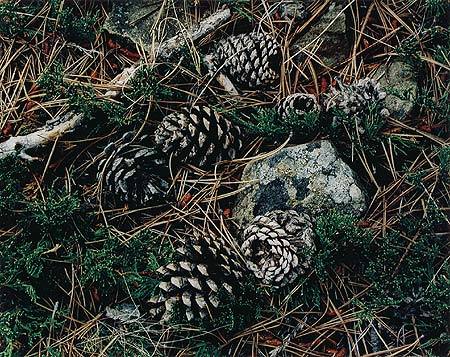
Beyond that, however, similarities pretty much end. Many pictures represent a very wide array of panoramic landscapes -- mountains, deserts, rivers, canyons, badlands, prairie, big sky. Others are closeups of plant life and the textures of surfaces (rock, sand, water). Some of these latter images verge on the abstract. The collection includes a sequence of photographs of the Colorado River's Glen Canyon in Utah in the early 1960s before its flooding to create Lake Powell. For a whole book devoted to Glen Canyon, see Porter's "The Place No One Knew."
The introduction is a general overview of the history of this region that laments the loss of much since the introduction of European settlement and modernization and describes the struggle that has gone on for more than a century between preservationists and developers. I recommend this book to anyone with an interest in the American West.
Eliot Porter's images are almost as synonymous with the American West as Ansel Adams' photographs, but for some reason, his works appear less in popular literature than those by Adams. This particular collection of color photographs consists less of sweeping depictions of iconic landscapes and more of quiet studies of nature, but careful study reveals that Porter was, indeed, a master of the craft.
No darkroom tricks, no wild experimentation, no cynical messages. The West's images are pretty straightforward, but Porter has just enough control of his lighting and composition techniques to make this collection interesting. Not the best nature/landscape stuff out there, but an inspiring book, nonetheless, that lets nature speak without being drowned out by the voice of the artist.