

What do you think?

Kate and Jancsi #1
The Good Master
Jancsi is overjoyed to hear that his cousin from Budapest is coming to spend the summer on his father's ranch on the Hungarian plains. But their summer proves more adventurous than he had hoped when headstrong Kate arrives, as together they share horseback races across the plains, country fairs and festivals, and a dangerous run-in with the gypsies.
In vividly detailed scenes and beautiful illustrations, this Newbery Award-winning author presents an unforgettable world and characters who will be remembered forever.
In vividly detailed scenes and beautiful illustrations, this Newbery Award-winning author presents an unforgettable world and characters who will be remembered forever.
196 pages, Paperback
First published January 1, 1935
About the author
Kate Seredy
71 books98 followersSeredy (Serédy Kató) was a gifted writer and illustrator, born in Hungary, who moved to the United States in 1922.
Seredy received a diploma to teach art from the Academy of Arts in Budapest. During World War I Seredy travelled to Paris and worked as a combat nurse. After the war she illustrated several books in Hungary.
She is best known for The Good Master, written in 1935, and for the Newbery Award winner, The White Stag.
Seredy received a diploma to teach art from the Academy of Arts in Budapest. During World War I Seredy travelled to Paris and worked as a combat nurse. After the war she illustrated several books in Hungary.
She is best known for The Good Master, written in 1935, and for the Newbery Award winner, The White Stag.
Ratings & Reviews
Friends & Following
Create a free account to discover what your friends think of this book!
Community Reviews
Displaying 1 - 30 of 378 reviews

April 10, 2014
The Good Master, a Newbury Honor book written in 1935, is set in the Hungarian countryside in the early 1900s. If you like nostalgic, heartwarming children's fiction, this book is SO good. I recommended this book to a GR friend for her young granddaughter, and started reminiscing about how very, very much I loved this book when I was a young teen. I read it so many times when I was a 10-15 year old bookworm that I'm surprised my copy of the book stayed in one piece. I hid it in my school desk so the teacher wouldn’t notice I was reading instead of listening to the lesson (yeah, I was that kind of kid).
Think Farmer Boy set in old-time Hungary, and then add Kate, a feisty, mischievous cousin from the big city of Budapest, who is sent to stay with her country cousin Jansci and his parents because she's so spoiled and unmanageable that her single dad doesn't know what to do with her any more. A good dose of country living, farm chores and firm love help Kate turn around, but she keeps her mischievous streak!
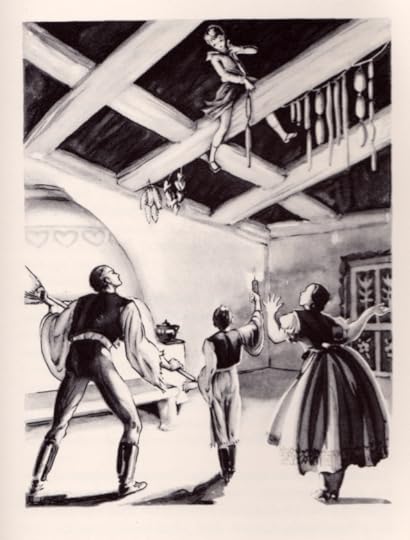
Kate snitching the family's homemade sausages
Kate and Jansci have a delightful series of escapades and adventures, and Kate learns to love the people around her and the simpler life in the country. (Heads up on one scene that might bother some readers: in one chapter gypsies steal from the family and "kidnap" Kate, though she actually begs them to take her away with them when she discovers them stealing, so she won't get tied up and left in an empty house.)
This book is beautifully illustrated by the author, and is based on the author's own experiences as a child in the early 1900s, when she spent summers in the Hungarian countryside with her father. It's a lovely tale of life in old Hungary, a little old-fashioned, but very heartwarming.
Think Farmer Boy set in old-time Hungary, and then add Kate, a feisty, mischievous cousin from the big city of Budapest, who is sent to stay with her country cousin Jansci and his parents because she's so spoiled and unmanageable that her single dad doesn't know what to do with her any more. A good dose of country living, farm chores and firm love help Kate turn around, but she keeps her mischievous streak!
Kate snitching the family's homemade sausages
Kate and Jansci have a delightful series of escapades and adventures, and Kate learns to love the people around her and the simpler life in the country. (Heads up on one scene that might bother some readers: in one chapter gypsies steal from the family and "kidnap" Kate, though she actually begs them to take her away with them when she discovers them stealing, so she won't get tied up and left in an empty house.)
This book is beautifully illustrated by the author, and is based on the author's own experiences as a child in the early 1900s, when she spent summers in the Hungarian countryside with her father. It's a lovely tale of life in old Hungary, a little old-fashioned, but very heartwarming.

March 23, 2019
I loved this book as a child and grabbed a second hand copy of the edition I knew when I saw it recently.
It reads now as a series of episodes in Hungarian farm life in the early twentieth century, before mechanisation, when flocks and herds were cared for by men who lived close to their animals, the harvest was cut by hand and hay brought in piled high on wagons, and the country people all wore traditional dress.
Seredy has idealised the life, and given her hero and heroine a series of adventures together - mostly with Jansci saving the reckless Kate from the consequences of her rash behaviour. It’s warm and happy, and holds up well for a nostalgic book written in the 1930s.
It reads now as a series of episodes in Hungarian farm life in the early twentieth century, before mechanisation, when flocks and herds were cared for by men who lived close to their animals, the harvest was cut by hand and hay brought in piled high on wagons, and the country people all wore traditional dress.
Seredy has idealised the life, and given her hero and heroine a series of adventures together - mostly with Jansci saving the reckless Kate from the consequences of her rash behaviour. It’s warm and happy, and holds up well for a nostalgic book written in the 1930s.

October 25, 2019
This story has a beautiful backdrop of rich Hungarian farmlands, abundant plains and rising mountains. It takes you through several seasons, showcasing each of their glories. Old Hungarian legend and folklore are slyly woven into the storyline too. It's a colorful mix that readers will enjoy!
Jancsi is at first excited about his cousin, Kate's, visit but at their initial meeting, he turns incredibly skeptical. And for good reason. Kate is an unruly, thoughtless girl right out of the gate; but as the story progresses, she turns into a responsible, good-natured member of the family.
Jancis and Kate enjoy several narrowing adventures and learn about all kinds of wonderful things. Another good family read-aloud!
Ages: 7 - 13
Cleanliness: mentions some smoking and drinking. Some Hungarian folklore/beliefs are explained. Kate is not a well-behaved child at the start of the book but she changes her ways and is nice and kind.
**Like my reviews? Then you should follow me! Because I have hundreds more just like this one. With each review, I provide a Cleanliness Report, mentioning any objectionable content I come across so that parents and/or conscientious readers (like me) can determine beforehand whether they want to read a book or not. Content surprises are super annoying, especially when you’re 100+ pages in, so here’s my attempt to help you avoid that!
So Follow or Friend me here on GoodReads! You’ll see my updates as I’m reading and know which books I’m liking and what I’m not finishing and why. You’ll also be able to utilize my library for looking up titles to see whether the book you’re thinking about reading next has any objectionable content or not. From swear words, to romance, to bad attitudes (in children’s books), I cover it all!
Jancsi is at first excited about his cousin, Kate's, visit but at their initial meeting, he turns incredibly skeptical. And for good reason. Kate is an unruly, thoughtless girl right out of the gate; but as the story progresses, she turns into a responsible, good-natured member of the family.
Jancis and Kate enjoy several narrowing adventures and learn about all kinds of wonderful things. Another good family read-aloud!
Ages: 7 - 13
Cleanliness: mentions some smoking and drinking. Some Hungarian folklore/beliefs are explained. Kate is not a well-behaved child at the start of the book but she changes her ways and is nice and kind.
**Like my reviews? Then you should follow me! Because I have hundreds more just like this one. With each review, I provide a Cleanliness Report, mentioning any objectionable content I come across so that parents and/or conscientious readers (like me) can determine beforehand whether they want to read a book or not. Content surprises are super annoying, especially when you’re 100+ pages in, so here’s my attempt to help you avoid that!
So Follow or Friend me here on GoodReads! You’ll see my updates as I’m reading and know which books I’m liking and what I’m not finishing and why. You’ll also be able to utilize my library for looking up titles to see whether the book you’re thinking about reading next has any objectionable content or not. From swear words, to romance, to bad attitudes (in children’s books), I cover it all!

June 28, 2017
This is a delightful, heartwarming story that is aimed at the 8-12 age demographic, but even teenagers and adults can enjoy the great storytelling. The characters are vivid and lifelike; Jancsi, Kate and Márton in particular I found to be very relatable. Coming at this book from an adult's point of view, I found that the characters have layers to them that are more than meets the eye. But Seredy keeps the complexity of the personalities as a sort of undercurrent to the story so that while young children may not pick up on it and can still enjoy the story at face value, an adult can appreciate the characters on a deeper level.
While there are a few moments of drama, for the most part, it is a tale of everyday life in the rural plains of Hungary in the early 1900's, prior to WWI. The country life is presented in an almost idealized manner, but is tempered slightly by a few instances of challenges and minor hardship. There are moments of warm family times, life lessons that the children learn and scenes described that are outright humorous.
One particularly poignant scene that I loved was when the priest was commending Jancsi for his bravery during an incident. The exchange was as follows:
Jancsi: "...I was not brave. I was just about scared to death."
The Priest: "That's just why I call you brave. The best of us are 'scared to death' when we are in danger. But only the courageous stay and fight."
Kate Seredy does a great job of keeping the narrative flowing, with each chapter segmented almost like a snapshot of an event in the story. It would seem that she also has a partiality for folktales and fables as there are several instances of older characters recounting such stories to Jancsi and Kate, which while it was a bit different I didn't find it a negative. Seredy also illustrated the edition I have (I believe all authorized volumes include her illustrations) and I found the art to be a wonderful addition to the story.
The book, which is loosely based on Seredy's childhood, was published in 1935 and received a Newbery Honor medal the following year. I recommend this for the original target age of 8-12 and I also think that it can be enjoyed by all ages. There is nothing in terms of content that I found to be objectionable. Although I think it worth mentioning that there is a very stereotypical representation of a gypsy clan in the story that some might not appreciate. Also worth mentioning is that the legend of Santa Claus is thoroughly invalidated in the latter half of the book, so if you, as a parent, wish to preserve your child's belief in the jolly ol' fellow then you may wish to skip this book. Otherwise it is a very fun and engaging tale that I think families will love.
Interesting Note: While born and raised in Hungary, Seredy didn't begin publishing her writing until she immigrated to the United States. All of her books were written in English and even though The Good Master and its sequel are very much about Hungarian culture, neither were ever translated into Hungarian, according to Wikipedia.
While there are a few moments of drama, for the most part, it is a tale of everyday life in the rural plains of Hungary in the early 1900's, prior to WWI. The country life is presented in an almost idealized manner, but is tempered slightly by a few instances of challenges and minor hardship. There are moments of warm family times, life lessons that the children learn and scenes described that are outright humorous.
One particularly poignant scene that I loved was when the priest was commending Jancsi for his bravery during an incident. The exchange was as follows:
Jancsi: "...I was not brave. I was just about scared to death."
The Priest: "That's just why I call you brave. The best of us are 'scared to death' when we are in danger. But only the courageous stay and fight."
Kate Seredy does a great job of keeping the narrative flowing, with each chapter segmented almost like a snapshot of an event in the story. It would seem that she also has a partiality for folktales and fables as there are several instances of older characters recounting such stories to Jancsi and Kate, which while it was a bit different I didn't find it a negative. Seredy also illustrated the edition I have (I believe all authorized volumes include her illustrations) and I found the art to be a wonderful addition to the story.
The book, which is loosely based on Seredy's childhood, was published in 1935 and received a Newbery Honor medal the following year. I recommend this for the original target age of 8-12 and I also think that it can be enjoyed by all ages. There is nothing in terms of content that I found to be objectionable. Although I think it worth mentioning that there is a very stereotypical representation of a gypsy clan in the story that some might not appreciate. Also worth mentioning is that the legend of Santa Claus is thoroughly invalidated in the latter half of the book, so if you, as a parent, wish to preserve your child's belief in the jolly ol' fellow then you may wish to skip this book. Otherwise it is a very fun and engaging tale that I think families will love.
Interesting Note: While born and raised in Hungary, Seredy didn't begin publishing her writing until she immigrated to the United States. All of her books were written in English and even though The Good Master and its sequel are very much about Hungarian culture, neither were ever translated into Hungarian, according to Wikipedia.
December 6, 2015
1936 Newbery Honor book. This is like the Little House books, except set in Hungary. I loved everything: the folk tales, Kate's antics, the details of everyday living. Why is this book not better known today? It deserves to be read.

January 6, 2017
I read this one again for a book group discussion. Once again I loved it, especially that story I mentioned before about The Land Where People Never Die. It is worth reading just for that story.
I love these stories that bring on nostalgia and make me ponder whether or not I could have lived and thrived back in the day. I'm fairly certain that I wouldn't have been able to, I am grateful for being here when and where I am. I had a fun moment when I turned a page and recognized an illustration from my childhood and realized that a story I loved as a child in the Collier's Junior Classics is a chapter in this book. That was fun. The other thing I loved in this book were the stories and/or myths that were shared, especially the story of Prince Mátyás. I am copying that one and gonna refer back to it many times.
I love these stories that bring on nostalgia and make me ponder whether or not I could have lived and thrived back in the day. I'm fairly certain that I wouldn't have been able to, I am grateful for being here when and where I am. I had a fun moment when I turned a page and recognized an illustration from my childhood and realized that a story I loved as a child in the Collier's Junior Classics is a chapter in this book. That was fun. The other thing I loved in this book were the stories and/or myths that were shared, especially the story of Prince Mátyás. I am copying that one and gonna refer back to it many times.

March 5, 2017
Hungary
Exuberant. Wholesome. Informative.
Ten-year-old Jancsi, an only child, is the first person we meet. On page 2 of the text, we learn that ...
It got so lonesome for poor Jancsi, he would have given ten horses for a brother. He had it all figured out -- he would give a donkey for even a sister. Not horses, just a donkey.
On page 76, a shepherd explains why he doesn't need money ...
"What would a shepherd be doing with money, Mister Nagy? I have everything here. I am happy. ... The sky gives me sunshine and rain. The ground gives me food. The spring gives me water. The sheep give me shelter and clothes. The beautiful flowers, the animals, the birds, show me what to carve with my knife.
Life was lots of work (with some play, of course), some of which is summarized in a paragraph on p 151. ...
The gigantic task of preparing against the long-hard winter went on. Eggs were stored in the cellar, milk made into cheese. Two pigs were getting fatter ... they would be butchered. Then Mother could make lard, sausages, smoked hams. Wagonloads of oats ...
I'm awed just reading this listing. If I were in that family, I wouldn't be able to pull my weight.
Reminiscent of Heidi.
Exuberant. Wholesome. Informative.
Ten-year-old Jancsi, an only child, is the first person we meet. On page 2 of the text, we learn that ...
It got so lonesome for poor Jancsi, he would have given ten horses for a brother. He had it all figured out -- he would give a donkey for even a sister. Not horses, just a donkey.
On page 76, a shepherd explains why he doesn't need money ...
"What would a shepherd be doing with money, Mister Nagy? I have everything here. I am happy. ... The sky gives me sunshine and rain. The ground gives me food. The spring gives me water. The sheep give me shelter and clothes. The beautiful flowers, the animals, the birds, show me what to carve with my knife.
Life was lots of work (with some play, of course), some of which is summarized in a paragraph on p 151. ...
The gigantic task of preparing against the long-hard winter went on. Eggs were stored in the cellar, milk made into cheese. Two pigs were getting fatter ... they would be butchered. Then Mother could make lard, sausages, smoked hams. Wagonloads of oats ...
I'm awed just reading this listing. If I were in that family, I wouldn't be able to pull my weight.
Reminiscent of Heidi.

January 22, 2021
This is such a sweet book, I hardly know where to begin. Of course, it's for children and that's obvious from the start, but some children's books just seem to be timeless, and this is one of them. I should note that I have never read this before. My favorite parts had to be the story of the Land Where People Never Die, and the chapter Mikulas, Bearer of Gifts. This is a sweet, timeless book I would recommend for anyone, young and old.

April 1, 2024
I've always remembered this as one of the loveliest books from my childhood, and it was a special treat to introduce my own children to it.
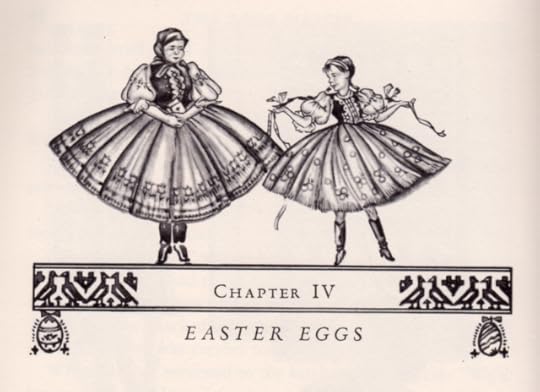
I will always have a place in my heart for books that present another culture in all its colorful glory, and this one is probably the most magnificent example I know. Everything is vivid, literally and metaphorically: Hungarian folk costumes, Easter eggs, pottery, flower-spotted fields and the vast skies overhanging the plains; the folktales interwoven into the main narrative; the customs for Easter, fair day, harvest, and Christmas; the warmth of characterization, where everyone lives not without conflict or worry but an overall serene, well-ordered, harmonious existence.
In addition to the attraction of local color, this book is all about the agricultural year and the work and customs attending it. Small wonder I have always loved it so! It's in some ways a Hungarian Farmer Boy story—and in fact was published at almost exactly the same time—though The Good Master splits its focus between the two cousins, and it gives a fuller picture of the entire farm and culture (rather than focusing narrowly on the experience of one central character). We don't get to know Jansci's daily life quite as well as we know Almanzo's, but we get a richer sense of the family, landscape, stories, and customs that make up his world.
And there is probably no father in literature, not even Father Wilder or Pa Ingalls, that can hold a candle to Jansci's father in The Good Master for his kindness, skill, wisdom, and impeccable sense of when to tighten the reins and when to loosen them.
I will always have a place in my heart for books that present another culture in all its colorful glory, and this one is probably the most magnificent example I know. Everything is vivid, literally and metaphorically: Hungarian folk costumes, Easter eggs, pottery, flower-spotted fields and the vast skies overhanging the plains; the folktales interwoven into the main narrative; the customs for Easter, fair day, harvest, and Christmas; the warmth of characterization, where everyone lives not without conflict or worry but an overall serene, well-ordered, harmonious existence.
In addition to the attraction of local color, this book is all about the agricultural year and the work and customs attending it. Small wonder I have always loved it so! It's in some ways a Hungarian Farmer Boy story—and in fact was published at almost exactly the same time—though The Good Master splits its focus between the two cousins, and it gives a fuller picture of the entire farm and culture (rather than focusing narrowly on the experience of one central character). We don't get to know Jansci's daily life quite as well as we know Almanzo's, but we get a richer sense of the family, landscape, stories, and customs that make up his world.
And there is probably no father in literature, not even Father Wilder or Pa Ingalls, that can hold a candle to Jansci's father in The Good Master for his kindness, skill, wisdom, and impeccable sense of when to tighten the reins and when to loosen them.

April 28, 2011
The story tells of a young boy growing up on a large ranch in pre-WWI Hungary. His cousin Kate from Budapest comes to stay with the family -- allegedly to recover strength after the measles but, in truth, because she is spoiled and naughty and her widower father cannot control her. (Yes, think Kate from Shakespeare's Taming of the Shrew, though I have no idea if the author intended the connection.) Over the course of a year and many exciting adventures (saved from drowning! kidnapped by gypsies! stops a horse stampede!), Kate grows to love country life and becomes pleasant and productive.
I loved this book as a child but couldn't remember the title until I came across it recently in a book list. It falls into the satisfying genre of broken people/things getting fixed. The book also contains interesting descriptions of Hungarian country life in the early 1900s -- traditional customs, dress, farm life -- and intersperses Hungarian folktales into the story. Makes me wish I were Hungarian. The author also illustrated her own book, and her drawings add beautifully to the story -- sort of an art deco meets folk art.
I loved this book as a child but couldn't remember the title until I came across it recently in a book list. It falls into the satisfying genre of broken people/things getting fixed. The book also contains interesting descriptions of Hungarian country life in the early 1900s -- traditional customs, dress, farm life -- and intersperses Hungarian folktales into the story. Makes me wish I were Hungarian. The author also illustrated her own book, and her drawings add beautifully to the story -- sort of an art deco meets folk art.

August 31, 2016
Own.
We read this book as our "Fun Novel" at the end of Whatchamacallit (Circle Time, Morning Time, Morning Basket, Symposium, Whatchamacallit). I loved the beautiful writing, thoughtful story, and many of the ideas presented.
I was disappointed by how Romani were portrayed in the story.
Kate, a wild, spoiled imp of a city-girl, is sent to live with her uncle and his family after an illness and the death of her mother. She is completely out of control and her father doesn't know what to do with her. She causes some crazy events in the beginning, but -spoiler- she becomes a settled, happy child who has adventures with her cousin.
My children were completely enthralled by the book: laughing at Kate's antics and begging for more.
This book is highly recommended by all of us with some qualifications about reading and discussing together.
We read this book as our "Fun Novel" at the end of Whatchamacallit (Circle Time, Morning Time, Morning Basket, Symposium, Whatchamacallit). I loved the beautiful writing, thoughtful story, and many of the ideas presented.
I was disappointed by how Romani were portrayed in the story.
Kate, a wild, spoiled imp of a city-girl, is sent to live with her uncle and his family after an illness and the death of her mother. She is completely out of control and her father doesn't know what to do with her. She causes some crazy events in the beginning, but -spoiler- she becomes a settled, happy child who has adventures with her cousin.
My children were completely enthralled by the book: laughing at Kate's antics and begging for more.
This book is highly recommended by all of us with some qualifications about reading and discussing together.

December 28, 2025
Really such a lovely book. Reminded me of Understood Betsy. Loved the Hungarian culture and folktales woven throughout.

December 14, 2016
Jonsi, a boy from the Hungarian Plains, is unimpressed when his cousin Kate comes to stay from the city. She's pale and skinny and insults his clothing! Kate's father says she has come to recover from the measles, but the truth is, Kate is dreadfully spoiled and headstrong. Her father can not control her and is hoping is brother will be able to guide Kate with a firm, but loving hand. As weeks turn into months, the cousins have many adventures together and Jonsi may decide that having a girl for a cousin isn't so bad after all.
This is a charming book. It is the Hungarian version of Little House on the Prairie! The ranch is presented as a healthy, good place to grow up. The cousins have many fun adventures but at the same time, the harsh realities of life on the plains are described in detail. Instead of Pa's fiddle and country dances, we have folk tales, gypsy music, and folk dancing. I liked the adventures of Kate and Jonsi and the folk tales were interesting. The folk tales give a better look at Hungarian culture and beliefs than the main narrative but they are very weird. I loved all the period details about life on a pre-industrial ranch, especially the brief mention of preparing and spinning flax. Mother and Kate must be very strong! The cover image is gorgeous. It reminded me of the Moravian Easter egg designs in , which makes sense. I wasn't crazy about the interior illustrations. The author illustrated the book herself and chose a stylish, sleek, modern style of illustrating her book. The style was not cozy or friendly.
At first I found Kate too headstrong and crazy but I grew to like her. If you like Pippi Longstocking, Anne Shirley and Laura Ingalls, you'll like Kate too. Jonsi isn't as memorable as Kate. He is a little goody goody at first but he and Kate bring out the best (and sometimes worst) in each other.
This is a charming book. It is the Hungarian version of Little House on the Prairie! The ranch is presented as a healthy, good place to grow up. The cousins have many fun adventures but at the same time, the harsh realities of life on the plains are described in detail. Instead of Pa's fiddle and country dances, we have folk tales, gypsy music, and folk dancing. I liked the adventures of Kate and Jonsi and the folk tales were interesting. The folk tales give a better look at Hungarian culture and beliefs than the main narrative but they are very weird. I loved all the period details about life on a pre-industrial ranch, especially the brief mention of preparing and spinning flax. Mother and Kate must be very strong! The cover image is gorgeous. It reminded me of the Moravian Easter egg designs in
, which makes sense. I wasn't crazy about the interior illustrations. The author illustrated the book herself and chose a stylish, sleek, modern style of illustrating her book. The style was not cozy or friendly. At first I found Kate too headstrong and crazy but I grew to like her. If you like Pippi Longstocking, Anne Shirley and Laura Ingalls, you'll like Kate too. Jonsi isn't as memorable as Kate. He is a little goody goody at first but he and Kate bring out the best (and sometimes worst) in each other.

April 1, 2020
This book, The Good Master, is a story about a boy whose family has to take care of his cousin, who is an unexpectedly rambunctious and misbehaved little girl. Throughout the story, with humor and love of your neighbor, the family helps the little girl, while bringing their family closer together. I love this book.

February 12, 2008
Good book for the whole family.

October 23, 2018
I expected better writing. We found this book did not flow well as the sentences were short and choppy. The story was okay, but my older children found it a bit juvenile.

September 15, 2009
When I was little I was quite a precocious reader, and my mother used to encourage me in this by forcing urging me to read lots of 'worthy' books, classics and Newbery Award winners and simplified biographies. I remember complaining endlessly to her about how boring they were, but I still did it, which must have gained her excellent bragging rights with the other mums. The Good Master was one such, but I distinctly recall enjoying it, so perhaps it was early on in the Reading Regime - before mutiny set in. (Swallows & Amazons was the straw that finally broke the camel's back, I found it SO LONG and SO DULL that I flatly refused to finish it. Then I tried it again a few years later of my own accord and loved it, though I didn't tell Mum that.)
Anyway, I read this one again the other day for book club, and considering a good 25 years must have transpired between readings I was surprised how many details had stuck in my mind - the skirts, the sausages, the Easter eggs! I thought it was quaint and folksy and I enjoyed the details about Hungarian farm life. In fact I wished she'd gone into MORE detail about Hungarian History & Traditional Customs - but to be fair, a child reader would probably not be as interested, so I think she made the right call by just touching on them briefly. A couple reviews on here compare it to Little House on the Prairie or Farmer Boy, and I can see the similarities. Ahhh farming, so wholesome and healthy for the body and soul! Nobody can remain a brat in the face of fresh air, bowls of milk straight from the cow, and Good Honest Farm Labour. Actually I can think of quite a few children's books that contain this theme - Heidi & The Secret Garden, just off the top of my head.
One of my uni lecturers had Roma heritage and was always talking about negative portrayals of 'gypsies' in children's literature (Enid Blyton is a culprit) - this one would've made her black list for sure. Dirty, thieving, lazy, not quite kidnappers but not far off it. I read some other reviews to see what people had to say about this, and found these very interesting and well-expressed words from someone called J Wallis:
Lots of older books like this one have dated messages and points of view that we would now consider wrong and distasteful. Instead of censoring or re-writing them I think it's really important to leave them as they are, and DISCUSS them! Kids can handle it! Heck, I think they can EVEN handle reading words like 'candle' and 'bread-and-dripping' without flying into a panic because they only know about electric light switches and margarine.
Anyway, I read this one again the other day for book club, and considering a good 25 years must have transpired between readings I was surprised how many details had stuck in my mind - the skirts, the sausages, the Easter eggs! I thought it was quaint and folksy and I enjoyed the details about Hungarian farm life. In fact I wished she'd gone into MORE detail about Hungarian History & Traditional Customs - but to be fair, a child reader would probably not be as interested, so I think she made the right call by just touching on them briefly. A couple reviews on here compare it to Little House on the Prairie or Farmer Boy, and I can see the similarities. Ahhh farming, so wholesome and healthy for the body and soul! Nobody can remain a brat in the face of fresh air, bowls of milk straight from the cow, and Good Honest Farm Labour. Actually I can think of quite a few children's books that contain this theme - Heidi & The Secret Garden, just off the top of my head.
One of my uni lecturers had Roma heritage and was always talking about negative portrayals of 'gypsies' in children's literature (Enid Blyton is a culprit) - this one would've made her black list for sure. Dirty, thieving, lazy, not quite kidnappers but not far off it. I read some other reviews to see what people had to say about this, and found these very interesting and well-expressed words from someone called J Wallis:
The Roma were a people group who had undergone centuries of hate and oppression, wherever they went. At one time, they truly did have a system of ethics where stealing from non-Roma, especially in a guileful or tricky way, was considered a great virtue. This was a perfectly logical adaptation to their life experience.
It is wrong to ascribe traits to an entire group of people, especially when those supposed traits are based on prejudice, instead of experience. However, it is equally wrong to deny an entire group of people their cultural history, simply because we find it offensive, by the standards and hindsight of two-hundred years later.
P.S. The grand majority of the tales of Roma "kidnapping" children turned out to be incidents of young people running off with the travelling people to escape their brutal, miserable lives, subject to the absolute authority of often abusive parents. The concept of children as individuals, possessed of human rights, is less than a hundred years old, but the desire of the human spirit to be free is as old as humanity.
Lots of older books like this one have dated messages and points of view that we would now consider wrong and distasteful. Instead of censoring or re-writing them I think it's really important to leave them as they are, and DISCUSS them! Kids can handle it! Heck, I think they can EVEN handle reading words like 'candle' and 'bread-and-dripping' without flying into a panic because they only know about electric light switches and margarine.

June 24, 2015
Back in elementary school, an edited version of parts of chapters 1 and 2 of this book was in my guided reading book. For some reason our teacher didn't use it in class, but I remember reading and enjoying the story of wild Kate who climbed up in the rafters and stole the sausages. I had never heard of Hungary, or Budapest, but it sounded interesting.
Fast forward 45 years and I came across a copy of the book the story was taken from. Unfortunately the beautifully-drawn illustrations are in black and white, except for the two portraits of Kate and Jancsi as frontispieces--such a shame, when the text gives so much space to the description of their brightly-coloured festival clothes. I suppose we're each supposed to imagine the colours in.
I really enjoyed reading the rest of Kate's story, but by the end I was drawing amused comparisons between this book set in Hungary and books like Farmer Boy. Ms Seredy knew her American audience of the 1930s, and the Newbery tropes are firmly in place: little spitfire girl sent to her relations in the country to convalesce from an illness learns that "every bite of bread takes a lot of hard work." I am aware this is true, but few authors feel the need to put it in so many words, twice in as many sentences. The heavy-handed flag-waving is what cost this review that fifth star.
In those days measles was a life-threatening disease; funny then how the "delicate" child can climb up into the rafters on her first night in the country and gorge on stolen sausages! Like Father Wilder, Master Nagy owns "thousands" really? of sheep, horses and cattle. Unlike Father Wilder, Master Nagy has crowds of adoring shepherds and horsemen to help him out. He too spends the winter carving his own chairs and showing the kids how to chop straw for bricks etc. Mother Nagy, like Mother Wilder, has no name and spends her time spinning, weaving, sewing and embroidering her family's clothes, when she's not cooking huge meals for the shearers, herders or guests. The miller tells as many tall tales as Laura Ingalls Wilder's Mr Edwards, too.
In a few short weeks Kate is strong enough to stop the horses stampeding (!) and take on half of the farmwork along with Jancsi, though we never hear of her doing any "woman's work" such as cleaning, cooking or washing dishes, because she's "just as good as a boy." There are all of the American frontier festivals--the county fair, the livestock sales, Christmas complete with a home-made Christmas tree decorated with strings of...popcorn? In Hungary? Really? They apparently sing Silent Night in Hungary, too and for a little excitement, a run-in with theiving gypsies--but even their stealing the fattened pig doesn't stop another magically appearing at sausage-making time.
I'm not sure what decade the book is meant to be set in, though apparently there are taxis and telephones in Budapest, so it must have been at least the 1920s--about the time Seredy left her homeland for the US.
For the "exotic" touch, numerous folk-tales are woven into the narrative; in fact, the adult me found there were too many, but that's a personal opinion. Aside from the specifics of Hungarian clothing and a few mentions of food, the story could have taken place on the American prairie.
Fast forward 45 years and I came across a copy of the book the story was taken from. Unfortunately the beautifully-drawn illustrations are in black and white, except for the two portraits of Kate and Jancsi as frontispieces--such a shame, when the text gives so much space to the description of their brightly-coloured festival clothes. I suppose we're each supposed to imagine the colours in.
I really enjoyed reading the rest of Kate's story, but by the end I was drawing amused comparisons between this book set in Hungary and books like Farmer Boy. Ms Seredy knew her American audience of the 1930s, and the Newbery tropes are firmly in place: little spitfire girl sent to her relations in the country to convalesce from an illness learns that "every bite of bread takes a lot of hard work." I am aware this is true, but few authors feel the need to put it in so many words, twice in as many sentences. The heavy-handed flag-waving is what cost this review that fifth star.
In those days measles was a life-threatening disease; funny then how the "delicate" child can climb up into the rafters on her first night in the country and gorge on stolen sausages! Like Father Wilder, Master Nagy owns "thousands" really? of sheep, horses and cattle. Unlike Father Wilder, Master Nagy has crowds of adoring shepherds and horsemen to help him out. He too spends the winter carving his own chairs and showing the kids how to chop straw for bricks etc. Mother Nagy, like Mother Wilder, has no name and spends her time spinning, weaving, sewing and embroidering her family's clothes, when she's not cooking huge meals for the shearers, herders or guests. The miller tells as many tall tales as Laura Ingalls Wilder's Mr Edwards, too.
In a few short weeks Kate is strong enough to stop the horses stampeding (!) and take on half of the farmwork along with Jancsi, though we never hear of her doing any "woman's work" such as cleaning, cooking or washing dishes, because she's "just as good as a boy." There are all of the American frontier festivals--the county fair, the livestock sales, Christmas complete with a home-made Christmas tree decorated with strings of...popcorn? In Hungary? Really? They apparently sing Silent Night in Hungary, too and for a little excitement, a run-in with theiving gypsies--but even their stealing the fattened pig doesn't stop another magically appearing at sausage-making time.
I'm not sure what decade the book is meant to be set in, though apparently there are taxis and telephones in Budapest, so it must have been at least the 1920s--about the time Seredy left her homeland for the US.
For the "exotic" touch, numerous folk-tales are woven into the narrative; in fact, the adult me found there were too many, but that's a personal opinion. Aside from the specifics of Hungarian clothing and a few mentions of food, the story could have taken place on the American prairie.

June 7, 2013
I received this book from my father for my tenth birthday...one of three books (the other two being The Singing Tree by the same author, and The Book of Marvels by Richard Halliburton). This one I finished by sundown. All three had a profound effect on my world view that has continued on into adulthood. For a kid who grew up in the middle of the Pacific ocean, these three books opened my eyes to the rest of the world in a way that hadn't happened before.
The story takes place in the early 1900s and revolves around Jansci, a young Hungarian boy and his trials and tribulations concerning the arrival on the family farm of his 'delicate' city cousin, Kate. Their story is interspersed with stories told by the adults around them, creating a multitextured landscape of the Hungarian people.
So take a moment, put away the cell-phone, smell the pages, and feel the warm Hungarian sun on your face. This book will take you there.
The story takes place in the early 1900s and revolves around Jansci, a young Hungarian boy and his trials and tribulations concerning the arrival on the family farm of his 'delicate' city cousin, Kate. Their story is interspersed with stories told by the adults around them, creating a multitextured landscape of the Hungarian people.
So take a moment, put away the cell-phone, smell the pages, and feel the warm Hungarian sun on your face. This book will take you there.

November 12, 2010
Jancsi lives happily with his parents in preWorld War 2 Hungary, on a prosperous ranch where life is busy but satisfying. When his city cousin Kate comes to recuperate after illness he is at first excited but then astounded at her headstrong, sometimes thoughtless behavior. The two children have a variety of adventures and become fast friends, under the paternal tutelage of Jancsi's father, the Good Master of the title. Except for the usual comments about girls' inferiority to boys, and the demeaning portrayal of gypsies, this book has aged pretty well. I clearly remember my mom reading this to me and I must have loved and studied the illustrations because they are so familiar. Newbery Honor.

August 18, 2009
Jancsi and his father, Marton, don't know wha they're getting into when they pick up Kate, Jancsi's cousin from the city, at the train station. Her father had written that she was "delicate" and had "had the measles" recently. They expect a shy little girl. They don't know that Kate's father had LIED about her!

January 16, 2008
I am 1/4 Hungarian, and this book was always a huge favorite in my family. It was recently introduced to the next generation and retains its appeal.

Read
August 11, 2015There was a lot of history in this sweetly written book by Kate Seredy.
April 4, 2017
"Little House" in Hungary. Wonderful, warm, inviting, and informative historical fiction. Perfect for children and adults of all ages.

October 20, 2020
A lovely snapshot of early 20th century rural Hungary. Tells a lot of the traditional stories in the framework of this story. Very sweet.

April 11, 2024
Kate Seredy is quickly becoming one of my very favorite children's authors. Her descriptions of life on the plains of Hungary during the early-to-mid 20th century are vivid and a delight. "The Good Master" actually reminded me just a little of "Understood Betsy," as it shows the transformation of the main character through good, honest work, healthy nutritious food, and lots of time and space to play and explore. The scene where The Good Master and his brother are making wooden chairs by hand particularly stood out to me:
"One by one the rough pieces were planed and whittled, smoothed and rubbed down. Liesurely, carefully, painstakingly, they worked until each piece fitted the other perfectly." (p. 187)
I look forward to reading this aloud again in a few years.
"One by one the rough pieces were planed and whittled, smoothed and rubbed down. Liesurely, carefully, painstakingly, they worked until each piece fitted the other perfectly." (p. 187)
I look forward to reading this aloud again in a few years.

March 6, 2021
I wasn't sure what I was going to think of this book when I first started it, but I ended up enjoying it. Kate was definitely a little monster at the beginning, but she started to grow and change quickly, which I appreciated. :) The details about farming and rural life in Hungary were interesting, and I enjoyed the children's adventures.
Just a note that I ended up skipping most of the stories that were told, as they usually had some sort of fairy/magical component, even if they started out as history.
Content--stories containing magic/fairies/etc. (not necessary to the main story); talk of gypsies telling fortunes, performing magic, casting spells (unclear whether this is true or not); some disobedience and wild behavior (not condoned)
Just a note that I ended up skipping most of the stories that were told, as they usually had some sort of fairy/magical component, even if they started out as history.
Content--stories containing magic/fairies/etc. (not necessary to the main story); talk of gypsies telling fortunes, performing magic, casting spells (unclear whether this is true or not); some disobedience and wild behavior (not condoned)

Read
October 12, 2025Read as part of my ongoing shelf audit. Verdict: Charming, but not something I'll revisit.
No rating because I'm long past being the target audience for this book and don't think my opinion should factor into its overall average. It was a cute pastoral depiction of life on the Hungarian plains and I did enjoy it in that regard - and it inspired me to make paprikash tonight, though that particular dish was never mentioned. The illustrations are lovely and expressive, and I appreciated that it touched a little on the lows and stresses of agricultural life (to the extent that it's evident to a child's perspective).
The stories/fairytales various characters told occasionally were the highlights for me. I do love a good folktale!
No rating because I'm long past being the target audience for this book and don't think my opinion should factor into its overall average. It was a cute pastoral depiction of life on the Hungarian plains and I did enjoy it in that regard - and it inspired me to make paprikash tonight, though that particular dish was never mentioned. The illustrations are lovely and expressive, and I appreciated that it touched a little on the lows and stresses of agricultural life (to the extent that it's evident to a child's perspective).
The stories/fairytales various characters told occasionally were the highlights for me. I do love a good folktale!

May 26, 2023
3.75 stars. I enjoyed so much about this, including the stories within the book and the art work (done by the author herself). I was really thrown off by the negative, racist depictions of Romani people during one section of the book. Granted I realize this was written in 1935, but that part was disappointing and difficult to read.

December 30, 2021
Except for chapter 10 which has a very stereotyped view of Gypsies, this is a quaint, wholesome book about a time and place (early 1900s Hungary) with which most people are not familiar. I especially enjoyed the Hungarian folktales told throughout. Most appropriate for late elementary ages.
Displaying 1 - 30 of 378 reviews