Jump to ratings and reviews
Rate this book

Lo cunto de li cunti

Rate this book
Lo cunto de li cunti ovvero lo trattenemiento de peccerille è una raccolta di 50 fiabe in lingua napoletana scritte da Giambattista Basile, edite fra il 1634 e il 1636 a Napoli. Questa opera della letteratura barocca compone, in una raffinata architettura, alcune persone e intrecci - come Cenerentola, La bella addormentata nel bosco, Il gatto sapiente e altre - che ebbero in seguito larga diffusione nella cultura europea dell'epoca tanto da costituire, nelle varie elaborazioni successive, un patrimonio comune a tutta la cultura mondiale.
Lo Cunto è un'opera preparata per il divertimento delle corti. Per la sua complessa struttura e il suo linguaggio teatrale si ispira alle tradizioni del racconto ed a vari generi letterari e allestisce un prototipo della letteratura seriale muovendosi tra le regole della commedia dell'arte, del racconto rituale e del formulario alchemico.
L'opera mette in scena alcune parole d'ordine della Modernità – la necessaria fuga dei giovani dai vincoli della famiglia patriarcale, il viaggio e i pericoli che comporta fino al confine con la morte, il cambiamento di status visibile anche sulla superficie del corpo - e i loro capricciosi regolatori - il Caso e la Fortuna, la Corte e il Principe, le Fate e gli Orchi, metafore filosofiche. È un'opera scritta nel periodo più folgorante del barocco e dell'invenzione della letteratura come strumento di conoscenza, di piacere e di dominio. I percorsi di questo libro sono una delle chiavi per osservare la cultura barocca e la sua letteratura, il momento della storia europea in cui si scoprono i mondi delle tecniche della comunicazione letteraria e i repertori remoti delle tradizioni marginali, le ferree regole dell'etichetta cortigiana e la furiosa vita della città e della piazza, i grandi viaggi e le culture della diversità.

508 pages, Kindle Edition

First published January 1, 1634

260 people are currently reading
3319 people want to read

About the author

Giambattista Basile

132 books56 followers
Born to a Neapolitan middle-class family, Basile was, during his career, a courtier and soldier to various Italian princes, including the doge of Venice. According to Benedetto Croce he was born in 1575, while other sources have February 1566. In Venice he began to write poetry. Later he returned to Naples to serve as a courtier under the patronage of Don Marino II Caracciolo, prince of Avellino, to whom he dedicated his idyll L’Aretusa (1618). By the time of his death he had reached the rank of "count" Conte di Torrone.

Basile's earliest known literary production is from 1604 in the form of a preface to the Vaiasseide of his friend the Neapolitan writer Giulio Cesare Cortese. The following year his villanella Smorza crudel amore was set to music and in 1608 he publish his poem Il Pianto della Vergine.

He is chiefly remembered for writing the collection of Neapolitan fairy tales titled Lo cunto de li cunti overo lo trattenemiento de peccerille (Neapolitan for The Tale of Tales, or Entertainment for Little Ones), also known as Il Pentamerone published posthumously in two volumes by his sister Adriana in Naples, Italy in 1634 and 1636 under the pseudonym Gian Alesio Abbatutis. It later became known as the Pentamerone. Although neglected for some time, the work received a great deal of attention after the Brothers Grimm praised it highly as the first national collection of fairy tales. Many of these fairy tales are the oldest known variants in existence. They include the earliest known versions of "Rapunzel" and "Cinderella".

Ratings & Reviews

What do you think?
Rate this book

Friends & Following

Create a free account to discover what your friends think of this book!

Community Reviews

5 stars
296 (32%)
4 stars
312 (34%)
3 stars
220 (24%)
2 stars
58 (6%)
1 star
18 (1%)
Displaying 1 - 30 of 138 reviews
Profile Image for Warwick.
Author 1 book15.4k followers
April 26, 2018
This obscure and wonderful collection of fairytales is not, perhaps, quite as filthy as you might expect from something called Lo cunto de li cunti, but it's still full of bizarre and scatological delights. Written in the early 1600s – before the Grimms, before Perrault – it contains the first known versions of famous tales like Cinderella, Rapunzel, Hansel & Gretel, or Sleeping Beauty, all of them dramatically different from how they're told today, and throws in for good measure a host of more recondite folk-stories that I had never heard before.

Their author, Giambattista Basile, was a kind of itinerant courtier and sometime soldier from outside Naples, who wrote in an elaborate, rococo form of Neapolitan as well as (elsewhere) in standard Italian. In The Tales of Tales, Basile gathers his stories together under a frame narrative, in a half-parodic imitation of Boccaccio: the tone is set early when a princess gets a curse put on her for laughing at an old woman's vagina, as a distant result of which it becomes necessary – don't ask why – for ten women to tell five stories each across the space of five days. Hence the alternative title of the Pentamerone.

Each story is no more than four or five pages long, which makes this an easy book to read, despite its length. And each begins with a helpful one-paragraph synopsis. I can give you an idea of the kind of thing we're dealing with by quoting one of these in its entirety – here's the précis of tale 5.1, ‘The Goose’:

Lilla and Lolla buy a coin-shitting goose at the market. A neighbor asks to borrow it, and when she sees that it's the opposite of what it should be, she kills it and throws it out the window. The goose attaches itself to a prince's ass while he's relieving himself, and no one but Lolla can remove it; for this reason the prince takes her for his wife.

Yep. The scene where the prince is trying to wipe his arse on the dead goose's neck is particularly to be recommended.

And this flair for the Rabelaisian is put to surprisingly effective use within the stories, generating some impressive insults and metaphors. ‘Why don't you shut that sewer hole, you bogeyman's grandmother, blood-sucking witch, baby drowner, rag shitter, fart gatherer?’ yells one character, while another is dismissed as ‘a flycatcher who wasn't worth his weight in dog sperm’. Someone else is described as being so terrified that ‘they wouldn't have been able to take an enema made of a single pig's bristle’.


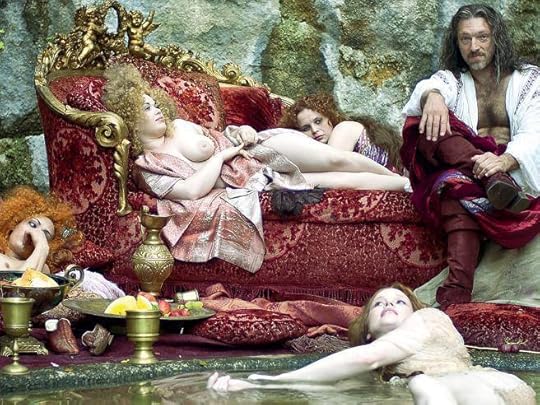
A still from the rather wonderful 2015 film version, directed by Matteo Garrone

Basile's obscurity, at least in the English-speaking world, is due in no small part to the lack of decent translations, which makes this new rendering from Nancy L Canepa – the first since the 1930s – extremely welcome. More than welcome; it feels staggeringly overdue. Most previous editions have been based on Benedetto Croce's ‘not always faithful’ 1925 translation into Italian, whereas Canepa is working straight from the original Neapolitan. To show what a difference it makes, let's return to that coin-shitting goose we met earlier. A line from the original tale runs:

Ma, scoppa dì e fa buono iuorno, la bona papara commenzaie a cacare scute riccie, de manera che a cacata a cacata se ne ’nchiero no cascione.


The previous complete English translation – from Penzer in 1932, working from Croce's Italian – translated this like so:

But dawn comes and it turns out to be a fine day: the worthy goose began to make golden ducats, so that, little by little, they filled a great chest with them…


But Canepa's translation restores the forceful vulgarity of the original:

And when morning breaks it's a nice day, for the good goose began to shit hard cash until, shitload upon shitload, they had filled up a whole chest.


You can see that it really feels like we're hearing Basile for the first time now. This gives a wonderful sense of discovery to Canepa's translation, even if for my own taste she sometimes seems to favour word-for-word accuracy over English readability (with the convenient, if believable, justification that Basile's own Neapolitan must have been quite a challenge even to contemporaries). Any quibbles are more than made up for by the wealth of notes and other apparatus, which give generous citations of the original and explain those flourishes of wordplay or references that Canepa has not attempted to modernise.

Taking this fabulous, irreverent tour of seventeenth-century life is an exhilarating experience, and even an uplifting one. Although he deals with violence, revenge and death, Basile is not especially interested in tragedy or cruelty; it's impossible to imagine him other than with a smile on his face. And indeed impossible to read him without one, either.
Profile Image for ميقات الراجحي.
Author 6 books2,333 followers
February 14, 2019
تعتبر قصص باسيلي من أقدم قصص الحكايات الشعبية والخرافية القادمة من القرن السابع عشر ميلادي 17م من التراث الإيطالي وغيره. ليس ثمة رابط بينها فهي أشبه بمجموعة قصصية كما نطلق عليها اليوم – حكايات – لكنها من الأدب الفنتازي تقرأ مثله في قصص ألف ليلة وليلة بما ماهو أفضل منها بكثير. هذا النوع من القصص مشابه لقصص سندريلا والأقزام السبعة وبياض الثلج تلك الحكايات التي يمتزج فيها الخيال بالخرافة.

كان حظ بعض هذه القصص أن تسربت لكتابات الكثير من الكتاب الأوروبيون خلال القرون 17 – 19م ميلادية كجزء من تراث الشعوب الجرمانية كحكايات وخرافات (الأخوين جرين، فيلهام وجايكوب) من ألمانيا. كقصة سندريلا والحذاء التي وجدتها في كتاباتهما وكذلك عند (شارل بيرو) من فرنسا، وهي في الأصل من قصص (باسيلي) الإيطالي التي كانت نحو 50 قصة أو حكاية.

من تلك القصص على سبيل المثال قصة مملكة ترغب سيدتها في أن تنجب طفلًا وتحمل بذلك الطفل بطريقة فنتازية عن طريق أكل "قلب" حيوان بحري أسطوري يصادف ولادته ولادة أخ له ابنًا لخادمة أمسكت بذلك القلب أثناء طبخه للملكة لتتوالى الأحداث حول لقاء الأثنين وسط غضب الملكة الأم التي باتت تخشى على ضياع مملكتها ومملكة ولدها من هذا الفرد الجديد الذي قد يطمح للكرسي وفق ظنونها ومع سذاجه ابنها.
ـــــ
ثمة فيلم صدر سنة 2015م استل بعض هذه الحكايا وهي ثلاث. كان إخراجه غاية في الروعة
Movie : Tale of Tales
Directed by Matteo Garrone
Profile Image for Zadignose.
307 reviews178 followers
Read
July 10, 2025
A Great collection of fairy tales, made great mainly by the style. It has the kind of far out fantastic elements that lingered from folk traditions going back to the middle ages, the sort of thing where a magic box or fairy can do absolutely anything instantly and miraculously, like a genie's lamp or a Holy Grail, and most problems are solved by magical intervention.

If you were to look at the book in terms of ideology, you might be mortified. If the book has an ideology it could be expressed as:

-Good people are beautiful.
-Ugly people are wicked.
-Being black is ugly, and that in itself justifies slavery.
-Good people will be magically rewarded, and wicked people will be justly punished, usually by physical dismemberment or very violent and painful death... thank god!

But it's not a book of ideology. It's fairy tales, wittily told, with an overabundance of metaphor, pushed to an extreme. It's entertaining for adults, and has a great cultural character as entertainment.

Some of the stories, as stories, are hardly worth talking about for their plots. Yet they're great experiences, driven by plot (there's an irony).

Better, in my estimation, than the forms of the same tales as they reemerged through Grimm into the popular imagination. I never in my life could have enjoyed "Puss in Boots," nor could I understand why anyone would ever care about that rotten tale, not even why toddlers would like it. But the story that inspired it, as told by Basile, is quite entertaining and goes beyond my expectation. I felt the same way about the stories that inspired Cinderella and Rapunzel, which in their modern forms are entirely without interest. Perhaps I just like the primitive and raw origins of folk literature, when dressed up by a crudely witty narrator.

This is a strong recommendation, even if it doesn't sound like one!
Profile Image for Деница Райкова.
Author 103 books240 followers
Read
March 17, 2019
Джамбатиста Базиле - "Пентамерон", изд. "Милениум" 2019, прев. Владимир Молев

Прочетох "Пентамерон".
Обичам приказки. Особено когато са добре "поднесени" и интересно разказани. А когато един сборник с приказки обещава, че ще запознае читателя с оригиналните истории за Пепеляшка, Снежанка, Котарака в чизми, и други - за които смятах, че не съм чувала, а при четенето малко по малко ги разпознах - е трудно да му устоиш.
Сборникът започва с "уводна част", която запознава читателя, с - така да се каже - повода да бъдат разказани тези истории. Тази уводна част е всъщност това, което в романите се нарича "завръзка" на историята. И макар историите привидно да се различават една от друга, всички те имат една цел - да накарат единия от основните си слушатели да прозре определена истина, а другия да разобличат и да стане така, че да получи наказание за злодеянието си. А цялата структура на книгата напомня за "щафета", която разказвачките - една от друга по-живописни - си предават, докато разказването постигне целта си.
През живота си съм чела много приказки и те са ми харесвали в различна степен. Това, което изпитах при четенето на тези, може да се опише с една дума: наслада. Защото те са стари, много стари истории, и това си личи. Личи си, че те са от онова време, когато е имало вечерни разкази около огнището, предназначени за ушите на всички които са там, за да чуят. В тях не липсва нищо - те са забавни, интересни, понякога страшни, друг път пиперливи. Звучат автентично и именно затова носят такова удоволствие.
Предвид споменатото в анотацията на книгата, очаквах, че бързо ще разпозная онези, които съм чела в някаква форма преди. Доволна съм да кажа, че не стана точно така, и че имаше такива, при които стигах почти до средата, преди да се сетя: "Та това е еди-коя си приказка!"
Впечатли ме и още нещо. Макар повечето приказки да са италиански, открих много мотиви, които съм срещала в други европейски, включително български приказки. Това не ме подразни, напротив - само потвърди за пореден път нещо, което си мисля винаги в такива случаи: "Всички сме едно". И хората навсякъде имат надежди и мечти, които си позволяват да "сбъднат" поне в приказките.
Разделям се с книгата с известна тъга. Историите ще ми липсват. Но това беше чудесно читателско преживяване и често ще си припомням тези истории.
Profile Image for Julian Lyubomirov.
229 reviews46 followers
March 17, 2020
Прочитът на двайсет приказки за един ден е много изтощителен, но тези наистина си струват и съм сигурен, че бих могъл да прочета още толкова до сутринта, ако не бяха свършили.

В ревюто има спойлери...

Следвайки съветите на магьосник, бездетна кралица намира начин да зачене. За тази цел трябва да изяде сърцето на морски змей, сготвено от девица. На следващия ден и двете понасят рожби в ут��обите си. Принцовете се раждат еднакви, с коси бели като убитото чудовище. Ревнивата кралица е против тяхната дружба и прави всичко възможно да прогони момчето на девицата далеч, той попада на много ��пасности, но брат му научава и тръгва да го търси; В друго кралство, крал се влюбва в гласа на девойка, без да знае, че тя всъщност е отвратителна старица, която плете хитрости с още по-отвратителната си сестра. След една прекарана нощ на тъмно с нея, кралят разбира истината и я изхвърля, но с помощта на фея, старицата успява да се превърне в чудна хубавица. Краят на сестра ѝ, обаче, не е толкова добър; Трети крал се обсебва по бълха, която угоява, докато тя не достига страховити размери. След смъртта ѝ одират кожата ѝ и кралят съобщава, че ще даде дъщеря си за съпруга на този, който успее да отгатне от какво животно е кожата. Никой, естествено, не успява да познае освен един човекоядец...

През есента на 2015 гледах филм "Tale of Tales" на режисьора Матео Гароне, с участието на любимата ми Салма Хайек. Сюжетът бе изплетен точно от тези три приказки. Спомням си, че тогава си изстрадах всичкото страдание, мислейки си колко прекрасно би било, ако съществуваше и книга. Не зная, може би съм търсил неправилно информация в интернет или просто ми е щукнало, че със сигурност няма такова нещо напук на детските ми вярвания, че всеки филм се прави по книга.
Преди няколко седмици в социалните мрежи попаднах на тази пленителна корица, дело на Фиделия Косева, и може би точно тук трябва да благодаря на Деница Райкова, тъй като нямам навик да следя новите книги и ако не беше тя най-вероятно още нямаше да зная за "Пентамерон". Та, истинско щастие беше това откритие! Благодаря ти, благодаря ти, благодаря ти, Деница!

Структурата ни е позната вече от "Декамерон". В продължение на пет дни, десет женички се събират и всяка една разказва по една история. А в основата на "Пентамерон" лежи приказката за принцеса Дзодза, която никога не се усмихва, независимо какви развлечения ѝ намира баща ѝ, а когато най-сетне това се случва, Съдбата я изправя пред горчиви изпитания.
Имаше както тъжни, така и много хумористични истории, ала честно казано, не мисля, че оригиналите са по-добри от познатите ни вече, както очаквах, че ще бъде. Не се чувствам зашеметен от тях, но всяка една е впечатляваща. Тук-там се срещат и повторения в сюжетите, но за приказките това е простимо. Препоръчвам я на всеки любител!
Profile Image for Erin the Avid Reader ⚜BFF's with the Cheshire Cat⚜.
227 reviews126 followers
April 8, 2017
Back in these ages, when they wanted to describe something super beautiful or super ugly, they made sure they drilled the descriptions into your skull. These tales are not a forgiving bunch. If somebody is kinda ugly, they are ABOMINATIONS. If somebody is kind of pretty they are PULCHRITUDINOUS. While they don't use these words, they'll use hundreds of words that are like these and enable in and on.

Just wanted to note that about this book.
Profile Image for Becky.
1,368 reviews57 followers
July 23, 2020
This is a brilliant and fantastical collection of early fairy tales. The framing story is really interesting and gives us almost an Arabian Nights set up to work within. Each story is a complete entity, and every one is worth reading. The style is light, informal and engaging... I am sure that this is thanks in part to the excellent translation, having read the notes at the start this has stuck as closely to the original as possible. A few of the attitudes expressed clash with modern sensibilities, the stories were written in the 1600s after all, however far less so than in nineteenth century written fairy tales such as Andersen or Grimm, and actually there were fewer instances than I have found in a lot of mid twentieth century literature as well. If you are unable to read past the couple of dodgy moments then I don't know how you would cope with reading any of the historic classics, as every one of them represents the time in which they were written. Having said this the collection is certainly not suitable for young readers, there is sex, violence and a fair bit of gore, certainly fairy tales for grown ups only.
Profile Image for Christine.
7,223 reviews569 followers
April 10, 2016
Collection presents early versions of Cinderella, Puss in Boots, and others. Very good. I really enjoyed the story about the king and the two old ladies. This is an adult collection with bawdy humor and a Cinderella who kills a step-mother.
Profile Image for DeAnna Knippling.
Author 173 books282 followers
October 17, 2018
Fifty fairy tales, told over five nights, from Italy over two centuries before the Brothers Grimm.

These tales weren't exactly for the little ones, as the subtitle suggests. Lots of excrement, sex, and racism. And obscure references--jokes about Italian culture of the time--that you're constantly having to stop and look up.

Not my favorite collection and not the easiest to read, but still interesting, especially seeing tales that were later picked up and censored by the Grimms.
Profile Image for Emiliya Bozhilova.
1,913 reviews381 followers
May 28, 2019
Не са моите приказки. Направо ми бяха противни - не намерих нищо хубаво или поучително, а само някакви безцелни ужаси и жестокости.

Ако братя Грим и Шарл Перо са променяли сюжетите в своите версии, това е само от полза за сюжетите. В този си вид ми напомнят онези пиратски видеокасети от 90-те с подскачаща, размазана картина и едногласов неразбираем превод зад кадър.
Profile Image for Tim Parks.
Author 121 books582 followers
January 6, 2019
This is a quite unique reading experience and an extraordinary translation from Nancy Canepa. It's hard to remember a book so packed with mad life and weird wisdom.
Profile Image for Igor G. S..
20 reviews2 followers
August 25, 2016
Una de las colecciones de cuentos populares más antiguas de Europa, toda una joya. A veces el lenguaje de Basile es demasiado "Barroco" (él no se limitó a copiar los cuentos, usó un lenguaje más culto y literario), pero es una obra de gran belleza, con cuentos que se alejan de esa imagen de canciones y purpurina que nos ha vendido nuestra sociedad obsesa de lo políticamente correcto. Aquí encontramos joyas como "El mirto", "El cuento del ogro", "las dos tortitas" y "La vieja desollada" (genial este último), pero también leemos sobre viejos conocidos como una Rapunzel muy peculiar ("Petrosinella") un Gato con Botas que es hembra ("Cagliuso"), una Bella Durmiente que da a luz gemelos mientras duerme ("Sol, Luna y Talía") o una Cenicienta astuta, desafiante y con un instinto asesino desarrollado ("La Gata Cenicienta").
Si quieres conocer nuevos cuentos o ver como han cambiado los "clásicos", este es tu libro. El Pentameron es imprescindible para aficionados y adictos al cuento popular.

One of the more ancient collections of popular stories of Europe, the "Tale of Tales" is a jewel. Sometimes Basile's language is too "Baroque" (he did not "just" copy the tales as he heard them, he used a more educated and literary language), but it is a work of great beauty, with stories that move away from this image of songs and glitter spread by our pollitically-correct-obsessed society. Here we find jewels like " The Tale of the Ogre", "The Myrlte", "The Two Cakes" and "The Old Woman who was Skinned Alive" (brilliant the latter), but also we read about Old friends like a very peculiar Rapunzel ("Petrosinella") a female Puss in Boots ("Cagliuso"), a Sleeping Beauty who gives birth twins while he sleeps (" Sun, Moon and Talía ") or a crafty, challenging Cinderella with a developed killer instinct ("Cat Cinderella")
If you want to know new tales or see how The classics changed, this is your book. Basile's Pentamerone is essential for Folktales' lovers and addicts.
Profile Image for Christina (A Reader of Fictions).
4,574 reviews1,757 followers
dnf
March 21, 2016
I didn't make it through the introduction, because that first story is racist as fuck and, sure, it was originally written in the 1600s but like I cannot and I don't want to.

The story is about a black slave girl, described as "that mass of dark flesh" who lies and takes the place of a good girl, and becomes the princess. I quit hard when the slave (she doesn't get a name) threatens to kill her baby because the prince was making eyes at the other girl:

"If you no move from windowsill, me punch belly and little Georgie kill."


That seriously makes me want to throw up.
Profile Image for Lindsey.
138 reviews40 followers
March 11, 2015
Interesting collection of stories, with flavors of both the West and the East (though, thank heaven, with fewer "May he live forevers" than the Arabian Nights). A notable difference from the Grimm collection was that most of the characters had names. I don't know if these are the collector Basile's contributions or a difference of culture.

I enjoyed the author's aversion to just saying "The next day..." or "When the sun rose..." Instead we read "As soon as the Sun with the broom of its rays had cleared away the soot of the Night" and so forth, each metaphorical reference more extravagant than the last.

But my very favorite story was that of whiny prince Nardo Aniello and the lovely Ogress' daughter Filadora, because of the following:

"But Filadora, drying his eyes, said to him, 'Fear not that my mother will touch a hair of your head. Trust to me and do not be afraid; for you must know that I possess magical powers, and am able to make cream set on water and to darken the sun...'

"When Nardo Aniello heard this, he answered, 'If you have magic power, as you say, O beauty of the world, why do we not fly from this country? For you shall live like a queen in my father's house.' And Filadoro replied, 'A certain conjunction of the stars prevents this, but the trouble will soon pass and we shall be happy.'"

Later it turns out that she literally meant the bit about the "certain conjunction of the stars--" that is, that the zodiac was astrologically affecting her magical abilities. But I have never read such an explicit reference by a character to the mechanics of fairy stories: "If you're so powerful, why don't you just get us out of this mess?" "Because that would make the story boring. Duh."
At least, it's not something you would find in any fairy tale that takes itself seriously. Maybe something by Terry Pratchett. In any case, it amused me no end.
Profile Image for Emanuela.
762 reviews39 followers
June 23, 2024
Avevo questo libro che avevo ricevuto in regalo da piccola ed ho voluto finalmente rileggere quelle fiabe d’infanzia.
Solo In questa occasione però ho scoperto che l’edizione che avevo era adatta all’età e quindi non integrale ma solo con le fiabe meno forti e violente.
Quindi, dopo aver letto quella, ho cercato l’ebook edizione integrale ed ho così scoperto anche il racconto cornice delle 5 donne in 10 giornate e mi si è aperto un mondo perché non avrei mai pensato a tutto questo.
Le fiabe sono tutte o quasi ambientate a Napoli e provincia, ma anche quelle che non lo sono la toccano in qualche modo.
Leggendola con testo originale a fronte sono riuscita a capire una lingua che mi sembrava lontana anni luce da quella moderna che conosco, ma anche a scoprire modi di dire ed usanze mai sentiti perché risalenti a un paio di secoli fa almeno, quindi mi sono attardata con molto piacere a leggere le ricche note e a fare ricerche ulteriori su quanto emergeva.
In effetti, come ho scoperto tempo fa con le fiabe dei Perrault e dei fratelli Grimm, le fiabe popolari, come quelle qui raccolte, erano molto meno edulcorate di quelle di oggi, e non usavano mezzi termini ma insegnavano con decisione, e in maniera probabilmente più efficace, la legge della vita.
La violenza non è dunque mai fine a se stessa e per questo, anche laddove mi disturbava un po’, in particolar modo per quella sugli animali indifesi, di solito si riusciva comunque a trovarle un senso, o quantomeno era la giusta punizione per i cattivi, in un mondo in cui il garantismo era ancora decisamente lontano, e vigeva la legge del taglione.
La mia curiosità era soprattutto per il racconto cornice, ma devo dire che poi la fine non mi ha soddisfatta, rivelandosi alquanto sbrigativa e scontata e riportandomi al piacere reale che era stato quello del viaggio con i racconti.
Profile Image for  Cookie M..
1,437 reviews161 followers
November 21, 2019
I loved the movie, but oh, that book. It is a collection of Italian fairy tales from the early 1600's. They are gruesome, dark, ironic and reflect an outlook on a world that treated its people in a like manner. Justice is not always swift in these tales, but it is exacting. The evil, selfish and stupid get what's coming to them. The truly beautiful and the innocent are rewarded with treasure beyond imagining.

These were court tales for people to amuse each other with while idling away the time between courses at banquets or waiting for the Count to put in an appearance.

Giambattista Basile compiled them into this collection, which was the first published book of European fairy tales.

I confess I only got one third of the way through it. It is lo-o-ong, and the stories behind to all sound alike after a while.

I was listening to the Audible version. I recommend the book form. Then you can pick and choose your way through, finding the stories that tickle your fancy.

A word of warning. These people were earthy. They enjoyed joking about bodily functions as much as 5th grade boys!
Profile Image for Marko Vasić.
581 reviews185 followers
August 15, 2018
Pentamerone, or "The Tale of Tales". Obscure and fantastic 17th's century tales for adults that burst out of: proverbs, luscious sexual insinuations, absurd, lust, incestuous and pervert sexual fantasies, reviles, interesting story lines and moral precepts at the end of each story. As it is well known - those tales were formidable inspirations for brothers Grimm, Andersen and Perrault to accommodate its sexual and obscure content to a form that is (more or less) children-susceptible. Hence, such a bereavement is that this work of art is translated in American English and not in British. For the former dialect is quite trivial, uncouth, vulgar, commercial and colloquial, that, in lesser manner, mares the beauty of this piece, although all of peasantry that is present in many stories is thus highlighted. Yet, if the translation was in British English, the one could expect specific humor, typical for its lore and exempt of modern colloquial phrases and words that the one may encounter in movies (eg. daddy, pal, dude etc.) and which is quite loathsome for my taste.
Profile Image for Книжни Криле.
3,601 reviews202 followers
August 16, 2019
Пет дни, десетима разказвача, общо петдесет истории, всички събрани в един-единствен том – „Пентамерон, или приказка на приказките”. Появилият се в първата половина на ХVІІ век труд на италианския поет и колекционер на приказки Джамбатиста Базиле излиза на български език в превод от Владимир Молев, благодарение на изд. „Millenium”. Нещо много повече от поредния сборник с приказки, „Пентамерон” неминуемо ще предизвика интерес у почитателите на самобитния фолклор и европейската разказваческа традиция. Прочетете ревюто на "Книжни Криле": https://knijnikrile.wordpress.com/201...
Profile Image for Nadia.
1,534 reviews528 followers
January 6, 2025
أصل الحكايات الخرافية التي كبرنا معها كسندرلا و الجميلة النائمة و حكايات أخرى تحكى في إطار حكاية إطار تذكرنا لحكايات ألف ليلة و ليلة .
Profile Image for Damiana.
384 reviews
September 5, 2020
Da anni desideravo leggere Lo cunto de li cunti, da quando cioè è uscito il film di Matteo Garrone al cinema. L'edizione che ho acquistato però (quella di simplicimus.me, non questa che sto recensendo) non ha la traduzione italiana a fronte e, per chi come me non capisce il dialetto napoletano, può risultare di difficile lettura e comprensione. Alcune favole sono riuscita a capirle ma altre proprio non c'è stato verso. Peccato.
Profile Image for Sakura Y.
137 reviews
January 21, 2022
literally j fairy tales w a sprinkle of misogyny and racism💖
Profile Image for Michael Haase.
355 reviews11 followers
January 24, 2018
Il Pentamerone, as it's otherwise called, is I think my favorite collection of fairy tales. Call me morbid, but I love the humor and absurdity of Basile's stories, unbound as they are from propriety and Christian morals. These tales include several of the darkest and most violent fables I've ever seen, and yet I've never before laughed so much reading a fairy tale collection. You can't help but laugh when so many ridiculous things occur, like a man assigning a bear to be his family physician and cook, or when a princess is wedded to an ogre because he miraculously pointed out that an animal's hide belonged to an oversized flea. There's also an element of action and excitement in some of the stories which is uncommon for fairy tales, such as in the story of "The Flea" when the ogre is chasing Porziella and her rescuers.

Part of the humor comes from Basile's attention to detail and vivid style of writing. Rarely do you get such colorful descriptions and insight into character psychology with fairy tales. The princess, for example, who is wedded to the ogre gives an impassioned tirade the likes of which you'd be hard put to find in writing of other fairy tale writers. Not even Anderson, who is famous for his detailed fables, gives his characters as much life as Basile does.

It's truly a joy reading his writing. I must warn those reading translations, that Basile's style is sometimes curtailed or censored (particularly with the Gutenberg translation), so that much of his style is lost. I loved reading those moments of bawdy humor that Basile has randomly scattered throughout, such as this quote from "The Raven":

"As he spoke he felt his legs stiffen and turn to marble. And when he went on to relate the affair of the horse in the same manner, he became visibly stone up to the waist, stiffening miserably--a thing which at another time he would have paid in read money, but which now his heart wept at."

"The Raven", though among the darkest of his stories, including things like necrophilia, patricide, brutal animal maiming, and suicide, I found the funniest of the collection. The ending almost had me in tears from laughing. The thing about Basile's stories is that it's simply impossible to take them seriously, like you might with Andersen's stories.

I'm sure I'm one of the few non-Italian people in the world that have heard of this collection before it was made into a movie in 2015, so I'll say for those who've watched the movie first, that stories do a great job of capturing the atmosphere and grotesque absurdity of the stories, but also gives them a stronger sense of tragedy, simply by virtue of making them visually realistic.

This collection is shocking and hilarious, as well as being the earliest recorded versions of some famous fables, such as "Sleeping Beauty", "Rapunzel", "Cinderella", "The Girl Without Hands", and "The Three Spinners". It is also the basis for Prokofiev's Opera, L'amour des trois oranges. So do give it a read when you have the chance.
Profile Image for Красимира.
Author 16 books39 followers
November 5, 2019
Най-напред: това не е книга с детски приказки! Като се абстрахираме от това, тя е много интересна и в нея можете да намерите първоизточниците на част от класическите приказки. Някои са трудни за разпознаване и биха могли да ви шокират. В текста открито се говори за секс, изнасилвания и разнообразни форми на насилие. Също така част от развитията не са особено поучителни от съвременна или от лично моя гледна точка. На мен примерно ми беше любопитно, но също така смущаващо да прочета следните истории:
Разбира се това са само избрани моменти. Изобщо с правилната нагласа приказките биха могли да ви бъдат много заб��вни - най-малкото има с какво да ви изненадат и никак не са банални.
Profile Image for Benjamin Chandler.
Author 13 books32 followers
December 9, 2012
This was one of the more interesting fairy tale collections I have read.

Collected in the early 1600s by Basile, this book has some of the oldest versions of some of the better-known fairy tales (e.g., Puss In Boots). But it also holds some very bizarre fairy tales I'd never read before. Many of them use plot devices familiar to any folklore buff—like the wicked stepmother, super-talented helpers, ogres of all kinds, enchanted beauties hidden in animal skins or fruit, hidden objects, and (of course) fairies—but they're all recombined in new ways. A story that seems like it's going the Hansel and Gretel route ends up with the girl living inside a giant fish. One tale I was sure would end up being Sleeping Beauty suddenly involves mysterious children named Sun and Moon and a jealous queen who solves problems through cannibalism. Many of the stories are almost off-handedly violent, speaking of characters' murders in such matter-of-fact ways that it seems almost mundane if it weren't so shocking. Some tales have little hints of sexual overtones and nudity as well, but that too is written without the wink and nudge you'd expect. The straight-forwardness was almost refreshing.

The stories are written in elaborate prose using a lot of metaphor. Lines like, "So next morning, as soon as the Sun with his golden broom had swept away the dirt of the Night from the fields watered by the dawn..." are commonplace.

I would not recommend sitting down and reading this book in one sitting. I did not. I read stories between other books, as a way of cleansing my palate. (The version I found was free on Guttenberg, but it did not have all 50 stories from the original; the version I downloaded only had 30-some tales. I also wished it had illustrations, but sometimes you can't have it all...)
Author 11 books11 followers
March 4, 2014
A fantastic translation, with an informative introduction and very helpful footnotes. This is an excellent resource for the earliest Western versions of some of the most well-loved fairy tales.

Canepa's work is especially welcome, since the last complete English translation was done by Sir Richard Burton in the late 19th century. While his version does tell all the tales, I've read that it is more of a freer translation, and it offers nothing in the way of context or notes. I have a copy of Burton's work, and while I would have enjoyed the Canepa's book on it's own, her version is simply magnificent in comparison.

Just a few of the stories that would be familiar today are proto-version of Cinderella, Puss-in-Boots, and Rapunzel. But these are not for kids! Cinderella is a murderer, Puss-in-Boots has a falling out with her owner, and Rupunzel is simply horrifying - or rather, the prince in the story is.

But aside from the more recognizable tales, the other stories are good as well. Standouts for me are The Flea, The Woman Who Skinned Herself (but only because I take her sister as meaning to be ridiculous, not as offering serious advice), and The She-Bear. This last one takes the story of All-Fur and goes even further - rather than dressing as an animal, the princess actually turns into a bear!

All in all, Canepa's translation is a gift to English readers interested in fairy tales and folklore.

Profile Image for Stephen Trygar.
Author 4 books5 followers
March 26, 2020
A tale told of five nights in which ten women present their own tales to the king and queen. Giambattista Basile's Pentamarone: Lo cunto de li cunti is structured as a frame story containing fifty tales told by ten women over five consecutive nights to a king and his villainous queen. This collection is regarded as the first collection in which all stories fit the category of "fairy tale". Later adapted by Charles Perrault and the Brothers Grimm, The Tale of Tales is a vastly underrated collection and contribution to the genre.
In this edition/translation, Canepa successfully hurdles the task of not only providing a coherent translation of Basile's colorful Neapolitan, but also provides a plentiful amount of notes and citations to be as insightful as possible.
On a personal note, I found The Tale of Tales to be quite amusing. Its dramatic, graphic, and evocative insults caused me to frequently burst out into a fit of laughter. I couldn't put the book down once I actually got into it.
Profile Image for Emanuele Bignardi.
27 reviews
May 8, 2022
Classica raccolta di fiabe costruita sullo schema del Decameron di Boccaccio. Nei cinquanta racconti dell'opera si intrecciano le vicende di principi e principesse, orchi e popolani, draghi e streghe. L'ambientazione - una moltitudine di regni dai nomi fiabeschi - è quella della campagna napoletana, e a quella terra appartengono i richiami culturali di cui sono intrisi i racconti.
Lo stile non è sempre facile, e sono frequenti termini dialettali o desueti. Le tematiche trattate, inoltre, sono spesso abbastanza adulte.
In definitiva, una lettura piacevole, oltre che una pietra miliare della letteratura italiana seicentesca.
Profile Image for Yanko Tsvetkov.
Author 10 books84 followers
August 24, 2021
Rating a classic is tough. On one hand, it should be viewed in its historical context. On the other, to be truly valuable to a modern reader, it should also relate to the present in some way. There’s a lot of value in the Tale of Tales—the sheer amount of allegories used for the motions of the Sun across the sky alone makes it a baroque masterpiece. But then, there are the usual bitter pills to swallow—romanticization of rape, and blatant, passionate racism. Pretty much like the Arabian Nights, total immersion is impossible. But there’s enough beauty in here worth salvaging.
Profile Image for Micah Genest.
Author 4 books9 followers
May 19, 2020
This has to be one of the most hilarious collection of fairy tales I have ever read. The story teller is always on point, crude, and honest. I really cannot compare this to any other collection of have read before.

There is a lot of extra descriptions to read in the stories, particularly when the narrator goes on about what he really means by something ugly or gross, and it is funny. Just amazing!

An entertaining read.
Displaying 1 - 30 of 138 reviews

Can't find what you're looking for?

Get help and learn more about the design.