

What do you think?

The Treasury of David: Volume 1
Bible. -- Psalms -- Commentaries.
Bible. -- Psalms -- Homiletical use.
Bible. -- Psalms -- Homiletical use.
- GenresChristianDevotional
490 pages, Hardcover
About the author
Charles Haddon Spurgeon
6,152 books1,718 followersCharles Haddon Spurgeon (1834-1892) was England's best-known preacher for most of the second half of the nineteenth century. In 1854, just four years after his conversion, Spurgeon, then only 20, became pastor of London's famed New Park Street Church (formerly pastored by the famous Baptist theologian, John Gill). The congregation quickly outgrew their building, moved to Exeter Hall, then to Surrey Music Hall. In these venues, Spurgeon frequently preached to audiences numbering more than 10,000—all in the days before electronic amplification. In 1861, the congregation moved permanently to the newly constructed Metropolitan Tabernacle.
Ratings & Reviews
Friends & Following
Create a free account to discover what your friends think of this book!
Community Reviews
Displaying 1 - 3 of 3 reviews

December 14, 2021
Took me over a year, but it was an excellent study of the first 57 Psalms.

March 25, 2020
Although I've done many drive-bys of the psalms, it was time for a deep dive. I wanted to move in, to abide in the psalms. Spurgeon's Volume 1 was a fine guide to Psalms 1-57.
After introductory comments, he writes a verse by verse exposition. Then comes —and this wording always delights— Explanatory Notes and Quaint Sayings, which are Spurgeon's gleanings from a wide swath of commentators. Augustine, Baxter, Bunyan, Calvin, Owen, and Zinzendorf are only a few. Even Shakespeare and Seneca.
What I loved:
•All the references and connections: Psalms quoted or alluded to in other parts of the Bible are noted. For example, Psalm 45 is a mini Song of Songs and Psalm 49 is a forerunner of Ecclesiastes.
•Hebrew, Greek, and Latin (and other modern languages) notes are included. I only have an acquaintance with Latin, but it is fun to grapple with. Usually the translation is included.
•It's a great antidote to chronological snobbery; rubbing elbows with eighteenth and seventeenth century thought is, I think, a good thing. These bringeth language oddities, but they becometh easier to understand with practice.
•As a word lover, I exult in the many metaphors, alliterations, assonance, and various tropes.
Death is not the house but the porch.
Prayer is the best remedy in a calamity.
Sin hurries us away from God; grace hastens us into his embrace.
Lord, hold me up, that I may hold out.
I decided this is a book to write in. Early on, it struck me how many I will s are in the psalms. I copied down each one.

What I did not love:
It is wordy. Two volumes bound as one, 915 pages, 7 months.
Some theological stances, say against instruments in worship.
It is caustically anti-Catholic, who are called The Papists.
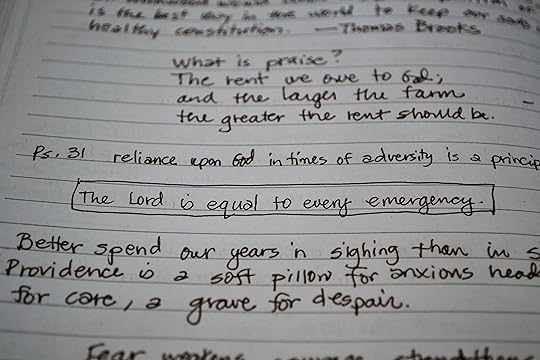
I copied quotes into my journal: 22 pages worth! Bring on Volume 2!
After introductory comments, he writes a verse by verse exposition. Then comes —and this wording always delights— Explanatory Notes and Quaint Sayings, which are Spurgeon's gleanings from a wide swath of commentators. Augustine, Baxter, Bunyan, Calvin, Owen, and Zinzendorf are only a few. Even Shakespeare and Seneca.
What I loved:
•All the references and connections: Psalms quoted or alluded to in other parts of the Bible are noted. For example, Psalm 45 is a mini Song of Songs and Psalm 49 is a forerunner of Ecclesiastes.
•Hebrew, Greek, and Latin (and other modern languages) notes are included. I only have an acquaintance with Latin, but it is fun to grapple with. Usually the translation is included.
•It's a great antidote to chronological snobbery; rubbing elbows with eighteenth and seventeenth century thought is, I think, a good thing. These bringeth language oddities, but they becometh easier to understand with practice.
•As a word lover, I exult in the many metaphors, alliterations, assonance, and various tropes.
Death is not the house but the porch.
Prayer is the best remedy in a calamity.
Sin hurries us away from God; grace hastens us into his embrace.
Lord, hold me up, that I may hold out.
I decided this is a book to write in. Early on, it struck me how many I will s are in the psalms. I copied down each one.
What I did not love:
It is wordy. Two volumes bound as one, 915 pages, 7 months.
Some theological stances, say against instruments in worship.
It is caustically anti-Catholic, who are called The Papists.
I copied quotes into my journal: 22 pages worth! Bring on Volume 2!

July 24, 2019
The Treasury of David is a 7 volume commentary on the Book of Psalms composed and compiled by Charles H. Spurgeon. Mr Spurgeon begins his commentary of each Psalm with a verse by verse commentary of his own thoughts, meditations, and Biblical exposition followed by a verse by verse running commentary of quotes, comments and sermon snippets from many of the giants of the faith. Each Psalm is then for a third time commented on with verse by verse "Hints to Preachers". I do not believe you will find many better commentaries of the Book of Psalms and this source is a treasury of knowledge as advertised. I think that all 7 volumes should be a part of any preachers library and am thoroughly enjoying using them as a supplement to a year long study through the Psalms. You can find these books on the cheap on line and because of their antiquity should be able to find free PDF's of the entire 7 volumes if you simply dig a little. Get these! You won't be disappointed!
Displaying 1 - 3 of 3 reviews