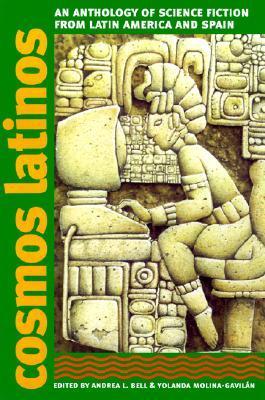
The first-ever collection of Latin American science fiction in English.
Opening a window onto a fascinating new world for English-speaking readers, this anthology offers popular and influential stories from over ten countries, chronologically ranging from 1862 to the present. Latin American and Spanish science fiction shares many thematic and stylistic elements with anglophone science fiction, but there are important differences: many downplay scientific plausibility, and others show the influence of the region's celebrated literary fantastic. In the 27 stories included in this anthology, a 16th-century conquistador is re-envisioned as a cosmonaut, Mexican factory workers receive pleasure-giving bio-implants, and warring bands of terrorists travel through time attempting to reverse the outcome of historical events.
The introduction examines the ways the genre has developed in Latin America and Spain since the 1700s and studies science fiction as a means of defamiliarizing, and then critiquing, regional culture, history and politics—especially in times of censorship and political repression. The volume also includes a brief introduction to each story and its author, and an extensive bibliography of primary and secondary works. Cosmos Latinos is a critical contribution to Latin American, Spanish, popular culture and science fiction studies and will be stimulating reading for anyone who likes a good story.
Cosmos Latinos, published in July 2003, is the first-ever collection of Spanish-language science fiction in English and has received unanimously rave reviews with a few "buts". I'm on the side of those who say "but". I knew there was trouble when I read the introduction, which explained that stories were selected "to reflect the historical progression of the genre", "geographical and thematic variety", but while "overall quality ... has also been a consideration", it was not the primary one.
The anthologists, Andrea L. Bell and Yolanda Molina-Gavilán, are well-meaning and hard-working scholars who let their scholarship get in the way of good literature. They chose works that illustrate the characteristics they say (others might disagree) typify Latin American and Spanish SF: a preference for "soft" and social sciences, an examination of Christian symbols and motifs, and humor, along with u- and dystopias. They also tried to cram in as many stories as they could, 27, so there are a lot of very short stories. One frustrated reviewer wondered if Spanish-language authors have considered writing longer works. Not all the stories are good, but I know those same authors have written better.
Still, the translations range from reasonable to very good, and when the stories are good, they are phenomenal. Reviewers, including me, recommend "Acronia" by Pablo Capanna, Argentina, 1966, a corporate workworld without clocks; "Post-bombun" by Alberto Vanasco, Argentina, 1967, a satire of life after the nuclear holocaust; "Cuando Pilato se opusó" by Hugo Correa, Chile, 1971, first contact; "Los embriones del violeta" by Angélica Gorodischer, Argentina, 1973, a planet with strange powers; "Ruido gris" by Pepe Rojo, Mexico, 1996, a human TV camera; "Como tuvieron que morir las rosas" by Michel Encinosa, Cuba, 2001, surreal cyberpunk.
Spain is represented by "En el planeta Marte" by Nilo María Fabra, 1890; "Mecanópolis" by Miguel de Unamuno, 1913; "Gu Ta Gutarrak" by Magdalena Mouján Otaño, 1968; "Estreno" by Elia Barceló, 1994; "El día que hicimos la Transición" by Ricard de la Casa and Pedro Jorge Romero, 1998. English-language reviewers loved the last three, and "Transición" is already on the reading list for the 2003 Sidewise Award for alternate history.
On SciFi.com, Paul Di Filippo enthuses that "the cultures and traditions and tools of these writers are skewed just enough from our arbitrary Anglo-American baseline to insure that a welcome sense of cognitive estrangement is presented even before the ostensible subject matter of each story is encountered". The stories, he says, use "our models as springboards to unique visions".
The Library Journal recommends that public and academic libraries buy it, and SFRevu recommends borrowing it from the local library but not necessarily buying it. I agree. The English-speaking world still needs a "best of" professional anthology of Spanish-language SF.
"Cosmos Latinos" edited by Andrea L. Bell and Yolanda Molina Gavilán is an unusual entry in the Early Classics of Science Fiction series. Instead of focusing on early stories, this anthology looks at science fiction from Latin America and Spain. There are a couple of short stories from the 1800s, and a few from 1952 and earlier, but 22 of the stories are from 1964 and later and 8 are from 1989 and later. While this series might not be the most appropriate place for this collection, it is a very interesting collection, and the author histories do offer some insight not only into the authors themselves, but the evolution of science fiction in Latin America and Spain.
There are 27 stories in all, and if you are anything like me, you probably are not familiar with any of these author's translated works. No authors are duplicated here, so you will be introduced to 27 authors. They come from a wide variety of countries including Mexico, Spain, Chile, Cuba, Brazil, El Salvador, Argentina, Venezuela, and Peru. You will also get a good variety of science fiction stories, including such themes as future societies, space travel, time travel, alien visitation, and cyberpunk.
The editors provide a nice introduction to Latin American science fiction, along with some good introductions to the authors. They also provide a large number of the translations for the stories included in this anthology. While this book might not fit the descriptive name of the series, there is little doubt that the content is well designed for the serious study of speculative fiction, so in that way this is certainly a worthy addition to the series.
For those interested in exploring science fiction that isn't rooted in American or English culture, try this anthology!
The book starts with a very good introduction that outlines some of the differences between English-language science fiction and its Spanish- and Portuguese-language counterpart. It also describes the various obstacles to sci-fi publishing in countries that speak these languages--the size of the local economies, the popularity of American/English books in translation, and political unrest, among others.
The anthology is arranged in chronological order, which is useful for tracing the development of science fiction from the late 1800s through the dawn of the new millenium. What I noticed most was that a sincere willingness to believe in the possibility of amazing technological utopias (late 1800s) gradually morphs into a definite trend towards creating frightening fictional distopias. It is also fun to connect ideas in the stories to historical events that were going on at the time.
I have not read all of the stories yet. Some of those I did read are "On the Planet Mars" by Nilo Maria Fabra (Spain 1890), "The Death Star" by Ernesto Silva Roman (Chile 1929), "Baby HP" by Juan Jose Arreola (Mexico 1952), "The Cosmonaut" by Angel Arango (Cuba 1964), "The Crystal Goblet" by Jeronimo Montiero (Brazil 1964), and "First Time" by Elia Barcelo (Spain 1994).
All of these have something to offer, but the ones that I enjoyed most were "The Crystal Goblet," which is longer and has good characterization as well as interesting ideas, and "First Time," which is stikingly chilling. I look forward to reading more of these stories.
I might not have picked it up if I'd realized it was only science fiction (rather than both sci-fi and fantasy) and also predominantly from the 1950-1970s, as I've struggled with sci-fi from that time period in the past. But the stories in this collection were uniformly compelling and interesting. I was glad for the extensive author notes and the introduction as well. I picked this up from the library but will probably buy it as well - lots of ideas I want to refer back to (and also to use the extensive bibliography as a reference).
If I can read this and love it…then every sci-fi fan out there will adore this collection! Of course, one of the beautiful aspects of sci-fi is the breaking down of boundaries, one that can unite a wide variety of disparate walks of life. However, to a certain degree, one would probably think that a historical anthology of science fiction written by just Latin authors would be limited to a rather select interest group. It’s sort of like using a certain fishing lure that excites the interest of the stripped bass but does nothing for the rainbow trout.
Well, I took the bait here, as I’m half Hispanic [a guero, if you will]. Although, in truth, I also have to admit that I’m actually not a huge sci-fi fan. Don’t get me wrong, I love me some Star Trek as well as a variety of films in that genre but when in comes to reading I just haven’t seem to have found the right authors.
So, with a heavy sigh, ultimately preparing myself for disappointment, I began this collection, which starts chronologically in the 1800s. Naturally, all of the early sci-fi literature no matter where or by whom it was written can be quite laborious due to its quaint outdated ideas of the future and its archaic language and syntax. I consider this to be an even smaller subset of an interest group and it is for only the true diehard fans. Regardless, because of my looking at this with more of a historically cultural viewpoint I was able to manage getting through these first few with at least something resembling an interest. Maybe they are even decent enough on there own, I can’t really say.
However, when this book got to stories written in the late 1950s to my surprise I found a story that just flat out entertained me period. However, I figured this was a fluke and I did not expect it to keep happening. All in all, I found quite a few here to my liking to the point that I would without question buy entire books by these authors. Specifically these are; Juan Jose Arreola [Mexico], Angel Arango [Cuba], Hugh Correa [Chile], Andre Carneiro [Brazil], Guillermo Lavin [Mexico] and Pepe Rojo [Mexico].
For me, the last author, Pepe Rojo wrote the most stunning of all of these. The premise is that a select few individuals are implanted with recording devices in their heads, which essentially makes them direct feeds to the television news stations that can broadcast live at a moments notice. They are indistinguishable from any other citizen so you never know who they are…and consequently who may be watching, clearly shades of “Big Brother” here maybe even some Phillip K. Dick paranoid surrealism.
However, when these “reporters” are activated they become subdued and passive almost zombie like, and this behavior definitely makes them stand out, in say, a hostage situation or a blazing warehouse fire. This sort of real time first person reporting also makes for news that literally places the viewer as if they themselves were there themselves making this type of “news” the biggest sensation on television.
For me, the true hallmarks of sci-fi is the subtext in any given story, one that not only entertains the reader on the surface but also should call to mind some very real world similarities that are often neglected and unspoken, all without beating us over the head with overt and blatant speeches. This story’s does an excellent job of this and attempts to show the true distinctions between man and machine, as well as the role between the media and humanity. For instance, one could view the active passivity of the reporter to be a mirror of the mental apathy of those at home watching these types of events from the safety of their home. There’s far more here present than this, all of which comes to a head when the reporter that narrates this tale follows a suicide jumper to a tall building. Find out for yourself what happens. READ IT!
COSMOS LATINOS IS RATED 81%. 27 STORIES : 4 GREAT / 16 GOOD / 4 AVERAGE / 2 POOR / 1 DNF
When I reviewed Iraq + 100, a collection of Iraqi SF, my comments were full of people who recommended this anthology. While there are many similarities - both feature a people group and language rarely emphasized in anglophone SF - there is one important difference. Cosmos Latinos is foremost a scholarly work. The introduction by the editors is an excellent look at the history, culture, tropes, and people of Spanish-language SF. It is the highlight of this volume and absolutely worth purchasing it for.
The stories are arranged in chronological order with emphasis placed on the 1960s to the mid-1980s. Many of the stories are appearing for the first time in English. Some are translated by the editors of the anthology. All of them are introduced in exceptional detail as befitting a serious work of literary history.
The stories are all pretty good with some truly great stories and only a few clunkers, but occasionally they felt too similar. Perhaps the translations didn’t quite communicate the style of the originals. But there is incredible diversity of era, nationality, and language here. Anyone should be able to find an author or two worthy of future reading.
The best stories are these:
“The Crystal Goblet” by Jerônimo Monteiro. 1964. A man has returned from being tortured by the government and finds a crystal goblet that he discovered during his childhood abuse. Within the goblet are haunting images of a possible future. Beautiful story and yet full of sadness. The writing is crystalline like the goblet and bounces around in time quite a bit.
“The Last Refuge” by Eduardo Goligorsky. 1967. The secrets he has been keeping from the government have been accidentally revealed and his must run for his life and try to escape his country which has cut itself off from the rest of the world. Another sad tale of hope in the face of oppression.
“Stuntmind” by Braulio Tavares. 1989. This is a very interested and elegant story about the prices paid for pushing the boundaries. In this instance, it is a small subset of humans who have the ability to interface with alien mentalities. It results in fabulous riches but has a serious cost in mind and spirit.
“Gray Noise” by Pepe Rojo. 1996. This story feels ripped from the modern headlines of citizen journalism, social media, influencer culture, and the corporations who benefit at the expense of the average person. Great ideas, well described, and full of interesting characters.
***
COSMOS LATINOS IS RATED 81%. 27 STORIES : 4 GREAT / 16 GOOD / 4 AVERAGE / 2 POOR / 1 DNF
“The Distant Future” by Juan Nepomuceno Adorno. 1862
Good. Hopeful and optimistic look at a utopian future for Earth.
“On the Planet Mars” by Nilo María Fabra. 1890
Good. Martian compare their perfection to Earth’s flaws.
“Mechanopolis” by Miguel de Unamuno. 1913
Good. A man stumbles into a world run by machines.
“The Death Star” by Ernesto Silva Román. 1929
Good. A rogue star approaching earth makes sudden biological changes to all of humanity.
“Baby H. P.” by Juan José Arreola. 1952
Good. “You too can harness your baby’s energy to run your household!”
“The Cosmonaut” by Ángel Arango. 1964
Good. Misunderstandings between a cosmonaut and an alien race lead to horrible consequences.
“The Crystal Goblet” by Jerônimo Monteiro. 1964
Great. A survivor of government torture finds a glowing goblet that he discovered as an abused young boy. Within the goblet, one can see the disquieting future.
“A Cord Made of Nylon and Gold” by Álvaro Menen Desleal. 1965
Good. An astronaut cuts ties with his spaceship and floats over the earth as it plunges into chaos.
“Acronia” by Pablo Capanna. 1966
Average. Workers are caught in meaningless work/lives as everything in their world is run by machines.
“The Last Refuge” by Eduardo Goligorsky. 1967
Great. A man flees an oppressive government that has cut his country off from the rest of the world. Finding a space shuttle, he struggles to escape on it.
“Post-Boomboom” by Alberto Vanasco. 1967
Good. Darkly humorous story of men trying to remember ‘facts’ to preserve them after the apocalypse.
“Gu Ta Gutarrak (We and Our Own)” by Magdalena Mouján Otaño. 1968
Good. Basque scientists use time travel to discover the ancient roots of the Basque people.
“Future” by Luis Britto García. 1970
Average. A paradox about the futility of trying for utopia.
“When Pilate Said No” by Hugo Correa. 1971
Good. A Messiah arrises on an alien world occupied by humans. The human try mightily to NOT let him die.
“The Falsifier” by José B. Adolph. 1972
Good, A brief alternate history of the Incas and their contact with aliens and religion.
“The Violet's Embryos” by Angélica Gorodischer. 1973
DNF. I couldn’t get into this story about violet patches that create the desire of stranded astronauts.
“Brain Transplant” by André Carneiro. 1978
Good. An insane scatalogical, sexual, experimental story of a professor teaching a classroom about brain transplants.
“The Annunciation” by Daína Chaviano. 1983
Poor. An angel seduces Mary.
“A Miscalculation” by Federico Schaffler. 1983
Good. A quiet story of a young boy staring up at the stars.
“Stuntmind” by Braulio Tavares. 1989
Great. Some people have the ability to mentally connect with aliens. This comes with huge rewards and equally large sacrifices.
“Reaching the Shore” by Guillermo Lavín. 1994
Good. A families life is tragically disrupted by a ‘chip’ addiction of the father that resulted from a taking part in a company trial.
“First Time by Elia Barceló. 1994
Average. A barely literate young woman talks about her first time … killing a “Forner.”
“Gray Noise” by Pepe Rojo. 1996
Great. Cyberpunk live-journalism and the mental, social, and financial price that a young man pays to engage in it.
“Glimmerings on Blue Glass” by Mauricio-José Schwarz. 1996
Poor. A detective wishes he was more like a certain fictional detective.
“The Day We Went Through the Transition” by Ricard de la Casa and Pedro Jorge Romero. 1998
Good. Time cops must prevent terrorists from disrupting the transition of power after France. Again and Again.
“Exerion” by Pablo Castro Hermosilla. 2000
Average. A young man plays video games while the authorities are en route to capture him.
“Like the Roses Had to Die” by Michel Encinosa. 2001
Good. Exciting and inventive cyberpunk and a wolf girl and a powerful “Wizard” search for her husband, captured when a job went wrong.
This is an anthology of literature translated from Spanish, Portuguese and Catalunyan ranging from the 19th to the 21st centuries. Most of the translations were by one of the editors, Andrea Bell, and all of these, to her credit, were fluid in English. The other editor, Yolanda Molina-Gavilán, and Ted Angell both translated some of the more chaotic texts and I believe they did well.
As to the original stories here's comments on some of them:
--Jerónimo Monteiro, 'The Glass Goblet,' 1964: a post-apocalyptic look through a magic stem-less glass, coupled with criticism of the cruelty of men in the character's time and place (Brasil under petty local boss-men).
--Magdalena Mouján Otaño, 'Gu Ta Gutarrak,' 1968, Argentina: it ends as one expects but meanwhile the reader is treated to an introductory course on Basque culture.
--Daína Chaviano, 'La Anunciación,' 1983, Cuba. I'm glad that the Christian community is morally advanced enough to tolerate this sacrilegious and slightly erotic story. Well told.
--Ricard de la Casa and Pedro Jorge Romero's 'The Day We Went Through the Transition,' 1998, España, is also found in the "SFWA European Hall of Fame."
This entire review has been hidden because of spoilers.
What an awesome collection! This one has a permanent place in my library. I throw this book in the face of anyone who says science-fiction exclusively belongs to Western culture. But don't worry, amigos, even the average gringo nerd will thoroughly enjoy the diverse stories collected in Cosmos Latinos. I wish they would follow up with a second volume, great stuff!
One of my favorite short story collections. Ideas you'd never seen in typical USA speculative fiction, and rarely in Canadian or British. A new way of seeing the world.
A collection of short sci-fi stories from Spanish-speakers around the world. The editors set themselves the task of using one story per writer to show the themes, styles and content which Spanish-speaking sci-fi writers have written over the last two centuries.
It's a scholarly book, which is instantly obvious due to the introduction being a long and academic contextualising of the works (I skipped that at the start, and went back later). However, the stories for the most part are not academic fragments but actual stories. A couple of the early pieces are extracts from utopian writing from the c18th which aren't stories per se, but the rest are regular short stories.
In some ways, it seems that Spanish-language sci-fi is fairly similar to English-language. The mid-c20th stories are mostly scared of nuclear annihilation, the late c20th ones concerned about corporations, hacking (regular and bio) and surveillance. Aliens are either curious or antagonistic, but human arrogance is the real villain. You know, all the good stuff from sci-fi.
But there's also stuff which is very clearly influenced by the countries the writers are from. I appreciated that each story had a bio page for its author, which gave context. Knowing how Argentine machismo/homophobia works gives Gorodischer's 'The Violet's Embryo' more depth, how Mexico's maquiladoras function brings out the satire in Schwarz's 'Glimmerings on Blue Glass', etc.
Some stories were more interesting and engaging than others, and my overall enjoyment of the book rose more towards the end when I found the stories were more consistently top notch. The translations were consistently good and readable, and the footnotes were useful but sparingly used, which was nice.
It was such a pleasure to read this crash course in Latin American and Spanish sci-fi. I didn't love (or even like) every story, but I really appreciated being exposed to a wider range of sci-fi, and have picked up a few new authors to explore.
I have such an appreciation for non-Western (read: European) science fiction. It's so rarely represented. Finding this volume in the Berkeley Public Library a few years back was wonderful.
I happened upon this while browsing at the library and was excited to pick it up as it ranges over a century of SF writing in Latin America, and contains work by many writers who are beloved by Spanish-speaking readers but largely untranslated into English (which is unfortunate for me since my Spanish is so limited).
It's divided into four sections by date: 19th century examples from the inception of the genre, stories from 1900-1950, 1960-1980s, and 1980s to the present. I have to say the opening section was a bit of a slog for me. As part of an Early Classics of Science Fiction series, I get why they were included, but fragments of essays on a 19th-century writer's personal vision of utopia are not the most impressive opener to an anthology such as this.
The stories I loved were all in the last two parts. Pablo Capanna's "Acronia" is a loopy, eerily prescient prediction of the future of work that has hints of Orwell and Stanislaw Lem. Angélica Gorodischer's "The Violet's Embryos" is a lyrical space-exploration stunner on par with the best of Tiptree. It looks like several of Gorodischer's novels have been translated into English, one by none other than Ursula K. Le Guin, so I will be definitely be checking those out.
Pepe Rojo's "Gray Noise" and Pablo Castro's "Exerion" were my favorite stories in the collection, though I felt all the stories in part 4 were worth reading. The first calls to mind a futuristic version of the movie Nightcrawler, in which cyborg reporters with camera eyes find themselves enabling horrors in order to get the best shot for their viewers. "Exerion" brilliantly uses the sci-fi premise of memory erasure and bodily hacking to reflect on the disjuncture and loss felt by many Chileans whose family members disappeared during Pinochet's reign.
Recommended for lovers of science / speculative fiction, and those interested in how a range of Latin American writers use the genre to indict oppressive governments and reflect on how technology shapes our global future.
The Distant Future ** On the Planet Mars *** Mechanopolis **** The Death Star ***** Baby H.P. **** The Cosmonaut *** The Crystal Goblet **** A Cord Mad of Nylon and Gold *** Acronia ** The Last Refuge *** Post-Boomboom ***** Gu Ta Gutarrak (We and Our Own) ***** Future **** When Pilate Said No *** The Falsifier ** The Violet's Embryo ** Brain Transplant ***** The Annunciation **** A Miscalculation ** Stuntmind *** Reaching the Shore ***** First Time *** Gray Noise ***** Glimmerings on Blue Glass ** The Day We Went through the Transition **** Exerion *** Like the Roses Had to Die **
A survey anthology of science fiction short stories by Hispanic and Latino authors from Spain, Mexico, Cuba, and South America, from the early days of science fiction writing to modern day. Some very powerful pieces, many of which have a much stronger element of political awareness, analysis and critique than one might expect to find in a representative sampling of North American science fiction writing.
eh. I'm not sure if I read this carefully enough but the stories were OK. There wasn't anything amazingly thought provoking but I did attempt to add my own spin on each scenario. I guess that is an engaging book.