The ongoing case files of the ultimate law Judge Dredd
Mega-City the future metropolis bustling with life and every crime imaginable. Keeping order are the Judges, a stern police force acting as judge, jury and executioner. Toughest of all is Judge Dredd. He is the law and these are his stories.
John Wagner is a comics writer who was born in Pennsylvania in 1949 and moved to Scotland as a boy. Alongside Pat Mills, Wagner was responsible for revitalising British boys' comics in the 1970s, and has continued to be a leading light in British comics ever since. He is best known for his work on 2000 AD, for which he created Judge Dredd. He is noted for his taut, violent thrillers and his black humour. Among his pseudonyms are The best known are John Howard, T.B. Grover, Mike Stott, Keef Ripley, Rick Clark and Brian Skuter. (Wikipedia)
We had lots of mournings this year: actors, musicians, people more or less famous. I've lost my uncle just two weeks ago and every day more adding to the count in warzones, car accidents, trainwrecks, eartquakes and so on. This year comics world lost Darwyn Cooke and Steve Dillon, co-creator of Preacher with Garth Ennis and for me the ultimate Punisher artist. It was great (painful, but great) finding lots of stories drawn by him in this volume of the awesome Wagner & Grant's Judge Dredd.
But of Dillon's issues on the Alabammy Blisters storyline (brit ambassador fell with plane in fat ladies cannibal infested swamp: judges go to the rescue XD) and Oz blockbuster saga filling almost all the volume (!!!) we have lots of great stories here: "Last of the Bad Guys" (an epic vengeance tale in the Cursed Earth and one of the few stories of Dredd published here in Italy 20 years ago... tempus fugit *sigh*), PJ Maybe's first steps on villainess, Dredd's re-match vs STAN LEE (not the smiling one), Judd's clone "Juddas" (a storyline that inspired in part the old Stallone Dredd movie) and, cherry on the cake, "Sweet Justice": a prose text story of judge Hershey by an uncredited NEIL GAIMAN that made me buy quickly on Amazon the kindle with the same name with her and other ones by Gaiman, Abnett and more writers and comic authors.
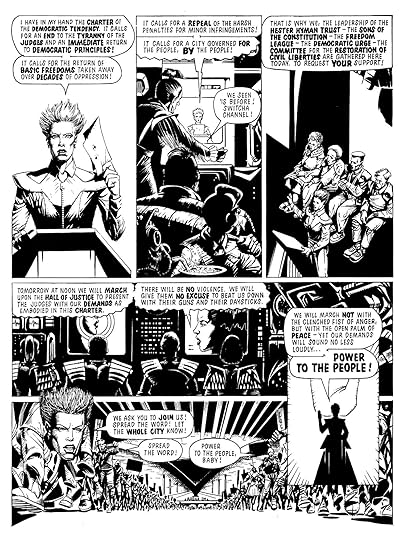
But the real dark gem of this 11th volume of J.D. Case Files is Revolution: a grim story without the usual humour about the fascist side of the judges. Chilling.
One of the best graphic novels I've read this 2016, year almost over to which I wanna say just one thing about Carrie Fisher:
The 11th collection of Dredd progs is, once again, a mixed bag of silly one-offs, a few multi-prog stories, and the 26 prog “Oz”, probably the most epic story since “Apokalypse War” or “Cursed Earth”. Despite a few minor duds in this collection, nearly every entry is enjoyable…even the ridiculous “Fairlyhyperman” which is such an insanely stupid insult to Superman that you can’t help but laugh at the absurdity of it all. But the obvious winner this time around is the “Oz” story which sees the return of Chopper, as well as a side plot involving evil clones Judges that all blends together quite well at the end. With all that, it actually manages to tell a compelling tale throughout its lengthy issues…again, something we haven’t seen in a long time. As usual, I’m still waiting for consistency across the spectrum when it comes to the art though…
I had really missed these long megaepics of Dredd. Oz is just so sweet with its 26 episodes, full of thrills. There is also whole bunch of short stories. Funny things, those. And some Steve Dillon art. Everything is right here.
An elephant in the room: some enterprising person or group of fans decided, at some point, that they could do the Complete Case Files books better. There are digital bootleg versions of the early Case Files floating around online; the difference is that the bootlegs have color where the original pages were printed in colour (the first two pages of most episodes before mid-1988), and they insert all the Dredd-related-but-not-Judge Dredd-proper stories at the appropriate point in the narrative.
For a lot of the earlier volumes, that's a minor improvement. (For some, it's an actively bad idea--at least one bootleg I've seen gets a lot of its colour pages from badly chopped-up and reformatted American reprints.) But in 1987, 2000 AD's production values were ramped up a bit, and as of a few episodes before Case Files 11 begins, the opening spread of the Judge Dredd feature was suddenly in painted colour. The half-tone versions of the colour pages in the printed Case Files 11 is decent--although it still gets muddy in a few places, like the beginning of "Return of Death Fist"--but it's distinctly not the way these stories were intended to look. And the bootleg files also include other Dredd-related pages from the original publications, the most interesting of which this time is this one, which was printed in the issue before "Oz" started.
There are a lot of in-jokes going on here, most of which I don't get and bet I'm not supposed to get, but the implication is that seven members of the 2000 AD staff had gone to Australia to research "Oz." (Was that the case?) The bent-over droid at far right is "Burt," a.k.a. Richard Burton; I'm guessing that the droid in the green sweatshirt and visor is John Wagner, and the one with the glasses and purple shorts is Alan Grant, but if anyone can correct me and/or fill in other information, I'd be grateful.
In any event, it seems as if Dredd stories had been stockpiled in advance of "Oz," which was the first "epic"-length Dredd story that had been attempted since "City of the Damned" a few years earlier. The 22 episodes (11 storylines) that precede it in this volume are drawn by ten different artists--only Liam McCormack-Sharp gets two stories, and they appear consecutively. And Tharg's stern note that the droids have one week to get "Oz" in order hints at how hurriedly it must have been put together: when the first three episodes of a 26-part story are all drawn by different artists (and nine different artists in all contribute), there's clearly some frantic catching up going on. Jim Baikie seems to have been the speed demon of the lot--not only did he draw the final two episodes, he drew the three that followed them (in the next volume).
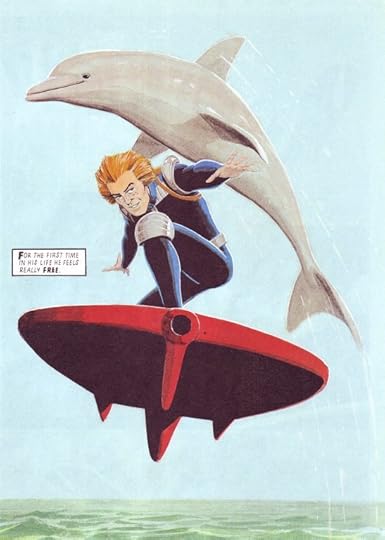
"Oz" is a new kind of Dredd epic, in the sense that Dredd is almost tangential to it. This one deals with either of them only during the Judda sequences; it's basically a Chopper story. (Dredd is entirely absent for long stretches of it, which was awfully unusual; so's the thematic two-page splash that opens the first episode.) Seeing all the parts of "Oz" together, actually, I can't help but wonder if the Judda plot was originally intended as a different story that would follow the Chopper/Supersurf sequence, and then got spliced into "Oz" when deadlines were getting tight. The Judda business turns up out of nowhere in the seventh episode (and when Chopper returns two weeks later, he picks up right where the sixth episode left off); the Judda and Chopper only appear in the same installment a few times, and the two plots' resolutions have almost nothing to do with each other.
Also, the Judda sequences are something of a distraction: Chopper's story is so compelling that mysterious violent weirdos shouting slogans, interspersed with chunks of exposition, get tiresome quickly. On the other hand, Brendan McCarthy's artwork here is a much better fit than it had been in Case Files 10--you can see him trying to give the series a consistent look. Unfortunately, it's a look that all the other artists ignore; when Will Simpson takes over for the conclusion of the Judda business, the visual energy goes way down all of a sudden.
It's interesting to imagine what "Oz," or in fact this era of Dredd, could have been like with a more consistent visual approach. There are very few artists who can handle a 6-to-8-page weekly strip, but it's just possible that Brendan and Jim McCarthy and Brett Ewins might have been able to tackle it together, at least for a while. (The latter two were mostly off drawing "Bad Company" during this era, though.)
I reread "Oz" after not having seen it in a long time, but a few months after rereading "Song of the Surfer"--which we'll be getting to in a few weeks. The "dangerous sports" aspect of this story goes over the top; there's a tragic thrill in the idea of a sport whose championship not everyone may survive, but a sport whose championship routinely slaughters most of its competitors doesn't seem like it could attract a lot of top athletes, you know? (Wagner addresses that a bit in "Song of the Surfer," but it passes without comment here.)
So the pleasures of "Oz" are less about its overall arc than its individual moments. I particularly love the sequence where the turtle gets another chance at life, which lasts all of five panels, but there are lots of other well-turned bits: Chopper going down in the storm, hearing everyone calling his name again; the "Space World" sequence, which gives Barry Kitson an opportunity to draw a very different sort of sci-fi image; McCarthy's image of Wipeout crouching on his board; the colour spread being reserved for the final two pages of part 20. (Whoops, that's another one that's not so effective in the printed book.)
The end of "Oz" was, famously, one of the major factors in the end of the Grant/Wagner writing partnership: Grant wanted Dredd to shoot Chopper in the back, Wagner wanted to reserve Chopper for future use. (Wagner has said that "Oz" was less a factor than their miniseries "The Last American" a few years later; Grant claims that Wagner divided up their collaborative gigs at the end of 1987, which would've been right after "Oz." In any case, they kept working together on occasional projects for another decade.) Grant's recollection is that "John wanted Chopper to win, but Dredd to let him go free because he respected him," and says he never read the final episode. In fact, Wagner's ending is a smart solution to the dispute, and doesn't resemble Grant's description.
It's not as if the partnership was producing inferior work (although it probably helped that they don't seem to have been quite as overworked in this period); they'd also gotten back to thinking about Dredd as a long game, setting plot threads that could reach into the future. The Judda routine set up the long-running "bloodlines" sequence, but the most durable invention here is an unlikely one: "Bug," the one-off that introduces PJ Maybe, who's still appearing regularly in the series almost 25 years later. The "young serial killer" premise is in place, and it's clear that they were planning on following it up quickly--but PJ's next appearance didn't happen for over a year, and this appearance doesn't suggest the Adrian Mole-style perception/reality split that would go on to define him. (Its other curious aspect: "Karen Berger Block," which appears in the first panel--Berger was arguably the most forward-thinking editor at DC Comics at that point.)
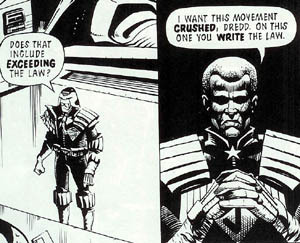
"Simp"--Cliff Robinson's best-looking story to date--ends with a plug for "Simp About the House," which also wouldn't appear for close to another year. "The Return of Death Fist" wraps up a dangling thread from "The Fists of Stan Lee." And then there's the "Revolution" three-parter, the long overdue follow-up to "Letter from a Democrat" and the most consistently fine story in this volume.
"Revolution" is a particularly timely story this week: it's about a peaceful demonstration, and the dirty tactics authorities use to try to break it up. The democratic coalition's intentions are a lot more specific than Occupy Wall Street's, but it's kind of unnerving that Wagner and Grant assume the people's right to assemble is something even the Judges wouldn't dare to mess with, when that currently seems to be anything but the case. (As Yves Smith puts it: "I’m beginning to wonder whether the right to assemble is effectively dead in the U.S. No one who is a wage slave (which is the overwhelming majority of the population) can afford to have an arrest record, even a misdemeanour, in this age of short job tenures and rising use of background checks.")
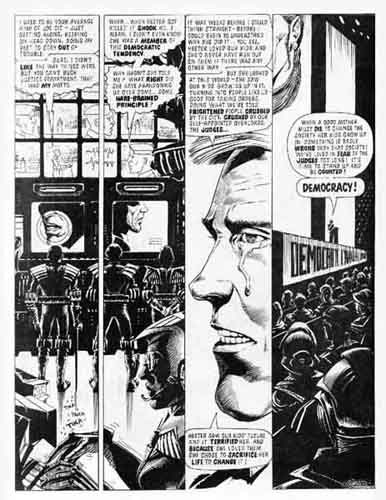
I'm a little surprised that "Revolution" appeared more than a year after "Letter to a Democrat," which it echoes formally as well as in plot--the panel where Blondel Dupre is on TV and someone at home is getting bored and changes the channel, and the repeated images of cowed citizens watching the incidents of the march on TV at home, directly repeat a bit from the earlier story. (It's smart that John Higgins draws this story, too, and his artwork here is much sharper than it was on "Letter.") The nasty judicial tricks that pop up in the closing sequences are appropriately shocking--the "family man" bit is particularly clever, and Judge Silver's paternalistic disapproval in his public speech twists the knife.
The only sour note is Dupre's earnest monologue on the final page, which is stirring where it needs to be stinging. Its implication is that we're finally going to be seeing more stories about Mega-City One's residents trying to get out from under the judicial jackboot, and we don't--not for another couple of years, anyway.
The other one- and two-parters in this volume that don't connect to broader developments generally don't have a lot going for them ("Corporal Punishment" is particularly dippy), and it's hard to understand why the thoroughly forgettable "Alabammy Blimps" sequence got five episodes while "Revolution" was squeezed into three. What "Alabammy Blimps" does have going for it is Steve Dillon's artwork, whose conflict-as-comedy approach prefigures the look he'd adopt for Preacher many years later. "Blimps" and Dillon's chapters of "Oz" were the final Dredd stories he'd draw for a few years: shortly after that serial ended, he and Brett Ewins cut way down on their 2000 AD contributions to concentrate on their new magazine Deadline.
Wagner and Grant are on fire in this stretch of Dredd's history - taking place in the year of my birth 1987 through to early '88. There's the first appearance of the dastardly PJ Maybe, a tussle with martial arts master Stan Lee, the dark early dawning of the democracy movement, some hilarious self-contained stories of mega-city one activity and the big daddy of late-eighties epics: OZ. The art throughout is extraordinarily strong - particularly showing off the monochromatic mastery of Liam Sharp, John Higgins and Steve Dillon. Brendan McCarthy's amazingly complex 'n surreal Oz pages are especially memorable and the constant juggle of the epic between multiple artistic hands is a serious feat.
My only criticisms of the collection are that the darkness of some of the (originally coloured) 'centre spread' pages can be so murky you can't actually read some credit boxes, any dialogue veering too close to centre is at risk of being swallowed by the unforgiving central crease and most egregiously there's a bit of a printing error and the end of Oz is chopped off by a repeat of the first twenty-odd pages. Whoops! Technical errors aside though it's nice to have this strange period on my shelf.
A monumental book in so many ways: firstly, it contains my first Dredd story - the first PJ Maybe episode - but most importantly it contains Revolution AND Oz, both of which essentially point the way for how Dredd would evolve and develop into something beyond the usual villain of the week grotesques into something more emotionally rich and satisfying. Revolution is the story that takes the threads of Letter From A Democrat and shows the way for so much of Dredd’s doubts with the Judicial system for years to come. It’s one of the first properly ambiguous Dredd stories in terms of muddying the water from fun satire to something more challenging
And then Oz just underlines that. Firstly it breaks the Wagner and Grant writing team over fundamental differences in how they view Dredd, with the latter favouring upping the grotesques and making Dredd ever worse than he already is and Wagner wanting to see if he can get some humanity in the ostensibly stubborn face of justice. It develops from the Revolution ideas, takes a detour via the Judda into exploring Dredd’s own bloodline (something the series would continue to mine for many years to come) but also for the first real time puts Dredd into moral dilemmas. He’s faced with the most extreme version of his own black and white version of the law, he’s got a begrudging admiration for Chopper himself and he essentially loses. The Stan Lee rematch earlier in the book reminds us of one of the rare times in which Dredd is humiliated (even though he wins this time), and this one ups that considerably. Dredd suddenly feels human
And because of that the series continues to this day. Dredd is now fallible and prone to doubts. He becomes a more insular figure, reluctantly in dialogue with himself as he finds himself faced with developments in his city beyond his understanding. He’s always aged, but suddenly the path to Dredd as something of a relic becomes visible. In one deft move, an entertaining romp becomes something far more richer and important. It’s as glorious now as it was as a 12 year old who didn’t understand half of it. A comics classic
It all started for me with an Anthrax song and then the 2012 movie Dredd. That is what prompted my mad quest to procure every single Complete Case Files as well as the Restricted Case Files books in the winter of 2012-13 . Over the past few years I've slowly been reading these books and have realized that I may never finish reading them all.
The writing is solid throughout, with continuity that is as tight as a drum. It's the artwork which swerves all over the road here, from brilliant to what I politely call “deadline art”. Cliff Robinson's artwork is head and shoulders above the rest of the pack here. Judge Dredd was a weekly strip, and there was a rotating crop of artists in order to make the going to press deadline. As a weekly reader this probably didn't matter, but when reading a huge swath of issues in a row like you do with this book it can be jarring from one story to the next.
The highlight of this book is the 26 part epic, Oz, where former champion skysurfer Chopper makes a prison break. Jug McKenzie has been the champion for the two years since Chopper has been in prison and was talking a lot of smack, which caught Chopper's attention. With nothing to lose, Chopper hops on a skyboard and goes on a harrowing journey across the ocean to Australia to compete in Supersurf 10. Some of the arcs in this book were about as fun to read as chewing chalk, but this one was a real page turner that kept me awake until I finished it.
Dredd's a good character and a good concept, but in my case a little goes a long way. There is a sameness to it all, even when they switch gears and Dredd is fighting rats, mutant alligators or martial artists. Dredd is great when I am in a certain frame of mind. The problem for me is that this frame of mind is becoming less and less frequent right now.
This is a very strange volume. Half of the book is take up with Chopper and a slight deviation about DNA, Fargo and the Judges. This half is really good, especially the parts following Chopper across the Cursed Earth and Atlantic. There are some cool and fun characters which add to the world of the Cursed Earth. It is also quite a thoughtful piece.
There are also some really good shorter stories. At the top of the pile is the Revolution (part of the America story) and Something to Fear which illustrate the manipulative side of the Judges and the limits they will go to maintain their power. It is a natural growth from how misleading was used to capture criminals in earlier case files.
In fact, most of the stories and arcs here feel like a natural continuation in the world of Dredd. There are the usual fun stories like a mega rat, man-eaters, an AI generated war amusement part which goes obviously wrong, and the return of Stan Lee and a Superman piss-take. There is also a good story about a spoilt kid and the repercussions of taking away punishment.
Yeah, storewide this is a strong book. In terms of art, it is propped up with work from Steve Dillon, Cliff Robinson and John Higgins, but the standout artist for me on this one is Barry Kitson who is a new one for me. On the whole, this books is a good bang for its buck and an excellent addition. Probably my favourite since case file 5.
Oz is a complete classic. Just out and out great Dredd mega epic. And Dredd loses. Kinda. I always love seeing other city judges and the Oz judges don’t disappoint. Some of the stereotypes don’t read as well 30 years later. But it’s a great read.
The democracy storyline too is quality and has repercussions for many years after. Such rich storytelling and one of those tales in which Dredd is most definitely the villain.
Plus our first introduction to PJ Maybe.
Case files 11 is a rich collection full of classic Dredd and a must for anyone wanting to experience the best of the early years of Dredd.
This entire review has been hidden because of spoilers.
Judge Dredd: The Complete Case Files 11 is full of world building, chins, heroics, rib breaking humour, three-dimensional characters, great art, mickey taking, epic camera angles, break necked paced stunts, cunning, daring do, plot twists, cameos, adventure and action! Brilliant and highly recommneded! Crisp high five! Get it when you can! :D
A huge tome that begins with ridiculous small stories, continues with a very strong story in Cursed Earth and then hits you in the face with the epic DREDD IN OZ! By far in the top 5 of the most epic stories in B&W Dredd tomes!
Love some of the artwork, especially on the epic Oz tale. Did not think I was going to enjoy the Oz story but the return of Chopper and the side story of the Judda was magnificent. Time for a break until I can source number 12 in the series in printed format.
While I enjoyed this edition of Judge Dredd i found the stories to be slightly hit and miss. Judge Dredd in Oz didn't gel with me, like it’s a solid story but I think it went on for just way too long.
The usual highs and lows to be found in this volume. While seeing Dredd do some pest control fighting giant rats might not be as good as it sounds there are certainly tales that make up for it, in particular the dark place that the Revolution story goes to, in which we explore the fascist side of the Judges. Half the book is actually devoted to the story Dredd in Oz, in which he actually spends little time in Oz. In fact, we see very little of him in the entire story, which mainly focuses on surfing champion Chopper, although it does introduce us to the Judda, and has a wonderfully OTT climax at Ayre's Rock. Oh, and of course there is also the amusing Superman satire Fairlyhyperman, in which the vigilante can only be defeated by kapokite. Oddly enough, the story which lends itself to the cover (about a guy who decides to dress strangely for his wedding) is possibly the worst one in the volume.
This volume contains the classic Oz saga and is worth every penny just for that. The increase in print quality of the original strips really becomes apparent in these reproductions given the more widespread use of colour from prog 500 onwards.
Not quite as good as the last few. Still prime Dredd action, but some stories and art only satisfactory rather than awesome sauce. It's a 4 really, but I can't give them ALL a 4, surely.... Interesting in that the subject matter is starting to touch weightier subject matter.