

What do you think?

Cuadernos de Igort #1-2
The Ukrainian and Russian Notebooks: Life and Death Under Soviet Rule
Written and illustrated by an award-winning artist and translated into English for the first time, Igort’s The Ukrainian and Russian Notebooks is a collection of two harrowing works of graphic nonfiction about life under Russian foreign rule.
After spending two years in Ukraine and Russia, collecting the stories of the survivors and witnesses to Soviet rule, masterful Italian graphic novelist Igort was compelled to illuminate two shadowy moments in recent the Ukraine famine and the assassination of a Russian journalist. Now he brings those stories to new life with in-depth reporting and deep compassion.
In The Russian Notebooks , Igort investigates the murder of award-winning journalist and human rights activist Anna Politkovskaya. Anna spoke out frequently against the Second Chechen War, criticizing Vladimir Putin. For her work, she was detained, poisoned, and ultimately murdered. Igort follows in her tracks, detailing Anna’s assassination and the stories of abuse, murder, abduction, and torture that Russia was so desperate to censor. In The Ukrainian Notebooks , Igort reaches further back in history and illustrates the events of the 1932 Holodomor. Little known outside of the Ukraine, the Holodomor was a government-sanctioned famine, a peacetime atrocity during Stalin’s rule that killed anywhere from 1.8 to twelve million ethnic Ukrainians. Told through interviews with the people who lived through it, Igort paints a harrowing picture of hunger and cruelty under Soviet rule.
With elegant brush strokes and a stark color palette, Igort has transcribed the words and emotions of his subjects, revealing their intelligence, humanity, and honesty—and exposing the secret world of the former USSR.
After spending two years in Ukraine and Russia, collecting the stories of the survivors and witnesses to Soviet rule, masterful Italian graphic novelist Igort was compelled to illuminate two shadowy moments in recent the Ukraine famine and the assassination of a Russian journalist. Now he brings those stories to new life with in-depth reporting and deep compassion.
In The Russian Notebooks , Igort investigates the murder of award-winning journalist and human rights activist Anna Politkovskaya. Anna spoke out frequently against the Second Chechen War, criticizing Vladimir Putin. For her work, she was detained, poisoned, and ultimately murdered. Igort follows in her tracks, detailing Anna’s assassination and the stories of abuse, murder, abduction, and torture that Russia was so desperate to censor. In The Ukrainian Notebooks , Igort reaches further back in history and illustrates the events of the 1932 Holodomor. Little known outside of the Ukraine, the Holodomor was a government-sanctioned famine, a peacetime atrocity during Stalin’s rule that killed anywhere from 1.8 to twelve million ethnic Ukrainians. Told through interviews with the people who lived through it, Igort paints a harrowing picture of hunger and cruelty under Soviet rule.
With elegant brush strokes and a stark color palette, Igort has transcribed the words and emotions of his subjects, revealing their intelligence, humanity, and honesty—and exposing the secret world of the former USSR.
384 pages, Hardcover
First published January 1, 2010
About the author
Igort
75 books179 followersIgort is an Italian illustrator, comic book artist, writer, publisher, film director and musician. He is considered a key figure in the development of European graphic novels.
Igor Tuveri was born in 1958 in Cagliari, Sardinia, Italy. At age 20 Tuveri moved to Bologne and started publishing comics with the pen name Igort. His early works appeared in 'Linus', a famous Italian comic magazine aimed at an adult readership, of which Igort himself will become editor-in-chief in the 2000's.
In the 80's Igort founded the independent magazines 'Il Pinguino' and 'Dolce Vita' with fellow cartoonists from the so-called 'Valvoline' collective. The collective included artists Daniele Brolli, Roberto Baldazzini, Lorenzo Mattotti, Giorgio Carpinteri, as well as American cartoonist Charles Burns. Igort's works from this period include Goodbye Baobab (1982), a story set in Japan in the 40s and co-created with Daniele Brolli, and Ishiki no kashi - Il letargo dei sentimenti (1984), a comic taking place in a futuristic version of Japan.
Igort is also one of the first Western authors to have worked in the Japanese manga industry, most notably with the series Yuri (1996) for Kōdansha.
In 2000, Igort founded his own publishing house, Coconino Press. The publisher played an important role in the development of the 'graphic novel movement' in Italy, releasing new works by national and international authors, as well as classic works by cartoonist like Jacques Tardi, Daniel Clowes, Adrian Tomine, Chris Ware, Will Eisner, and so on. In 2017 Igort left Coconino to found a new publishing house, called Oblomov Press.
Between 2008 and 2009, Igort travelled through the Ukraine, Russia and Siberia, carrying out research for the books Quaderni Ucraini (2010, Ukrainian Notebooks) and Quaderni Russi (2011, Russian Notebooks). Together with the two volumes of Quaderni Giapponesi (2015-2017, Japanese Notebooks), these form a trilogy of illustration travel notebooks.
In 2019, Igort directed the live action film adaptation of his most famous graphic novel, 5 is the Perfect Number (2002), starring actors Toni Servillo and Valeria Golino.
Besides drawing, writing, publishing and occasionally working in cinema, Igort has also been a life long musician. Since 2022 he hosts a Youtube Channel on the medium of comics, called 'lezionidifumetto·it'.
Igor Tuveri was born in 1958 in Cagliari, Sardinia, Italy. At age 20 Tuveri moved to Bologne and started publishing comics with the pen name Igort. His early works appeared in 'Linus', a famous Italian comic magazine aimed at an adult readership, of which Igort himself will become editor-in-chief in the 2000's.
In the 80's Igort founded the independent magazines 'Il Pinguino' and 'Dolce Vita' with fellow cartoonists from the so-called 'Valvoline' collective. The collective included artists Daniele Brolli, Roberto Baldazzini, Lorenzo Mattotti, Giorgio Carpinteri, as well as American cartoonist Charles Burns. Igort's works from this period include Goodbye Baobab (1982), a story set in Japan in the 40s and co-created with Daniele Brolli, and Ishiki no kashi - Il letargo dei sentimenti (1984), a comic taking place in a futuristic version of Japan.
Igort is also one of the first Western authors to have worked in the Japanese manga industry, most notably with the series Yuri (1996) for Kōdansha.
In 2000, Igort founded his own publishing house, Coconino Press. The publisher played an important role in the development of the 'graphic novel movement' in Italy, releasing new works by national and international authors, as well as classic works by cartoonist like Jacques Tardi, Daniel Clowes, Adrian Tomine, Chris Ware, Will Eisner, and so on. In 2017 Igort left Coconino to found a new publishing house, called Oblomov Press.
Between 2008 and 2009, Igort travelled through the Ukraine, Russia and Siberia, carrying out research for the books Quaderni Ucraini (2010, Ukrainian Notebooks) and Quaderni Russi (2011, Russian Notebooks). Together with the two volumes of Quaderni Giapponesi (2015-2017, Japanese Notebooks), these form a trilogy of illustration travel notebooks.
In 2019, Igort directed the live action film adaptation of his most famous graphic novel, 5 is the Perfect Number (2002), starring actors Toni Servillo and Valeria Golino.
Besides drawing, writing, publishing and occasionally working in cinema, Igort has also been a life long musician. Since 2022 he hosts a Youtube Channel on the medium of comics, called 'lezionidifumetto·it'.
Ratings & Reviews
Friends & Following
Create a free account to discover what your friends think of this book!
Community Reviews
Displaying 1 - 30 of 275 reviews

November 14, 2016
The 1932 Holodomor is looked at through first person interviews in the UNB. The new Russia and the Chechen War are examined in the RNB. Igort connects the stories with stark art that makes you feel the oppression that permeates the subject matter. Needless to say this book has taken on a new dimension of urgency - highest recommendation.

January 13, 2016
I am not naturally drawn to graphic books, but I am fascinated by Eastern Europe so it was hard to pass up an opportunity to read an advance copy of The Ukrainian and Russian Notebooks, a book of graphic non-fiction. The Notebooks are based on interviews Igort -- pseudonym for Igor Tuveri -- conducted with a number of Ukrainians and Russians living in contemporary Ukraine and Russia. The Ukrainian part of the notebooks focuses on the 20th century history of Ukrainian, including the horrendous forced famine in 1932 and extreme violence under Stalin. The Russian part focuses on contemporary Russia, and the death of a female journalist who was investigating atrocities in Chechnya. There is nothing cheery or lighthearted about this book despite the fact that it is in the form of drawings. What Igort depicts is not new to me nor does the format allow for much in depth information, but there's definitely a powerful and disturbing quality that Igort conveys with his expressive black and white drawings. This will not be for everyone, but it's a good -- although truly brutal -- graphic primer on 20th and 21st century Ukraine and Russia. Thank you to the publisher and Netgalley for an opportunity to read an advance copy.

January 28, 2016
A harrowing account of the Holodomor, the Famine-Genocide in Ukraine in 1932 and 1933 and the murder of journalist and human rights activist Anna Politkovskaya are the two stories depicted in this graphic novel.

Because of Stalin's collectivization program, millions of people starved in the USSR, the Holodomor in the Ukraine alone has numbers cited from 3 to 7 million. Other estimations even run into the 10 million. There were several factors that contributed to these numbers. Low harvest, the massive export of grains by the USSR, the killing of livestock resulting in less food and available labor, and the deportations and executions of the peasants for fear of uprisings.
The book is designed in the form of a journal and recounts several accounts of eye witnesses as short vignettes, showing how they hid their grains, killed their horses, were evicted from their homes, even how cannibalism was a common occurrance.

In the second story, we learn of Anna Politkovskaya, a journalist who reported on Chechnya and even wrote several books about the atrocities there. This was not taken lightly and she received several death threats during her life. In 2006 she was murdered in the elevator of her flat.
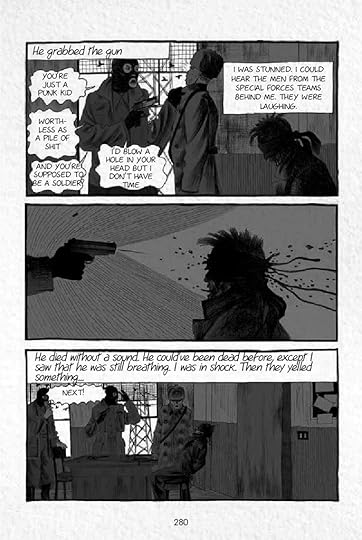
The artwork was nicely done. Graphic and dark, you can feel the pain and sadness coming through. As you can only tell so much in a comic, the narrative was also at times hard to follow because of some continuity issues. It is however, a fantastic book. History in the form of a graphic novel makes it quite interesting to actually read up on a topic.
Review copy supplied by publisher through NetGalley in exchange for a rating and/or review.
Because of Stalin's collectivization program, millions of people starved in the USSR, the Holodomor in the Ukraine alone has numbers cited from 3 to 7 million. Other estimations even run into the 10 million. There were several factors that contributed to these numbers. Low harvest, the massive export of grains by the USSR, the killing of livestock resulting in less food and available labor, and the deportations and executions of the peasants for fear of uprisings.
The book is designed in the form of a journal and recounts several accounts of eye witnesses as short vignettes, showing how they hid their grains, killed their horses, were evicted from their homes, even how cannibalism was a common occurrance.
In the second story, we learn of Anna Politkovskaya, a journalist who reported on Chechnya and even wrote several books about the atrocities there. This was not taken lightly and she received several death threats during her life. In 2006 she was murdered in the elevator of her flat.
The artwork was nicely done. Graphic and dark, you can feel the pain and sadness coming through. As you can only tell so much in a comic, the narrative was also at times hard to follow because of some continuity issues. It is however, a fantastic book. History in the form of a graphic novel makes it quite interesting to actually read up on a topic.
Review copy supplied by publisher through NetGalley in exchange for a rating and/or review.

March 7, 2025
Igort is a famous Italian cartoonist from a Soviet immigrant family (either Russian, Ukrainian, or mixed - it’s not clear from the info online). I am a Ukrainian reader from Luhansk, now a refugee, and here is my review of his book - probably the first one from an actual Ukrainian on this website.
This book is divided into two parts (or rather, it was published first as two different books in Italian and combined later), so I will write about each part separately.
Ukrainian Notebooks (based on the author’s 2008 trip to Ukraine)
Visuals
Don’t get me wrong, Igort’s general drawing style is good, however, as soon as he starts to illustrate historical parts (1920-30-40s Ukraine), it quickly becomes a mess. It’s clear that he knew very little of traditional Ukrainian culture and didn’t have any authentic references when drawing. He probably was looking up only Russian photographs and therefore the style of clothes people wear, architecture, and interior design cannot be recognized as Ukrainian. It messed with my brain a lot - I kept forgetting what he was talking about because the cognitive dissonance was too much to deal with.
He calls houses izba (an old Russian word for a house, never used by Ukrainians) instead of hata (an old Ukrainian word for a house, still used nowadays). He puts traditional Russian hairstyles and beard styles on Ukrainian men (yes, we can tell because it’s really that different). Everyone in the “historical” part of the narrative wears traditional Russian clothes instead of traditional Ukrainian clothes, drinks chai from samovars, and eats exclusively dishes of Russian cuisine.
Contrary to modern Russian propaganda, Russian and Ukrainian traditional cultures differed greatly, so it was evident that when Igort was drawing memories of Ukrainians, he drew them in a historically inaccurate way, using references from the art and photos of Russian villagers.
One more example of how Igort’s shallow understanding of the details translates into incorrect or distracting visuals: when showing weddings and funerals in the Soviet Union, he expresses them continually through images of the traditional rituals in Orthodox churches. He forgets that the church and religion were outlawed during the communist era and Soviet weddings and funerals looked different from traditional ones.
Writing
The narrative is shredded because it is based on conversations with people the author randomly spoke with throughout his journey. There is no continuous story Igort is telling through these dialogs, it’s just a bunch of people talking at the same time. It is an interesting technique but unfortunately, two cons are coming with it.
Firstly, the author mentions a bunch of irrelevant people and names throughout the story, for most of them to never appear again. Secondly, it seems Igort only spoke with beggars on the street, old people, some of them terminally ill, poor people who were willing to tell him their sad stories, etc. I do think it’s important to tell different stories of people from all walks of life in literature. However, the problem with this book is, these are the only stories Igort collected in Ukraine. There is not a single young person in his narrative, not a single normal story of the normal life of a working-class man or a woman, not a one small business owner, not a one happy family. Of course, Ukraine, like any other country, has its problems, its beggars, old lonely poor people, etc. But why did he deliberately choose to solely represent Ukraine by beggars?
He also makes an impression in his writing that only the Russian language is spoken by everyone he met and even by everyone in the past. The fact is, Igort himself does speak some Russian and most probably doesn’t know any Ukrainian, therefore it’s logical that everyone who he met in Ukraine and who was willing to speak to him, was speaking Russian so he could understand them. However, he concludes the wrong thing from this experience and instead of appreciating how these people spoke Russian for him, he ends up thinking these people only speak Russian.
People he describes seem always very lost and Soviet-oriented, fascinated by Russian literature and stuck in the past. Are they really, or it’s, once again, something Igort himself is fascinated with and therefore views through his favourite lenses? Are they telling only the stories of misery and loss, or that’s how the author shapes the narrative because that’s what he understands the best out of all he has been told?
The author used the incorrect spelling of the names of Ukrainian cities, geographical objects, and even personal names (Kiev instead of Kyiv, Chernobyl instead of Chornobyl, etc) - but, curiously, Enerhodar and Mykolaiv were spelled correctly (who knows what spared them…).
Unfortunately, he was affected by the Russian narrative of separating Ukraine into Eastern/Western Ukraine (it's just East and West of Ukraine, not the separate countries, thank you very much). Even Soviet supporters say to him this separation is false: He says it's not true that Ukraine is divided, with one side pro-Western and the other nostalgic for the Soviet Empire. However, Igort has his own agenda and while writing down what people say, he pushes his narrative anyway.
In Soviet flashbacks, everyone calls each other comrade which is… funny.
There are some sentences written in such a non-coherent way that makes you stop reading because you can’t comprehend what the author meant: The Ukrainian steppe of Anton Pavlovich Checkhov is imposing. I still don't know what he meant.
Igort also uses lots of words that might request some explanation for those foreign readers who did not study USSR history in depth but there are no definitions given.
Historical accuracy
Regarding modern Ukraine, Igort showed pre-Euromaidan discrimination against Ukrainians pretty openly. He spoke about how in the pre-Euromaidan era Russian businesses were colonizing the market and Russian citizens migrated to the East of Ukraine, living in the best areas, while actual Ukrainians were pushed to poverty and living in the old, ugly, logistically uncomfortable areas.
What I liked about the historical part was how Holodomor plays a big role in the narrative. Igort met with the survivors during his trip and explored the details of the genocide, unrecognized by the UN. He lists the countries that recognized Holodomor as a crime against humanity and informs the reader about the Russian revisionist communist uprising and the glorification of Stalin in popular Russian culture. He shows how modern Russians don’t care about the historical truth of the past and don’t take any responsibility for the crimes committed.
Igort also called out Walter Duranty's anti-Ukrainian propaganda in the Western media of the time.
Igort mentioned resistance to collectivization in the early Soviet period in Russia, however, fails to mention that in Ukraine it was much more prominent. It gives the impression that Ukrainians did not resist the Soviet occupation at all which was not the case (in fact, because of strong resistance to collectivization in Ukraine, genocide by famine was organized by Stalin to kill the people’s will to rise).
The author does not have enough empathy or critical thinking to see the results of the collective trauma of a man-made famine, Nazi and Soviet occupation, and Russian colonialism in a modern Ukrainian identity and in the problems with which the people he speaks with struggle daily. He does not engage critically with the sayings like During communism, we felt like people. Everything was economical. A cylinder of gas cost eighty rubles. Now it costs 113 hryvna - a fortune when you realize pensions are 550 hryvna. or In the Soviet Union we lived in good conditions: everyone had a job, everything was affordable. ... Today people don't have jobs, prices are up, and no one sees a light at the end of the tunnel. He does not challenge this worldview or at least explain it to a reader, he does not put notes with details about the realities of the Soviet economy, medicine, and education so the readers can engage with the quote and see for themselves whether the personal worldview of this particular beggar correlates to the historical reality or not. The author just sees it as truth.
Igort often uses a condescending tone when explaining Ukrainian realities: Independent or not, Ukrainians in this geographical area often define themselves as Russian.
He ends his Ukrainian Notebooks with this distasteful and untrue statement:
A rich, flourising, independent nation, once considered the silo of Europe, today has been reduced to desctruction. With the fall of Communism, the Soviet cult of industrial production perished. The Five-Year Plans and the kolkhozy are memories. Today life goes on by interia. The Ukrainian homo soveticus is a lost being, deprived of a role. The man considered responsible for this enormous disgrace is the most loved Russian politician in the West, Mikhail Gorbachev, Gerenal Secretary of the CPSU, whom at one time everyone in Ukraine called "Mineral Secretary".
Russian Notebooks
Visuals
I like how Picasso’s Guernica was incorporated into the page when talking about war.
Writing
In Russian Notebooks, Igort tries to focus on two topics: the realities of the Russo-Chechen wars and the assassination of Anna Politkovskaya, a Russian investigative journalist of Ukrainian descent, who was writing about the genocide of the Chechen people. I say he tries because I think he kinda fails on both.
When handling such a topic, I would expect some historical information to be presented for the reader, especially considering that Chechen people are not talked about in the media and their culture and history are less known compared to their occupiers. So I was glad to see a chapter called 150 years earlier, right? I got excited about knowing more about Chechnya! But... it was a Dostoevsky biography instead. He starts another chapter to explain the complicated relationships between Chechnya and the Russian Empire during Tsar times, to describe battles rooted in long history, and to show how the Soviet Union influenced the region! But gets distracted again and ends it with a Leo Tolstoy biography. You see a pattern, right?
Great Russian Literature! We will not ask about what it does in this particular text which has nothing to do with it. We will not analyze how it failed to make Russian culture civilized, humane, and merciful. We will not engage with it critically. We will just admire it. It’s so Great!
That’s how in less than 200 pages dedicated to Chechnya, you will constantly read about Tolstoy, Tolstoy, Dostoevsky, Tolstoy, Dostoevsky, Dostoevsky, Tolstoy (that’s exactly the number and the order of the mentions of Tolstoy and Dostoevsky in this book).
Regarding the second topic, Anna Politkovskaya’s life and death, Igort doesn’t spare us from shallow literary comparisons either. He compares her writing with Tolstoy: simple, pointing writing. Spare, and yet, for that very reason, deeply human. Was Tolstoy an investigative journalist? Did he save lives? Did his writing open the world’s eyes to a real genocide, a mass murder of a whole nation? No. In this sense, Anna Politkovskaya is a much more accomplished writer than Tolstoy - she was dealing with real danger, and her work has and continues to have a real impact.
But this delusional Western continues too: ...Anna was infused with the ethical sense that spills out of the pages of nineteenth-century Russia. I’m sorry, which ethical sense? Nineteenth-century Russia is known for its slave-owning, genocides, colonialism, imperialism, and erasure of native nations of Siberia. To push this propagandist narrative of great culture and Great Literature is not only to engage with modern Russian revisionism of the actual realities of the nineteenth century but also to diminish the person who the author is talking about, a truly great person who did truly brave things.
Igort also calls Chechen Caucasians in the European sense (since they live near Caucasian mountains), however, I think that in the American edition that should have been changed due to them still using “Caucasian” as a synonym for “white” when talking about race. It may therefore be confusing for American readers.
Historical accuracy
When talking about the Russo-Chechen wars, Igort fails to call out Russian imperialism and colonialism for what it is because he is deeply rooted in Russian culture himself and cannot separate his preferences in literature from the harsh realities of the real world.
The last chapter in Russian Notebooks covers a Ukrainian person deported and tortured in Siberia during the Soviet times, which portrays a realistic image of the deported people’s destiny, however, it's unclear why Igort put it to the Russian Notebooks instead of Ukrainian ones. It has nothing to do with Russo-Chechen wars and Anna Politkovskaya.
There is also an epilogue available in my edition, added in 2014 after the Russian invasion of Ukraine and occupation of Crimea.
All that the author shares about the events is the truth except that he mixes up Ukrainian and Russian culture a lot (as we already saw previously so I was not surprised) and his translator uses article the when writing about Ukraine (the Ukraine is simply grammatically incorrect to write).
The epilogue contains not only the written text but also three graphic chapters:
1 - How unprepared the Ukrainian army was for the 2014 invasion and how Ukrainian civilians were helping the mobilized young soldiers with food and equipment at the beginning of the war while the commanders abandoned them. The author fails to mention that this was a result of many years of Russian infiltration into Ukrainian politics and the military.
2 - How expensive coal and wood became in Russia-occupied regions of Ukraine. I did not understand why it was an important story to tell when at the same time people were literally kidnapped, tortured, and murdered in Russia-occupied regions. Like please, choose your priorities.
3 - A story of a Russian soldier who partook in the occupation of Luhansk city (where I am from) but decided to quit the army and was murdered by the Russian army. The soldier was portrayed as a martyr while there was nothing said about Luhansk civilians and our plight, even though the level of violence in the city was all-time high and many regular Ukrainians were murdered by the Russian army all the same.
Overall, I understand that in speaking about Holodomor, modern Ukraine, Russo-Chechen wars, Anna Politkovskaya, and the Russian invasion of 2014 Igort had the best intentions. He tried to speak the truth and bring attention to important injustices in the region. However, due to his focus on Russian culture and his main knowledge being of Russia and not of the places it colonized, the general narrative of these stories was really confusing. I think the author would have benefited from Ukrainian/Chechen consultants/reviewers who could provide an indigenous perspective and enrich the tone of the book.
This book is divided into two parts (or rather, it was published first as two different books in Italian and combined later), so I will write about each part separately.
Ukrainian Notebooks (based on the author’s 2008 trip to Ukraine)
Visuals
Don’t get me wrong, Igort’s general drawing style is good, however, as soon as he starts to illustrate historical parts (1920-30-40s Ukraine), it quickly becomes a mess. It’s clear that he knew very little of traditional Ukrainian culture and didn’t have any authentic references when drawing. He probably was looking up only Russian photographs and therefore the style of clothes people wear, architecture, and interior design cannot be recognized as Ukrainian. It messed with my brain a lot - I kept forgetting what he was talking about because the cognitive dissonance was too much to deal with.
He calls houses izba (an old Russian word for a house, never used by Ukrainians) instead of hata (an old Ukrainian word for a house, still used nowadays). He puts traditional Russian hairstyles and beard styles on Ukrainian men (yes, we can tell because it’s really that different). Everyone in the “historical” part of the narrative wears traditional Russian clothes instead of traditional Ukrainian clothes, drinks chai from samovars, and eats exclusively dishes of Russian cuisine.
Contrary to modern Russian propaganda, Russian and Ukrainian traditional cultures differed greatly, so it was evident that when Igort was drawing memories of Ukrainians, he drew them in a historically inaccurate way, using references from the art and photos of Russian villagers.
One more example of how Igort’s shallow understanding of the details translates into incorrect or distracting visuals: when showing weddings and funerals in the Soviet Union, he expresses them continually through images of the traditional rituals in Orthodox churches. He forgets that the church and religion were outlawed during the communist era and Soviet weddings and funerals looked different from traditional ones.
Writing
The narrative is shredded because it is based on conversations with people the author randomly spoke with throughout his journey. There is no continuous story Igort is telling through these dialogs, it’s just a bunch of people talking at the same time. It is an interesting technique but unfortunately, two cons are coming with it.
Firstly, the author mentions a bunch of irrelevant people and names throughout the story, for most of them to never appear again. Secondly, it seems Igort only spoke with beggars on the street, old people, some of them terminally ill, poor people who were willing to tell him their sad stories, etc. I do think it’s important to tell different stories of people from all walks of life in literature. However, the problem with this book is, these are the only stories Igort collected in Ukraine. There is not a single young person in his narrative, not a single normal story of the normal life of a working-class man or a woman, not a one small business owner, not a one happy family. Of course, Ukraine, like any other country, has its problems, its beggars, old lonely poor people, etc. But why did he deliberately choose to solely represent Ukraine by beggars?
He also makes an impression in his writing that only the Russian language is spoken by everyone he met and even by everyone in the past. The fact is, Igort himself does speak some Russian and most probably doesn’t know any Ukrainian, therefore it’s logical that everyone who he met in Ukraine and who was willing to speak to him, was speaking Russian so he could understand them. However, he concludes the wrong thing from this experience and instead of appreciating how these people spoke Russian for him, he ends up thinking these people only speak Russian.
People he describes seem always very lost and Soviet-oriented, fascinated by Russian literature and stuck in the past. Are they really, or it’s, once again, something Igort himself is fascinated with and therefore views through his favourite lenses? Are they telling only the stories of misery and loss, or that’s how the author shapes the narrative because that’s what he understands the best out of all he has been told?
The author used the incorrect spelling of the names of Ukrainian cities, geographical objects, and even personal names (Kiev instead of Kyiv, Chernobyl instead of Chornobyl, etc) - but, curiously, Enerhodar and Mykolaiv were spelled correctly (who knows what spared them…).
Unfortunately, he was affected by the Russian narrative of separating Ukraine into Eastern/Western Ukraine (it's just East and West of Ukraine, not the separate countries, thank you very much). Even Soviet supporters say to him this separation is false: He says it's not true that Ukraine is divided, with one side pro-Western and the other nostalgic for the Soviet Empire. However, Igort has his own agenda and while writing down what people say, he pushes his narrative anyway.
In Soviet flashbacks, everyone calls each other comrade which is… funny.
There are some sentences written in such a non-coherent way that makes you stop reading because you can’t comprehend what the author meant: The Ukrainian steppe of Anton Pavlovich Checkhov is imposing. I still don't know what he meant.
Igort also uses lots of words that might request some explanation for those foreign readers who did not study USSR history in depth but there are no definitions given.
Historical accuracy
Regarding modern Ukraine, Igort showed pre-Euromaidan discrimination against Ukrainians pretty openly. He spoke about how in the pre-Euromaidan era Russian businesses were colonizing the market and Russian citizens migrated to the East of Ukraine, living in the best areas, while actual Ukrainians were pushed to poverty and living in the old, ugly, logistically uncomfortable areas.
What I liked about the historical part was how Holodomor plays a big role in the narrative. Igort met with the survivors during his trip and explored the details of the genocide, unrecognized by the UN. He lists the countries that recognized Holodomor as a crime against humanity and informs the reader about the Russian revisionist communist uprising and the glorification of Stalin in popular Russian culture. He shows how modern Russians don’t care about the historical truth of the past and don’t take any responsibility for the crimes committed.
Igort also called out Walter Duranty's anti-Ukrainian propaganda in the Western media of the time.
Igort mentioned resistance to collectivization in the early Soviet period in Russia, however, fails to mention that in Ukraine it was much more prominent. It gives the impression that Ukrainians did not resist the Soviet occupation at all which was not the case (in fact, because of strong resistance to collectivization in Ukraine, genocide by famine was organized by Stalin to kill the people’s will to rise).
The author does not have enough empathy or critical thinking to see the results of the collective trauma of a man-made famine, Nazi and Soviet occupation, and Russian colonialism in a modern Ukrainian identity and in the problems with which the people he speaks with struggle daily. He does not engage critically with the sayings like During communism, we felt like people. Everything was economical. A cylinder of gas cost eighty rubles. Now it costs 113 hryvna - a fortune when you realize pensions are 550 hryvna. or In the Soviet Union we lived in good conditions: everyone had a job, everything was affordable. ... Today people don't have jobs, prices are up, and no one sees a light at the end of the tunnel. He does not challenge this worldview or at least explain it to a reader, he does not put notes with details about the realities of the Soviet economy, medicine, and education so the readers can engage with the quote and see for themselves whether the personal worldview of this particular beggar correlates to the historical reality or not. The author just sees it as truth.
Igort often uses a condescending tone when explaining Ukrainian realities: Independent or not, Ukrainians in this geographical area often define themselves as Russian.
He ends his Ukrainian Notebooks with this distasteful and untrue statement:
A rich, flourising, independent nation, once considered the silo of Europe, today has been reduced to desctruction. With the fall of Communism, the Soviet cult of industrial production perished. The Five-Year Plans and the kolkhozy are memories. Today life goes on by interia. The Ukrainian homo soveticus is a lost being, deprived of a role. The man considered responsible for this enormous disgrace is the most loved Russian politician in the West, Mikhail Gorbachev, Gerenal Secretary of the CPSU, whom at one time everyone in Ukraine called "Mineral Secretary".
Russian Notebooks
Visuals
I like how Picasso’s Guernica was incorporated into the page when talking about war.
Writing
In Russian Notebooks, Igort tries to focus on two topics: the realities of the Russo-Chechen wars and the assassination of Anna Politkovskaya, a Russian investigative journalist of Ukrainian descent, who was writing about the genocide of the Chechen people. I say he tries because I think he kinda fails on both.
When handling such a topic, I would expect some historical information to be presented for the reader, especially considering that Chechen people are not talked about in the media and their culture and history are less known compared to their occupiers. So I was glad to see a chapter called 150 years earlier, right? I got excited about knowing more about Chechnya! But... it was a Dostoevsky biography instead. He starts another chapter to explain the complicated relationships between Chechnya and the Russian Empire during Tsar times, to describe battles rooted in long history, and to show how the Soviet Union influenced the region! But gets distracted again and ends it with a Leo Tolstoy biography. You see a pattern, right?
Great Russian Literature! We will not ask about what it does in this particular text which has nothing to do with it. We will not analyze how it failed to make Russian culture civilized, humane, and merciful. We will not engage with it critically. We will just admire it. It’s so Great!
That’s how in less than 200 pages dedicated to Chechnya, you will constantly read about Tolstoy, Tolstoy, Dostoevsky, Tolstoy, Dostoevsky, Dostoevsky, Tolstoy (that’s exactly the number and the order of the mentions of Tolstoy and Dostoevsky in this book).
Regarding the second topic, Anna Politkovskaya’s life and death, Igort doesn’t spare us from shallow literary comparisons either. He compares her writing with Tolstoy: simple, pointing writing. Spare, and yet, for that very reason, deeply human. Was Tolstoy an investigative journalist? Did he save lives? Did his writing open the world’s eyes to a real genocide, a mass murder of a whole nation? No. In this sense, Anna Politkovskaya is a much more accomplished writer than Tolstoy - she was dealing with real danger, and her work has and continues to have a real impact.
But this delusional Western continues too: ...Anna was infused with the ethical sense that spills out of the pages of nineteenth-century Russia. I’m sorry, which ethical sense? Nineteenth-century Russia is known for its slave-owning, genocides, colonialism, imperialism, and erasure of native nations of Siberia. To push this propagandist narrative of great culture and Great Literature is not only to engage with modern Russian revisionism of the actual realities of the nineteenth century but also to diminish the person who the author is talking about, a truly great person who did truly brave things.
Igort also calls Chechen Caucasians in the European sense (since they live near Caucasian mountains), however, I think that in the American edition that should have been changed due to them still using “Caucasian” as a synonym for “white” when talking about race. It may therefore be confusing for American readers.
Historical accuracy
When talking about the Russo-Chechen wars, Igort fails to call out Russian imperialism and colonialism for what it is because he is deeply rooted in Russian culture himself and cannot separate his preferences in literature from the harsh realities of the real world.
The last chapter in Russian Notebooks covers a Ukrainian person deported and tortured in Siberia during the Soviet times, which portrays a realistic image of the deported people’s destiny, however, it's unclear why Igort put it to the Russian Notebooks instead of Ukrainian ones. It has nothing to do with Russo-Chechen wars and Anna Politkovskaya.
There is also an epilogue available in my edition, added in 2014 after the Russian invasion of Ukraine and occupation of Crimea.
All that the author shares about the events is the truth except that he mixes up Ukrainian and Russian culture a lot (as we already saw previously so I was not surprised) and his translator uses article the when writing about Ukraine (the Ukraine is simply grammatically incorrect to write).
The epilogue contains not only the written text but also three graphic chapters:
1 - How unprepared the Ukrainian army was for the 2014 invasion and how Ukrainian civilians were helping the mobilized young soldiers with food and equipment at the beginning of the war while the commanders abandoned them. The author fails to mention that this was a result of many years of Russian infiltration into Ukrainian politics and the military.
2 - How expensive coal and wood became in Russia-occupied regions of Ukraine. I did not understand why it was an important story to tell when at the same time people were literally kidnapped, tortured, and murdered in Russia-occupied regions. Like please, choose your priorities.
3 - A story of a Russian soldier who partook in the occupation of Luhansk city (where I am from) but decided to quit the army and was murdered by the Russian army. The soldier was portrayed as a martyr while there was nothing said about Luhansk civilians and our plight, even though the level of violence in the city was all-time high and many regular Ukrainians were murdered by the Russian army all the same.
Overall, I understand that in speaking about Holodomor, modern Ukraine, Russo-Chechen wars, Anna Politkovskaya, and the Russian invasion of 2014 Igort had the best intentions. He tried to speak the truth and bring attention to important injustices in the region. However, due to his focus on Russian culture and his main knowledge being of Russia and not of the places it colonized, the general narrative of these stories was really confusing. I think the author would have benefited from Ukrainian/Chechen consultants/reviewers who could provide an indigenous perspective and enrich the tone of the book.

August 16, 2019
The illustrations had an innocent simplicity to them that I thought paired well with what I expected from the content.
Sadly the writing lacks cohesiveness.
With the exception of Igort retracing Anna's steps after her death. That portion seemed to flow quite nicely.
The rest of the graphic (especially the first half) was inelegant and emotionless.
I felt like I was reviewing notes for his first draft.
There are many interesting tidbits in here and you will certainly learn from it...
But I was hoping for something more captivating given the subject matter.
Sadly the writing lacks cohesiveness.
With the exception of Igort retracing Anna's steps after her death. That portion seemed to flow quite nicely.
The rest of the graphic (especially the first half) was inelegant and emotionless.
I felt like I was reviewing notes for his first draft.
There are many interesting tidbits in here and you will certainly learn from it...
But I was hoping for something more captivating given the subject matter.

May 31, 2016
How many ways can people come up with to torment and kill each other when they are fed dehumanizing propaganda and forced to choose between violence against others or violence against themselves and their families? How much damage can people do once they've given up hope on the possibility justice in any form?
What happens to people who don't go along with the narratives an authoritarian regime has demanded they accept and propagate?
At what point did truth telling become so dangerous and governments so corrupt that assassination becomes just a fact of every day life, so much so that it is barely noticed by so many?
Well, I suppose those in power have always had PR problems that they try to solve through violence and efforts to control. And those who acknowledge injustice always have been a danger to those who wish to dominate people. Tyranny has always eliminated enemies of their desired narratives--threatened or killed those who try to break the spells wrought by propaganda and misinformation.
Even in a somewhat functional democracy speaking truth to power is dangerous. How much more so in a world in which human life has no value? And it is clear from this book how little human life is valued in the eyes of so many leaders and movements that have taken hold in Russia and connected regions.
This book is a testament to the power of truth and stories, the survival of suppressed narratives that live on even after their tellers have lost the will to live. And the work of journalists and activists and lawyers, risking their lives to try to defend or protect people and uncover and share their stories and predicaments. One such person discussed in the pages of this book is journalist and human rights activist Anna Politkovskaya, assassinated in 2006 at the age of 48 for her work investigating the 2nd Chechen war.
If you are looking for a light or uplifting read, stay far away from this collection of illustrated and cared for oral histories and investigative journalism. Its intimacy and compelling, often cinematic art, much of it in sepia tones, draws the reader (at least this one) on a journey that will not end once the book is set down.
Igort's Notebooks sheds a painful light on hushed histories of Ukranian genocide in the 1930s and offers glimpses into the lives of soldiers fighting in the hellish Chechen wars--it gives voice to soldiers and human rights warriors fighting for their lives against a government war machine that sees them as worthless pawns or outright enemies. This book delves into a history of large scale violence and corruption as well as individual assassinations of people who insists on telling the truth about injustice and government corruption.
This is so many books/experiences in one volume, held together by multifarious voices all attesting to brutality of one kind or another. And it is as sobering as it is tragic and horrifying. And it is beautiful, too. Not just the art, but the people willing to share their experiences and weaving a richer and richer tapestry of life, a kind of fighting that is also a testament to courage and love and compassion and the tenacity of truth even in the face of tyranny.
Reading it now it feels like a cautionary tale. Is this really the world the right wing government and right-wing populist movements here in the U.S. want to build? I asked a friend this question and they responded, without pausing: "Yeah. I think so." Devastating to consider.
It's definitely not the world I want to live in. I fear for us all as I witness the degradation of an already tenuous and corrupt democracy. And, each day I see acts of courage, people taking risks, making themselves vulnerable, and raising their voices to honor their vision of a more just and tenable home and a better world...
What happens to people who don't go along with the narratives an authoritarian regime has demanded they accept and propagate?
At what point did truth telling become so dangerous and governments so corrupt that assassination becomes just a fact of every day life, so much so that it is barely noticed by so many?
Well, I suppose those in power have always had PR problems that they try to solve through violence and efforts to control. And those who acknowledge injustice always have been a danger to those who wish to dominate people. Tyranny has always eliminated enemies of their desired narratives--threatened or killed those who try to break the spells wrought by propaganda and misinformation.
Even in a somewhat functional democracy speaking truth to power is dangerous. How much more so in a world in which human life has no value? And it is clear from this book how little human life is valued in the eyes of so many leaders and movements that have taken hold in Russia and connected regions.
This book is a testament to the power of truth and stories, the survival of suppressed narratives that live on even after their tellers have lost the will to live. And the work of journalists and activists and lawyers, risking their lives to try to defend or protect people and uncover and share their stories and predicaments. One such person discussed in the pages of this book is journalist and human rights activist Anna Politkovskaya, assassinated in 2006 at the age of 48 for her work investigating the 2nd Chechen war.
If you are looking for a light or uplifting read, stay far away from this collection of illustrated and cared for oral histories and investigative journalism. Its intimacy and compelling, often cinematic art, much of it in sepia tones, draws the reader (at least this one) on a journey that will not end once the book is set down.
Igort's Notebooks sheds a painful light on hushed histories of Ukranian genocide in the 1930s and offers glimpses into the lives of soldiers fighting in the hellish Chechen wars--it gives voice to soldiers and human rights warriors fighting for their lives against a government war machine that sees them as worthless pawns or outright enemies. This book delves into a history of large scale violence and corruption as well as individual assassinations of people who insists on telling the truth about injustice and government corruption.
This is so many books/experiences in one volume, held together by multifarious voices all attesting to brutality of one kind or another. And it is as sobering as it is tragic and horrifying. And it is beautiful, too. Not just the art, but the people willing to share their experiences and weaving a richer and richer tapestry of life, a kind of fighting that is also a testament to courage and love and compassion and the tenacity of truth even in the face of tyranny.
Reading it now it feels like a cautionary tale. Is this really the world the right wing government and right-wing populist movements here in the U.S. want to build? I asked a friend this question and they responded, without pausing: "Yeah. I think so." Devastating to consider.
It's definitely not the world I want to live in. I fear for us all as I witness the degradation of an already tenuous and corrupt democracy. And, each day I see acts of courage, people taking risks, making themselves vulnerable, and raising their voices to honor their vision of a more just and tenable home and a better world...

June 28, 2016
Wow. This was a difficult read, not in the sense of being hard to comprehend, but in the emotional impact. So much pain ... so much suffering ... so much death ... Igort's narrative jumps around a bit, telling stories in quick bursts. It helps keep the bleakness from being overwhelming. The artwork is lovely, reminiscent in some ways of the classic EC war comics. The sequence from page 276 to 281 where a young soldier is ordered to perform an execution is phenomenal. Artistically, this book is amazing. Narratively, it's harrowing. This is as it should be. Events such as these should be examined and documented and remembered, but should never become familiar or comfortable.

November 14, 2022
This was a powerful double volume providing very helpful context for the current conflicts in this region. I particularly resonated with the portions describing first hand accounts of the Holodomor

April 28, 2016
Graphic nonfiction featuring first-person accounts of the real-life horrors that occurred during the Ukrainian famine of 1932 and the recent conflict in Chechnya. Content warning: Graphic descriptions of brutality.
It was actually the subtitle rather than the title that caught my attention: Life and Death Under Soviet Rule. Author Anthony Marra's books have made me really interested in this region and its history. If you've ever read Constellation of Vital Phenomena or The Tsar of Love and Techno, you will find many of the situations in this book familiar. This nonfiction book is bleaker than Marra's fictional works. There is very little hope, just survival. The glimmers of humanity are quickly extinguished.

It was written and illustrated by Igort, an Italian comic author. It is 384 pages, but it only took a couple of hours to read since the pages are filled with artwork. The artwork is effective and haunting. The illustrations emphasize the reality of the events described. The drawing style and color palette suit the content; the published version is sepia-toned with selective splashes of black and saturated reds. You can get a good sense of the book by looking through the pages available on Google Books. This book is a collection of survivor and witness testimony, historical records, and author reflections. The historical information wasn't extremely in-depth, but it gave much-needed context to the interviews. Igort's analysis and reflections made it obvious how deeply he cares about the subject. The phrasing was a little awkward sometimes. I'm not sure if that was because of translation or a very conversational writing style.
The content is divided into two sections: The Ukrainian Notebook and The Russian Notebook. The organization of this book is a little scattered within its individual sections.* It really is structured like a notebook. At times, it reminded me of a documentary in book form. My issues with the organization made it hard to have a complete understanding of the historical facts, but the individual elements are all very impressive. I did not finish the book feeling that I could produce a coherent summary of historical facts, but I did finish it with a fuller understanding of the human impact. The most powerful (and horrifying) parts of this book are the personal accounts of the survivors.
The Ukrainian Notebook deals specifically with the situation in Ukraine during the late 1920s/early 1930s, with a focus on dekulakization and Holomodor (man-made famine). The Kulaks (property owners) of Ukraine resisted collectivization. In retaliation, the Soviet government, led by Joseph Stalin, devised a regimented plan to obliterate the problem and remove them from their homeland.* The situation became so desperate that cannibalism and necrophagy became commonplace. 131,409 individuals were deported. The Soviet campaign was successful and the Kulak population had been reduced from 5.6 million to 149,000 between the years of 1928 and 1934.
The Russian Notebook focuses on Russia in the 2000s and the Second Chechen War. The focal point of this section is Anna Politkovskaya, a journalist and human rights activist, who was assassinated near her Moscow apartment. Anna was an inspiring woman and a vocal opponent of the Second Chechen War. I am always in awe of people who fight on behalf of others, despite the threats to their own survival. I admire those that are able to preserve their value system and their empathy for all people, even when they have seen the darkest of humanity. I thought this author description particularly chilling: "the sense of oppression one feels in a place that only appears to be free, where the system depends on a cloak of indifference that can cover up any kind of crime without any punishment ever taking place." I could remember many of the events discussed and this book and the format helped me form a complete picture of the human beings behind the events I saw on the evening news.
The author closes the book with a postscript that ties the events of 2014 (the Russian annexation of Crimea and the invasion of Ukraine) to the historical context he provided in the previous pages. He tells the story of a Russian soldier, "not an activist, not a troublemaker, simply a man who had made a decision. A just man who paid for his choice." The Ukrainian and Russian Notebooks isn't easy subject matter; it is difficult to read what fellow humans have endured. It tells the stories of people who are most affected by the political decisions made in distant cities and who are doing the best they can to survive. It serves as a reminder that barbaric methods did not die with the past and how all the events of the past have a profound effect on the present and future. It gave me greater historical context for the fiction works I have already read and served as an introduction that encourages me to do further reading on the subject. I am adding The Bloodlands: Europe Between Hitler and Stalin by Timothy Snyder to my "to read" list.
_______________________________________
I received this copy from NetGalley and the publisher, in exchange for an honest review.
* The organization was sometimes hard for me to follow. On page 32: "This famine was intentionally provoked; the documents prove it." I expected to see an example of this, but all that followed were callously casual observations from officials. Further research led me to a Wikipedia summary of American historian Timothy Snyder's research, Deliberate targeting of Ukrainians. Three hundred pages later in section two, there is a part regarding the deportation of the Kulaks that would have made more sense with the proper time period in section one, rather than the proper country in section two. It also includes a telegram that seems to be some of the documentation mentioned on page 34. I think it may have been structured this way to tie the two notebooks and the events together, but the way it was done was confusing.
"Maybe we'd like to share our secret, that secret called war, but those who live in peace have no interest in hearing it." - Anna Politkovskaya
It was actually the subtitle rather than the title that caught my attention: Life and Death Under Soviet Rule. Author Anthony Marra's books have made me really interested in this region and its history. If you've ever read Constellation of Vital Phenomena or The Tsar of Love and Techno, you will find many of the situations in this book familiar. This nonfiction book is bleaker than Marra's fictional works. There is very little hope, just survival. The glimmers of humanity are quickly extinguished.
It was written and illustrated by Igort, an Italian comic author. It is 384 pages, but it only took a couple of hours to read since the pages are filled with artwork. The artwork is effective and haunting. The illustrations emphasize the reality of the events described. The drawing style and color palette suit the content; the published version is sepia-toned with selective splashes of black and saturated reds. You can get a good sense of the book by looking through the pages available on Google Books. This book is a collection of survivor and witness testimony, historical records, and author reflections. The historical information wasn't extremely in-depth, but it gave much-needed context to the interviews. Igort's analysis and reflections made it obvious how deeply he cares about the subject. The phrasing was a little awkward sometimes. I'm not sure if that was because of translation or a very conversational writing style.
Human brutality sparks the imagination…
The content is divided into two sections: The Ukrainian Notebook and The Russian Notebook. The organization of this book is a little scattered within its individual sections.* It really is structured like a notebook. At times, it reminded me of a documentary in book form. My issues with the organization made it hard to have a complete understanding of the historical facts, but the individual elements are all very impressive. I did not finish the book feeling that I could produce a coherent summary of historical facts, but I did finish it with a fuller understanding of the human impact. The most powerful (and horrifying) parts of this book are the personal accounts of the survivors.
One can adapt to anything. The patience of Ukrainian peasants is proverbial.
The Ukrainian Notebook deals specifically with the situation in Ukraine during the late 1920s/early 1930s, with a focus on dekulakization and Holomodor (man-made famine). The Kulaks (property owners) of Ukraine resisted collectivization. In retaliation, the Soviet government, led by Joseph Stalin, devised a regimented plan to obliterate the problem and remove them from their homeland.* The situation became so desperate that cannibalism and necrophagy became commonplace. 131,409 individuals were deported. The Soviet campaign was successful and the Kulak population had been reduced from 5.6 million to 149,000 between the years of 1928 and 1934.
Rage. It lashes out at life's little things.
The Russian Notebook focuses on Russia in the 2000s and the Second Chechen War. The focal point of this section is Anna Politkovskaya, a journalist and human rights activist, who was assassinated near her Moscow apartment. Anna was an inspiring woman and a vocal opponent of the Second Chechen War. I am always in awe of people who fight on behalf of others, despite the threats to their own survival. I admire those that are able to preserve their value system and their empathy for all people, even when they have seen the darkest of humanity. I thought this author description particularly chilling: "the sense of oppression one feels in a place that only appears to be free, where the system depends on a cloak of indifference that can cover up any kind of crime without any punishment ever taking place." I could remember many of the events discussed and this book and the format helped me form a complete picture of the human beings behind the events I saw on the evening news.
Anna's was a better Russia, and perhaps what we have learned from her is the need to remember, to not turn a blind eye or look the other way, to not accept prepackaged truths but to defend everyday values no matter what, the values that make us, after all, human.
The author closes the book with a postscript that ties the events of 2014 (the Russian annexation of Crimea and the invasion of Ukraine) to the historical context he provided in the previous pages. He tells the story of a Russian soldier, "not an activist, not a troublemaker, simply a man who had made a decision. A just man who paid for his choice." The Ukrainian and Russian Notebooks isn't easy subject matter; it is difficult to read what fellow humans have endured. It tells the stories of people who are most affected by the political decisions made in distant cities and who are doing the best they can to survive. It serves as a reminder that barbaric methods did not die with the past and how all the events of the past have a profound effect on the present and future. It gave me greater historical context for the fiction works I have already read and served as an introduction that encourages me to do further reading on the subject. I am adding The Bloodlands: Europe Between Hitler and Stalin by Timothy Snyder to my "to read" list.
_______________________________________
I received this copy from NetGalley and the publisher, in exchange for an honest review.
* The organization was sometimes hard for me to follow. On page 32: "This famine was intentionally provoked; the documents prove it." I expected to see an example of this, but all that followed were callously casual observations from officials. Further research led me to a Wikipedia summary of American historian Timothy Snyder's research, Deliberate targeting of Ukrainians. Three hundred pages later in section two, there is a part regarding the deportation of the Kulaks that would have made more sense with the proper time period in section one, rather than the proper country in section two. It also includes a telegram that seems to be some of the documentation mentioned on page 34. I think it may have been structured this way to tie the two notebooks and the events together, but the way it was done was confusing.

March 18, 2023
Igort's Ukrainian and Russian Notebooks are deeply disturbing, revealing a decades-long pattern of violent Russian interference in neighboring states. Originally published as two separate volumes in Italy, this English translation presents both volumes with additional postscript material. Although the original volumes were published more than a decade ago, it's frightening how timely they are in 2023 given Vladimir Putin's ongoing invasion of Ukraine.
The first volume focuses on the Holodomor, Stalin's relentless campaign to starve Ukrainian peasants in the early 1930's. The author focuses on individual stories of those who suffered under this state-imposed famine, and many of these tales are hard to read given the abundant details of official indifference to widespread suffering.
With the second volume, the timeline moves forward to the Second Chechen War at the beginning of the twenty-first century. In this case, the focus is specifically on journalist Anna Politkovskaya's efforts to document the brutality unleashed on civilians during the war, work which ultimately led to her assassination in Moscow on October 7, 2006 (Putin's birthday). The sheer cruelty unleashed by the Russian military's "special services" in Chechnya is truly horrifying, all the more so given that Politkovskaya's reporting was so thorough and well-documented.
Finally, the postscript material briefly covers the Russian invasion of Crimea in 2014. Here, Igort focuses on the fate of an individual Russian soldier who sought to leave the army during the invasion, and paid for that decision with his life, very likely beaten to death by his fellow soldiers.
These disparate narratives spread across the decades paint a chilling portrait of Russia's relentless determination to achieve its aims, regardless of the human cost. This does not bode well for Ukraine, which is currently suffering under the weight of this evil history. I've said little in this review of Igort's graphic style and approach to narrative, but suffice to say that his stylistic choices are so appropriate that they never get in the way of the history itself, which is the ultimate testament to his considerable skills as an artist.
The first volume focuses on the Holodomor, Stalin's relentless campaign to starve Ukrainian peasants in the early 1930's. The author focuses on individual stories of those who suffered under this state-imposed famine, and many of these tales are hard to read given the abundant details of official indifference to widespread suffering.
With the second volume, the timeline moves forward to the Second Chechen War at the beginning of the twenty-first century. In this case, the focus is specifically on journalist Anna Politkovskaya's efforts to document the brutality unleashed on civilians during the war, work which ultimately led to her assassination in Moscow on October 7, 2006 (Putin's birthday). The sheer cruelty unleashed by the Russian military's "special services" in Chechnya is truly horrifying, all the more so given that Politkovskaya's reporting was so thorough and well-documented.
Finally, the postscript material briefly covers the Russian invasion of Crimea in 2014. Here, Igort focuses on the fate of an individual Russian soldier who sought to leave the army during the invasion, and paid for that decision with his life, very likely beaten to death by his fellow soldiers.
These disparate narratives spread across the decades paint a chilling portrait of Russia's relentless determination to achieve its aims, regardless of the human cost. This does not bode well for Ukraine, which is currently suffering under the weight of this evil history. I've said little in this review of Igort's graphic style and approach to narrative, but suffice to say that his stylistic choices are so appropriate that they never get in the way of the history itself, which is the ultimate testament to his considerable skills as an artist.

March 3, 2016
I received an ARC of this book from the publisher in exchange for an honest review.
This is an important work, asking questions that have no answers. Igort excels at bringing to life history, in this case it is the history of Ukraine and the USSR. I had no trouble reading a graphic novel of this size (more than three hundred pages), but I had trouble with the content. My main complaint is that there are no links to the sources. Igort wrote a non fiction book, non fiction graphic novel. And non fiction requires from an author to provide links to his sources.
When he describes interviews, I understand that the source is this exact person telling the story he or she remembers. But when Igort makes claims that Holodomor was artificially created in order to kill specifically Ukrainians, that sounds groundless. Why is that? Because if he cared to look up history books, he’d know that in 1932-33 not only Ukraine suffered from famine, but many other Soviet regions too. To name a few: Siberia, Volga region, Kazakhstan, Southern Ural and others. Yes, partly the famine was caused by the policy of the USSR against kulaks (rich peasants) and because of the USSR goal to export grain. But besides that it was caused by a combination of factors, including low harvest and increased demand for food because of an industrialisation (too many people moved to the cities, too few stayed to work the land).
It was a tragedy of several nations. Ukrainians has a specific word that means the famine was targeted specifically against them - Holodomor. That is their choice. But people in the other regions and of other nationalities died too. They killed and ate their babies. Because there was nothing to eat. They ate horse skin. They died. Not only Ukrainians, but Russians, Kazakhs and other nationalities. That’s how stalinism worked. There was one great goal for everyone, to export as much grain as possible, and no one could simply say: Ha, I don’t feel like doing it today. You had no choice. Not only in Ukrainian SSR, but everywhere else too.
I feel I’d like that part much more if Igort put more effort into making it more objective.
As for the second part, describing life and death of Anna Politkovskaya, I pretty much remember the times described. And I can say Igort painted more accurate picture than in the first part of the book. It pains me to admit, but journalists _were_ killed in Russia because they wrote what they decided to write, not simply what was safe to write. Politkovskaya was one of those journalists.
She wrote about Chechnya and what happened there, describing all the atrocities of war. She reported what happened recently there and wrote books on what happened some time ago there. She was respected by many different people, but unfortunately her narrative didn’t match the official one. The outcome was that she was killed in an elevator of her own home. Shot at four times, to be exact, including one shot at the head. The killers were quite professional.
What pains me even more to admit, is that these two books were written by Igort. Not because he is a foreigner painting more or less an objective picture of my fatherland. But because there are no such books in Russian. A nation wide tragedy called stalinism took place, and some people still can say things like ‘Stalin won WWII and he did what he had to do! He was great!’ When I hear something like that, said sometimes even by my friends or relatives, I am lost. I don’t know how to respond. And my only hope can be that they don’t know all the details.
Like, for example, they don’t know about the famine of 1932-33, caused partially by Stalin’s crazy goals. Or how many people perished in Gulag. In order for them to know that, there have to be books. Different books, painting different pictures, not the only picture in which Stalin is a great war strategist and a national leader.
Igort created such books, but where are books written by Russian authors? Sure, we have scientific historical works on specific topics, as the said famine. Solzhenitsyn’s The Gulag Archipelago contains about 1200 pages. Needless to say not many enthusiasts will plunge into the grim descriptions of the Soviet rule, extending for more than one thousand pages.
Graphic novels present a great opportunity to combine the power of a word with the power of a picture. I don’t believe we would see in a near future any Russian artist/writer creating a graphic novel on the Gulag or stalinism. But maybe this is what we need. We need closure. We didn’t have it when the USSR finally decomposed. That’s why some people still believe in some mythical Stalin who did what he did for the good of every Soviet comrade. And books like Igort’s help to dissolve this illusion.
This is an important work, asking questions that have no answers. Igort excels at bringing to life history, in this case it is the history of Ukraine and the USSR. I had no trouble reading a graphic novel of this size (more than three hundred pages), but I had trouble with the content. My main complaint is that there are no links to the sources. Igort wrote a non fiction book, non fiction graphic novel. And non fiction requires from an author to provide links to his sources.
When he describes interviews, I understand that the source is this exact person telling the story he or she remembers. But when Igort makes claims that Holodomor was artificially created in order to kill specifically Ukrainians, that sounds groundless. Why is that? Because if he cared to look up history books, he’d know that in 1932-33 not only Ukraine suffered from famine, but many other Soviet regions too. To name a few: Siberia, Volga region, Kazakhstan, Southern Ural and others. Yes, partly the famine was caused by the policy of the USSR against kulaks (rich peasants) and because of the USSR goal to export grain. But besides that it was caused by a combination of factors, including low harvest and increased demand for food because of an industrialisation (too many people moved to the cities, too few stayed to work the land).
It was a tragedy of several nations. Ukrainians has a specific word that means the famine was targeted specifically against them - Holodomor. That is their choice. But people in the other regions and of other nationalities died too. They killed and ate their babies. Because there was nothing to eat. They ate horse skin. They died. Not only Ukrainians, but Russians, Kazakhs and other nationalities. That’s how stalinism worked. There was one great goal for everyone, to export as much grain as possible, and no one could simply say: Ha, I don’t feel like doing it today. You had no choice. Not only in Ukrainian SSR, but everywhere else too.
I feel I’d like that part much more if Igort put more effort into making it more objective.
As for the second part, describing life and death of Anna Politkovskaya, I pretty much remember the times described. And I can say Igort painted more accurate picture than in the first part of the book. It pains me to admit, but journalists _were_ killed in Russia because they wrote what they decided to write, not simply what was safe to write. Politkovskaya was one of those journalists.
She wrote about Chechnya and what happened there, describing all the atrocities of war. She reported what happened recently there and wrote books on what happened some time ago there. She was respected by many different people, but unfortunately her narrative didn’t match the official one. The outcome was that she was killed in an elevator of her own home. Shot at four times, to be exact, including one shot at the head. The killers were quite professional.
What pains me even more to admit, is that these two books were written by Igort. Not because he is a foreigner painting more or less an objective picture of my fatherland. But because there are no such books in Russian. A nation wide tragedy called stalinism took place, and some people still can say things like ‘Stalin won WWII and he did what he had to do! He was great!’ When I hear something like that, said sometimes even by my friends or relatives, I am lost. I don’t know how to respond. And my only hope can be that they don’t know all the details.
Like, for example, they don’t know about the famine of 1932-33, caused partially by Stalin’s crazy goals. Or how many people perished in Gulag. In order for them to know that, there have to be books. Different books, painting different pictures, not the only picture in which Stalin is a great war strategist and a national leader.
Igort created such books, but where are books written by Russian authors? Sure, we have scientific historical works on specific topics, as the said famine. Solzhenitsyn’s The Gulag Archipelago contains about 1200 pages. Needless to say not many enthusiasts will plunge into the grim descriptions of the Soviet rule, extending for more than one thousand pages.
Graphic novels present a great opportunity to combine the power of a word with the power of a picture. I don’t believe we would see in a near future any Russian artist/writer creating a graphic novel on the Gulag or stalinism. But maybe this is what we need. We need closure. We didn’t have it when the USSR finally decomposed. That’s why some people still believe in some mythical Stalin who did what he did for the good of every Soviet comrade. And books like Igort’s help to dissolve this illusion.
September 26, 2025
Igort is an Italian author of graphic books, when not working in film or publishing. The Ukrainian Notebooks is the result of travel in that country just before the 2014 war, and is composed of portraits of the lives or rural Ukrainians with short bits of history, particularly on the Soviet-provoked famine (in the breadbasket of Europe) and the Stalinist purge of the kulaks that preceded it. The history is grim and painful; the personal stories are harrowing. Igort's ability to get people to talk to him in detail about the grief of their lives is even more astonishing than his compassionate and powerful depiction of them.
The Russian notebooks is something altogether different--it honors Anna Politovskaya, surely one of the greatest journalists, and her reporting, especially the information she was able to unearth about Russian war crimes in Chechnya. She was murdered for not letting war crimes go uninvestigated, surely by Putin's goons (they didn't bother with poison this time and simply shot her to death).
One of the aspects of Politovskaya's reporting and Igort's account of it is how much Putin's regime honors that Russian tradition of abusing their own soldiers. In Chechnya, at least--and we see some of this in the Ukraine at least before they started the prison recruitment scheme--men were abused enough to become sadistic machines and then discarded when they were used up, to be persecuted if they spoke out.
How is at least that aspect different from the Romanovs who expected peasants to serve for decades and threw them into wars with little training, ammunition, or leadership? How is it different from the Stalin who so badly bungled the German invasion?
The Russian notebooks is something altogether different--it honors Anna Politovskaya, surely one of the greatest journalists, and her reporting, especially the information she was able to unearth about Russian war crimes in Chechnya. She was murdered for not letting war crimes go uninvestigated, surely by Putin's goons (they didn't bother with poison this time and simply shot her to death).
One of the aspects of Politovskaya's reporting and Igort's account of it is how much Putin's regime honors that Russian tradition of abusing their own soldiers. In Chechnya, at least--and we see some of this in the Ukraine at least before they started the prison recruitment scheme--men were abused enough to become sadistic machines and then discarded when they were used up, to be persecuted if they spoke out.
How is at least that aspect different from the Romanovs who expected peasants to serve for decades and threw them into wars with little training, ammunition, or leadership? How is it different from the Stalin who so badly bungled the German invasion?

October 3, 2021
Las primeras páginas de este cómic no te preparan, de ningún modo, para lo que viene poco después. Los Cuadernos ucranianos recogen relatos personales principalmente sobre el Holodomor, la terrible hambruna que asoló Ucrania a principios de los años 30, y en la que después se supo que Stalin había tenido una responsabilidad directa. Tan directa como para que pueda calificarse de genocidio. Leemos cosas como La carretera de Cormac McCarthy y nos estremecemos imaginando un futuro así de negro, sin advertir la cantidad de distopías reales y ya realizadas que hay en nuestro pasado. O en nuestro presente: la ultraviolencia de La naranja mecánica palidece frente a lo que Igort cuenta en los Cuadernos rusos sobre las violaciones de derechos humanos en Chechenia perpetradas por soldados rusos o por las autoridades chechenas. Creo que desde Ánima de Wajdi Mouawad, con su relato de la masacre de Sabra y Chatila, no había leído nada que me dejara con tan mal cuerpo. Y entre todo ese horror, la valentía de varias personas que buscan dar a conocer al mundo lo que sucede allí. Sobre todo la de Anna Politkóvskaya, la periodista asesinada en el 2006, y a quien estos Cuadernos rusos homenajean.
Es una lectura terrible, y aun así me ha sorprendido la empatía, la ternura incluso con que Igort recoge los testimonios de las personas a quienes entrevistó. Se nota que llegó a entablar con algunas una relación cercana, como prueba el que los Cuadernos ucranianos estén dedicados a una de ellas, Serafima Andréyevna.
Madre mía, ahora entiendo algo mejor por dónde iba Andrey Kurkov en Pingüino perdido.
Hay varias citas de Anna Politkóvskaya en los Cuadernos rusos. Esta es mi favorita:
Es una lectura terrible, y aun así me ha sorprendido la empatía, la ternura incluso con que Igort recoge los testimonios de las personas a quienes entrevistó. Se nota que llegó a entablar con algunas una relación cercana, como prueba el que los Cuadernos ucranianos estén dedicados a una de ellas, Serafima Andréyevna.
Madre mía, ahora entiendo algo mejor por dónde iba Andrey Kurkov en Pingüino perdido.
Hay varias citas de Anna Politkóvskaya en los Cuadernos rusos. Esta es mi favorita:
«Veo que las personas quieren cambiar sus vidas a mejor, pero no depende de ellas. Y, para soportar esa situación se mienten a sí mismas. En mi sistema de valores, ésa es la postura de la seta que se oculta entre el follaje. No importa: la encontrarán y con toda seguridad la arrancarán y se la comerán.
»Cuando uno nace humano, no puede comportarse como una seta.»
April 8, 2016
I won this book from a Goodreads Giveaway.
This graphic novel is in two parts. The Ukrainian section is a series of "chapters", each a graphic rendition of someone's retelling of their experiences. Interspersed are short pieces on the relevant history. The Russian portion of the book examines the death of the Russian reporter Anna Politkovskaya and also retells several of the stories that she and her fellow journalists have reported.
This was not a get-through-it-in-one-setting book, despite the graphic format, for two reasons. One, the topic was just too dark for me to get through in one sitting. I had to take breaks and remind myself that there was goodness to be found in humanity. And because it was a graphic novel, the images reinforces the message so there really was no looking away from the brutality. Two (and slightly unfortunately for me), after a while the stories just blended together into a chain of unending human suffering. And I think the stories deserved more from me. Reading one or two a day gave me time to properly reflect on the individual voices, instead of just remembering the gloom and doom.
That being said, I think the art in the book is fantastic and really lends itself to setting the mood for the story. You can tell the author put in a lot of time to listen and put together everyone's story. It is a stark, unforgiving, and hard hitting book, and well worth the read.
This graphic novel is in two parts. The Ukrainian section is a series of "chapters", each a graphic rendition of someone's retelling of their experiences. Interspersed are short pieces on the relevant history. The Russian portion of the book examines the death of the Russian reporter Anna Politkovskaya and also retells several of the stories that she and her fellow journalists have reported.
This was not a get-through-it-in-one-setting book, despite the graphic format, for two reasons. One, the topic was just too dark for me to get through in one sitting. I had to take breaks and remind myself that there was goodness to be found in humanity. And because it was a graphic novel, the images reinforces the message so there really was no looking away from the brutality. Two (and slightly unfortunately for me), after a while the stories just blended together into a chain of unending human suffering. And I think the stories deserved more from me. Reading one or two a day gave me time to properly reflect on the individual voices, instead of just remembering the gloom and doom.
That being said, I think the art in the book is fantastic and really lends itself to setting the mood for the story. You can tell the author put in a lot of time to listen and put together everyone's story. It is a stark, unforgiving, and hard hitting book, and well worth the read.
April 21, 2016
I'm fascinated by the Soviet Union and the Cold War so I always try to pick up new releases that look interesting. I came across this one by accident and I am so glad. First off, the book itself is so beautiful! I've never been this impressed before by a graphic novel. I love Igort's drawing style. He created such an eerie atmosphere with his drawings of people suffering and being tortured.
This story is told in two parts. The first is Ukrainian Notebook which deals with the Holodomor in 1932-33 in which Stalin's policies caused a famine that killed an estimated 2.5–7.5 million Ukrainians. The second is Russian Notebook which deals with the Russian war in Chechnya and assassination of journalist Anna Politkoyskaya who asked the wrong questions.
Overall, these are two stories which I don't think the West is as aware as we should be. This was the first time I read about the famine, and although of course I'm familiar with Chechnya I did not know about the torture prisons and all the godawful things that happened at the hands of the Russian soldiers.
I wanted to give this 5 stars, but I felt the ending was too fragmented as there were a couple stories tacked on at the end that weren't directly related to the Ukraine or Chechnya. 4.5 stars.
This story is told in two parts. The first is Ukrainian Notebook which deals with the Holodomor in 1932-33 in which Stalin's policies caused a famine that killed an estimated 2.5–7.5 million Ukrainians. The second is Russian Notebook which deals with the Russian war in Chechnya and assassination of journalist Anna Politkoyskaya who asked the wrong questions.
Overall, these are two stories which I don't think the West is as aware as we should be. This was the first time I read about the famine, and although of course I'm familiar with Chechnya I did not know about the torture prisons and all the godawful things that happened at the hands of the Russian soldiers.
I wanted to give this 5 stars, but I felt the ending was too fragmented as there were a couple stories tacked on at the end that weren't directly related to the Ukraine or Chechnya. 4.5 stars.

February 21, 2016
This is not light reading. This is not fun and games. This book is deeply disturbing because although it is history, it is modern history and still going on, and still unchanged. Reading this book would be equivalent to reading about the concentration camps in Germany while it was still going on.
So, if you want to know what has happened, and is happening in Russia and the Ukraine, this is an excellent, well written book to explain the whole thing. There is old history, setting things up, there are written reports, as well as people the author has interview who remember things, like the famine under Stalin.
The first book is about the Ukraine. The second part is about Anna Politkovskya who reported on some of the atrocities of modern day Russia.
Here is a sample page about the famine.

And here is a sample page about the murder of Anna.

If you know nothing about what human torture is like in Russian, and parts controlled by Russia; if you want to want to learn about recent Soviet and Russian history; and if you want to understand why these things are happening, this would be a very easy book to pick up.
I would not say it was a pleasure to read, because it was not. It was disturbing, dark and sad. However, sometimes that is how we have to learn about the world.
Thank you to Netgalley for supplying this book for an honest review.
So, if you want to know what has happened, and is happening in Russia and the Ukraine, this is an excellent, well written book to explain the whole thing. There is old history, setting things up, there are written reports, as well as people the author has interview who remember things, like the famine under Stalin.
The first book is about the Ukraine. The second part is about Anna Politkovskya who reported on some of the atrocities of modern day Russia.
Here is a sample page about the famine.

And here is a sample page about the murder of Anna.

If you know nothing about what human torture is like in Russian, and parts controlled by Russia; if you want to want to learn about recent Soviet and Russian history; and if you want to understand why these things are happening, this would be a very easy book to pick up.
I would not say it was a pleasure to read, because it was not. It was disturbing, dark and sad. However, sometimes that is how we have to learn about the world.
Thank you to Netgalley for supplying this book for an honest review.

January 14, 2016
This. The Ukrainian and Russian Notebooks comic is probably the most important comic of the year. It's a devastating story consisting of smaller incidents that has led the world to this point - it tells us how the Soviet Union destroyed so much and how the flame from those times still lives strongly in Russia. I live in Finland next to Russia. The comic is divided in two sections, Ukrainian and Russian notebooks. The Ukrainian part is mostly about the great famine and what the Russians actually did to Ukraine during their rule. The Russian notebook then is mostly about Anna Politkovskaya, her murder and Chechnya. The reading experience is immense, scary and makes you feel ill. It's hard to believe what's happening in Russia and what the Russians did not long ago, poor Chechen people. I can only compare this to Joe Sacco's Palestine and this is just as marvelous.
The art works very well with the story line and the structure works out too. There are some structural problems though, as in, the Russian part is a bit scattered compared to the Ukrainian one. It would've needed a better pacing mostly. Anna's role and the analyses of her deeds are definitely the best part as well as the Chechen disaster and the Ukrainian famine. The latter ones are hideous in nature. It doesn't matter that the comic isn't perfect, since it goes through stuff that's hard to depict and I congratulate Igort for being brave enough to do this. I hope we will get this in Finnish, even if Russia wouldn't approve that. That country has a tendency to interfere, but not let anyone else do the same to them. I'm not a big fan of Russia and now even less. Comics like this change the world. I highly recommend this.
The art works very well with the story line and the structure works out too. There are some structural problems though, as in, the Russian part is a bit scattered compared to the Ukrainian one. It would've needed a better pacing mostly. Anna's role and the analyses of her deeds are definitely the best part as well as the Chechen disaster and the Ukrainian famine. The latter ones are hideous in nature. It doesn't matter that the comic isn't perfect, since it goes through stuff that's hard to depict and I congratulate Igort for being brave enough to do this. I hope we will get this in Finnish, even if Russia wouldn't approve that. That country has a tendency to interfere, but not let anyone else do the same to them. I'm not a big fan of Russia and now even less. Comics like this change the world. I highly recommend this.

November 3, 2016
I normally rate books on how much I enjoy them, but that won't work here. This isn't a book for enjoyment.
It is a very well-done introduction to two horrific chapters of recent Russian history. The graphic format works well. I almost certainly would not have picked up a textual book about these subjects, because I simply wouldn't want to read a long, scholarly description of them. The German atrocities of WWII are well-known today. But the atrocities of Stalin, which killed even more people, are much less known and discussed today. The events in Chechnya are also little-discussed in the US.
The 'comic' format, based largely on interviews, makes the stories come vividly alive. The stories are so unpleasant that they could give nightmares. It is always hard for me to believe how cruel ordinary humans can be to each other when they find themselves in certain situations.
There are some drawbacks to this presentation. A few maps would have helped. Much of it is based on interviews, so we are essentially seeing a few first-person accounts. That is fine. But other parts are filled-in with the authors interpretations of what happened. Those should be checked against other sources. Truth is, they say, the first casualty of war, so we may never really know what took place in some of these events. But they are important to know about, as they continue to influence current events.
It is a very well-done introduction to two horrific chapters of recent Russian history. The graphic format works well. I almost certainly would not have picked up a textual book about these subjects, because I simply wouldn't want to read a long, scholarly description of them. The German atrocities of WWII are well-known today. But the atrocities of Stalin, which killed even more people, are much less known and discussed today. The events in Chechnya are also little-discussed in the US.
The 'comic' format, based largely on interviews, makes the stories come vividly alive. The stories are so unpleasant that they could give nightmares. It is always hard for me to believe how cruel ordinary humans can be to each other when they find themselves in certain situations.
There are some drawbacks to this presentation. A few maps would have helped. Much of it is based on interviews, so we are essentially seeing a few first-person accounts. That is fine. But other parts are filled-in with the authors interpretations of what happened. Those should be checked against other sources. Truth is, they say, the first casualty of war, so we may never really know what took place in some of these events. But they are important to know about, as they continue to influence current events.

March 12, 2018
A very good graphic novel mainly focusing on the Ukrainian famine of the 30s and the Chechnyan war.
Horrible personal stories of starvation, cannibalism, torture. Also many political comments and explanations, Anna Politkovskaya's story (murdered for writing about the horrible things going on in Chechnya) and an epilogue about the recent Ukrainian-Russian war (which I actually did not really get).
Very good art and I learned many things.
Horrible personal stories of starvation, cannibalism, torture. Also many political comments and explanations, Anna Politkovskaya's story (murdered for writing about the horrible things going on in Chechnya) and an epilogue about the recent Ukrainian-Russian war (which I actually did not really get).
Very good art and I learned many things.

February 9, 2021
Con testimonios rudos, Igort realiza un reportaje gráfico de profunda humanidad acerca de dos períodos oscuros de la historia reciente.

November 29, 2020
As someone with first-hand experience of the former Soviet Union (plus a bit of academic expertise), I'm always wary of media about the region that are produced by people who are neither from there, nor recognized experts on it. I have little patience for depictions that employ reductive stereotypes and clichés, and I'm simply more likely than most Western Europeans to notice inaccuracies, distortions and things that don't quite ring true. Even with well-intentioned, factually accurate non-fiction, there's a big chance that the main thrust will be presenting information that might be new and surprising to a Western general audience, but is familiar or obvious to me.
As such, it was with some trepidation that I started reading The Ukrainian and Russian Notebooks, a comic by Igor Tuveri (alias Igort), who hails from Italy, despite his decidedly Slavic first name. My first impression confirmed my concerns: the front cover (of my English edition, at least) is adorned with the sub-heading "Life and Death under Soviet Rule", but the blurb claims that half of the book is about the work and murder of Anna Politkovskaya... in the decidedly post-Soviet 1990s and 2000s. Thankfully, I was quickly distracted from this rather egregious gaffe, when I flipped through the book and saw Tuveri's wonderful art.
It's clear to me that Tuveri is, first and foremost, an artist. He doesn't just provide serviceable images to illustrate the stories he's telling, in the manner of most mainstream comic artists. No, in this comic, the art is at least as much of an attraction as anything else. His style is sketchy and a little rough, but every panel is beautiful. Above all, it's remarkable how expressive and evocative his artwork is. The illustrations completely embody the moods and emotions of their stories – melancholy, despair, anguish, bitterness, loneliness, resignation, guilt... and occasionally glints of hope, idealism, admiration, and even joy. This is mostly achieved very subtly, through simple images and careful use of colour, though at times he lets loose with wild, expressionistic pieces.
This book is not actually a reproduction of Tuveri's notebooks or sketchpads, but it's put together in a way that feels almost like it could be. The focus flits from one subject to the next with little warning, with some topics receiving much more attention than others, often for no readily apparent reason. Sometimes the abrupt subject changes can feel jarring, and some short passages feel out of place, but the pseudo-notebook effect also has a positive role, creating the illusion that Tuveri himself is taking a backseat, simply sharing his impressions and the stories of his interlocutors in an impartial, unobtrusive way.
The first 175 pages mostly consist of ordinary Ukrainians talking about their lives – interspersed with occasional bits of travelogue or reflection from Tuveri. These accounts are invaluable pieces of Alltagsgeschichte, providing windows into life in provincial Ukraine from the 1920s through to the 2000s. Their greatest value is the way in which they put different events and eras on the same plane. The dramatic horrors of the Holodomor and the Nazi occupation are laid bare, but they're placed alongside the ups and downs of personal lives, and the numerous hardships that characterized the whole period. For some of the people included, major historical events like Stalin's death and the USSR's collapse seem to barely be blips on their radar. I particularly appreciate the way that, after WW2, the difficulties and injustices are presented as primarily socioeconomic, rather than issues of civil rights. When Westerners think of the Soviet Union, they tend to focus on political and civic freedoms, but these accounts clearly reflect the fact that most Soviet citizens were more concerned about access to quality healthcare and basic necessities than about their ability to publicly criticize the regime. Another important element – obvious to anyone familiar with the region, but perhaps surprising to the average Westerner – is the negativity about the post-Soviet period, completely dispelling any Western misconception that the 1990s might have been a time of triumph and rejoicing about the end of communism. Overall, by focusing on first-hand accounts and steering clear of high politics, Tuveri largely avoids making any political arguments in this section. He's quite forthright about calling the Holodomor a centrally planned genocide, but apart from that he doesn't generally try to assign blame, which I think is wise, as political argumentation or a clear agenda would only distract from the powerful stories he presents.
Pages 176–315 relate to Anna Politkovskaya and the Chechen conflict. This section is a lot more focused than what precedes it (despite some small digressions), and probably as a result it's even more affecting. Rather than meandering life stories, this section compiles accounts of atrocities committed during Russia's military operations in the Caucasus, tied together with stuff about the work and assassination of activist-journalist Anna Politkovskaya. Compared to the preceding section, the author feels more present here, expressing admiration for Politkovskaya and condemnation of the Russian state. As such, this section feels somewhat polemical, and it could be criticized for providing little coverage of atrocities committed by Chechens, though it's important to note that, like Politkovskaya, Tuveri is also sympathetic towards Russia's soldiers, acknowledging the victimhood of even those who committed war crimes, and including their voices alongside those of Chechen civilians.
The next 30 pages relate to Stalin’s deportations to Siberia of kulaks (peasants accused of resisting collectivization or opposing the Bolsheviks). This section is more straightforward history than most of the book, and it feels a little out of place, but it’s still very moving.
The final section, pages 351 to 367, is a sort of epilogue dedicated to the post-2014 conflict in Ukraine. Tuveri’s prose introduction to this section is outspoken in blaming the situation on the Russian government, and in condemning the “inertia” of Western states, but in the comic itself he focuses on what he does best, presenting the personal stories of real, ordinary people on both sides, rather than the political whys and wherefores. The result is one of the most powerful parts of the book, and a strong note on which to end.
For someone with little prior knowledge of the region, The Ukrainian and Russian Notebooks would provide an honest insight into the former Soviet Union. It’s too focused on the negatives to be said to give a comprehensive, holistic picture, but it’s commendably focused on the experiences of ordinary people, especially compared to something like the work of Aleksandr Solzhenitsyn, which is so influential in shaping foreign perceptions of the USSR. Moreover, thanks to its focus on personal testimonies, this work should be invaluable even to people from the region, providing vivid glimpses into realities and experiences seldom discussed in the public sphere. When Tuveri’s own analysis is presented, my inner sovietologist notes some hints of naïveté and oversimplification, but such concerns are minor, as political argumentation is largely eschewed in favour of first-hand accounts. Above all, this comic is absolutely beautifully drawn, with artwork that’s not just worth poring over in its own right, but is perfectly crafted for the stories it tells.
As such, it was with some trepidation that I started reading The Ukrainian and Russian Notebooks, a comic by Igor Tuveri (alias Igort), who hails from Italy, despite his decidedly Slavic first name. My first impression confirmed my concerns: the front cover (of my English edition, at least) is adorned with the sub-heading "Life and Death under Soviet Rule", but the blurb claims that half of the book is about the work and murder of Anna Politkovskaya... in the decidedly post-Soviet 1990s and 2000s. Thankfully, I was quickly distracted from this rather egregious gaffe, when I flipped through the book and saw Tuveri's wonderful art.
It's clear to me that Tuveri is, first and foremost, an artist. He doesn't just provide serviceable images to illustrate the stories he's telling, in the manner of most mainstream comic artists. No, in this comic, the art is at least as much of an attraction as anything else. His style is sketchy and a little rough, but every panel is beautiful. Above all, it's remarkable how expressive and evocative his artwork is. The illustrations completely embody the moods and emotions of their stories – melancholy, despair, anguish, bitterness, loneliness, resignation, guilt... and occasionally glints of hope, idealism, admiration, and even joy. This is mostly achieved very subtly, through simple images and careful use of colour, though at times he lets loose with wild, expressionistic pieces.
This book is not actually a reproduction of Tuveri's notebooks or sketchpads, but it's put together in a way that feels almost like it could be. The focus flits from one subject to the next with little warning, with some topics receiving much more attention than others, often for no readily apparent reason. Sometimes the abrupt subject changes can feel jarring, and some short passages feel out of place, but the pseudo-notebook effect also has a positive role, creating the illusion that Tuveri himself is taking a backseat, simply sharing his impressions and the stories of his interlocutors in an impartial, unobtrusive way.
The first 175 pages mostly consist of ordinary Ukrainians talking about their lives – interspersed with occasional bits of travelogue or reflection from Tuveri. These accounts are invaluable pieces of Alltagsgeschichte, providing windows into life in provincial Ukraine from the 1920s through to the 2000s. Their greatest value is the way in which they put different events and eras on the same plane. The dramatic horrors of the Holodomor and the Nazi occupation are laid bare, but they're placed alongside the ups and downs of personal lives, and the numerous hardships that characterized the whole period. For some of the people included, major historical events like Stalin's death and the USSR's collapse seem to barely be blips on their radar. I particularly appreciate the way that, after WW2, the difficulties and injustices are presented as primarily socioeconomic, rather than issues of civil rights. When Westerners think of the Soviet Union, they tend to focus on political and civic freedoms, but these accounts clearly reflect the fact that most Soviet citizens were more concerned about access to quality healthcare and basic necessities than about their ability to publicly criticize the regime. Another important element – obvious to anyone familiar with the region, but perhaps surprising to the average Westerner – is the negativity about the post-Soviet period, completely dispelling any Western misconception that the 1990s might have been a time of triumph and rejoicing about the end of communism. Overall, by focusing on first-hand accounts and steering clear of high politics, Tuveri largely avoids making any political arguments in this section. He's quite forthright about calling the Holodomor a centrally planned genocide, but apart from that he doesn't generally try to assign blame, which I think is wise, as political argumentation or a clear agenda would only distract from the powerful stories he presents.
Pages 176–315 relate to Anna Politkovskaya and the Chechen conflict. This section is a lot more focused than what precedes it (despite some small digressions), and probably as a result it's even more affecting. Rather than meandering life stories, this section compiles accounts of atrocities committed during Russia's military operations in the Caucasus, tied together with stuff about the work and assassination of activist-journalist Anna Politkovskaya. Compared to the preceding section, the author feels more present here, expressing admiration for Politkovskaya and condemnation of the Russian state. As such, this section feels somewhat polemical, and it could be criticized for providing little coverage of atrocities committed by Chechens, though it's important to note that, like Politkovskaya, Tuveri is also sympathetic towards Russia's soldiers, acknowledging the victimhood of even those who committed war crimes, and including their voices alongside those of Chechen civilians.
The next 30 pages relate to Stalin’s deportations to Siberia of kulaks (peasants accused of resisting collectivization or opposing the Bolsheviks). This section is more straightforward history than most of the book, and it feels a little out of place, but it’s still very moving.
The final section, pages 351 to 367, is a sort of epilogue dedicated to the post-2014 conflict in Ukraine. Tuveri’s prose introduction to this section is outspoken in blaming the situation on the Russian government, and in condemning the “inertia” of Western states, but in the comic itself he focuses on what he does best, presenting the personal stories of real, ordinary people on both sides, rather than the political whys and wherefores. The result is one of the most powerful parts of the book, and a strong note on which to end.
For someone with little prior knowledge of the region, The Ukrainian and Russian Notebooks would provide an honest insight into the former Soviet Union. It’s too focused on the negatives to be said to give a comprehensive, holistic picture, but it’s commendably focused on the experiences of ordinary people, especially compared to something like the work of Aleksandr Solzhenitsyn, which is so influential in shaping foreign perceptions of the USSR. Moreover, thanks to its focus on personal testimonies, this work should be invaluable even to people from the region, providing vivid glimpses into realities and experiences seldom discussed in the public sphere. When Tuveri’s own analysis is presented, my inner sovietologist notes some hints of naïveté and oversimplification, but such concerns are minor, as political argumentation is largely eschewed in favour of first-hand accounts. Above all, this comic is absolutely beautifully drawn, with artwork that’s not just worth poring over in its own right, but is perfectly crafted for the stories it tells.
July 3, 2025
Como especie somos lo peor que hay. Necesario pero no sé si recomendable... una perversidad que se supera cuando ya parecía extremo. Complicado de digerir manteniendo algún optimismo.
May 25, 2023
Stories I hadn’t heard of before. Loved that this was from a personal experience point of view. Lots of perspectives and experiences.

February 12, 2016
This is really two books in one. I had a rough start with this work but it got better as I continued reading. The book is presented as a journal in the format of a graphic novel. I think the editor is right to say this work will go down in history with other graphic journalists work. In this review I will look at book one, “The Ukrainian Notebooks” and part two, “The Russian Notebooks” respectively.
Since this is a “journal” it was a bit frustrating for me at the beginning of the book one to see the author starts focusing on one’s person life or something that happened only to move on prematurely to another subject that left the readers hanging. But when the book really starts with the interviews of older Ukrainians to get their account of living through the Cold War the book gets really good. Book one tells the incredible and almost unbelievable suffering of Ukraine during the Ukrainian famine of 1932 and life subsequently after that horrific experience. People died from starvation and survivors pursued drastic means of survival including eating roots, cannibalism and digging up dead people from the grave. The biggest part of this tragedy was the fact that much of it was the result of Communist Russia’s economic policies; it was largely a man-made phenomenon. This is a story that people today need to hear especially in Russia and the Ukraine where some have started to idealize “the glory days” of the USSR. I was quite sadden to read the various accounts of the effects of Stalin’s war on the peasants. I know the term “never again” is often associated with the Holocaust but I think it is just as applicable to Soviet economic ideologies.
Book two of the book is titled “The Russian Notebooks” and tells us of events more contemporary. It focused mainly on the work of the Russian journalist Anna Politkovskaya whose work was controversial and was mysteriously murdered on October 7th, 2006 in Moscow. The author starts out with an account of her murder and moves backward to her work for human rights and justice that led her to expose the Russian atrocities during the war against Chechnya. Like book one, “The Russian Notebooks” also tells stories of horrific evil against innocent people. The brutality will be more shocking for readers since it is more recent and no doubt some might think we have progressed from the method of warfares in the past. It is not so much that war is terrible that the book gives an account of; it is the fact that systematic human rights violations were committed by the Russian military against civilians that the authorities knew were innocent. Anna’s journalism vetted through various sources including survivors and Russian soldiers with guilty consciences. The book also touches a little on the recent Ukrainian conflict today.
Why is this book important? I think it is to wake people up from their apathy of the evils that are still ongoing but also for justice. There is a role of global public opinion that speaks out against what is evil and while some wrongs won’t be right on this side of eternity it is hoped the global community speaking out against what is wrong might restrain future evils committed. On a more personal note I’ve had the opportunity when I was younger to have trained with the Russian military and also the Ukrainian military. It is saddening to read this book in light of those experiences.
I also want to note minor editorial issues that perhaps might be helpful for future editions: On page 32 we see the author say “Ukraine has seen its share of famines in 1922…” but then page 33 talks about the 1932-33 famine and the story before this page was also about the 1932 famine. Was this a typo? If not I think the author should explained why the sudden jump to 1922. On page 39 at the bottom of the page we read “A decisive tool in implementing this plan was the Secret police, a for-” then it just stopped. Something similar can be seen on page 46.
NOTE: This book was provided to me free by Simon & Schuster and Net Galley without any obligation for a positive review. All opinions offered above are mine unless otherwise stated or implied.
Since this is a “journal” it was a bit frustrating for me at the beginning of the book one to see the author starts focusing on one’s person life or something that happened only to move on prematurely to another subject that left the readers hanging. But when the book really starts with the interviews of older Ukrainians to get their account of living through the Cold War the book gets really good. Book one tells the incredible and almost unbelievable suffering of Ukraine during the Ukrainian famine of 1932 and life subsequently after that horrific experience. People died from starvation and survivors pursued drastic means of survival including eating roots, cannibalism and digging up dead people from the grave. The biggest part of this tragedy was the fact that much of it was the result of Communist Russia’s economic policies; it was largely a man-made phenomenon. This is a story that people today need to hear especially in Russia and the Ukraine where some have started to idealize “the glory days” of the USSR. I was quite sadden to read the various accounts of the effects of Stalin’s war on the peasants. I know the term “never again” is often associated with the Holocaust but I think it is just as applicable to Soviet economic ideologies.
Book two of the book is titled “The Russian Notebooks” and tells us of events more contemporary. It focused mainly on the work of the Russian journalist Anna Politkovskaya whose work was controversial and was mysteriously murdered on October 7th, 2006 in Moscow. The author starts out with an account of her murder and moves backward to her work for human rights and justice that led her to expose the Russian atrocities during the war against Chechnya. Like book one, “The Russian Notebooks” also tells stories of horrific evil against innocent people. The brutality will be more shocking for readers since it is more recent and no doubt some might think we have progressed from the method of warfares in the past. It is not so much that war is terrible that the book gives an account of; it is the fact that systematic human rights violations were committed by the Russian military against civilians that the authorities knew were innocent. Anna’s journalism vetted through various sources including survivors and Russian soldiers with guilty consciences. The book also touches a little on the recent Ukrainian conflict today.
Why is this book important? I think it is to wake people up from their apathy of the evils that are still ongoing but also for justice. There is a role of global public opinion that speaks out against what is evil and while some wrongs won’t be right on this side of eternity it is hoped the global community speaking out against what is wrong might restrain future evils committed. On a more personal note I’ve had the opportunity when I was younger to have trained with the Russian military and also the Ukrainian military. It is saddening to read this book in light of those experiences.
I also want to note minor editorial issues that perhaps might be helpful for future editions: On page 32 we see the author say “Ukraine has seen its share of famines in 1922…” but then page 33 talks about the 1932-33 famine and the story before this page was also about the 1932 famine. Was this a typo? If not I think the author should explained why the sudden jump to 1922. On page 39 at the bottom of the page we read “A decisive tool in implementing this plan was the Secret police, a for-” then it just stopped. Something similar can be seen on page 46.
NOTE: This book was provided to me free by Simon & Schuster and Net Galley without any obligation for a positive review. All opinions offered above are mine unless otherwise stated or implied.
April 10, 2022
A la luz de los acontecimientos actuales, contar con un punto de vista ajeno a los medios de comunicación masivos y las redes sociales es realmente invaluable.
Testimonios abrumadores que nos muestran a unos países extremadamente complejos que viven y han vivido una realidad completamente ajena a la nuestra, una realidad que no conocemos y mucho menos entendemos.
Un libro brutal en el mejor y peor sentido de la palabra.
Testimonios abrumadores que nos muestran a unos países extremadamente complejos que viven y han vivido una realidad completamente ajena a la nuestra, una realidad que no conocemos y mucho menos entendemos.
Un libro brutal en el mejor y peor sentido de la palabra.

May 28, 2023
Definitely a heavy read but an important one.

January 5, 2017
Actual rating: 4.5 stars
Oof, this was BRUTAL. I mean, I know Russia and Eastern Europe is kind of messed up right now, but I actually had no idea about the atrocities that Igort covers in the notebook-style comic work.
As the title insinuates, this work is divided into two parts: The Ukranian Notebook, in which Igort interviewed Ukranians who had survived the government-sanctioned famine (aka The Holodomor) that occurred in 1932-1933. The second part, The Russian Notebook, takes a closer look at Anna Politkovskaya, a Russian journalist and human rights activist who was assassinated for her coverage of the atrocities happening in Chechnya.
Both notebooks covered subjects that I was 100% ignorant about. As I noted in my review of March: Book One, I'll forever be grateful to books that highlight lesser-known history (contemporary or otherwise) and political issues.
The work is presented in a vignette-style and what I appreciated most was how unobtrusive Igort is - he really lets the interviewees speak for themselves and that's apparent in the text. Occasionally, Igort would provide context about who he was interviewing, or some relevant history, but it never overshadowed the voice of the speakers.
The art is a muted red-ish colour palette which suited the somber material. Many passages were also drawn without panel borders - they would simply be start pencil etched images with text to accompany them - which were often used to delineate from the interview transcriptions. This was a smart and subtle way to separate the texts and also lent to the "notebook" style of the work.
Would highly recommend this, and I really hope more of Igort's work gets translated in English.
Oof, this was BRUTAL. I mean, I know Russia and Eastern Europe is kind of messed up right now, but I actually had no idea about the atrocities that Igort covers in the notebook-style comic work.
As the title insinuates, this work is divided into two parts: The Ukranian Notebook, in which Igort interviewed Ukranians who had survived the government-sanctioned famine (aka The Holodomor) that occurred in 1932-1933. The second part, The Russian Notebook, takes a closer look at Anna Politkovskaya, a Russian journalist and human rights activist who was assassinated for her coverage of the atrocities happening in Chechnya.
Both notebooks covered subjects that I was 100% ignorant about. As I noted in my review of March: Book One, I'll forever be grateful to books that highlight lesser-known history (contemporary or otherwise) and political issues.
The work is presented in a vignette-style and what I appreciated most was how unobtrusive Igort is - he really lets the interviewees speak for themselves and that's apparent in the text. Occasionally, Igort would provide context about who he was interviewing, or some relevant history, but it never overshadowed the voice of the speakers.
The art is a muted red-ish colour palette which suited the somber material. Many passages were also drawn without panel borders - they would simply be start pencil etched images with text to accompany them - which were often used to delineate from the interview transcriptions. This was a smart and subtle way to separate the texts and also lent to the "notebook" style of the work.
Would highly recommend this, and I really hope more of Igort's work gets translated in English.

January 2, 2017
'The Ukrainian and Russian Notebooks' by Igort with English translation by Jamie Richards is an excellent non-fiction graphic novel, but it's not one that is easy to read because of the subject matter.
It's really a two part story, with enough atrocity for both stories. The Ukrainian notebook is about something called the Holodomor that happened in the 1930s under Stalin. The events of that time are told as vignettes by survivors that the author has run across. Millions of people starved or were executed during this time. There are stories of people killing their horses, or hiding food, or eating things that are not true food to have something in their bellies. There was even cannibalism.
The Russian Notebook portion deals with more modern events in Chechnya and the death of a journalist. The author visits the building she lived in and recounts stories that she reported on. Increasingly, her life was threatened, so it is a tragic inevitability that her life should end. Individual stories in this section are by soldiers who were witness to, or participated in, atrocities.
The stories are not pleasant, but the tragic events of history need to be told so that they can never be repeated. I think a graphic novel works well to tell this sort of story because the violence is vivid and the stories are unflinching. A truly interesting work.
I received a review copy of this graphic novel from Simon & Schuster and NetGalley in exchange for an honest review. Thank you for allowing me to review this graphic novel.
It's really a two part story, with enough atrocity for both stories. The Ukrainian notebook is about something called the Holodomor that happened in the 1930s under Stalin. The events of that time are told as vignettes by survivors that the author has run across. Millions of people starved or were executed during this time. There are stories of people killing their horses, or hiding food, or eating things that are not true food to have something in their bellies. There was even cannibalism.
The Russian Notebook portion deals with more modern events in Chechnya and the death of a journalist. The author visits the building she lived in and recounts stories that she reported on. Increasingly, her life was threatened, so it is a tragic inevitability that her life should end. Individual stories in this section are by soldiers who were witness to, or participated in, atrocities.
The stories are not pleasant, but the tragic events of history need to be told so that they can never be repeated. I think a graphic novel works well to tell this sort of story because the violence is vivid and the stories are unflinching. A truly interesting work.
I received a review copy of this graphic novel from Simon & Schuster and NetGalley in exchange for an honest review. Thank you for allowing me to review this graphic novel.

February 18, 2017
Sad and Beautiful.
To quote Dave Eggers this is a "Heartbreaking Work Of Staggering Genius."
Though I am sure Dave was being tongue-in-cheek in calling his own book by that title,
it is also a perfectly apt description for this book,
and I mean that sincerely.
Emphasis on the Heartbreaking part, as we are given an unusually unadulterated glimpse of surprisingly recent and also geographically, and politically distant horrors.
But it is very relevant to anyone interested in human rights.
i.e. any Human Beings on the side of the Humans.
It heavily features real-life hero Anna Politkovskaya,
https://en.wikipedia.org/wiki/Anna_Po...
who was assassinated in 2006.
By Putin? Hmmmmm... Wiki says he has killed at least 21 (since coming into power)
https://en.wikipedia.org/wiki/List_of...
Though I thought I had read/heard a much much higher number somewhere, ...
(was it THIS book?)
The art is absolutely superb!
It's beauty helped cushion the sadness of tales of man's inhumanity to man.
And though Russia and the Ukraine seem remote in many ways,
this is frighteningly relevant and poignant today,
here,
and anywhere,
at all times!
Highly recommended.
.
To quote Dave Eggers this is a "Heartbreaking Work Of Staggering Genius."
Though I am sure Dave was being tongue-in-cheek in calling his own book by that title,
it is also a perfectly apt description for this book,
and I mean that sincerely.
Emphasis on the Heartbreaking part, as we are given an unusually unadulterated glimpse of surprisingly recent and also geographically, and politically distant horrors.
But it is very relevant to anyone interested in human rights.
i.e. any Human Beings on the side of the Humans.
It heavily features real-life hero Anna Politkovskaya,
https://en.wikipedia.org/wiki/Anna_Po...
who was assassinated in 2006.
By Putin? Hmmmmm... Wiki says he has killed at least 21 (since coming into power)
https://en.wikipedia.org/wiki/List_of...
Though I thought I had read/heard a much much higher number somewhere, ...
(was it THIS book?)
The art is absolutely superb!
It's beauty helped cushion the sadness of tales of man's inhumanity to man.
And though Russia and the Ukraine seem remote in many ways,
this is frighteningly relevant and poignant today,
here,
and anywhere,
at all times!
Highly recommended.
.

September 15, 2018
You simply cannot finish this graphic novel---the stories made that much more intense by the harrowing drawings of the horrors historically inflicted upon Ukraine and Chechnya by Russia---without feeling great emotion and anger. To me, there is no difference between what Stalin did in his time, and Putin is doing now. Millions of Ukrainians then and today have been killed, while millions more have somehow survived almost unimaginable horrors, from violent beatings to deportations. And yet, so little is known here in the West about both these historical and present events. More people should read this, and many other books, what reveal the truth. "The past is never dead. It's not even past." (Faulkner)
[It makes me wonder about the stories my mother (an Ukrainian DP who emigrated to the United States after WWII and who lived through the forced famine) told me, that while many of them were horrifying, she may have chosen to leave out even more terrifying parts because they were so hard for her, or to protect my siblings and me.]
[It makes me wonder about the stories my mother (an Ukrainian DP who emigrated to the United States after WWII and who lived through the forced famine) told me, that while many of them were horrifying, she may have chosen to leave out even more terrifying parts because they were so hard for her, or to protect my siblings and me.]
Displaying 1 - 30 of 275 reviews