Cvjećar Constant Abeels, strastveni zastupnik progresa, živi u Brüselu u zori tehnološke revolucije koja bi s dolaskom plastike, tog novog materijala pred kojim je blistava budućnost, trebala okončati kužna, nezdrava isparavanja i truljenje vegetacije. Obustava opskrbe vodom u krivom trenutku prisiljava Constanta na odgađanje otvaranja preuređene trgovine. U Palači tri sile, u kojoj uranja u potragu za svojim spisom, pogađa ga putena ljepota Tine, zaposlenice pune razumijevanja. Zajedno će otkriti maketu novog Brüsela, projekt megalomanskoga poduzetnika Freddyja De Vrouwa...
Ludi strojevi, delirični znalci, urbanisti za psihijatrijsku instituciju zatvorene vrste... Ovom pričom, kojom se nježno rugaju glavnom gradu koji ih je inspirirao, Schuiten i Peeters potpisuju najsarkastičniju i najsmješniju epizodu Opskurnih gradova.
François Schuiten was born in Brussels in 1956, as the son of two architects. He studied at the Saint-Luc Institute where he met Claude Renard. Together, they created the comics 'Aux Médianes de Cymbiola' and 'Le Rail', as well as three volumes of '9ème Rêve'. François also collaborated with his brother Luc on the series 'Terres Creuses' which was published in the legendary Pilote magazine. His final breakthrough into the mainstream of comics came with his transfer to the more adult Métal Hurlant magazine. In 1980, together with Benoît Peeters, he created the series 'Cités Obscures', in which his love of architecture is magnificently visible.
کتاب بروسل، پنجمین جلد از مجموعه #گرافیک_ناول شهرهای عجیب، اثری استثنایی است که هنر، ادبیات، و فلسفه را پیوند میدهد. این داستان با الهام از شهر واقعی بروکسل(پایتخت بلژیک)، شهری خیالی به نام "بروسل" را خلق نموده؛ شهری که تلفیقی ست از معماری، فناوری، و تخیل و در عین حال پیچیدگیهای مدرنیته و هویت شهر بروکسل واقعی را یادآوری میکند.
منشا ایده شهر بروسل (احتمالا) شهر بروکسل، با میراث معماری غنیاش، یکی از پایگاههای اصلی سبک هنر نوو (Art Nouveau) در جهان است. این شهر همواره ترکیبی از تاریخ، سنت، و مدرنیته را به نمایش گذاشته. در مقابل، بروسل، نسخهای خیالی از این شهر است که عناصر استیمپانک را به مرکزیت خود میآورد. در بروکسل واقعی، تضاد میان بافت قدیمی و معماری مدرن به چشم میخورد، اما در بروسل این تضاد به شکلی اغراقشده بازنمایی میشود؛ مثلا بصورت آسمانخراشهایی غولپیکر در کنار سازههای بخارمحور و دستگاههای پیچیدهای که به وضوح از فناوری قرن نوزدهم الهام گرفتهاند. اصطلاح «بروکسلسازی» (bruxellisation) به همین تغییرات ارجاع دارد.
بروسل، با الهام از بروکسل، معماریای خلق کرده که در آن گذشتهی باشکوه با آیندهای صنعتی و ماشینی تلفیق شده است. ساختمانهایی با طراحیهای پیچیده، که جزئیاتی از هنر نوو و ایدههایی از ماشینهای عظیمالجثه در خود دارند. این فضا، دنیایی میسازد که هم آشنا و هم بیگانه به نظر میرسد. بروسل از عناصر استیمپانک برای بررسی جدال میان انسان و پیشرفت صنعتی بهره میبرد. همانطور که در شهر واقعی بروکسل، مدرنیته اغلب جای هویت تاریخی را میگیرد، در بروسل نیز فناوری و توسعه، نظم و اصالت را تهدید میکنند.
داستان بروسل بیش از یک ماجراجویی گرافیکی است؛ این کتاب در لایههای عمیقتر خود، پرسشهایی درباره تأثیر پیشرفت صنعتی و مدرنیزاسیون بر فرهنگ و هویت انسانی طرح میکند. آیا پیشرفت تکنولوژیک به معنای پیشرفت بشر است؟ چگونه میتوان میان حفظ میراث گذشته و نیاز به توسعه تعادل برقرار کرد؟ اینها سؤالاتی هستند که در دل روایت نهفتهاند و کتاب را از یک اثر تخیلی به یک اثر فلسفی تبدیل میکنند.
Brüsel est le cinquième album (si l’on met de côté les spin-offs) de la chronique des Cités obscures. En apparence, l’esthétique est plus réaliste, moins maniériste, que les premiers volumes : Brüsel apparaît d’abord comme une grande ville européenne de la deuxième moitié du XXe siècle, avec ses commerces, ses administrations, ses travaux et même ses panneaux publicitaires aux messages stupides.
Mais, très vite, le fleuriste dont on suit l’histoire, se rend compte que quelque chose ne tourne pas rond : les coupures d’eau courante et de téléphone se multiplient, les services publics sont totalement embourbés dans les protocoles et les administrateurs sont pris d’une obsession technocratique de la croissance.
Il s’agit donc du paysage urbain comme grand corps malade, où les plantes en plastique ont remplacé la végétation, où les dossiers administratifs s’entassent dans des hangars (et ne servent plus que de matelas pour les ébats des protagonistes), où la spéculation et l’appât du gain est la principale préoccupation des dirigeants, où des quartiers entiers sont rasés en toute hâte par des promoteurs peu scrupuleux, et où, enfin, la ville, tel un Titanic immobile, sombre dans les eau, sous le poids d’une futaie de gratte-ciels.
C’est, surtout, une ville malade où les médecins sont tous de dangereux charlatans, où les hôpitaux sont des lieux tantôt insalubres et surchargés, tantôt aseptisés et déserts, où les patients sont livrés à leur sort. Une image frappante, métaphore de la corruption du tissu urbain, présente un chirurgien en pleine opération, expliquant à ses confrères combien il est salutaire d’extraire du patient tous les organes prétendument inutiles : amygdales, végétations, appendice, vésicule, intestin… On comprend vite que le malade ne survivra pas.
Cet album développe ainsi des idées déjà présente dans Samaris - la ville factice -, dans Urbicande - l’action volontariste plaquée sur l’organique, - et dans Armilia - le ciel masqué par les zeppelins. Mais alors que ces premiers volumes se plaçaient franchement sur le terrain du fantastique, le récit laisse ici une impression à la fois révoltante, ironique et parfois visionnaire du monde moderne, qui, (au-delà même du souvenir de la “bruxelisation” historique de la ville de Bruxelles évoquée par les auteurs de l’album), n’est pas sans rappeler tour à tour Le Procès, L'Amérique et Le Château de Kafka.
Brüsel is the obscure city which most obviously parallels a city in our own world, and Brüsel is the album which is perhaps most directly a satire on the ‘real’ world.
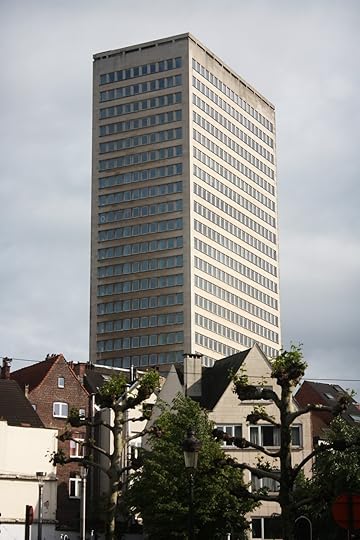
The main target is ‘Brusselisation’ (bruxellisation), a term applied, in Wikipedia's apposite citation, to ‘the indiscriminate and careless introduction of modern high-rise buildings into gentrified neighbourhoods’. It takes its name from the way Brussels bulldozed half of its historic heritage in the 1950s so they could ‘modernise’ ahead of Expo 58. Most notoriously, Viktor Horta's art-nouveau masterpiece the Maison du Peuple was replaced by a beige skyscraper.
Before
After
François Schuiten grew up in Brussels and his parents were both architects; in Brüsel the whole story is magnified and retold as it were through a fairground mirror. Brüsel, as the story begins, is a pretty town with crooked streets and a tram network, surmounted by the Palais des Trois Pouvoirs:
But ‘progress’ is in the air. The city authorities are in thrall to smarmy town planner Freddy de Vrouw, and city funds are drained and redirected into realising his futuristic vision of what a modern city should be like.
Scale model of the new Brüsel
Of course, things do not quite work out according to the blueprints. Running alongside this architectural satire is a general critique of misdirected ‘progress’ – one main character is a ‘plastic florist’ who makes synthetic flowers – and all of it is funneled into a Kafka-esque medical thriller too, involving an underwritten female lead who contrives to lose her clothes every time she trips over.
‘Nous avons tous été malades…’ one character says. ‘Oui, malades du progrès !’ comes the reply. One of Schuiten's most Schuitenesque albums, beautifully drawn, this is another solid entry to the series. This 2008 reissue includes an introductory essay about Brussels in which Benoît Peeters outlines some of the main points of Brusselisation, and explains the key transformations that served to turn Brussels into Brüsel.
بعد از ده سال همکاری، بالاخره تصویرگری همقد نویسندگی شد!
توی پنجمین همکاری پیترز و شوتین، بالاخره تصاویر کتاب نهتنها به متن رسیدن، بلکه در Brüsel حتی تونستن پیام و تم داستان رو قویتر کنن. پیترز اینجا یه مأموریت اصلی داره: خلق رقت احساس (Pathetic Fallacy)! به زبون سادهتر، کاری کرده که بروکسل، این شهر مریض و در حال فروپاشی، مثل یه انسان بیمار و اسیر تخت بیمارستانی به نظر بیاد که همین بیمارستان خودش حالش زاره و نیاز به درمان داره. بروکسل اینجا قربانی هم جاهطلبی سرمایهداریه، هم کُمرادهای کمونیستی، و پیترز طبق معمول یه راهکار داره: آنارشی!
Abeels و بیماری بروسلوز(؟) = یه استعارهی محشر! اینجا داستان با یه الگوری و یه پارالل تصویری-متنی غنیتر شده. بیماری Abeels به نوعی انعکاس وضعیت خود شهره، و این پیوند باعث میشه هم معنی سمبلها عمیقتر بشه، هم کشف و شهود خواننده بیشتر.
اگه با دنیای پیترز آشنا باشین، این فلسفهش براتون آشناست: یه عنصر آشوبگر همیشه لازمه تا آزادی و میانهروی، لاجرم اتفاق بیافته! همون چیزی که تو La route d'Armilia، La Tour و مخصوصاً Fever in Urbicand دیده بودیم. اینجا هم تینا همون عامل آشوبه. نقش دوگانش—هم توی سیستم بروکراتیک شهر، هم تو زندگی Abeels—تنها چیزی که شهر و شخصیت اصلی رو به رستگاری میرسونه. اون بهشتی که Abeels اول داستان با پلاستیک ساخته بود، در نهایت به شکل طبیعی و ارگانیکش براش محقق میشه.
شوتین اینجا سنگ تموم گذاشته! یکی از تفاوتهای مهم این جلد اینه که شوتین با پنل بندی هوشمندانه (دقت کنید به صفحه اول و آخر و تفاوت عرض و طول پنل ها در ایجاد خفقان و برعکسش)، با تدوین و کارگردانی تصاویر، دقیقاً همون احساسی رو خلق کرده که پیترز میخواسته. یه نمونه عالی کارگردانی و تدوین صفحات ۷۲ و ۷۳ هستن—حتماً یه نگاه بندازین! علاوه بر این، نقاشیها تو این جلد بهشدت غنیتر و پر از جزئیات شدن، که لذت بصری رو چند برابر کرده.
در کل: بعد از جلد اول، این یکی رُ از همه بیشتر دوست داشتم. دلیلشم واضحه: پیترز و شوتین بعد از هرجومرج La route d'Armilia، بالاخره یه تعادل ارگانیک و همکاری پویای عالی رُ پیدا کردن!
پی نوشت:
در راستای تم «قیمت پیشرفت یا the price of progress» اول ریویوی خودمو نوشتم و بعد از چت جی پی تی خواستم تا متن ریویوی منو یه جوری تغییر بده که استقبال بیشتری ازش بشه. حالا بیایید ببینیم نتیجه چی میشه؟ آشوب یا پیشرفت.
This is my third visit to Franco-Belgian creators Schuiten and Peeters's Cités obscures. The series of graphic novels is currently difficult or impossible to read completely in English, as it has passed between several different publishers, leaving many of the volumes out of print and prohibitively expensive. (Only my rather scattered academic employment and my urban living situation, which together give me access to three good library systems, has allowed me to get this far into the series!)
Brüsel is the volume that introduces both the character of Constant Abeels, a genial and quietly romantic florist, and the titular Brussels-like city, both of which will later feature in The Theory of the Grain of Sand, my favorite entry in the series so far. This volume is a fantastical polemic against the modernization of urban centers, an activity it depicts as driven by crass profiteers, on the one hand, and starry-eyed speculators who have lost touch with human needs, on the other.
As the old Brüsel is demolished and replaced with ultra-modern skyscrapers, the city begins to sink under the weight of this misguided utopia. Meanwhile, Constant hopes to join the modernization process by turning his business to the sale of plastic rather than organic flowers on the principle that the former will not decay and die. But, harassed by unreliable municipal services and suffering from a tuberculosis-like illness, he goes on the journey that structures the novel through the bureaucratic and medical apparatuses of both the old and new Brüsel.
Both versions of the city are shown to be flawed, particularly through the depiction of two hospitals: the lazar-house-like Catholic hospital run on medieval principles of bloodletting and its modernist replacement staffed by bickering and absent-minded "projectors" out of Swift's Lagado. The real principle of health, Schuiten and Peeters imply, is to be found in love and fellowship, embodied in Constant's amorous encounters with the Luddite-like rebel, Tina (a character admittedly undeveloped, except for her rather flippantly-portrayed porn-scenario sexuality).
Comics has a privileged relationship to the modern city: it is an art form whose modern development, whether in Europe, Asia, or North America, grew in tandem with the urban masses the first newspaper strips and comic books were made to entertain. That makes it a thematically rich topic for graphic novels to explore, and Schuiten and Peeters's ambivalence about urban development is ideal for the medium, whose own formal features often resemble architecture as much as any other form of art.
Artistically, Schuiten's detailed work here is superb, especially when he transitions to more vertical page layouts with the transformation of the city; likewise, the two authors' depiction of various social spaces is a droll use of near-fantasy or magical realism to revivify familiar urban experiences. But the characterization is very thin and the polemical point made a bit simplistically; the craft and artistry of the creators aside, I prefer the subtler mysteries of Samaris and The Theory of the Grain of Sand.
This is my third visit to the Obscure Cities, having thoroughly enjoyed my time in Samaris and Urbicande. Brüsel is in some respects very similar to the other Obscure Cities comics I’ve read, but in some ways markedly different.
Most notably, a lot of the basic premise and structure is very similar to that of La Fièvre d’Urbicande. The story follows an older male protagonist who plays a largely passive role, being swept along by events, generally powerless to affect them as they escalate wildly. Like the series’s other protagonists I’ve encountered so far, his thoughts and motivations are unclear, and he comes across as rather petty and pathetic. In some ways he’s a point-of-view character, an everyman struggling to make sense of events along with the reader, but in other ways he’s a negative, unsympathetic figure. Again just like in Urbicande, Brüsel also has an inscrutable female who seems to be a stronger character than the protagonist, but inexplicably throws herself at him.
Also like in La Fièvre d’Urbicande, architecture and urban planning are at the very centre of everything. In fact, Brüsel is first and foremost an indictment of the 19th- and 20th-century urban planning policies of real-world Brussels. That’s an admittedly pretty niche subject, but with their idiosyncratic approach, Schuiten and Peeters manage to make it a highly compelling one. Brüsel leans even more into the Kafkaesque aspects already present in Samaris and Urbicande, its characters at the mercy of an absurd bureaucracy that has no regard for individuals. In this way, it becomes a more universal story about government, capitalism, power, vision and progress – not just a parochial allegory for one city’s local politics.
The main way that Brüsel stands out compared to the other Obscure Cities comics I’ve read so far is that it’s much more straightforward. Its events are less fantastical, its plot’s less mysterious, and its overall purpose – critiquing Brussels’s urban planning – is much more patently manifest. This could be seen as an improvement – it’s certainly more readily comprehensible, and so less frustrating – but it also deprives the comic of a certain magic. Whereas Samaris and Urbicande feel like they operate on a more symbolic, almost poetic or dreamlike level, Brüsel seems to be propelled by an essentially rational internal logic. This isn’t a problem in itself, but it is a little problematic with regard to the protagonist’s love interest; without the veil of dream logic, the sudden, inexplicable romance feels kind of tacky and gratuitous.
However, there are ways in which I think Brüsel compares very favourably to the others I’ve read. Most noticeably, Schuiten is at the absolute top of his game with the artwork. The city of Brüsel is rendered stunningly, and every panel contains a remarkable amount of detail – all greatly enhanced by wonderful colouring. There’s still a certain stiffness to Schuiten’s drawings, but this actually suits the story, with its awkward characters and rigid bureaucracy. Another improvement is the storytelling: Samaris and Urbicande are sometimes bogged down by wordy narration, but Brüsel never suffers from this, as it has no narration boxes, and its dialogue feels more streamlined.
Overall, Brüsel isn’t my favourite from the series – I crave a bit more mystery – but it’s nonetheless an excellent comic, and it leaves me very motivated to keep reading more.
Indictment again the bruxellisation, more precisely of the vaulting of the Senne and façadisme.
Things I learned about Brussels: -the city was hit by a cholera epidemic in the 19th century - the facade of the Temple des Augistins, which stood on what is now Place de Brouckère, now adorns the l'église de la Trinité (rue Bailli, Ixelles) -The authors pretend that Poelaert had only designed a pillar and half a church, but that doesn't seem to be the case. - The authors have included a picture of an elephant said to be used for the construction of the North-South connection, but this seems to be a fabulation.
This instalment was followed by extracts of the movie Dossier B.
I liked this graphic novel evolving around humanity’s constant need to achieve more and achieve the ultimate goal of so-called efficency disguised as the greed for destruction in the name of progress.
Gorgeously imagined breakdown of a city as envisioned by two fans of architecture with a real bone to pick with self-enriching bureaucrats, delusional ideologues, and anybody who thinks ‘progress for progress sake’ is a good argument for anything.
The book even starts with a bit of interesting (if negatively opinionated) history on the town, several cool old photos of it, and a random drawing of a naked lady. Off to a bit of a rocky start, one might say.
The naked lady returns in time, with even more provocative panels accompanying, but luckily for us there's a bit more maturity at play here, even if it is the playfully satirical (and somewhat absurd) kind, that unfortunately still doesn't include more roles for women than a housekeeper, a nurse, and the manic pixie dream girl, falling for our dull, hapless, lifeless lead the first moment his words grace her ears, for who the hell knows what reason, if she didn't spell it out for us herself.
Rage against the machine! That is, taking the Kafkaesque inhumane bureaucracy for task for running a man ragged between its apathetic, solipsistic departments, each in charge of sending you to the next one, while higher powers decide what next to break and replace on their way to bankrupting the city. What is a man to do?
Well, scream at a manager and score with a hot activist who doesn't wear underwear and crashes trains for fun (though the first seems slander, as you can find out in time yourself, wink wink). Most of his time though is spent either coughing out his lungs in variously incompetent medical facilities, each a disconcerting horror story of fussy neglect and self-assured ignorance, or following men with large words and larger frames in variously imagined architectural achievements, each a mundane horror story of selfish visions and careless decisions.
The graphic novel is gorgeously drawn, these vivid towers of brutal empty architecture, merciless in their disdain for the living and a joy to follow under the artist's loving pen. And even while the loudest characters have only contempt for the natural world, the artist draws the snowed-in cityscapes and the windy autumn countrysides with such evocative beauty, I could almost feel them - and wish to do so for real.
Yes, while the lords and the deciders cry for a fully manufactured world, where plastic is love and beauty, anything old is only for the wastebin, electricity is health and vitality (when not frying one's mind), little sky can be seen amongst the army of skyscrapers, and nobody has any time for the actually living, it is clear that this is not where the sympathies of the artist & the writer lie, as the deciders are all sycophants, madmen, or exploiters; as their projects lay waste to the city and its people; as the land drowns, the buildings collapse, the humans wither, and nothing anywhere is built properly; as the city itself is poisoning its citizens, with the doctors only helping it along; and a pantiless, chaotic-good activist-in-love might be the only one who has it figured it out.
And yet, the book’s a somewhat complicated thing to judge. It often hits on a good point while also plundering through yet another dully imagined scene or a conversation where nobody sounds like an actual human being, least of all our mad activist lady (and the occasional determination to get more boobs in the book is just eyerollingly juvenile).
And yet, I have been in meetings with leaders who just don't get it, because they have an opinion and it doesn't matter how ill- or uninformed it may be, or stupidly self-serving - they have got the power and so everybody else is there to just suck up on their way to another meaningless project, that at best is just a waste of time, and at worst, well, you can imagine. One can't help but wonder how some of these people have indeed become leaders (and that was long before I started reading the news habitually); it’s moments like these that I can’t help but think that we do live in a stupid, stupid world, too often led by callous, self-serving, deceitful people whose position tells of no grand genius, but just some luck, some pluck, and the occasional inheritance; and that here too these two guys have a goddamn good point.
One can only wish that their glimmers of hope shine upon us as well.
"Brüsel", de Benoît Peeters y François Schuiten, es una obra destacada dentro de la serie Las Ciudades Oscuras. La trama se centra en la transformación de la ciudad de Brüsel, un reflejo ficticio de Bruselas, y aborda temas como la especulación inmobiliaria y la modernización desmedida. A través de la historia, los autores critican las políticas urbanísticas que priorizan el lucro sobre la preservación del patrimonio y la calidad de vida de los ciudadanos.
El arte de Schuiten en "Brüsel" es impresionante, con ilustraciones detalladas que capturan la esencia de una ciudad en constante cambio. Cada viñeta refleja la meticulosidad del autor, presentando arquitecturas que combinan elementos steampunk y modernistas. La narrativa de Peeters complementa perfectamente estas imágenes, ofreciendo una sátira sobre el progreso mal entendido y la burocracia ineficaz. Pero de nuevo, no he llegado a entrar en la historia, la verdad, un tanto absurda.
encore une couverture qui m'a tapé à l’œil dans la bibliothèque d'un ami de mon père. Esthétiquement au rendez-vous , c'est une histoire simple assez naïve voir insensée parfois mais qui s'explique par de larges possibilités d’interprétation. On y met en question le 20e siècle et le progrès plus précisément ;;.
This entire review has been hidden because of spoilers.
Прекрасни рисунки, но по-скоро посредствена история. Встъпителното есе, обаче, е великолепно - 'ядосано', добре описващо промяната в архитектурата и устройството на Брюксел от края на XIX през XX век.
Patriotische Brüseler gegen die Modernisierung der Architektur Die Stadt Brüsel hat genug von der Vergangenheit - die Zukunft, plastiziert und modernisiert, ruft! Raus mit den biologischen Pflanzen, her mit Kunststoffpalmen! Weg mit den alten Stuckgebäuden, setzt moderne, klare, funktionale Hochhäuser an ihren Platz! Der ehemalige Florist Abeels will mit diesen Gedanken mithalten. Doch je länger er sich in diesen neuen Häusern befindet und sich damit beschäftigt, umso kränker wird er, und alle um ihn herum scheinen sich plötzlich nur noch um sich selbst zu kümmern - bis er auf die dauersabotierende Tina trifft.
Über die Reihe der "cités obscures" kann man vieles sagen, aber eins nicht: Dass sie sich wiederholt. Praktisch jeder Band ist völlig anders zu dem davor, sowohl von Inhalt als auch von Zeichenstil. Ich hatte zu einem anderen Band geschrieben, dass es sich mehr um Gedankenexperimente als Unterhaltungsliteratur handelt, und das wird hier erneut deutlich.
Ist die Moderne ein Virus, der uns infiziert? Muss die Zukunft das alte immer auslöschen, damit sie blühen kann? Und was geschieht mit den Menschen in einer Stadt, die sich in einem rasenden Tempo zu einem nicht wiedererkennbaren Moloch entwickelt? Ist es da nicht Bürgerpflicht, sich zu wehren? Oder muss man akzeptieren, dass mit den alten Gebäuden auch die alten sozialen Strukturen verschwinden und durch modernisierte, anonyme Beziehungen ersetzt werden?
Leider setzt sich aber auch ein Kritikpunkt, den ich immer schon an dieser Reihe hatte, fort - es ist ein furchtbar kalter, rationaler Erzählstil und ein extrem statischer Zeichenstil. Passend zum Thema des Buchs: Eine Plastikpflanze in der Comicwelt. Eine funktionale Plastikpflanze, aber ihr fehlt eben der Saft, der sie zu einer schönen Pflanze machen würde.
I think I've lost the taste for these. The drawings are still beautiful, but I'm not all that interested in the "mystery" - pretty often no core and/or bureacracy.
The Obscure Cities is BD/Comics at its best. This deserves a place in every history, study on the subject, or even personal dive into the world of graphic novels.
I really liked the subtle link between progress in surgery and construction as if the city was a patient and as usual the great scenery and compositions
I have been fascinated recently to come across the work of some European graphic novelists that were completely unknown to me. Moebius is one that I have found fascinating, and this one also fits that category well. This is one of the Obscure Cities that was developed by Francois Schuiten and Bernard Peeters -- and note that I did not say that the book was developed by them. What they have done, with the help of many other people, is to develop a series of almost-but-not-quite real places that align to our own history/planet/whatever but aren't real. Brusel is one of those places, and this graphic novel is set within. A series of somewhat odd circumstances happen to the main character in this set of stories, and questions are raised about how we preserve history while we progress into the future, and how we may not agree on the best path forward, whether it is in developing technology or in medicine. It ain't the Brussels we know, folks, but that doesn't mean it isn't relevant!
It reminds me more than a bit of some of the French avant-garde writers from my college English courses, or of folks like Donald Barthelme. It is alternative history of a Gallic sort, coupled with extraordinarily detailed drawings of a world of an alternative time and place. I found it fascinating, but it may not be to everyone's taste.
For pages and pages more information about the Obscure Cities, don't miss the reference in the opening material to the website www.altaplana.be/start. Fascinating stuff and much, much more to explore if you like this kind of thing.
François Schuiten and Benoit Peeters dive back into their fantastical and inscrutable world of Les Cités obscures ("The Obscure Cities") with Brüsel, a alternative version of the real Brussels but under the filter of their keen design of retro-futurism. Schuiten and Peeters envision their world as perpetually trapped in the early 1900s when it comes to architecture and fashion, but technology progress towards unearthly designs. The backdrops of Brüsel feature a mixture of Art Nouveau, Art Deco and early Modernism, with language, clothing and attitudes feeling equally formal and antiquated. It's a wonderful mix of design choices that grant them such a unique flavor in the medium.
The story here, however, is one that I really couldn't get into. The plot centers around the idea that the old city of Brüsel is being destroyed by the advancements enforced by a wealthy businessman named Freddy de Vrouw. Constant Abeels owns a flower shop in one of the historic districts that stands in de Vrouw's way, putting our protagonist in the thick of it all. But Constant is a bit of a passive character, making his story rather uninteresting. His passivity allows him to simply be our eyes towards the larger goings on, but as he doesn't really do anything aside from exist, it's hard to really feel connected with the growing turmoil in Brüsel.
For me, this was the weakest entry in the series I've read yet, but nonetheless it's still enjoyable enough due to Schuiten's splendid realization of the city of Brüsel.
There is actually a comics shop in downtown Brussels named after this volume, and I had assumed for some reason that it was originally in Dutch and a standalone tale. In fact it was originally in French (but I read the Dutch translation) and it's the fifth (at least; counts vary) in a series of works with the overall title Les Cités Obscures, which sort-of translates to "The Obscure Cities", set in a succession of parallel conurbations which are closely related to those on our own world. There's no doubt whatsoever as to which city Brüsel refers to, particularly since my edition is prefaced with an angry and well-illustrated essay about how urban development has destroyed communities and heritage in the real Brussels.
It's a book of polemic rather than plot. Our hero, Constant Abeels, is a florist who has switched from real flowers to plastic ones. He gets drawn into the steampunkish world of the urban developers of Brüsel, led by the sinister Mr De Vrouw (whose name means Mr Woman); at the same time he is subjected to medical treatment for a condition similar to but not entirely like tuberculosis; and keeps encountering the enigmatic Tina Tonero, whose clothes have a tendency to fall off at strategic moments.
I found this sufficiently intriguing that I will try and find the rest of the series, starting from the beginning, in the original French.
Originally published in French, this is a continuation of the Cities of the Fantastic series. It deals with a man who is trying to stay afloat in a city which is undergoing a vast transformation from a 19th century style of living to a futuristic model. It deals with vast issues of old versus new culture and the growing pains necessary to accomplish this. Neither the old nor the new has much to offer the main character in the way of spiritual wealth and it ends on a very "return to nature" moment. Well done as always from these authors.
En este volumen Schuiten-Peeters construyen una fábula sobre la voracidad del progreso y el lado oscuro de la modernidad. Para ello recurren al paralelismo entre la salud y la enfermedad de los habitantes y de la propia ciudad. El tránsito personal de Constant Abeels en este volumen es menos anímico o espiritual que el de otros protagonistas de otras ciudades oscuras pero las ilustraciones de Schuiten siguen siendo igual de maravillosas. Brüsel funciona sin duda como un buen espejo deformado de la ciudad de Bruselas.
La ciudad de Brüsel, con referencias perfectamente reconocibles de su modelo Bruselas, está perfectamente dibujada; el arte del volumen es muy bueno. Sin embargo, la historia no llega a la misma altura. La idea está bien y hay partes muy buenas, como la operación y la obsesión por quitar "órganos innecesarios" en analogía con la reforma de la ciudad. Pero en general todo avanza un poco a trompicones, y el ¿romance? no tiene ni pies ni cabeza. El prólogo acerca de la bruselización de, valga la redundancia, Bruselas, puede ser bastante interesante para quien no conozca su historia.
Me compré este libro en Bruselas tras hacer un tour de cómic por la ciudad, el tour 100% recomendado. Después de ello estuve buscando un libro con acuarelas de la ciudad.
Hablando con uno en una tienda me recomendó este cómic, una Bruselas distópica que enseña partes de la ciudad. La verdad me moló el tener un souvenir formato cómic y lo pillé. Y al contrario que blacksad, este no me gustó en absoluto. Como dato curioso, solo aparece un personaje femenino, y cada vez que aparece acaba siempre desnuda.
L'urbanisation galopante et absurde de Brüsel, l'administration kafkaïenne, des savants loufoques, un promoteur véreux et une histoire d'amour totalement improbable...
L'ensemble donne une excellente BD, centrée sur la ville de Brüsel bien sûr.
La fin au cours de laquelle Tina et Constant sont bien sûr réunis, est assez poétique, une forme de poésie un peu onirique et un peu surréaliste qu'on retrouve dans plusieurs autres épisodes.
The problem here is the writing. I think that this whole book is merely an idea. There is no character building and the whole story is incredibly thin. From a graphic novel about architecture/urbanism, I would expect some amazing panels, but here they are far and in between. I do like the drawing style but I would even go as far as to say, that its conservatism hinders the story (however watered down that already is).
Encore un travail intéressant de Schuiten et Peeters. L'œuvre nous conduit à une Bruxelles malade. Les erreurs d'urbanisme et d'architecture de trois générations passées laissent des résultats terribles pour la qualité de vie des futurs habitants,ce livre est une excellente explication de ce qu'est la Bruxellisation.
Intéressant rappel des conséquences des grandes visions dans l'urbanisme ainsi que du rôle des politiciens et des promoteurs dans l'urbanisation de Bruxelles. Qu'est-ce que cela peut signifier d'être visionnaire opportuniste et irréfléchi.