Symmetry is one of the ideas by which man through the ages has tried to comprehend and create order, beauty, and perfection. Starting from the view that symmetry = harmony of proportions, this book gradually develops first the geometric concept of symmetry in its several forms as bilateral, translatory, rotational, ornamental, and crystallographic symmetry, and finally rises to the general abstract mathematical idea underlying all these special forms. This first paperback version of Hermann Weyl’s widely-read essay includes the beautiful illustrations of the cloth cover edition.
Hermann Klaus Hugo Weyl (9 November 1885 – 8 December 1955) was a German mathematician, theoretical physicist and philosopher. Although much of his working life was spent in Zürich, Switzerland and then Princeton, he is associated with the University of Göttingen tradition of mathematics, represented by David Hilbert and Hermann Minkowski. His research has had major significance for theoretical physics as well as purely mathematical disciplines including number theory. He was one of the most influential mathematicians of the twentieth century, and an important member of the Institute for Advanced Study during its early years.
Weyl published technical and some general works on space, time, matter, philosophy, logic, symmetry and the history of mathematics. He was one of the first to conceive of combining general relativity with the laws of electromagnetism. While no mathematician of his generation aspired to the 'universalism' of Henri Poincaré or Hilbert, Weyl came as close as anyone. Michael Atiyah, in particular, has commented that whenever he examined a mathematical topic, he found that Weyl had preceded him (The Mathematical Intelligencer (1984), vol.6 no.1).
- Now Hermann, have you quite finished preparing your lecture?
- I have, darling.
- You've practiced it?
- Three times, darling.
- I suppose it's about something terribly complicated that I won't understand.
- Not at all, darling! This one will be non-technical. I want to reach out to a broader audience for once.
- Really! And what is the title?
- It's very simple, darling. Symmetry.
- That's it, "Symmetry"?
- Just one word, darling.
- Are there pictures?
- I've even included a poem.
- Tell me.
- God, thou great symmetry Who put a biting lust in me From whence my sorrows spring For all the frittered days That I have spent in shapeless ways Give me one perfect thing.
- Oh, that's quite beautiful! And you said there were pictures too?
- Many.
- Would you show me some?
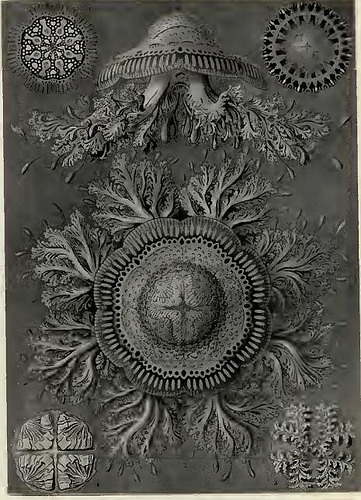
- Let me see. Here's an octagonally symmetric Discomedusa.
- How extraordinary!
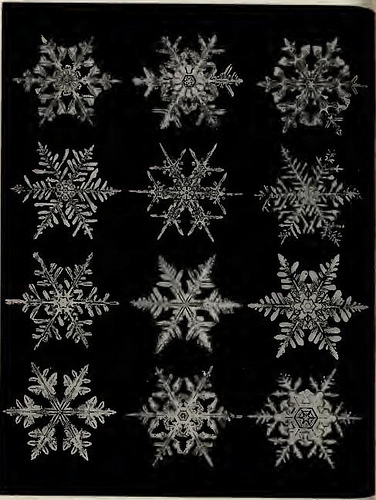
- And here are some snowflakes. I refer to that passage from Mann that you like so much, with the Hexagonale Unwesen.
- That was very clever of you.
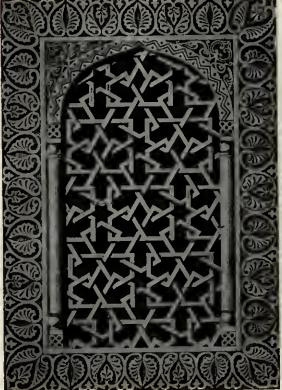
- And here's the mosque window we saw in Cairo. Another hexagonal symmetry, but a more complicated one.
- Goodness me. You know, I think I may come and listen to you. For once.
- I would be honoured, darling.
- You're quite sure it's non-technical?
- Well, almost.
- Almost. I smell a rat. Maybe you could elaborate?
- Ah... I do assume that people know the difference between affine, metric and projective geometry. That's reasonable, isn't it?
- Hermann...
- And some relativity. Everyone knows relativity these days, don't they? Oh yes, and Galois theory of course. I think that's everything. I'm keeping it really simple.
- Hermann, you know, I wouldn't love you so much if you didn't keep doing this sort of thing.
- I feel just the same way about you, darling.
- Is that a symmetry?
- I suppose you might say it was an example of D₂. The elementary group consisting of a reflection and the identity.
- Hermann, you do say the sweetest things sometimes. I will come. Even if it's just the slightest bit technical.
- You really will, darling?
- Hermann, I wouldn't miss it for worlds. I'm already thinking about what I'm going to wear.
This was probably one of the coolest books in the world when it was first published. There are now better books to learn about symmetry from, but these lectures are still somewhat interesting.
An intriguing lecture series. My knowledge of group theory is now rudimentary at best so the proofs and the demonstrations in lectures 3 and 4 got away from me, but it still adds up to a vivid demonstration of symmetry’s outsized significance in the sciences and arts.
Unfortunately, it did not meet my expectations, knowing who the author is. The Introduction is by far the deepest and thought-provoking part of the book, and to a lesser extent the Conclusion. The body of the book, however, is like a bag of curiosities, a walk through a museum of symmetries nature and art with appended mathematical translations. It supports some of the claims of the introduction at most only by the number of different examples. Again, only the Introduction is, as far as I am concerned, worth revisiting.
I just picked this up from my shelf now that I'm back at my parents' house. It is not my normal kind of book. I got it a while ago when I thought I wanted to be a physicist. Not particularly interesting in my opinion. I just dislike the confusion of mathematical concepts with their colloquial uses.
Let's start with a question. Who was Hermann Weyl?
Hermann Weyl was, if you're unfortunate enough to know him while studying math, a terrifying figure. Not that it mattered much in this book. Weyl who wrote "Symmetry" was Weyl the popularizer of math, while tying it to examples in world culture.
The book begins by explaining bilateral symmetry in ancient civilization. From Greek sculptures, to Sumerian and Medieval European art, Weyl tried to show how symmetry had been central in human life. It is good to see this, because, generally, mathematics are considered abstract and far-removed from cultural life. This is a big theme of this book: how humans are so fond of symmetry, and how it reflects in our art from time to time.
Some of the time, he took digression about symmetry in biological world (talk about cell division). Like with cultural items above, this is also recurring theme in the book: symmetry happens everywhere, so let's appreciate it.
Well, guess what happens next: the book becomes full of picture, very fancy ones at that, depicting walls, reliefs, pillars, anything from all over the place that shows symmetry. Not that it's bad -- it's actually edifying -- but after some time, you wonder if Weyl was writing book instead of spamming pretty images.
To his credit, though, he did explain what kind of symmetry is where, as exampled by what, along with (relatively!) easy-to-understand explanation of the math.
But I hasten to add: readers would be served things like vectors, matrices, and groups. Now I'm not psychic, but I think Weyl forgot that he was writing for the public, instead of STEM college students...
Excellent Expository and Mathematical Survey of Symmetry from Notion to Reality to Concept. He brings a grand tour of the Mathematical History and Application of Symmetry in and of life.
Too good to understand without having had a more thorough look into mathematics and/or geometry beforehand. The ease how Weyl opens up and intertwines the wide range of disciplines touched in this series of lectures is an enjoyable sight.
Un classique! La plus convaincante argumentation en faveur de l'identification du concept de symétrie à celui de groupe d'automorphismes. Je demeure sceptique sur ce point, mais j'admire le travail.
This is a short but very dense fix-up of four lectures given by Weyl on the eve of his departure from the Institute for Advanced Study at Princeton, wherein he builds motivation for the mathematics of symmetry out of real-world examples: art, biology, crystals, atoms, and spacetime. And it's meaty stuff: the difficulty spikes sharply towards the end of lecture 2, and anyone without a broad undergraduate level understanding of math and science might feel left behind.
Part of that is a modern trend away from focusing so severely on Euclidean geometry (as in, straight from Euclid) in primary education. Another part is a rather different mathematical vocabulary that modern (high level) mathematics has simply left behind: as just one example, Weyl calls a 2-d matrix (a, b; c, d) of numbers "unimodular" whenever the "modul" ad-bc is 1 or -1. Modern mathematicians still use the term "unimodular," but ad-bc is the "determinant" of the matrix. Thank or blame the Bourbaki group for the vocabulary changes, probably.
Nevertheless, there are lots of provocative ideas in these lectures, and several important works named as avenues for further reading. Weyl's comment that Galois theory is the relativity theory for a finite set of numbers blew me away, for example... but mathematical maturity is required!
Compared to another book in the "Princeton Science Library" series - WHY BIG FIERCE ANIMALS ARE RARE, by Paul Colinveaux - SYMMETRY doesn't quite hit the "general reader" sweet spot, and so merits 3½ out of 5 stars, rounded down. If you do pick it up, expect to need to read it more than once.
Publicado en 1952, estamos ante un libro que segue perfectamente vixente hoxe en día, no cal Hermann Weyl presenta a simetría coma un tema vasto e relevante na arte, a natureza e a física. Entre as súas pretensión atopamos a de ofrecer un exemplo que mostre o funcionamento do intelecto matemático e a de dar unha indicación das múltiples ramificacións da simetría, dende os conceptos máis intuitivos ata as ideas máis abstractas.
No limiar o autor cita un dobre obxectivo: por un lado mostrar a gran variedade de aplicacións da simetría na arte e a natureza, e por outro esclarecer a relevancia filosófico-matemática da idea de simetría. E aínda que afirma tamén que pretendeu escribir un libro para non especialistas, creo que é necesario afirmar que hai unhas cantas pasaxes certamente técnicas, que fan deste un libro pouco recomendable para aqueles que non dispoñan dunha certa base matemática. Trátase dun libro curto pero denso. En concreto, utiliza bastante nocións de teoría de grupos para analizar varios tipos de simetría.
Weyl demostra un amplo coñecemento doutras materias ademais da súa propia, con bastantes exemplos da bioloxía ou as artes, así como numerosas citas literarias. Todo isto dálle moito empaque á obra, conseguindo por momentos un híbrido ben interesante, que logo queda algo difuminado cando esquece a súa pretensión inicial de ser un libro para non especialistas.
Por último, e concernente á edición portuguesa de Gradiva, botei en falta unha maior resolución nas imaxes que acompañan o texto, hai un bo feixe delas e nunhas cantas resulta bastante difícil observar o comentado polo autor debido á baixa calidade desas imaxes.
Hermann Weyl takes a conversational approach to the history, application, and mathematical language of symmetry. The first two sections are remarkably accessible and bring in interesting examples from art, biology, and physics. The book develops the necessary mathematics, elements of the theory of finite groups, lucidly. I would be very interested in reading this book again after I have gained more algebraic knowledge.
A useful introduction to the topic, but Weyl does not indicate anything terribly new (to people even marginally familiar with group theory like I am). Perhaps where the book shines is in its ability to connect disparate domains into a cohesive unit, and to serve as an invitation.
It is also interesting to see the other Weyl, the structuralist-Platonist musing over symmetry while still being drawn to those philosophical undercurrents that makes the intuitionist Weyl.
A collection of 4 lectures given by Hermann at Princeton in 1951 that focus on symmetry. Both rom a physical understanding; art, patterns, designs, and from a mathematical treatment at medium-advanced levels. Covers symmetry in a 2-dimensional plane, and in 3 dimensions, mostly as illustrated by crystals. Was a pretty quick read if you don't dive into fully understanding all the math. A rewarding look at this topic even if you don't.
An exploration of symmetry (bilateral, translatory, rotational, ornamental, and crystallographic) beyond mathematics and throughout nature, science, and it's application in art and design...
Jumping from the symmetry group of the 3D lattice in one sentence to Hans Castorp contemplating snow flakes in the next was always going to get me going.
Before the substantial and then formal distinction between the "two cultures", there abunded pamphlets that could seamlessly merge humanities and science. Such hybrids, as we could rather inappropriately call them today, are still produced, if in lesser quantity, and strand those perceivedly opposite loci of culture. This quick book is a conspicuous example. In this gentle, fascinating and smooth essay, that recollects and expands some lectures delivered by the author, Weyl famously brings the reader at the root of the concept of symmetry through a safe and illustrative journey that involves graphical art and arrives at mathematics passing through physics, etimology (the double meaning of right), aesthetics (symmetry as balance in Greece), history and some philosophy. Nice to find the author himself amused at the fact that ancient Sumerians and Egyptians already intuited many truths through the practical developments of ornaments some millennia before the notion of group of automorphisms could be delineated. Symmetry break-up in biology and organic chemistry, and the role of symmetry at the core of relativity and quantum theory are also mentioned, and short appendices provide some technical details of demonstrations.
A clearly written and interesting introduction to the mathematical notion of symmetry, starting with concrete examples of symmetric works of art throughout history, then analyzing several particular symmetry types using the notion of a symmetry group, and finishing with a fully abstract discussion of symmetry, groups, and their more general role in mathematics. The language is a bit dated at times and the technical difficulty is uneven; that said, my understanding of the mathematical meaning of symmetry, and of group theory as a general mathematical tool, has been greatly clarified by the book, and it only took about a week to read—so it's got my vote.
Mr Weyl gallops through the world of biology, art and mathematical physics, using symmetry as the origin. A beautiful text, to read with a book on abstract algebra real close if one is not already an algebraist.