April 23
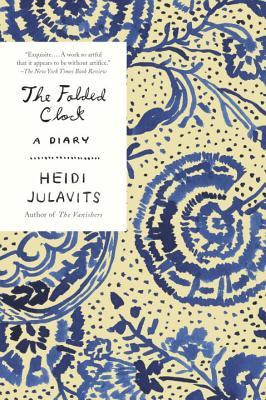
Today I finished Heidi Julavits' The Folded Clock and resumed a book I'd barely started, Eckhart Tolle's A New Earth. It's interesting how the disparate books you happen to be reading at or near the same time interact with each other in your brain and complement the experience of reading the other—even for someone like me, whose book choices have followed no singular logic, pulled in many directions.
I am working for a few more months at a bookstore before I start a Ph.D. program in English literature in the fall. This situation places a number of competing demands on my reading time. On one hand, these months before my program begins will likely be the last period of my life for a long time when I will be able to read what I want, rather than what's assigned or what a project demands, so I'd better try to read what I've been meaning to read forever as a prerequisite for considering myself a fully literature human, e.g. Don Quixote. (Interestingly, when a professor at my program advised that I take just this approach to my last months of freedom, she invoked Don Quixote as her example: "If you've always been meaning to read Don Quixote, read it now." I took this as a sign of how deeply simpatico we were, since Don Quixote really was at the top of that particular mental reading list for me. I still have not started Don Quixote.)
On another hand (this particular beast has more than two), the last few months at my bookstore represent a very cool and rapidly vanishing opportunity to review books on our store blog. Since my fantasy is to one day be important enough in the literary world to be paid to share my opinion about a book at some length, I feel the need to take advantage of this fleeting chance to publish reviews in a forum where they will actually be seen (not to mention the remuneration in $10 gift cards!). Of course, this means reading a very different type of book than Don Quixote: the not-yet-released and the newly released, e.g. The Folded Clock. These time-untested books pose a high risk that I will either have no respect for them and thus be unable to recommend them to the world, or that I will like them fine but not really have anything to say about them. Which defeats the goal with which I picked them up in the first place.
Finally, we have the shoring-up-of-perceived-reading-weaknesses-before-graduate-school category of book choice. One of these weaknesses for me is contemporary fiction, so that does overlap with my last category, but my biggest is critical theory/criticism. Needless to say, the marketing director of my popular independent bookstore will probably not be excited to publish my review of Of Grammatology, however enthusiastic.
Between these demands, my reading this year has been all over the map. A New Earth was actually the recommendation of a friend to whom I'd complained of certain negative emotions I couldn't seem to break free from, jealousy, resentment and the like. And of course this has nothing whatever to do with The Folded Clock, which I picked up because Heidi Julavits was coming to our store.
Until it did.
It should go without saying that I think highly of this friend. I am not (in my mind) the kind of person who reads A New Earth (although I am, in reality, reading A New Earth). I approach figures like Eckhart Tolle with the (un?)healthy skepticism of the snob. I don't like gurus. I don't like populizers. I don't like modern western interpreters (skewers) of ancient eastern ideas. (That is to say, I don't like them for myself; I have little doubt that people like Tolle have a more benificent influence on society than, say, Snookie or whoever. I just don't personally have a use for these people; I can read the original Buddhist thinkers for myself, thank you. I don't need Tolle to introduce me to a philosopher "whose name was Jean Paul Sartre." Fuck, I wish I were reading Sartre.)
But I do really love Pema Chodron's When Things Fall Apart (also pushed on me by a friend), so I need to give this Eckhart Tolle character a fair shake, despite the fact that I have heard of him. And, though I'm only 65 pages in right now, he seems like potentially necessary post-Folded Clock therapy. For the twentysomething who aspires to literary-somethingness and feels secretly convinced she will die alone, A New Earth and similar might be a fitting antidote for dangerous levels of exposure to the lifestyle and accomplishments of Heidi Julavits.
I know the barest of facts about Heidi Julavits, but what I know is enough. She is married to the writer Ben Marcus, with whom she co-founded The Believer (an anthology of which I am hip enough to own, though nowhere near hip enough to ever actually read, since it was published in a period after the 1790s). They are happily married and she thinks they will remain married. She is a highly respected novelist and writing teacher. She is pretty. Her first novel won an advance of $500,000, a sum I can't wrap my brain around. She and her family travel to places like Italy and Germany. When she was precisely my age (lest I comfort myself that these are the inevitable luxuries of the hardworking literary fortysomething), she went to Morocco.
I, who consider myself a not very materialistic person, have spent the last few months obsessing and agonizing and doing crazy uncharacteristic things for money so that I can afford to travel and see something of Europe before I buckle down for graduate school. I have been to three European countries—three more than my own father—but it's not enough. I want more. I am a bottomless wanting pit, a machine of endless desire. Heidi Julavits is the embodiment of my desires for myself, of what I want to be. She is a social butterfly; she throws dinner parties. If she were a lowly bookseller working in a bookstore at a special event where she happened to be speaking in promotion of The Folded Clock, she would probably be able to get up the nerve to talk to herself. (Then again, maybe not. Her diary recalls the days when she waited at Joan Didion's table and never told her that she could quote passages from her work.)
I still do not have the money to travel to Europe.
In the New York Times review of The Folded Clock, reviewer Eula Bliss notes Julavits' "rich life" but attests that she was spared "the discomfort of envying Julavits" by "becoming her" over the course of reading the diary. Eula Bliss must have recently read A New Earth (and be a far more skilled cultivator of the awareness that kills ego). I envy the hell out of Julavits' rich life. At the same time I am aware that I have not been alive as long as she has and there is still time to acquire or fail to acquire the things I want, and so I am terrified of not acquiring them. Wouldn't it be better to be completely unattached, to disassociate from such desires? Where can striving to be loved or fuckable or a great writer possibly lead us when we're all destined to age and die? Do I want to have ambitions and strive for them, or do I want to be spiritually awake and not identify with my lifestyle or my accomplishments? Probably this is a false dichotomy. I'm only 65 pages in.
Unlike Eula Bliss, I do not include making me become Heidi Julavits among Heidi Julavits' accomplishments in The Folded Clock. There are, however, many accomplishments. Like all diaries, this one is hopelessly self-involved, but she manages to be entertaining even to people who are demonstrably not Heidi Julavits. I occasionally laugh at her jokes; I am never not interested in her stories or her confessions. In her endless quest to pin down what exactly is this elusive, constructed identity of Heidi Julavits, even though it is not my quest because mine is a different identity. As for us all, her self-awareness is necessarily limited by her inability to escape her own perspective. How she believes she is universally perceived by the world and how I and a few other strangers-to-her perceived her when she came to our bookstore do not always line up. This is interesting to me, but does not necessarily speak to her powers as a writer.
In her reading at our store, she spoke of her diary as being a very different kind of writing exercise than her novels because she would begin each entry with "Today I..." and simply see where it would take her. She had no idea where she would be going beforehand, but when it worked, she knew she had gotten there. There was very little editing or rewriting; it was hit or miss reflection, with a starting point of that day and an ending point of anywhere. This seems like a good writing exercise for an aspiring twentysomething literarysomething, or anyone who is self-absorbed, which is to say anyone.