Jump to ratings and reviews
Rate this book

El comensal

Rate this book
La muerte es un acontecimiento de primer orden. Cuando la parca se lleva a un ser querido heredamos lo que quedó sin resolver, y el dolor, o la liberación, que acarrea el deceso se extiende en el tiempo hasta que el vivo asume no sólo la desaparición del otro, sino también parte de la suya propia en la medida en que estamos hechos de retazos de los demás.

En esta novela autobiográfica Gabriela Ybarra trata de comprender su relación con la muerte y la familia a través del análisis de dos sucesos: el asesinato de su abuelo en 1977 a manos de ETA y el fallecimiento de su madre en 2011 por un cáncer. Así, la primera parte de El comensal es una reconstrucción libre (por tanto, no esconde la parte de ficción de toda memoria) del secuestro y posterior asesinato del empresario español Javier de Ybarra, quien también fue alcalde de Bilbao y presidente de la Diputación de Vizcaya durante el régimen franquista. Aunque esta muerte ha sacudido a todo el clan familiar (los padres de la protagonista tienen que abandonar el País Vasco y convivir con un escolta), no es hasta que la madre de la narradora enferma fatalmente que los duelos no hechos y las herencias políticas no asumidas (a veces por ignorancia) estallan.

El comensal es una novela importante por dos cosas: la narración de un conflicto histórico desde un lugar personal procurando la huida del victimismo y el reconocimiento de la importancia que tiene el hacer visible la muerte para asumirla. Acostumbrados como estamos a que los procesos de deterioro y fin de la vida se escondan, la novela sorprenderá por lo que tiene de reconciliación con la enfermedad, que aquí es relatada con luminosidad y sin puritanismo ni autocompasión.

176 pages, Paperback

First published September 3, 2015

40 people are currently reading
1502 people want to read

About the author

Gabriela Ybarra

4 books40 followers
Gabriela Ybarra (1983) lives in Madrid. "El comensal" is her first novel.

Ratings & Reviews

What do you think?
Rate this book

Friends & Following

Create a free account to discover what your friends think of this book!

Community Reviews

5 stars
169 (14%)
4 stars
346 (30%)
3 stars
451 (39%)
2 stars
124 (10%)
1 star
49 (4%)
Displaying 1 - 30 of 174 reviews
Profile Image for Kalliope.
738 reviews22 followers
January 13, 2022


This was recommended to me in a local bookshop as a curious work. I had no idea that it had been nominated for the 2018 Man Booker International Prize, and I suspect that it offers a very different experience to an international readership than it does to a Spaniard.

This is not a novel, but an exploration of two deaths in Gabriela Ybarra’s family: the grandfather, Javier Ybarra, who was assassinated by the Basque terrorist group ETA in 1977 (just a few days before the first elections held in the new democratic Spain), and the other of her mother, at a relatively young age due to cancer.

For me the first part – about a third of the book – was the most interesting part. The Ybarra family is highly prominent in Spain although Gabriela’s branch is not as affluent as the one associated with one of the top local banks. Her account is very detached and is more a product of her research on the assassination conducted as an adult than of her own memories or those of her father, who lived through the kidnap and the killing. Although the report will feel very close to a Spanish reader, it however remains frustratingly sketchy.

In her account she mentions that her father, a businessman, was writing a book too. At one point, Gabriela asked him a detail regarding the assassination, to include it in her book, to which he replied: “That is my territory”.

Googling I found a much more interesting account of the day of the kidnapping. It is a chapter out of the book written by her father. The book is this one: Nosotros, Los Ybarra


The second section of Gabriela’s is expectedly more personal and twice as long. One suspects that writing about her beloved mother was Gabriela’s way of dealing with her sorrow. And yet this account remains detached too. Her writing is frank and candid, zeroing in on all the circumstantial details to a great degree, possibly with the aim to create a feeling of immediacy, but she overdoes it. At times the accumulation of inconsequential minutiae detracts from the pathos of her loss, and the reader could ask herself what was the point of sharing this personal tragedy.
Profile Image for Carolyn.
2,749 reviews748 followers
April 2, 2019
Gabriela Ybarra was born into one of the most prominent Basque political families. Her grandfather Javier fought for the Spanish Nationaists in the civil war and was mayor in the 1960s. In 1977 he was kidnapped by the Basque separatist group ETA from his home and assassinated when his family couldn't come up with the ridiculously high ransom demanded. The family continued to have threats made against them for the next thirty years with a bomb once sent to her father in 2002, who had to have a bodyguard continually by his side.

When her mother died of cancer in 2011, Gabriela found she could see little of her mother in the newspaper obituaries and decided to research and write about her grandfather's kidnapping and death, resulting in this account of both her grandfather's and mother's deaths. In some ways this juxtaposition makes for a strange little book but it somehow works. Gabriela cared for her mother while she underwent cancer treatment in New York and while the account is intimate and loving, it is not overly sentimental. She speaks directly to us as she revisits the places her mother went in New York. The translation from Spanish by Natasha Wimmer appears to have been well done with the language flowing simply and elegantly. 3.5★
Profile Image for Paul Fulcher.
Author 2 books1,956 followers
March 13, 2018
My mother’s death brought back my grandfather’s death. Before it, the killing was just a pair of handcuffs in a glass case next to the bronze llamas that my parents had brought back from Peru. The tedium of illness recalled the tedium of the wait during the kidnapping. My father began to talk about blood-stained rosaries. It would be months yet before I could understand his pain.
To have a grave in the forest would be lovely. Perhaps I should hear the birds singing and the rustling above me. I would like such a thing as that.
Robert Walser, The Walk
Book 6/13 from the Man Booker International and, given the high standard this year, not one I expect to be close to my shortlist.

Ultimately this sort of book – a semi-fictional tribute to the author’s family members – is just not too my taste. I had a similarly adverse reaction 2 years ago to the MBI longlisted War and Turpentine (my review), where my review conclude: “family biography tends to be of disproportionate interest to those in the family”, and I had the same sentiments here. Also the book is frustratingly brief and many of the more promising threads simply aren’t pursued.

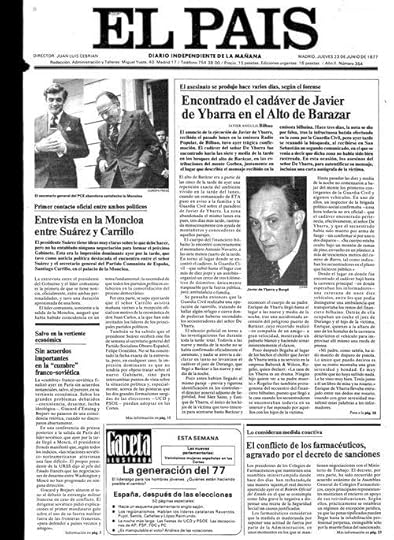
On 20th May 1977, only 4 days after the first democratic election in Spain for over 40 years, the Basque politician (from a Spanish royalist party) Javier Ybarra was kidnapped from his family home, by a group of Basque Separatists, a splinter group of ETA, and, after negotiations had failed, was, one month later, executed. His body was discovered on 23 June, as per this El Pais front page:

description

The Dinner Guests is by his grand-daughter, Gabriela Ybarra and retells, in a lightly fictionalised format (‘free reconstruction’) the story of two deaths in her family: the very public death of her grandfather, before she was born and played out daily in the media; and the private death of her mother from cancer, with which she was intimately involved. As she explains:

This novel is a free reconstruction of the story of my family, especially the first part, which takes place in the Basque Country in the spring of 1977, six years before I was born. During the months of May and June of that year, my father’s father – my grandfather Javier – was kidnapped and killed. I heard the story for the first time when I was eight.
[…]
What I describe in the following pages isn’t an exact reconstruction of my grandfather’s kidnapping or of what really happened to my family before, during and after my mother’s illness: the names of some characters have been changed and some passages are inventions based on stories. Often, imagining has been the only way I’ve had to try to understand.


The novel opens with a rather restrained and factual reconstruction of the events of her grandfather’s kidnapping seen from the perspective of the family. The dignity of those involved – even it has to be said the kidnappers at the time her grandfather was taken – is the most striking aspect:

The sawn-off handcuffs were sitting on the chest of drawers in the hall. Next to them were four lengths of rope, and the scraps of cotton with which the kidnappers had wrapped the women’s wrists so as not to hurt them. The strips of tape for their mouths and the cloths used to cover their faces were in the bin in the kitchen. None of the siblings wanted to sleep alone in their rooms. They chose to lie down together, sprawled on the sofa.

This account largely draws on public sources, although Ybarra does take the opportunity to correct a few myths:

It isn’t true that my grandfather asked the kidnappers to kill him on the spot. What my grandfather said was: ‘The worst you can do is shoot me.’ It isn’t true that my father’s youngest sister escaped the kidnappers by hiding in a wardrobe. She was bound to the bed frame, like everyone else. Nor is it true that my father and his siblings began negotiations with the kidnappers that very Friday, 20 May.

The account of her mother’s death from cancer is far more intimate, and painful to read, but, at the risk of being brutal, has been done before. Pre John Diamond and others this would have been shocking and informative but now, however cathartic it undoubtedly was to write, doesn’t really add to the canon. And as she admits, she isn’t really able to convey on paper her feelings about her mother:

My mother wasn’t three paragraphs long, or six. My mother was warmth and presence. Goodness and light.

Potentially the strongest part of the novel should be the glue holding the two parts together – the author’s father, involved (unlike the author) with both deaths. The author grew up with the story of her grandfather’s death as almost a fairytale like any other:

The stories about ‘La ETA’ and my grandfather’s killing were mixed with others that my father told me about Pompeii, Degas’s ballerinas, Darío’s ‘The princess is sad’ poem, and Max Ernst’s bird men.

But she tells us – see the opening quote – that when her mother fell ill her father opened up more about the events of 1977. At times we get a glimpse into his emotions – notably at her mother’s burial when her father encourages her, as he did with his father, to look at the body:

‘I saw it,’ he said. At the time I didn’t pay much attention, but now I think I understand how important it was for him to see his dead father. It helped him to stay sane. To acknowledge that what had happened was real. My father wanted me to see my mother so that I could handle her death better. I didn’t want to. I don’t regret it now, because the last time I saw her, she had already stopped existing.

But – and perhaps this is where reality gets in the way of a good story – her father remains rather emotionally distant to her, and hence to us so we don’t really get any sense of his feelings:

My mother was a feather. My father is a concrete block that wishes it was a feather.

Her father was also a politician and under threat from the terrorists, and her (too-brief) account of growing up in the 1980s against the background of the ETA campaign – when car bombs and assassinations became almost routine – has strong echoes of the also-MBI longlisted Frankenstein in Baghdad: but the latter is a far stronger book.

During the roughest years at the beginning of the eighties – the so-called años de plomo, or Years of Lead – the neighbours pretended that nothing was happening: they played tennis, had cocktails, went out sailing and visited the open-air restaurants of Berango. The tension was under wraps. A car in flames, a dead body, and a few hours later everything seemed to return to normal.

Natasha Wimmer is one of our finest translators – her version of 2666 one of the great pieces of 21st Century translation – but here she can only work with what she has been given, and the prose only occasionally soars, most noticeably when the author invokes Robert Walser, or with the arresting image that opens the book, but which, rather typically for the book, is never really developed:

The story goes that in my family there’s an extra dinner guest at every meal. He’s invisible, but always there. He has a plate, glass, knife and fork. Every so often he appears, casts his shadow over the table, and erases one of those present.

The first to vanish was my grandfather.


The book does end though on a neat moment of resolution of sorts:

A month and a half after my mother died, on 20 October, 2011, ETA announced a final halt to armed conflict.
Profile Image for Paula Mota.
1,665 reviews563 followers
Read
May 4, 2020
DNF
No espaço de um mês é o segundo livro de um autor basco que leio e que me desilude. Pegam no tema riquíssimo que é a ETA e usam-no para expiar os seus demónios no tom mais terra-a-terra possível. A Gabriela Ybarra interessa mais escrever as memórias da sua família, centradas sobretudo na morte da mãe com cancro, e faz do avô, raptado e assassinado pela ETA, quase uma nota de rodapé.
Profile Image for Libros Prestados.
472 reviews1,045 followers
March 30, 2016
He dudado muchísimo en cómo puntuar este libro, y de alguna manera me fastidia no ponerle cuatro estrellas, pero hay cosas que me han descolocado un poco.

En primer lugar, no me importa que un libro lleve fotografías, sobre todo si se trata, en esencia, de un libro de no ficción. Pero mientras una fotografía de periódico del padre de la autora al quitarle las esposas que usaron los secuestradores puede ser pertinente, lo son menos la fotografía del cadaver de Robert Walser, o los resultados en google image de una palabra. Sé que es un mecanismo utilizado en literatura actual, pero no llega a convencerme.

Aunque lo que verdaderamente me chirría (más por no verlo que por otra cosa, creo) es que este libro habla de dos historias diferentes (el secuestro por ETA del abuelo de la autora y la muerte por cáncer de su madre) que se supone que están unidas porque un hecho provocó el recuerdo del otro, pero yo no lo siento. Para mí es como si esta novela fueran dos trenes que van por vías distintas, sin llegar a unirse. Hay un momento en el que ambos se cruzan e incluso los pasajeros se saludan con la mano (cuando cuenta que el entierro de su madre fue público por ser de la familia que era), pero es sólo un momento. He sentido este libro deslavazado. Son partes que no acaban de encajar, aunque la autora me "diga" que ambas están unidas.

Y lo peor es que las dos historias son muy interesantes. Sí, el relato de cómo un ser querido muere por una enfermedad y el efecto que tiene en el narrador es algo que hemos visto miles de veces, y sin embargo, en este caso no llega a ser manido o artificioso. Cierto, no es excelso, pero logra implicar al lector. Aunque, siendo sincera, me ha interesado mucho más la historia sobre el secuestro de su abuelo, y más que eso, los recuerdos que se pueden tener del mismo en su familia y su propia experiencia con la amenaza terrorista, ya que su familia tuvo que marchar a Madrid para huir de ella. Lo más interesante del relato que hace la autora es precisamente la incertidumbre, el mezclar realidad y ficción, el no saber exactamente qué es verdad, cuáles son producto de la imaginación de la escritora y cuáles son hechos que le han contado, que pueden ser ciertos o no.

Que no se me entienda mal, es un buen libro y me ha gustado, pero me han parecido dos historias separadas y pegadas en el mismo libro. Lo cual me pareció sorprendente, porque ambas son verídicas y afectaron a la autora de manera diferente.
Profile Image for Neil.
1,007 reviews758 followers
April 7, 2018
This is a very short book that I really enjoyed reading. On reflection, after finishing it, it does feel as though large parts of it are missing and it would have been better if it were longer and some of the threads of story that are introduced and then ignored had instead been developed. It is a book of two parts. In the first, the author gives us a "free reconstruction" (i.e. based on fact but with things added) of the kidnapping and eventual murder of her grandfather. This was a real event which took place in 1977, 6 years before the author was born. As Ybarra was not alive at the time, her account of her grandfather’s death is based on her research. She presents us with a story that includes articles from the Spanish press as well as glimpses into the private life of the family. This part of the book is a real mixture of reporting and emotional insight and it works well, although it is over almost as soon as it has begun.

The second part of the book is much longer and is a much more intimate story about the death of the author’s mother from cancer.

"My mother’s death brought back my grandfather’s death. Before it, the killing was just a pair of handcuffs in a glass case next to the bronze llamas that my parents had brought back from Peru. The tedium of illness recalled the tedium of the wait during the kidnapping."

This second section interleaves the story of the author’s mother’s cancer with a visit the author makes a year later to the hospital and to other places her mother had wanted to see when she was alive. Here, it really does feel like the author has deliberately set out on a journey to honour her mother, almost a pilgrimage. The first section has a similar feel to it, but without the physical movement: it still feels like a pilgrimage to honour her grandfather, but based on research rather than action.

The prose throughout is very simple but, for me, that makes it all the more effective. It feels personal and intimate throughout and I think this is helped by the fact that it was written in a very immediate fashion: again and again we read that Ybarra is sitting on a train or in a waiting room and is taking notes that then make their way into the story. This makes it feel like we are reading something very direct.

It would be disingenuous of me to not say something about the book I started reading prior to this one but of which I only read half before giving up. Both books are translated from Spanish into English. The other book I am talking about is The Impostor by Javier Cercas, So why did I give up on one but read the other in a single enjoyable sitting? I am not an expert on translation, so what follows is purely an impression and not an educated critique. However, it does feel to me, after a brief bit of internet research, that the difference might be at least partly down to translation. Somewhere on the internet, I read that Spanish naturally consists of long sentences that, if translated as such directly into English, become "ungainly". And this was my main issue with The Impostor: once I had noticed the plethora of colons and semicolons (many of which were used in ways that break the "rules" of English punctuation), I could not un-notice them and it became impossible for me to concentrate on the story. This wasn’t helped by the fact that the story itself was written in a way that held the reader at a distance from the protagonists. Here, in The Dinner Guest, the translation reads far more naturally for an English reader and the emotion in the book allows the reader to engage with the characters in a way that I did not find possible with The Impostor.

Overall, I found this to be a simple but emotional book. Maybe it could be said that it covers topics others have covered before, but I think that Ybarra’s mother and grandfather would be proud of what she has done. 3.5 stars, but I have rounded it down because the book teases us with so many possibilities that are not explored, so it ultimately feels a little frustrating.
Profile Image for Federico Sosa Machó.
449 reviews132 followers
March 31, 2018
Dos historias aparentemente independientes dan forma a esta breve novela, nominada al Man Booker 2018: la del asesinato del abuelo de la narradora por parte de la ETA, y la de la enfermedad y muerte de su madre víctima de un fulminante cáncer. El nudo que las enlaza es la consciencia y asunción de la muerte como instancia decisiva, que conmueve la vida hasta reformularla en diferentes sentidos. Ha sido Martín Heidegger quien ha insistido en que la clave de lo humano es la de constituirnos en seres para-la-muerte. Esa irremediable verdad la ocultamos refugiándonos en la cotidianeidad protectora que tranquiliza y calma la angustia. En esta novela ese velo protector se descorre y vemos a la enfermedad y a la muerte de forma directa, y es a partir de esa visión descarnada que se resignifica la historia familiar y los vínculos que ella genera. La novela presenta un lenguaje claro y muchas veces conciso, que permite que sea la propia historia contada la que ocupe el primer plano. En síntesis, por momentos dura aunque sin golpes bajos ni melodramas, una interesante narración sobre un tema no necesariamente agradable pero que apunta directo a las cuestiones esenciales que hacen a lo humano.
Profile Image for Stephanie ((Strazzybooks)).
1,421 reviews111 followers
December 18, 2020
“She wasn’t bothered by birthdays, or new places. When we moved to Madrid, it took her scarcely any time to get used to the city. When she was admitted to the hospital, she immediately belonged to the hospital.”

3.5/5

I was excited to discover The Dinner Guest at a secondhand bookstore, as it’s written by a woman and translated from its original Spanish. I am always trying to read more translated books by women.

I appreciated this read. It’s the author’s personal family story, behind a veneer of fiction. In her words it’s a “free reconstruction of the story of [her] family”. The narrator reflects on her family’s unique and violent political past, while spending time with her mother who is dying of cancer. The interspersing of past and present worked most of the time, though sometimes it broke my connection.

I really liked the writing and language. It was concise, sparse, and piercing. The small details all added up to something a lot bigger by the end.

I’m glad I picked this up. It was a memorable read.
Profile Image for Nadia.
1,535 reviews527 followers
June 19, 2025
رغم ان العمل مصنف على أنه رواية الأحداث انه يحمل العديد من صفات السيرة الذاتية.
العمل يقدم جزءا من ذاكرة أسرة إيبارا ممثلة في اختطاف و اغتيال الجد و موت الأم بسبب السرطان و تهديد الاب من قبل منظمة "إيتا".
Profile Image for David.
1,683 reviews
December 5, 2019
Before Gabriela Ybarra was born, her grandfather was murdered by ETA, the Basque national resistance in 1977. Javier de Ybarra was the mayor of Bilbao in the 1960s. After his death, the family lived with a police escort. Their life was altered.

In 2010, while Gabriela was studying in New York, her mother was diagnosed with cancer. Gabriela’s personal life was altered.

The story begins at a fast pace reliving the tension, fears, stress and the horror of the family dealing with the kidnapping. Time was running out and the family couldn’t raise the high price for his release. Often it reminded me of Patria by Fernando Aramburu.

Decades later, the story evolves around her mother’s painful demise. this section reminded me of “Just Say her Name” by Francisco Goldman. The hopeless, frustrating feeling of loss that keeps surfacing.

Gabriela Ybarra brings the political life into the personal, as a young person coping with death. Sometimes a I wanted more of the political aspect, but that is just me. Her frankness makes one realize how fragile life is and how death, is always present. Coping is the biggest challenge.

It was a short but intense read.
Profile Image for Ainhoa Rebolledo.
Author 11 books85 followers
December 18, 2015
Por fin una novela salida de las tripas y no de un taller de escritura creativa. Sí, una mujer cuenta lo que siente al respecto del asesinato de su abuelo a manos de ETA –el proceso previo, también– entremezclando las sensaciones que le produce la muerte fulminante de su madre. Cuenta qué hace, qué piensa. A ratos lo hace de forma desordenada, a ratos googlea demasiadas cosas que no tienen ninguna importancia, tal vez habría que haberle pasado la tijera a algunas partes pero, claro, se trata de una novela completamente visceral y hay que tener mucha sangre fría para detectar qué sobra y qué no. Una novela para leer debajo de una manta, en el sofá, en invierno escuchando a Little Walter (por ejemplo) y, al terminar, hay que quedarse mirando el techo unos 13 minutos. Después se guarda el libro o se regala a alguien y ya se puede retomar la vida frívola y todas esas cosas que tanto nos divierten.
Profile Image for Monik.
209 reviews27 followers
December 12, 2021
“Cuentan que en mi familia siempre se sienta un comensal de más en cada comida. Es invisible, pero está ahí. Tiene plato, vaso y cubiertos. De vez en cuando aparece, proyecta su sombra sobre la mesa y borra a alguno de los presentes”.
En El Comensal Gabriela Ybarra nos habla de sis muertes y una silla vacía en las reuniones familiares. La del invitado fantasma, aquel que ya no está. La primera ausencia es la del abuelo, Gabriel Ybarra, secuestrado y posteriormente asesinado por ETA en Junio de 1977, antes de que la autora naciera. La segunda es la de su madre, fallecida tras una larga enfermedad en 2011. Una es lejana en el tiempo y la vida, por lo que debe investigar, preguntar, recurrir al relato externo; la otra la vivió de cerca. Una le sirve para reflexionar sobre el peso del legado familiar, la otra sobre lo poco que en realidad estamos aquí.
“La muerte antes de tiempo siempre es violenta, irse joven lo es. Igual que partir de un disparo es siempre antes de tiempo. No importa la edad”.
El Comensal no es para todo el mundo porque Ybarra es muy gráfica, muy descarnada a veces, y me temo que si no estás con buen ánimo, te puede dejar hecho polvo. Avisados estáis.
Profile Image for natura.
462 reviews65 followers
April 15, 2018
Acabo de leer la reseña de otro lector y me he reconocido en ella: me ha costado decidirme a ponerle solo 3 estrellas a esta obra porque me ha gustado, pero tiene algunos "desencuentros" que me bajan el nivel.
Por lo pronto, es una obra de ficción pero con más de un 50% de autobiografía, es decir, que ha cambiado algunos nombres, datos y detalles, pero las experiencias que cuenta son reales. Y eso me descoloca un poco, porque no acabo de ver claro en algunos puntos hasta dónde llega la ficción, y me lía a la hora de valorar el estilo.
Por otro lado, las dos partes en las que está dividido el libro son dos episodios de la vida de la autora, que se supone que tienen que estar conectados pero que dan la sensación de que no lo están tanto como deberían. Evidentemente, hay referencias de uno hacia el otro en diferentes aspectos, pero no los conecta claramente, los separa tanto temporal como físicamente, y te deja una sensación rara, como que te cuenta episodios sueltos al buen tuntún.
Aún así, las dos historias enganchan y son interesantes. Están contadas con crudeza y sencillez, sin apología del sentimentalismo pero desde muy adentro, y te llegan. Te llega la angustia, el dolor, la confusión, el miedo a la muerte en sus diferentes caras, las relaciones familiares como lazo indisoluble y que te marca la vida.
Yo me la he leído de una sentada, y tanto la parte del secuestro del abuelo como la del cáncer y muerte de la madre me han conmovido, a pesar de que me quedo con ganas de ahondar más en muchos aspectos, sobre todo del caso del asesinato del abuelo.
Buena lectura, en cualquier caso
Profile Image for Viv JM.
735 reviews172 followers
July 21, 2019
Whilst there were certainly some poignant moments in "The Dinner Guest", it was just too meandering and directionless for me and I don't think it will make much of a lasting impression.
Profile Image for Simona.
238 reviews23 followers
April 12, 2018
Intimated story of the author and her family (with the focus on kidnapped grandfather and dying mother) is painted on the historical background - the terrorist activism of the separatist group ETA in Spain. It is an emotional story, but without excessive sentimentality, and precisely this narrative voice is the strongest element in this average, but very readable story. For now ⭐️⭐️⭐️ but I have a feeling that this is a slowly sneaking up story ...
Profile Image for ♑︎♑︎♑︎ ♑︎♑︎♑︎.
Author 1 book3,802 followers
August 10, 2019
This very short novel is a fascinating read, if only for its relationship to fact, and for the way Ybarra chooses to explore her factual family history inside a fictional framework. For me it was a study in the challenges and limitations of autofiction.

The first chapter is an astonishingly understated story about the real-life kidnapping and murder of Ybarra's grandfather. Subsequent chapters about Ybarra’s mother's death from cancer are equally astonishing, in a completely different way.

What holds me back from loving this novel is this: I felt Ybarra’s purpose is defeated by her decision to write autofiction rather than memoir. Ybarra wants to explore the nature of truth-telling, and of family history, and the way families weave their own mythologies, where even in the space of a generation what really happened is lost. But all these themes, I believe, would have been far better served if there were some kind of stab at ‘objective truth’ allowed for in this story, or at least strived for. This novel falls into an uneasy, uncanny valley between real and not-real. I know the characters have direct real-people analogs, but the characters are adrift in a fictional setting, where I don’t know how to respond to their griefs and sufferings—what’s real? what’s made up?—and my confusion distracts me. I just don’t know how to take the tragic happenings in this novel.

On the other side: If this is fiction, and not memoir, why not loosen the stranglehold the author keeps on her prose? Why not let the story soar and speculate? If this is fiction why not use the elements of fiction to their fullest? I found the restraint in this novel a bit straight-jacketing. It’s as if Ybarra is telling her story in a noise-cancelling room. There are no reverberations in this prose. No invitations for to speculate and soar beyond the very restrained limits Ybarra puts on her homage to a truth that is by her own choice a fiction.

It could be I just don’t like autofiction. This is the third book in a row I’ve read where the fiction hones so closely to an author’s truth that it’s hard to know what to think about it. In all three cases I found myself thinking that this genre has a lot of traps.
Profile Image for Chris.
946 reviews115 followers
December 8, 2023
‘My mother was many of the things that are said about the dead, but in her case they were all true.’ — Chapter XVI

As a teenager staying with a French family from southwest France in the sixties I seem to remember seeing the slogan 4+3=1 occasionally painted on walls. I thus became aware then of a nationalist movement of the Basque people on either side of the Franco-Spanish border and learned to recognise words related to the region such as Biscay, Gascony and, later, Euskadi and its Spanish equivalent, País Vasco.

All this was brought to mind when I considered the abstract cover design of the English translation of Gabriela Ybarra’s El comensal: it mingles the gold and red of the Spanish flag with the green, white and red of the Basque flag the Ikurriña.

Not insignificantly the splashes associated with the painted scrawl of the red stripe hint at blood, for this novel is focused on death, whether by assassination, suicide or, especially, from metastasis.

The Dinner Guest has three geographical settings – the port city of Bilbao in Vizcaya province, the Spanish capital Madrid, and New York City. Told in unvarnished, almost deadpan, style with short chapters Ybarra’s narrative paradoxically is unbearably moving as she recounts living with a tragic family history, the constant threat of violence, and her mother’s long painful illness. Moving backwards and forward in time – now in past tense, now in present tense – she describes attempting to dig into events occurring before she was born, searching newspaper stories, notetaking during interminable periods in hospital waiting rooms, recording her reflections on her laptop.

And what is she assembling here, formed from contradictory anecdotes, scattered memories, impersonal reports? Nothing less than a response to childhood trauma and a lifetime of sustained anxiety that death is always around the corner. The trauma originated when she became aware that something unspeakable happened to her paternal grandfather Javier de Ybarra y Bergé, a prominent member of one of the leading Basque families in Vizcaya. Then the fact that not only did her father have to have a bodyguard but that the family suddenly had to up-sticks and move to Madrid all contributed to a lasting anxiety which found its nadir in the slow decline of her mother.

And it all goes back to the 1970s when the Basque separatist movement ETA turned to kidnapping, assassination and other forms of terrorism to achieve their aims. It takes until the eve of ETA unconditionally renouncing violence in 2017 for the meaning of her life to crystallise:
‘Now, after having spent months in the archives reading my grandfather’s story, I understand that the symbolic value of Neguri and my last name still endures. My private life is still political. And so is my mother’s death. The language, the silences, the houses, the small tensions of living together, the feelings… It’s all political.’

Gabriela Ybarra’s fictionalised nonfiction account – she has had to change some names and imaginatively reconstruct some events – brings home the reality of experiencing trauma and living with that experience, a situation that too many others are having to go through right now, day in and day out. Her novel is about finding out the how and the why certain things happen, and she tells her story honestly; paradoxically it’s also uplifting. There’s even talk of understanding though not yet of reconciliation.

And who is the dinner guest at the family table? According to Ybarra tradition it is Death, whose shadow may – without warning – pass over any one person at the meal.
Profile Image for Beverly.
1,689 reviews406 followers
March 26, 2021
My thoughts:
• This is an autobiographical novel as the author states in the Author’s Note at the beginning of the book – “This novel is a free reconstruction of the story of my family….”, which looks at two deaths in a her family.
• Part One is about the kidnapping and murder of her grandfather in 1977 in Basque Country, six years before the author is born, and which her family did not speak about and she learned about it from a classmate.
• I was intrigued by the opening paragraph: “ The story goes that in my family there’s an extra dinner guest at every meal. He’s invisible, but always there. He has a plate, glass, knife, and fork. Every so often he appears, casts his shadow over the table and erases one of those present.”
• This was a very public event as the Ybarra was a prominent political family , the grandfather was abducted in front of his family (which included the author’s father), and were filled with guilt when they could not meet the kidnappers’ ransom demands.
• In Part Two the author is writing about the six months between the her mothers cancer diagnosis and death and her grief period
• I found the writing to be elegant and very matter-of-fact and set the tone for a story exploring the private pain and grief the narrator and family experienced.
• The translation was well done.
• I did find the bridge between Part One and Part Two to be a little bumpy and it took me a minute to adjust to the second storyline.
• Though this is autobiographical fiction, not sure if it worked that well here as what is true and what is fiction, what I took away is that the emotions were true and maybe the fiction came in smaller details.
• The interesting connection between the two parts is the narrator’s father which was present at his father’s kidnapping and his wife’s demise from cancer. And has one of the best lines in the book – “I didn’t think about death, or not much. Now I believe that the standard is to die before one’s time.”
Profile Image for Nicole Scavino.
Author 3 books178 followers
November 12, 2019
«Mi madre tenía un carácter desprendido de los lugares, de los objetos y de su
propio cuerpo. Cuando murió, las únicas pertenencias que tuvimos que organizar
fueron su ropa y sus zapatos. No había nada más que fuera exclusivamente suyo.
Pasaba la mayor parte del tiempo en el despacho de nuestra casa, pero sin embargo,
nada de lo que había en este cuarto le pertenecía solo a ella. No le dolía cumplir años,
ni cambiar de ciudad. Cuando nos mudamos a Madrid, apenas tardó en adaptarse a Madrid. Cuando la ingresaron en el hospital, enseguida perteneció al hospital.»

Escribir textos con ilación, comprensibles, complejos de temáticas variadas debe ser singularidad de plumas sensibilizadas y valientes de colocar por escrito todo lo que la mente piensa, siente y acalla. No es complejo cuando lo que brota desde la escriba es un texto perfectamente legible y bien compuesto. Gabriela Ybarra nos cuenta la historia de Javier, su abuelo asesinado en manos de un tal Jorge miembro directo del ETA. Gabriela conoce el daño prolongado y temporalizado que le ha ocasionado este grupo a los suyos y a los de otros. La historia de Javier y de Gabriela, de la familia Ybarra puede ser la historia de miles de españoles escapando de un extremismo que se poza ahí: entre el dolor y la incredulidad de desconocer la humanización, que de ideas y distopías el mundo no sirve.

En paralelo y mediante juegos temporales (del tipo «flashbacks»: Hay un dolor que se clarividencia en la pluma autobiográfica de Gabriela: «Mi madre perdió el conocimiento el tres de septiembre de 2011 a media tarde. Estaba
sentada en la cama, mirándome, cuando su ojo izquierdo empezó a temblar.»
This entire review has been hidden because of spoilers.
Profile Image for Tom Mooney.
917 reviews398 followers
August 14, 2018
THE DINNER GUEST by Gabriela Ybarra.

This Spanish non-fiction/novel, longlisted for the international Booker, is essentially a meditation on dying.

Ybarra's family are an inherant part of the establishment in the Basque country and so have long been the targets of separatists. In 1977, six years before she was born, her grandfather was kidnapped and murdered by ETA.

The Dinner Guest recounts his killing alongside a very personal account of Ybarra's mother's losing battle with cancer.

Though the many threads of the story don't always tie together, I found this a very honest and heartfelt account of death in the family. There were several moments of gut-wrenching emotion and Ybarra's straightforward, candid style works very well.
Profile Image for Andy Weston.
3,199 reviews227 followers
October 13, 2018
Media summaries of this novella concentrate on the kidnapping and murder of the narrator’s grandfather by ETA terrorists in 1977, however it is not a plot-driven novel at all, rather a meditation on loss, both personal and public.
I need to be careful in launching any criticism against the publicity; though it is usually what attracts the reader it is so often exaggerated or, as in this case, inappropriate. Instead, if I had read what it is actually about, I probably wouldn’t have read it. I tend to avoid books about personal loss, as I guess many do, but I found this a very rewarding read, beautifully written.
Specifically, the large part of the story is about the narrator living with, and caring for, her mother as she dies of cancer.
Profile Image for Sylvia.
Author 21 books357 followers
April 7, 2018
Leer El Comensal, por un lado, es como leer dos novelas en una. Se divide en dos partes, la primera referida al asesinato del abuelo de la autora, la segunda sobre la muerte de la madre muchos años después. El todo referido a cómo se vive el duelo. Y el duelo, en estas páginas, se vive profunda, dolorosa e inexplicablemente a la par de una imagen de Robert Walser muerto en la nieve.

Esta no es una novela --aunque la autora y la editorial así la llamen-- no, esto es un hermoso ejercicio de autoficción en el que la autora se permite unir dos muertes cuyo único vínculo es el impacto que tienen para la familia. Con un lenguaje sencillo y una cronología clara, Ybarra nos permite visitar el portal de la muerte de dos personas en su familia y, también, el portal del dolor propio.

Un libro extraño, conmovedor.
Profile Image for Jaroslav Zanon.
226 reviews182 followers
November 21, 2020
Partendo dal desiderio di ricostruire il sequestro e la morte del nonno paterno, Gabriela Ybarra, giovane autrice spagnola, ripercorre la storia della sua famiglia. Il libro è diviso in due sezioni: una dedicata al nonno, l'altra alla scomparsa della madre. Non è facile definire questo libro perché non è un romanzo in senso stretto, ma non è neanche un memoir. Vi posso assicurare, però, che è un libro molto doloroso. Ybarra guarda la morte in faccia e vuole capire come si affronta (e si è affrontato) il lutto nella sua famiglia. Questo libro è una bomba. Caldamente consigliato.
Profile Image for Fran.
1,191 reviews2 followers
October 2, 2020
Sentences and images are strung together like pearls on a necklace. Each pearl beautiful but the necklace makes the statement. This novel feels a bit like that. I was alternately unsettled and saddened. The bouncing around of dates during which this novel is told doesn't seem fluid enough for the rawness of emotion and I felt like a floundering fish at times, unsure of when or where I was in the novel.
7 reviews
August 29, 2020
Me hice espectativas sobre el tema del libro que no se cumplieron, esperaba leer sobre el rapto de un político por parte de terroristas de ETA pero en realidad eso sobre una familia y lo que le tocó vivir rapto del abuelo, muerte por cáncer de la madre de la escritora, es un testimonio digno de ser escuxhado pero no era lo que esperaba.
Profile Image for Stephanie.
321 reviews8 followers
June 25, 2019
I didn't love this one, or like it much at all, which is an exception for me among the Man Booker International nominees. The novel as a whole felt very thin, with only the barest veneer of the fictional—fine, very good to draw from life itself, but only if you say something substantial. Ybarra begins the story with a promising anecdote about a ghostly dinner guest, drops it immediately, and never really picks up the thread of anything imaginative later. She reimagines her grandfather's kidnapping by the ETA in about 10 pages, and then jumps to caring for her mother while she dies slowly of cancer—which, yes, very sad, very painful, but not if you don't make me care about any of your "characters". My bet is that this was a bestseller in Spain only because the Ybarra family was a powerful family in Basque politics, and thus targeted by the Basque separatist group ETA—which, speaking of, there's hardly any information on in the text. What I know I learned from Wikipedia. Ybarra is also completely uncritical of the extreme wealth her family is swimming in—her family flies to and from New York with abandon for her mother's specialized medical treatment, and her mother buys an apartment in Brooklyn with skyline views of Manhattan with barely a thought—and spares barely a sentence in speculating about why her grandfather (a very wealthy monarchist!!! with execrable politics!!! just look at the fucking platform of the Spanish Nationalist Party) could have possibly been targeted by the ETA, and a renegade branch of it at that. The total lack of real self-reflection, and all these forced attempts at spare surreality, made for a very boring book by a very wealthy person. Snooze.
Profile Image for Raquel Casas.
301 reviews224 followers
May 6, 2019
«La muerte antes de tiempo es siempre violenta, irse joven lo es. Igual que partir de un disparo es siempre antes de tiempo. No importa la edad».
🥀
Leo «El comensal» y no puedo evitar relacionarlo con el poema «Los de la edad madura» de Adrienne Rich que yo interpreto como dedicado a esos padres que eran «tan amables. Nos hubiesen dado cuanto quisiésemos: la fuente de frutas colmada para nosotros» pero que nunca hablaron:
«De la burda mancha en esa pulida balaustrada/ De la grieta en la ventana del estudio, o las cartas/ Bajo llave en el cajón, y la llave destruida».
🥀
Los secretos de familia, los hechos silenciados, como ese asesinato de su abuelo o el suicidio del tío del que nunca se hablaba pero que planeaba, como un invitado incómodo, en la convivencia. La autora intenta dar sentido a la muerte de su madre a través de la escritura de este libro. Y las muertes nunca suelen ir solas sino de la mano de las precedentes.
🥀
Es difícil hablar de la muerte de la madre. Annie Ernaux en «No he salido de mi noche» lo hace desde la culpa, la autojustificación y el dolor; Simone de Beauvoir en « Una muerte muy dulce» lo hace tomando una cierta distancia, como si escribiese un ensayo, protegiéndose por el desconsuelo que siente; Ybarra lo hace de una forma luminosa y honesta, conteniendo el dolor con los diques de las palabras y yendo más allá, hacia el reencuentro con sus origenes y la historia familiar. Todo está relacionado.
🥀
Un libro que me ha sorprendido y conmovido. Voy a casa de mi madre a darle un abrazo. Muchas gracias, @smichdti por prestármelo ❤️
#GabrielaYbarra #Elbanquete #leoautorastodoelaño #Librosparaelduelo #escrituraterapéutica #MaternidadesLit
Displaying 1 - 30 of 174 reviews

Can't find what you're looking for?

Get help and learn more about the design.