Jump to ratings and reviews
Rate this book

Arcadia

Rate this book
Henry Lytten - a spy turned academic and writer - sits at his desk in Oxford in 1962, dreaming of other worlds.

He embarks on the story of Jay, an eleven-year-old boy who has grown up within the embrace of his family in a rural, peaceful world - a kind of Arcadia. But when a supernatural vision causes Jay to question the rules of his world, he is launched on a life-changing journey.

Lytten also imagines a different society, highly regulated and dominated by technology, which is trying to master the science of time travel.

Meanwhile - in the real world - one of Lytten's former intelligence colleagues tracks him down for one last assignment.

As he and his characters struggle with questions of free will, love, duty and the power of the imagination, Lytten discovers he is not sure how he wants his stories to end, nor even who is imaginary...

608 pages, Kindle Edition

First published August 20, 2015

532 people are currently reading
11289 people want to read

About the author

Iain Pears

42 books944 followers
Iain Pears is an English art historian, novelist and journalist. He was educated at Warwick School, Warwick, Wadham College and Wolfson College, Oxford. Before writing, he worked as a reporter for the BBC, Channel 4 (UK) and ZDF (Germany) and correspondent for Reuters from 1982 to 1990 in Italy, France, UK and US. In 1987 he became a Getty Fellow in the Arts and Humanities at Yale University. His well-known novel series features Jonathan Argyll, art historian, though international fame first arrived with his best selling book An Instance of the Fingerpost (1998), which was translated into several languages. Pears currently lives with his wife and children in Oxford.

Ratings & Reviews

What do you think?
Rate this book

Friends & Following

Create a free account to discover what your friends think of this book!

Community Reviews

5 stars
2,040 (32%)
4 stars
2,501 (39%)
3 stars
1,327 (20%)
2 stars
329 (5%)
1 star
139 (2%)
Displaying 1 - 30 of 1,086 reviews
Profile Image for Bradley.
Author 9 books4,865 followers
September 14, 2017
There are so many ways I'm tempted to tackle this review, nearly as many ways as there is to read this novel, and that's not a bad thing. Indeed, it means that there's so much going on in here that I simply want to keep talking about.

I could simply say that I was delighted and I can continue to be enthusiastic about this novel for ages, but instead I'll try a few of my ideas out, perhaps calling it the Cloud Atlas that's better than Cloud Atlas, pulling together a narrative that is not only interesting but actually makes a lot of sense in the final pull-through, unlike Mitchell's rather overhyped (mainstream) SF.

Indeed, Pears points us right at potential problems and says, hey, look at this, I'm going meta, but rather than just dancing around the issue, I'm going to give you background, reason, plot development, and even more foundation as to WHY this meta is not only necessary... but why it is delightful to the crafting of the entire tale. And it is. Very much so.

Because what we've got is a fine literary blending of the key and core beauties of what made up pastoral literature back in its heyday, its beauty, its undercurrents of politics, its transpositions of topics both obvious and subtle, with what turns out to be a detailed historical spy novel couched within the omnipresent and omniscient black machine of a dystopian future society getting caught up in the potential nightmare of having just discovered time-travel.

So let's look at this: pastoral, historical spy fiction, hard-SF.

Come on. Who can't appreciate this? It's not only literary... it's beautifully drawn and interesting, with great characters, and an inherent time-travel potential paradox tragedy that threatens to destroy all universes. I'm not joking. This is the kind of thing I live for. And you know what's great? It takes its time, showing the wonder and the beauty of all the things we should care about or hate, even as we slowly realize just how much is at stake. It just gets worse because we're in the slowly boiling pot, getting to know everyone and everything as if we just don't need to worry about speed.

And we don't. This isn't a plot-driven novel. Or rather, it is a plot-driven novel just so long as you are a spider placing a rather large web, creating outer circles along different characters and settings and slowly moving inward until a razor-like focus pinpoints the little monster of a fly threatening to unravel the entire web. And by then you're invested in that web. :)

As for characters, I really enjoyed them all, but the ones I really focused on was Angela and Lytten. We could say that Lytten is the main Main Character, even if he's the unconscious spider, but I have to make an addendum to my estimation and point the Main Character finger fully at Rosalind, the inestimable and glorious pastoral fairy queen, the most perfect of Shakespeare's women... otherwise known as that mischievous kid next door who sometimes takes care of Lytten's fat cat.

What a surprise.

As for the SF parts, all of which usually get my engines moving, I rather enjoyed this take on time travel. It really kicks the legs out on a lot of the paradoxical struts and mainstays of the physics and makes for a really cool tale.

Am I reminded of Heinlein's Number of the Beast? Maybe. And as for all you people who love to see your favorite works of the imagination come to life, you're in for a sweet ride, too. This one caught me, too.

I will be rather sad if this book doesn't eventually get the kind of cult-recognition it deserves. Remember, even Dune went pretty much unrecognized for five years before the cult following blew it out of the water. This isn't the same kind of book, mind you, but it really needs that cult following. It's clever, complicated, literary, very imaginative, and its blurb doesn't come close to doing it any justice at all.

Why aren't you reading it???
Profile Image for Violet wells.
433 reviews4,479 followers
November 14, 2016
It was the teenager rather than the adult in me that enjoyed this. Arcadia is a novel brimming with mischief, a kind of YA romp featuring stories within stories, time travel and alternative universes. As I understood it, the novel is like a dramatised archaeological dig in search of the beginning and the end of its own story.

It’s not going to be easy to summarise the plot premise but here we go: Professor Henry Lytten, a retired Oxford Don, nurtures the ambition to write a novel about a rural arcadia called Anterworld. He has compiled pages and pages of notes but never quite managed to forge his extensive notes into a story. Angela Meerson is a researcher in a dystopian future who has created a portal to parallel universes except it turns out to be a time machine. She travels back to the 20th century where she meets Henry and steals his ideas for Anterworld which she uses as a kind of prototype for her continuing quest to create a parallel universe. The portal is hidden in Henry’s basement. A young girl called Rosie accidentally enters the portal while looking for Henry’s missing cat and finds herself in Anterworld. Her arrival plays havoc with the elementary rules of causation previously existent. Meanwhile Angela’s employer sends a man into the machine to find Angela and arch villain Zoffany Oldmaster, who wishes to employ Angela’s discovery for his apocalyptic ends, is hunting for Angela’s daughter who is a renegade in the new society where emotion is forbidden.

The most fun part of the book is Anterworld where the storyteller is the most revered figure in society and the Story is what gives everyone’s lives order and meaning. Pears has lots of fun here weaving in literary references, most notably Shakespeare’s As You Like It, the frivolous but wise tone of which he employs throughout his depiction of this rural feudal world.

The prose is simplistic as is the depiction of relationships. There’s no psychology, no insights into what makes people tick. The descriptive writing is very generic, almost lazy. Detail is often ignored or sketched in with a single brushstroke. All Pears’ creative energy is channelled into the design of this book, which is very clever. You could say the most fundamental art of the storyteller is to work out where a story begins and where it ends. Pears ingeniously keeps us guessing where his story begins and ends until the last chapter.


Profile Image for Beverly.
950 reviews467 followers
February 9, 2019
Someone much smarter than I wrote this book, Iain Pears must be brilliant. This is a time travel, other worlds extravaganza. It's a complete mind scramble. It's your brain on drugs, a psychedelic romp through the past, present and future and a treatise about the otherworldliness of time itself.

The main thesis seems to be that time is a modern construct made so we can move about the world in an orderly fashion, but it's not real. The author explains it well in this passage:

"What is condemned in this brutal age as dementia, senility and worse is, in fact a substantial step forward which aligns the mind rather more accurately with reality than our normal state. . . .

Children have little sense of time; not do the very old. They live in an ever- present now, which stretches into the past and off into the future.

Anyway, I have made it sound rather dull and dry, but this book is tons of fun. It includes time travel, storytellers, strong smart women, violence, spies from the cold war, romance and dastardly weird villains.
Profile Image for switterbug (Betsey).
936 reviews1,495 followers
January 10, 2016
What an utterly delightful, absorbing tale this is, one that blends several genres, although technically it would be speculative fiction. It’s light in tone but complex in plotting, and is adventurous, romantic, suspenseful, and rich in time-honored themes…or, wait, I mean, time travel themes, with a parallel universe. Pears creates a world (or worlds) so thoroughly believable and accessible that even the convolutions aren’t difficult to follow. He builds his narrative so gradually and keenly that the reader has many revolutions of the wheel to get into the groove of what is happening.

There’s the future, a hostile technocracy, which can be a dangerous place of scientific espionage, but also where eccentric psychomathematician Angela Meerson is finely tuning her unstable time-esque machine. There’s also 1960, with all the paranoia of Cold War Intelligence and undercover operations. That’s the time where Professor Henry Lytton, semi-retired British Intelligence and quintessential scholar, and Rosie, fifteen-year-old brainy and beautiful girl, live. Rosie pops in to feed Henry’s cat, and Angela popped in some time ago to get away from the technocrats. She and Henry became good friends, and she surreptitiously hides her machine in his cellar.

The most colorful and enchanting world is Anterworld, a place that looks like the ancient past, but might in fact be the future, after the eve of destruction. There’s no literature in Anterworld, either, except for “The Story.” The Story has its genesis in a whimsical notion by Professor Lytton, a fantastical world that has come to fruition because of Angela’s machinations--and her machine. Henry wrote the manuscript as an enchanting admixture of the secular, mythical, philosophical, prophetic, and fairytale, one that becomes a book of knowledge for the people who inhabit this world. To them, it is a sacred store of values, morality, and wisdom. Story Tellers are a select elite of the highest order. There is even a hallowed ground where judgement is sought.

What makes this novel different than others of its class is the fluidity of time. Cause and effect is turned on its head, and can occur simultaneously. The scales of past and future are balanced with the present as fulcrum. As the narrative will show, “Time travel has nothing to do with either travel or time.” If this sounds deliberately confusing, it is only because you haven’t read this mouth-watering book. If you are looking for an imaginative, cerebral, romantic, enterprising, witty (and periodically comical), and dazzling story of intrepid and searching individuals, I recommend this theater of human voyage, sure to be a timeless favorite!
Profile Image for Sarah.
759 reviews71 followers
September 29, 2017
And read #4 was just as wonderful! I love this book :)

This book has become one of my go-to books when I really want to get lost in something. I've now read it four times and I can comfortably say that it's one of my top 5 favorite books ever.

As I was reading this I was trying to figure out what makes it so perfect for me. I love the humor, the characters, the literary references, the plot, the story… It's a perfect book. The humor is definitely my favorite. It's that wonderful understated humor instead of the annoying "Look at me!" type.

The book starts out with a moment in a pastoral setting where a boy sees an apparition. Then it switches to the POV of a man named Henry Lytten, the man who is writing the pastoral story. He's had a goal of writing a fantasy novel but he wants it to be a unique work that gets rid of all of the tripe in other fantasy novels. He wants something original.

Things get very confusing very quickly and I honestly had no idea what was going on the first time I read the beginning of this. Now, of course, it just makes it that much more fun to be in on it. Really, really fun. It's a difficult book to describe, however, because so much of it is a potential spoiler. The story weaves in and out of the past, present, and future, and often what we learn doesn't come into the story until much later in the story. It's also very difficult to decide whether this one is sci-fi or fantasy. There's a major science component in the time travelling psycho-mathematician, Angela Meerson. However, the science boils down to something that I think would really irritate hard sci-fi lovers, despite her extraordinarily detailed description of exactly what is happening. On the fantasy end of things, all we really have is a story that takes place in a pastoral setting. There's no magic, dragons, swordplay, or pretty much anything that would make it 100% fantasy. The world that Meerson comes from is a dystopia but the discussion from Henry's side is all about how to write a fantasy novel - while he's putting his thoughts into action. I've had other books that were hard to define but not other ones where my opinion changes every time I read the book.

It's a rare book that I can read and reread, and a rarer book that I can read three times in a year. Actually, I don't think I've ever done that one before.

The audiobook is ably narrated by John Lee and Jayne Entwhistle and I would be hard pressed to choose between the print and audio editions of this. It's such a wonderful and brilliant book and I really must read the other two books I own by this author. The problem is that I just keep picking this one up :)
Profile Image for Велислав Върбанов.
925 reviews161 followers
October 2, 2025
„Аркадия“ е много готина и заплетена история! В нея по страхотен начин се преплитат три свята и съответно техните сюжетни линии... В началото книгата ми се стори доста неразбираема, тъй като сюжетите се разказват паралелно, но впоследствие се подреждат като в сложен пъзел.

Докато търси изчезнала котка, Роузи открива в мазето на проф. Литън портал към идиличния фентъзи свят Антеруолд( който би трябвало да е просто измислен от професора)... В бъдещето, което пък е доста мрачно и антиутопично, математичка открива начин за пътуване във времето( или пък в паралелни светове), след което тайнствено изчезва... Книгата несъмнено е странна, но и силно разпалваща въображението... Иън Пиърс е успял елегантно да съчетае елементи от различни жанрове!
Profile Image for Olethros.
2,724 reviews534 followers
March 17, 2022
-Mezcla de muchas cosas para arropar un concepto relativamente sencillo.-

Género. Narrativa fantástica (o, quizá, más bien ciencia ficción fantástica).

Lo que nos cuenta. El libro Arcadia (publicación original: Arcadia, 2015) nos presenta a Rosie Wilson, una joven que llega a otro mundo a través del sótano de su vecino, Henry Lytten, antiguo miembro de la inteligencia británica que tiene planificada una novela de fantasía desde hace mucho tiempo. Angela Meerson es una científica que forma parte de una sociedad tan plutocrática como totalitaria y que es la responsable de una máquina revolucionaria.

¿Quiere saber más de este libro, sin spoilers? Visite:

http://librosdeolethros.blogspot.com/...
Profile Image for Viv JM.
735 reviews172 followers
August 15, 2016
4.5 stars.

You need to have some patience to get the most out of Arcadia. There are three separate strands in the book - a future sci-fi dystopia, a medieval-feeling fantasy world, and 1950s Oxford (not forgetting to throw in a little espionage and romance!) For at least 200 pages, the reader has no idea how the three worlds fit together. However, because the writing is so delightful, that never felt like a problem or a chore, and slowly seeing how everything fitted together was rather lovely. The book is full of literary and cultural references, but these are subtle and playful, rather than self-consciously clever. The characters are well developed and in particular, it was great to have such amazing female characters of different ages.

Overall, I found Aracadia to be an intelligent, funny and utterly charming read. I would recommend to lovers of fantasy, sci-fi, thrillers, historical fiction and romance. That covers pretty much everyone, right?
Profile Image for Sam Quixote.
4,801 reviews13.4k followers
September 7, 2015
An Oxford don is writing a fantasy book like his colleagues Lewis and Tolkien did. He’s visited every now and then by a young girl who helps around the house and who discovers a magic mirror in his basement that leads into a pastoral wonderland – almost like the fantasy landscape the don is creating. A couple hundred years in the future, a psychomathematician has discovered a portal to parallel universes – which are real – and has chosen to hide in one because she's nuts. The magic mirror is hers which she left in the don’s basement after travelling back in time. There’s also a young lad training to be a Storyteller, which is some kind of priest.

I’m 20% of the way into this 600+ page doorstopper and I’m giving up here. This is well past the 50-page limit I usually allow for a book to convince me it’s worth continuing with. There’s no story – nada, zip! Just these boring characters who aren’t doing anything. The don reads his fantasy crap to colleagues in a pub then sits about his house with his fat cat eating sponge cake. The girl meets some passed-out traveller and listens to the don patronise her. The kid in training to be a priest sees a ghost and is patronised by his teachers. Come on! What is Iain Pears doing?!

The psychomathematician’s chapters were vaguely interesting, particularly the glimpse into the parallel world where Nixon became President, not JFK. Even then though – what was the point? And most of the time her future science dystopia into tedious office politics.

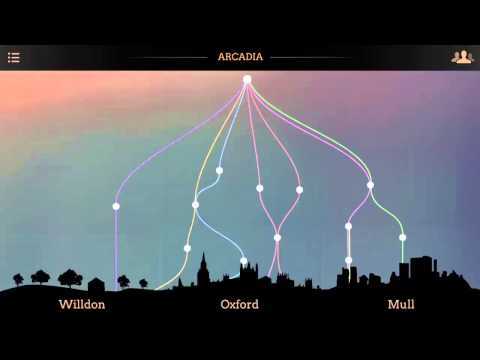
There’s also a much-publicised app to accompany the novel. All it is, is the novel – which you have to purchase piecemeal – laid out differently with the “plot” lines visually laid out allowing the reader to select which pathways they want to read it. Apparently Pears’ vision was to create multiple versions of Arcadia to give each reader a different reading experience. Ambitious, sure, but the finished article just looks gimmicky and underwhelming, particularly as it's far less innovative than it would have you believe.

I read Iain Pears’ An Instance of the Fingerpost when it first came out and loved it. A post-English Civil War whodunit told from the perspective of four different narrators where it was up to the reader to decide who was telling the truth – a superb mystery! Arcadia though is sprawling tedium much like its namesake written by Sir Philip Sidney in Elizabethan times (who is referenced in the text). I don’t know what the story is, why I should care, nor am I interested in any of the characters. I’m not about to force myself through several hundred more pages of this crap – so long, Arcadia!
Profile Image for DeB.
1,045 reviews277 followers
November 13, 2016
5.0 stars This tops DARK MATTER by Blake Crouch! I have been in a bit of a book drought, looking back. You know, those GOOD FOR YOU books , or SUPPOSED TO BE GOOD books that you've earnestly taken on because they are about your country's history,or because they've ended up on the shelf from NetGalley, or perhaps were the latest book by a favorite author. The ones that left you with sand in your eyes and a reluctance to tax your tired close-up vision with the next grind-your-way- through book on that pile. Hmm... Netflix?

"Imagine a landscape. Bathed in sunshine, sweet-smelling from the gentle shower that fell overnight then stopped as dawn broke... A young boy looks down on them. His entire universe is here, the few villages with their rivalries, the seasonal round of crops, animals and festivities.
He is about to leave it forever."

So begins ARCADIA by Iain Pears, the immensely entertaining and enjoyable novel which hooked me with that first passage and had me on the run, exuberantly until its conclusion.

Initially, I felt like I was in the midst of the author's literary version of pinball, each chapter sending me careening across the board into unknown territory only to stop briefly and then be jarred off to another version of this book, bearing little connection to the other. Then, suddenly, the chaos became TIME, and I settled into meet the future as it encountered the past, the genius heroic scientist initially holding off the greedy power monger from stealing the invention they believed could create new universes. Dr. Angela Meerson escapes from three hundred years in the future to 1960, to fine tune her discovery and create more.

Fast-paced, subtly ironic and grand fun, Iain Pears has created a book to brighten the brain, force delighted concentration on the story and has made it very hard to put down, no matter what measure of real time in the HERE and NOW it takes to read it all at once.

Five delighted stars at ARCADIA.
Profile Image for Lyubov.
441 reviews219 followers
April 13, 2017
Дълго обмислях как да започна този текст, а и имах нужда от време, за да разплета кълбото от емоции, които книгата породи у мен. "Аркадия" на Иън Пиърс прилича на онзи чудат реквизит за магьоснически номера, състоящ се от привидно несвързани по между си метални обръчи, които обаче реално не можем да отделим един от друг, колкото и упорито да се опитваме.

Всичко започва уютно и по английски, когато 15 годишната Роузи тръгва да търси една изчезнала котка, а открива портал към друг свят, който се намира в мазето на оксфордски професор. Че къде другаде? Или за да перифразирам популярния цитат на Толкин: Започва път от моето мазе.

Цялото ревю: http://www.chetecut.com/2017/04/blog-...
Profile Image for Roger Brunyate.
946 reviews741 followers
June 4, 2018
A Brilliant Juggling Act

Science fiction, fantasy, and dystopia are not normally my favorite genres. But I do respond to intelligence and culture and the ability to dance across boundaries as though they didn't exist. And I am a sucker for a good story well told with interesting characters, all guided by a strong moral sense that is not too simplistic. Iain Pears enfolded me in mystery and delight from the first few pages of his new novel and held me in his spell for five hundred more. In the first two chapters alone, he sets up the perfect working of an ideal world, then turns it inside out to show the mechanics, then enters it again from a totally different direction. Read only 20 pages, and just see if you are prepared to stop there.
Imagine a landscape. Bathed in sunshine, sweet-smelling from the gentle shower that fell overnight then stopped as dawn broke. A dense grove of holm oak stands at the foot of a hill, damp with the drops of soft-sounding water which leave the ground moist but firm underfoot.
The opening lines, limpid and lovely. Perhaps a bit over the top, too self-consciously poetical? Indeed, and that is the point. A few pages later, we get a middle-aged scholar, Henry Lytten, reading his fantasy to a group of other amateur novelists in an Oxford pub much as his friends Tolkien and CS Lewis used to do. "Bit of Ovid in there," one of them remarks, and indeed he is right; the holm oak gives it away, that tree that seems a staple of classical landscapes but you don't encounter anywhere else. Lytten, with a thorough classical education, is recreating the Arcadia of Greek and Roman pastoral, that ideal world populated by amorous shepherds and shepherdesses, where the occasional visit by a demigod or nymph wouldn't be anything out of the ordinary. Professionally, Lytten is an expert in Sir Philip Sidney, whose own Arcadia was the prose equivalent of Ovid for the Elizabethans. He is also a lover of Shakespeare, who created many Arcadias of his own; later parts of the story so closely recreate the scenes in the Forest of Arden from As You Like It that the novel might easily qualify as one of the retellings in the Hogarth Shakespeare series.

But it is so very much more. The literary references—like the scientific, mathematical, and philosophical ones that will come in later—are there for the adult reader, but the story is one that you could give to a young teen of either sex in full confidence that they would not put the book down until they were finished. In those opening pages, a young shepherd named Jay encounters what he takes to be a fairy, the sudden appearance in a cave of a girl of about his age, smiling radiantly in a halo of light. In the next chapter, we meet Rosie Wilson, Lytten's fifteen-year-old neighbor who comes in occasionally to feed Professor Jenkins, his malevolent cat. Poking around in the basement to hunt for her absconding charge, Rosie walks through an old Victorian iron pergola that is being stored down there, and sees a young shepherd boy gazing up at her with awe.

The best Pears book I have read before this was The Dream of Scipio , a tour-de-force set in the Midi that juggled three time-periods: the late Roman Empire, the Avignon papacy, and Vichy France. Pears has three distinct worlds here too: Lytten's utopia that he calls Anterworld; a chilling future dystopia that we shall meet in the next chapter, where vast populations huddle in huge industrial complexes in a blighted landscape; and Lytten's own period, the early 1960s, when postwar reconstruction and Cold War fears battle for the future of society, where visions of a welfare-state utopia seem less real than nuclear holocaust. But unlike the separate and substantial chapters in Scipio, the three worlds here interpenetrate all the time; the entire novel is a brilliant juggling act. Anterworld, for example, does not exist merely in Lytten's head; it can be accessed physically, as we have seen. And not merely from the present, but from the future.

For in Chapter 3, in a sealed-off research facility on the Isle of Mull, we meet Angela Meerson, a "psychomathematician" who has invented a machine for accessing alternate universes. This makes her a hot property for the fascist oligarchs who run this dystopia, since it seems to open access to unlimited resources of food and space. But Meerson realizes that, so far from going to other universes, it merely transports the experimenter to other periods within one's own. In other words, a time machine. This may sound crudely Wellesian, but Pears is actually quite subtle in his philosophical exploration of how past may affect future and vice-versa, a theme that Tom Stoppard also explores in his dramatic masterpiece, Arcadia , which I assume was an influence here. Yet he also shows that, barring major catastrophes, it is quite difficult to change history. Meerson runs a computer simulation that shows that, although things might have been different for a few years had Nixon defeated Kennedy in 1960, history would nonetheless have reverted to the same course within two decades. Anyway, Angela Meerson escapes with the secret of her machine by traveling through time herself, becoming a good friend of Henry Lytten, in whose basement she stores various parts of her equipment.

There are other themes too. Lytten, for example, has had what is called "an interesting war," and still does occasional work for British intelligence. But I did not find the Le Carré elements as successful as the rest. And while I was always interested in the hunt for Angela Meerson and the secret of her machine, in the end this all took second place to the scenes in Anterworld, which opened out and took on a life of their own, going far beyond their Arcadian or Arthurian origins. Although I have spent a lot of time here describing all the things that intrigued me as an adult, my greatest enjoyment came when I returned to my thirteen-year-old self and settled down to this magnificent romance of young lovers, ancient rituals, and the pursuit of justice. I hated to see it end.
Profile Image for Althea Ann.
2,255 reviews1,209 followers
April 15, 2016
I've read all of Iain Pears' novels, and enjoyed all of them. I felt a little bit of trepidation about this one, after hearing that it was designed to be read in an electronic app, with alternate endings available. (https://www.washingtonpost.com/entert...) I found the wisdom of this idea doubtful, as in general, I feel that it's the author's job to make those kind of decisions and to stick with them.

However, the printed version of the book, which I read, has no "choose your own adventure"-type elements. And I loved it.

However, it really did not resemble, even slightly, any of Iain Pears' previous (widely ranging) work. It resembled David Mitchell's 'Cloud Atlas,' more than anything.

In Arcadia, we're introduced to three separate 'worlds' - or, maybe, 'timelines':

A pastoral realm resembling traditional European fantasy scenarios - with, perhaps, a few hints that this low-tech society might actually be a post-tech, post-'collapse' world. When a girl appears out of nowhere one day, like a vision, it's assumed that she must've been a 'fairy.'

A high-tech future dystopia where overpopulation is extreme, most animals are extinct and society is extremely authoritarian and corporate. But with the exception of a few Luddite rebels, people take their world for granted.

1940's England - where we meet a tweedy professor who's a minor member of the Inklings, does a bit of government spy-work on the side, and who works on creating a rather plot-less fantasy world in his spare time.

In the future scenario, we discover that a brilliant researcher has been working on a device that's either a time machine or a way to travel to - or create - alternate universes. Threatened with a corporate takeover of her work by an amoral CEO who'd use her discoveries unethically, she flees through her machine to a place which will give her time and space to work.

However, when her device is accidentally discovered - and used - events start snowballing out of control. Physics demands that timelines be in 'agreement' - and if contradictions are created, whole worlds could end up zapping out of existence.

The above is a vastly simplified summation. This is a nice, twisty, complicated novel. It's got a bit of the portal fantasy in it, a bit of harking back to HG Wells' original Time Machine as well as its many descendants - and even, perhaps, a bit of Terminator! The separate worlds are nicely developed in parallel, and the separate threads are brought together masterfully.

Highly recommended. In conclusion, I send out a grimace of annoyance toward the public librarian who snidely informed me that this is "not a science fiction book" and I say, "IS SO!!!"
Profile Image for Carlos.
672 reviews304 followers
October 13, 2016
Wow this book has had me going in circles all the time I been reading it , it is so complex, so well thought out that even if it was boring I would have had to the massive amount of work done by the writer, but alas this book is not boring at all, it is a massive epic of adventure, science, multi universes and different timelines all walking alongside each other without touching until they needed it to . Slow start until you familiarize with all the characters but it becomes addicting after that.
Profile Image for Liviu.
2,519 reviews706 followers
September 4, 2015
finished the novel and got the Ipad App and while the main points noted below stand, I will add a few conclusion:

- book - loved the ending which was in a way the only one that made sense and kept the suspense of disbelief; less sophisticated than the main works of the author (Instance of Fingerpost, Dream of Scipio and Stone's Fall) and the quasi-solipsistic nature (universes, societies and people as bubbles, now are here, now are not, but obviously there is someone from the outside to observe this) still lingered till the end but that's the nature of this kind of tale; I think that I(M) Banks did it considerably better in Transition which has a lot of similarities in essence with this one; this said, still an excellent novel and while maybe not a top 10 of the year, a top 25 for sure, but for this I need time to see how the book settles in my memory

- app - easy to navigate, has extra content as advertised (10 pov tales) though only The Assistant's Tale seems to be considerably bulked from what I saw, with more in the Manager's tale too and some notes, but not much more in what I think are the main tales (Scientist, Professor, Teacher, Young Girl and Student); as it is very low priced as of now, definitely a must for anyone who enjoyed the novel and has an ios device to read it; however since part of the skill of a writer of complex books is intertwining the strands to make sense and the app basically reduces everything to linear tales (event-wise from the perspective of the tale pov obviously as calendar-wise things are trickier) which meet whenever the pov's meet so to speak, the app is interesting for the extra-content first and foremost and the book is a level higher than the app

- overall - there is much more sophisticated sf out there, including stuff dealing with the themes of this one (see Transition for example) and the book is not the author's best (hard to beat masterpieces like Instance of a Fingerpost or The Dream of Scipio), but it still an excellent one worth reading; for more detail see below my early review


(early review)
read about 1/2 of the published version so far (there is a related app which is advertised at having about 1/3 more content and where the storylines can be re-arranged, but will try only after I finish the novel)

while I am not really a fan of the quasi-solipsistic novels where universes (with people, memories and all) come and go like bubbles and only the selected few know of this (and somehow said selected few are "like us", ie always from the dominant culture and never some undiscovered genius from some marginal places), this one tries to be rational and probabilistic posing that while there is one physical universe stretching from the Big bang to the Big Crunch, the information space is multiple and flexible, so realities can come and go based on how probable they are;

in particular when in some several centuries ahead future (2222!) which is a sort of semi-dystopic Brave New World (technocratic but with renegades) a genius mathematician (manipulated earlier by the government by inducing a pregnancy to enhance the emotions which power her work, manipulation that doesn't work the way envisioned but later etc etc) decides that her breakthrough machine to colonize the (assumed by the standard model) Multiverse actually only goes into our universe (past - whatever this means) and can actually change everything (see the above mentioned trope discussion) and needs to sabotage her work and abscond, transports herself into the late 1930's (with anti-aging agents in her body which ensure her surviving for centuries barring accidents and the like) and starts on the decades long work to rebuild her machine, her story and the one of spy/academic Henry Lytten who wants to write a Tolkien(who as the novel starts is his relatively close friend in Oxford 1960) like masterpiece but without wizards, kings and the like intersect, especially when Angela (the mathematician from the future) tries to test her reconstructed machine on a fictional world (creating it from a storyline) and Tolkien's one proves self-contradictory and implodes even when the orcs and trolls are taken out;

and so it goes, beautifully written and quite engaging so far, but not yet sure if it won't jump the shark at some point, while still kind of far from the author's awesome multi-layered works (Fingerpost, Scipio, Stone's Fall) from the past and more of a pastiche of past and present sff
Profile Image for Amanda.
1,199 reviews275 followers
September 5, 2016
4.5 stars! It took me almost 3 weeks to read this which is a REALLY long time for me. This book is a complicated genre bender that takes some patience but the reward is huge. Pears has a crafted a beauty in Arcadia and when I finished I immediately wanted to start it again because I know I missed stuff.

It starts out in 1960 with a girl named Rosie who goes in a basement in search of a cat and ends up in another world. Or is it another time? There is also a scientist trying to probe that time does not exist which as you can imagine has some pretty dire consequences. As these threads start to weave together a fascinating story emerges.

This is the second book by this author that I have read and he is ambitious in his undertakings but I think for the most part he is successful with it.

This won't be for everybody but if you are considering it allow yourself some extra time, pay attention and sit back and enjoy the payoff.
Profile Image for Cherisa B.
706 reviews96 followers
April 23, 2024
Tripping the light fantastic, Pears blends three worlds into a unique story based on Oxford donnish fantasy, physics, and dystopian apprehension. Adjusting to switching between these worlds took a few chapters, but the author does a terrific job of pulling us in and helping us keep things straight. If you ever wanted Aragorn to come striding off the page, to know if science works for the social good or just professional satisfaction for its practitioners, or feared the wealthy technocrats who seem to run the world however they choose, let Pears give you his version of possibilities on how it might all turn out.

A fantasy, science, myth, social construction and even romance mashup makes for a rocking good time.
Profile Image for Metodi Markov.
1,726 reviews439 followers
May 19, 2025
OMG, защо си го причниних това мъчение, лист след лист!?!

Едвам довърших този книжен мастодонт, определено и само заради ината си да не оставям много книги недочетени. А трябваше да не си губя времето и нервите...

Надявах се поне нещичко интересно да се случи, но уви!

Ужасно слаби истории, част от героите са ок, част са като едва изрязани от оризова хартия човечета, супер слабо изпълнение по отношение на световете - и на Антеруърлд, и на далечното бъдеще, та даже рехавата шпионска нишка в Толкинова Англия е зле списана. Никак не помагат безсмислените и отегчително дълги диалози.

Жестока творческа немощ, съчетана с нескончаемата авторова логорея почти ме довършиха и правят "Аркадия" една от най-скучните книги прочетени от мен някога. Абсолютно безвкусна, както споменатата в текста английска кухня.

Така се почуствах и след прочита на "Джонатан Стрейндж и мистър Норел" на Сузана Кларк. Преливане от пусто в празно и никаква книжна магия, за съжаление.

Пиърс умее да пише, но тук това не помага, само добър стил и граматика не могат да вдъхнат живот на този уродлив книжен Франкенщайн.

Наградата за най-дразнещ и посредствен персонаж отива без конкуренция у Роузи!!!

Оформлението и работата по книгата на издателство Orange Books са безупречни, щеше ми се и книгата да е на ниво, но уви.

P.S. Сега научих, че книгата е замислена и започната като мултимедиен проект, който е позволявал прескачане в трите истории по желание на читателя. В последствие е преработена в класически роман. Ако го знаех, сигурно въобще нямаше да го прочета...
Profile Image for Ivz Andonova.
227 reviews60 followers
August 31, 2017
Докато четях тази книга се чувствах все едно съм в центъра на литературен пинбол, в който всяка глава ме захвърляше в неизвестна територия за кратко, а после ме запращаше към друга, после хаоса се превърна във време, сложността стана по-сложна, но изключително добре обмислена, вплете наука, световни и алтернативни вселени и различни времеви рамки, които вървяха едни до други, без да се докосват докато не се нуждаеха от това. Хипотезата, която се представя, като се има предвид, че доколкото съществува физическа вселена, простираща се от Големия взрив до Големата катастрофа, информационното пространство е многократно и гъвкаво, така че реалностите могат да идват и да си отиват, и да се развиват въз основа на това колко вероятни са, и бъдещето е неизменно свързано с миналото като едно общо цяло, всички моменти се случват едновременно, а времето е ограничена илюзия, с която просто трябва да се справяме, е рационална и страхотно впечатляваща. Сюжетът няма да го разказвам, защото ще трябва да спойлна, а и е труден за обяснение. Основното е, че "Аркадия" е много пристрастяваща, леко иронична и великолепно сложна- Пиърс е създал книга, която прави сериозна йога на мозъка, форсира концентирано удоволствие от историята и постига това да не можеш да се откъснеш от нея, без значение тук, сега, преди и/или после, трябва да я прочетеш веднага. "Аркадия" е от най-добрите книги, които съм чела тази година, надявам се оставащите книги, които ще прочета до края на годината, да са в готовност- трудно ще е да я надминат.
Profile Image for Sarah.
1,008 reviews262 followers
March 25, 2018
No idea where to start reviewing this one. It is not a book that lends itself an easy explanation. The first chapter will have you thinking Fantasy. Later chapters will have you thinking Historical Fiction. Beyond that you’ll say, “Ah! I have it. Science Fiction it is.” It’s all of them really.

The first half of this book will seem like 6 or 7 or 8 different plot threads. You’ll be questioning how in the world any of them could possibly be related. Then slowly the threads begin to come together and the connections are made and you’ll sort of just be in awe of it all.

The setting and the prose are beautifully told. From the very first chapter Pears sucks you in and whisks you away. There are several parts that will make you laugh out loud. The book is told in a literary style, and yet it seems to constantly be poking fun at itself or its predecessors (Tolkien for one, perhaps even Shakespeare) for their occasional absurdity.

The characters are lots of fun. I adored Rosie, Lytten, and Angela. They aren’t like any characters I can think of. There were a handful that did feel sort of one-dimensional but I think it was with good reason and purposeful on the author’s part. Then there was a handful that felt one dimensional and I don’t think was purposeful on the author’s part, but the result of them being background characters who happened to get their own POV chapters.

And this is the reason I deducted a star. With so many shifting view points, there were inevitably story lines I loved and was eager to read, and then as the book went on there were story lines that I really just stopped caring about all together. I think I skimmed some of them eventually. The Oldmanter, Jack More, Hanslip plot threads I really just didn’t care about at all. Every time we jumped to them I just sighed and sort of rushed through. It isn’t that they weren’t relevant or necessary, they sort of were. It’s just that they weren’t really told as well. It seemed like maybe the author didn’t even enjoy writing them.

Major spoilers:

So all in all- I really enjoyed and loved it. I think it’s better to read this going in blind with no expectations and be surprised by it all as you go. I’d recommend to fans of fantasy and science fiction.
Profile Image for Мари Чернева.
80 reviews
April 2, 2017
Аркадия е от онези редки книги, които показват, осъзнаване на своята дълга история на научна фантастика и фентъзи. Романът също функционира като произведение на експериментално писане: историята първоначално е била замислена като интерактивно приложение, което позволява на читателя да избере свой собствен път през повествованието.
Историята има амбициозен сюжет. В сутерена на къщата на професор в Оксфорд, 1960 година, младата Роузи Уилсън се въвлича в търсене на изчезналата котка, но вместо това намира портал към друг свят. Антеруолд е идиличен фантастичен свят на слънчеви полета и мрачни гори, където традициите се поддържат от мъдри разказвачи. Но Роузи е чувала за света преди – това е създаването на фентъзи роман написан от професор Хенри Литън, който няма никаква представа, че светът за който пише, съществува в мазето му. В същото време, в бъдеще, учен открива тайна за пътуване във времето, но осъзнава, че тя има потенциално опустошителни последствия. Тя трябва да избяга в миналото, за да се предотврати нейното изследване и да не попадне в неподходящи ръце.
Разказът скача между Антеруолд, Оксфорд и ужасяващото бъдеще. Въпреки че, науката за пътуване във времето не е голям фокус на този роман, Пиърс се съсредоточава върху сюжета – концепцията за пътуване във времето е доста сложа, рисуване върху квантовата физика, за да се свие разликата между причина и следствие. Миналото и бъдещето са изобразени като ковък държави. Като герои се движим из световете и чакаме до последната страница, докато разберем отговора на най-търсения въпрос от нас. Дали Антеруолд представлява нашето минало или бъдеще?
Разнообразието от настройки и символи позволява на Пиърс да разчупи жанра. В различни точки, Аркадия се чувства като смесица между фентъзи светове, шпионски романи и мрачни ужасяващи видения. Научно-измислените елементи са неразделна част от сюжета и не се натрапват прекалено силно в основния разказ и Пиърс върши страхотна работа да обяснява абстрактно.
Аркадия е една оригинална книга. Тя е смесица от източници, коментар на по-широк пейзаж на спекулативна фантастика. Едно приключение, в което си струва да потънете. Едно огромно и могъщо въображение, което ви кара да настръхвате.
Profile Image for aPriL does feral sometimes .
2,198 reviews541 followers
October 6, 2017
People who have finished reading ‘Arcadia’ are scratching their heads trying to decide whether to describe this story as a science fiction or fantasy. I pick Fantasy, with speculative science bits. The novel is also a literary read, not that most readers will notice as the author is sneaky! Whatever it is, it is a delight! There are no bleak noir betrayals or horrific chopped body parts. It also is a novel best enjoyed as a cold read, so, if I were you, I’d try to avoid spoilers!

A new secret invention causes a lot of characters to have a changed future - or maybe it is their pasts that have changed, or maybe it is a parallel universe? They don’t know and neither do we!

A time traveler and inventor slowly messes up all of the characters in shocking (to them) ways. I found myself widening my eyes in increasing enjoyment as the various plots and timelines began to spin together. The author, Iain Pears, playfully twists and turns the plot in a wonderful spiral of recursive surprises and unexpected mysteries.

Wow! ’Arcadia’ is totally wonderful. It is a rare gem - a warm literary read full of humor without snark or sarcasm. It is filled to the brim with bibliophile love, with obvious homages to:

Brave New World
The Chronicles of Narnia
The Time Machine
Alice's Adventures in Wonderland & Through the Looking-Glass
Shakespeare As You Like It
The Lord of the Rings
Stanley Kubrick’s movie “Dr. Strangelove or: How I Learned to Stop Worrying and Love the Bomb”

but, gentle reader, you do not have to have read or seen any of the above to enjoy the novel.

The book does have mixed reviews, so it apparently matters if you, gentle reader, normally prefer fast-paced action thrillers or amazing hard-science technological innovation or dark stories of destructive emotional pain which is usually mitigated by characters killing something - not to be found here. Also, those readers who hate changing narrative pronouns (I, s/he), a large cast of characters, and/or timelines which skip around a lot (putting the book down for a couple of days is not recommended) may feel the book does not ’connect’; however I did not experience this emotional distance between me and the book as I read it in three days straight (I did shower).

This is a clever book of puzzles and twists nesting inside more twists. I also like literary homages very much, and this book is loaded with them. I was reminded of Jasper Fforde’s Thursday Next series by the multiple references to famous characters and plots in literature. However, ‘Arcadia’ is not as overt, gentle reader as Fforde’s novels. I do suspect knowing something, though, about Shakespeare and famous books in the canon of science fiction and fantasy genres adds value to the fun of reading ‘Arcadia’.
Profile Image for J.J. Garza.
Author 1 book762 followers
March 7, 2017
Como todos los que reseñan, tengo mis sesgos. Uno de los más conocidos es que castigo mucho el hype. Otro que manejo muy mal las expectativas de lo que leo y eso incide directamente en la calificación de mis libros. Pero uno de los más bonitos es mi tendencia a sobre-recompensar la metaficción. Yo me hice lector con uno de los libros campeones de esta estratagema literaria, así que caigo como menso con cada libro que toma un camino similar. Por supuesto que si conjuntamos esto con cualquiera de los dos sesgos anteriores, podemos tener sorpresas (véase por ejemplo que El Extraño Caso de Harry Quebert es un libro metaficticio, y es un libro pésimo. Alucinante, pero pésimo).

Todo esto viene a cuento porque empecé a leer Arcadia con toda la esperanza de darle 5 estrellas. A la mitad del libro y encaminándome al final estaba seguro que iba a tener cuatro, pero no cinco. Y al final ocurrió lo que me temía: que Iain Pears es uno de esos escritores cultísimos, capaces de conjuntar ideas literarias en tramas genéricas y que el twist del final me revelaría una habilidad impresionante. Dicho y hecho. Y cinco estrellas.

Esta novela se la juega a todo por la trama. Por entender qué es la trama, y por entremezclar el grandioso concepto literario del ‘poder de la historia’ con conceptos más bien cuánticos sobre el tiempo y el espacio. ¿Qué es la causa y qué es la consecuencia? ¿El tiempo es lineal? ¿Qué son el pasado y el futuro? ¿De verdad existe un eterno retorno, una serie interminable de iteraciones donde una variación en la causa o en la consecuencia se retroalimenta ad infinitum?

Me fascinó la manera en la que Pears plantea esta historia. Cuando uno cruza uno de los túneles de entrada de Disneylandia se encuentra con la frase: ‘Aquí dejas el mundo del hoy y entras al mundo del Ayer, del Mañana y de la Fantasía’. La novela opera en tres teatros similares. El ayer es una historia de espías situada en el Oxford de 1960 y con uno de los Inklings como protagonista. El mañana es un futuro distópico gobernado por una tecnocracia que ha destruido todo viso de humanidad en aras de la eficiencia. Y la fantasía es el mundo creado por Lytten (el Inkling), una especie de utopía fantástica y pastoral. Cómo embonan estos tres mundos es el quid de la novela, con personajes entrando y saliendo de estos mundos y haciéndonos preguntar todas las cuestiones del párrafo anterior.

Y si bien ésta es su fuerza, tiene la debilidad de que al enfocarse a todo por la trama descuida esencialmente la prosa. Un escritor de este calibre y esta formación debería poder adornar y hacer gala de las letras, pero Pears no lo hace. No sé si sea decisión estilística o error, pero de haber escogido narrar con más belleza esa novela habría trepado para mí escalones en la difícil jerarquía de mis libros top de toda la vida.

De cualquier modo, es el primer libro del año que se lleva las 5 estrellas y no me voy a cansar de recomendarlo. Los testamentos al poder de contar historias están siempre altos en mi mente y afortunadamente ésta no fue la excepción.
Profile Image for Ellinor.
758 reviews361 followers
September 13, 2015
With Arcadia Iain Pears is trying an experiment: He wrote a novel whith several interwoven storylines which can be read in the traditional way from cover to cover. At the same time he created an app which depicts how the storylines are interwoven and which enables the reader to read the different stories independently and switch from one to other whenever feeling like it or one two or more of the characters' meet. All of this sounds great and it was great to read and to work my way through the app at the same time - but only up to a certain point.

There are three different settings in this novel: Oxford in 1960, Mull, an island off the Scottish coast in around 2200 and Anterworld, a fictional realm with somewhat medieval structures. There are 10 different (main) characters whose stories can be followed. There are timetravel, a spy-story, a murder mystery, a love story etc. This sounds a bit complicated - and it is. You really have to concentrate to remember where in which storyline you currently are, who is who and when is when. The confusion is usually settled once you reach the point when two characters meet but this often takes very long.

The novel is quite complex but at the same time most of the storylines seem very trivial. The Young Girl's Tale was my favourite until it became a rather ridiculous lovestory. The spy story was so very predictable as was the murder mystery. All the time I was waiting for something great, absolutely new to happen. And when that finally seemed to be the case the novel simply ended and too much was left unexplained. Maybe I just didn't understand it (I sometimes have my problems with the logic in timetravels). I was also quite disappointed by the way most storylines ended, either somehow disappointing and unfinished or once again very trivial.

At the beginning I really liked the app. It gave more structure to the novel and made it easier to follow the story. There was also additional info on Anterworld which explained why Prof. Lytten constructed it the way he did. But once the story progressed I noticed that there were simply some flaws in the app. The app shows the different characters' stories as lines which cross when the characters meet. To be completely correct they would have to be ordered so that they show how the events happen chronologically to each character. I can understand that this is not always manageable because it would give away too much of the story but in the Assisstant's story this makes the app just wrong and useless.

(I received a free digital copy via Netgalley/Faber & Faber. Thanks for the opportunity!)
Profile Image for Judy.
1,960 reviews457 followers
July 20, 2016
Reading this novel was pure fun for me.

An Oxford professor in 1962, who was a spy in WWII, turns his hand to writing a fantasy novel that contains no magic. His teenage neighbor Rosie, who feeds his cat, stumbles through a portal into another world that turns out to be the world the professor imagined for his novel. A rebellious psychomathematician from the 24th century uses her own invention to escape from her boss, returns to 1939 and becomes a temporary spy herself.

Many time periods; real and fantasy and futuristic worlds; adventures and love affairs and a supercapitalist combine in surprising ways. It is a bit of a crazy mashup of several genres but somehow Iain Pears makes it work.

That is more than I knew going in. I just knew I have liked every Iain Pears novel I have read and started reading. So I'm not going to say more. Either you'll find your way into and out of Arcadia or you won't. Hint: you should be a fan of complex plots and have read either C S Lewis or JRR Tolkein in your youth, with possibly a tad of Isaac Asimov.
Profile Image for Kara Babcock.
2,110 reviews1,595 followers
May 31, 2016
Every so often, you read a novel that knocks it out of the park. And I’m not talking about the obvious classics, or the much-hyped new releases that also deliver on what they promise. I’m talking about the ones that sneak up on you. Arcadia is one of the best time travel stories I’ve read in a long while—more than that, it’s one of the best books I’ve read in a year already burgeoning with good reads. Iain Pears takes what could have been a good, converging story of multiple characters and times and turns it into a transcendent love letter to literature and storytelling itself.

It all starts … actually, that doesn’t really work for recapping the plot of a book about time travel. Arcadia’s universe is very much a block-time one, wherein, as Angela explains, all moments are happening simultaneously: time is simply a limiting illusion we humans have to put up with. Pears keeps most of the technical details around how Angela’s machinery works vague, but I think that’s for the best. But here are the settings: 1960s Oxford, the late 22nd century, and Anterwold (the temporal location of which I best not divulged for fear of spoilers). The inciting force, if you will, takes place in the second of these settings: Angela Meerson has invented a machine her boss believes will let them access (and exploit) parallel universes, but she believes it “merely” enables time travel within our universe. She proves this, at great personal cost, and turns herself into a fugitive in the process. Hiding out in the twentieth century, she continues tinkering with the machine, creating Anterwold in the process from the notes of her temporally native friend, Henry Lytten. There are, of course, complications.

Arcadia possesses a certain level of self-deprecation, or at least, of insouciance towards to the sacredness of a text. It is filled with allusion and intertextual shenanigans. Take Rosalind, for instance, the fifteen-year-old girl who feeds Henry’s cat and subsequently stumbles into Anterwold, setting into motion a series of events that have profound repercussions for the universe as a whole. Pears goes beyond merely lampshading the allusion to As You Like It in Rosalind’s name by making the parallels much more explicit. There are all the Shakespeare standbys of cross-dressing and mistaken identity, complete with Rosalind disguising herself as “Ganimed” and hanging out in a forest with Aliena until she falls in love with an exiled nobleman. Done so deliberately, this could still be seen as derivative—if it weren’t for the fact that Anterwold is itself a construct, a fake reality Angela’s machine has generated, in which these patterns of plot are destined to play out.

It’s this essential paradox, the idea that Anterwold is both an imagined and real place at the same time, that blows my mind. In some ways Pears draws on modern ideas of procedurally generated universes now becoming more popular in games: Anterwold comes from a set of rules Henry has dreamed up in his attempt to create a “better” fantasy society. It’s Tolkien without the dragons; Lewis without the talking animals. The inhabitants and the way they act are supposed to feel somewhat artificial, because aside from the “major” characters Henry sketched himself, they literally are stock characters. Yet at the same time, Rosalind’s interference means that Anterwold has also become “real” in the sense that it is connected to the 1960s timeline in some way. It is the 1960s’ past or future. So we have this literary creation now reified, with people who were once creations of another person’s mind. It is all very meta.

Meanwhile, in the future, there are those who would like to track down Angela and the data she took with her. Pears’ 22nd century is a terrifying place where “science” has been co-opted into state-sponsored scientism. The population is kept happy with mood-altering drugs and cognitvely-boosting implants; they live to work and produce and consume. Anyone who wants to think for themselves or question this status quo is a “renegade” and either arrested or, if they are lucky, barely tolerated in one of the several Retreats dotted throughout the world. Angela, born into this society and fortunately among the elite herself—albeit with a strong streak of individualism—admits she only began questioning it after experience the comparatively liberal, if technologically primitive, 1930s through 1960s.

My favourite part of Arcadia’s incredibly complex, interwoven strands of narratives have to be Rosalind’s interactions with Anterwold’s inhabitants. She is a fierce, intelligent, uncompromising young woman—in short, every bit the heroine of her namesake, transported into the 1960s and born to parents who just don’t have her breadth of vision for the potential that her life could have. Rosalind is so alive, and I love it. When she takes the Anterwold characters to task, she seems much older than her years—yet so often, her actions betray a kind of naive optimism fostered by her somewhat sheltered youth. Furthermore, I love the rapport she develops with Angela. The “us against the world” vibe is very satisfying, especially against the somewhat comical backdrop of communist intrigue (in England) and a murder-mystery-slash-uprising (in Anterwold). Most importantly, these protagonists when against bigger, badder, better-armed forces not through the use of force or even its threat, but through sheer, unadulterated brilliance. Those are my kinds of heroes.

There are so many other stories happening within this book, though, it is hard to play favourites. It took me longer than usual to read it, partly because I was dragging it out, not wanting it to end. I was savouring every plot line, because even the other plots were fascinating. I wanted to see Jack More continue to develop as an individual as he hunted down evidence of Angela in his present and further explored his nascent attraction to her estranged daughter. Alas, all that potential doesn’t seem to go anywhere, and I was a little disappointed that Jack never quite seems to come into his own. Emily, on the other hand, is delightful. While I suppose some might consider the last-minute reveal at the end something of a cheat, or at the very least, somewhat cheap, I adored it. The foreshadowing was there, and Pears just brings it all together so masterfully.

It’s this intricate evidence of a plan that makes Arcadia a masterpiece. Other reviews mention that this book initially came out as an app, and that one could explore it interactively or non-linearly or something. I don’t know about that—this hardcover does not mention any app whatsoever, and I experienced the narrative linearly insofar as I read it from first to last page as Pears has structured the pages. So I can’t speak to what others experienced when they dipped into this story, but I love the little glimpses at the seams that he gives us. Time travel stories are really tough to do. And there is so much seeming coincidence here in this novel—yet it all ties together. Even Lucien Grange’s disappearance isn’t left hanging but instead comes together, neatly providing a solution to the mystery of the Devil’s Handwriting and giving Angela further thought to chew on. And with each new development in this vein, my impression of Arcadia became more thoroughly positive: I was just having such a good time and getting so much stimulation, intellectually and emotionally, as a result.

I took a chance on Arcadia. I’d never heard of Iain Pears, hadn’t really any hype about this book online. It was just there, staring at me from the New Books shelves in the library, daring me to take it. I almost said no. The description on the jacket does little to beguile the reader; it reminded me of those books that overreach, and that made me wary. I’m so, so happy I overruled my inner cynic and took this chance. Arcadia is more than an entertaining read for me: it was a refreshing, reinvigorating look at science fiction and storytelling and all sorts of clever literary tricks and conceits. I had fun; I relished every page. I want to do it all again, and my only regret is that there can only be one first reading.

Creative Commons BY-NC License
Profile Image for Bettie.
9,977 reviews5 followers
September 29, 2016
Description: Henry Lytten - a spy turned academic and writer - sits at his desk in Oxford in 1962, dreaming of other worlds.

He embarks on the story of Jay, an eleven-year-old boy who has grown up within the embrace of his family in a rural, peaceful world - a kind of Arcadia. But when a supernatural vision causes Jay to question the rules of his world, he is launched on a life-changing journey.

Lytten also imagines a different society, highly regulated and dominated by technology, which is trying to master the science of time travel.

Meanwhile - in the real world - one of Lytten's former intelligence colleagues tracks him down for one last assignment.

As he and his characters struggle with questions of free will, love, duty and the power of the imagination, Lytten discovers he is not sure how he wants his stories to end, nor even who is imaginary...


Opening: Imagine a landscape. Bathed in sunshine, sweet-smelling from the gentle shower that fell overnight then stopped as dawn broke.

This was the main holiday gift to myself in 2015 and am only getting around to it in Autumn 2016, without the safety of the app. (An affectation too far, methinks). I shall keep my own records as I work through....
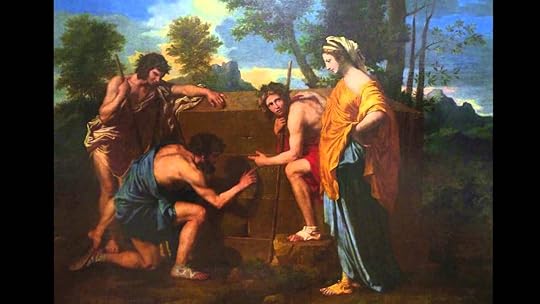
Et in Arcadia ego - Nicholas Poussin, 1637-38
Rosie Wilson, 15.
Dog - Freddie
Henry Lytton - spy, now novelist
Angela Meerson (old friend of Henry)
Cat - Professor Jenkins

ANTERWOLD, the domain of Willden:
Jay, 11,
The Visitor
The Storyteller

THE FUTURE 2222AD A boggy island, NW Scotland
Jack More - security guard
Angela Meerson - mathematician
Dr Robert Hanslip
Oldmanter
Lucien Grange - sales rep, Oldmanter's crony
Alex Chang (found Gunter)


Looks like lightening!


Sir Philip Sidney penned a book entiled Arcadia but it was never finished.

Glorious storytelling which combines nigh-on every fairytale and childhood fiction from the past 100 year or so. But the base literature here is rather low, Pears did not confuddle us with his own pen, he merely latched on to those masters who came before, so whilst I totally enjoyed this story, Pears failed to impress on his own account.
Profile Image for Aya.
356 reviews191 followers
August 3, 2022
Пръсна ме тази книга. Толкова паралелни линии и случващи се неща, които на пръв поглед нямат нищо общо, но това да не ви заблуждава - всъщност всичко има своето обяснение, хронология, причини и леле... направо ми отвя главата тази сложна плетеница. Станах фен на Иън Пиърс, то е ясно!
Profile Image for Zulfiya.
648 reviews100 followers
March 25, 2016
Is it just me?

Writing is good, but it is also insipid and spiritless, academic and boring.
Too many plotlines that are interwoven, but not exactly exciting or riveting, and the author was definitely overreaching in his approach. It is not a secret that Iain Pears often uses multiple plot lines, and quite often successfully, but this time, as i mentioned earlier, he really overreached.

in addition, it was not sci fi - sci- fi, but something that is had to define - medieval historical novel, the novel set at the time of WWII, investigative/crime novel with the pinch of fantasy and love story ... a genre-bender that did not work for me at all.

As for science in his novel, I do not think it can even be defined as science ...

I wish you would explore your waters, I. Pears ....
Displaying 1 - 30 of 1,086 reviews

Can't find what you're looking for?

Get help and learn more about the design.