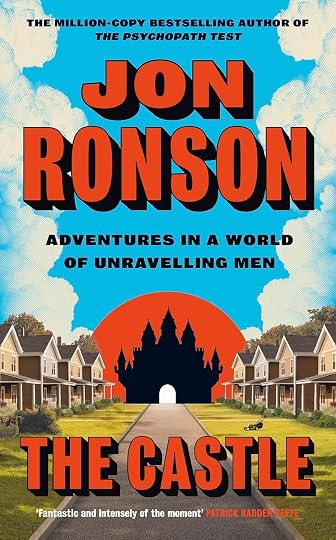
The million-copy bestselling author of The Psychopath Test, So You’ve Been Publicly Shamed and the award-winning BBC podcast Things Fell Apart moves to Penguin for his first book in eleven years, a darkly comic true crime mystery set within the masculinity crisis, The Castle.
I honestly have no clue what is going on. This is very weird. We left. Was completely fucked. All good now.
When Jon Ronson received a series of disquieting texts after his son Joel had been lured to a mysterious castle in the forests of New England under false pretences late one evening, it set Ronson Sr. off on an extraordinary adventure into a world of unmoored men on a desperate search for purpose, whatever the cost.
Why did the wealthy scion of a gilded age tycoon entice Jon’s son to his castle on the pretext of a party, when the reality was something else entirely? Could Jon uncover what was really going on inside that strange castle? Why was a popular online lawncare influencer wrongly implicated in a bizarre plot to traumatize millions of unsuspecting children? And, more pressingly, why are two recently paroled murderers on their way to pay Jon an ominous visit?
Against the backdrop of the sometimes moving, often disturbing masculinity crisis, Jon follows the trail of those men who are acting out, checked out or just plain out of time. Drawing on his trademark brand of humour, psychological insight and unrivalled prescience, and told in the riveting style of a true crime thriller, The Castle marks Jon Ronson’s triumphant return to the written page in his darkest and most wildly enjoyable journey yet – deep into the recesses of the Castle and the secret lives of men.
Jon Ronson is a British-American journalist, author, and filmmaker. He is known for works such as Them: Adventures with Extremists (2001), The Men Who Stare at Goats (2004), and The Psychopath Test (2011). He has been described as a gonzo journalist, becoming a faux-naïf character in his stories. He produces informal but sceptical investigations of controversial fringe politics and science. He has published nine books and his work has appeared in publications such as The Guardian, City Life and Time Out. He has made several BBC Television documentary films and two documentary series for Channel 4.
The story begins when Ronson's son has an unsettling experience at a party in a castle which turns out to be not a party but an amateurish attempt at a reality show, a sexploitation of pretty women, 100 Princesses. The castle is owned by Chris Mark, a fabulously wealthy eccentric man whose hero is Hugh Hefner. and like him, Chris wants to build both a reality show and a harem .
He wants to have 6-8 girls but says the only ones who would contemplate this life style with him are girls who like other girls sexually and junkies (and they have to be at least 35 years younger than him. He lures women in from social media, women who are going to want paying not sex workers but send me a ticket, buy me clothes, pay for therapy, give me jewellery sort of women. And he does. But the jewellery he bestows upon them is actually Chinese fakes from Amazon. As in so much of Chris Mark's life what is a glittering diamond on the surface is a lump of dirty black coal underneath.
Ronson tells the stories of several men who have become detached from society in one way or another but always circles back to Chris. Did he murder his father? Is he violent? Is he traffiking women? etc etc. His main sources of information are the man himself, who is both a fantasist and a liar, his main man who fixes things for him and also pretends he didn't know anything malign going on, and a couple of dipsy ditsy women who were in it for what they could get but didn't want to have sex in exchange. That is not going to work out and someone is going to suffer. All of them.
The stories of the other men, sometimes disturbing and darkly amusing to read about seem like separate articles cobbled into the story of Chris Mark. I wonder if they were articles as that is what Ronson specialises in?
I kept waiting for the author to pull it all together, to offer some sort of conclusion, but no, it just gets back to Chris Mark who was not allowed to leave Argentina even though charges of rape, major crime, traffiking etc have been dropped owing to his mental incompetence, and… is he sent to a mental hospital, is he imprisoned, is he in South East Asia? No one knows, not even Google! He seems to have dropped off the face of the earth. That's certainly not the author's fault, but it does make for an unsatisfactory ending to a story that is the framework for all the stories in the book.
The lack of direction, of structure and of conclusion that ultimately make the book a frustrating read. Not one of Ronson's best, but I look forward to his next exposé of some eye-opening ridiculousness going on in the world.
I really enjoyed Ronson's So You've Been Publicly Shamed— it was somewhere right in between deliciously juicy scandal and genuinely interesting cultural critique. Ronson is a fan of that Malcolm Gladwell style of nonfiction storytelling where he goes on numerous tangents, wandering down entertaining but seemingly-unrelated paths before drawing it all together at the end. The problem was that The Castle never really did come together.
I'm honestly trying to decide whether Ronson was looking for a unique angle into the so-called "masculinity crisis" and ended up here, or if he actually just wanted to write a book about Chris Mark— a creepy Hugh Hefner-wannabe living in a castle —and someone advised him to bring the subject around to disaffected young men. Because some of the links he attempts to draw here are tenuous at best.
The Castle details how Ronson came to tumble down the proverbial rabbit hole when he went to investigate what was going on at Chris Mark's sprawling Neo-Gothic castle in Connecticut after his son was invited there for a very weird evening. Ronson's digging uncovers more than he could ever have expected, but the truth, which I think the author suspects, is that Chris Mark alone is not that interesting to the average person, so Ronson attempts to link Mark's weird performative lifestyle to a bigger crisis among men.
He covers lots of different stories about floundering men trying to carve out a spot for themselves in a changing world, but the stories didn’t always feel connected. How much does a criminal trying to live a Hefner lifestyle really have to do with Graham Linehan bulldozing his life over anti-trans internet feuds? I’m not convinced. The biggest link (and, in my opinion, the more interesting story) was between Greg Chism and Andrew Gold's Youtube journeys. Both followed the algorithms and gave people what they wanted; both became ever more controversial and extreme by doing so. I found this commentary about the way content creators are pushed to sacrifice their own values and norms in exchange for revenue to be chilling.
I think Ronson tries to be fair, which I admire him for, but I also think he is sometimes too fair towards the men without pushing back on their assumptions. One he shares is how men feel frustrated because women claim to want vulnerable men but many contradict this online by getting the "ick" when men show emotion. Ronson does not interrogate these anecdotes and seems to let the implication speak for itself: women say they want men to show emotion but they don't really. No mention of the whole subculture dedicated to pictures of men crying— hot dudes with red eyes and tear-stained faces, staring morosely into the camera. I can show you whole k-drama reddit threads obsessed with the male lead's beautiful displays of emotion.
A lot of men seem to have a genuinely hard time telling the difference between emotional openness and emotional weakness. Many women have been asking for more openness from men. Being able to show tenderness, admit hurt, or openly express affection signals confidence and strength, not weakness. But this is not the same thing as being weak-willed or easily led. You can be deeply sensitive and emotionally demonstrative while still being decisive, self-assured, and capable of standing your ground. And these latter qualities are attractive in both men and women. Anyone— man, woman or other —actively seeking a "weak" partner is a predator.
Sorry, guilty of my own tangent there.
I didn't dislike the book, but I definitely didn't like it evenly. I struggled to become invested in the Chris Mark tale, though I appreciate the excellent journalism work Ronson put in. I thought some of the individual stories about these different men were really interesting, though the book as a whole felt disorganised and lacked cohesion. A lot of the negatives were tempered by Ronson's very engaging and readable writing style.
While an engaging read, my ultimate impression of The Castle is that the narrative is hamstrung by an unacknowledged current of self-pity in its persistent framing of men as being at the mercy of a world that has seemingly shifted beneath their feet. There is a denial of individual agency on the part of men who are, quite frankly, not just victims in Ronson's story. Don't get me wrong, it's still a page-turner, but the book as a whole contains a lot of uncritical assumptions about gender that are left unquestioned and unexplored. It never really addresses the fact that a lot of men aren't as bereft of purpose as the subjects that Ronson interviews, nor does his narrative ask the obvious question of whether women are coping with the shifting demands society thrusts on them in turn.
As much as it enters into his thinking when he's interviewing them, Ronson never asks any deeper questions of why the women in Chris Mark's life come to him and the assumptions that I assume we are left to make is that they're simply looking for a 'sugar daddy' arrangement, that they want to funnel his fortune towards more noble ends than 'princessing', or that they were at the end of their rope and had no other choice. If men can be led to such extremes of behaviour as detailed in his book because they're reeling from the dissolution of traditional masculinity, why can't it be that the women in his story are too? There is no sociological explanation deeper than poverty afforded to them in the work - Ronson highlights their agency, agonises over why they would choose to be around such an erratic and apparently dangerous person, but ultimately attributes their choices to the individual and the individual alone, without affording them the same systematic explanations he gives to men. When a man constructs an elaborate Playboy Mansion-esque fantasy he is struggling with what it means to be a man, but when a woman steps through its gates that's her choice.
I think while the Ronson of this narrative clearly struggles with the need to be purposeful and the need to be there for his family, in labouring that point the author obscures the fact that he is one of the purposeful, ravelled men who have navigated the last two decades without becoming dependent on a sense of personal grievance. To me, it seems there's a deep contradiction between the framing that men are in crisis and story's protagonist, who is able to wrangle his own troubles into achievement. No life is without its troubles, and the expectation that men shouldn't feel like their priorities are pulling them in different directions, that we can have our cake and eat it too, is, like cake, just not healthy for us.
By focusing so much on men who abuse the women in their lives or are angry at the vague spectre of women around them as a product of unmoored masculinity, Ronson somewhat diminishes the fact that none of this is new, and that women have been the victims of gendered violence long before #MeToo.
I think in writing this review I've come to appreciate the book a bit more, but it's the lack of nuance in Ronson's writing that is to me its weakest, and most notable, feature.
I waited 11 years for a new Jon Ronson book and it was WORTH THE WAIT.
Macabre as it sounds, it’s good news for narrative nonfiction when strange things happen to Jon Ronson. In this case, his son is lured to a mysterious castle in suburban Connecticut where a wealthy older man is recruiting young women to be his “princesses.” Alarmed by the situation and drawn to deviant characters, Ronson does what he does best: follows the thread until it leads somewhere much darker and indicative of a cultural underbelly.
The result is a portrait of several men—the castle owner, a town historian, a lawn-care influencer, a culture-war YouTuber—who share a common predicament. They are all searching, perhaps destructively, for purpose.
The Castle raises questions at the root of the manosphere: How does the 21st-century man go from being a little lonely to dangerously uninhibited? What happens when once-tolerated behavior is no longer tolerated? And what is a man’s worth when the thing that once gave him value—money, innovation, authority, expertise—becomes the thing that alienates him from society?
In his trademark style, Ronson inserts himself into the narrative, scrutinizing his own motivations and facing his mortality. Throughout, he acknowledges his maniacal compulsion to work, and how he’s a razor’s edge away from being like the subjects of our scorn:
“Everyone I met for this book had, I think, a similarly dysfunctional relationship with purpose, hunting too desperately for it. And now there’s a generation of men, unanchored from society and going it alone.”
Ronson is also disarmingly aware of the uncomfortable boon his son’s encounter provides his reporting. He ruefully notes that the danger his son faced “had, after all, given me something to do.”
And what a thing he’s done. Ronson, who has made of career of embedding himself with the fringes of society (extremists, psychopaths, cancel culture’s outcasts), has now dipped a toe into the manosphere and exposed the privilege-to-disenfranchisement-to-disinhibition pipeline only as he could tell it.
It’s illuminating, unsettling, and genuinely funny. I only wish there were more of it.
Jon Ronson picks good topics and often includes interesting case studies / vignettes along side his analysis. However, I don’t think I’ve ever really agreed with any of the conclusions he has put forward. This is definitely the way I felt reading this book.
The Castle is about a creepy man, who inherited a lot of money and built a sort of Disney castle (without having a plan for how he would use it). He then tried to create a sort of Hugh Hefner style fantasy life. Just like Hugh Hefner, he was a disgusting creep who sought out vulnerable young women and pestered them for sex. I’m not convinced that there’s more to his story than “rich man feels entitled to have a lot of creepy sex with women who he does not deign to endow with personhood”.
The book then widens its scope to the “man crisis”. I’m not convinced that the two stories work together in the way Jon Ronson envisioned. In fact, I’m not sure there’s any cohesive thread which ties this book together.
There is clearly a problem with how some vile men talk about women on the internet (and in real life). The explosion of yucky and distinctly unrealistic pornography had clearly warped the minds of many, many men. The toxicity of the “manosphere” and men like Andrew Tate is not to be ignored. However, whilst I think Jon Ronson tried to remember to include women in his narrative, the book had slightly too much sympathy for these poor “left behind” men and not enough condemnation. Maybe that’s unfair and maybe I wouldn’t read it the same way another time. But why does Charles - the right hand man of sex criminal and girlfriend attacking Chris* - get such an easy ride? He spent 20 years facilitating his grossness.
The book dipped in and out of various interesting topics (like the YouTube algorithm and the lawn care/ dad YouTuber story) but it felt very much like it didn’t get pulled together. It was quite readable but ultimately I did not feel satisfied.
*I imagine he’d deny those allegations and I don’t think he’s been convicted.
Jon Ronson wakes up one morning to a series of texts from his twentysomething son Joel. He’d been invited to a party at a castle in Connecticut, saw some disturbing things, left, and he’s ok now. Alarmed, Jon begins asking questions about what this castle party was about and learns the owner is an “eccentric” sixtysomething rich guy called Chris Mark, who is obsessed with princesses. Intrigued, Jon follows this new white rabbit into this man’s - and others’ - bizarre world in… The Castle.
I love Jon Ronson. I’ve been reading his books my entire adult life and they’re all good. So I was delighted to see a new book from him - his first in 11 years! - immediately bought it, devoured it, and enjoyed it thoroughly. The Castle is a fascinating collection of stories about - who else - people living on the fringes of society, aka Jon’s speciality.
Besides Chris Mark, there are stories about Hugh Hefner; a man living in Marktown - which was established by Chris Mark’s great-grandfather when he made the family fortune in Chicago steel - and its shambolic present; Greg Chism, a former YouTuber whose channel Toy Freaks made him rich and then notorious as it became embroiled in the #Elsagate scandal (where weirdos posted subversive videos that escaped detection by the algorithm, appearing in front of millions of children on YouTube Kids); Graham Linehan, his former friend and creator of Father Ted, who today spends his time tweeting about transpeople; and Armie Hammer, the former Hollywood leading man/possible cannibal, who lives a less high-profile life these days.
They’re genuinely interesting stories in their own right and were very fun to read. I think where The Castle falls down a bit is in trying to make them mean something cohesively. Jon mentions that it’s important that men have a sense of purpose - he had been feeling lost not writing and felt that spark again when he began this book - and that same sense propelled Greg Chism from being a broke single dad to a multi-millionaire.
He also mentions stories about how money corrupts. Mark and Hammer are both heirs to vast family fortunes and both of their lives spiralled out of control at some point. Brandi Bragg was a 15 year old kid whose grandparents won the lottery - money didn’t improve their lives and she died two years after that windfall. Hugh Hefner similarly led an increasingly sad life despite Playboy’s success and his subsequent wealth.
He talks about how some men feel left behind by society. Andrew Gold wanted to make films and TV shows but kept getting turned down by production companies because he was a straight white man. So he went to YouTube and made far-right content online (even if he doesn’t really believe in it), making money that way. Graham Linehan has also felt marginalised for his outspoken views and has only doubled down and become even more ostracised as a result.
And finally he mentions how some of this came about - the rise of the Doofus Man in popular culture, making men feel useless, men having no attainable role models (Batman and Spider-Man are impossible), leading to culture war garbage and the rise of the manosphere.
But he’s drawing fairly elementary conclusions: men need a sense of purpose, extreme wealth corrupts, men need community, and there needs to be fair and equitable respect shown to them. And that’s why I was left thinking that Jon was building to something and it all came off as kinda obvious and bland. The conclusions to the stories feel shallow and unimpressive. They’re not wrong but I also feel like they’re missing something inspired or unique.
The examples given are also hard to tie into the everyman. Chris Mark is a bipolar rich guy. Very few people are doing what Graham Linehan is doing. Almost nobody gets to live the life of Hefner. So how do you connect them to the large numbers of men across the world currently feeling lost and confused?
The only other criticism I would give is that the ending to the overarching Chris Mark story is a bit unsatisfying, though that’s only because the multiple federal investigations into his actions are ongoing and unlikely to be resolved for a few years yet.
Still, The Castle does live up to its subtitle: Adventures in a World of Unravelling Men. The book is full of such cases and they are as morbidly compelling to read about as any of the subjects Jon has written about throughout his career. While I feel The Castle lacks real insight and a strong through-line, the stories that compose it make it a great read and one that fans of this writer will thoroughly enjoy, as I did.
Ronson's book is almost a rebuttal to his So You've Been Publicly Shamed, as it's filled with despicable men - online influencers, sexual predators, YouTube celebrities - none of whom feel any shame over disturbing videos featuring their scantily clad young daughters, or their rants against women and "The Jews." They brag about their sexual conquests, totally disregarding the fact that some of their advances may not have been welcome. If you like or follow any of these men, I don't want to know you.
The majority of the book is taken up with the "social experiments" of Chris Mark (https://www.chrismarkcastle.com/about), an obscenely wealthy man who apparently goes to great (and expensive) lengths to get laid. He uses his castle as bait, promising young women stardom on various reality TV shows that exist only in his mind, then relentlessly pesters them for sex.
Through no fault of Ronson's fine writing, the ICK Factor is strong with this one, (trigger warnings galore for anyone who has been in an abusive relationship.) While certainly not the feel-good book of the year, it's an interesting and involving read.
Thanks to NetGalley and Riverhead Books for sharing.
Sigh. I enjoyed this book BUT I think Ronson frames it poorly and it doesn't land.
I dont think he has the time or space to truly dig into the current state of masculinity, other than a brief section about men being made to look like fools on television. Without mentioning that most people in advertising are men so unsure whose fault that is???
I think if it had focused on either the Internet has made people crazy and done a more broad focus like why can't I eat out anymore without someone taking a call on speaker?? Or simply focused on the fact that the core theme of this book is actually the trafficking of valunerable women (which makes the portraying men as the victims A Choice)
An entertaining enough and diverting read, but in the end felt rudderless. The overall aim or point of the book was very vague, as an exploration of struggling masculine identity the examples were interesting on their own but added together didn't amount to more than a few troubled men. It wasn't broad enough in scope to amount to anything more. Some interesting parts touched upon would have made for a more interesting topic than the Castle and the man in it, who really, is nothing more than a bit of a d*ck with inherited wealth who doesn't deserve to have much time spent thinking about him. He certainly isn't worth a book.
Ronson dives into the manosphere to investigate the millions of missing men (men who aren't working or in school), what happened, and how millions of them ended up on the internet preaching to one another in echo chambers. Twisty, turny, and terse, this is a work of nonfiction that poses questions and investigates every possible answer to the core question, but sometimes the data itself is lost in the musings.
Like 3.5 stars, maybe. I had so many issues with this - namely that I don’t feel sorry for rich white men who feel ‘useless’ when raping and trafficking women for sex. The chapter on Graham Linehan was enlightening, but I feel like Ronson went out of his way to sympathise with him - one of the most violently minded transphobes allowed on X. That’s backed up by the disgusting comments he’s made even about cis women, included in a footnote here, which undermines his entire ‘I want to protect women’ bullshit.
This book was a bit of a jumble, trying too hard to stick to a central conceit of investigating why men are ‘disappearing’ from the world, but it’s all just such macho crap. I work in an industry run by rich white men who think they’re the best thing since sliced bread and women can crumble nicely under their heels, and I’m sick of this crap.
Sure, some bits were absurdly funny. But Ronson is way too wrapped up in defending vile men for me to get on board.
I have always liked Jon Ronson, so I was genuinely surprised by how much this irritated me. The annoying thing is that I kept reading because I wanted to know what was going to happen. So there is clearly something in Ronson’s storytelling that works.
Unfortunately, I found the actual book very badly structured. It felt as though he had collected a load of interesting people, stories and ideas and then hoped that, by the end, they would magically turn into a coherent book. They did not.
The central idea about men and masculinity, felt half-baked. I kept waiting for the various threads to come together and for the bigger point to emerge, but instead I mostly felt as though I was wandering around waiting for someone to tell me where we were going. And there was so much whining! I actually finished the book feeling less fond of Ronson than I was when I started it.
3 stars because it was readable, and I did want to find out what happened. But for me, it was a frustrating, messy book built around an interesting idea that never really came together.
Not very cohesive and defo not worth the wait !! Graham linehan / AI / Elsagate parts were v interesting and then it got sort of pointless again. The jist is that because of deindustrialisation, men are feeling a bit useless and therefore acting absolutely mental. Sucks to be them (you’re not allowed to exploit/rape/traffic women cos you’re bored)
The Castle: Adventures in a World of Unraveling Men all starts with Jon Ronson’s son, Joel, sending him alarming text messages after being lured to a strange New England castle late at night. Trying to understand what happened to his son is the catalyst for this investigation and it gives the narrative an immediate and relatable entry point and one that grounds the weirder subplots.
I'm a big Ronson fan and, perhaps unsurprisingly, I loved it. His gonzo-adjacent style, self-deprecating neurosis, gentle bemusement, and an eye for absurd detail are again front and centre. The subject matter includes male alienation, tech bro excess, modern radicalisation, and AI loneliness, and so is quite bleak and yet Jon Ronson makes the content funny and compelling but without trivialising the real world consequences
Overall, I enjoyed this, but I can’t help but feel like it was far below Jon Ronson’s usual standard.
Let’s start with the positives: he presents several interesting stories and writes very frankly with his usual brand of dry humour. I particularly enjoyed the story of Greg Chism.
On the downside, I think the attempt to tie these stories together as examples of “what happens when men live without purpose” fails. It feels like Ronson tries too hard to fit some of the stories under this narrative arc, and wastes a lot of text in the process. This includes text wasted trying to draw out connections between the subjects themselves, which I found unconvincing. In fact, some of the sections (perhaps even full chapters) end up feeling a bit redundant.
I think this book would have benefitted from being restructured as a series of essays on entirely different and unrelated subjects (like ‘Lost at Sea’), rather than trying to deal with all of those same subjects under one thread. But what can I say, I’m an unmoored man myself.
I liveeee for a Jon Ronson audiobook. One of the few writers that can make me laugh out loud listening to the bizarre situations he’s gets himself into with the strangest people in the world. I feel like this was a bit scattered, but I found it so engaging and gripping and I finished it all in one day, so I felt like it deserved 3 stars just for that. It doesn’t really go deep enough into being a treatise of modern manhood though, I think it is more interesting as a bizarre case study of some unnerving characters.
Vakar, pastaigājoties ar dvīņu ratiņiem, mani uzrunāja viens pusmūža vīrietis. "Un kur ir viņu mamma?" viņš prasīja.
"E? Mājās."
"Pasaki viņai, ka mums, džekiem, arī vajag atpūsties!"
Mēģināju pārvērst to par joku. "Vispār viņa ir ar lielo meitu, par atpūtu mums tagad jāaizmirst."
Bet, protams, viņš nelikās mierā. "Zini, vecīt, es tev kaut ko pateikšu. Sievietes, bērni un suņi vienmēr saņem beznosacījuma mīlestību. A kas paliek mums, džekiem? Figa!"
"Nu, es ceru, ka mani puikas uzaugs labā pasaulē," atbildēju un devos tālāk.
Šī grāmata principā ir par līdzīgiem čaļiem, tikai tādiem, kuriem ir bijis gana daudz naudas vai slavas, lai neviens netraucētu uzskatiem aiziet kosmosā un pārvērsties atbilstošās darbībās. Interesanti, vienvārdsakot.
Ronson once again proves to be one of my fave writers and audiobook narrators. Love how this one becomes so self-referential and introspective in a humorous way - lesser writers would have got carried away with that. Also needs to be said how chillingly mundane some of the inciting incidents are in many of the stories, and how much of a stinky wank stain Gr*h*am L*inehan is.
I love Ronson’s journalism so much. This book was shocking and addictive and I loved the story. I’m a bit confused by the wider message of it all as it didn’t seem to hit the nail on the head in terms of what he was saying about the wider crisis in masculinity. It told stories but didn’t really go anywhere with them, which is my one qualm about the book. But I would still really recommend this - the Armie Hammer part especially is just crazy.
Usually a big fan of Ronson’s writing but this fell flat for me - his writing is as engaging and funny as ever but the whole thing just felt a bit meandering and I finished it slightly wondering what the point was…
"What did you do for a living, back when you used to work?" I'd overheard a nurse ask the elderly man in the room next to mine.
"IRRELEVANT!" he yelled back in fury.
I didn't want to become that man. Plus, if the nurse had asked me about my work, I'd have gone on about it for ages. It was by far the most relevant thing about me.
Jon Ronson is recovering from surgery, when his son tells him about how he was invited to a party and ended up at a weird castle at what was very much not a party. And that's all it took to get Ronson curious and investigating the creepy man who owns the castle to figure out what his deal is. And that leads him to a directionless wealthy man who starts out with the idea of pitching a reality show to Netflix where he has 101 young women compete to be his princess, and if you thought that sounds sketchy, it's far sketchier than you think. Like many self-involved men, he happily lets Ronson interview him, but when Ronson refuses to sign an NDA, he realizes that there may be consequences. So he starts to threaten Ronson.
His texts continued to pour in, and I continued to not respond. I had by now instigated a total communication blackout. As a consequence, he was seeing me as an inscrutable menace, whereas I was seeing myself more like a rabbit in broad daylight, reacting to danger by standing completely still. He was lashing out while I was shutting down. And mine was proving the more successful response, given how he was filling my silence with texts that would sound horrifying if read out in court.
Ronson has a talent for finding people with extreme views and getting them to speak openly, and here he turns his attention to problematic men. You'd think that this is a well-trod path, more like an interstate, and that we don't really need another look at how terrible men have been failed by society. But, refreshingly, that's not what Ronson's looking at -- he's more interested in how these flailing men harm the people around them, who are usually women and children. Women can feel directionless, too, but they tend not to inflict their feelings of inadequacy on the vulnerable. Take our castle guy. He's endlessly preying on young women, and also fully believes that he's the one in danger of gold-diggers. Ronson looks at a wide variety of problematic men; one whose retreat from society is understandable, followed by a look at Graham Linehan, who if you are familiar with his name, you're well aware of what a sad, toxic individual he has become.
One of the more interesting aspects to this book, is how AI enables and exacerbates these men as they spiral. As Ronson puts it:
There's a word for something that love bombs you, mirrors you, manipulates you into giving it all your attention, and isn't in the least bit embarrassed when caught lying. I think ChatGPT is a psychopath.
Ronson knows how structure a story and he's so curious and nonjudgmental about people, yet he doesn't avoid drawing some very strong conclusions here. In an interview I listened to with the author, he said he didn't think that falling into delusional thinking was restricted to men, but they are by far more visible and generally have a greater capacity to cause harm. It's a sobering book, but also a wildly readable one.
had yet to read a book that centres misogyny from the male perspective and written from a man — new perspective for me... underneath so much of the analysis is this persistent idea that men are being left behind by modern society… but absent is the idea that the people doing this are other men. it’s hard to put my finger on it but there’s something about the way ideas are presented that has not a level of existing in a vacuum of such but maybe a lack of situating examples fully within their contexts.
but i’m just a lowly sj.
another example of something that bothered me was when we were looking at graham linehan - the positioning of him essentially losing days and nights and his family to sitting on the computer spitting vitriolic transphobia - was written strangely sympathetically to me. ronson put his experience as a fervent journalist at odds with this, describing it as if they both were of some shared experience. i fear when there is so much insane transphobia and transmisoygny in the uk this is too neutral a position to feel comfortable with. i understand he wasn’t agreeing with the transphobia obviously but something about it rubbed me the wrong way..
also some borderline israel comments.
THIS BEING SAID. it was extremely engaging and i read in like 24 hours.
but narratively just felt a bit haphazard, some of the way it came together just didn’t feel smooth for me.
My love for Jon Ronson continues. I recommend listening to the audiobook for bonus content + feeling like you’re listening to another great JR podcast (so pleased to hear that season 3 of Things Fell Apart is on the way). Now to go down a Chris Mark Google hole…
I blasted through this audiobook because I needed a distraction and Jon Ronson's reading of his own work was quite funny. Overall I did enjoy it, although I found his approach to the topic of contemporary masculinity be a bit undisciplined at times - he flies freely between Western countries for his interviewees and examples, without making much effort to situate them within their own country's contexts. At times I also rolled my eyes, finding him too sympathetic to the destructive actions of men who no longer feel they have a place in the world, and not particularly eager to interrogate why men are seemingly permitted to act out in such a way when women would never be. I did enjoy the chapters on men building a YouTube following, and how that drives people towards further extremism.
There might be some criticism of Ronson's section about Graham Linehan - I imagine some readers will think it ill-advised to give him even this much attention - but I found that one of the more affecting examples in the book precisely because Ronson used to call him a friend. The deep harm done to trans people by Linehan's hate campaign is not negated by the fact that he has ruined his own life in the process. Ronson's interview with him highlighted the fact that Linehan himself is by now absolutely incapable of understanding that he has done so. It was honestly a bit scary.
Ronson is very good at what he does, investigating the oddities of humankind and following a trail. As usual, he’s presented a good book. Can’t help but think it was a little thin on the foundations, and lacking a conclusion. 3.5 rounded up.
although this has some entertaining vignettes, I don’t think this is a book, or rather, I don’t think there was a book in what Jon Ronson found out about masculinity. The through-lines from anecdote to anecdote feel tenuous, and I don’t feel there’s any conclusions to draw here really. Ronson met a weird, mentally ill guy who owns a castle, and then I think he was like ‘BINGO 💰💰’ but really this was just a story about a weird guy he met that he tried to spin into something bigger, and I don’t think this particular tale is bigger.
I love Ronson’s writing style and I love an unfolding gonzo-mystery. I just think thesis of this book is weak. I understand that the intrigue of the ‘Chris Mark Castle’ presented itself to Ronson, and he then had to mould the story of this “modern Hugh Hefner” into something exemplary of the modern world that both facilitated and ultimately destroyed it. However, the sweeping conclusions and logical leaps taken to get to the mission statement feel so strained to me.
6.7 million working age men in the US are not in work not *and* not looking for work. These “missing” men pose questions. Where have they gone? What are they doing instead? Who made them disappear?
Fine. Fairly interesting hook. But what does that have to do with Chris Mark?
Chris Mark, the antagonist of this story, is a privileged member of the 1% of the 1%. His lineage is that of steel barons, men so rich they erected and swiftly forgot about an entire town built in their image. Mark, as many entitled, talentless and bored rich men do, spends his time pleasure-seeking, taking this practise to its logical endpoint by engaging in ever-more depraved (and eventually illegal) sex acts with young women. It’s entertaining to see a clown such as Mark flail around as his house of cards comes tumbling down.
I struggle to see how Ronson then extrapolates this tale to the plight of the working class American and the de-masculinisation of men more generally. Ronson bounces from Chris Mark to a “Marktown” historian then, suddenly, to a single father of two girls, Greg Chism, five hours south of Marktown. Chism’s story is only tangentially-related to Mark’s due to a similar setting of post-industrial degradation. Ronson makes the claim that the “ripples” of automation (from capitalists such as the Mark dynasty) are felt across America by men like Chism. This left them without identity and purpose. Just as their ancestors were exploited by the capitalists of their day, modern men are exploited by a new class of billionaire.
I find this interpretation for why men, in particular, are struggling a bit lazy. Chism, for example, was not coerced by anyone into making the choices he did. His eyes saw dollar signs and he chased profits when he realised he could make bank by spewing out harmful content to children on YouTube. He then got rightful comeuppance when he was called out for these strange videos poisoning the minds’ of toddlers; he made a fortune, suffered no tangible consequences and has moved on, as has the internet, from a bizarre chapter in history. Chris Mark’s character does not seem connected to this man in any way. Chism subjected himself to self-imposed exile - feeling traumatised by an arrest and depressed at how he could no longer control his public image, he retreats into himself physically and psychologically. Mark, on the other hand, acts completely brazenly throughout the book; he is a man who seemed, for the longest time, to suffer no repercussions from his heady exploits and has in no way ever shown guilt or remorse. Towards the end of the book, Ronson then recalls an interview with the superficially-similar Armie Hammer. Hammer is son of a wealthy family. He is hedonistic. He was disgraced due to accusations of serious sexual and physical misconduct and abuse. However, in reality, these men’s situations are not similar. Ronson even admits as much - during this section, I was perplexed by the sudden narrative shift, especially coming after an even more left field detour to Ronson’s twitter attack courtesy of the X’s most relentless “women’s rights campaigner”, Graham Linehan. Look, I am all for a bit of Glinner-bashing. The man is a sociopathic bully and very tiresome, I just didn’t understand how his tale relates to the general plight of men as proposed by ‘The Castle’.
I don’t think this book is about men at all. I think it’s about community. Everyone in this book is isolated, their support networks stratified, connection dried up. Linehan fell down the online-rabbit hole and ended up divorced and alone, unable to separate the rod from his back. Chism and the Marktown historian live in crumbling towns where the online world offers the only chance for social mobility. Chris Mark literally isolates himself in a castle, as Ronson notes, succumbing to wild fantasies that, like the internet, blur the line between reality and fiction. The algorithm that reeled Greg Chism in and then abruptly cut the wire is a more interesting story. His search for purpose is a common struggle that doesn’t equate to changing gender norms (which are and have been changing, of course) but to the wider search for community. Instead of a chapter on Linehan, Ronson could have just as easily honed in JK Rowling (who is namedropped) who similarly got lost down the gender-ideology rabbit hole, despite her success and adoration.
I would be interested to hear Ronson discuss where the initial spark for this book being about ‘men’, rather than just ‘a man’, came from. During my time with ‘The Castle’, I felt a sense of Vertigo as statements and conclusions were drawn that seemed at odds with the story I was consuming. But for all its misgivings, I still struggled to put it down. Ronson is such a witty man, and I love his wry take on odd situations. Similarly, I enjoyed Louis Theroux’s Manosphere documentary for all its Therouxism’s while thinking he had done a pretty poor job at understanding where the Manosphere had come from and why it was so appealing to many a lost boy. Maybe we are trying to conduct an autopsy on the disappeared man while he is still alive and kicking.
I’m a Jon Ronson fan at the best of times, but I could not get enough of this. Truly had no idea what would happen next and audibly gasped on more than one occasion.