O Caçador é a história de um homem que atinge Nova Iorque frontalmente como a explosão de uma caçadeira no peito. Traído pela mulher que amava e enganado pelo seu parceiro no crime, Parker atravessa o país apenas com um pensamento – vingar-se friamente e reclamar o que lhe foi roubado.
Darwyn Cooke was an Eisner Award winning comic book writer, artist, cartoonist and animator, best known for his work on the comic books Catwoman, DC: The New Frontier and Will Eisner's The Spirit.
In 1985, Cooke published his first comic book work as a professional artist in a short story in New Talent Showcase #19, but economic pressure made him leave the career and he worked in Canada as a magazine art director, graphic and product designer for the next 15 years.
In the early 1990s Cooke decided to return to comics, but found little interest for his work at the major publishers. Eventually he was hired by Warner Bros. Animation after replying to an ad placed by animator Bruce Timm.
He went on to work as a storyboard artist for Batman: The Animated Series and Superman: The Animated Series, and in 1999 he animated the main title design for Batman Beyond. He then worked as a director for Sony Animation's Men in Black: The Series for a year.
DC Comics then approached Cooke about a project which he had submitted to the publisher years earlier which eventually became Batman: Ego, a graphic novel published in 2000.
The critical success of that project led to Cooke taking on more freelance work, such as X-Force, Wolverine/Doop and Spider-Man's Tangled Web for Marvel Comics and Just Imagine... Stan Lee for DC.
In 2001, Cooke and writer Ed Brubaker teamed up to revamp the Catwoman character. They started with a 4 issue serial "Trail of the Catwoman" in Detective Comics #759-762 in which private detective Slam Bradley attempts to investigate the death of Selina Kyle (AKA Catwoman).
The story led into a new Catwoman title in late 2001 by Brubaker and Cooke, in which the character's costume, supporting cast and modus operandi were all redesigned and redeveloped. Cooke would stay on the series, which was met with critical and fan acclaim, up until issue #4. In 2002 he would write and draw a prequel, the Selina's Big Score graphic novel which detailed what had happened to the character directly before her new series. Cover to DC: The New Frontier #6. Cover to DC: The New Frontier #6.
Cooke's next project was the ambitious DC: The New Frontier (2004), a six issue miniseries which sought to tell an epic storyline bridging the gap between the end of the golden and the start of the silver age of comic books in the DC Universe. The story, which was set in the 1950s, featured dozens of super-hero characters and drew inspiration from the comic books and movies of the period as well as from Tom Wolfe's non-fiction account of the start of the US Space Program The Right Stuff. The major DC characters are introduced in "The New Frontier" in the same order that DC originally published them, even down to the correct month and year in the story's timeline. In 2005, Cooke won an Eisner Award for "Best Limited Series", and a Joe Shuster Award for "Outstanding Canadian Comic Book Cartoonist" for his work on the series.
Most recently, Cooke contributed to DC's artist-centric anthology project Solo. His issue (#5, June, 2005) featured several different stories in different styles with a framing sequence featuring the Slam Bradley character. In 2006, Solo #5 won an Eisner Award for "Best Single Issue."
In July 2005, it was announced that in 2006 Cooke and writer Jeph Loeb would produce a Batman/Spirit crossover, to be followed shortly afterwards by an ongoing Spirit series written and drawn by Cooke. Batman/The Spirit was ultimately published in November 2006, followed in December by the first issue of Cooke's The Spirit. In June 2007, Cooke and J. Bone won a Joe Shuster Award for "Outstanding Canadian Comic Book Artists" for their work on "Batman/The Spirit", and Cooke won "Outstanding Canadian Comic Book Cartoonist" for his work on "The Spirit".
In July 2006, it was announced that Warner Bros. Animation and DC Comics would release a series of direct-to-DVD animated movies based on important DC com
10/30/25: Reread for Fall 2025 Detective Fiction class. Of course, there's not detective in this one. Just Parker and other criminals and his victims. Really, really liked again Cooke's 1962-style martini and cocktail dress art style, a master class. in black and white and deep blue. YOu should listen to Miles Davis, Kind of Blue, that late fifties and early sixties cool jazz, but this opening to the Parker series, in media res, is revenge, best served with rage for his having been screwed out of his cut in a recent heist, and shot, left for dead, by his wife.
5/26/1^, original review: finally picked this up because Darwyn Cooke just recently died, may he RIP, so I wanted to honor his name and work by revisiting a little of his work, and picked something y'all told me was his best stuff. I have not been a huge fan of his work, particularly, his DC stuff, his Before Watchmen work that I found an uninteresting cash grab. This was by far the most interesting work he has done that I have seen, in part because it meets my interests in graphic crime stories at the moment. It's a stylish, stripped down version of a lean and mean, stripped down story. Vut I know I need to dig deeper into Cooke's work.
The story is an adaptation of Richard Stark's Parker The Hunter, where Parker makes his first appearance. Stark is one of Donald Westlake's pseudonyms. And this is a series Cooke was doing when he died; he adapted and illustrated a few of the Parker books. The telling, typical sixties style is fast and hard and tough. Parker is a sociopath, a criminal who treats everyone the same: badly. And his story begins here in revenge; he's a wronged man on a tear to get satisfaction. His wife, in connection with The Mob, had ripped him off and left him for dead and he intends to get his money back, against all odds.
The story and Parker's character are hard-boiled detective, sexist, surrounded by curvaceous, heavily eyelashed women who sometimes seem to allow him to be rough with them. But this is noir, these are all bad men and women, this is the underworld, and everyone seems to have it coming. It's all about revenge, in a way, for everyone. And does it matter that we learn Parker's loving wife was forced to shoot him or she woudl be killed by these thugs? Then taken in against her will by one of the jerks? Not to Parker.
I like the tight-lipped lean-ness and mean-ness of the story, but the strength of this adaptation is the art, 1962 Manhattan, Madmen territory, though seedier and with a more square-jawed lead. Cooke is terrific here in recreating the period and especially, the noir feel as it pertains to that period. It has "style," or "class,"as they might have said then, brat-packily, as the women read Vogue and the men drink their bourbon neat. The story opens refreshingly with silent panels, and sometimes uses this tone-setting strategy throughout. It's blue-toned, cartoony, pulpy, kind of nihilistic fun, as the story is from the perspective of an amoral criminal that you tend to root for. It's pretty much just a narrative slap in the face or a sucker punch to the gut, but thanks, I needed that. Straight, no chaser.
When I heard a comic adaptations were being done to Richard Stark’s stories about professional thief Parker, I had a lot of doubts. There’s been a bad trend of trying to turn any book, tv show, film or video game with any nerd appeal at all into graphic novel form and the results have been mixed at best. So I wasn’t running out to pick this up. But I saw some good reviews on it from fellow Parker fans and when I came across this at the local library, I checked it out, and I’m glad I did.
Darwyn Cooke did a terrific job of converting the original novel about bad ass Parker looking for his money and revenge after being betrayed and left for a dead after a heist. Set in 1962, the artwork has a retro modern vibe to it that is as cool as Don Draper in Alaska. There’s nothing new added to the story, and Cooke lifts much of the dialogue from the book, but what I found very interesting is how he used the art to substitute for narration.
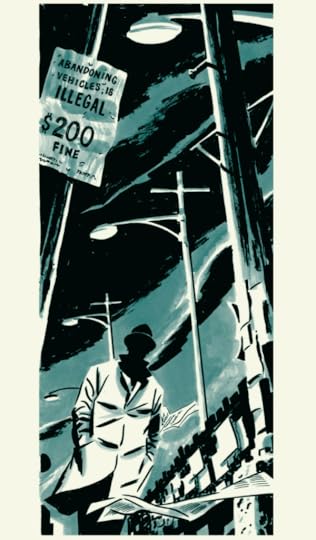
Most of the panels don’t have any captions at all and simply rely on the action drawn to tell you what’s going on, and it’s done beautifully. I especially loved the first part where Parker walks into New York without a dime to his name but using a simple scheme quickly gets a pocketful of cash, a new suit and a good meal. Cooke’s artwork tells the story and establishes Parker’s nature with barely a word. It’s a pure example of how the comic’s medium can be unique and great when done well.
If you haven’t read about Parker, I’d advise reading the books first to get Stark’s prose in it’s original form, and if like what you see there, pick this up as an excellent companion piece to it.
Darwyn Cooke adapted several of Richard Stark's (pseudonym of Donald Westlake) Parker novels. (Mel Gibson's Payback is based on The Hunter.) Parker has been double-crossed and left for dead. Now he'll stop at nothing for revenge. Parker is just as awful as those he's going after. This is some old school noir at its finest. Cooke's art feels straight out of the 50's where this took place. It's highly stylised, fitting perfectly with the time. There's a lot of violence here, quite a bit directed towards women. It is a product of its time, so be forewarned.
Illustrator Darywn Cooke's adaptation of the classic blood soaked revenge fueled noir, The Hunter by Donald Westlake's most renowned pseudonym Richard Stark captures the essence of the novel and manages to better it by adding a layer of grit to the grime, in the process creating a visually perfect picture to compliment he prose.
Parker is a professional thief, taking only the most profitable jobs; its high stakes, high risk, high reward.
When an opportunity arises to take a cut of a cool 90k, he goes all in only to be betrayed by the women he loves and double crossed by his partners.
Left for dead, Parker emerges like a hellfire Phoenix and sets out to get revenge on those who wronged him.
My rating: 5/5 Stars. Parker is a great character; his brutal nature perfectly captured in this adaptation. If you're a fan of the novels, this is a must read graphic novel.
I grew up reading pulp novels from the 50s and 60s that my uncle collected, and while this isn't in novel form, it took me back to those days.
The artwork for this graphic novel is excellent, often substituting for the narration and you don't miss those empty worded panels at all! You get the atmosphere and grittiness of underworld NYC from the black and grey images Cooke supplies us with. My only real complaint is the font wasn't always easy to read. I'll definitely be looking out for the next in the series.
Parker is a hard nosed professional thief, only taking the well paying jobs. When he starts running low on dough, he seeks out another score. This gets him by until he is double crossed by some of his cohorts and his lady out of his share of 90 grand. After some time in the slammer, Parker is bent on revenge. Just how many bodies will pile up until Parker gets his man and his dough?
This entire review has been hidden because of spoilers.
Based on the acclaimed novel of the same name by the late Richard Stark (Donald Westlake), artist Darwyn Cooke adapted it to the graphic novel medium. Parker, set up by a desperate man in need of paying off some sketchy loans, seemingly returns from the dead to settle a score. Running through members of a massive crime organization dubbed, The Outfit, Parker makes it clear he wants his money back - at any cost.
I know I've been told 'round these parts that Parker is an excellent character, but after reading this, I couldn't believe just how bad-ass he was. That's right, I went there. Not only was he calm, confident and collected in just about everything he did; he kicked some serious ass in the process.
Also, the artwork in this was just tremendous. Cooke painted the world of 1960s New York in blacks, whites and various shades of blue. I've never seen anything like it and it really fit the atmosphere of Stark's story.
I'll go so far as to say this is easily one of my new favorites and the best graphic novel I've read since Batman's The Long Halloween. I have no idea how this measures up to the original source but if it's any indication on how this series is set to progress, count me in as a extremely interested.
When I found out the local used bookstore was closing for good, I headed down there to use up my store credit. This was one of my purchases.
I last read the Parker series when University of Chicago Press reissued them and I forgot most of the wrinkles of the first book so this was an all new reading experience for the most part.
Darwyn Cooke has crafted something amazing here. Unlike a lot of adaptations, it stands on its own but remains faithful to the spirit of the original work. I was skeptical that Cooke's Tothian style would be suitable for the subject matter but he brilliantly captures the tone of the series.
His Parker is a little more handsome than I pictured Parker when I read the books but I was quickly on board. The baddest thief around is the baddest thief around in any medium. This was a slam dunk for me. Five out of five stars.
I'm a big fan of Darwyn Cooke's art, and his art is amazing in this. However, I didn't enjoy this at all. The protagonist, Parker, is a pretty horrible person. You're supposed to feel sympathy for him as he goes on his rampage of revenge against the people that tried to kill him, but by the end of the story I kind of wish that they had succeeded in killing him. The biggest problem I had with his character is the way that he treated women. He physically and mentally abuses the women that he encounters in the story. In one particular scene, he beats up an innocent woman in order to cause a distraction, and then casually contemplates raping her. He then realises a few minutes later that he had accidentally killed her. That's not the kind of person I enjoy reading about.
Starts off with a helluva quiet bang, but massive punch in the face nonetheless. Slows down some once we start to learn a little backstory, and eases into a slow smoulder with an acrid smokey haze of bitter revenge.
The source material is obviously rich, oozing atmosphere, personality and sensuality. I'm impressed as much at how little Cooke needs to extract to tell a tight but layered tale to us, and how well he translates a prose-heavy story into arresting, storytelling imagery.
Under the combination of Stark's and Cooke's hands, Parker is a cold bastard with a clear purpose, using his talents and conscience nearly as empty as a sputtering car's tank to stalk methodically to his goal.
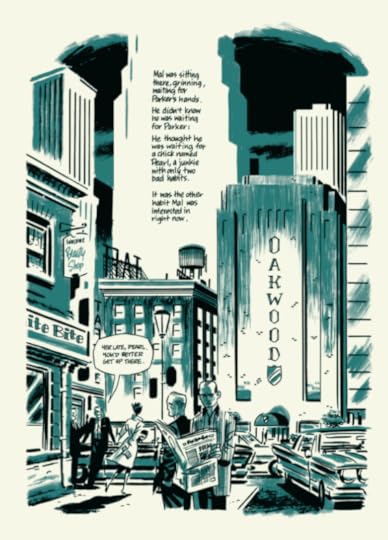
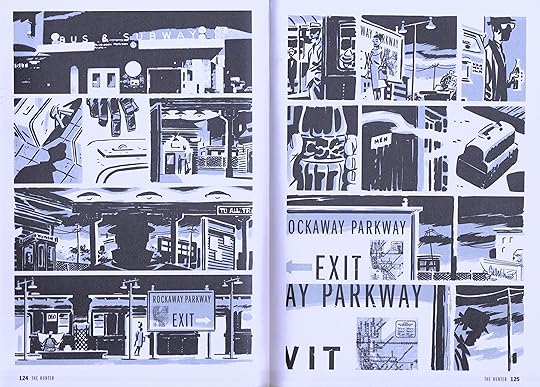
The art is terribly good, especially the staging pages - the one setting the stage for a whole set piece, arranging a selection of the props and signs of what occurred over hours of planning to tell us a whole story in one collage.
The story is great, tight, understated. The art is stylish, evocative and has a very distinct personality - like that brooding guy at the end of the bar, hunched over his double bourbon like he means to do serious harm to someone - himself or someone else, he hasn't decided.
After watching the Mel Gibson movie again last week, I decided to give this one a try.
Both Payback and this graphic novel are based on Richard Stark’s first Parker novel and so they basically tell the same story.
Parker has been double-crossed by his partner in crime Mal Resnick, shot at by his wife and left for dead. Resnick took Parker’s part of the loot and used it to pay off his debts to the Outfit, a crime syndicate. But Parker isn‘t dead at all. And now he’s back to get his revenge and take back his money.
There are a few differences between the movie and the comic. The job Parker and Resnick did together, which in both instances is told in flashbacks, is completely different and the role of Parker’s wife in it is also slightly changed.
That turned out to be a good thing for me, because otherwise there would not have been much of a point in me reading this only a week after I’ve seen the movie.
Unfortunately this means that Lucy Liu’s character from Payback is missing here, or more precisely, is massively changed and does only make a rather short and insignificant appearance. Which really is a shame, because hers is one of the most fun characters in the movie.
But more importantly, I don’t like the changes to the main character. Parker is a total bad-ass in the movie as well. But in the comic his brutal force is also directed towards innocent people. Parker was easy to root for when he only kicked the asses of all the bad guys, but much less so when he’s violent towards women (that didn’t shoot or try to shoot him). That turned me off completely. He’s also lacking the self-deprecating quality and some of the cool of Mel Gibson’s impersonation. I don’t know which one‘s closer to the character of Richard Stark’s book, but it doesn’t matter. Point is, I loved the character in the movie but thought he’s an asshole in the comic.
I’m still willing to give this a three star rating instead of a two, because the story nevertheless is entertaining and the comic does also look incredibly cool. It has that wonderful 60ies style that makes it great to look at.
Am I continuing with this one, though? I’m not sure. I just don’t like the guy.
Starkly (no pun intended - or was it?) effective crime story that will seem familiar if you've seen either Point Blank with Lee Marvin or Payback with Mel Gibson, both of which used Donald Westlake's first 'Parker' novel for their cinematic screenplays. This was one nasty little piece of sadistic, un-P.C. and probably misogynistic business . . . and I loved nearly every minute of it! (Sometimes you just want to get down in the mud and say "&$#% it, it's time for some rough justice.") It was a perfect collaboration as I'm a fan of both Cooke's stylish superhero work ( DC: The New Frontier and Batman: Ego and Other Tails) and Westlake's prodigious pulp output. Look out, everyone - Parker's back in town, and he's coming to collect his cut with a vengeance.
The late Darwyn Cooke provides us with an adaptation of a Donald E. Westlake novel, containing everything that makes a great hard-boiled noir. It's brutal (and I mean brutal), there's double-crossing and you bet a whole lot of dimly-lit rooms. Parker is not a man you want to cross (both betray or literally get in the way of). You would essentially be collateral damage. Parker doesn't care. He's just a man on a mission to get what belongs to him.
A mysterious man enters New York City in what looks like the 1950s. He's only got the clothes on his back but his wits soon has him attired in new clothes and on his mission again. He's Parker and he's been double crossed by his former partner and his wife out of money from a job they pulled in South America. But when they left him for dead, guess what? He wasn't!
A classic revenge setup then. Only unlike similar stories of vengeance (and I immediately thought of Frank Miller's The Hard Goodbye as a comparable book) the hero is entirely unsympathetic. He's as rough with the girls as he is with the boys and after mutilating his woman it's difficult to root for Parker.
He's one minded and tough, so like all good revenge stories with the archetypal "hero" he quickly kills his way to the focus of his hatred. The story has it's moments but ultimately felt that it was a bit stale. Like I said before there are a lot of revenge stories out there if you look at recent films (Taken, Last House on the Left, Kill Bill, Oldboy) or books (The Hard Goodbye, Hellblazer, Wolverine) it's a rich subgenre. Parker, while being a slightly different take on the hero, fits the mould of the revenge storyline and it's no different from any you've seen before. Parker is unstoppable and infallible. He kills his way through the book successfully, doing what he set out to do. And that's fine, but it gets a bit dull once you realise the hero is always going to win.
Darwyn Cooke's artwork is utterly fantastic. He captures the look and feel of 50s Manhattan effortlessly and the shadowing of his work and lack of colour are all plus points to the noir world he is working in. This is what tips a 3 star storyline into a 4 star comic book. It's dark and moody, scathing and furious, and always eye catching. Cooke deserves a lot of praise for his treatment of a long forgotten crime character from the inimitable Donald Westlake's early career.
"The Hunter" then lives up to the title. Dazzling artwork from a master of his craft, this is a noir crime drama played out stylishly through the comic book genre. Compellingly brutal reading, Cooke's breathed new life into an old story. An excellent read.
071110: i have now read/seen this story in 3 media: as a film point blank, as a novel, as this graphic adaption...
it is a different experience in each, prompting some thought on its iterations. story is simple, story is slightly different between book and graphic, quite different as film: film follows brief introduction of treachery, concentrates then on revenge, treated in some way as the absurdist theatre it is. book takes a bit more effort, shows up certain implausibilities, while graphic has beautiful stylization, ???? ??? 2010s: beautiful era-specific visualization, but also suggests story weaknesses, primarily treacherous stimulus. film is completely other, focusing more on the outfit vs parker, but of each i like this as graphic best...
misogynist of it times in popular culture, laudatory of the individual, skeptical of any sort of ideals: this makes no claims of high art, defines itself as genre, strips all the complexity, believability, ambiguity, of both characters and plot. i do not know if it was original of its time: it is not now, but somehow this simplicity, this naïveté, this clarity of right- basically our hero/antihero- versus wrong- everybody else, makes the story work in a way that asks no critical appraisal, makes the story coherent...
liked this work more the second time than the first reading..
There are few things I love more then Crime Fiction. There are few things in that genre that I love more then the great Don Westlake’s Parker novels. Written under the pseudonym Richard Stark and spanning twenty four novels, the series follows professional thief Parker from job to job.
The books themselves vary little, most follow a pretty set formula Where in, A) Parker takes a job. B) Some poor fool crosses him. C) We follow said poor fool as we watch him try to escape from Parker’s wrath. D) The Poor Son Of Bitch Thinks he’s escaped Parker’s wrath. E) He finds out he hasn’t. F) We double back in time with Parker to find out just how he found the poor fool and how he’s going to make the poor fool wish he’d never been born.
What makes The Parker books unique, is their utter lack of sentimentality. Parker is not a thief with a heart of gold, not even remotely. He’s a cold, mean and often times pure nasty son of a bitch, who extracts vengeance like someone pulling out teeth with a claw hammer.
Parker at the core of his character is simply someone who doesn’t give a fuck. He’s like Tom Ripley without delusions of grandeur. He will straight up murder you and your family. Not because he hates you, not because you made him mad, not because he’s crazy but because he’s a professional thief with no delusions about what he does, and if you need to die so he can do what he does, well that’s a price he’s more then willing to pay.
How cold is he? Upon finding his wife’s dead body he expresses his grief by carving up her face so the police can’t put her picture in the paper and then dumping her body in the park. Just so his quarry won’t know he’s coming.
Based on the first novel in the series, Darwyn Cooke’s The Hunter, his retelling of the first Parker story, ends up being as perfect of an adaptation as Parker is ever going to have. Cooke’s retro style and clean line drawn artwork ends up being the perfect conduit for Stark’s efficient, clean, hard prose, and dark pitiless storytelling. There are sequences here, like Parker's wordless entry into New York, that are done so perfectly they almost hurt.
The first book starts with Parker gunning for revenge. Betrayed and left for dead by his partner and spouse, Parker decides to get some good ole fashioned vengeance, even if he has to kill half of the gangsters in New York to get it.
As he did in his seminal New Frontier, Cooke art perfectly captures the time period. It’s not just set in the early sixties, it looks like it was made then. With it’s overripe dames, hard cut men, and purty purty style The Hunter manages to look like something that escaped from Mad Men’s raging id. The warmth of the retro style is perfectly off set by Starks cold merciless story which Cooke perserve’s perfectly. The last thing you see in the book is Parker’s cold unforgiving eyes staring out from the back of the book, announcing the next chapter is coming out in a year. I can hardly wait.
An old favorite is all well and good, something that lets you look at an old favorite as though it’s the first time is something to be truly cherished.
What a mixed bag for me. There’s some truly top-notch talent on display here, both in storytelling and art. Cooke’s style is incredible — sharp, moody, and pure noir. His art is perfectly suited for this adaptation: heavy inks, bold lines, and cinematic layouts that drop you straight into the 1960s crime world. Parker himself is all grit and menace, an unrelenting professional criminal who feels dangerous on every page. The heist setup and double-crosses keep the story moving, and Cooke knows when to let panels breathe so the tension builds.
That said, the violence against women really drags the book down for me. My understanding is that it’s faithful to Stark’s original novel, but on the page it comes across as ugly and needless, undercutting the brilliance of the visual storytelling. It made the book harder to fully embrace, even though the craft is undeniably top-tier.
Overall, this is a striking and stylish & proves just how good comics can be at delivering hardboiled crime. I’ll definitely try the next volumes (The Outfit, The Score, Slayground), but I’m hoping the focus leans more on Parker’s heists and less on dated, ugly tropes. I get that it’s “of its era,” but it still pulled me out of the experience.
- This is a very faithful adaptation to the source material. The few changes that I noticed were made just to work better with the graphic medium. - Beautiful hard-boiled art style, reminiscent of the art of Sin City. - Better ending point than the original novel, which had another job tacked on at the end. - Really nice hardcover book with a book jacket cover.
CONS:
- Interior art is grey-scale, not in color like the cover. - So similar to the novel that it is redundant to read both. - The entire Parker series has not (yet?) been made into graphic novels, although there are a few more volumes.
Great hardboiled suspense graphic novel. Darwyn Cooke's art is fantastic. It captures the era, 1960s America, beautifully. If you want a Mad Men style criminal graphic novel, then look no further.
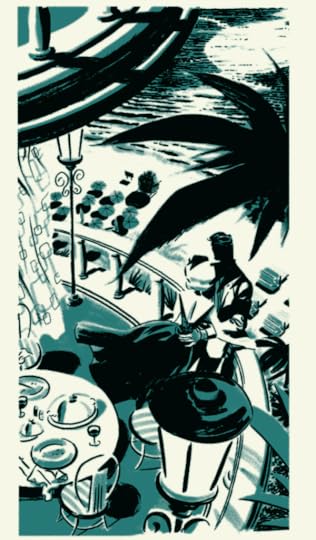
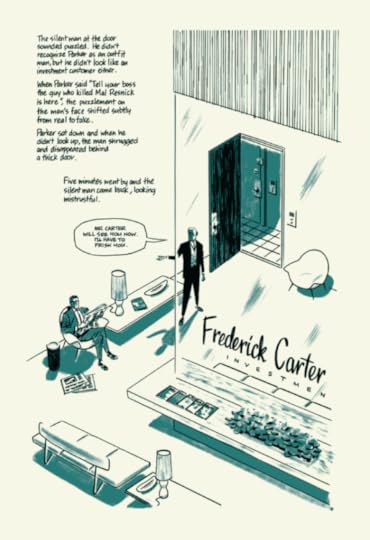
Richard Stark's first Parker novel, The Hunter, was the perfect story to be recreated as a graphic novel. The graphics are dark and powerful. Parker is a little more handsome than I pictured him. Stark said when he was creating Parker, he pictured someone like Jack Palance. Perfect. The story was written in 1962, so Cooke clearly had a lot of fun recreating those days. The store signs, the clothes, the mid century modern furniture. Lots of great detail.
I also enjoyed where they chose to end the story. In the original novel, everything gets wrapped up but then there's this whole section on the cops taking him in for questioning on another matter. I felt like this whole part of the book was anticlimactic, and I ended up a little less satisfied with the read. Here they lop off that entire part of the story and end things where it should've ended in the first place. Stark died in 2008 and this book was published in 2009. I'm not sure how much Stark was involved but I like to think he was happy to have the chance to rewrite history.
Richard Stark writing plus quality art. A great,great Graphic Novel and now I finally see why Cooke's art is so highly rated.
Almost black,white art that makes the story come alive very strong. You can see Cooke is a real Richard Stark fan, Parker is drawn like a mean looking guy which is a copy of my ideal look for Parker that i have in my mind when i read the books.
The art and visual storytelling by Darwyn Cooke are excellent. Just detailed enough for clarity yet stylized enough to evoke a noir-type atmosphere.
There are rare times when a graphic novel's story does not live up to it's artwork. This is, unfortunately, one of those times. Although there are occasional interesting mystery novel elements; this is basically a dark, unpleasant revenge story.
The main character, Parker, is an amoral thief who got double-crossed and spends the entire novel working his way back up the line of criminals and thugs to the person responsible. The criminal-underbelly world he travels on this journey is unpleasant and brutal. Both innocent and guilty are killed by Parker's actions but it doesn't seem to phase him for longer than a panel.
Parker is also a surprisingly single-note character. He is consistently the strongest in every fight, the smartest in every contest and the most attractive to every female character. I think we all want our heroes to have certain strengths but by the end of the story it's starting to feel more like the writer's idealized fantasy alter-ego than an actual flesh and blood human being. In the end, after all the bloodshed, it barely feels like anything of any value has been accomplished.
Perhaps the original novel depicts a more believable protagonist, or a more compelling inner struggle, but this graphic novel adaptation falls a bit short of that.
Two stars for the brilliant artwork. No stars for a story which was unnecessarily brutal, pointless and not short enough.
Detective fiction in comics form of this level of quality is quite rare, or at least that's been my experience. Darwyn Cooke has done an outstanding job adapting this classic novel by the great Donald Westlake (writing as Richard Stark.) I'm only familiar with the Parker books by reputation, but the genre "hard-boiled" definitely applies. Short summary: Parker returns from the dead for some payback. Obviously he's not really dead, and this comes as a bit of a surprise to the folks who thought they left him that way. Hijinks ensue. Parker is tough, ruthless, and relentless, and it's not really spoiling anything to say that his payback is every bit as glorious as it should be. Cooke adapted several of the Parker books, and I've heard nothing but praise for them. His art is well-suited to the material, having a wonderful retro vibe to it. He draws a bit like a cross between Alex Toth and Michael T. Gilbert, with maybe a touch of Steve Ditko as well. It's a smooth cocktail that goes down easy, with a surprising kick to it. Good stuff!
Years ago, I discovered Richard Stark's 'Parker' thanks to this book. I'd been a fan of Darwyn Cooke's work for years so when I heard about this particular project I decided to check out Stark's novels. I figured I'd read them so that I could then see how close to the source Cooke had stayed in bringing his adaptation to the comic book page.
I really liked those Richard Stark novels. But! To read this adaptation was... amazing. The quality of the original story is without question, but to read it, as faithfully adapted & illustrated by Darwyn Cooke, was really special.
The Terminator 2.0 I remember sifting through a bunch of books written by Dawryn Cooke and seeing this series pop up in the form of the Martini Edition. Immediately I was hooked. A crime story adapted and illustrated by one of my favourite artists? Boom. Done. Only took about a month for Diamond to ship everything, but the four volumes finally came. And since I am one of the only people on the planet who didn’t really like The New Frontier, and one of the only people on the planet who thought that Before Watchmen: Minutemen was a near masterpiece of a story, I was ready for a new Darwyn Cooke Story. RIP by the way.
First I’ll delve into the story and characters. The story is structured as an unfolding revenge story that we don’t know is a revenge story until just over halfway through. This is a very straightforward and fast moving introduction to this world. There is barely a dull or slow moment in this book. I’ll get into the negatives with this later. The entire feel of this book is very noirish, stylish, and sometimes dreamlike, especially in the first scene which by the way is probably the best scene in the book. This book reminded me of 2 other stories. Goodfellas (1990) and A History of Violence (2005). If you enjoyed those two movies you will more than likely have a good time with this book. That’s what I can say about the book. Its a solid crime story with one of the most stone cold merciless bastards of a protagonist I’ve ever scene. Parker is just a terrible person man. I don’t think he did one thing in the book for unselfish reasons. This doesn’t mean I thought he was a bad character though. Far from it. I will get more into his complex yet simple character later. But I will say that Parker is also not an anti hero. He’s straight up just a bad-ass criminal that we are following through this crime ridden world. The supporting characters like Mal, Lynn, and a few others are nothing toooooo special but do provide for some truly great flashback moments.
My negatives with this book are 2 fold. One is the way some story beats are told, and the other is certain things about our main protagonist that were lacking. Okay so I know that these books were adapted from novels but at some point at least twice in all 4 parts of the story it felt like I was reading one. Meaning lots of long pages of text and lots of exposition. There isn’t anything else I can call this. There is a lot of exposition. And what’s the classic rule we’ve heard a gazillion times? SHOW DON'T TELL. This book did not accomplish that at many points. I know we don’t need to see absolutely everything, and maybe somethings are more interesting to imagine, but goddamn there were a few things I would’ve liked to have seen. But unfortunately there was a lot of exposition dressed up in cursive writing next to an amazing illustration. NOW in terms of the character of Parker, I have some complaints. Overall I do like his character, but in this book he is waaaay to impersonal. He is like I said before, a stone cold merciless bastard of a protagonist that will kill anyone in his way. Even innocent people who had nothing to do with him and his revenge mission. But this isn’t really my problem. Since we are given such little insight into Parker’s personality, personal limitations, or deeper traits, I don’t really see too much reason to truly care. I was entertained by reading this unstoppable T-800 esc dude wiping out everyone in his path, but in terms of a connection to the character or relatability, there wasn’t much unfortunately.
What more is there to say about Darwyn Cooke’s iconic art style? I stopped so many times mid speech bubble just to gawk at the incredible penciling and inking I had in my hands. I know I sound cliched as hell saying this, but I don’t think anyone else’s style could encapsulate the Golden age 1950s/1960s feel as much as his. Even scenery in this book is gorgeously drawn. And one of my favourite aspects of the book is that not every drawing of a person is hyper detailed and perfect. Sometimes a lack of detail or polished forms really gives the book a more interesting aesthetic. At least to me. The blue shading and filling also works very well.
In the end, this is a solid and very intriguing crime/revenge story. The story unfolds in a very smooth and unexpected way and the art is to die for. There are certain things lacking in terms of our main character and there is a lot of exposition that is not needed. Letter Grade: (B+)
Book Construction: Since I didn’t end up getting the Martini Edition, the four hardcover volumes are more than sufficient. These are some of my favourite hardcovers I own just because of the production value. The actual hardcover has a rough texture, there is a different silhouette imprint on each of them, and the spine is written in slightly embossed white cursive. Delicious. The paper is also thick ass card stock. So that’s also great, because compared to the recent marvel trades where you could put a whole threw the paper by blowing on it, this paper quality is fantastic.
As anyone reading this should know, "Parker" is one of fiction's more famous noir characters: ruthless, meticulous, callous and pretty indestructible. So, y'know, pretty cool. Unfortunately, our library only has a spotty assortment of Stark's books, and so to follow the plot from the very beginning, I have to alternate between the real novels and Cooke's graphic adaptations.
Luckily, I was already familiar with this first story from the Mel Gibson film "Payback," (which was a pretty great movie, because nobody does psycho like Mel - and now we know why). Which was good, because what we get is a lot of this:
....which is kind of "all the plot without all those annoying words!" Except that Stark happens to be very good with words; and so while this book maintains at least some of his dark dialogue, it totally losses the feel of Stark's excellent descriptive writing. However, this book did serve its purpose of at least setting me up for the second novel, The Man With the Getaway Face, which I read a year or so ago. And so that brings me up to #3 now, The Outfit, which the library also only has in graphic novel form...but then they do have the "real" book for #4...and so on.
If you're really a big graphic novel fan, than this is pretty well done - nice, two-color '60s-style artwork. But otherwise, you can't beat Stark's original stories. And yes, I know I could just buy beat-up, read-and-toss copies on Amazon - but even those go for between $10-15 with shipping; apparently, people who own these books don't want to part with them.
Violento, desagradable a ratos, un protagonista con el que no empatizas aunque puedas entender sus razones. Novela negra con un estilo de cómic muy gráfico e impactante. Me lo prestaron y lo leí poco a poco para aquilatar el mal rato.
Darwyn Cooke’s ‘Parker: The Hunter,’ the first in a series of Richard Stark crime noir novels adaptations, begins in a swirl of activity, conveyed almost exclusively in the purely visual language of comic books.
Parker, a big, rangy, man, dirty and ragged, ready to explode. For some unknown reason out striding down the middle of the George Washington bridge into 1960s Manhattan, purposefully moving into the city, oblivious to all the cars and people, intent only on what he’s got to do. Within a few breathless and breath-taking pages, he’s bummed a smoke and created a false identity and finagled his way into a clean suit and some funding and slammed into his wife’s apartment. His wife, who thought she had killed him.
The way Cooke does all this is made even more amazing by the fact that he rarely shows Parker’s face, that he draws in quick, bold black lines and colors in only with cyan, and that for twenty-odd pages Parker utters only three words. Those are to the nice guy who’s offering him a ride across the bridge: ‘Go to hell.’
This is everything comics should be. Cooke grabs you and then doesn’t let you go. It’s just like what happens with a good book or movie, but in the singular style of this unique medium.
Noir is an ideal genre for the graphic novel because the prose is terse and oriented toward action and dialogue. This is particularly true of the Parker novels. Donald Westlake, writing as Richard Stark, is nothing but economic, firing off quick, staccato bursts of words—only as many as are needed to propel the story.
Parker is hardly an introspective character, either. He lives just for the scores he makes in high-end armed robberies. Saying he’s amoral is a little too easy, because he knows what’s enough and is fair to his colleagues.
One of those colleagues, a mob underling perfectly named Mal, turns out to be unfair to Parker in a big way. He takes Parker’s money. Being left for dead doesn’t matter as much to Parker as losing his anonymity when he’s busted for vagrancy. But what’s really important is the money.
Parker is driven by one clear goal—he wants his money back.
Cooke translates that drive and Westlake’s narrative energy into slashing lines and action-filled panels that pull you from one into the next as Parker, cold-blooded as a reptile, leaves a trail of death behind him. He works up the ‘outfit’s’ chain of command, gets his money, and gets away. No message, just plot. But hey, what a plot. And Parker, on a relentless trajectory, gets you on his side.
Stark’s Parker makes Lee Child’s Jack Reacher look wimpy. This is not for the faint of heart. Forget about the milk of human kindness.
Darwyn Cooke is the perfect artist to take on this brutal yet appealing killer. One great thrill of a comic book.
(Reprinted from the Chicago Center for Literature and Photography [cclapcenter.com:]. I am the original author of this essay, as well as the owner of CCLaP; it is not being reprinted illegally.)
Late author Donald Westlake is apparently a revered figure in the world of crime novels, which admittedly I'm not much of a fan of; and while writing under his pseudonym "Richard Stark," one of his most infamous characters turned out to be a professional con-man and complete sociopath known only as "Parker," who made the first of his 24 literary appearances in the 1962 novel The Hunter, adapted last year into comic form for the very first time by respected visual artist Darwyn Cooke. But I don't know, maybe I'm the wrong person to be reviewing this, but I found the actual storyline to be abhorrent, just utterly abhorrent, a tale that celebrates the kind of violent psychopath who for example made up the vast majority of mid-level Nazis during World War Two, who spends the entire book basically going around beating the sh-t out of random women (just to cite one infamous example), not because they had anything to do with the botched crime for which Parker is seeking revenge, but literally because they happen to be random strangers who just happened to get in his way one day while he was seeking this revenge. I found the entire thing just really distastefully misogynist, and the only reason this book's getting as high a score as it is is because of the exquisite Mid-Century Modernist visual style of Cooke, which is obviously the main reason he wanted to adapt this particular story in the first place. I mean, obviously it floats some people's boats, in that Parker grew over the years to become an entire franchise unto himself; but this kind of charm-free, incomprehensibly violent story is just not for me at all.