What happens when you invite as many jazz musicians as you can to pose for a photo in 1950s Harlem? Playful verse and glorious artwork capture an iconic moment for American jazz.
When Esquire magazine planned an issue to salute the American jazz scene in 1958, graphic designer Art Kane pitched a crazy idea: how about gathering a group of beloved jazz musicians and photographing them? He didn’t own a good camera, didn’t know if any musicians would show up, and insisted on setting up the shoot in front of a Harlem brownstone. Could he pull it off? In a captivating collection of poems, Roxane Orgill steps into the frame of Harlem 1958, bringing to life the musicians’ mischief and quirks, their memorable style, and the vivacious atmosphere of a Harlem block full of kids on a hot summer’s day. Francis Vallejo’s vibrant, detailed, and wonderfully expressive paintings do loving justice to the larger-than-life quality of jazz musicians of the era. Includes bios of several of the fifty-seven musicians, an author’s note, sources, a bibliography, and a foldout of Art Kane’s famous photograph.
Roxane Orgill is an award-winning writer on music and the author of JAZZ DAY: THE MAKING OF A FAMOUS PHOTOGRAPH, illustrated by Francis Vallejo (Candlewick Press). JAZZ DAY earned six starred reviews and won The Boston Globe-Horn Book Award for Best Picture Book in 2016. Orgill has written several biographies for young readers, including SKIT-SCAT RAGGEDY CAT: ELLA FITZGERALD and FOOTWORK: THE STORY OF FRED AND ADELE ASTAIRE (Candlewick). She is also the author of DREAM LUCKY, a book for adults about big-band jazz, race, and politics in the 1930s (Smithsonian Books). She lives in Dobbs Ferry, NY.
Some books for kids have a hard road ahead of them. Here’s a secret. If you want a book to sell just oodles and oodles of copies to the general public, all you have to do is avoid writing in one of two specific genres: poetry and nonfiction. Even the best and brightest nonfiction books have a nasty tendency to fade from public memory too soon, and poetry only ever gets any notice during April a.k.a National Poetry Month. I say that, and yet there are some brave souls out there who will sometimes not just write poetry. Not just write nonfiction. They’ll write nonfiction-inspired poetry. It’s crazy! It’s like they care about the quality of the content more than make a bazillion dollars or something. The latest book to fall into this category is Jazz Day: The Making of a Famous Photograph by Roxane Orgill. Melding topics like jazz musicians and photography with history, poetry, and some truly keen art, this isn’t really like any other book on your shelves. I’m betting that that’s a good thing too.
It was sort of a crazy idea for a graphic designer / jazz buff to come up with. By 1958 jazz was a well-established, deeply American, musical genre. So why not try to get all the jazz greats, and maybe some up-and-comers, into a single photograph all together? The call went out but Art Kane (who really wasn’t a photographer himself) had no idea who would turn up. After all, they were going to take the picture at ten in the morning. That’s a time most jazz performers are fast asleep. Yet almost miraculously they came. Count Basie and Thelonious Monk. Maxine Sullivan and Dizzy Gillespie. Some of them were tired. Some were having a great time catching up with old friends. And after much cajoling on Kane’s part a photo was made. Fifty-seven musicians (fifty-eight if you count Willie “Lion” Smith just out of frame). Orgill tells the tale in poetry, with artist Francis Vallejo providing the art and life. Extensive backmatter consists of an Author’s Note, Biographies, a page on the photo and homages to it, Source Notes, and a Bibliography that includes Books, Articles, Audiovisual Material, and Websites.
Jazz is often compared to poetry. So giving this book too rigid a structure wouldn’t offer the right feel at all. I’m no poet. I wish I had a better appreciation for the art than I do. Yet even with my limited understanding of the style I found myself stopping when I read the poem “This Moment” written from the point of view of Eddie Locke, a drummer. It’s the kind of poem where it’s composed as a series of quatrains. The second and fourth lines of each stanza are repeated as the first and third lines of the next. It was fortunate for me that Orgill mentions in the back of the book that the poem is a pantoum. I’d never have come up with that term myself (I thought it was a sestina). Most of the poetry in the book isn’t really that formal. In fact, Orgill confesses that, “I write prose, not poetry. But this story demanded a sense of freedom, an intensity, and a conciseness that prose could not provide.” The result is that most of the poems are free verse, which I much preferred.
Did you know that when publishing a book for kids you’re not supposed to turn in your manuscript with an illustrator already attached? True fact. Editors like having the power to pair authors and artists together. To be honest, they have experience in this area and sometimes their intervention is sublime (sometimes it fails miserably too, but that’s a tale for another day). I’m afraid I don’t know what Candlewick editor saw Orgill’s manuscript and thought of Francis Vallejo as a potential illustrator. If I knew I’d kiss them. Detroit born Vallejo is making his debut with this book and you’d never know in a million years that he wasn’t a born and bred Harlemite. His style is perfect for this tale. As adept at comic style panels as he is acrylic and pastel jazz scenes, there’s life in this man’s art. It was born to accompany jazz. It’s also particularly interesting watching what he does with light. The very beginning of the book shows a sunrise coming up on a hot August day. As it rises, shadows make way. This play between light and shadow, between the heat of the photo shoot and the cool jazz clubs that occasionally make an appearance in the text, gives the book its heart. It’s playful and serious all at once so that when you lift the page that reveals the real photograph, that action produces a very real moment of awe.
There’s been a lot of talk in the world of children’s literature lately about the research done on both works of fiction and nonfiction. Anytime you set your book in the past you have a responsibility to get the facts right. Part of what I love so much about Jazz Day is the extent of the research here. Orgill could easily have found a couple articles and books about the day of the photograph and stopped there. Instead, she writes that “Kane was by all accounts a wonderful storyteller, but one who did not always adhere to the facts. With the help of his son Jonathan Kane, I tried to set the story of the photograph straight.” Instructors who are teaching about primary sources in the schools could use this anecdote to show how reaching out to primary sources is something you need to do all the time. The rest of the backmatter (and it really is some of the most extensive I’ve ever seen) would be well worth showing to kids as well.
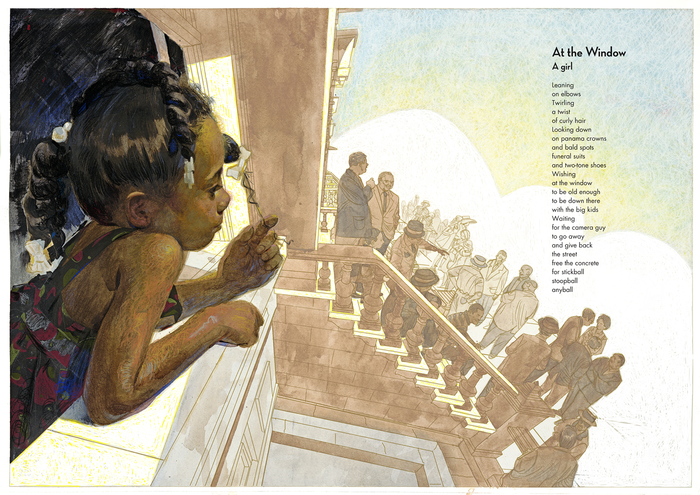
The question then becomes, whom is this book for? The complexity of the subject matter suggests that it’s meant for older kids. Those kids that might have a sense of some of the history (they might have heard what jazz is or who Duke Ellington was at some point in their travels). But would they read it for pleasure or as a kind of assigned reading? I don’t know. I certainly found it amusing enough, but I’m a 37-year-old woman. Not the target age range exactly. Yet I want to believe that there’s a fair amount of kid-friendly material here. Poems like “So Glad” and “quartet” may be about adults talking from an adult perspective, but Orgill cleverly livens the book up with the perspective of kids every step of the way. From the children sitting bored on the curb to a girl peering down from her window wishing the jazz men and photographer would just go away, kids get to give their two cents constantly. Read it more than once and you’ll begin to recognize some of them. Brothers Alfred and Nelson crop up more than a couple times too. Their mischief is just what the doctor ordered. With that in mind, it might be a good idea to have kids read different poems at different times. Save the more esoteric ones for later.
Jazz is hard to teach to kids. They know it’s important but it’s hard to make it human. There are always exceptions, though. For example, my 20-month-old is so obsessed with the book This Jazz Man by Karen Ehrhardt that he’ll have me read it to him a hundred times over. To my mind, that’s what this book is capable of, if at a much older level. It humanizes the players and can serve as a starting point for discussions, teaching units, you name it. These men and women are hot and tired and laughing and alive, if only at this moment in time. It’s a snapshot in both the literal and figurative sense. It’ll take some work to get it into the right hands, I suspect, but in the end it’s worth it. Jazz isn’t some weird otherworldly language. It’s people. These people. Now the kids in the book, and the kids reading this book, have a chance to get to know them.
Marvelous. About half is the poems (mostly free verse, like improv.) and about half is all the notes that many of us always wish for. Iow, very useful in an educational setting!
But also beautifully illustrated, and engaging. Not for tots, really more for those children old enough to do research reports. But the poems and pictures certainly can be shared with jazzy little ones if you have a family of different ages. Don't forget to play some jazz before and after reading, too!
I'd actually never seen the photo before and appreciate that it was reproduced in a fold-out. This is a book you want in paper, not on an e-reader, if at all possible. Do hunt it down from your library, and if you're interested in American music (or black history) do consider buying it if your library doesn't have it.
I'm so pleased to be able to report that my little library in semi-rural Missouri did buy it. I think it was because of a grant for this past summer reading program which was focused on music, but for whatever reason, they did choose it, and yay!
A poetic look at the making of a famous photograph.
The well-written introduction gives readers all they need to be able to appreciate the project Art Kane took on in dreaming up this photograph. The poems themselves take readers into the sights, sounds, and feels of the set that day in August 1958 and do much to create enthusiasm for jazz music and its many makers.
The photo is included in a special fold out section and the poems preceding it do much to build up the readers' anticipation of the photo's unveiling. Back matter includes an author's note that details why the author wrote the book and the creative decisions she made in the process. An outline of the photo assigns each person in the photo a number which helps the reader identify everybody. Biographies for the different jazz musicians referred to in text are included which give readers some important facts about each but also keeps it grounded in the moment in time that this book is set.
A section titled Harlem 1958: Beyond Esquire helps readers to understand the historic impact this photo had and its continuing influence. A bibliography is also included and offers the reader a wealth of information in the form of not only books, but articles, AV, and websites.
This is a must read for all ages; the level of research and the special treatment of this subject make it a book not to be missed.
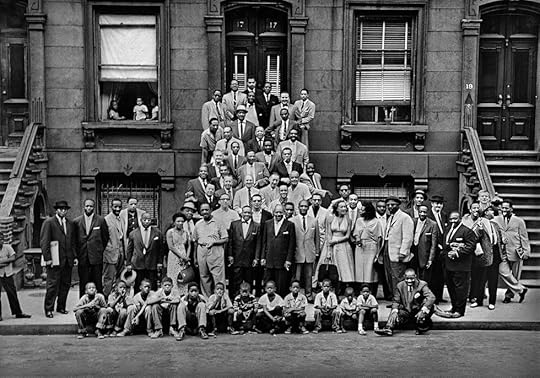
This is the famous photograph, Harlem 1958, the topic of this picturebook:
I love the concept of Jazz Day (i.e., its successful attempt to recreate the day the famous photo was taken). And the amount of research that was put into this project simply amazes me.
The clever, mostly free verse poems and the vibrant illustrations that at times look improvised or like a work still in progress both convey the spirit of jazz perfectly:
I also really appreciate the educational value of Jazz Day as I learnt a lot from it, especially from its introduction, author's note, selected biographies and a partial list of other homages to the famous photo.
So why only three stars then, you might ask. The reason is totally personal: I am not that interested in jazz and Jazz Day didn't really change that. It didn't speak to me, if you know what I mean.
I can't convey strongly enough how much I love this book. The text is wonderful, pictures, illustrations-just perfect. I am thrilled that children will be learning more about such amazing icons of jazz. Btw, Jazz Day should have many top awards bestowed upon it.
Music historian and children's author Roxanne Orgill takes a look at the creation of the famous photograph, "Harlem 1958," in which fifty-seven jazz musicians gathered in Harlem for a photo shoot for a special supplement of Esquire Magazine, on 'The Golden Age of Jazz.' Using mostly free-form poetry, with a few more formal poems as well, Orgill chronicles the process in which graphic designer Art Kane gathered so many Jazz luminaries for the shoot that day, as well as the interactions amongst the musicians, and between the musicians and the neighborhood boys gathered to watch the proceedings.
An enjoyable and informative book, one which highlights a moment in history about which I knew very little, Jazz Days: The Making of a Famous Photograph is creative history, offering a poetic depiction of the people involved in one iconic mid-20th-century picture. I appreciated the information made available, both in the poems themselves, and in the detailed after-matter, which included a general history of the making of the photograph, a mini-biography of each musician depicted in the poems, and a long list of further reading material. The poems themselves were sometimes a little uneven - this is the author's first attempt at writing in this form - but the stories they told were always involving. Recommended to anyone looking for picture-books featuring music, musicians, and/or Jazz.
Richie’s Picks: JAZZ DAY: THE MAKING OF A FAMOUS PHOTOGRAPH by Roxane Orgill and Francis Vallejo, ill., Candlewick, March 2016, 66p., ISBN: 978-0-7636-6954-6
“Late Thelonious Monk, pianist
The man from the record company hired a taxi To pick up Thelonious Sphere Monk Who had a regular gig with a quartet At the Five Spot in Cooper Square Turned them away Night after night Late Monk was always late For work at the Five Spot Straight to the piano To play a melody His quartet could not follow Did a dance during Johnny Griffin’s solo Or went for a stroll through the club Six nights a week Mondays off
Ten in the morning was unspeakably early For Thelonious Sphere Monk Who was always Late Taxi waited outside his building On West Sixty-Third Meter running An hour and more While Monk tried on jackets To complete the perfect outfit Emerging at last in pale-yellow linen Skinny tie, dark slacks, porkpie hat And the inevitable bamboo-frame sunglasses The ones he always wore to play ‘Misterioso’”
JAZZ DAY is a toe-tapping nonfiction picture book for older readers. It’s a poetic look back at a long-ago day on a street in Harlem when a famous photograph came into being.
What classical music is to others, jazz is to me. The other day while driving up the freeway, I was listening to Jazz91, KCSM from the College of San Mateo, when “Blue Monk” came on. The song is a year older than me.
I wish that I were still so fresh and engaging.
After reading JAZZ DAY, with the melody of “Blue Monk” still on my mind, I retrieved a list of the top popular songs from that same year, 1954, opened YouTube, and began playing those sixty-two year-old “popular” songs. To tell you the truth, I didn’t get very far. One after another, the songs were incredibly dated. But that’s not the case with the jazz that came out of 1954 or the rest of the Fifties.
In 1958, with growing mainstream interest in jazz, jazz buff and graphic designer Art Kane imagined photographing a crowd of jazz musicians in front of an “absolutely typical brownstone” in Harlem. He successfully pitched the idea to Esquire magazine for its forthcoming issue on American jazz. JAZZ DAY is the story, told in poems, about the musicians who showed up that day for the iconic photograph and the neighborhood kids who happened to be there too.
Given that this was a 10 a.m. unpaid gig, Art Kane couldn’t predict who would show up. The fifty-seven musicians who ended up being photographed include both the well-known and the relatively anonymous. This was an amazing era for jazz, and so many of my own favorites such Jackie McLean, Sonny Stitt, Ella Fitzgerald, and the members of the Miles Davis quartet who would shortly thereafter record “Kind of Blue” are missing from the photo.
Illustrator Francis Vallejo does a stellar job of capturing the personalities of the musicians and the neighborhood children who were also immortalized in the photograph. Readers who examine the illustrations will be rewarded with glimpses of the attire and automobiles of that era.
The author employs a variety of poetic forms to tell the story. I love the way that contemporary popular black culture is seamlessly woven into poems like “How to Make a Porkpie Hat, Lester ‘Pres’ Young, tenor saxophonist.” The author also provides detailed front- and back-matter explaining the history of the photograph and the musicians in it.
You can’t read a book like this without musical accompaniment. One of the musicians photographed was Art Blakey. Here’s a taste of his band in 1958, which includes a 20-year-old Lee Morgan: https://www.youtube.com/watch?v=M57Qr...
Jazz has always been compared to poetry. It's fluid and ever changing; not sticking to strict form in most senses. This book felt perfect as a collection of poems. It embodied the personalities of some incredible jazz greats. This group of people requires freedom, not structure.
Francis Vallejo's illustrations match perfectly. The acrylic and pastels show movement- like these cats can't sit still. Which, my guess is, they couldn't-- there's a reason it took 5 hours to take this shot. There's a bit of a comic-panel style in some of these illustrations as well. Particularly in Hat.
My favorite poems: • So Glad about Milt "Fump" Hilton, bassist and amateur photographer who wanted his wife to also capture the film. • Late about Thelonious Monk, pianist • She's Here! About Maxine Sullivan, singer • Esquire, 60 Cents about Alfred, a boy who was hanging around that day of the photograph
Lastly, I was blown away by the notes at the end of the book. Orgill provides some background into her inspirations. There is a collection of mini biographies for each musician who is featured in a poem, along with the corresponding illustration by Vallejo. There are source notes, and an extensive bibliography. Never in a poetry book have I seen a bibliography-- but this just shows that Orgill did her work thoroughly.
This is an incredible snapshot of history in beautiful words and illustrations. I strongly recommend this book to anyone who has a passion for history, poetry, jazz, or just a well-crafted piece of work.
Jazz Day is remarkable poetry collection in which the author recreates an iconic 1958 Harlem photograph spotlighting many famous jazz musicians in just 21 poems. The poems flows beautifully as the sets up the background starting with Kane's inspiration of the photograph to providing short glimpses of the musicians' biography. Since I don't listen to jazz, a lot of the musicians were new to me and I learned a great deal from the poems. My favorite part of the book is the illustrated reproduction of the famous photograph. The illustrator beautifully captures not only the photograph in great details in acrylic and pastel painting but also captures the tone and the excitement of the photo shoot in progress. There is also an extensive resources page with thumbnail biographies, list of source notes, and bibliography for further reading. Jazz Day is a great resource for teachers and librarians who would like to do a lesson on music and poetry.
It's hard to top a book like this one for thoroughness. The author really did the necessary legwork here. This is a book of poems chronicling the taking of a famous photograph of jazz musicians for Essence magazine. Honestly, I'd never heard of the photo prior to reading this book, but I read this and learned quite a lot. A copy of the photo is contained in a foldout page in the middle. I liked this book for a lot of reasons, but more than anything I like that there is no part of this book that is not done to the highest caliber. The poetry, the mixed-media illustrations on the cover, the beautiful paintings inside, the biographies at the end, the research it took to get it all just right; this was a book that wanted to get it right, and it spared no effort to assure that that happened. Very impressive, from beginning to end.
This narrative nonfiction is a story about 1958 Harlem and the making of a picture in a magazine article about jazz players. Throughout the story we get to take a look at the musicians talent and struggles, their memorable characteristics, and the atmosphere of Harlem at the time which was full or energy both good and bad. The story takes us on a journey of how the photographer got all the musicians together for one big picture and features dozens of real-life jazz musicians. I think this story would definitely be used in the classroom because it has a strong plot that's easy to understand and sheds light on some information the children might not necessarily learn from the textbook about the era of jazz and it's great influencers.
This is a tasteful and rich tribute to jazz and its history and culture in the 1950's. It contains poems which tell the story of a unique magazine photograph being made and highlights many jazz musicians, as well as the regular people watching it in the Harlem community. The writing is creative and illustrations are astonishingly beautiful. The book also shows the real magazine photo in its middle and identifies each in the photo in the notes at the end. I also liked a lot that the author in his end notes said he hoped that the poems contained the sounds of jazz music and that they would drive readers to listen to recorded or live jazz. Excellent book.
Winner of American Library Association Notable Book Award, Boston Globe-Horn Book Award for Best Picture Book 2016, Center for the Study of Multicultural Children's Literature Best Books of 2016 and many others provides a picture into Harlem 1958. This book has much to offer readers as both an inviting and engaging example of poetry but also to expose readers to Jazz and Harlem in the late 1950s. The poems center around the day that graphic designer Art Kane arranged the photograph of famous jazz musicians on a front stoop in Harlem in 1958. The book includes biographies of the fifty-seven musicians, an author’s note, and a fold-out of the famous photograph.
I really like Betsy Bird's Goodreads review on this one because while praising this book to no end, she also brings up the difficulty of nonfiction poetry books Standing the test of time and the difficulty of pinpointing this book's audience, since it is a book for middle grade readers. I think Betsy's notes about reading some poems now (the poems by the younger boys) and other poems later is fascinating.
Regardless, this book was a joy for me to read and view, and I don't think I'm the only one.
In 1958, a graphic designer named Art Kane had the idea to get as many famous jazz musicians together as he could and take a photograph in Harlem. Told in verse, this is the story of how it happened. Each little poem is like its own jazz riff, and the artwork is full of life and energy.
What a cool concept for a book, and I love how this writer and illustrator pulled it off. It certainly made me want to listen to some jazz music and learn more about these great artists.
This is quite a book. Unfortunately, a nonfiction book about jazz written in a poetry format is something of a hard sell. While I didn't really enjoy reading the book, it is still quite a book.
Loved the illustrations, also liked that there is biographical information at the end and of course that the photograph is included. This book made me interested in something I wasn't particularly interested in before.
Make sure this book is on your TBR list. I think it easily has a place on Mock Sibert and Mock Caldecott lists. Love that this 1 event is captured in smaller moments through poems. Great back matter at the end.
A beautiful book that celebrates a historic photograph from 1958 of key jazz musicians and community members in Harlem, all told through poetry. Even though the book is in picture book form, the long, thought-fully crafted poems would be appropriate for middle school (and adult!) readers as well.
This was an amazing book about a famous photograph of jazz singers. Not only were there poems and pictures of the jazz singers at the end of the book were little biographies of some of the musicians who had gone to have their photo taken.
By the late 1950s, jazz was as very popular and decidedly American art form, and so, in 1958, Esquire Magazine decided to do an article about it. Graphic designer Art Kane got the job, but his innovative idea about how he wanted to do the article was different and risky.
Kane's idea was to invite as many jazz musicians as were willing to show up early in the morning on Tuesday, August 12, 1958 after a long night of playing in clubs and photograph them on the front stoop of a Harlem brownstone (17 East 126th Street, NYC, to be exact). Oddly enough, Kane was a big jazz fan, but he didn't even own a professional camera when he proposed his idea. Esquire had put an open invitation out to members of the musician's union, Local 802, for anyone connected to jazz. Would Kane's idea work? Would anyone show up? Kane was a wreck until musicians started to show up, 57 in all, and so did a bunch of neighborhood kids.
Jazz Day is a collection of 21 jazzy, free verse poems that describe the events of that iconic moment in the history of jazz. Some of the poems describe the scene as the day unfolds on East 126th Street, the difficulty of getting so many musicians to listen to instructions when they are busy greeting each other - "they don't notice/too busy with how you been....musicians/don't hear/words of instruction/only music"
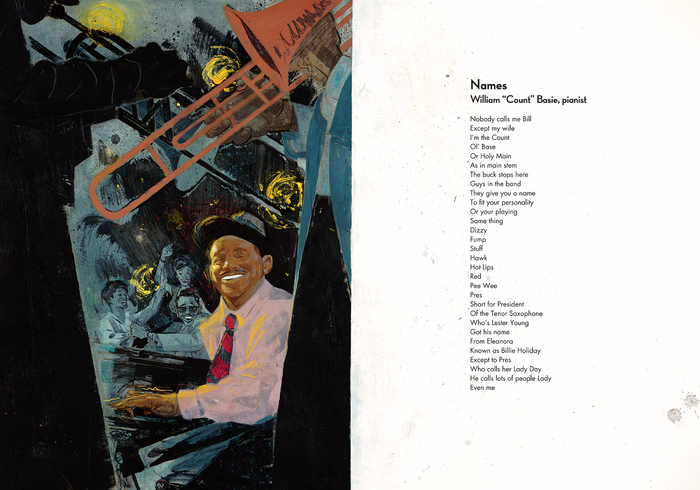
Musicians can be q quirky bunch and Roxane Orgill has really captured that trait. There is a poem detailing how some of the great jazz musicians got their nicknames, including Count Basie, Dizzy Gillespie, Billie Holiday called Lady Day by Lester Young, who was called Pres, considered to be President of the Tenor Saxophone. One of my favorites is "How to Make a Porkpie Hat" about Lester Young's iconic hat. And there is "Late" about Thelonious Monk, late because he had spent so much time picking out what to wear. This was followed by a fun Alphabet poem listing what musician were wearing.
Orgill also gives voice to some of the kids who were there for the day - a young girl sitting at her front window twirling a lock of hair, watching and wishing she could be down there, too, waiting for it all to be over so she can go out and play. Then, there are the 12 boys sitting on the curb next to Count Basie, jostling each other, thrilled to be in the presence of such a great musician.
The 1950s was the golden age of jazz and that is just what the Esquire article called their article. In the end, it is the photograph that has lived on. The book includes a two page spread of the photograph that was finally used, and a praise poem for the cool, calm Art Kane for letting the chaos of the day determine his photograph.
Francis Vellejo's has painted his own jazz composition with his acrylic and pastel illustrations that perfectly capture the chaos, the excitement, the confusion, the grandeur of the musicians, in fact, all the events of the day. Be sure to take a close look at all of them to discover some wonderful details.
This is a wonderfully imaginative poetic homage to these great jazz musicians, some of it based on fact, some come from imagination, all come from a clear love of jazz. Back matter included Biographies of the individuals named in the poems, sources beyond the Esquire article, Source Notes, a Bibliography, Articles, Audiovisual Material and Websites for further reading and investigation.
This book is recommended for readers age 8+ This book was purchased for my personal library
In 1958, in front of a nondescript brownstone in Harlem, a man named Art Kane managed to gather 58 jazz musicians, and using a borrowed camera, captured one of the most iconic photos that would symbolize the "Golden Age of Jazz." In the Author's Note in the back of the book, Roxane Orgill tell us that "the poems in this collection were all inspired by Art Kane's photograph Harlem 1958. The verses about the musicians are based on fact" (p. 43).
Orgill has recreated that day back in 1958 through a series of free verse poems. She begins by focusing on the photographer, Art Kane, and how he is alone on the street, wondering if anyone at all will show up. Subsequent poems focus on the arrival of some of the jazz artists, and some poems depict funny scenes involving the neighborhood children who hung around the location and were able to interact with the musicians. The free verse style of the poetry, combined with the slightly abstract style of illustrations, provides a reading experience that is both relaxed and slightly chaotic at the same time. It is laid back and free flowing, much like jazz music itself.
While reading this book, I was inspired to search for and listen to the jazz recordings of the artists in the book, and I am sure I am not the only one who will be inspired to do this. This book would make an excellent accompaniment to a program in jazz studies.
The topic and reading level of the poetry make this a picture book that is intended for an older reader. Kane's Harlem 1958 photograph is included, as well as an Author's Note, biographies of the featured musicians, source notes, and an extensive bibliography. The Author's Note does a very good job being honest with the reader and highlighting areas where certain events or people have been fictionalized.
Overall, this is an exceptionally well done informational text that is very creative in the way that the author and illustrator have depicted the events of the day and the artists that participated.
This nonfiction picture book tells the story of the iconic photograph, Harlem 1958, which captured a one-of-a-kind meeting of 57 jazz musicians, many legendary, some just getting into the biz, in the same photo on one incredible day. Esquire magazine photographer Art Kane arranged to close off a street in Harlem and advertised for any and all jazz musicians to show up at the appointed hour. He had no idea how many might actually show, but he succeeded marvelously with 57 (one more came, but ended up not in the final shot because he was sitting on the stoop next door!). This photo has been the subject of a documentary film ("A Great Day in Harlem"), other books, a reunion photograph, and various homages ("A Great Day in Seattle," etc), as is explained in the excellent author's notes. The story of how the photo was set up and little anecdotes about the musicians are told in entertaining poems, giving details like the pale-yellow suit worn by Thelonius Monk, or how Lester "Pres" Young liked to create a porkpie hat out of a fedora; many of the musicians were so happy to see each other, it seemed like a big happy reunion, and of course, corralling a bunch of musicians to stand in any kind of formation was almost like herding cats. There were also several local boys who ended up in the photo, and although the book is nonfiction, the author explains that she did fictionalize them a little, since no one knows who most of them were, giving them names and adding some drama to some of their scenes. But the end notes also include nice short one-paragraph biographies about 16 of the highlighted musicians. The colorful acrylic and pastel illustrations are beautiful, realistic portraits with splashes of color and together with the text they convey a jazzy feel. Beautiful book.
I have a thing for books that tell the story behind photographs or moments in history, and this book does exactly like that in a series of poems. It was the brain child of Art Kane, a graphic designer who thought it would be cool to invite jazz musicians to Harlem for a photograph on one particular morning in 1958. Fifty-eight men and women showed up, and 57 of them posed for that photograph that ended up in a feature for of Esquire magazine, a slice of history captured forever, thanks to Kane's foresight. The poems and the acrylic and pastel illustrations effectively capture the unique personalities and styles of several of the musicians as well as the fears Kane had that no one would show up for the photo shoot. Choosing to acknowledge the young boys and other onlookers to this gathering, the author also seems to have channeled the very feel of jazz in some of the lines. Back matter includes thumbnail sketches of these talented individuals. Readers will surely want to search for their recordings if they aren't familiar with their work. What a pitch-perfect tribute to some of the great jazz musicians of that time! There is a playfulness to many of the poems as one girl just wishes they'd hurry up and leave so she can get outside on the street and play and several of the musicians are more interested in catching up with each other than with capturing this historical moment. The book won't necessarily appeal to everyone, but for anyone who loves music and photography or anyone who has been touched by a moment in cultural history, an event that seems almost larger than life, this book is a treasure.
Jazz, history, and photography are all combined in this outstanding nonfiction prose picture book. It will not be an easy sell for children, but it is a fantastic book to use in the classroom or library class. In 1958, Esquire magazine was planning a special issue on American Jazz. Any jazz player was invited to NYC for a group photo...instruments not required. There was a concern if anybody would show up, but many did. This is the story behind the photograph...the joy the musicians felt at seeing each other, quirks of some of the musicians, thoughts of the photographer, and the setting of the hot city street are all combined into a story about a moment in time from August 12, 1958. Of course, the climax of the story is the fold out spread of the actual photograph. I really enjoyed reading about this piece of history I had never heard about. One paragraph biographies are included at the end of the story of each musician included in the photo.
Jazz Day is based off of a true story of one magazine's idea to take a photograph of the most famous and important musicians and artist from Harlem in 1958. This is a collection of poems and bios about many of the important figures from the Harlem Renaissance.
Jazz Day is an excellent collection of poems that can be used to educate students about the Harlem renaissance and some of it's most important individuals, like the jazz artists depicted in the poems and bios that are included in the collection.
Some texts that I would pair with this text would be poems written by the famous poet and crucial part of the Harlem Renaissance, Langston Hughes. This collection of poems and Hughes' poems paired together can teach students about the type of music and art that was developed during this time period in New York.
This text can be used as a mentor text on educating students about the Harlem Renaissance and the important people involved in making the art involved in it.
In 1958 Art Kane decided the jazz musicians must unite. He has a crazy idea that all the jazz musicians should take a photograph, but not just any photo. On an early morning in August in Harlem would be the time and place. Who would show up? Would anyone at all even show? How was there?
Get supplies to create your own Porkpie Hat. Make your own design on the hat. Why do you think some musicians wore these? What is your opinion on jazz music? Justify your answer. Explain the different types of musicians in the book. What was your favorite one? Are there any instruments that you are able to play? Create your own acrostic poem for JAZZ. Share with the class. What’s the significance for each of the letters? Distinguish the different parts of this story. What types of poems where in here? What’s the difference between those and the biographies wrote about each person in the ph
Orgill, R. (2016). Jazz day: the making of a famous photograph. Somerville, MA: Candlewick.
Art Kane pitched an idea to invite Jazz musicians to be apart of 1 big Group photo. A surprise that a well number of people showed up. Not all were famous at the time most of the musicians were just starting out. Included in the picture is some curb kids. To go along with the photo Roxana Orgill made inspirational poetry to describe the making of the finished picture.
I enjoyed reading this book. I like to listen to Jazz music so the title was interesting to me. The poetry brought a unique setting to it as well.
I would say this book is for older kids. It contains poetry and lots of well known jazz musicians. Great for a student who loves both poetry and history. Not only does it describe the process of the photo but the history behind it. It includes the biography of some of the musicians.
The genre of Jazz Day is poetry picture book. This book of poetry was awarded with The Washington Post's Best Children's and young adult of 2016 and the Children's Literature Assembly's Notable Children's Book in the Language Arts award in 2017. This book is intended for children 8-12. This unique poetry picture book tells the behind the sense the scene story of a famous Jazz photograph. I gave this book 4 stars. I enjoyed the way the poems told a story. The illustrations were amazing and textured. Each poem is told from a different perspective. The theme was easy to follow and built up on the one before. There were words that I could see young readers needing to look up or ask an adult about. I think this book would be appealing to young readers who are interested in history or music. I would use this book to reference different Jazz artists such as Dizzy Gillespie.