Jump to ratings and reviews
Rate this book

The Water Princess

Rate this book
Based on supermodel Georgie Badiel’s childhood, a young girl dreams of bringing clean drinking water to her African village

With its wide sky and warm earth, Princess Gie Gie’s kingdom is a beautiful land. But clean drinking water is scarce in her small African village. And try as she might, Gie Gie cannot bring the water closer; she cannot make it run clearer. Every morning, she rises before the sun to make the long journey to the well. Instead of a crown, she wears a heavy pot on her head to collect the water. After the voyage home, after boiling the water to drink and clean with, Gie Gie thinks of the trip that tomorrow will bring. And she dreams. She dreams of a day when her village will have cool, crystal-clear water of its own.

32 pages, Hardcover

First published September 13, 2016

22 people are currently reading
1800 people want to read

About the author

Susan Verde

34 books163 followers
Susan Verde is a New York Times bestselling children’s author, children’s yoga and mindfulness expert, former teacher, and parent. By 2022 she will have more than 20 picture books in the marketplace. She is a highly sought after speaker at conferences, festivals, and schools across the nation, and spends half the year on the road working with children and families. Verde is a frequent contributor to online magazines and has appeared on multiple podcasts speaking about writing, parenting, mindfulness, and yoga. She lives in East Hampton, New York.

Ratings & Reviews

What do you think?
Rate this book

Friends & Following

Create a free account to discover what your friends think of this book!

Community Reviews

5 stars
1,697 (51%)
4 stars
1,117 (33%)
3 stars
370 (11%)
2 stars
80 (2%)
1 star
49 (1%)
Displaying 1 - 30 of 649 reviews
Profile Image for Calista.
5,434 reviews31.3k followers
March 25, 2020
Wow, I wasn’t expecting this wonder at all. This is based on the childhood experiences of Georgie Badiel. This village had to walk 4 miles every day to fill a jug of water and back and that was their water for the day: drinking water, washing water. When it was out, there was no more water.

Our girl prayed for rain and water from the sky to fall so she wouldn’t have to walk to get the muddy water. It wasn’t always clean water.

The artwork is amazing with rich earth tones. The protagonist is amazing, bright eyed and hopeful. There is a final page they talk about 1 billion people on the planet don’t have fresh water and there is a daily struggle for water. It’s an enlightening book.

The nephew thought the story was ok. I need to find him something he will like fast. He’s put up with my picks for a while now. He asked why they didn’t have a sink to get water? I told him that some people don’t have those luxuries. He didn’t seem to understand the concept. Everyone he knows does have those things. He gave this 2 stars. He said it was ok for a boring story. He wants something with action.
Profile Image for La Coccinelle.
2,259 reviews3,568 followers
October 1, 2018
This would be an eye-opening book for a lot of kids. Imagine having to spend all day walking just to get clean water. You couldn't even go to school because of this! It's hard to believe that in the 21st century, almost a billion people still don't have access to clean water.

This book introduces this idea in an accessible way, with a sweet story about a little girl who goes with her mother each day to collect water. Gie Gie wishes the water were closer, but there's really nothing she can do about it.

The illustrations are really beautiful, evoking the plains of Africa and really setting the scene for the simple story.

I would definitely recommend this book, even to older kids who might think they're too old for picture books; it could start an interesting discussion about wells and water and inequality.
Profile Image for Bookishrealm.
3,246 reviews6,430 followers
February 28, 2017
This definitely is a good read a loud that teaches children about how the world doesn't necessarily have the same amount of clean drinking water for everyone. Some people have to walk miles everyday just to get clean drinking water. The artwork was amazing and I definitely want to learn more about the foundation that was discussed at the end.
Profile Image for Margie.
464 reviews10 followers
April 27, 2021
This is a surprisingly light-hearted book considering the topic is water poverty.  Because the book is told through the eyes of a child, many pages reflect an innocence and joyfulness that carry the "Water Princess" through one of her long and arduous days. 

The beautiful illustrations start with a young girl, Princess Gie Gie, looking up at a sky full of countless stars, "My kingdom . . . the African sky, so wide and so close.  I can almost touch the sharp edges of the stars."  The full page illustrations, done primarily in soft browns and yellows, take us with Gie Gie and her mother on their long day's journey to get water.

Imagine being a child and rising before dawn each day to walk four miles or more to bring back water for drinking, cooking and bathing.  This book is based on the childhood memories of high fashion model Georgie Badiel who spent summers with her grandmother in Burkina Faso, a country in West Africa.  Each day, like Princess Gie Gie, Georgie and her grandmother would make a long journey to get water carrying heavy pots on their heads.

Alternately plaintive and playful, The Water Princess packs a powerful message - the lack of clean drinking water for over a billion people around the world, one in six. Water Princess is also a perfect name for volunteers like my sister-in-law who go to countries around the world installing wells in villages and refugee camps. I am in awe of the lifesaving missions they perform every day.

The story ends somberly with Princess Gie Gie asking her maman, "Why is the water so far?  Why is the water not clear?  Where is our water?"  Her mother answers her, "Someday you will find a way, my princess.  Someday." 
 
The photos following the story show that Georgie Badiel has found a way.  Together with another organization they are installing wells in Burkina Faso and other countries in need.  Information about these organizations can be found at https://www.georgiebadielfoundation.org/ and https://www.ryanswell.ca/

Books like this are sorely needed to introduce children and all of us to the basics of water poverty and its existence around the globe. Here in the U.S. we could start with the shameful episode which sent lead-poisoned water into thousands of homes in Flint, Michigan for months. Recently Jackson, Mississippi went without drinking water for over a month after a powerful winter storm knocked out antiquated infrastructure. The same storm left parts of Texas without drinking water for weeks. 

The next time I turn on a tap I will be grateful for the clean water that flows from it - and try not to use too much of it.
Profile Image for Otis  Chandler.
412 reviews116k followers
December 3, 2018
I happened upon this book the night after the Charity:Water annual gala. Charity:Water is an amazing organization that helps people exactly like the ones in this story.
Profile Image for Melki.
7,299 reviews2,617 followers
July 30, 2019
Imagine needing to make a daily trek for miles and miles to obtain something most of us take for granted - water. Many women in Africa send their days doing just this, as one in six people do not have access to clean drinking water.

The author makes does a fine job of relating this sad fact for the younger reader, including two pages at the end of the book with actual photos, and ways the reader can make a difference.

The artwork by Peter H Reynolds is simply stunning.

description

description
Profile Image for Abigail.
8,011 reviews265 followers
March 25, 2020
Inspired by the childhood experiences of fashion model Georgie Badiel, who spent her summers fetching water from a well some distance from her grandmother's village in Burkina Faso, author Susan Verde and illustrator Peter H. Reynolds have crafted a tale of Princess Gie Gie, who dreams of a day when cool, clean water is readily available nearer to her home. Wishing alone cannot help her, however, and every day she makes the long trek with her mother to fetch their family's water supply...

An engaging and thought-provoking look at the issue of water scarcity, which affects one in five people globally, The Water Princess is also a visual treat, featuring absolutely gorgeous artwork that captures both the beauty and harshness of Princess Gie Gie's African home. The rich brown and sepia tones of daytime contrast nicely with the deep purplish/blue of night, while Gie Gie herself is ably captured through every change of mood and expression. Recommended to anyone looking for children's stories addressing issues of poverty and resource scarcity, as well as to those looking for beautifully illustrated picture-books.
Profile Image for Amanda.
3,883 reviews43 followers
November 21, 2016
Not to be able to receive an education because you spend your day--every single day of your life--just trying to gather the neccesities to survive; it's unimaginable, but it's reality for so much of the world.

The Water Princess doesn't preach or beat the reader over the head; rather, it invites the reader to walk along the characters and visit Gie Gie and her family for just one day to experience what it is like to live without daily water accessible whenever we want. A very powerful message told simply and beautifully.
Profile Image for Rachel.
1,180 reviews28 followers
March 15, 2017
In Africa, water is precious because it is scarce. In some villages there isn't even a well yet, so the women must go to collect some from the river every day. It is hard work, and the water itself isn't even clean. The Water Princess, a story based on the childhood experiences of Georgie Badiel, brings this issue to the fore in a heartfelt way. In it, a young girl named Gie Gie imagines herself a princess who can control all around her, all except water, which refuses to listen. Her childlike games end when the day starts and she and her mother head off to collect water. Once they return home, they have to complete all the other chores. Despite the hardships we perceive they face, their lives are not only hardship; the little girl is still a child, she sings and dances and plays with her friends while she does this task. Verde's words endear us to this charming girl, and Reynold's impressionistic art immerses us in her world. Almost every page is covered in browns and yellows to the point where the sky almost melds into the ground. This gives us the feeling of how dry the land is, how persistent the sun is, how thirsty the people must be, and thus, why this daily trek to retrieve water is essential. At the conclusion of the story, is a page that explains a bit more about the real world situation of African people like this. It is well worth reading with a child, for it can lead to a discussion about how important access to clean water is, and how it influences poverty, health, and the rights and lives of women. The Water Princess is a beautifully told story that holds an important message within its pages
Profile Image for Agnė.
790 reviews67 followers
February 16, 2021
This gorgeous picturebook is based on the childhood experience of Georgie Badiel, a supermodel who started a foundation committed to providing access to clean drinking water to Burkina Faso and other African countries.
“Imagine if you couldn’t go to school because you had to spend each day walking for miles just to get water and not even know if the water you reach will be clean.”

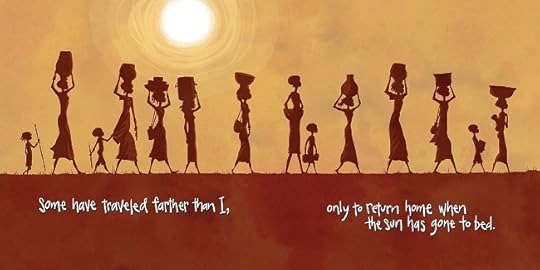
Susan Verde's poetic, gentle, simple story made me thirsty just by reading it and served as a powerful awakening. Did you know that even today, nearly one billion people around the world don’t have access to clean water?

I simply LOVED Peter H. Reynolds' illustrations: the colors, the lettering, everything.


Profile Image for Ali.
24 reviews
February 16, 2018
The Water Princess is about a girl named Gie Gie and how she had to travel miles everyday just to have access to water. It described how she had to wake up, before the sun rose, walk over 4 miles to get water and then spend the rest of the day walking back. Gie Gie and her mom wouldn't return until sun down. Then they would clean the water in order to drink it, cook with it and clean their clothes with it. Then the process would happen again the next day.

This book is a wonderful depiction of a high-fashion model, Georgia Badiel's childhood experience. As a teacher, I would use this book in a kindergarten to second grade classroom. We would discuss diversity and how different places in the world don't always have access to things that are necessary for living. One could use this book to discuss authentic learning and how students can make a difference or change in something that doesn't seem "fair". Additionally, the illustrations are stunning. Every inch of the page is consumed with color; the colors of a sun rise, the colors of the desert and the colors associated with the night. These illustrations add character to the story.
Profile Image for The Reading Countess.
1,920 reviews57 followers
July 12, 2017
Short, yet powerful phrases tell the trials of how one out of six human beings (!) endure a lack of access to clean water. Women and girls are the usual servants to the daily treks miles away to and from water holes, thereby eliminating any possibility of schooling.

The voice in this is spot on. The illustrations are drawn by none other than Peter Reynolds. I plan on reading this aloud to kick off our annual Read to Feed.

Highly recommended
Profile Image for Emma.
3,348 reviews460 followers
May 23, 2016
Interesting and eye opening but . . . not much in the way of a plot.
Profile Image for Niki Marion.
424 reviews6 followers
January 21, 2017
Fabulous conversation starter for all of us who take our plumbing and access to water for granted.

In related news, where is my picturebook about Flint, Michigan?
Profile Image for Jill.
2,301 reviews97 followers
August 26, 2017
This story is based on the childhood of the high-fashion model Georgie Badiel, “Gie Gie,” who was born in Burkina Faso.

As a young girl, Gie Gie, along with the other girls and women of her grandmother’s village, walked every single day for miles to fill up pots with water, which they carried back home on their heads. No matter how hard she wished, she couldn't change that reality.

The next morning, they had to start out again. But Gie Gie’s mother tells her when she goes to sleep at night, she should dream of finding another way. And we know she grows up to do just that.

The author reports in an Afterword:

"In Burkina Faso alone, nearly a quarter of the population has no access to clean water. Both illnesses from contaminated water and the time it takes to collect water every day prevent many children from going to school. The walk itself is on average four miles each day . . . !”

Today, Georgie Badiel has a non-profit foundation to help bring clean drinking water to the people of Africa. The organization also builds sanitation facilities and plants trees. On the Foundation website she writes: Don’t waste your time and money trying to emacipate a women or educate a girl who do [sic] not have access to clean drinking water. Your effort will be useless. Water is first.”

I loved the stunning illustrations by Peter H. Reynolds. His palette is perfect for depicting the hot, dry landscape. And yet, amidst the sere background, the faces of the characters are expressive and beautiful.

Evaluation: This book provides a beautiful means to teach children in the West that not all children are as fortunate as they, and that there is much work to be done. The Foundation reports that the desperately poor nation of Burkina Faso has more than 17 million people, but water and sanitation are a luxury to most: The British trust WaterAid estimates that at least 6,000 children under five die each year from the lack of these basic necessities.

As the author and illustrator write at the end of the book, “We hope this story brings awareness to the ongoing crisis and inspires you to be a part of the change.”
Profile Image for Margarita Rodriguez.
16 reviews
June 6, 2019
1.) I want you guys to think a little with me before we start our book. Just keep your thoughts to yourself and really think, but do not say anything out loud. Can you imagine your life without water? Not having it right down the hallway or in your kitchen or bathroom? Not even in water bottles that someone bought? (give them time to think) I know I could not imagine life without having easy access to water, raise your hand if you can't imagine life without water either. (students raise hands) What are some things we use water for? Where can we find this water? (we can find them in water bottles, sinks, fountains, and we drink it!) Good job! We do drink water and we can find them in all those places. We also use it to cook, wash our clothes, wash our hands and bathe. What color is our water? (yes, it is clear) There are countries in Africa (point to it on the globe) who have no access to clean water and have to walk lots and lots of miles just to get water, and then clean it before they can drink it. Not like us. The girl in our book today is Gie Gie who lives in one of those countries and has to walk lots of miles to get water. She travels with her ‘Maman’ which is mother in French, to get the water. Can you say maman? (say maman). We will hear Maman a lot through the book, as we see them travel to get their water...

2.) Tell the meaning of a key word: ‘Maman’, Provide important background information & raise questions to spark curiosity

3.) It is important for students to understand the privilege and blessing they have of living in a first world country that has access to something that many take for granted: water. Having them question what life would be like without water before the story will allow them to understand how far and hard it is for others around the world to access something they may not think twice about as a privilege. Providing that context of where Africa is and how people in countries within Africa travel for their water also sets an understanding of what the book will be about. Also, since the author uses Maman a lot, I felt it was important to prepare the students of that word before we started the story.


9 reviews1 follower
April 19, 2018
This book best fits the genre of Informational text. It is appropriate for grades k-5, and is very informative for all ages. The book depicts the struggle that billions of people around the world face every day--the lack of access to clean water. The issue is twofold because even if people get to a water source, the water may be dirty or contaminated.

I really loved this book because it allows readers to consider, particularly those fortunate enough to live in developed areas, how easy it is to take things for granted like having clean, running water at our disposal. The information that follows the story contains some very eye-opening facts, such as 1-in-6 people around the world do not have access to clean water. Also, collecting water is a daily chore that means the difference between life and death, so much so that children are needed as extra hands and, therefore, are not able to go to school. A lot of people, particularly children, do not understand how fortunate we are to be able to go to school or have a say in how we spend our days because we don't have to worry about things like getting water because we have access at our fingertips.

I think that this book is a very powerful tool for teachers to educate students about how fortunate we are. Teachers can use this in grades k-5 to generate a class-led discussion after reading this book together. Children can be asked to imagine what it would be like not to be able to get a drink of water when you are thirsty because you don't have any, or if you do it needs to be transported back home and boiled first. Students can also write their reactions and feelings in a journal. Teachers in fourth and fifth grade can use this book to kick-start a problem-solving project where students will research and propose solutions to the lack of access to clean drinking water around the world.
Profile Image for Chance Lee.
1,399 reviews158 followers
January 2, 2018
A beautiful, important book about a young girl in Burkina Faso who must travel with her mother to get water. She wishes water would come easily -- as if you could open a tap in your own home -- but that's not the way it works for her village. She and her mother make the long hard trek to the well and back, stopping at the well to have a little fun and socialize.

The back of the book has information on the Georgie Badiel foundation. Badiel is a model and this story is based on her life. Her foundation works to bring clean water to children in Africa.
Profile Image for Margaret.
1,531 reviews67 followers
June 2, 2018
Princess Gie Gie is a goddess, yet try as she might, she can't bring water to her home. Instead, she has to wake up early with her mother to walk and gather water. I love this story! Gie Gie is a precocious and fun narrator, the illustrations are lovely, and it's a powerful story. Marian accidentally (well, not really accidentally) ripped several pages and I had to read this on my own. Her review will have to wait until she's older.
Profile Image for Kelly.
1,060 reviews35 followers
December 5, 2017
A beautiful story that will engage and educate all readers about the true value of water.
Profile Image for Tegan.
1,150 reviews95 followers
July 6, 2018
This is such a humbling, heart tugging book. The illustrations are beautiful and convey the setting wonderfully. Gie Gie is lovable and can inspire readers to help.
Profile Image for blue.
156 reviews24 followers
December 27, 2019
The artwork is as beautiful as the message being conveyed
132 reviews1 follower
October 11, 2022
À aller voir aussi : le site de la fondation de Georgie Badiel afin de pousser l'apprentissage du droit à l'eau avec les élèves.
17 reviews1 follower
November 18, 2019
What a powerful book to help raise awareness of resources such as clean and clear water that most of us have taken for granted. Using vivid graphics and bold, white fonts against colored background, the book depicts an African girl’s daily life.

Gie Gie, who calls herself the princess of the vast African sky, has to get up very early every morning, carry a pot on top of her head, and walk miles and miles with her mom on barefoot to collect water from a well. While there, they have to wait in line for their turn to fill their pots with dusty earth-colored water. They would then carry the heavy pots home for cooking, cleaning, and washing clothes. Daddy quickly returns from the fields to join mom and Gie Gie to drink and eat. It seems that that’s the only time during the day they have access to food and cooked clear water.

It is hard to believe that Gie Gie and her family have to spend the whole day to obtain clear water, let alone other resources such as food, washing machine, school and education. However, throughout the book, the main characters demonstrate optimistic and positive attitudes towards such obstacles. The little girl imagines her magical powers; mom and daughter sing and dance on their way to fetch water; and children play and mothers chat while waiting for their turns.

When Gie Gie asks her mom about their own “flowing, cool, crystal-clear” water, mom encourages her to sleep, dream, and believe that “someday you will find a way, my princess.” The last pages share the story of the true heroine, Georgie Badiel, who has brought changes to her village and beyond. Bravo!

This book makes me realize how blessed I am, and I am truly thankful for everything I have. It also teaches me how to face hardships with an optimistic and strong heart. There is a will, there is a way.
Profile Image for Kasey.
16 reviews
June 2, 2019
“If you are thirsty, where in your house can you get water?” Listen to the children’s answers about sinks and refrigerators.
“The water that comes from your sink or refrigerator, is it clean? Can you drink it and not get sick?” Listen to their answers.
“Right, the water in your house is safe to drink. What if you couldn’t get water in your house? Then where would you get water?” Listen to the children shout out things about stores.
“What if you didn’t have stores?” Guide their answers to lakes and rivers.
“Lakes, rivers, or maybe even the rain? In the book we are about to read, they live in Africa and it doesn’t rain very often there. You will hear the main character talk about the dust, because of how dry it is. Did you know that there are people in the world that live without water in their homes? Sometimes, they have to walk for miles to even get water. Usually the water is dirty and if they drink it, it’ll make them sick, so they have to boil it to clean it. We are going to read a story about a girl and her mom, who get up everyday and walk to get water.”

In this opening, I used questions to spark their curiosity and to get them to think about their own lives. Next, I gave the students background information and explained some things in the story, like why mom boils the water and why the main character references the dust. I decided on these two opening moves, because I wanted students to think about the things they don’t have to worry about. They have clean running water right in their own homes. They have stores that are easily accessible. While I read the story, I might ask the class about why the characters in the story have to walk and not drive or take a bus.
This entire review has been hidden because of spoilers.
Profile Image for Mary Vondra.
23 reviews
January 26, 2019
Opening Moves
*Draw attention to the illustrator’s craft
*Lay the groundwork for understanding of diverse setting and people


*Draw attention to the illustrator’s craft
Ask students/patrons if they know what an illustrator is? Discuss authors and illustrators highlighting that sometimes the author is the illustrator and sometimes the illustrator is another person who works together with the author as partners. The illustrator draws the pictures to bring the author’s words to life. Then discuss the author and illustrator of The Water Princess.
*Lay the groundwork for understanding of diverse setting and people
What is a princess? What does a princess wear on her head? Is the crown/tiara valuable? (Discuss what valuable means?) What does the girl on the cover have on her head? In some parts of world water is very valuable. What would make water so valuable? Today we are going to read about a girl named Georgie Badiel who grew up in the country of Burkina Faso. It is a country in a part of the world that is very different from where we live. (Show them on the globe.) While I read I want you to think about why the water on her head is as valuable as a crown made out of diamonds.
Profile Image for Emily Keebler.
17 reviews
June 5, 2019
1. Imagine when you wake up in the morning there is no water in your house to brush your teeth, or drink with breakfast, there are no pipes to bring the water, no pumps. Now imagine that the water that you can go get isn't at the grocery store, but 4 miles away. You can't drive there, and you can't ride your bike, because it has no space for the container you will put the water in. You have to walk. This is the reality for many people around the world, and we will be reading about Gie Gie, who has to walk to get water every day.
2. Provide important background information, foreshadow the problem of the story.
3. I chose to provide background information because in the United States, most of us have instantaneous access to water, and to understand the story it is important to understand what some people have to do to get water. I chose to foreshadow the problem of the story because otherwise I feel students would have a lot of questions during the reading, and this way some of those questions are addressed before reading.
This entire review has been hidden because of spoilers.
Displaying 1 - 30 of 649 reviews

Join the discussion

Can't find what you're looking for?

Get help and learn more about the design.