Jump to ratings and reviews
Rate this book

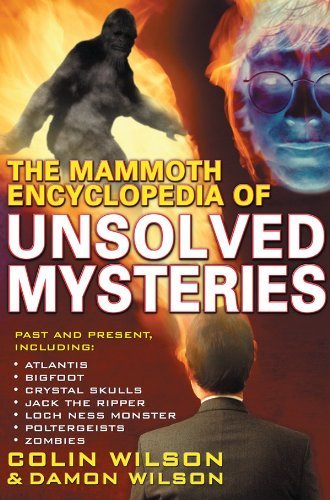
The Mammoth Encyclopedia of the Unsolved

Rate this book
Now available in one tremendous volume is a compelling and remarkable history spanning over two thousand years of the greatest unsolved mysteries known to mankind, the Bermuda Triangle Bigfoot crop circles crystal skulls the Holy Shroud of Turin the Hope Diamond and other cursed jewels the mystery of the Mary Celeste mummies and their curses poltergeists sea monsters spontaneous human combustion Tunguska and other falling meteors vampires zombiesIncludes a mystery never examined before - the missing maps of AtlantisColin Wilson is an acknowledged expert in the field of the unexplained and is in constant demand by the mediaColin has a track record of proven successes with the Mammoth series, including, most recently, The Mammoth Book of Murder

824 pages, Kindle Edition

First published January 1, 2000

91 people are currently reading
512 people want to read

About the author

Colin Wilson

401 books1,291 followers
Librarian Note: There is more than one author by this name in the Goodreads database.

Colin Henry Wilson was born and raised in Leicester, England, U.K. He left school at 16, worked in factories and various occupations, and read in his spare time. When Wilson was 24, Gollancz published The Outsider (1956) which examines the role of the social 'outsider' in seminal works of various key literary and cultural figures. These include Albert Camus, Jean-Paul Sartre, Ernest Hemingway, Hermann Hesse, Fyodor Dostoyevsky, William James, T. E. Lawrence, Vaslav Nijinsky and Vincent Van Gogh and Wilson discusses his perception of Social alienation in their work. The book was a best seller and helped popularize existentialism in Britain. Critical praise though, was short-lived and Wilson was soon widely criticized.

Wilson's works after The Outsider focused on positive aspects of human psychology, such as peak experiences and the narrowness of consciousness. He admired the humanistic psychologist Abraham Maslow and corresponded with him. Wilson wrote The War Against Sleep: The Philosophy of Gurdjieff on the life, work and philosophy of G. I. Gurdjieff and an accessible introduction to the Greek-Armenian mystic in 1980. He argues throughout his work that the existentialist focus on defeat or nausea is only a partial representation of reality and that there is no particular reason for accepting it. Wilson views normal, everyday consciousness buffeted by the moment, as "blinkered" and argues that it should not be accepted as showing us the truth about reality. This blinkering has some evolutionary advantages in that it stops us from being completely immersed in wonder, or in the huge stream of events, and hence unable to act. However, to live properly we need to access more than this everyday consciousness. Wilson believes that our peak experiences of joy and meaningfulness are as real as our experiences of angst and, since we are more fully alive at these moments, they are more real. These experiences can be cultivated through concentration, paying attention, relaxation and certain types of work.

Ratings & Reviews

What do you think?
Rate this book

Friends & Following

Create a free account to discover what your friends think of this book!

Community Reviews

5 stars
124 (27%)
4 stars
165 (36%)
3 stars
118 (26%)
2 stars
34 (7%)
1 star
8 (1%)
Displaying 1 - 30 of 39 reviews
2,142 reviews27 followers
Read
March 28, 2022
One begins to read the introduction, and there's so much worth quoting one gives up and sticks to reading; and it's so much in accord with what one thought, whether to begin with or especially all the more so after various things, quoting would be preceded or followed by 'as one always thought', sounding silly after a couple of times.

Meanwhile there is a mention of Ian Wilson, and one wonders why Colin Wilson isn't mentioned. One looks again, and realises why!

Of course, if one began one's acquaintance with his works with The Philosopher's Stone, and didn't merely categorise it as another mystery or fight of fancy, it's bound to happen that one recalls his name as one begins this book, having forgotten why one bought it in the first place - not the monsters on the cover, but the name of the author!

Why Amazon has so few of his works, or those of similar beloved authors of one over decades, is the real mystery. Fans and connoisseurs of James Hilton, Colin Wilson, or for that matter A. J. Cronin and more, would love to see - and buy - their collected works on Amazon, but even the World's End series of Upton Sinclair wasn't available until recently, and Agatha Christie works aren't yet available as a complete collection.
.......

"In 1957 the science writer Jacques Bergier made a broadcast on French television that caused a sensation. He was discussing one of the great unsolved mysteries of prehistory, the sudden disappearance of the dinosaurs about sixty-five million years ago. He suggested that the dinosaurs had been wiped out by the explosion of a star fairly close to our solar system – a “supernova”. He then went on to make the even more startling suggestion that the explosion may have been deliberately caused by superbeings who wanted to wipe out the dinosaurs and to give intelligent mammals a chance.

"Even the first part of his theory was dismissed by scientists as the fantasy of a crank, and the reaction was no better when in 1970 Bergier repeated it in a book called Extra-Terrestrials in History, which began with a chapter called “The Star that Killed the Dinosaurs”. But five years later an American geologist named Walter Alvarez was studying a thin layer of clay on a hill side in Italy – the clay that divides the age of the dinosaurs (Mesozoic) from our own age of mammals – and brooding on this question of what had wiped out whole classes of animal. He took a chunk from the hillside back to California, and showed it to his father, the physicist Luis Alvarez, with the comment: “Dad, that half-inch layer of clay represents the period when the dinosaurs went out, and about 75 per cent of the other creatures on the earth”.

"His father was so intrigued that he subjected the clay to labouratory tests, and found it contained a high proportion of a rare element called iridium, a heavy element that usually sinks to the middle of planets, but which is thrown out by explosions. Alvarez also gave serious consideration to the idea of an exploding star, and only dismissed it when further tests showed an absence of a certain radioactive platinum that would also be present in a supernova explosion. The only other alternative was that the earth had been struck by a giant meteorite, which had filled the atmosphere with steam and produced a “greenhouse effect” that had raised the temperature by several degrees.

"Modern crocodiles and alligators can survive a temperature of about 100 degrees C; but two or three degrees higher is too much for them, and they die. This is almost certainly what happened to the dinosaurs, about sixty-five million years ago. And that is why this present book contains no entry headed: “What became of the dinosaurs”? We know the answer. And we also know that Bergier’s “lunatic fringe” theory was remarkably close to the truth."

" ... In the article on spontaneous human combustion, I have quoted a modern medical textbook which states that spontaneous combustion is impossible, and that there is no point in discussing it. But the evidence is now overwhelming that spontaneous combustion not only occurs, but occurs fairly frequently."

"In 1768 the French Academy of Sciences asked the great chemist Lavoisier to investigate a report of a huge stone that had hurtled from the sky and buried itself in the earth not far from where some peasants were working. Lavoisier was absolutely certain that great stones did not fall from the sky, and reported that the witnesses were either mistaken or lying; it was another half century before the existence of meteorites was accepted by science.

" ... The inference is surely that it is more fruitful to be intrigued by the possibility of some prehistoric monster in the depths of Loch Ness than to dismiss it as a childish absurdity."

"Sceptical investigators all seem to make this same curious logical error. William James pointed out that if you want to disprove that all crows are black, you do not have to try and prove that no crows are black; you only have to produce one single white crow. So a bookful of cases of fraud or excessive gullibility proves nothing except that those particular cases are fraudulent. But one single case of a paranormal event for which the evidence is overwhelming does demolish the argument that the paranormal is, by definition, fraudulent."

"Consider a question raised by the zoologist Ivan Sanderson. On a moonlit night, on a dust-covered road in Haiti, he and his wife both experienced a curious hallucination of being back in Paris in the fifteenth century. (The story is told in full in “Time in Disarray” in this volume.) Gardner would declare that this is a question that should simply not be asked unless the answer is that Sanderson was either drunk or lying. But it is obvious that he was neither. Those who knew him (and I have a letter on my desk from one of them at the moment) agree that he was an honest man who was not remotely interested in the “supernatural”. It is also worth asking how Sanderson’s servants knew he had been involved in an accident – although it occurred in a remote and deserted spot – and that he would be home at dawn."

" ... Russian and American scientists have been experimenting with ESP as a means of communicating with submarines under the polar ice. ... "

" ... But then we come upon a case in which someone has clearly foreseen the future, and we know this is not simply a question of intuition. The notion that time has a one-way flow is the very foundation of western science; everything depends on it. If precognition is possible, then our basic assumptions need revising."

"Sanderson makes it clear, for example, that he believes that some of the Haitians he encountered possessed powers of “second sight”. One of these remarked to him after his “timeslip” experience, “You saw things, didn’t you? You don’t believe it, but you could always see things if you wanted to”. In short, Sanderson himself could have developed or perhaps simply rediscovered his paranormal faculties."

" ... In my book The Occult I have cited many cases that seem to illustrate the same point. For example, the famous tiger-hunter Jim Corbett describes in Man Eaters of Kumaon how he came to develop what he calls “jungle sensitiveness”, so he knew when a wild animal was lying in wait for him. ... "

Would that be the story I read decades ago and still recall so vividly that it makes one shiver with goosebumps, about the hunter stepping back barely a fraction of the moment before the cheetah he was laying in wait for sprang at him from above the roof instead of sauntering in directly in front of him from the forest along the only way it normally came? While the hunter was waiting in the dark in the doorway of the hut, obscured by dark in the brilliant moonlit night, his rifle aimed ready, the cheetah had been on the roof over his head, paused to jump on him - and the instinct that made the hunter step back for no reason, saved his life; he fired even as the cheetah leapt down at him, facing him.

I believe Arthur Conan Doyle may have copied this in the final hunting down of Dr Moriarty by Sherlock Holmes.

"If this book needs any justification, it is that it is a modest attempt to catch a few glimpses of the strangeness that lies on the other side of the curtain."
.......

Author discusses the legends around Arthur and Merlin, describing various histories and giving a very satisfactory account of reality of Arthur, and then going on to Merlin, again bringing the legends to a satisfactory order.

"So it is a mistake to think of a magician as a Walt Disney cartoon character wearing a tall conical hat with stars painted on it. Real sorcerers are closely related to modern “spirit mediums”; they assert that their power comes from spirits. Modern “magicians” – such as the notorious Aleister Crowley – believe that power can be obtained over spirits by the use of certain precise rituals, which must be performed with punctilious accuracy.

"The traditional role of tribal witch doctors and shamans is as intermediaries between human beings and the spirit world, and their chief function is to ensure good hunting or good harvests. Celtic druids belonged to this tradition. Druidism was a form of nature worship; it came to Britain around 600 BC with the Celts, but many older forms of nature religion had existed long before that: Stonehenge, for example, was a temple for such worship and is precisely aligned to the stars."

Further parts about Merlin aren't as satisfactory as those about Arthur. However, author concludes-

"The books by Nicolai Tolstoy and Norma Lorre Goodrich are rich and complex detective stories that will leave most readers in a state of “enlightened confusion”. The final picture that emerges is of a real King Arthur, who was one of the greatest generals of the Dark Ages, and of a real Merlin, a shaman and druid, who was Arthur’s counselor and adviser. Both were men of such remarkable stature that, even within a few decades of their deaths, they became the subject of endless legends. The legends have blurred the reality to such an extent that it is now virtually impossible to discern the outline of the real men who lived sometime between AD 450 and 550. But the outcome of all the detective work is at least a certainty that they actually existed."
.......

The chapter on Atlantis is mindboggling for anyone who knows little more than the germ of information, and is very detailed, but a tad disappointing to a reader of Colin Wilson, since not a shred of a conclusion is offered.

" ... Plato, writing about 350 BC, was the first to speak of the great island in the Atlantic Ocean which had vanished “in a day and a night”, and been submerged beneath the waves of the Atlantic."

" ... Solon, the famous Athenian lawgiver, went to Saïs in Egypt about 590 BC, and heard the story of Atlantis from an Egyptian priest. According to the priest, Atlantis was already a great civilization when Athens had been founded about 9600 BC. It was then “a mighty power that was aggressing wantonly against the whole of Europe and Asia, and to which your city [Athens] put an end”. Atlantis, said the priest, was “beyond the pillars of Hercules” (the Straits of Gibraltar), and was larger than Libya and Asia put together. It was “a great and wonderful empire” which had conquered Libya and Europe as far as Tyrrhenia (Etruria in central Italy). Deserted by their allies, the Athenians fought alone against Atlantis, and finally conquered them. But at this point violent floods and earthquakes destroyed both the Athenians and the Atlantians, and Atlantis sank beneath the waves in a single day and night."

" ... The Atlantians were great engineers and architects, building palaces, harbours, temples and docks; their capital city was built on the hill, which was surrounded by concentric bands of land and water, joined by immense tunnels, large enough for a ship to sail through. The city was about eleven miles in diameter. A huge canal, 300 feet wide and 100 feet deep, connected the outermost of these rings of water to the sea. ... "

"Isis Unveiled astonished its publisher by becoming a best-seller; it made its author a celebrity, and she went on to leave New York for India and to found the Theosophical Society. ... She also claims that the survivors of Atlantis peopled Egypt and built the pyramids about a hundred thousand years ago. ... "
.......

"The Baader-Meinhof Gang" begins by detailing a joint hijacking of an airliner by Palestinian and German terrorists together, demanding release of terrorists in prison in Germany. This failed, but another kidnapped German was subsequently murdered by their associates who'd demanded release of the same prisoners as ransom.

Wilson then goes on to describe the history of the gang.

"Mahler now arranged for the group – which included Baader, Meinhof, Ensslin, and himself – to escape from Germany to the Middle East, where they were trained in terrorist tactics by the Popular Front for the Liberation of Palestine (PFLP)."
.......

"The Barbados Vault" is interesting enough.

"The Negroes obviously believed there was some kind of voodoo at work – some magical force deliberately conjured by a witch or witch doctor, the motive being revenge on the hated slave-owners. It sounds unlikely, but it is the best that can be offered."

Again, notice their opinion being not taken seriously.

Next one, The Basa Murder, is interesting - and satisfactory - in its reaching a conclusion of justice for the victim.
.......

"The Bermuda Triangle" is one of the best in this and on the subject; Wilson mentions various incidents, various writings on the subject, and theories explaining the vanishing of various flights, ships, and crews. In particular he mentions work of Adi-Kent Thomas Jeffrey,, titles The Bermuda Triangle, overshadowed by the far more famous one of same title by Berlitz, and leaves an impression that the former is far more worth reading. He speaks of magnetic lines of earth, and this he's written about more, elsewhere in a work describing Salisbury mound, chalk horses and more.
.......

The next chapter, on and titled Bigfoot, gives details of various incidents if Nortwest U.S. and Western Canada involving sightings and more, and goes on to speak of the Asian version, mentioning incidentally that the word Yeti is of a Central Asian language.

The word in Sanskrit and therefore in most of India refers to a monk who attempts attaining Divine while undergoing, consciously and otherwise, great physical and worldly travails and pains; the transformation of usage of this word for a species other than homosapiens perhaps took place due to the creatures being seen rarely, singly, and in remote locations, in the same state that such a monk would be, long haired and unkempt, observing no worldly customs that belonged to human settlements.
.......
1 review1 follower
Read
December 4, 2013
Most of the stories in here I've already read, however, the chapters on Fulcanelli and the Mysteries of Alchemy, The Holy Shroud of Turin, the Man in the Iron Mask and Rennes-Le-Chateau all allude to Priory of Sion and Merovingian Dynasty theory which has been debunked.

Either that or the government is just covering it up: Either way the information is outdated, but what can you expect from a book printed in 2000?
Profile Image for Erin.
Author 15 books331 followers
June 24, 2013
2.5 rounded up. Really, really patchy. Some chapters were interesting, others I totally glazed over, but I guess that is partly to be expected in something that covers such a wide range. Although I think it says a lot that by the end I was using it to help myself fall asleep...
7 reviews
June 19, 2011
i think Wilson just wanted to sell another book.
2,142 reviews27 followers
December 22, 2021
One begins to read the introduction, and there's so much worth quoting one gives up and sticks to reading; and it's so much in accord with what one thought, whether to begin with or especially all the more so after various things, quoting would be preceded or followed by 'as one always thought', sounding silly after a couple of times.

Meanwhile there is a mention of Ian Wilson, and one wonders why Colin Wilson isn't mentioned. One looks again, and realises why!

Of course, if one began one's acquaintance with his works with The Philosopher's Stone, and didn't merely categorise it as another mystery or fight of fancy, it's bound to happen that one recalls his name as one begins this book, having forgotten why one bought it in the first place - not the monsters on the cover, but the name of the author!

Why Amazon has so few of his works, or those of similar beloved authors of one over decades, is the real mystery. Fans and connoisseurs of James Hilton, Colin Wilson, or for that matter A. J. Cronin and more, would love to see - and buy - their collected works on Amazon, but even the World's End series of Upton Sinclair wasn't available until recently, and Agatha Christie works aren't yet available as a complete collection.
.......

"In 1957 the science writer Jacques Bergier made a broadcast on French television that caused a sensation. He was discussing one of the great unsolved mysteries of prehistory, the sudden disappearance of the dinosaurs about sixty-five million years ago. He suggested that the dinosaurs had been wiped out by the explosion of a star fairly close to our solar system – a “supernova”. He then went on to make the even more startling suggestion that the explosion may have been deliberately caused by superbeings who wanted to wipe out the dinosaurs and to give intelligent mammals a chance.

"Even the first part of his theory was dismissed by scientists as the fantasy of a crank, and the reaction was no better when in 1970 Bergier repeated it in a book called Extra-Terrestrials in History, which began with a chapter called “The Star that Killed the Dinosaurs”. But five years later an American geologist named Walter Alvarez was studying a thin layer of clay on a hill side in Italy – the clay that divides the age of the dinosaurs (Mesozoic) from our own age of mammals – and brooding on this question of what had wiped out whole classes of animal. He took a chunk from the hillside back to California, and showed it to his father, the physicist Luis Alvarez, with the comment: “Dad, that half-inch layer of clay represents the period when the dinosaurs went out, and about 75 per cent of the other creatures on the earth”.

"His father was so intrigued that he subjected the clay to labouratory tests, and found it contained a high proportion of a rare element called iridium, a heavy element that usually sinks to the middle of planets, but which is thrown out by explosions. Alvarez also gave serious consideration to the idea of an exploding star, and only dismissed it when further tests showed an absence of a certain radioactive platinum that would also be present in a supernova explosion. The only other alternative was that the earth had been struck by a giant meteorite, which had filled the atmosphere with steam and produced a “greenhouse effect” that had raised the temperature by several degrees.

"Modern crocodiles and alligators can survive a temperature of about 100 degrees C; but two or three degrees higher is too much for them, and they die. This is almost certainly what happened to the dinosaurs, about sixty-five million years ago. And that is why this present book contains no entry headed: “What became of the dinosaurs”? We know the answer. And we also know that Bergier’s “lunatic fringe” theory was remarkably close to the truth."

" ... In the article on spontaneous human combustion, I have quoted a modern medical textbook which states that spontaneous combustion is impossible, and that there is no point in discussing it. But the evidence is now overwhelming that spontaneous combustion not only occurs, but occurs fairly frequently."

"In 1768 the French Academy of Sciences asked the great chemist Lavoisier to investigate a report of a huge stone that had hurtled from the sky and buried itself in the earth not far from where some peasants were working. Lavoisier was absolutely certain that great stones did not fall from the sky, and reported that the witnesses were either mistaken or lying; it was another half century before the existence of meteorites was accepted by science.

" ... The inference is surely that it is more fruitful to be intrigued by the possibility of some prehistoric monster in the depths of Loch Ness than to dismiss it as a childish absurdity."

"Sceptical investigators all seem to make this same curious logical error. William James pointed out that if you want to disprove that all crows are black, you do not have to try and prove that no crows are black; you only have to produce one single white crow. So a bookful of cases of fraud or excessive gullibility proves nothing except that those particular cases are fraudulent. But one single case of a paranormal event for which the evidence is overwhelming does demolish the argument that the paranormal is, by definition, fraudulent."

"Consider a question raised by the zoologist Ivan Sanderson. On a moonlit night, on a dust-covered road in Haiti, he and his wife both experienced a curious hallucination of being back in Paris in the fifteenth century. (The story is told in full in “Time in Disarray” in this volume.) Gardner would declare that this is a question that should simply not be asked unless the answer is that Sanderson was either drunk or lying. But it is obvious that he was neither. Those who knew him (and I have a letter on my desk from one of them at the moment) agree that he was an honest man who was not remotely interested in the “supernatural”. It is also worth asking how Sanderson’s servants knew he had been involved in an accident – although it occurred in a remote and deserted spot – and that he would be home at dawn."

" ... Russian and American scientists have been experimenting with ESP as a means of communicating with submarines under the polar ice. ... "

" ... But then we come upon a case in which someone has clearly foreseen the future, and we know this is not simply a question of intuition. The notion that time has a one-way flow is the very foundation of western science; everything depends on it. If precognition is possible, then our basic assumptions need revising."

"Sanderson makes it clear, for example, that he believes that some of the Haitians he encountered possessed powers of “second sight”. One of these remarked to him after his “timeslip” experience, “You saw things, didn’t you? You don’t believe it, but you could always see things if you wanted to”. In short, Sanderson himself could have developed or perhaps simply rediscovered his paranormal faculties."

" ... In my book The Occult I have cited many cases that seem to illustrate the same point. For example, the famous tiger-hunter Jim Corbett describes in Man Eaters of Kumaon how he came to develop what he calls “jungle sensitiveness”, so he knew when a wild animal was lying in wait for him. ... "

Would that be the story I read decades ago and still recall so vividly that it makes one shiver with goosebumps, about the hunter stepping back barely a fraction of the moment before the cheetah he was laying in wait for sprang at him from above the roof instead of sauntering in directly in front of him from the forest along the only way it normally came? While the hunter was waiting in the dark in the doorway of the hut, obscured by dark in the brilliant moonlit night, his rifle aimed ready, the cheetah had been on the roof over his head, paused to jump on him - and the instinct that made the hunter step back for no reason, saved his life; he fired even as the cheetah leapt down at him, facing him.

I believe Arthur Conan Doyle may have copied this in the final hunting down of Dr Moriarty by Sherlock Holmes.

"If this book needs any justification, it is that it is a modest attempt to catch a few glimpses of the strangeness that lies on the other side of the curtain."
.......

Author discusses the legends around Arthur and Merlin, describing various histories and giving a very satisfactory account of reality of Arthur, and then going on to Merlin, again bringing the legends to a satisfactory order.

"So it is a mistake to think of a magician as a Walt Disney cartoon character wearing a tall conical hat with stars painted on it. Real sorcerers are closely related to modern “spirit mediums”; they assert that their power comes from spirits. Modern “magicians” – such as the notorious Aleister Crowley – believe that power can be obtained over spirits by the use of certain precise rituals, which must be performed with punctilious accuracy.

"The traditional role of tribal witch doctors and shamans is as intermediaries between human beings and the spirit world, and their chief function is to ensure good hunting or good harvests. Celtic druids belonged to this tradition. Druidism was a form of nature worship; it came to Britain around 600 BC with the Celts, but many older forms of nature religion had existed long before that: Stonehenge, for example, was a temple for such worship and is precisely aligned to the stars."

Further parts about Merlin aren't as satisfactory as those about Arthur. However, author concludes-

"The books by Nicolai Tolstoy and Norma Lorre Goodrich are rich and complex detective stories that will leave most readers in a state of “enlightened confusion”. The final picture that emerges is of a real King Arthur, who was one of the greatest generals of the Dark Ages, and of a real Merlin, a shaman and druid, who was Arthur’s counselor and adviser. Both were men of such remarkable stature that, even within a few decades of their deaths, they became the subject of endless legends. The legends have blurred the reality to such an extent that it is now virtually impossible to discern the outline of the real men who lived sometime between AD 450 and 550. But the outcome of all the detective work is at least a certainty that they actually existed."
.......

The chapter on Atlantis is mindboggling for anyone who knows little more than the germ of information, and is very detailed, but a tad disappointing to a reader of Colin Wilson, since not a shred of a conclusion is offered.

" ... Plato, writing about 350 BC, was the first to speak of the great island in the Atlantic Ocean which had vanished “in a day and a night”, and been submerged beneath the waves of the Atlantic."

" ... Solon, the famous Athenian lawgiver, went to Saïs in Egypt about 590 BC, and heard the story of Atlantis from an Egyptian priest. According to the priest, Atlantis was already a great civilization when Athens had been founded about 9600 BC. It was then “a mighty power that was aggressing wantonly against the whole of Europe and Asia, and to which your city [Athens] put an end”. Atlantis, said the priest, was “beyond the pillars of Hercules” (the Straits of Gibraltar), and was larger than Libya and Asia put together. It was “a great and wonderful empire” which had conquered Libya and Europe as far as Tyrrhenia (Etruria in central Italy). Deserted by their allies, the Athenians fought alone against Atlantis, and finally conquered them. But at this point violent floods and earthquakes destroyed both the Athenians and the Atlantians, and Atlantis sank beneath the waves in a single day and night."

" ... The Atlantians were great engineers and architects, building palaces, harbours, temples and docks; their capital city was built on the hill, which was surrounded by concentric bands of land and water, joined by immense tunnels, large enough for a ship to sail through. The city was about eleven miles in diameter. A huge canal, 300 feet wide and 100 feet deep, connected the outermost of these rings of water to the sea. ... "

"Isis Unveiled astonished its publisher by becoming a best-seller; it made its author a celebrity, and she went on to leave New York for India and to found the Theosophical Society. ... She also claims that the survivors of Atlantis peopled Egypt and built the pyramids about a hundred thousand years ago. ... "
.......

"The Baader-Meinhof Gang" begins by detailing a joint hijacking of an airliner by Palestinian and German terrorists together, demanding release of terrorists in prison in Germany. This failed, but another kidnapped German was subsequently murdered by their associates who'd demanded release of the same prisoners as ransom.

Wilson then goes on to describe the history of the gang.

"Mahler now arranged for the group – which included Baader, Meinhof, Ensslin, and himself – to escape from Germany to the Middle East, where they were trained in terrorist tactics by the Popular Front for the Liberation of Palestine (PFLP)."
.......

"The Barbados Vault" is interesting enough.

"The Negroes obviously believed there was some kind of voodoo at work – some magical force deliberately conjured by a witch or witch doctor, the motive being revenge on the hated slave-owners. It sounds unlikely, but it is the best that can be offered."

Again, notice their opinion being not taken seriously.

Next one, The Basa Murder, is interesting - and satisfactory - in its reaching a conclusion of justice for the victim.
.......

"The Bermuda Triangle" is one of the best in this and on the subject; Wilson mentions various incidents, various writings on the subject, and theories explaining the vanishing of various flights, ships, and crews. In particular he mentions work of Adi-Kent Thomas Jeffrey,, titles The Bermuda Triangle, overshadowed by the far more famous one of same title by Berlitz, and leaves an impression that the former is far more worth reading. He speaks of magnetic lines of earth, and this he's written about more, elsewhere in a work describing Salisbury mound, chalk horses and more.
.......

The next chapter, Bigfoot, gives details of various incidents if Nortwest U.S. and Western Canada involving sightings and more, and goes on to speak of the Asian version, mentioning incidentally that the word Yeti is of a Central Asian language.

The word in Sanskrit and therefore in most of India means a monk who attempts attaining Divine while undergoing, consciously or otherwise, great physical and worldly travails and pains; the usage of this word for a species other than homosapiens perhaps was due to the creatures being seen rarely, singly, and in remote locations, in the same state that such a monk would be, long haired and unkempt, observing no worldly customs that belonged to human settlements.

"It was in January 1958 that Dr Alexander Pronin, of Leningrad University, reported seeing an Alma."

Alma is the Russian name for the creature.
Profile Image for Andreas Schmidt.
810 reviews11 followers
August 3, 2017
Try to live with both your lobes
La traduzione è riuscita a fare scempio di questi testi, oltre che ai classici "typo", le date spesso non coincidono un 1926 diventa un 1936, eccetera. Colin Wilson è un "giornalista" dell'occulto e del paranormale che è riuscito a mettere insieme una grande quantità di informazioni in tal senso, prendendo i più autorevoli. Purtroppo molti di questi testi sono obsoleti, hanno spesso più di una ventina d'anni e alcuni "misteri" non sono più tali. Mi sento comunque di affermare che c'è un motivo se gran parte delle teorie qui presentate non sono considerate dalla scienza ufficiale. Capitoli a parte sono stati riservati per l'archeologo T.C. Lethbridge (tralasciando Velikovsky, che ancora non ho avuto il piacere o il dispiacere di leggere); anche se Wilson è più o meno innocente, perché da giornalista riporta le "notizie", si lascia spazio a quelle che mi sembrano sempre di più farneticazioni di un pazzo che in fine carriera ha abbandonato la scienza (e la logica). Lethbridge, appunto un pazzo che dice di aver scoperto il funzionamento dell'universo sulla base delle sue risposte con il pendolo, avanzando ipotesi a dir poco ardite - nello stesso testo "the power of the pendulum", si lancia in ardite affermazioni sulla base di conoscenze totalmente sbagliate, come per esempio il non sapere che non era costume romano divinizzare l'imperatore, informazione che mi sembra basilare per un archeologo no? Quindi in definitiva, può essere un testo interessante, ma va preso decisamente con le pinze.
47 reviews1 follower
August 15, 2020
Great Reading

If you are into strange, weird stories, that bigger belief, this book might set you straight.
I found the stories engrossing, intriguing and very interesting.
At times I found myself thinking, yeah right, but the more I read into each story, the more I thought, well maybe what I am reading is fact.
I found the book had plenty of variety to keep you interested.
1 review
Read
June 22, 2021
Amazing

This is, without a doubt, my favourite book. I am currently on my 6th (possibly 7th, I've lost count) reading of this book. Colin Wilson is such an amazing author and he does his research in every little detail. I cannot recommend this book enough. If you haven't read this book, I envy you! The joy of reading this again for the first time would be amazing.
Profile Image for Jim Sturgill.
74 reviews
January 16, 2020
Fascinating collection

Enjoyable read covering various topics related to the paranormal and occult around the world. Some familiar tales as well as many new to this reader. Great job!
Profile Image for Sian.
42 reviews1 follower
September 10, 2020
Another fantastic book.

I really enjoyed this book. It is really well researched and provides a very balanced view of the mysteries and shows how knowledgeable and we'll read the author is.
Profile Image for Sarah.
74 reviews4 followers
July 26, 2017
Great introduction to some cases that I was not familiar with, but no new information about the cases with which I was familiar. I imagine it is a good reference for further reading.
6 reviews1 follower
July 29, 2019
Excellent

Very interesting read, full of fascinating information and intriguing theories. I enjoyed all aspects of this book and will be seeking out other works by this author
Profile Image for Hristozar Lekov.
171 reviews12 followers
September 5, 2020
Изключително добро и подробно четиво, събиращо едни от най-завладяващите загадки, с които се е сблъскало човечеството. Някои от тях пропуснах, защото не ме вълнуват, но други с интерес прочетох.
Profile Image for Paul Hartzog.
169 reviews12 followers
April 9, 2022
I used to read books like this when I was a kid, and I ran across this one recently and read it just for kicks. It was as delightful now as these kinds of books always are.
Profile Image for Esther Paula Klenov.
1 review
April 9, 2025
The gray man of BenMcDhui, Jack the Ripper,
the devil's footprints, the Bermuda triangle,
the Teresita Basa murder, Kaspar Hauser...
Just some of my favorites.📚😀
Profile Image for Differengenera.
427 reviews66 followers
November 23, 2025
love this guy. It's too far-fetched to suggest West German authorities murdered members of Baader–Meinhof but there's compelling evidence that Atlantis is real
Profile Image for Il_mare_ghiacciato .
134 reviews7 followers
June 26, 2022
Il tomo è una versione condensata di altre opere degli autori, e spesso si sente. Gli argomenti sono trattati in maniera superficiale, ripetitiva, ma danno buoni spunti di ricerca, suggerendo anche ulteriori letture di approfondimento (attenzione, almeno in questa edizione non è presente un'appendice bibliografica).
Ti rimane la sensazione che alla fine del capitolo tu non ne sappia molto più di prima. Comunque una lettura gradevole e leggera, da non prendere neppure troppo sul serio... Consigliato come primo approccio al genere misterico, ma assolutamente sconsigliato a chi ha già letto altro materiale; se avete curiosità specifiche, meglio una monografia.
Profile Image for Naomi.
408 reviews21 followers
April 30, 2015
The late Colin Wilson is one of those writers I can never decide about: when he's good, he's very, very good, and when he's bad, he's horrid. This book is certainly value for money; it's huge, and if you're at all interested in mysteries, the occult, and general "ghosty stuff" there should be something in it for you. At the outset, I claim myself as an open-minded sceptic. I truly want there to be ghosts, etc in the world, and if you give me enough evidence, I will believe it.

But against all this is Colin Wilson being... Colin Wilson.

He comes across as almost rabidly anti-science and anti-intellectual in some places (unless said science or intellectuals are supporting his case.) His scathing comments about those who doubt the existence of vampires decry "the usual rationalizations" without successfully refuting them. He has staked his support in known frauds such as the Fox Sisters and Uri Geller (I'm not sure whether this was written before or after Uri was outed publicly as a fraud.) In places, he seems determined to not think through the obvious implications of what he's written. For example, in a chapter that establishes someone's "spirit guide" has told them information that is nonsense, he defaults to "the spirit guide was lying", not "the person who claimed to have a spirit guide was lying."

This all would have still rated this book three stars, but I find Wilson almost painfully bigoted in places, particularly regarding sex and sexuality. His argument in chapter 51, that the plays of William Shakespeare could not have been written by Christopher Marlowe (a viewpoint I support in general) is that "Marlowe's work shows the prudery that is often characteristic of homosexuals - the distaste for crude smut." In chapter 42, he touches on a case where a woman was raped (word usage his own) by orderlies in a mental hospital. He writes that this woman's doctor "began to suspect that the orderlies may not have been entirely to blame" due to her having an apparent second personality or a case of possession by a spirit who 'wanted it.' Wilson seems in full agreement of this notion.

I don't expect the man's writing to be a bastion of twenty-first century progressive attitudes toward minorities, but these unpleasant (and usually unnecessary/irrelevant) little opinions crept in often enough that it began to be a truly uncomfortable read, rather like Christmas dinner with that one elderly relative who is in the habit of piping up with something racist, sexist, etc. right in the middle of innocuous conversation, putting everyone on edge as to when their next rude remark will show up and how offensive it will be.

Toward the end, I have to admit my mind actually began to wander through some chapters, and this was partly because of Wilson's refusal to use any kind of balance or reasoning in discussing the various topics this book covers. During his discussion of the possible murderer of Mary Rogers, he dismisses the idea that Poe himself was the murderer (a valid and most likely stance), simply on the reasoning that "there have been plenty of alcoholic men of genius... not a single example of one who has ever committed a murderer." Between such staunch but rather baseless logic and the little tidbits of bigotry throughout, this was a much more tedious read than it needed to be.
Profile Image for Tim Pendry.
1,150 reviews489 followers
April 27, 2009
The Mammoth compilations are usually good value and this is no exception. Authored by the redoubtable Colin & Damon Wilson, it is the merging of the bulk of two earlier works, pulling some 63 'unsolved mysteries' together from A (King Arthur and Merlin) to Z (Zombies).

It is not sensationalist though the subject matter is sensational. It provides a reasoned first stab at assessing these mysteries - nearly all of some cultural importance - so that you can, by the end of the book, have your own opinion whether there is 'something in them' or they are just hoaxes or utter nonsense based on the credulousness of the dim-witted.

I had some fun systematically assessing each 'mystery' as it was presented by the Wilsons - in relation to the persuasiveness of any possible argument that there was something in the mystery that could be taken at face value, whether I thought they were relevant to life as we live it today and to their imaginative or mythic value.

Top of the list for further investigation on these terms were the following:-

* What precisely was Philip K. Dick 'possessed' by that gave him such imaginative power?

* How did the Dogon of Africa know what they appeared to know about the stars?

* What is the true story of Homer and the Fall of Troy?

* How does hypnosis work?

* What is the provenance of the Oera Linda book and its relationship to the legend of Atlantis?

* Did 'hidden masters' ever actually exist?

* Rennes-le-Chateau (naturally).

* The Piri Re'is Map (another tale of Atlantis).

* The existence of sea monsters.

* Time slips.

* Vortices as bridges between natural and 'supernatural'.

* Zombies.

* (And top of the list) the phenomenon of synchronicity.

At the other extreme, we have the probable nonsense or trivia of Agatha Christie's disappearance, the stories of the Devil's Footprints, the Glozel mystery, the 'real' Mona Lisa and the Joan Norkot mystery - entertaining enough but really the stuff of folk legend or of tales spun out of lack of information and a rich imagination.

But the book is immensely entertaining. The care taken to tell each story as canonically as possible make it an invaluable reference tool that should be in any library of popular culture.

If the vast bulk of it presents mysteries that are only mysterious because information of importance is missing, occasionally the Wilsons do go into territory where Arthur C. Clarke's dictum that magic is undiscovered science really might apply.

Some 'mysteries' are still not adequately explained by current scientific knowledge. Though they may be explained, until then we may rightfully be respectful of those who continue to ensure that anomalous events are not swept under the positivist carpet because of their inconvenience.

We owe a great debt to Charles Fort's refusal to do this a century ago and a lesser one to the Wilsons and others who keep 'problems' before our eyes for eventual solution by means yet to be discovered.
Profile Image for Дени ★ Проданова .
504 reviews9 followers
May 29, 2015
Това е една страхотна книга, разкриваща света на възможностите. Хареса ми това, че автора не твърди, че която и да е от включените теории и истории са чистата истина. Излага фактите такива, каквито се ширят из времето, и оставя читателя сам да си прави изводите.
Въпреки слабото начало с историята за Агата Кристи, в която нямаше особена мистерия, то всяка следваща глава притежава онова малко нещо, което да те накара да се замислиш. Доста неща се припокриват, но това само усилва чувството, че, може би наистина има някаква връзка.
Също така книгата обръща внимание на най-големият проблем на съвременната наука, а именно колко закостеняла в разбиранията си е тя. Догматизма, който се проявява от болшинството учени е точно това, което възпира работата им и прогреса като цяло.
Най-голямо впечатление ми направи теорията за Завихрянията. Изследванията на Летбридж са изумителни а теорите, които следват от тях, освен, че звучат правдоподобно, но може би дори разкриват връзката, която липсва между науката и свръхестественото. Ако се вникне в теорията за завихрянията и се съпостави с фактите, които са факти, но нямат обяснение (включително много примери от същата тази книга) то може да се достигне до изводи, които ще те държат буден с дни. Може дори да стигнеш до умозаключения като това, че може би Аристотел не е бил прав в разбирането си за ерос и танатос като движещи сили въпреки, че е бил на прав път (лично мое мнение).
Това е книга, която събужда философа в теб, а нима не е точно това начина за достигането до истината, колкото и субективна да е тя?
4 reviews
August 27, 2014
There are sixty-three sections in this book, each detailing myths the author chose to include. Lengths vary from a couple pages to about twenty or thirty at the most. Each can be read in one sitting though.

I picked the book up toward the end of my long childhood love affair with myths and urban legends, and was disappointed with what I found. I liked reading about mysteries, the unsolved, and similar phenomenon very much, but I really preferred reference books and catalogs, and the title had made me think that's what I was buying. These are more like articles written for a newspaper (and are sometimes just as dull!)

The editing is also pretty sloppy, not so that it's not unreadable, but it is distracting sometimes.

If this is the kind of book you're looking for, and you don't mind a few minor faults it's definitely worth picking up, but if you don't quite know what you're buying it's probably going to be a disappointment.
Profile Image for Matteo Pellegrini.
625 reviews33 followers
January 23, 2014

OItre sessanta misteri che hanno coinvolto e ancora oggi appassionano l'umanità. Strane creature, fenomeni paranormali, delitti irrisolti, pratiche magiche... Un'indagine sull'ignoto nella quale Colin e Damon Wilson analizzano ipotesi e soluzioni. Molti sono i quesiti ancora in sospeso: che fine ha fatto la mitica isola di Atlantide? È il volto di Cristo quello impresso sulla Sacra sindone? Chi fu realmente William Shakespeare? I vampiri sono esistiti davvero? E poi ancora, storie di contatti con gli extraterrestri, le apparizioni del mostro di Lochness, i delitti di Jack lo squartatore, la maledizione del diamante Hope... Eventi e personaggi, creature e oggetti che custodiscono segreti di ogni tempo e luogo. Un campionario di interrogativi che sfidano da secoli il nostro desiderio di conoscere e di cercare risposte agli enigmi della storia.

3 reviews1 follower
May 19, 2011
I started this book as a conspiracy nut and finished it (years later) as a skeptic. Whether that was down to the way the book presented each mystery is unlikely but nonetheless, it was a great read which encouraged me to always investigate stories further and take nothing at face value. I have heard that the author is a believer in things "Woo" related but the stories are presented in an unbiased way (sort of) and easily accessible. It is a decent starting point if you are at all interested in mysteries and the paranormal.
Profile Image for Emily.
9 reviews2 followers
January 3, 2014
Crazy weird unsolved mysteries? Yes please! I've really enjoyed breaking up my non-fiction reading with some interesting material like this. I like how consolidated the information is and how different the content varies. It's not just the normal conspiracies/unsolved mysteries-- Bermuda Triangle, JFK Assassination or Bigfoot. There's a lot of other crazier and weirder stories that I've never even heard of. I've enjoyed reading this one and recommend this for the person who likes some interesting unsolved mysteries.
Profile Image for Elena.
80 reviews3 followers
March 15, 2011
A very entertaining reading! I've always been interested in history, archaeology and folklore and this book mixes up all of these and more: superstions, legends, 'unsolved mysteries' etc. From the Lochness monster to the legend of Atlantis, from the Pyramids to the Holy Shroud... well, the author tries to keep a rational view on all these 'mysteries' and give evidence, so these stories are even more fascinating.
Displaying 1 - 30 of 39 reviews

Can't find what you're looking for?

Get help and learn more about the design.