Here are 100 of the most violent films in cinema history, the ones that viscerally affected moviegoers and stayed fixed in their minds forever. Understand how and why these films work through an illuminating analysis of their influence and iconography in such classics as Sam Peckinpah's The Wild Bunch, and John Woo's The Killer . See how directors kept pushing back the boundaries of acceptable violence, from the slicing of an eyeball in Un Chien Andalou to the chopping of an ear in Reservoir Dogs , from the creepy voyeurism of Peeping Tom to the shocking shower scene in Psycho , Amorality, anti-heroism, censorship, controversy, and the continuing popularity of the violent image to kickstart a movie and provide thrills all receive an enlightening discussion. Plus : an endpiece written in the light of September 11th .
WHAT DO YOU MEAN YOU CAN’T HAVE YOUR CAKE AND EAT IT TOO? OF COURSE YOU CAN!
Here’s a quote. Mao Tse-Tung said : "All political change anywhere in the world must come from the barrel of a gun". Okay, so he would have been a Clint Eastwood fan.
Here’s another : “The people who burned witches at the stake never for one moment thought of their act as violence; rather they thought of it as an act of divinely mandated righteousness. The same can be said of most of the violence we humans have ever committed.” ~Gil Bailie (Goodreads author)
Pauline Kael summed up movies’ essential nature in one of her book titles : “Kiss Kiss Bang Bang”.
Movies show violence - as cathartic - as corrupting - as entertaining - as inevitable - as self-defeating - as sexy
How to think about violence in movies? Me and Georgia went to see Scott Pilgrim vs The World yesterday (how long will it be before she’ll only go with her mates?) and whilst it was a goofy, endearing, loopily kinetic cake-slice of dayglo eye-candy, with a witty script, and is hereby recommended, still what you get along with the million knowing cultural references is long minutes of cartoon fighting. No one is ever hurt even slightly as this movie does not inhabit the real world, but even so, the film’s non-story involves the delicate prehensile Scott fighting and defeating his new girlfriend’s “seven evil ex’s”. Fighting is fun.
In Falling Down Michael Douglas plays an average office worker who snaps one day right smack in the middle of a traffic jam. He leaves his car right there and walks. First he just wants to get home but every encounter he has provokes him to escalating violence. At first we’re guiltily on his side as he trashes a corner shop for overcharging and wrecks a Macdonalds because of their food not being fast enough. This is pure wish fulfilment, as he dispatches gang bangers and white supremacists. But then as he finally makes it through the mayhem to his home we find his wife has a restraining order out on him and we see that one kind of violence (the kind we like – smash that burger bar!) turns so quickly into the kind we don’t like that the lesson is clear, it’s the same thing. It’s a lesson the movies like to teach us, over and over again. Makes you think that they think we’re all pretty slow that they have to keep on repeating it. Or, it makes you think they think that what we think is quite different from what we think we think.
In Fight Club violence is the catharsis that jolts another average office worker out of his prefabricated life into something much realer, full of blood and pain and anarchy. One of the very few movies which say - yes, men love violence. It’s their nature. Roll with it. But most movies are not that honest.
Most movies show violence as ultimately self defeating but spend most of their time on the adrenal rush of the reprehensible violence so that the self-defeat is either a mere footnote or it’s there all right but it’s not the part of the movie you remember (Taxi Driver). Most violent movies in one way or another are like Death Wish, The Last House on the Left and I Spit on your Grave. In these movies the first section (which may be up to half the movie’s length) consists of ghastly violence, rape, torture and murder of one or more women, shown at excruciating length. The second hour shows the revenge of either the survivor or the survivor’s family. If the audience feels that the first hour is reprehensible, as well they might, or maybe, if they’re teenage boys, if they get some kind of jollies from the first hour, and therefore feel somewhat guilty, the second hour steamcleans all that away. Revenge is a form of violence everyone enjoys. You might be firmly against the death penalty but you’ll be punching the air when Dr Collingwood, father of Marie, slices up Krug, the principal rape-murderer, in The Hills Have Eyes. Thus the critics like to say that these films morally compromise us all, that our liberalism is only skin-deep.
This book is a pretty good illustrated essay on this difficult (all-pervasive) subject. By page 23 Fulwood is already pointing out that all weapons are essentially substitute penises, from knives to baseball bats to Harry Callaghan’s famous .44 Magnum. Speaking of which he points out that at the beginning of Dirty Harry, when Clint as Callaghan delivers his famous do ya feel lucky punk speech, the punk in question gives up his own gun then asks if Harry’s gun was loaded or not (“I got to know”) – it turns out to be empty, so – because of the throttling liberal citizens’-rights regime he works under – Harry is impotent. Ah! Neat! But by the end of the film, Harry has broken every rule and re-asserted his masculinity so – after a similar did-I-fire-five-or-six speech, this time bang! he’s potent again.
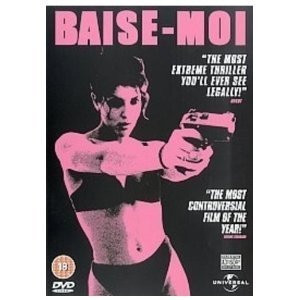
All the usual genre suspects are dealt with in this book, horror, gangster, war movies, etc. It’s like a whistlestop tour of everywhere you really wouldn’t want to stay for more than ten seconds. But after reading this I’m thinking that violent movies are all essentially right-wing and on a mission to call forth our own inner rightwingery in one way or another. It’s a bit of a generalisation, way too glib. I need to watch a few more, just to see if this argument really holds water. So I’ve just added Baise-Moi, Texas Chainsaw Massacre : The Next Generation and Kill Bill to my Lovefilm rental list. Purely in the interests of research, you understand.
Don’t read this book if you don’t want spoilers to literally every movie mentioned and then some.
Despite summarising every movie in excruciating detail, this book still doesn’t say much about them in the end. I mean there’s some insightful thoughts in here regarding how violence in cinema has had real life consequences, or at least was perceived to have done so, but the majority of it is movie summaries that can come across as disconnected.
At least it’s a good list of movies to watch if you’re bored.
The British author brings some interesting insights from being an outside view, but he also misses some important aspects of the American movies he's covering and has no idea about it, to the detriment of his book. The writing can sometimes feel too much like a college seminar piece.