From early childhood to life after eighty, the great challenge of any friendship is keeping it healthy and strong. In this funny, engaging book, award-winners Jane Yolen and Mark Teague present humorous, naughty dinosaur antics that any young sibling or friend will instantly recognize -- followed by dinosaur-sized hugs and expressions of affection. Do children in your home ever fight over a toy? Do good friends at school ever push or call names? And do buddies also know to share, give cookies, and apologize? Come along and laugh in the tenth full-sized book in this highly acclaimed series -- as little ones make friends and stay friends ... the dinosaur way!
Jane Yolen was a novelist, poet, fantasist, journalist, songwriter, storyteller, folklorist, and children’s book author who wrote more than three hundred books. Her accolades include the Caldecott Medal, two Nebula Awards, the World Fantasy Award, three Mythopoeic Awards, the Kerlan Award, two Christopher Awards, and six honorary doctorate degrees from colleges and universities in Massachusetts and New Hampshire. Born and raised in New York City, the mother of three and the grandmother of six, Yolen lived in Massachusetts and St. Andrews, Scotland.
We’ve read a few of these “How Do Dinosaurs..” books so far and we really like them!! The illustrations are awesome, the rhymes are great, and they always come with a good life lesson. Our only grievance with them is that the dinosaurs are always boys! It’s always “he he he” and we’d love to see a girl dinosaur in one of these stories! We’ll keep reading them and hopefully we’ll find one! 🦖🦕
Mark Teague has been one of my favorite illustrators since I was a kid and read Pigsty. I'm glad I came across this one and I want to read the rest of these dinosaur themed books now! This is a sweet book about how to mend a friendship when there's a falling out, dinosaur style.
My littlest loves this series of dinosaur books. I enjoy the messages that each book portrays. This one taught him that all friends have disagreements, but you can always make things right again. A great message for little ones.
This book is another one loved by the preschoolers at the ecc and I have read it to them many times. What I like about this book is it takes an animal that is perceived as mean and turns them into an animal that is good at keeping and having friends. I think this book would be really good for a student/ group of students who have interest of dinosaurs. I also think this would be a good book to read to a class that might be having problems with friendships!
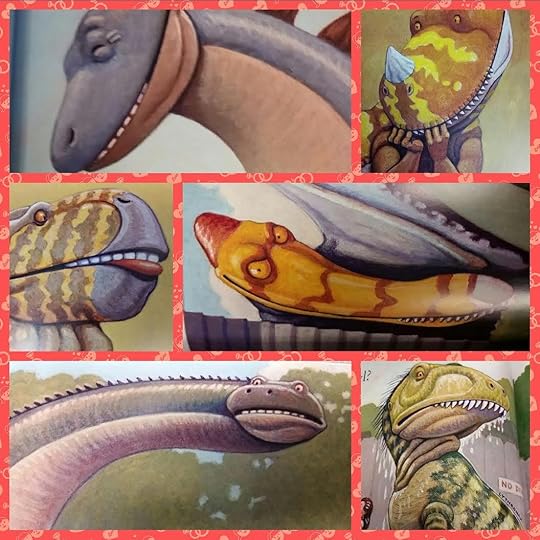
This books has a serious case of the Creeper Dinosaur Face:
Other than that, this has the usual things going for it as the other books in the series: great colorful and inviting illustrations with passable simple rhyming text. The theme is somewhat odd though, in that all of these books show you how to be good after being bad, so why do we need specifically about trying to be friends? But really, this formula works (dinosaurs+feels-thinking about it too much), so I'm sure it's not really an issue.
Future titles: How Do Dinosaurs Organize Their Closet? How Do Dinosaurs Behave in an Elevator? How Do Dinosaurs Perform Routine Non-Daily Grooming Rituals? How Do Dinosaurs Demonstrate Non-Physical Contact Affection?
Probably Not Future Titles: How Do Dinosaurs Deal With Panhandlers? How Do Dinosaurs Emoji Their Emo? How Do Dinosaurs Enter Into a Dialogue About Race Relations, International Security, and Individual Rights in a Post-9/11 World? How Do Dinosaurs Realize Not Everything Requires a Trigger Warning?
Love this series and the set-up for this book is terrific. But the problem resolution didn't quite resonate with me. I wish there was more focus in inviting a friend to play with you or playing the game your friend wants. There's a little too much focus on bringing toys to school to play together or giving your friend a gift.
I like all of these dinosaur books by Yolen and Teague, but this one really cracked me up with the facial expressions and body language throughout, especially Leptoceratops writing "Dilong is Stupid" on the blackboard. Classic!
How Do Dinosaurs Stay Friends? By Jane Yolen is the fictional story that tells about how dinosaurs keep friends. This story uses rhyming phrases to tell children how they can be a good friend. This entire story is based around two dinosaur friends who got in a fight and they figure out how they are able to stay friends by forgiving each other. This book would be ideal for first or second graders because it deals with conflict resolution and gives examples of social interactions that may occur. The illustrations by Mark Teague are exquisite and show the different types of dinosaurs in vibrant colors with the name of each dinosaur written along their backs so that children can identify the various types of dinosaurs. The cover instantly catches your eye as it features two dinosaur friends hugging; we as a reader know that they will eventually become friends again because of this. I would pair this book with Dinosaurs! By Gail Gibbons because the students can take the information from the nonfiction text and apply it to the fictional one by trying to identify characteristics of each dinosaur in Yolen’s book based on what they learned in Gibbons’.
Do children in your home ever fight over a toy? Do good friends at school ever push or call names? And do buddies also know to share, give cookies, and apologize?
In this funny, engaging book, award-winners Jane Yolen and Mark Teague present humorous, naughty dinosaur antics that any young sibling or friend will instantly recognize -- followed by dinosaur-sized hugs and expressions of affection.
Along the same vein as the other Dinosaur books but with a gentle reminder that there is a better way to solve disagreements and fights. When I read it today I asked if the second grade class eever got in fights with their friends and two girls motioned that they did with each other. By the end of the story they were nearly hugging and on had her head on the other's shoulder. Don't tell me that picture books don't have an impact. Today it did!
I feel like this short story is to teach and inform kids how to be a friend and put your pride and ego aside. The story starts with the question "How do dinosaurs stay friends?". The story talks about all these different negative scenarios and options (questioning) such as "Does he tell a lie to the teacher on his friend?" or "Does he throw his friend's lunchbox straight into the lake?". Now obviously these questions are supposed to be blatantly obvious things NOT to do. The story then talks about the examples of how to be a friend. Sharing and helping are mentioned and the story ends on a positive note.
This series has great illustrations, but is very confusing for younger readers because it appears to create mixed messages. The first half of the books show and describe terrible behaviors and ask if the dinosaurs do those things (well to a kid, the answer seems obvious: yes! They are doing those things on the page right now!). Kids see these bad examples and get ideas for bad behaviors, and then all of a sudden the second half of the books say “no, dinosaurs don’t do those things, they do these things!” which is very confusing because we just saw them doing the bad behaviors, so it seems like they do do those bad behaviors.
Personally I find this book is full of cliches and so repetitive, however, I have to give these books a lot of credit because they really do draw the attention of children and after all if we're trying to get children to read. When picking a book for the children’s reading group, you want to read a book that they really want to look at and you know children love dinosaurs. As such, even though I'm not a huge fan, as long as the children in the reading group love these, I will continue to read them. So, I have to say this one gets a good score.
While I totally liked the theme, there were too many other things that didn't work for me: "Does he egg his friend's front door? Does he scribble a note with a horrible scowl?" I'm hoping little ones aren't too familiar with egging doors and I didn't really care for a few of the examples provided. Plus the rhyme didn't add to the story for me. It seemed to make it harder to read. On a good note, the illustrations did their best to work with the text.
Great book for kids! This book teaches kids how to have nice hands and that having respect for others and not only our friends will benefit them. This books uses pictures of dinosaur's doing not so nice things like hitting a peer, or throwing things when angry and losing their friends in the process. Then, it shows how to do things differently and apologize and regaining lost friends, or peers who were upset no longer are. I highly, highly, highly, recommend.
How Do Dinosaurs books are a fun series of books for your dinosaur loving young reader. The rhyming text, variety of dinosaurs, and the classic illustration of the parents make this a fun book to read. Quite a few of these books have had my husband and I laughing out loud or remembering a time the exact same thing has happened in our home.
i love these books-they have a nice rhyming scheme. it asks a bunch of questions (how do dinosaurs stay friends), does he tear up a book that his friend let him take? does he throw his friend's lunch box straight in the lake? at the end it says no a dinosaur doesn't and then it lists ways to be a good friend.
Перебільшення (і фізичне, виражене в графіці, і поетичне, виражене в поведінці) все-таки є класним прийомом, коли створюєш дитячі книжки. Вони ще й прекрасно римуються! Правда, мені не сподобалося, що динозаври дарують свої улюблені іграшки тим, з ким посварилися - мої батьки б цього точно не дозволили))
A feel good read that children will enjoy on friendship. I as an adult was remained of some very basic lessons. 😊 Lessons of friendship: Send a note taking the blame; let your friend choose the first toy; write a note that says "Really, I don't want to fight.". A feel good read.
Quote:
...that even though friends may occasionally fight, there is always a way to make everything right.
This one may not quite have the charm of others in the series, but I still enjoyed it. Good reminder that all friends (and family members!) fight sometimes, but if we each take responsibility for making it better, our relationships can heal stranger than they were before.
Good but not great entry in this series. Due to the length of the second half, the dinosaur resorts to rather excessive gestures to apologize for the fight, well beyond the standard apology that is most likely appropriate to the situation.
I think this book would make a good read aloud because it shares with kids in a fun way how they can be and stay friends. Even though it is sharing how it works with dinosaurs, they are still things that children can do to stay friends and I think they would enjoy it.
My daughter loves this series. This isn't her favorite of them but it's still a great hit. Glad there are many from this author and illustrator combo. Great for any young reader who likes dinosaurs (of which there are MANY).
The tenth book in the dinosaur series, this one explores how dinosaurs make up after a fight. First the book explores all the awful things an angry dinosaur (or person) might do after a fight. Then the book describes kind things that the fighting friends might actually do to make amends.
Poor Dilong! I did like his bright colors, though. I didn't care for the use of the word "stupid" or for the egging of the house. But I did like the learning to get along even though sometimes we argue concept.
1-2 sentences per page. Big colorful, realistic illustrations. The first part of the book describes how to not treat a friend, and the second half of the book talks about how to treat a friend, even after a fight, and how good hugs and good attitudes towards others keeps a friend.
This entire review has been hidden because of spoilers.
Jack borrowed this book from the Canal Winchester Library. I picked it because he loves this series. We read it together at Dada's office while we waited for his meeting to end. Jack had me read it twice and enjoyed the dinosaurs; though, he was rather upset when they were fighting.
Some of the rhymes were a little clunky and a few page breaks might make this a little awkward to read aloud. Otherwise, cute story with a nice message and detailed, full color illustrations.