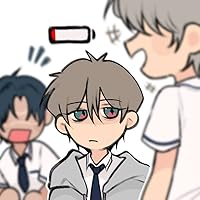
Apparently, the Laundry Got There First
In “Honey Bee & Lemon Balm: sweet moment,” Jil Hashikura lets shared detergent, horny panic, and one increasingly meaningful pair of hands beat sex to the job of proving two people belong together
By Demetris Papadimitropoulos | October 4th, 2026
Desire is noisy in Jil Hashikura’s “Honey Bee & Lemon Balm: sweet moment.” Kaoru Mitsuya, former yakuza turned florist’s employee and boyfriend-in-residence, has no trouble naming what he wants. Six months into his relationship with Yuichiro Shirouzu, he has work, shelter, meals, affection, someone waiting at home, and a life he once had little reason to imagine. One omission keeps bothering him: they still have not had sex. Hashikura gets an impressive amount of mileage from Kaoru’s suffering, but the better joke is on his accounting. He keeps measuring intimacy by the one boundary not yet crossed while the pages quietly accumulate everything he has already been given.
Early on, Kaoru knows perfectly well that Yuichiro needs time. Their physical relationship has reached kissing and light touching, and Yuichiro’s inexperience makes anything further difficult enough that Kaoru consciously tells himself to respect his pace. He is also frustrated. Those facts do not cancel each other, however conveniently romance might prefer them to. Kaoru wants his boyfriend sexually and wants to feel that appetite returned. Gradually, “not yet” begins to sound to him less like timing than evidence. If Yuichiro wanted him with the same urgency, wouldn’t it look more like this?
Most romance sequels have already spent their original fuel. The couple got together; now what? Hashikura admits the problem in her afterword, where she says she wondered what another volume could do “since the main couple was already together,” and credits Yuzu, a new source of sexual chaos, with helping push the story forward. You can occasionally feel the push. Still, “sweet moment” mostly resists the drearier sequel trick of damaging a relationship simply to make readers watch it heal again. Kaoru and Yuichiro remain happy. Hashikura has to find movement inside that happiness.
Everything useful about her solution appears in a tube of moisturizer. Yuichiro notices Kaoru’s chapped hands after drying his hair and offers him cream. Kaoru immediately tries to negotiate better real estate. Yuichiro restricts treatment to his hands. Then the scene slows. Kaoru thinks Yuichiro’s hands are delicate; Yuichiro calls his “thick and soft.” Kaoru feels breath near his neck. He notices a heartbeat. Soon the supposedly innocent business of holding hands has him aroused. Nothing dramatic has happened. Hashikura simply lets touch alter category while the characters are still performing the same small action.
The smell of the moisturizer gives the scene another turn. Kaoru says something smells good; Yuichiro assumes he means the cream. “No,” Kaoru tells him. “I meant you.” A comic cannot literally deliver scent, so the dialogue identifies what the image cannot, while the drawing handles what follows: proximity, attention, the slight reorientation of bodies toward one another. Hashikura often strips away some surrounding detail when contact matters most. The effect is less dreamy than selective. A room exists until, for a few panels, the hand or face inside it matters more.
Rather than letting the tenderness cure his complaint, Kaoru kisses Yuichiro and says, “I won’t do anythin’ more. Just this.” Then his interior voice gives away the real wound. He does not want to ruin the happiness or closeness he already has, but it would be a lie to call it enough. He wonders whether Yuichiro will ever “want me back.” That phrase makes the problem larger than intercourse without making intercourse irrelevant. Kaoru already has affection, touch, scent, cohabitation, care. What he lacks is desire returned in a form so plain that he does not have to guess.
If Kaoru fears that he is not wanted enough, Yuichiro fears that he is somehow too little to keep wanting. Talking to Yuriko about a transparent fictional “friend,” he describes a man with a younger lover who freezes when things become intimate, imagines all the better people his partner might find, and cannot understand the choice already made. “Every time he says he loves me,” Yuichiro admits by proxy, “I have to wonder why me.” Kaoru looks at hesitation and suspects deficient desire. Yuichiro looks at devotion and suspects a future correction. They are both collecting evidence against themselves.
Put them in conversation and the difference is audible. Kaoru’s thoughts come in slang, profanity, horny panic, and rapid self-revision. His feelings tend to arrive before tact has found its shoes. Yuichiro qualifies, pauses, diverts, invents a friend. Neither mode is linguistically elaborate, but their rhythms tell us plenty. Kaoru rushes toward meaning. Yuichiro needs time before he will admit that there is meaning to disclose. Their sexual mismatch is already present in the speed of their speech.
Against this arrangement comes Yuzu, who regards personal space as a charming superstition. He spots the couple’s problem, tells Kaoru that Yuichiro is making things difficult, offers himself as the more cooperative option, and promises that he can satisfy Kaoru better. The maneuver is hardly subtle, but it clarifies something Kaoru has not. He has spent chapter after chapter saying he wants sex. Here is someone willing to provide it immediately, without waiting, uncertainty, or any need to decode a blush. Kaoru does not want him. The shortage was never bodies.
Perhaps the funniest proof arrives when Yuzu’s increasingly aggressive touching produces almost no sexual response. Yuzu takes this as an insult to objective reality. Kaoru is almost as surprised. Then he realizes that an earlier version of himself probably would have reacted but now thinks, “I only can if it’s him.” The sentiment is simple; what it reveals is specific. Kaoru has not lost any of his appetite. Desire has acquired a proper noun. The thing he has been impatient for is inseparable from the person making him wait.
Another scene exposes how much intimacy Kaoru already recognizes without giving it that name. Asked what he loves about Yuichiro, Kaoru starts with “stupidly cute” and then falls into increasingly useless, perfect detail. Yuichiro smiles more when drunk. He comes home smelling of flowers. He is trying to learn to tolerate liver. He makes excellent kakuni. When an annoying customer wears him down, he scratches beneath his nose, and Kaoru suspects nobody else has noticed. The list gets better as it gets less conventionally romantic. Kaoru knows Yuichiro down to a private tic. He knows the person he worries he does not possess.
Domestic life keeps leaving similar clues. Baths, meals, clothes, shop shifts, deliveries, birthdays, sleeping arrangements, drinking glasses: none is important alone. Together they begin to describe a household. The best joke is laundry detergent. Someone observes that Kaoru and Yuichiro already smell alike despite not having slept together. No cosmic affinity is required. They use the same detergent. Kaoru has been waiting for intercourse to certify that their bodies share an intimate life. Their laundry has already filed the paperwork.
In Sagan Sagan’s “Old-Fashioned Cupcake,” adult desire likewise emerges through routine, appetite, embarrassment, and ordinary days that turn out not to be emotionally ordinary at all. Hashikura’s pages put more pressure on physical spacing. Yuzu closes gaps whenever he chooses. Kaoru wants to close them and learns to stop. Yuichiro eventually crosses them himself. The movement of one body toward another therefore changes meaning depending on who initiates it, what has been asked, and whether anyone had to be cornered first. Often the most eloquent panel is the one before contact.
More is at stake in Kaoru’s flower-shop job than the cute visual contrast of an ex-yakuza carrying delicate arrangements. The National Police Agency of Japan treats leaving organized crime and establishing legitimate employment as linked problems of social reintegration, with formal programs involving police, reintegration centers, and participating employers. “sweet moment” does not seriously investigate those systems, and Kaoru is no case study. But the context clarifies what Yuichiro originally hands him along with romance: ordinary work, routine, responsibility, and somewhere he is expected tomorrow. Flowers are almost incidental to the larger luxury of becoming boring.
It also matters that Kaoru remains recognizably Kaoru. He does not acquire gentleness by shedding his rough speech, libido, size, temper, or ability to fight. The gym scenes keep strength literal. The flower shop gives that strength fragile things to handle. Yuichiro gives it a different test: sometimes nothing needs to be pushed, fixed, taken, or protected by force. Kaoru’s growing attractiveness lies partly in his capacity to act and his increasing willingness not to act before he is invited.
That care makes Yuzu’s behavior the volume’s most irritating inconsistency. When Yuichiro hesitates, Hashikura attends to the hesitation. Kaoru checks himself. Time slows. Yuzu receives different treatment. Kaoru tells him to quit and later says plainly that he told him to stop; Yuzu continues touching, straddling, provoking, and trying to coax a sexual reaction while the pages turn the encounter into escalating farce. The issue is not that Kaoru is secretly as frightened as Yuichiro. It is that his refusal is perfectly intelligible. The manga is very good at the danger of misreading Yuichiro and less disciplined when Yuzu simply refuses to read Kaoru at all.
Read alongside that problem, Yuzu’s usefulness becomes a little too legible. He can supply jealousy, temptation, scent jokes, an outsider’s diagnosis of the couple’s sex life, and the occasion on which Kaoru has to explain why Yuichiro is irreplaceable. Hashikura’s afterword is almost comically candid about his propulsion duties. Yet he earns some of his space. His shameless availability proves that Kaoru’s frustration is not solved by a more willing partner, and his habit of collapsing distance throws Kaoru’s learned restraint into sharper relief. He is both the lever and, occasionally, the squeak of the lever.
One fact keeps Kaoru’s education from turning into a lesson about how he ought to be satisfied with cuddling. He is not wrong to want sex. Shared detergent is not intercourse; knowing somebody’s favorite pork dish is not sexual reciprocity; tenderness cannot automatically substitute for an intimacy one partner openly values. Yuichiro is equally entitled to take time. The difficult part sits between those truths. Kaoru cannot turn wanting into entitlement, but neither can he reasonably intuit every stage of Yuichiro’s private readiness. Love may involve learning another person’s signals. It cannot require permanent clairvoyance.
Part of what changes on Yuichiro’s birthday is that he finally stops being only the person whose limits Kaoru has to infer. The celebration itself is wonderfully modest: Chinese takeout, home, relief at having time together. Yuichiro admits that he has always found it easier to encourage other people’s romances than to trust his own feelings. Kaoru asks whether he can touch him again. Yuichiro agrees. Kaoru immediately wants to travel backward in time and punch his impatient former self, which is about as close as his interior life gets to contemplative serenity. More important, Yuichiro is now choosing forward motion rather than merely failing to resist it.
Once he says, “If it’s okay for me to turn out the light, take my hand,” every earlier hand scene comes back at once. The hand began as chapped skin. Yuichiro cared for it. Kaoru compared it with his boyfriend’s. Holding became erotic. Kaoru then proved capable of holding without treating contact as permission for more. Now the same object carries a question. Yuichiro does not need to announce himself suddenly transformed or fearless. Kaoru taking his hand answers him physically, but not ambiguously. Hashikura has spent the volume making this gesture mean one thing after another until it can finally mean consent.
Under the covers comes the neatest joke in the book. Kaoru, who has spent months thinking about sex with almost professional dedication, realizes he forgot a condom. Yuichiro has one. He bought it at the convenience store on the way home. That purchase quietly rearranges what came before it. Yuichiro’s desire had a private history Kaoru could not see. The supposedly impatient partner arrives unprepared; the supposedly hesitant partner has planned ahead. And then, with desire mutual, permission clear, and protection available, Kaoru’s body refuses to cooperate. Anatomy files an objection.
Laughter keeps the moment from becoming either reward or humiliation. Yuichiro teases him. Kaoru suffers. They tickle each other, laugh until it hurts, and realize that there is no reason they cannot try again sober. Nothing important has failed. That is precisely what the failure proves. Yuichiro wants him. Kaoru now knows it. Neither man has been rejected. Sex can remain something they want without being made to certify the relationship. When Yuichiro notices how warm it feels to be held by a lover, the embrace is visually familiar but emotionally altered. Earlier, holding felt wonderful and insufficient. Now it no longer has to stand in for anything.
Other weaknesses are quieter. Kaoru’s cycle of arousal, restraint, frustration, and self-rebuke repeats a few times after its psychological point is secure. Yuichiro’s reserve suits the story but leaves Kaoru much fuller as a consciousness. And the bonus story “My Garden,” which jumps nineteen years backward and gives waiting a much longer timescale, arrives after Chapter 6 has already found such a clean stopping place that it feels slightly appended, however intelligently it echoes the main story’s interest in feelings that take time to become speakable. I rate “Honey Bee & Lemon Balm: sweet moment” 84/100, translating to 4/5 Goodreads stars.
Small things are finally where Hashikura trusts the book most. A hand begins as skin that needs lotion and ends as a way to ask a sexual question. A smell travels from cream to skin to flowers to laundry. An embrace appears early as something Kaoru loves while privately calling inadequate, then returns after intercourse has become possible, gone wrong, and stopped functioning as proof. Hashikura does not teach him to want less. She changes what he knows how to count.