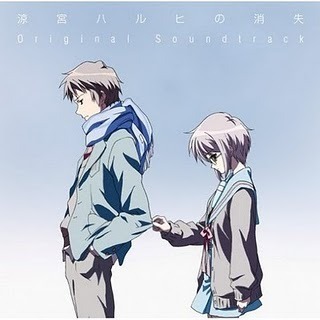
Một thế giới không tồn tại người ngoài hành tinh, người đến từ tương lai hay người có siêu năng lực, một thế giới mà ở đó, Nagato Yuki trở thành một cô gái dễ e thẹn, Asahina Mikuru xem Kyon như người xa lạ, còn Kyon trở lại với cuộc sống thường nhật sóng yên biển lặng của một học sinh cấp ba. Thế nhưng, sự bình thường ấy lại khiến Kyon hoang mang, cậu bắt đầu tìm kiếm những vết tích về sự “bất thường” của các thành viên đoàn SOS. Buổi tiệc Giáng sinh của đoàn SOS do Haruhi đề xuất liệu có thể tiến hành thuận lợi hay không?
Nagaru Tanigawa is a graduate of the Kwansei Gakuin University School of Law. In 2003, he won Kadokawa's Grand Prize for Literary World for his work on the Haruhi Suzumiya series.
Without a shred of doubt the strongest book in the Haruhi series. It’s much more serious and gripping than what has come before.
Haruhi is gone. And it’s like she was never there. Now Kyon, who has always been grumpy and reluctant to play along with Haruhi and the others, has to do some soul-searching. Will he accept this new normal, the normal he has been annoyingly begging for ever since he met Haruhi? Or will he try to restore order and return the world to how it was before?
The story so far: On the surface Haruhi Suzumiya seems to be an ordinary if hyperactive Japanese schoolgirl, but in reality she is a being of immense power, possibly even God herself. Luckily for the rest of the us, she doesn't realize any of this. She's surrounded by the SOS Brigade, a club she started for the purpose of discovering aliens, espers, sliders, and time travelers. Ironically, the Brigade is filled with exactly the kind of people she's seeking, though none of them have any intention of telling her. Yuki Nagato is an android created by the alien Data Overmind; Itsuki Koizumi is an esper with highly specialized powers for dealing with Haruhi's reality-warping; and Mikuru Asahina is a time traveler. The only normal Brigade member is Kyon, the guy who had the misfortune to sit in front of Haruhi in class.
Disappearance begins a week before Christmas. The SOS Brigade has been in service for about seven months, and the stress of keeping Haruhi in check is starting to take its toll on Kyon and one of the other Brigade members -- though not who'd you expect. After listening to Haruhi's grand plans for a Christmas party (plans that violate a number of school rules and the fire code), Kyon returns home and falls into bed.
The next day begins normally enough, but on his way to school he notices a number of oddities, most notably that his entire school seems to've come down with the flu overnight -- except his classmates insist that that the epidemic started a week ago. Even Haruhi is absent.
Or so he thinks.
At lunch, SHE arrives. The girl who sits behind him in class. Except SHE isn't Haruhi. SHE is someone who should not be here -- cannot be here. Yet no one else notices anything wrong. They think SHE has been here all along. When he asks about Haruhi, no one knows what he's talking about. He rushes from class to find the other Brigade members, only to discover that Koizumi's whole class -- the classroom included -- has disappeared. When he approaches Mikuru, she doesn't know who he is and his attempt to convince her he knows her by revealing personal information -- yeah, going up to a girl and telling her you know she has a mole on her breast, not a good idea. Even Nagato seems to be an ordinary school girl now, sitting quietly in the Literature Club room reading, exactly as she used to before Haruhi took over the room.
Kyon faces a tough decision -- this is the ordinary world he's been craving since Haruhi forced herself into his life, yet it's not his world. This is what he's wanted for the last three books, but now that he has it, he has doubts. And so he sets out to restore the world to the way it was, and he must do it without the help of the other Brigade members.
This book is amazing. Up until this point, I've found the Haruhi Suzumiya series amusing but fluffy. The first volume was an origin story, so it got away with being a bit plotless since the focus was on establishing the world and characters. The second novel was an old-fashioned, "Let's put on a show!" story right out of the old Judy Garland/Mickey Rooney Musicals, with the added spice of Haruhi's reality-bending powers blurring the line between film and reality. It succeeded primarily because the characters were so much fun to be around, but by the end I was doubting how far these sorts of stories could carry the series before it would become nothing but inconsequential incidents more fitting for a daily comic strip than a novel series.
I have no more doubts. Put it this way, the anime series adapts four of the first five books. This is the one they skipped. Why? Because they were saving it for the movie. That's not to say this is some grand epic -- it's actually the shortest volume so far, at a mere 180 pages, and the only major fight happens off stage. There's a lot crammed into the story, but it's almost entirely introspective as Kyon comes to terms with the altered reality.
The most memorable moments are Kyon's interactions with the alt-Nagato. With the real Yuki's alieness removed, what remains is a sad, shy girl so lonely that one act of halfhearted kindness will make her fall in love.
Just as with the real Yuki, this Nagato hardly ever speaks, but unlike the real version she's able to convey her feelings with small gestures that reveal the depths of her misery -- tugging at Kyon's sleeves, handing him an application for the Literature Club in the hope that he'd come back and see her even though any sane woman would be filing a restraining order.
The revelation about what this alt-Yuki is and what Kyon must do to her to restore the world is absolutely heartbreaking to the point that I'm not sure he made the right choice, though he does make up for it somewhat in the penultimate scene when he discusses events with the real Nagato and reveals how far he'd go to save her.
(As a side note, the movie version hasn't received an official US release yet, but it is -- ahem -- available. The TV show was a pretty good adaptation of the books, but ultimately just light entertainment. As such, I was completely shocked by how powerful the film is. They completely nail it. Howard Hawks once defined a great film as having three great scenes and no bad ones, and this certainly meets his criteria and more.)
the time travel and friendship storyline was good but FUCK i strongly despise how the author writes female characters. i'm gonna need male authors to start getting more input from women when writing female characters because NO.
Vì đọc nhiều review nói tập 3 là tập truyện ngắn, không ảnh hưởng đến cốt truyện chính nên mình mới bỏ qua nó nhưng đọc xong cuốn này rồi mới thấy đó là quyết định không đúng đắn cho lắm. Tập 4 này liên quan khá chặt chẽ đến một câu chuyện trong số đó, ngoài ra những truyện khác cũng được nhắc thoáng qua. Nội dung những truyện ấy cũng được nhắc lại trong đây nên không lo bị khó hiểu nhưng khi đọc vẫn cảm thấy thiếu thiếu cái gì đó.
Thật ra serie này mình đã định dừng ở tập 2 rồi nhưng đọc được nhiều bình luận khen về tập này, thậm chí cho rằng đây là cuốn hay nhất serie nên mình mới đọc thử. Và có lẽ vì quá mong chờ một câu chuyện hấp dẫn gây cấn nên khi đọc xong mình có phần thất vọng. Khách quan mà nói cuốn này hay hơn đứt tập 2, nó tiếp nối được nhiều ưu điểm của tập đầu tiên, nhưng theo mình thì vẫn không hay bằng tập 1, nhất là ở cái không khí mới mẻ, tươi vui của một cuốn light novel mở đầu.
Tình huống trong đây khá bất ngờ, gây nhiều tò mò và đến sau cùng cũng có một lời giải thích hợp lý. Nhưng không khí truyện hơi bị trầm buồn và bức bối, đặc biệt là trách nhiệm đổ lên vai Kyon quá lớn. Đây là điểm mình thấy hay nhất trong tập này, quyết định mà Kyon buộc phải đưa ra giữa các lựa chọn thật sự khá nghiêm túc và nặng nề, có lẽ những tập gần cuối cũng sẽ có nhiều những phút giây trầm buồn như thế.
Trong cuốn này có một sự thay đổi của một nhân vật có thể xem là yêu thích nhất của mình ở những tập trước khiến mình cũng khá thất vọng ~_~
Điều mình thích khi đọc light novel đó chính là dù thế giới trong đó có bay bổng, khó tưởng đến thế nào thì tác giả vẫn đi đến cùng với trò chơi mình đặt ra. Làm mình thấy thế giới đó dù là tưởng tượng nhưng vẫn hiện ra rất thật, mọi tình tiết đều rất logic với những nguyên tắc trong thế giới đó, và đó là sản phẩm của sự đầu tư chất xám nghiệm túc chứ không phải tha hồ vẽ vời bay bổng như vẻ ngoài của nó. Trong cuốn này cũng vậy, từng chi tiết nhỏ đều được lý giải một cách logic, cho thấy được sự tôn trọng của tác giả đối với người đọc, đôi lúc có cảm giác đọc tiểu thuyết thật sự chứ không phải light novel nữa.
Sau tập này thì chắc sẽ ngưng đọc các tập tiếp theo thật rồi. Nhưng mình vẫn rất thích serie này, đặc biệt là các nhân vật trong đó. Và có lẽ cũng vẫn sẽ ngóng chờ đọc tập cuối, à 2 phần của tập cuối mới đúng chứ, nghe nói đó là tập hay nhất serie ấy :p.
My favorite of the Haruhi books that I have read. In previous books, I have loved the situations and characters, and I have laughed at Kyon's reluctant passivity in the face of Haruhi's steamroller personality, but this is the first time that he takes an active role in his own fate and it makes him a much more compelling character. I don't know if this is a translation issue, but there are many instances where a line is not spoken by the main character but is responded to nonetheless. I believe that we as readers are intended to bridge the gap and assume that Kyon has asked the question in the meantime. It actually works quite well. It seems almost dreamlike when stray thoughts become something tangible that people react to. This is not a great place to jump into the Haruhi books, but it is a step in the right direction if you liked any of the previous books at all.
This is absolutely the best book of the series so far. From this best book a wonderful movie was made, and I was thrilled just as when I first watched the movie (it was almost a first read since I didn't remember clearly the ending)
This is also the Haruhi Suzumiya story that best developed its characters, in particular Kyon and Nagato, especially when i was thinking in the previous books "will the character ever develop or they will stay static archetypes all the time?"
I'm only doubtful about one thing that this crazy sci-fi story has left unanswered, an it might be a bg plot hole if it will not be answered, so I hope a future story linked to the ending of the book will also remove my doubt.
Since this was the last thing adapted in the anime, I'm excited to read never-adapted stories that are into the following books. I'm also excited to read the source story of the most hated arc of japan animation, i.e. the Endless Eight.
The movie was way better. So was the first book, despite this particular story being my favorite part of the anime, in its movie form. The comments about Asahina were truly endless and brought this book down a star on their own. Also, the book seemed to circle around the same points several times, and not even the ones that could be considered to be hard-to-follow. I dunno, it just wasn’t particularly well-written. The Godfather book-to-movie trajectory may be similar to what we have here.
What exactly does Haruhi represent? Whilst the melancholy of Haruhi Suzamiya posits that she's some kind of playful, unappeasable God like being who acts on a capricious whim, the stated conclusion to this particular novel suggests that she also represents the pure fun and joy of life. My own thoughts on this are that furthermore, she's a metaphor for maybe fiction or ideas, or imagination or possibly anything you like because the question of this novel is "could you do without her"? and at the end Kyon posits that you'd be absolutely crazy to suggest that you couldn't. It's ironic, then, that having watched the anime through a couple of times and now, ploughing through the original novels, I'd have to say the same thing; once you've got a taste of Haruhi Suzamiya you couldn't possibly imagine a world in which she didn't exist, but then, I've always been attracted to chaotic pleasures, the unpredictable and the surprising. Haruhi is full of a willful arrogance that can be frustrating and also rewarding and one has to engage with things one finds testing in order to take additional pleasures away from them. Ultimately in this book Kyon rejects an easy, sedate, Haruhi-free life because like the symbolic hill that greets him on the way to school every morning, he wants the ultimate reward that comes with sweating it out.
This novel, of course, formed the basis for the Haruhi feature film which finally arrived after the series 2 seasons had wrapped (I'm sure some see it as an apology for the frustrating second season, but there's really nothing to apologise for) and it's easy to see why they held out in adapting this book because, despite being only the fourth in the series it nicely ties up its themes and ideas. By itself it's less of a masterpiece, a fairly light tale of alternate realities and time travel and consisting of ideas we've mostly seen before, but continuing to build on earlier work (and this riffs a lot on a short story from the previous novel, which seems to have been written as setup) as it does and taking a fresh emotional look at characters we already know and love, particularly Kyon but also, surprisingly Nagato, it really completes the journey we've started - to that extent I'm not sure in which direction the series can truly go from here, but the I suppose the point of having Haruhi in your life is that you never quite do know, do you?
The shortest, and also best, the series has to offer. That's no different from the anime, where this story serves of the culmination of the entire series (and also is currently its ending).
Some of that is lost by the omission of many of the side stories when reading the novels in publication order. A big part of this book is to showcase the character's (especially Kyon and Nagato) character growth throughout the series. Without Endless Eight, Live Alive, and The Day of Sagittarius, the story loses a bit of its emotional impact. Melancholy, Sigh, and Boredom simply don't show development of the characters in any way that would meaningfully indicate that this book should occur. Nagato shows signs of being bugged in the anime, but in the books it just sort of happens. They tell you that Kyon and Nagato have developed, but it wasn't shown. A cardinal sin.
The author's fondness for omitting quotation marks for certain moments of Kyon's dialogue is also by far at its worst here, and it really is clumsy. I don't like that style at all, and I have no idea if it's a result of poor translation or simply poor writing.
All that being said, the story is still there, and it's Disappearance. Even without build-up, it still shines like a diamond. A diamond in the rough in the case of the novels.
Perhaps I'll wait a bit longer before continuing this, as I'm clearly more of a fan of Kyoto Animation's Haruhi than Tanigawa's. Maybe it's the English degree looming on the horizon, or perhaps I'm just bored with content I've already seen done better. Hard to say. I could sure go for some hot pot, though.
I wasn't all that thrilled with the last book in this series, so I took a long break from reading the light novels just so I could clear my head. I have to admit that if I hadn't already had this book sitting on my shelf, I might not have started back in on the series but now I'm glad that I have. This book was far better than book three was.
What I liked most about this entry was that it addressed the idea of what would happen if Haruhi was never around. Would Kyon really be enjoying his life? Would he still be able to be around the well-endowed Asahina? What would Haruhi be like? I'm glad to say that this book showed a pretty entertaining view of another world and that it's much more engaging and fun than the previous book.
The only downfall is that due to the typical light novel length, the story didn't go into as much detail as I'd want. The alternate world does give us a great look into the main characters, but only a brief one. I kind of wouldn't mind seeing more of that world and how the characters would interact with one another. (Here's hoping that world gets a spin off much like the Evangelion series has spun off of its alternate universes.)
If you're like me and have been sitting on the fence about this book, it's worth reading and diving into the series again. If you're a fan then you've probably already got this book or have it on order. If not, then this is something you've got to have.
This is definitely the highlight of the series so far (true of the anime version too), and I think it speaks to how good this volume actually is when I realized how very little is changed in transition to the film version, although hilariously, a visual element present in the ending of the film is specifically called out as being a tired trope by the narrator/writer in the text. Really, the minor flaw here, and throughout the series so far, is that Tanigawa is all too happy to tell and not show. As a writer he just seems to want make sure his readers know certain things instead of discovering or intuiting them. This can be a good thing at times - the book pointed out some smaller implications of the time traveling that I didn't notice in the film since it wasn't specifically spelled out, which for me was in fact enriching, being that I am a dummy. So for plot machinations, this is fine. But for some of the finer "emotional"/character discoveries, the film does a much better job of teasing things out, by eliminating some of the minor realizations Kyon has along the way, so that the major revelation at the end - Kyon misses Haruhi and his old life - is much more effective and climatic. Yeah, it's basically "It's a Wonderful Life" but it's a damn satisfying take on it.
This entire review has been hidden because of spoilers.
In this fourth volume, the first with all new material for me, Nagaru Tanigawa sets up an It's a Wonderful Life scenario where Kyon wakes up in a world (not quite) without Haruhi Suzumiya and he's the only one who remembers how things should be.
Filled with Kyon's typical sardonic self-narrative that he occasionally speaks out loud, yet somehow this story really finds a heart as he learns who is behind the change, just how much he misses the world from which he came, and, ultimately, that he has the power to decide how the world will be, including understanding what consequences that will bring.
Despite its typical Japanese young adult fare, Nagaru Tanigawa cleverly slips nice subtle moments throughout. A great volume in a very good series.
If you liked the first three, or even if you didn't, this one is worth checking out! The plot is absolutely fantastic. What happens if you wake up one morning and everything you know to be true has changed?
This would be a 5 star book, but since it's a translation I found the wording to be weird at times. I think it's hard to translate these books from Japanese to English because one of the things that makes it really great is Kyon's humour. He's so sarcastic and funny. I don't think the translation really captures it the way it's intended. Some things just come across sounding awkward at times. Still a great read nonetheless. Some slightly awkward wording didn't alter my enjoyment of the book. I just wish I could read Japanese or something so I could really enjoy everything this book has to offer, you know? Oh well, maybe one day! ;)
Ah, brought the wrong book in the series. I haven't even read book 3 yet. Oh well.... :/
I loathed the first and second book, I just couldn't like Suzumiya's character. But this was different. Despise not being able to understand some of the events that were mentioned (due to the reason above), this volume was strangely charming. Tanigawa was able to keep record of all of the events in his plot, although the timeline in this book is not at all straight. Also, the characters, and the mechanics behind their power are very elaborated. What excited me the most, are the numorous astronomical references.
About this version
It was such a pain reading this in Vietnamese, due to the science - fiction terms. What the hell does thể ý niệm hợp nhất even mean?
Recommended for
Anyone who loves hyperactive schoolgirls + passive dudes + aliens + book - loving robots.
This book is an absolute turning point in the series. I loved the series before I read this, but this book is why I continue to love it. While I cannot recommend the first book without heavy caveats, the second book at all, or the third book if you aren't already a fan, this book is genuinely good. Of course, it doesn't have any impact without what came before. Oh well. Still one of my favorite books in one of my favorite series. And things really look up from here.
"Cheers to saving the world by overloading it with fun with John Smith!"
"Please remember the name John Smith, Haruhi..."
Please don't forget. That I was here
I feel like I am a very well read person. Not to pat myself or even gloat but I really do love stories from all sources of media, books, film, TV, video games, anime, manga, light novels, foreign language films/TV, board games, visual novels you name it I've done it all. The best part about being a consumer of all media is that I get to pick out and consume the best stories from each medium rather than settle with one medium and consuming everything it has to offer, the good and bad. Nah I just like experiencing everything good it has to offer. So that why it's no exaggeration when I say that The Disappearance of Haruhi Suzumiya, this story arc that's part of a wider series is the single most important story I have ever experienced in my life. It's film anime adaptation was my first exposure to the story right after I finished watching the Anime series. That movie has been part of my top 3 favourite films of all time regardless of genre or live action/animation. The original anime would be top 3 favourite animes of all time however the Disappearance of Haruhi Suzumiya was on another league. When I eventually read the manga adaptation the story was still as phenomenal as ever. And now that I have finally experience the original light novel adaptation of this amazing story I can confirm it is still one of the best narrative experiences out there. It's kind of amazing how Nagaru Tanigawa nailed this story in the original novel. Kyotoani simply added their extra flair and didn't even need to change the story, that's how good it is (That being said the movie is still the best version of the story simply because of the raw craftsmanship, direction, acting, animation and music at display that heightens and elevates an already perfect story to be even more phenomenal) the movie is one of my favourite movies of all time and now the light novel is easily one of my favourite books of all time too.
Of all characters in fiction Kyon is my favourite character ever and it's all because of this story. I'm no chosen one fantasy badass or a tortured soul who's all cool and mysterious. You know who I am? I'm just a sarcastic cynical git who is so tired of this unprecedented unpredictable and annoying thing called life. I accept the ridiculousness of it and mock the predictability. I lie to myself saying that I care nothing for the interesting or the unexpected to happen in reality it's just a coping mechanism to hide the deep seated melancholy and Boredom I always feel. We internalise this coping so much we eventually become blind to how truly amazing, interesting and downright fun our crazy unpredictable life actually is. We don't usually notice how good we had it... Until it's gone.
15 year old me (Coincidentally the same age as Kyon) experiencing this story was one of those seminal moments in a young person's life and for me it was about an hyperactive 15 year old anime girl with a big imagination who also happened to be God and the sarcastic background fodder she brang along with her. Kyon can lie all he wants but deep down he was the one who was melancholic. He was the one who wanted something interesting and extraordinary like the supernatural to be real. He accepted and settled with the mundane but deep down was still that kid that wished for more. Haruhi bringing excitement to his life, in his words was what saved his world. By simply overloading it with fun. And most importantly, he was there.
The whole point of this story is a ways for Kyon to go through this transformative arc of realisation and acceptance. Showing just the extent this otherwise lazy high schooler went through just to get back what he once had is a testament to how much the original world meant to Kyon. In a way it really does feel like the previous books have been leading up to this story.
This book is also about memory, how at one moment we exist in another's life, whether we're close or not is not important, what's important is that we were there. It's about how with time and memory all of that can quickly disappear. All it takes is for one person to remember for your world to change. How a book about silly anime characters in a high school club manages to say more in a 180 pages than most modern works with over a 1000 is a testament to the genius of The Disappearance of Haruhi Suzumiya. I genuinely don't believe there will be anything like this series or book again
So, we've finally achieved something that shines brightly to show its worth, haven't we?
My main problem with SUzumiya would be how the wordplay was predictable and ended up creating a hole in the creativity pot that allowed you to see everything that lay in there. However, this volume really proved to me to have the strength that at the same time the vase is broken, the contents spread out in such a complex way that they overlap and are overlapped by others, thus creating an interesting word game where the reader just has to hunt them down. !
The point is actually that the writing is not so far-fetched as to generate so much complexity, but perhaps creativity can turn the tide and form delicately traced paths to a distant sea? If so, then it is enough for me to weave my praises without any care for malice.
The junction of narratives here also expands, in particular, I highlight time travel, travel that previously seemed empty of explanation, when in fact it was a preparation, like a malleable mystery to be filled by the cement of the answer.
Even the plot twist was nice with a good writing construction, even though the illustrations play a very obvious role to eliminate some options
For philosophy, we have some development of Kiyon and characters adjacent to him. I wouldn't say that its construction in particular was so good, since it's practically an ellipse from volume 1, but more far-fetched, however other characters become really interesting, in addition to the twisted slice of life in a positive way, doing a good job for such developments
Changing the subject a little and going to the philosophical way of the topic, there is a much discussed topic in science fiction, which would be the rights of artificial intelligence.....
Currently, we have reached a consensus that self-developing artificial intelligences that prove to be high performers may indeed have rights compared to humans. For some human-race supremacists, this may be absurd, but pride aside, let's be a little more pessimistic about our brilliance......
One of the theories of human origin is of a supernatural creator, but it can be a little inconvenient to work so much in an occult that is not connected to science. It is precisely for this reason that we postulate several theories to link the scientific to the religious, the rational X to faith.... Thus, one of the theories that was formed as a result of this clash was the "virtual simulation".
God would be like a kind of programmer and we would be his programs, but we contain the virus of the first sin, and so humans become these conflicting lines of code that create their own emotions out of it.... Defending this is not fighting for it. mediocrity is not fighting for robots, but fighting for our own existence. Well, you see.... Assuming that such a theory was right and that we could be reinterpreted in this way, denying the rights of such "AIs", would also be denying humanity by domino consequence. After all, if it can smile like a human, learn like one and still generate emotions that can still be logically attributed, even if contradictory, why shouldn't we also clench our teeth and fists to protect such a life?
That said, how many out there would be willing to sentence an artificial life to death while holding a gun to their own head? Or would you still like to use so-called "rational arguments" like "This is a form less than perfection of the human being" or "What if a revolution happens? Will you take the risks?"..... Ha, it may seem boastful of my part of criticizing the conflicting arguments of others while I am a real hypocrite, but you know...... It was with this exact type of "rational argument" that slavery spread all over the world.
So, are we really that evolved to say that we wouldn't commit acts as mundane, wrong, and irrational as "slavery" while so hypocritically doing the same thing we used to do? Indeed, ethics grew, but no solid and immutable foundation was ever built to deal with it..... Ethics is not an illusion, but it can easily be confused with one as it can be replaceable and malleable.
Anyway, I liked how this volume made me think and how much fun it was.... I wouldn't say it was amazing, but it was certainly very good
Living up to its hype, or at least the hype of its anime film adaptation, The Disappearance of Haruhi Suzumiya is by far the best novel in the series since the first installment. Of the first four novels, only this and Melancholy accurately stand as proper narrative novels. Sigh tries to pose as a direct sequel to Melancholy after skipping six months' worth of events, and the novel's overall plot pales in its gravity compared to the battle of its predecessor, at once offering a more relaxed "slice-of-life" atmosphere to cool down from the high-stakes near-apocalyptic climax of Melancholy, while also seeming like a dud explosive, promising by relation to Melancholy to give the audience another wacky ride, while in actuality all the supernatural elements are incredibly tame and the conclusion is brushed through with a bit of a non-ending. Boredom is not even a novel, consisting instead of a handful of sequential episodes, subtly developing Nagato's character while not much else happens w/r/t Haruhi herself (and indeed the series could have benefited more, at this point, by changing its title to reflect the reliance on Nagato's plot-device powers). It is perhaps a little strange that Disappearance, though taking place chronologically after Sigh, mostly sidesteps the events of that second novel in favor of tying directly into the "Bamboo Leaf Rhapsody" story of the Boredom collection, the side-effects being a further diminishing of Sigh's overall worth w/r/t the series as a whole and a simultaneous augmentation of Boredom's own merit.
After nearly a year of the SOS Brigade's existence, Kyon finds himself apparently whisked away to another dimension, parallel to his original, featuring much the same cast, only in different roles, and with the unusual return of Ryoko Asakura, formerly an agent of Nagato's same Data Overmind, and who had previously made an attempt on Kyon's life back in the first novel. Curiously, we finally get something close to resembling a "slider" as potentially teased by Haruhi herself back in her original introduction (though, as it happens, Kyon didn't actually "slide" anywhere). In this different version of the world, the upperclassman Asahina has no contact with her kouhai Kyon, Nagato has changed from an emotionless alien robot to an incredibly shy, bookish girl who hides her insecurities with a mask of indifference falsely resembling her more familiar self, Koizumi's classroom straight up does not exist within this incarnation of the school building, and (in case you couldn't tell by the book's title) Haruhi seems to have disappeared entirely.
Thrown into this strange new scenario without explicit guidance from his paranormal friends, Kyon has no choice but to stumble through his life, hoping for a miracle to help him figure out what moves to make. When he visits the literary club room, former site of his world's SOS Brigade, Kyon (after accidentally almost-assaulting the meek new Nagato) is somewhat surprised to see an old computer sitting on a desk, an out-of-place artifact when no computer existed before Haruhi hijacked the room, and the one in SOS Brigade ownership was a high-end model regardless. He also finds Nagato's copy of Dan Simmons's Hyperion, used as a plot device in Melancholy, and it contains a bookmark with a cryptic message, just as it had previously - the message is different, of course, giving Kyon something of a clue to resolve his current situation. He is thus tasked with gathering "the keys" so that he might be freed of this new world, with a deadline of two days.
Tanigawa jerks the reader around for a couple dozen pages before finally allowing Kyon to learn of Haruhi's presence in this reality. Kyon's friend Taniguchi, having been in the nurse's office one day and absent from school the next, was (in)conveniently separated from Kyon while he screamed at Asakura for existing in Haruhi's stead. When Taniguchi finally shows back up, he reveals that Haruhi's been attending the school adjacent to Kyon's North High, leading the observant reader to question why Haruhi would have ever attended any other school when a mysterious stranger clued her in to the existence of aliens, time travelers, and espers in North High (that is, Kyon having time-traveled to help Haruhi create faux-Nazca lines when she was in middle school, three years prior to the story's "present"). Luckily for both protagonist and reader alike, the Haruhi of Kouyouen Academy responds immediately to Kyon's recollections of that Tanabata holiday three years ago, with his pseudonym "John Smith" being all the proof she needs (oh, by the way, Koizumu and the rest of his class from North attend Kouyouen now). Strangely, Haruhi recalls a second encounter with John Smith, later in the night after the line-drawing incident.
After gathering all the members of the SOS Brigade (including a traumatized Asahina), the old computer in the literary club room kicks to life to give Kyon a message from the "real" Nagato, presenting him with the choice to either stay in this mundane world or return to the paranormal chaos of his life with Haruhi and her Brigade. Obviously, Kyon chooses to go back to his own reality, having decided earlier in the novel that he actually misses Haruhi and her shenanigans. He is thus thrust back in time to the day of the Tanabata festival, encountering the adult Asahina just after she had previously spoken with his several-months-earlier incarnation, whereupon Kyon realizes he did not slide to an alternate dimension, but rather the world around him was reconfigured while only he retained the knowledge of its previous incarnation. The two of them later going to Nagato's house, after she'd frozen the several-months-earlier Kyon and Asahina (Small) in time, to be reawakened for the end of the "Bamboo Leaf Rhapsody" story from the previous book. We thus learn from Nagato that she cannot synchronize with her self from the December of Kyon's first year of high school (as she could with her July self), tasking Kyon and Asahina (Big) with fixing reality by striking the culprit with a special needle that would neutralize the power stolen from Haruhi and used to rewrite the fabric of reality.
The twist? Nagato herself was the culprit, having learned how to "feel" by hanging out with her friends in the SOS Brigade, having become overburdened from constantly righting Haruhi's own alterations to reality. Not only did she create a mundane reality as a backward gift for Kyon, incorrectly thinking he'd prefer a simpler life, but she also resurrected Asakura to act as a fail-safe, retaining her psychotic behavior but rewriting her allegiance to the Data Overmind as a deep dedication to protecting the new, milquetoast Yuki Nagato. Asakura manages to stab Kyon with her old knife before he has the chance to inject human!Nagato with alien!Nagato's cure. In a tastefully abrupt deus ex machina, Kyon is saved by a second set of Nagato-Asahina-Kyon, hinting a future event wherein Kyon must use Asahina to time-travel back to December 18 and have Nagato act once more as a human(oid) shield against a homicidal Asakura. Tanigawa thus reveals a larger-scale plan to have his characters time-travel back and forth, cementing the "Bamboo" story as integral to the series as a whole, signifying Boredom as one of the most important books for its inclusion of that tale.
It should go without saying that Haruhi is the most pleased when Kyon awakens from the coma that Nagato establishes to cover up the previous three days. In typical "tsundere" fashion, Haruhi pretends she merely cares for the well-being of her Brigade members, and unfortunately Tanigawa doesn't do too much to really make the reader feel her growing love for Kyon. But what's most bothersome is that human!Nagato is set up so perfectly as a cute little love interest, yet the same chapter where her shy cuteness reaches its zenith is the same wherein Kyon realizes he misses Haruhi's presence. The reader can only imagine the possibility that the malfunctioning alien!Nagato may have rebuilt herself as the demure human!Nagato to appeal to Kyon more directly, taking on a personality not unlike that of the childlike, easily-spooked Asahina. And perhaps Asakura existed to make sure Kyon didn't leave human!Nagato's version of the world. But alas, we are cuckholded out of a victory for Best Girl. And without any great flags raised for Haruhi herself, as would usually end the series's stories on high notes!
Postscript: Extremely fucking hyped to get around to the film adaptation, god damn.
This entire review has been hidden because of spoilers.
A surprisingly serious entry in the Haruhi Suzumiya series, where, as the title suggests, Haruhi herself doesn't feature an awful lot, having disappeared for a large part of the book.
For most of the story, Kyon finds himself alone in a new world where the SOS Brigade was never formed and the only member he still has any access to is Yuki, reverted back to her initial role as the sole literary club member. Without all the brigade members around - not least the absence of Haruhi causing any mayhem - this isn't as funny as the previous entries in the series as there isn't as much opportunity for them all to bounce dialogue off each other, but in return we get a deeper story surrounding Kyon and how he really feels about the life Haruhi forced him into, now that he's found himself forced back out of it. It's genuinely gratifying to that, for all his past complaining, he realises that he actually enjoys the crazy lifestyle he'd been living, that he misses all the eccentric characters around him and that he's willing to fight to retain that abnormal world. There's a lot of development for Kyon in this one and it builds and pays off really well, so it's definitely his volume.
And, as well as Kyon, it's a great volume for Yuki, too as we see her slow development over the series really start to come to fruition in some surprising ways, with genuine displays of emotion from the quiet, bookworm alien. It really feels like the two of them have bonded immensely by now and I'm very interested to see how that develops further. The unexpected reappearance of Ryoko Asakura was interesting to see as well and leaves me wondering if we'll be seeing more of her in the future, too.
I started reading this on Christmas day, because it's set around Christmastime and ultimately, that doesn't play a huge part in the story, but it does add some nice colour to it, particularly at the beginning. And for my earlier mention that it's not as funny as previous Haruhi books, that doesn't mean that it isn't funny at all, because there still are some good gags throughout - how Mikuru feels about Haruhi making her dress as Santa, for one - just less than usual, with more of a focus on story and character this time round, which worked very well indeed for me. It's a great volume of a great series!
It's really quite incredible what a good adaptation can do. The Disappearance of Haruhi Suzumiya film is my favorite anime film of all time, and a very close contender for my favorite animated film period. Needless to say, I had high expectations coming into this novel.
Unfortunately, this is the novel where Tanigawa's weak prose, hit-or-miss internal monologue, corny metaphors, and redundant information really shows itself. Maybe it's all the fault of a bad translation, but this fantastic time travel drama tale feels mishandled when the text comes across as amateurish half the time. Still, it's a great story with great characters, culminating in a shocking and satisfying conclusion.
Of course, all the positive aspects of this book are only elevated in the film by thoughtful animation, emotional voice acting, and an engrossing soundtrack. Meanwhile the negative aspects of the book, namely the sentence-to-sentence text, is whittled down to the core of its meaning and what doesn't work in the text is removed or reworked in a way that so beautifully works on the screen. For example, Kyon's internal conflict about which world he should choose in the text is just a stream of consciousness couple of pages where "I" and "you" become so interchangeable, it loses that feeling that these are two sides of Kyon arguing with each other. Whereas in the film, a second Kyon literally stands on himself and demands him to make a choice.
I'm not normally one to say the movie is better than the book. It's so rare, in fact, that I had to make such a big deal of it in this review. Because when all is said and done, if we never got the film, I would laud this as a wonderful shift in tone for the series, going from a lighthearted supernatural slice of lice comedy to a more thoughtful drama that I hope the rest of the series continues doing. But we do have the movie, and I can't help but compare. And when it all culminates in the final moment with Nagato, her "Thank you" to Kyon is heartbreaking and powerful, but it can't quite touch the sheer emotion and weight of the scene in the movie, where the subtle animation touches and Nagato's soft but painfully emotive voice drives home the importance of that single scene. So for me, I'll take the film.
This entire review has been hidden because of spoilers.
📚🇯🇵La desaparición de Haruhi Suzumiya – Nagaru Tanigawa (2004)
⛩️Se aproxima navidad y Haruhi reúne a la brigada SOS para organizar una fiesta en la sala del club. Sin mucho ánimo, Kyon acepta, pero cuando vuelve a casa sucede algo que no esperaba que pasara al día siguiente. Haruhi ya no estaba en la escuela, la clase se Koizumi ya no existía, Mikuru no reconocía a Kyon y Nagato pasaba a ser una chica tímida del club. El mundo había borrado la existencia de Haruhi Suzumiya, pero solo Kyon recordaba todo lo que habían vivido juntos.
⛩️Así Kyon iniciara una travesía en la escuela buscando algún rastro de la vida que dejo atrás para comprender que sucedió y buscando el culpable. ¿Habrá sido Haruhi Suzumiya quien reinicio el mundo?
🍡Opinión: una de las mejores novelas de la saga, ya que, a diferencias de la mayoría de los libros, esta es solo una historia, y no varios relatos sin conexión directa.
🍡El desarrollo de Kyon se aprecia mucha más acá. Ver como el mundo en el que vivió, donde tantos problemas tuvo, de un día para otro desaparece, donde lo único que queda son sus recuerdos, lo pone en el conflicto de vivir esta vida tranquila o si prefería la emocionante y angustiantes actividades que vivían junto a la brigada.
🍡Esta novela fue adaptada a película en 2010, destaco esto porque, tanto en la película como en el libro, logra transmitir las sensaciones de Kyon, la confusión, desesperación, la melancolía de lo que vivió, y la frustración por que nadie le cree su historia. En lo personal me acordaba el tono frio de la película que le daba aun mayor peso a esa sensación de pena.
🍡Por último, encontrar este libro fue una travesía de años, ya que es casi imposible conseguirlo, pero ahora puedo decir que por fin tengo toda la saga en español que salió. Una novela y película que recomiendo, incluso si no conoces nada de la saga.
What a phenomenal read. This is one of my favorite movies of all time and reading this and really getting to reappreciate it in this format makes me so warm. I literally finished it in a day I couldn’t put it down at all.
This also makes me see the kind of narrator Kyon is. Honest, direct, he can be extremely perserve (but in this book it’s toned down so much!), and how sincere of a person he can be. He’s also undeniably attracted to Asahina, struggling with himself a lot, and is -clearly- still growing as a person. His interrogation with himself and posing these questions (despite how basic they are) leaves me to wonder what are the so obvious things I complain about but secretly love?
And my, does he love Haruhi. He loves his friends, he loves the unique mysteries of life thats inexplicable. Nagato’s arc, a stoic overlooked side character taking center stage in a time traveling plot!
I love the concept of never fully being able to understand the backstories of his friends (at least for now) because they’re legitimately on a different level than him and know so much. Especially Asahina. Which is worth mentioning how weird it was for her to indulge in him when they were alone, an adult woman reliving herself for a moment is one thing but i think breathing him in was a bit much. But considering how he was in the last two books I’d much rather this be my criticism.
I like how they hint about time loops, I’m honestly excited to get to the endless eight book. I love these characters and am excited to where the adventure continues to take them!
The Disappearance of Haruhi Suzumiya is the fifth novel in the series, and has a different tone than previous novels. While preparing for a Christmas party with the SOS Brigade, Kyon wakes up one day and finds the world completely changed; Himself being the only one who has any memory of the change.
This novel was adapted into a successful movie which does a great job of conveying the story, however the novel has some notable advantages in terms of conveying suspense. In the novel the name of a character can be implied for several pages, leaving the reader guessing who it is, whereas in the anime you will just recognize them by appearance.
I recommend this novel to fans of the series, especially fans of the Disappearance movie. You will need to have read at least Melancholy for the character and setting establishments before reading this novel.
Очарован съм. За пореден път Харухи удря в душата и сърцето ми. Точно на тази част от лайт новелата е базиран и едноименния филм, който навремето така ме зашемети. За пореден път не съм обективен, но и за пореден път няма как да бъда, защото това е света на Харухи. Главният герой е Кьон, който трябва да разбере защо в неговото училище никой не си спомня Харухи и Коизуми. За Асахина той е напълно непознат, а Нагато си го спомня по съвсем различен начин. Накратко, света на Харухи е без Харухи. Кьон тръгва по тъничката пътечка от трошички, която го води до откритие след откритие кой и защо е променил буквално целия свят. Ще пътува във времето, ще се среща с опасни личности и въобще по много от онова, заради което обичам тази поредица. Давай, Кьон, напред.
So far this is my favorite Haruhi volume and it really isn't a contest anyway considering how this develops further and further anything it had established on the past books And tell me Are you happy with the current world you live in? Maybe that's a question for another day, one where I don't have a headache to begin with