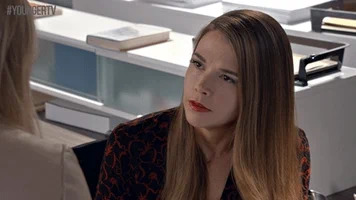
The biggest knock I kept hearing on Pamela Redmond Satran’s Younger is that no one would ever believe it if a 40-something woman pretended to be in her 20s. The feminist in me wants to scream, “Would you ask that question about a book about a MAN???” but I saved my vocal cords the strain because of course you wouldn’t. Nobody gives a shit how old a man is unless they’re casting his girlfriend in a movie. Ask Maggie Gyllenhaal. Hell, I’ve even seen discrimination about the age of the book - “It’s ten years old, who cares what it has to say about anything?”
The premise might be just this side of implausible, but if you want gritty realism, consider the very plausible idea that lead Alice thinks she has to pretend she’s in her 20s just to be more desirable to pretty much everyone: her hot, young new fling Josh; the publishing company where she gets a job; even her cool, younger friends. But after the year from hell in which she lost her mother and her marriage, she has a little too much New Year’s Eve champagne and decides it’s time for her own year of yes. As a 20-something, Alice gains access to everything that had been denied her as a 40-something. She’s still Alice (sorry, had to), but because of a simple change of integers, she’s suddenly sexy and employable and all the things women my age take for granted (and the reason that my friend Kelsey and I had a pact to take each other out at 39 because we assumed - not incorrectly - the world for a 40-something was a cold, vacuous expanse).
For readers in their 40s, Alice’s trip through the 20-something looking-glass is breezy, sexy wish fulfillment, like My Fair Ladywith the condescending misogyny turned down. (In this iteration, Alice is both Higgins and Doolittle, because #feminism.) But for younger Younger readers like me, Alice’s predicament is ostensibly a cautionary tale. We won’t be in our 20s forever, and if we think the world is an unkind place now, just wait until we start getting crow’s feet. For readers of any age, Alice is a fascinating case study in ageism in the workplace, in the dating world and in self-perception. Alice never tried all these exciting, sexy things because she thought her expiration date had passed. It’s only when she saw her more youthful self-reflected in the eyes of everyone around her that she had the courage to go out and live.
It may sound like a frothy rom-com, because, well, it is (and it’s a really good one). But Younger resonates because it’s ultimately not about getting the guy as much as it is about getting the life you always wanted but didn’t dare dream you could have. Anyone who thinks it’s a trite, slight message need only look to the reinvention of 65 year-old Caitlyn Jenner. Like Caitlyn, Alice has felt invisible, trapped and isolated for years, and both of these bad-asses decided they’d had enough. Their external appearances didn’t match who they truly were inside, so they found themselves at ages that are usually bitter punch lines or dead ends, and they did something truly revolutionary for women of certain ages: They started over.
Obviously, Alice and Caitlyn aren’t equals (stand down, concern trolls), but the message of both triumphs is similar: We are not constrained by the bullet points of our biography. We are not our age, our gender, our sexual orientation, or whatever boarding school we couldn’t afford. Who we are is so much more interesting and complex than any of these classification tools, but it’s up to us to show that to the rest of the world.