Jump to ratings and reviews

Win a free print copy of this book!

20 days and 09:25:25

5 copies available
U.S. only
Rate this book

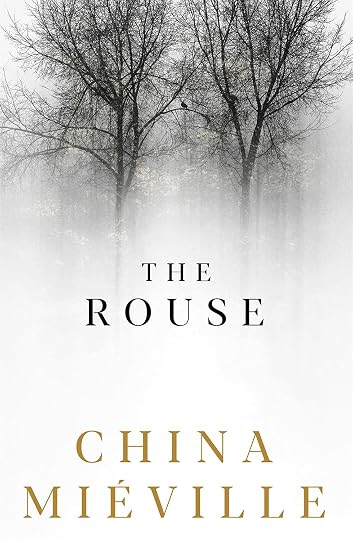
The Rouse

Win a free print copy of this book!

20 days and 09:25:25

5 copies available
U.S. only
Rate this book
From the bestselling, award-winning master of uncanny fiction comes a defining work, twenty years in the making – a deeply moving, decade and continent-spanning epic of grief, global tumult, and grim conspiracy.

Maur’s life has been shaped by an unbearable loss. But in the aftermath of what is an apparently ordinary tragedy, deeper, stranger questions arise . . . Their answers may lie within the dark heart and darker history of an old soldier who shares Maur’s obsessions – and is violently pursued by the same unknown, unquiet forces.

So begins The Rouse, a masterpiece unlike any other: at once a sprawling saga of the bloody twentieth century, and the intimate story of two lives, their loves, regrets and secrets – and a terrifying journey into infinite mystery.

1264 pages, Hardcover

First published September 15, 2026

Loading...
Loading...

About the author

China Miéville

144 books16.1k followers
A British "fantastic fiction" writer. He is fond of describing his work as "weird fiction" (after early 20th century pulp and horror writers such as H. P. Lovecraft), and belongs to a loose group of writers sometimes called New Weird who consciously attempt to move fantasy away from commercial, genre clichés of Tolkien epigons. He is also active in left-wing politics as a member of the Socialist Workers Party. He has stood for the House of Commons for the Socialist Alliance, and published a book on Marxism and international law.

Excerpted from Wikipedia.

Ratings & Reviews

What do you think?
Rate this book

Friends & Following

Create a free account to discover what your friends think of this book!

Community Reviews

5 stars
65 (36%)
4 stars
49 (27%)
3 stars
37 (20%)
2 stars
18 (10%)
1 star
11 (6%)
Displaying 1 - 30 of 80 reviews
Profile Image for Booksblabbering || Cait❣️.
2,467 reviews1,045 followers
Review of advance copy received from Publisher
August 12, 2026
Was this 20-years-in-the-making novel worth the 1,300 pages? 
I feel like I need to be roused from an unsettling and unsatisfying sleep after finishing this.

If you are familiar with Miéville‘s works, you will know he is one of the most unique and avant garde authors writing at the moment. He writes in wide ranging genres and manages to make each story totally unique and strange.

The Rouse follows a grieving mother who is trying to discover answers about her dead soldier son. She meets an old, cynical soldier who is pursued by unknown, supernatural forces.
It is a spy thriller, war novel, ghost story, and family saga against the violent backdrop of the 20th century.

The first part grabbed me - Miéville emotionally encapsulate a floundering, grieving mother estranged from her son struggling with guilt. Fair warning, there are no quotation marks - you are left to puzzle out what is dialogue, thought, or narration.

To be a mother. You remember what it was? Are you still a mother? To walk alongside shy alien agency. Time-travel through witness. Her tiny boy, say, raising a bath sponge to chew and suck on at once, Maur seeing it and gasping to recall and feel her own young mouth doing the same. Feeling the exactitude of jumps two-feet-together into puddles when he performed them. As if his hand she had held was also her own.

Then, it is almost as if it is a new book as we swap to a Cold War soldier - an account which is violent and horrifying. Ultimately, a warning against Western imperialism and the complicated chain of command.

The storylines take a while, but they do converge. It takes patience and a trust in the author. 
However, this experience left me floundering and confused for the majority of the novel. At 40%, I still had no idea where we were headed. At 80%, I remained mostly confused. 

This is a book that is pretentious. I hate calling a book that as I think a good author can make a book accessible to different levels of audiences. However, this requires deep focus. There are references to 20th century English history, to literature and political theory, as well as leftist and liberation groups.

A lot of the commentary probably went over my head. This was so packed with allusions that I often felt intimidated rather than eager to pick it up. 

I appreciated the depictions of fascism, portrayals of masculinity, the duty of a soldier, and the responsibilities of a citizen of a state. The prose and formatting was also genius, although I can’t say to understand the purpose behind some of the random words and disjointed formatting:

weeping dust, speaking dust, pissing dust, exhaustedly turned their dust attention in her dust direction voice, voices familiar, a beat left for a curse, urgent, declaiming and declaimed to, disputation.

Don’t get me wrong. That sounds amazing, but what does it mean?

That was my biggest problem with this novel: it is incredibly ambitious and the genius behind it is apparent, but as a reader I was left confused and frustrated. As someone who has loved previous works by Miéville, I was ready for this to be a new favourite. I was ready to dedicate time and focus, trusting that the pay off would be worth it. 

Alas, I dragged myself through more than half of this book, grappling with a slow pace, a dense, mostly unexciting plot, unlikable yet complex characters, and a frustration that I’m not ‘clever’ enough to get it.

I’m sure this book will be a masterpiece to many. I’m sure critics will find it incredibly impressive and genre-defying.
I felt like I had beaten over the head with a bloated 1,300 book whose supernatural elements are as vague as shapes in the dark.

One of my biggest disappointments in recent years, but I acknowledge this is a VERY personal opinion.

Physical arc gifted by Pan MacMillan - I could knock someone out with it.

Bookstagram
Tiktok
Profile Image for nastya .
400 reviews572 followers
Did Not Finish
September 21, 2026
Dnf p 175 because I lost interest. This is a maximalist work of fiction and I respect that. Unfortunately, I am not into it and I don't want to read another 1000 pages to be disappointed. The part of grieving mother did engage me for a while but it got old. I even listened to his interviews in the hopes they'll spark interest. I guess I don't have enough faith in China. Isn't it interesting what we are prepared to endure for some writers and not the others? I recognize that, I did more for Pynchon. Maybe I'll be back when China becomes Pynchon. Or maybe I, at my age, just lost interest for self-important works? I similarly didn't care for the new DeWitt.
Profile Image for Roman Clodia.
3,027 reviews5,075 followers
October 6, 2026
DNF about 400 pages in - spoilers below

This is undoubtedly an ambitious and impressive project but for this reader the 1200+ pages just didn't justify their length. The two strands of personal (Maur) and political/military (Allerdyce) unravel in tandem but there was way too much repetition for me: Allerdyce learns about the supernatural 'Rouse' and all the appurtenances and then tells Maur about them. Neither are really characters in a rounded sense, they are functions within the text, and so I didn't have any emotional connection to them that might have locked me in beyond wanting the understand the cosmic mystery at the heart of the story. And there is a metaphysical mystery here: the use by the military of The Rouse to awaken the dead and literally use them as a capitalist resource in imperial wars across the globe while covering up the secrets in their archive.

I guess the issue for me is that anyone already well-versed in Marxist critiques of imperialism, the military-industrial complex, and the imagery of the dead as a haunting exposure of authoritarianism, will be ahead of the game here and the literary qualities weren't enough on their own to keep me in this dark world through so many pages.

There are so many tropes of the hidden underworld in literature from the Odyssey and Aeneid, mythologies of an underworld that exist in many cultures and even the use of magic in Harry Potter (the apports reminded me of the teleportation devices in Harry Potter, also everyday objects) that it's hard for me to find this revelatory. Of course, Mieville deliberately resists any kind of heroic good-wins-out resolution but given where we are in late-stage capitalism, that's hardly a surpise.

Individual readers will find their own intertexts here: I was especially taken by the idea of a colonial river being a conduit back to the Thames, surely an allusion to the end of Heart of Darkness where Conrad connects the Congo to the Thames, another piercing exposure and condemnation of imperialism that makes use of an existential vision of 'the horror! the horror!'. I was also thinking about Mariana Enriquez and the way she uses the paranormal such as in the streets of her cities crowded with the jostling shades of the disappeared to make political points.

So my 3-star rating isn't meant to be a negative review of this book, just an indication of why I tired of it after 400 pages - I skipped straight to the end to see where this goes and that was enough for me. If the book had been 400-500 pages in total, I would have finished it, but it became exhausting, feeling bogged down in Maur's strand and I was feeling diminishing returns.
Profile Image for Nigeyb.
1,600 reviews450 followers
September 27, 2026
I have been completely consumed by this book since starting it. Despite its heft (1257 pages / 41 hours of audio) I got through the audiobook in a week. Listening rapt at every opportunity

The Rouse is a triumph that embeds a socio-political critique into speculative fiction in this powerful tale of state-sponsored necromancy. Blending the claustrophobic dread of Cold War intelligence with the heartbreaking intimacy of a mother’s grief, China Miéville constructs a world where bureaucratic violence extends beyond the grave, weaponising fallen soldiers into a commodified "void army”. Through a sprawling timeline, urban geography, an international perspective, and the military, the novel examines how imperial bureaucratic processes exploit human loss

This ticks many of my boxes: the counterculture, the Cold War, occult knowledge, espionage, popular culture, the supernatural, and speculative fiction

It is a brilliant, atmospheric study in grief, memory, and structural power with no neat, heroic outcome, instead a brutal, systemic honesty. I suspect it will nag at me until I venture back for another foray into it’s stunningly rich narrative

The audiobook is something special. In a novel where the eerie overlap of state surveillance and lost voices is central, the audio adds an extra layer of atmosphere. The multi cast performances shift between the bleak interiority of Maur’s timeline, the Stallo/Allardyce eldrich soldier narrative, concrete poems, and crackling, static-drenched transmissions which turn the audiobook into a haunted broadcast to create an immersive, unsettling piece of audio drama

5/5

Profile Image for J. L. R..
204 reviews44 followers
Review of advance copy received from NetGalley
July 11, 2026
Let’s get this out of the way first. The Rouse is a staggering 1250 pages long; an immense novel carved out of beautiful, intricate, dense prose. Reading this is a mighty endeavor, not for anyone who wants something quick and easy, and not for anyone who wants clear answers to its central mysteries. I read this in a miasma of confusion and dread, stumbling around in the dark, compelled forward by the brief glimpses of supernatural horror, the elegant writing, and a detailed character study of its two protagonists, Maur and Allardyce. It’s a decades-spanning tour of the 20th century imperial sins of the Western world, an aching story of a single mother’s life-defining loss, and a Cold War spy thriller where even the mastermind spies don’t know who, what, why, or how they’re fighting.

Whittling any book down into a 5-star rating system is, of course, contrary to art at some fundamental level, though I usually don’t mind and often enjoy the act of doing it. But for this? For China Miéville (one of my favorite authors of all time) and his 20-years-in-the-making tome, a book that left me unsettled and unsure of what to think or feel? I don’t know how to rate this. I still don’t know what exactly to think about it. It begs for a reread, but I don’t know if I’ll attempt that, at least not for a decade or so.

But is it worth reading, you ask? If the previous two paragraphs haven’t scared you away, then yes, it’s definitely worth reading and engaging with, if for no other reason than I need to talk to someone about it! I know I’ll be diving into any analysis I can find online once it’s out there in the world. If you’re a fan of China Miéville - in particular, his more knotty, complex later work - then of course, you have to dive deep into the murky waters of The Rouse.

I still don’t know what I think about it, but let’s see if I can’t wrangle something together. It’s a hard book to spoil, but I’ll refrain from any huge revelations. That said, it’s hard to talk about without mentioning what becomes its core idea, revealed relatively early in the book but still requiring a few hundred pages of setup, so I’m not going to try to avoid it. Last chance to back out without knowing the essential premise.

Okay.

The first part of The Rouse is told exclusively from the perspective of Maur, a young, single mother living in London in the 1970s. She gives birth to Ewan, or Yew; a quiet boy who quickly discovers a morbid fascination with martial matters. Maur hangs out with leftists and hippies while not fully subscribing to their ideologies, but she’s left-wing enough to be disquieted by Ewan’s intense love of war. Sure enough, as soon as he’s able to, he joins the army, and as the years pass, becomes more and more tormented for reasons unknown to Maur and us. And then, he dies. Under mysterious circumstances. Ruled a suicide.

And then we introduce our second protagonist; Allardyce. We lurch back in time to the 1950s, where the young soldier serves in the British Army’s Cold War campaigns and soon has a bizarre encounter that he - and us as readers - are unable to understand. Just a brief glimpse of…a nothing. A vague shadow. A hole in the world. But soon Allardyce and the reader discover the central truth and preoccupation of The Rouse.

Ghosts are real.

For the rest of the novel, we follow two plotlines; Maur dealing with the grief of losing Ewan while starting to investigate what really happened to him, and Allardyce, joining a secret wing of the British military specializing in ghosts and “apports”, weird items that the ghosts seem to create, or maybe that create the ghosts in the first place. In some ways, The Rouse is an installment in a sub-genre that includes works like The X-Files or Control, stories about a shadowy government agency that investigates the paranormal. These types of stories run on the juxtaposition between clinical, rational bureaucracy and the surreal and the uncanny. How can you categorize the uncategorizable? The Rouse intensifies this clash. No one really knows what ghosts or apports are. Are ghosts maybe some other kind of entity created upon death? What does any given apport do? How can you tell what is or isn’t an apport? We’re left in the dark along with the organization, desperately hoping for something to give us answers, answers that humanity wasn’t meant to know, or maybe physically can’t.

Despite this focus on the occult, The Rouse is in many ways one of Miéville’s least supernatural books. The few glimpses we get of the ghosts are the strongest part of the book for me - they exist only as terrifying absences but are partially physical and embodied. If you drop a sheet onto one…it forms to their shape. Yes, The Rouse manages to make the classic draped-sheet ghost into something truly terrifying. By the time the book ends, there have been a precious few moments of true supernatural horror, where the prose itself spirals into incoherence with its characters. Brief flickers of something definitely unreal. As a speculative fiction fan, I wanted to see more of the unnatural here, but maybe that’s the point. Miéville would rather us be like his characters; desperately hoping for just another glimpse at the world’s secrets.

Speaking of the prose; it’s beautiful but certainly isn’t usually prioritizing ease of reading. Miéville won’t write a simple sentence when there’s another more ornate or witty way of writing it. This is likely to be the biggest barrier to entry to anyone’s enjoyment of this book. I know I found it both impressive and frustrating. Especially in his refusal to use quotation marks to signal dialogue. In the first half of Maur’s sections, there simply aren’t any quotations marks. You have to tell from context what is spoken dialogue, what is thought, and what is simply narration. This isn’t the first literary work I’ve read that does this, but I still can’t agree with any justification for this. It’s simply confusing. Maybe this was an issue with my ARC, but quotation marks return about halfway through Maur’s sections for no apparent reason. And for Allardyce’s, dialogue is always represented by an em dash instead. At least this was more legible than the early part of Maur’s, but it’s still unnecessarily annoying.

That being said, anyone who loves well-crafted language will feast to bursting here. I don’t think that prioritizing simple legibility in prose is an unalloyed good. Often, it’s the opposite! Grappling with The Rouse is what its author wants. It’s tough but still satisfying. There’s a ton of references to 20th century English history, to various leftist and liberation groups, to poetry and literature and political theory (I was especially proud at recognizing an obscure The Tempest pun), as well as just a bunch of words I’d never seen before, many obviously coined by Miéville himself. Reading this on my ereader was extremely helpful, as I could usually highlight a word and see its meaning. Some of this is true in the rest of the author’s work, but I want to stress that it’s dialed up to 11 here. This is his most literary work, without question. And like the best of literary fiction, it excels most in its character work. Maur and Allardyce are rich, complex characters, and will certainly stick with me for longer than most book characters do. They’re flawed and grieving, monstrous and saintly, and never feel anything less than fully human.

There’s so much stuffed into this book, so many rabbit holes of ideas and twisting paths of history, that I undoubtedly missed a lot. It’s about parenthood, grief, espionage, failed revolutions, fascism, masculinity, empire, death, religion…I could go on and on. But if there’s one central vein at the heart of this book, it’s this. In the great Cold War battle between capitalism and communism, capitalism won emphatically; but its victors are left adrift. The liberal capitalist democracies of the world, without their ideological foes, have fallen to imagining conspiracies, fighting old wars, and being displaced by the illiberal capitalist monsters they’ve created. Monsters that are in bed with the very same demons both capitalists and communists once fought: fascists. Now there’s nothing left to fight these demons…except the ghosts of the leftists they destroyed.

And ghosts are real.

The Rouse is an undeniable artistic achievement. It’s profoundly well-written. It’s also maybe too smart for me to fully understand. I was confused perhaps a little more often than Miéville intended. I’m not sure that it needed to be this long. At times it’s repetitive, with its characters going through the same beats over and over again, only mildly differentiated. I wanted to see more of the supernatural and occult. I don’t really know entirely what propelled Miéville to spend 20 years on this. It’s certainly not as enjoyable or fun as most of his other work.

But some of the best art requires this kind of wrestling. It doesn’t give up its secrets or its joys without effort. So, let’s go with this.

The Rouse is set to publish September 17th, 2026.

Thanks to NetGalley for the advance copy in exchange for an honest review. All thoughts expressed are my own.

Read more of my reviews at https://terrasomni.substack.com.
Profile Image for Squire.
493 reviews9 followers
October 1, 2026
I've wondered when Mieville was going to get back to writing challenging weird fiction. It's been 15 years since his novel Railsea and 10 years since the novellas This Census Taker and The Last Days of New Paris. We did get the unlikely collaboration with Keanu Reeves in The Book of Elsewhere (where Mieville did what he could to save it from mediocrity.)

This 1200-page monster is Mieville's magnum opus; it is a masterwork like no other: sprawling, dense, encyclopedic, philosophic, experimental, horrific, intensely emotional. I won't go so far as to call it a masterpiece, but it is one-of-a-kind. Even for Mieville.

In The Rouse, the sins of the western world come to a head as the actions of Britain after WWII lead to the discovery that certain discordant bugle notes can rouse the dead; and so the race to weaponize The Roused begins (with Britain leading the way, of course.) The story centers around two persons: Maureen Towns, single mother of a son who committed suicide at Camp Shackleham--the base of top-secret R Unit roused experiments; and Steven Allardyce, R Unit's most obsessive and talented soldier. Their storylines are on a collision course that contains scenes of unbelievable horror and indescribable grief and despair. It will encompass Mieville's career and his fears for the 21st century. And test the hardiest reader's mettle.

It IS worth noting that impetus for the novel was the real-world incident of five deaths (ruled suicides), and the conspiracy theories surrounding them, at Princess Royal Barracks in Surrey, England.

In hardcover, the novel clocks in at 1246 pages (more in the two-volume distributed ARC); and the question readers are asking themselves is whether or not the novel is worth the page count. Certainly, a trimmer, more-focused 8-9-hundred-page novel would have a wider audience. But I wouldn't have wanted that; and, readership-be-damned, I don't think Mieville would have wanted that either.

It's 1200 pages that feels like 1200 pages. Trying to speed through this work full of British slang, archaic and obsolete occult terms, and a plethora of military acronyms will prove frustrating and lead to DNFing The Rouse. Best to read with a dictionary (or phone 😉) at hand, find a comfortable pace, and not rush things. Storylines don't start to converge until around page 400, but if you're still with it, the lights will come on and your trust in Mieville's leadership will be justified.

The problem with following two alternating stories over 1200 pages is that you get attached to one and then break off to continue the other. The novel begins with a 99-page section entitled "The Story of a Life" that introduces Maur and her son Ewan that is simply beautifully written and evokes such emotion in the reader that when "The End" appears on page 100, it is more than just jarring-- it is shocking to the extreme in that the reader realizes that Ewan is never coming back. He's gone. That's it. The next page announces the beginning of an 1100-page/32-section epilogue that promises, hopefully, a resolution to Maur's grief. What holds it all together once the storylines start alternating is Mieville's gift for beautiful and challenging language.

And weirdness.

What makes this the magnum opus it is, is that Mieville leads the reader down all the rabbit holes he navigated in all of his previous works:

From the irrationality of borders in The City & The City, the living grotesquerie of the modern metropolis in the Bas-Lag trilogy, the hidden layers of London, alien linguistics in Embassytown, Lovecraftian materialism or a general rejection of "comfort" fantasy, Mielville's entire oeuvre is thematically present in The Rouse. As I stated earlier, I don't think Mieville wanted to edit it down.

So, it may be messy, but the reader gets the whole of China Mieville in The Rouse. If you can check your ego at the door and entrust your sanity to him, you won't get all the answers you're looking for, but Mieville will get you through this sometimes-murky labyrinth of a novel.
Profile Image for David M.
479 reviews375 followers
September 22, 2026
very difficult to write a review of a book of this magnitude. For now I'll just say I unequivocally recommend it.
Profile Image for HK.
11 reviews3 followers
Review of advance copy
July 31, 2026
I read this behemoth of a kaleidoscopic miasmic tendronised tentacles….

I read The Rouse.

I passed the test of patience and sustained effort that is needed to surmount this Mount Analogue.

What do I feel? Melancholy. I have been looking forward to this book as a China Miéville fanatic.

What do I think about this book?
A Pantagruel waste of smartness and inventiveness in a Quixotic attempt to rechristen a Cold War hidden-history spy thriller ghost story in literary glory. Good grief.

Oh, then there is grief. What Grief it was? An Oracle of the Holy Bottle of hierarchical Prestige.
The following is hidden for spoilers.
Profile Image for Ben Dutton.
Author 2 books59 followers
Review of advance copy received from Netgalley
September 12, 2026
China Miéville's epic new novel The Rouse is a monumental, 1,200 page doorstop of a novel that utterly entranced me - even when I wasn't entirely sure where it was going - and was left quite breathless by the end.

The first section, where we meet Maur in the 1970s, seems quite traditional in presentation and detail, and then about a hundred or so pages Miéville tell us, "This is the end... Now everything else is codas.’ What follows is split into two strands - the story of Maur and her son Ewan who becomes a soldier and that of Trooper Allardyce, another soldier, an.expert at killing but better at reviving the dead. The Rouse is a ghost story - though that word 'ghost' doesn't appear often, it is a family epic about trying to find a human bond, and it is about infrastructure, military and otherwise, and the way it impacts on the world.

The Rouse breezes past quickly and doesn't feel quite the length that it actually is. Miéville is a master storyteller - if you've read any of his other work you'll know what to expect - but if you're new to him, this novel is perhaps the culmination of a career - he has been writing it for decades apparently. It is probably his masterpiece. I think first I need to read it again.

Thanks to the publisher and Netgalley for the ARC.
Profile Image for The Blog Without a Face.
354 reviews84 followers
September 28, 2026
How to Wake the Dead with Two Notes and a Defence Budget

TL;DR: The Rouse is the largest ghost story anyone has attempted in a generation and one of the few worth the attempt. Miéville raises the dead with a bugle and a defence budget and sets a mother’s grief in the middle of the machinery, where it outlasts every acronym. Too long, too clever, and frightening anyway.

Between the August of 1914 and the eleventh hour of the eleventh month of 1918 the British Empire put something near a million of its own men into the chalk of Picardy and the clay of Flanders and the sand at Gallipoli and the silt of the Tigris, and in China Miéville’s telling not one of them has ever got up again. Every other war gives up its dead. Malaya gives them up and Aden and Oman and Bosnia, and a clerk somewhere is keeping count. The four years of the Great War give up nothing. The novel calls this the Kaiser’s Enigma and sets it down the way a man sets down a stone he has carried a long way and walks on without explaining it. It is the strangest fact in a book built of strange facts.

The premise is this. The Rouse is the bugle call the British Army blows at its sleeping soldiers, two notes on a rising figure, and blown in the right place by the right men it wakes the other kind of sleeper. What comes up is not a soul. What comes up is born at the death and of the death and knows nothing of the life that went before, and the men who traffic in such things have a dozen names for them, revenants, lespries, suppletions, the Roused, the way a slaughterman has names for the cuts. Soldiers Rouse best. The British Rouse best of all, a fact the book treats as it treats the weather, and so there is a unit of the state that has been at this work since the nineteen fifties out of a saltbitten camp on a shingle spit in East Anglia, and the dead shed objects, a comb, a boot, a button, and every object the dead shed has a flaw in it somewhere, a snag, and the flaw is how the living tell such things from things merely made.

Against that machinery Miéville sets a woman named Maur Towns, and she is the reason to read the book. She raises a boy on her own in the Harlesden and Kilburn of the seventies and eighties, a quiet longlimbed boy who climbs everything, trees and walls and the gate to the front yard, and the boy joins the RAF Regiment because it is a thing to do and comes home from Bosnia and in 1995 dies at a barracks called Shackingham, two shots, an open verdict, one of a run of deaths at that place the Army has decided to call suicides. The opening movement, titled A Story of Life, carries her from a maternity ward to a coroner’s court and is the best thing in the book. Miéville renders her from the outside as a regimental historian would, what she does with her hands, what she keeps in her pockets, the seeds and stones that begin going missing from her handbag in the years after, and he cuts the story with fragments of a later interview in which an older flatvoiced Maur answers questions the book withholds, so the grief is always arriving from two directions at once. Then the novel leaves her in 2006 with a journalist’s campaign and a padre and a letter that was not in the world the night before.

The other half of the book belongs to a man. Steven Allardyce, Choirboy to the men who knew him young and Stallo to everyone after, a Special Air Service trooper of the Malayan Emergency who walks into a jungle clearing where an English sycamore is growing that has no business east of Suez, and comes out of that country with something at his back that he will spend the next fifty years calling his control. He is recruited to the spit. He loses hours. The chapters that follow him through Oman and the Cold War run in another register, dashed dialogue, squaddie argot, the memoranda of a ministry that has read The Golden Bough and The Beano with equal attention, and they are where the book is funniest and where it is slowest and those are often the same page. There is a Christmas party in the tunnels under the spit that the novel goes back to for the rest of its length the way a tongue goes back to a broken tooth. Stallo is rendered from without, a man who takes rooms and holds a weapon a certain way, and the book never says what he feels and never leaves it in doubt. There are cover names and acronyms enough to fill a filing cabinet, and there are stretches in the middle third where the reader is inside the filing cabinet and the filing cabinet is dreaming.

Miéville was born in Norwich in 1972 and raised by his mother in north-west London, in the same few square miles Maur walks with her pushchair, and he came to fiction by way of social anthropology at Cambridge and a doctorate at the London School of Economics that became a Marxist theory of international law, a strange apprenticeship for a horror writer and the right one for this book. He stood for Parliament for the Socialist Alliance in 2001 and lost. He wrote the Bas-Lag novels and took the Arthur C. Clarke Award three times and the Hugo for The City & The City, and after Railsea in 2012 he went fourteen years without a full novel of his own, writing instead novellas and a history of the Russian Revolution and a book on the Communist Manifesto and a collaboration with Keanu Reeves. His publishers say The Rouse was twenty years in the making and the Guggenheim Foundation paid for some of those years and the book reads like it. Not in the sense of labour. In the sense of sediment.

What frightens in it is mostly what is withheld. The Roused want two things of the living and both are small. They want to be read ghost stories, and the book keeps a shelf for the purpose, M. R. James by the paragraph, and they want to be shown blank pages, and the second want is worse than the first and the novel never says why. The set pieces are few for a book this long and land because they are few. A staircase in an old officer’s house. A séance at a bomber station. A letter that will not hold still. The helicopters, which the book cannot leave alone, which come down in every decade with the same word in the ears of the men beneath them until the reader learns to flinch at a rotor. And under all of it something older than any of the dead that calls itself Old Pal and laughs, and the laughing is the one thing in twelve hundred pages that never gets an explanation and never needs one.

Pull back far enough and the argument of the book is this. That the afterlife is not a thing found but a thing built, like radar, like the bomb, in the same generation and by the same class of men, and that once built it was a province to be administered and a market to be cornered and a front to be held, and that a nation which had lost one empire among the living went looking for another among the dead. It is a large claim and Miéville makes it without raising his voice. He makes it with paperwork.

The snags are real. The book runs to twelve hundred and sixty pages and there is a plainer novel two thirds that length inside it that would have cut deeper for carrying less, and the interludes, a glossary of oscilloscope terms, the stages of decay of a standing dead tree, are sediment too, some of it bedrock and some of it silt. The espionage plot accrues bodies and factions faster than it can make them matter. One character says that jargon is always poetry and the book believes her, and the reader is not always invited to. And the Roused are rationed. Hundreds of pages go by in which the dead are a rumor in a memo. The book does not give a fuck what a horror reader wants. That is its right and it pays for it.

Close the book and the machinery goes first, the acronyms and the factions and the men in the filing cabinet. What does not go is a boy on a gate and a woman’s hands and a handbag that will not stay full and the two notes of a bugle blown across a shingle spit at men who have been ordered to get up at once. Some of them do.

- Review by Elias Crone
Profile Image for Dan Trefethen.
1,347 reviews94 followers
October 6, 2026
This one was weird, even for China Mieville. That's saying something.

He had been working on this book, on and off, for 20 years, while he was doing other things. He changed during that time, the world changed, and his writing style changed. He poured everything he's got into this one. It shows, it's overstuffed at over 1200 pages, but what a ride.

The book's first 200 pages is a rather routine story of a working class single mother in London getting pregnant and raising a quiet, subdued son who joins the army and then dies by gunshot - murder or suicide? The army says suicide, but Mom is unconvinced. The End.

Then the next 1000 pages tell the story of what comes after, focusing on another soldier, Trooper Allerdyce, nicknamed Stallo when he makes Sergeant. Stallo was in the same unit as Ewan the boy in the first part, but the intersection only becomes clearer when Stallo interacts with the mother, Maureen, known as Maur. Maur has a friend whose daughter in the army also died under suspicious circumstances.

So much for basic plot outlines. Now let me tell you how weird this book is.

After the first 200 pages the writing style becomes fragmented, somewhat baroque, and peppered with oblique references to culture, military lore, and ancient history. The Unit in the army is engaged in identifying objects that are connected to the paranormal, and serve as gateways to raise the dead - or are they the revenants of dead or something else? They are referred to as the Roused. Both Maur and her friend think that their children may still exist in some way, and seek answers.

Mieville keeps us on the back foot by the uncertainty of what we're dealing with and his arcane writing style. The prose is completely packed with allusive, elusive references that carry a lot of freight if you recognize them, and if you don't they still provide a sense of verisimilitude. Mieville did years of research to add references to real places and events, however obscure they may be. The more you recognize, the more you'll understand. Here's a quote that seemed to be the author speaking to us: "Jargon is always poetry". Some of the sections read more like poetry than prose, more than any other of Mieville's books.

If you read the book you will finish by saying "WTF did I just read?". I listened to a 2 hour interview with Mieville where he said that was the expected response. He revels in uncertainty and ambiguity. He's not providing answers, he's giving the readers an immersive experience that you're not going to get anywhere else. As with any such experience, it can be exhausting and overwhelming as you constantly struggle to orient yourself to what you are reading means, or what is actually happening. The meaning will not be clear. it will be evocative. Here's a quote about Stallo (Mieville's main POV character) that seemed to relate to the author himself: "You're so busy avoiding giving straight answers that it takes a while to realize you couldn't if you wanted to. Even to yourself." In the interview, Mieville refers to a 'dreamwork of texture' that infuses the book. He also revels in the numerous Easter eggs he's included that give the text depth and heft.

Yeah, shelve this book with Pynchon's Gravity's Rainbow and Danielewski's House of Leaves (both of which Mieville cites in the interview). It's that kind of book. You have to take a deep breath and clear your calendar before you dive in.

I don't recommend it as the first Mieville book for anyone. But for Mieville readers, it's a must read. This book has obsessed him for 20 years and he's not sure what he'll do next, probably some non-fiction (which he's been doing periodically in the past couple of decades). This book is the result of him growing from a young writer to a middle-aged one, and digesting all the epochal events (his words) that have occurred in that time. Although it covers a forty year period, it's not a nostalgia piece. It's a book from an author who is worried about the epochal changes he sees.
Profile Image for Dana.
496 reviews21 followers
Review of advance copy received from Publisher
July 23, 2026
The Rouse is unlike any other book I've ever read, and that's not hyperbole. It is a dense, beautiful, infuriating, sprawling novel that will delight many a reader if they will take the time to digest it.

I thought the way the story was divided up was brilliant. As a mom myself, I could understand the story ends after such a tragedy. Everything else exists in a different plane. When the POV shifted, though, I found myself increasingly confused by what was occurring. This isn't an easy novel to read. I felt I was drowning in the deep end at times, and then I would get a brief moment of clarity, a glimpse of understanding, before being swiftly dragged back under. It is likely a novel that requires multiple re-reads for full understanding. At roughly 1300 pages, that's quite an undertaking.

As I mentioned, this book is for a specific reader who sees what I've written and gets excited rather than intimidated. If you are that reader, I advise you to read slowly, perhaps read sentences and passages twice if needed. Give this epic journey the time and attention it needs and deserves.

3.5 stars for the first read through. I will definitely read it again upon release.

Thank you to the publisher and NetGalley for the advanced copy.
Profile Image for Jamad .
1,357 reviews38 followers
October 11, 2026
I found The Rouse by China Miéville a rather mixed experience. The opening section, following Maur and her son Ewan from his childhood to his tragic death in the army, was the part I enjoyed most. It felt grounded and gave the story a strong emotional foundation.

Then the book takes a sharp turn into military conspiracies, the supernatural and experiments involving the dead. There are some genuinely inventive ideas here, and Miéville certainly has an imagination that knows few limits. However, at over 1,200 pages, the novel is far too long for its own good. The increasingly elaborate prose and experimental passages sometimes became rather wearing, and the sheer volume of strangeness eventually felt excessive.

An ambitious, unusual novel with some excellent moments, but one that would have benefited considerably from a firmer edit.
Profile Image for Jonathan Hawpe.
347 reviews36 followers
Review of advance copy received from Publisher
September 1, 2026
China Mieville's 20-years-in-the-making magnum opus The Rouse is a triumph of the imagination, and my personal favorite novel of 2026. Its uncanny mix of mother & son drama, reality shifting conspiracies, sociopolitical labyrinths and psycho-cosmic otherworldliness is intellectually thrilling and emotionally devastating. It is a startlingly bold use of a kind of neo-gothic-post-modern-fantastic to reckon with tragedy, love, violence, human interconnection, the inescapable rot of power, and the unknowableness of the universe. Here the literary venn diagram overlaps as much with Cormac McCarthy, Thomas Pynchon and Toni Morrison as it does with Philip K. Dick, Stephen King, and Ursula K. Le Guin. 10 stars out of 5.
Profile Image for Frank Vasquez.
362 reviews28 followers
July 22, 2026
Wild. I did not expect this from Miéville, after all of these years without any Miéville fiction. With The Rouse, he once again proves he is the premiere imaginative writer in genre fiction, both capable of flourish and wit in command and presence of style as well as superhuman capacity for richly evocative plotting and storytelling. The Rouse is a BIG READ, with a lot of build and a lot more familiar than unfamiliar until the line is so blurred that you get the sense you, the reader, are what’s unusual to the text. Absolutely brilliant and exhilarating. Perhaps my only complaint is that I did struggle to remain absorbed by and invested in this read with my electronic copy. This is certainly a novel that deserves a physical copy for reading.
Thank you to NetGalley and Del Ray for this advanced copy.
Profile Image for Oliver Shrouder.
572 reviews11 followers
October 12, 2026
An incredibly frustrating read - the first 200 ish pages which cover Maur's grief and the earlier life of Allardyce are incredible, and the topics were treated with the tenderness they needed. But the 900 that followed concerning the attempts of the government to use the dead as an asset and the VA and apports and characters purposely left out of the loop for everything - including the ending! - it became an incredibly turgid read. I love a ghost story but burying it in so much day-to-day living and being on the run and long conversations between people who don't know anything about the larger plot - it lost me massively by then.

Not sure what to even rate this. There are moments of utter brilliance and poignance but i feel like i've been dragged through a word soup bookended by Maur's experiences with grief.

Can't recommend it - perdido was half the length of this and did ten times the legwork
Profile Image for Caitlin Holloway.
569 reviews2 followers
September 26, 2026
This is a book that both writes about and embodies depersonalisation in so many different contexts. There are moments in this book that felt very grounded and confrontational in a really interesting way and others where I felt as though I was being dragged behind the weight of Miéville's intellectual crusade and felt extremely disconnected from the book. Maur is by far the highlight of this novel, I often found myself tolerating the alternative chapters just to reach for her narrative voice again. I almost feel like the novel would have been far better without the non-Maur part both in content and page count. The use of formatting at certain peak points was fantastic, I only wish I had reached those peak points a bit faster. I trust Miéville far more than other authors like David Foster Wallace and James Joyce who write overly long exercises in intellectual tolerance for the reader, but it is only because of that trust that I managed to tolerate the less interesting parts of this book. I enjoyed it but hope he returns to a more embodied and active pace in his next writing project.
Profile Image for Nick.
181 reviews27 followers
October 13, 2026
Life is just a prologue to a ghost story.

The Rouse is a story of Death and twisting it every which way until it breaks. It imagines Death in shades, revenants, hauntings, and frequencies like sound. The Rouse is a song to forcefully awaken the dead, a slow, two-note down-up-down-up consisting of CGCGCG or sometimes CGEG. Described as like "a bugle call we all know and love...born out of a sort of...memory...[o]f some powerful kind. An echo of a deeper frequency, one used for centuries to get a soldier up. Get up at once".


“Mostly,” he says, “the dead are memories. No good to anyone. But if you’re the right sort of person and you die just right? Then get up at once, the bugle’s sounding. The Unit’ll step in. R Unit. And they’ll spin people like you any shit to get you to help. “Die just right, and they’ll play the Rouse.”


The plot switches back and forth between Trooper/Sergeant Steven Allardyce in the past and Maureen (Maur) in the present. Allardyce is a man who starts out as an underaged British trooper on patrol against communists in south-east Asian places like Singapore and ends up the legend of the R Unit, a section of the British government that deals with what forces may come after Death. His arc follows how he trains to understand, control, and defeat the phenomena, i.e. revenants and whatever else lurks behind the curtain of Death. He's intuitive, likes doing his research and reading, and is an absolute hooligan from beginning to end. I thoroughly enjoyed the buildup of how he becomes who he is, and I already know his character will stick with me a while.

Then there's Maur, the plucky single mother of a son who joins the army and somehow gets involved with the R Unit. She gets kidnapped multiple times, goes on the run and undercover multiple times, and is overall just pulled along by several different people and agencies who all want to use her for their own reasons. She is a strong medium who drips ectoplasm, can contact the other side, and can act like a beacon to revenants.

Most importantly, Maur draws the attention of the big bad guy of Deathland, who calls himself their Old Pal: "It whispers, is what they say it does. It says it’s a friend. It laughs and plays". While Allardyce's arc is of him dealing with Old Pal in the past, Maur's arc is of her trying to beat it back a second time in the present.


Whatever name you give it, it’s been trying to come a long time. It’s not here yet but now people are helping it, pull it, so it’s coming quicker.


It's also of Cybill, another woman with a child in the army, and her letter to her daughter Jules that got touched by the other side. This haunted letter (AKA an apport, a term used for a haunted object) also acts as a beacon to the forces trying to find them and use them for their own means. Cybill just wants to talk to Jules again, to Rouse her, even if doing so risks inviting something far more malevolent through the door after her. . .


I was with the Unit a long time, and even for me it was years before I realised it’s not just the Roused over there . . . That thing, that other thing was never alive. And it’s not just something bad. If I’m right it’s more like the bad that bad things are.


I really enjoyed the structure of this book. Each part felt intentional, and gave a backbone to rest on even as things felt like they were barreling into chaos. You could count on Allardyce to tie up loose ends one by one.

Speaking of, there's an excellent array of characters here, like Bowler, Allardyce's longtime R Unit friend, and Myton, Croome, Hook, Strude, and Jock. There's Maur's friends, Sonya and Dev, before her life gets turned upside down and she can never speak to them again for fear of putting them in danger.

Finally, this story pulsates with the Weird. Even though R Unit have very specific terms for these death-related phenomena (lespries, revenants, apports, etc.) it's still very much acknowledged throughout that they really have no idea what they're dealing with.


—What was it? Stallo said.
Myton gave a faint smile and looked up at a corner of the ceiling like an embarrassed schoolteacher.—I can’t help but reflect on quite how many times throughout history that question has been asked. Of it, or like phenomena. And how many times an adequate answer has failed to come.


They can make up as many terms and possible rules as they want, but it's very much unknown cosmic forces they're dealing with, and that is the only thing they do know. Though the Rouse can be used to put the dead to work for them, the understanding of how everything after Death works remains foggy and superstitious at best. They even rely on folklore solutions like salt/sand circles, quipu, and hagstones.

I thoroughly enjoyed this amazing journey of a book over the course of this year's summer. And it touches on so much more than I was able to cover here. If you enjoyed Miéville's recent collab with Keanu Reeves, The Book of Elsewhere, or are into conspiracy organizations that handle dangerous dark forces outside our understanding like the SCP Foundation or The Magnus Archives, or like other New Weird authors like Jeff VanderMeer and his Area X series, you'll find this a lovely wicked epic to sink into with stomach-dropping, hair-raising imagery.

Thank you to the publisher and NetGalley for the free digital copy of this book. I am leaving my honest feedback here voluntarily.


Profile Image for Red.
249 reviews17 followers
October 11, 2026
I fear any quick summary or short review of a book as complex as The Rouse is going to be doing it a disservice. China Mieville has been one of my favourite authors for a long time, and I was incredibly excited when this book was announced. And, once again, my expectations were completely subverted, and I’m hoping that my jumbled thoughts will form something vaguely resembling a review.

The Rouse follows two main timelines: that of Sgt. Allardyce and Maureen (‘Maur’) Towns. Maur has always had an unusual relationship with her son, Ewan, and her emotions are complicated when he leaves home to pursue a career in the military. But her life is shattered when he dies, an apparent suicide, on base. Further investigation simply brings up more questions, and her pursuit of the truth will lead her spiralling into a conspiracy that stretches back decades. The truth behind her son’s mysterious unit, and the truth of The Rouse. Allardyce is a cold war soldier who witnesses something inexplicable. His search for the truth leads him down a different path, towards the unit and Camp Awfulness and the secrets it hides. As his loyalties become further and further divided and something ancient stirs, Allardyce must decide what kind of world he wants to shape. And I should mention the fact that there are lots of ghosts, in case you were under the impression that The Rouse is purely literary without any supernatural elements.

One of my favourite aspects of The Rouse (but the one that I think will put the most people off) is that it doesn’t seek to please or satisfy. It doesn’t shy away from being strange or offbeat, which shouldn’t be a surprise to me as a China Mieville reader, yet The Rouse just took it to a whole new level. It breaks the rules of what a book should do, for better or for worse. It meanders, it stays on small details. Plot threads are picked up and apparently abandoned. There are scenes which are so bizarre that they feel out of place at the time, yet when looking back, they become an intrinsic part of what the book is trying to do. It’s disorienting - the time period is often hard to pin down, it’s littered with symbolism (most of which likely flew completely over my head) and quiet depth, not to mention the pacing which fluctuates from slow to breakneck speed. On paper, it shouldn’t work. It should be a mess of a book, and it is messy in many respects yet it somehow works, culminating into something worthy of the title ‘magnum opus’.

And of course I have to talk about the writing. Mieville does have somewhat a reputation for dense prose full of words you need a thesaurus for, and there is a little of that but his usual style is surprisingly stripped back. The writing sometimes felt sparse and restrained, yet the imagery was still incredible. Some of the most genuinely terrifying passages of writing I’ve ever come across were in this book, stuff that is going to stick with me for a long time and it was so affecting purely because Mieville knew what to leave unsaid behind the words.
Ultimately, my takeaway here is that I would sell my soul for China Mieville to write more horror.

I get the sense that this is Mieville’s most personal work to date. I really liked the themes explored - grief, motherhood, death, and, of course, the corruption of government and capitalism’s destruction of the world. Grief is a theme he’s explored before - The Scar has one of my favourite meditations on it - but the combination of grief with parenthood feels new for him. And as always, the characters shine through. Maur was such an excellent protagonist. Her development throughout was one of my favourite aspects of the book. I loved how relatable and human she was despite everything unfurling around her, as well as of course her strength. I also found Stallo’s character to be, quite like the rest of the book, paradoxically compelling. He’s a jumble of negative traits representative of the world he was born into - anger, violence, selfishness, his actions are, most of the time, deeply unsympathetic, yet his struggle felt so innately human. I think the reason some may find the book dissatisfying is because the ultimate catharsis doesn’t come from the defeat of the ‘big bad’ or resolution of all of the plot elements, but instead from the characters. The Rouse is a book about people, about their continuation in the face of death. Stallo chases death, he fixes himself in it, cannot leave it behind and lets it consume him. Maur cannot escape death, she surrounds herself with it too but doesn’t stop remembering the living and her own life.

My one disappointment is that I was approved for the arc a week before publication date and, as a consequence, felt myself rushing through it a little to finish before the deadline. This is not the kind of book that should be rushed through, and as a consequence I definitely felt like I was missing out on a decent amount of the depth and symbolism. It really needs to be read slowly and savoured, and I can definitely see myself taking the opportunity to read it again and do so in the future.

Ultimately, The Rouse is offputting, bizarre, disorienting, frustrating, wonderful, rich and deeply compelling all at once. It’s going to be a polarising one, and I can definitely see why a lot of people are going to bounce off it. There are no straight answers to be found - the book even tells the reader itself in one of my favourite quotes: “Perhaps it mouthed somewhere, that swimmer, what might have been the start of answers, that it mouthed silence.”
It feels like an anomaly in the publishing landscape, and I can confidently say I don’t think I’m ever going to read anything like it again. It feels like the start of a new era for China Mieville and I personally cannot wait to see what he creates next.
947 reviews28 followers
Review of advance copy received from NetGalley
September 10, 2026
I've been looking forward to this for many years: a new Miéville novel (I don't really count the Keanu Reeves collaboration).

The book is structured around two main timelines, initially separated by decades but gradually moving towards one another.

The first follows Maur (as in Maureen). Her story begins when she is in her early twenties and decides to carry an accidental pregnancy to term, giving birth to a boy she names Ewan (or Yew). We then follow her across much of her adult life as she raises him, struggles to understand a son who is very different from her (very likely neurodiverse), and eventually watches him join the army. His choices, and what happens to him afterwards, draw Maur into the strange world at the centre of the novel.

The second timeline begins much earlier, in the 1950s, and follows Stallo, a young man who joins the army and is recruited into a secretive unit investigating the Roused: strange remnants left behind by certain people after death. The military quickly becomes interested in understanding these phenomena and, inevitably, in whether they can be turned into weapons.

The novel moves back and forth between these two lives over several decades. As Maur and Stallo become increasingly entangled with the Roused, their separate stories begin to converge, while both are forced to deal with accumulating personal trauma and the growing realisation that neither the military nor they themselves fully understand what they are dealing with.

The book covers a plethora of topics, which is something I typically struggle with, but the author's (and editors') decision to have the courage to publish a 1,200+ page novel gives all of these ideas enough room to develop properly.

The central theme running through the book is a critique of the military-industrial complex. There is a great deal about its tendency to seek enemies where none may exist, weaponise anything that can theoretically be weaponised, corrupt and sacrifice young men and women, and continue expanding even when the purpose of its existence is no longer clear. The anti-war sentiment is central throughout. Miéville spends considerable time cataloguing the various military adventures undertaken by the UK (and, to some extent, the wider West), often to the detriment of local populations and the soldiers sacrificed for reasons that are difficult to justify or even understand.

Another theme is trauma, loss, and PTSD. These are handled with nuance and elegance. The author spends a great deal of time exploring the protagonists' inner worlds and what happens to them after repeated exposure to horrific events, including the psychological mechanisms they develop simply to survive and deflect pain that would otherwise become all-consuming.

Yet another theme is the ambiguity of the "other" and the enemy. Miéville deftly explores the shifting realities of otherness, and the extent to which enemies are often products of perception rather than reality. He seems to decry the tendency of modern states and militaries to assume the worst in people rather than recognise the good, thereby creating the very threats they claim to fear.

Conspiracy, paranoia, and uncertainty are also explored. The boundary between the supernatural and the imagined is never made entirely clear. Some characters are genuinely pursued, while others may only believe they are. Some events appear to have a real basis, while others do not. Interpretations of what is happening frequently diverge from reality (assuming there is a single reality at all).

Finally, the novel is also about motherhood and friendship. Maur is one of the most inspiring female protagonists I have encountered in contemporary literature. She is bold, relentless, flawed, and deeply loving. She is a mother who loves her son and never forgives herself for believing she failed to love him enough. She learns, adapts, and pursues what she thinks matters at enormous personal cost. She is the highlight of the novel. If you want to be humbled and inspired by a female protagonist in her fifties, this is the book for you.

I absolutely loved this book and found it bold, ambitious, and genuinely innovative. It has an agenda and makes no attempt to hide it, but it explores difficult ideas through a setting that might otherwise invite dismissal: supernatural horror. The worldbuilding and imagination underpinning the story feel uniquely Miéville, though even his earlier books rarely carried such an overt political and moral programme.

What I found here was a novel that seems to take some of the strongest elements of Clive Barker's Weaveworld, Trumbo's Johnny Got His Gun, and John le Carré's best spy thrillers and transform them into something entirely its own.

I think this will become a cult classic, perhaps more so than any other book Miéville has written.

My thanks to NetGalley and the publisher for providing me with an early copy of this book in return for an honest review.
Profile Image for James.
769 reviews59 followers
Did Not Finish
October 14, 2026
DNF@20% There’s something about how this is written that doesn’t work for me, where I’m hyper aware of the author trying out different things structurally so that I can’t get into the actual narrative. Jealous of people who are fans of this one!
Profile Image for Brad.
32 reviews1 follower
September 26, 2026
1,246 pages of metaphors mixed with philosophy intertwined with New Weird Fiction and a dash of contemporary fiction. I don’t even know how to rate this just yet. It’s somewhere between 3.75 and 4 for me. After it has marinated for a while, I may have a more definitive rating.

I enjoyed it but it was a hard read. Miéville’s writing was ethereal and compelling but it was also so damn cryptic at times, which you could say was the point, but it pulled me out of the story more than once.
Displaying 1 - 30 of 80 reviews