When F. Scott Fitzgerald was fourteen and living in the Crocus Hill neighborhood of St. Paul, he began keeping a short diary of his exploits among his friends, friendly rivals, and crushes. He gave the journal a title page—Thoughtbook of Francis Scott Key Fitzgerald of St. Paul Minn. U.S.A.—and kept it securely locked in a box under his bed. He would later use The Thoughtbook as the basis for “The Book of Scandal” in his Basil Lee Duke stories, and brief sections were copied over the years for use by scholars and even published in Life magazine.“Are you going to the Ordways’? the Herseys’? the Schultzes’?” Here, for the first time, is a complete transcription of this charming, twenty-seven-page diary highlighting Fitzgerald’s escapades among the children of some of St. Paul’s most influential families—models for the families described in The Great Gatsby. Presented in a simple format for both scholars and general readers alike, The Thoughtbook of F. Scott Fitzgerald includes a new introduction by Dave Page that covers the history and provenance of the diary, its place and meaning in Fitzgerald’s literary development, and its revelations about his life and writing process.
One of the earliest known works by F. Scott Fitzgerald, The Thoughtbook provides a unique glimpse of Fitzgerald as a young boy and his social circle as they played among the grand homes of Summit Avenue, making up games, starting secret societies, competing with rivals, and (at all times) staying up-to-date on who exactly is vying for whose attention.
Francis Scott Key Fitzgerald, widely known simply as Scott Fitzgerald, was an American novelist, essayist, and short story writer. He is best known for his novels depicting the flamboyance and excess of the Jazz Age, a term he popularized in his short story collection Tales of the Jazz Age. During his lifetime, he published four novels, four story collections, and 164 short stories. Although he achieved temporary popular success and fortune in the 1920s, Fitzgerald received critical acclaim only after his death and is now widely regarded as one of the greatest American writers of the 20th century. Born into a middle-class family in Saint Paul, Minnesota, Fitzgerald was raised primarily in New York state. He attended Princeton University where he befriended future literary critic Edmund Wilson. Owing to a failed romantic relationship with Chicago socialite Ginevra King, he dropped out in 1917 to join the United States Army during World War I. While stationed in Alabama, he met Zelda Sayre, a Southern debutante who belonged to Montgomery's exclusive country-club set. Although she initially rejected Fitzgerald's marriage proposal due to his lack of financial prospects, Zelda agreed to marry him after he published the commercially successful This Side of Paradise (1920). The novel became a cultural sensation and cemented his reputation as one of the eminent writers of the decade. His second novel, The Beautiful and Damned (1922), propelled him further into the cultural elite. To maintain his affluent lifestyle, he wrote numerous stories for popular magazines such as The Saturday Evening Post, Collier's Weekly, and Esquire. During this period, Fitzgerald frequented Europe, where he befriended modernist writers and artists of the "Lost Generation" expatriate community, including Ernest Hemingway. His third novel, The Great Gatsby (1925), received generally favorable reviews but was a commercial failure, selling fewer than 23,000 copies in its first year. Despite its lackluster debut, The Great Gatsby is now hailed by some literary critics as the "Great American Novel". Following the deterioration of his wife's mental health and her placement in a mental institute for schizophrenia, Fitzgerald completed his final novel, Tender Is the Night (1934). Struggling financially because of the declining popularity of his works during the Great Depression, Fitzgerald moved to Hollywood, where he embarked upon an unsuccessful career as a screenwriter. While living in Hollywood, he cohabited with columnist Sheilah Graham, his final companion before his death. After a long struggle with alcoholism, he attained sobriety only to die of a heart attack in 1940, at 44. His friend Edmund Wilson edited and published an unfinished fifth novel, The Last Tycoon (1941), after Fitzgerald's death. In 1993, a new edition was published as The Love of the Last Tycoon, edited by Matthew J. Bruccoli.
The Thoughtbook of F. Scott Fitzgerald: A Secret Boyhood Diary, published by the University of Minnesota Press in 2013, gives Fitzgerald fans a portrait of the artist as a very young man. The Thoughtbook was written by Fitzgerald when he was 14 years old, and it covers the months August 1910 to February 1911. It’s a short book, as the original thoughtbook is just 14 hand-written pages, but it gives the reader an interesting glimpse of the young writer. The 2013 edition is the first mass-market re-printing of this diary, making it widely available to the public for the first time. (A limited edition of 300 copies was printed by the Princeton University Library in 1965.)
The Thoughtbook also features an Introduction and Afterword by Dave Page, one of the most well-known experts on Fitzgerald’s life in Saint Paul. Page was also the co-editor of the 2004 collection The Saint Paul Stories of F. Scott Fitzgerald, and the co-author of the 1996 book F. Scott Fitzgerald in Minnesota: Toward the Summit. Fitzgerald was born in Saint Paul, Minnesota, in 1896. When Scott was two years old, the family moved to Buffalo, New York, but they returned to Saint Paul in 1908, and Scott lived in Saint Paul off and on until 1922. Although the Fitzgeralds moved nearly every year to a different address in Saint Paul, they didn’t move far, and all but one of the Saint Paul houses that Fitzgerald lived in are still standing.
At the time Fitzgerald started the Thoughtbook in August of 1910, he had already published three short stories in his school’s arts magazine. The Thoughtbook begins with the sentence, “My recollections of Nancy are rather dim, but one day stands out above the rest.” Already Fitzgerald has grabbed the reader’s attention. You naturally want to know what happened on that one day that stands out above the rest. You can’t tell from the Thoughtbook that Fitzgerald will become a great writer who turns out beautiful sentences with ease, but there are some themes in it that will inform his later writing. Fitzgerald is already highly attuned to gossip, people’s social lives, and how fickle girl’s affections can be. Fitzgerald makes lists of the prettiest girls, and he also makes note of who he thinks is the prettiest, and who he thinks is the best talker.
In the Afterword, Page makes the excellent point that Fitzgerald was part of the social elite during his time in Saint Paul. His maternal grandfather, Philip McQuillan, owned a very successful wholesale grocery business, and built an impressive house in Saint Paul’s fashionable Lowertown neighborhood. Fitzgerald went to Saint Paul Academy, one of the most prestigious private schools. His social circle included the sons and daughters of Saint Paul’s wealthiest families. Fitzgerald was finely attuned to issues of status and class, and those subjects appear again and again in his writing. Malcolm Cowley famously wrote of Fitzgerald’s “double vision” in a 1953 essay, “It was as if all his fiction described a big dance to which he had taken, as he once wrote, the prettiest girl…and as if he stood at the same time outside the ballroom, a little Midwestern boy with his nose to the glass, wondering how much the tickets cost and who paid for the music.” (Quoted on p.38, The Thoughtbook of F. Scott Fitzgerald) This duality is one of the reasons why Fitzgerald is such an interesting writer. Like any great writer, he was extremely observant and he was able to see things from other points of view.
Of course, The Thoughtbook of F. Scott Fitzgerald is a piece of juvenilia, but it’s still a unique look at one of the most important American authors of the 20th century.
Very slight book and I enjoyed it, but there is not enough there for just a casual Fitzgerald fan. Read the author's "Towards the Summit" if you want a really interesting history of FSF in St. Paul. "The Perfect Hour" which was about his correspondence with Ginevera King was also a fascinating look at the young FSF that I highly recommend. Read those, then "Thoughtbook"
Got it from the library, as I am reading, Great Gatsby in September. I wanted to jump in and learn all I could about F. Scott Fitzgerald. I LOVE U of MN Press. I should dedicate a year of reading exclusively their own books. :)
Francis Scott Key Fitzgerald kept a memoir, called Thoughtbook of ... What an excellent name to call your own story.
Set in St. Paul, where he resided. * reproduced here exactly as F. Scott Fitzgerald wrote it. Including misspellings, punctuation errors and other idiosyncrasies and anomalies.! I love that. A true Journal.
Molly- His mom Nancy- Gardener James Imham- Inky. His BFF. Sled at Nancy’s together. Kitty Williams- Dancing School. Brought her candy to her home. For christmas, got embarrassed. Left the box with her and ran home. Mr. VanArnumm- dancing teacher.
Violet Stockton, niece to Mrs. Finch. Spent a summer by his side. Dark brown hair and eyes. 1 year older. Cut off a snip of Violets Hair, with Foley. Archie Mudge told me (him), you hated me. Frances or Scottie- Daughter
Now is deep below ground in a humid- sensitive room protected by fingerprints. I wonder if they give tours to the curious."
This was a delightful look into an interesting period of F. Scott Fitzgerald's life. I love that we're pretty much perusing through a 14 year old boy's diary. That alone should warrant interest. I've got to say that though the thoughtbook is only 27 pages its rifled with such astute observations and amusing thoughts. I also love how the book is riddled with misspellings and grammar mistakes which really shows that this was the work of a young boy. All in all, you really do get to see a glimpse of that future writer in Scott. The editor also makes some interesting connections between the material in this thoughtbook and some of Scott's early works. This a fantastic little piece of Fitzgerald history and I highly recommend it for those who are not only a fan of Fitzgerald but also interested in seeing a part of an author's life we rarely get to know in depth.
3.5 stars. The diary of 14-year-old Scott Fitzgerald. Interesting to look at this formative writing with its near-constant attention to social interactions. The seeds are there.
The Thoughtbook of F. Scott Fitzgerald, A Secret Boyhood Diary, Dave Page editor (pp 65). This booklet was written for F. Scott Fitzgerald devotees, as it explicates a childhood diary, written when Fitzgerald was 14 & 15. It is interesting at its most basic level because of its unaffected observations of childhood friendships, crushes, and activities. The editor also draws numerous parallels between various parts of the short diary and Fitzgerald’s later writings. Additional material is an overview of Fitzgerald’s family, childhood, and the communities in which he was raised, all of which influenced his later writing. If you’re a big fan of F. Scott, this is probably worth its $12.95 list price.
Leslie Silverman , mention is made of The Cairo in Washington, DC, where Fitzgerald and his mother spent a winter to avoid the cold weather of Buffalo, NY. Did you know he stayed there?
Fitzgerald’s boyhood journal (with entries from 1910-1911) is a true historical treasure. Not only is it amusing to receive a firsthand glimpse into his youthful activities and most memorable thoughts, but it is fascinating to recognize his budding talent for storytelling and unflinching observation amidst seemingly inconsequential scribblings. His written voice is utterly natural, and yet already distinctively his own. This is a must read for any Fitzgerald lover!
Favorite extract: “She had some sort of book called flirting by sighns and Jack and I got it away from Violet and showed it to all the boys. Violet got very mad and went into the house. I got very mad and therefor I went home. Imediatly Violet repented and called me up on the phone to see if I was mad. However I did not want to make up just then and so I slammed down the receiver. The next morning I went down to Jacks to find that Violet had said she was not coming out that day. It was now my turn to repent and I did so and she came out that evening befor, however I had heard several things, and as I found afterwards so had Violet and I wanted to have justified. Violet and I sat down on the hill back of Shultze's a little away from the others. ‘Violet,’ I began, ‘Did you call me a brat.’ ‘No’. ‘Did you say that you wanted your ring and your picture and your hair back.’ ‘No' ‘Did you say that you hated me’ ‘Of course not, is that what you went home for’. ‘No, but Archie Mudge told me those things yesterday eve-ning.’ ‘He's a little scamp’ said Violet Indignantly. At this juncture Elenor Mitchell almost went into hysterics because Jack was teasing her, and Violet had to go home with her. That afternoon I spanked Archie Mudge and finished making up with Violet.”
What a fantastic find! This little journal, although short, gives the reader a better concept of the mind behind the author to-be than any full-length biography.
F. Scott Fitzgerald as a 14 year old is clearly already headed toward his literary greatness: a fairly advanced level of self awareness, reasoning and introspection combined with the fact that he takes a very mature view of people and events shows how uniquely conscious this boy really was of society, and how well this childhood diary translates to his adult works.
While the topics discussed by young Fitzgerald (mostly girls, best friends and secret clubs) are decidedly the interests of a teenager, his descriptions and rationality throughout completely elevate the stories to the point where one can really start to understand a few things about the matured author.
I think this quote from 14 year old Fitzgerald regarding a once-close friend perfectly sums up this review and exemplifies the well-thought nature of Fitzgerald's childhood: (Copied exactly as it's printed) "I devote a whole chapter to these two because for a long time they were my ideals but latly one has fallen in my estimation [...] In the first place we thought Paul a hero and be both considered him our best friend [...] Now I don't dislike him. I have simply outgrown him."
It was a delightful quick read into the budding talent that was F. Scott Fitzgerald's. Editor Dave Page does an excellent job tying in the life of Fitzgerald to the events described in this short diary. He also links the people mentioned into characters that would later populate the novels and short stories of Fitzgerald. It is Page's narrative that makes the characters come alive. He dispels the idea that Fitzgerald was essentially a "poor boy, on the outside and looking into the world of the wealthy". We learn that as a youth the Fitzgeralds were always very well off, contrary to the opinions of many. Page has researched personal letters of FSF's wealthy friends, discovering that they always felt "he was one of us". Page explains that FSF had a gift of "double vision" that was apparent at an early age. He had the "ability to participate in his fiction and at the same time to stand aside and analyze that participation that gave his work maturity and power". Unfortunately, to some this has seemed like being on the outside and looking in. We also learn that Fitzgerald never threw any of his writing away—bits and pieces would often be tweaked and re-used. Page's analysis, for me, was much more interesting than the writing of the young Fitzgerald.
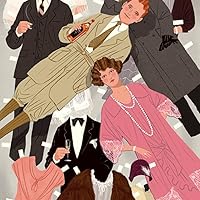
What a little gem of a book! Someone had given it to me as a gift in 2013 when it was published, I didn't realize what it was, put it on my Fitzgerald shelf, then forgot about it until the other day. This 22-page diary by a 14-year-old Fitzgerald is just terrific. While the topics are girls, crushes, and friends, his writing style is already recognizably intact. What a pleasure. There are also nine pages of pictures that include the people he mentions, homes around St. Paul that relate to the material, and a newspaper clipping. I kept staring at the cover photo, which also appears inside and looks just like him as an adult, and feeling oh so sad about what lies ahead.
I took off a star because, while I appreciate what David Page did to bring this to us, his Introduction plus 35-page Afterward are twice as long as the diary itself and bloated with unnecessary material. They also don't contain original thought or his own research but many quotes by others.
Fitzgerald was more observant at 14 than I am as a grown-ass attorney.
These are some of my favorite lines (mostly from the commentary; the actual Thoughtbook is just a few scant pages):
"the stamp that goes into my books so that people can read it blind like Braille"
"Playwrit/poet, Novelist, essayist, philosopher, loafer, useless, disagreeable, silly, talented, weak, strong, clever, trivial, a waste, In short a very parody, a mockery of one who might have been more but, whom nature... made less... with apologies for living, Francis Scott Fitzgerald"
This was a library lunchtime read...very short little book with F. Scott Fitzgerald's boyhood journal from his days in St. Paul. There are a lot of thoughts on which girl likes which boy and who Fitzgerald likes best. The list changes frequently. The thing I took away was how much I wish I'd have kept a diary when I was younger. That would be interesting to look back on now. But, I've never been a good diarist. I've tried at least a dozen times throughout my life and after a gung-ho start of a few weeks, it trickles to zero. I would love to see all the girls I had crushes on and other silly thoughts that popped into my head as a 13 year old.
I was very excited when I found out I won this book. So when I received it in the mail yesterday I sat down and read it. It was such a good read, to read another's dairy and see how they thought. I felt like I was seeing it all through his eyes. It was good fun to read about someone else and his friends. Also, to see into a boys mind on crushes sort of. I hope this gets amazing reviews. Hope many people read and love it like I did. I just know this is going to be one of those to reads on a cloudy day for me!
Picked this up off the new books cart - F. Scott Fitzgerald was born in St. Paul so I thought it would be some good local reading. The actual "thoughtbook" is pretty short and mostly talks about Scott's friends and girls he liked and whether they liked him back. Pretty normal pre-teen stuff. The afterword shows how these early writings directly influenced Scott's later work. Having read only The Great Gatsby, I wasn't familiar with the other works mentioned, but this book would be good for an F. Scott enthusiast or a high school student writing a paper.
I won this book through a Goodreads First Reads giveaway and was excited to see that I won. I really enjoyed reading the thoughtbook and getting a glimpse at F. Scott Fitzgerald's life as a fourteen year old, rather than what I already knew about him after he became a writer. Another thing I liked about this book was the pictures included. This was a quick, interesting read, and overall I enjoyed it! (3.5 stars)
Very insightful look at our country's most important author as a young boy. His early "thoughtbook" (as he called it) reveals the classic longings of Fitzgerald's later writing - he is the dashing knight vying for the attention of the prettiest girl in the room. There will never be another Fitzgerald; he is simply the best, and this publication of his early diary entries provides a remarkable window into the young dreamer before he became the giant.
"Once I belonged to a cruelty to animals society and Betty Mudge told them that I cut off rats' tails and so I received a note signed by ten girls telling me politely but firmly that I was fired from the organization. " - F. Scott Fitzgerald at 14.
I received this book free through Goodreads First Reads. I enjoyed the actual thoughtbook and wished it had been longer. I lost most of my interest in the book after the first couple pages of the afterward. It was not very appealing and became slightly confusing.
Short but entertaining, this book gives a little glimpse into the life of F. Scott Fitzgerald as a teenager. Not only do you learn more about the famous author, you also can enjoy a good laugh at the silliness of growing up with this book.
Ce n'est pas le meilleur ouvrage sur Scott Fitzgerald mais il est très joli. Mais l'intérêt de faire un livre sur seulement une quinzaine de pages, je trouve cela dommage. Mais à lire car l'analyse à la fin est très bonne.