What do you think?
Rate this book


29 pages, Audiobook
First published January 1, 250
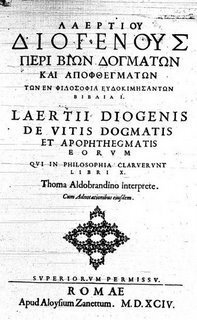
I am very sorry that we have not a dozen Laertiuses, and also that he was not more expansive or more thoroughly informed. For I am equally eager to know the fortunes and lives of these great teachers of the world, no less carefully than their doctrines and ideas.—Montaigne, Book II, Essay X: Of Books
I for one prefer reading Diogenes Laertius, in [him] there lives at least the spirit of the ancient philosophers . . . The only critique of a philosophy that is possible and that proves anything, namely trying to see whether one can live in accordance with it, has never been taught at universities; all that has ever been taught is a critique of words by means of other words. —Nietzsche, Schopenhauer as Educator
__________
Equally uncertain is the reason for the text's survival: if Diogenes Laertius had readers in his own lifetime, we don't know who they were. The manuscript may well have been published only posthumously, prepared by a scribe forced to work with unfinished material. No one knows how many copies were initially made. Unlike the corpus of Plato, which was carefully preserved by his school, or the treatises of Aristotle, which came to be widely read, studied, and copied in antiquity, it's as if the manuscript had been preserved by a quirk of fate, just like the wall paintings in Pompeii. —James Miller, Introduction
__________
Let me now put the finishing touch, as one might say, to my entire work and to the life of this philosopher by presenting his Chief Maxims, thereby bringing the whole work to a close and offering as its conclusion the beginning of happiness . . . —Book 10, Epicurus
The Lives contains fifty-two epigrams by Diogenes on forty-six philosophers and twenty-nine epigrams by other poets, both named and anonymous, on twenty-three philosophers.and the ones which he includes of his own creation, usually concerning the Philosopher's death, come from his Pammetros, a collection of epigrams about various Philosophers. The first one he includes, about Thales, runs as follows:
One day as Thales watched the games,
You snatched the sage from the stadium.
I commend you, Zeus, Lord of the Sun, for drawing him toward you;
For he could no longer see the stars from earth.
The extant poems are so wretched as fully to justify van Gutshmid's thanks to Apollo and the Muses for allowing the collection as a whole to vanish. —Herbert S. Long
perhaps the worse verses ever published. —W. R. Paton
The real reason Diogenes had written his book, Nietzsche suggested, was to provide an artificial framework that would justify republishing the wretched epigrams he had written about the deaths of the philosophers. Nietzsche further speculated that these had been a total failure with the public when they had first appeared as part of a collection of his miscellaneous poems and that he was anxious to find a pretext for republishing them. —Glenn W. Most
Diogenes' own epigrams, when extracted in order from the prose accounts in his Lives, do at times show thematic continuity or other linking devices that are typical of carefully arranged epigram collections, such as Meleager's Garland.
"In the ancient world, philosophy was conceived of and practiced not only as a specific intellectual activity, characterized by a set of doctrines, but first and foremost as a particular way of life different from and considered superior to the kinds of lives lived by most other men."
 [Image: Book Cover]