Two Comics Legends Tap Into The Speed Force! In this acclaimed collaboration, iconic comic book creators Grant Morrison (The Multiversity) and Mark Millar (The Authority) conspire to put the Scarlet Speedster through the most grueling and the life-changing challenges they can conjure up! First, the Flash must battle against every hero's nightmare: a sentient super-costume that consumes the life force of anyone who wears it. Then, the Fastest Man Alive must find a way to counter his old foe the Mirror Master before everyone he cares about in reversed-aged out of existence. After that, Wally West barely has time to breathe before he's forced to enter a race spanning all of time and space against an unbeatable opponent: with the loser's world to be erased from existence! Of course, with friends like Jay Garrick, Max Mercury, and Jesse Quick by his side, the Keystone Comet can face down nearly any threat imaginable: but not even an entire team of speedsters can outrun death itself. And when the Black Flash comes for him, Wally will have to go deeper into the Speed Force than he's ever dared, or lose everything he holds dear! Morrison and Millar are joined by artist Paul Ryan, John Nyberg, Ron Wagner, Pop Mhan, and many more for a celebrated run with comics' most celebrated runner.
Collecting: The Flash 130-141, 80-Page Giant; Green Lantern 96; Green Arrow 130; & material from JLA: Secret Files
Grant Morrison has been working with DC Comics for twenty five years, after beginning their American comics career with acclaimed runs on ANIMAL MAN and DOOM PATROL. Since then they have written such best-selling series as JLA, BATMAN and New X-Men, as well as such creator-owned works as THE INVISIBLES, SEAGUY, THE FILTH, WE3 and JOE THE BARBARIAN. In addition to expanding the DC Universe through titles ranging from the Eisner Award-winning SEVEN SOLDIERS and ALL-STAR SUPERMAN to the reality-shattering epic of FINAL CRISIS, they have also reinvented the worlds of the Dark Knight Detective in BATMAN AND ROBIN and BATMAN, INCORPORATED and the Man of Steel in The New 52 ACTION COMICS.
In their secret identity, Morrison is a "counterculture" spokesperson, a musician, an award-winning playwright and a chaos magician. They are also the author of the New York Times bestseller Supergods, a groundbreaking psycho-historic mapping of the superhero as a cultural organism. They divide their time between their homes in Los Angeles and Scotland.
This is a greatly condensed definition, straight off the Wikipedia page, written by someone who obviously has lots of time on their hands:
“The Speed Force is an energy field that grants all speedsters their power. Several speedsters have merged with it, including Barry Allen, Johnny Quick, Wally West, Jay Garrick, Jesse Quick and Max Mercury. Those with access to the Speed Force can use a large number of abilities, usually revolving around speed, including: superhuman endurance, accelerated metabolism, increased and accelerated perceptions, accelerated healing, decelerated aging, Speed Force aura, supercharged brain activity, electrical generation, life force stealing, some degree of enhanced strength, vortex creation, phasing, Speed stealing, infinite mass punch, and others…the Speed Force is a vaguely defined extra-dimensional energy force from which most, but not all, heroes in the DC Comics universe with super-speed draw their enhanced abilities”
The emphasis on “vaguely” is mine – meaning the writers can pretty much take the whole concept of the Speed Force and bend it and twist to whatever cow-catcher plot device they can think of: “The Flash is in trouble! Let’s just tweak the “force”, give him a new ability and get him out of it. ”
The TV show, now going into its third season, has just begun to tap into the concept, which means I’m going to have to bone up on this stuff in order to just answer (vaguely) the questions that will start flying when I watch it with my family.
*sigh*
As to this volume, it’s a reissue of some the Millar/Morrison co-written stories from the late ‘90’s. The fastest man alive in the DC universe at the time was Wally West, not Barry Allen. Barry Allen died sacrificing himself in order to straighten out DC’s confusing continuity problems years ago. Still in the picture and helping out are the speedsters:
Jay Garrick – The Golden Age Flash and the only speedster who wears Depends. The Flash can never outrun incontinence. Just sayin’.
Max Mercury – The Zen speedster, whatever the hell that means.
Jesse Quick – Daughter of a dead speedster. Hey, isn’t one of the characters on the TV show, who got exposed to Speed Force named Jesse? Foreshadowing? Maybe?
Impulse/Bart Allen – He’s a junior speedster. His mom is from the 30th century
Some solid and entertaining tales include:
Yep, Wally’s dead in about sixty minutes if he doesn’t do something quickly.
Some romantic stuff with girlfriend, Linda Park. He can whisk her away to the Taj Mahal in seconds, it takes me a couple of years to remember to buy flowers for my wife.
In order to save the Earth, Wally has to race a cute little guy from Radioworld through time and space. Whoever loses, their planet goes boom.
A nice, effective crossover (whatever happened to those) with the Green Lantern (Kyle Rayner) and the Green Arrow (Connor Hawke).
The bell tolls for thee, Wally West – the Black Flash (Death) is coming for you. How he gets out of this one is actually fairly cool.
Millar/Morrison take an occasional sip from the Speed Force, but they thankfully, don’t turn the fire hose on the reader.
Bottom Line: Before their heads went up their rear ends, both Millar and Morrison were once capable of some fine work. Morrison in particular liked to show off his love of DC’s rich past when he could and that is nowhere more evident than in a terrific story about what happens when Jay Garrick takes over Wally’s duties as Keystone City’s protector for a day.
Also fun was The Flash helping Millar come up with a story for a Flash annual.
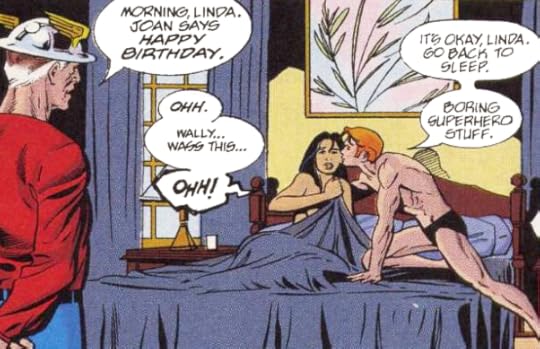
Being a speedster means never having to knock.
This volume is more of a jumping off point for those already familiar with the character rather than a gateway for noobs.
These writers took Flash as far as they could with the character, gave him a tremendous speed boost. This was the best version of the character. Barry Allen was good, but Wally West was the best Flash, period.
Grant Morrison embraces his love of the Golden Age in his run on The Flash. He mines goofy tales of the past, updating them with modern story telling and high science. He starts out with a story about a possessed suit that takes over metas using up their energy as it absorbs their powers. It's great. In a story with Mirror Master, Wally has to stop MM before Linda, who is going backwards in a mirror dimension, erases herself. I really liked the story where Jay Garrick takes over guarding Keystone City for a day too. Then we get a fun crossover with Green Lantern and Green Arrow. Next is a very Golden Age-esque story where the Flash is forced to race continuously to save Earth from destruction while these Celestial types bet on who will win. That was my favorite story in the collection. Finally, we get the first Black Flash story as Flash has to outrace his death.
The art is very 90's. Paul Ryan does about half the book. He's a lesser John Byrne clone. Ron Wagner and Pop Mhan draw the later half and their art is very dated.
Incidentally this comes in between Book 6 and Book 7 of Mark Waid's epic Flash run. He took a year break before coming back.
Wally must fight a new enemy called "The Suit" and when it targets members of the flash family it becomes more personal and I love this and then a story with Mirror master and his crazy tactics and I love the twists here and then a story with Jay and an insight into his life in a day and I love it plus his friendship with Clifford devoe was fun and then a crossover with GA and GL as they fight some villains plus Dr Polaris and how they stop them and then a trial which plays a bit comedic-ly but just shows the intelligence of Wally to save the day and its awesome!
And then finally the big stories like "the human race" where wally has to fend off against these alien beings called "the gamblers" where he has to race alongside Krakkl or against it to save his world and its one of those stories that just shows his powers and how awesome he is and I freaking love how the whole planet gets together to save the day! <3!
And then "the black flash" story where it targets Wally and showing what happened to Linda and its heart-breaking and yeah hits hard but when Wally has to face off against death itself, its one of those epic moments where he outraces death itself to save his lady love and pop the question of marriage and OMG its romantic and crazy and just perfect in every sense of the word!
One of the most creative runs on the book and just shows how well the grasp these two writers have on the book and I loved this short run and the art was pretty good too, so yeah a must recommend from me!
Grant Morrison is the main reason why I picked up The Flash, I quite like what Morrison had done with the Batman series, after all.
However, I must admit the old fashioned 1990s artwork really isn't my favorite (though this volume is supposedly published in 2016, how strange...) therefore I could only finish two or three stories: mainly The Human Race and The Black Flash, in the latter story The Flash (Wally West) actually damn it, that's pretty impressive.
Though I didn't find all of the stories to be great, still I'm glad to be introduced to the Flash and his speeder family.
PS: I really like the cameos of Captain Boomerang (I just love his older blue-colored custom!), Captain Cold etc!
De las runs más flojas de Morrison, los primeros tres números son contra The Suit, quedando todo roto y obligado a usar un traje de súper velocidad para salvar las papas,,, meh.
Sigue un unitario con un personaje infaltable en cada trabajo del escocés para Dc, el otro escocés, Mirror Master. Más meh… entretenido de todas formas.
Unitario de Jay Garrick buscando el casco de un viejo rival, el Thinker, mientras Wally se recupera… oda a la Silver Age. Meh.
Continua con un crossover de tres partes con Green Lantern y Green Arrow, donde se toman un crucero para acompañar a Wally en el último tramo de su recuperación. Se enfrentan a tres vándalos de tercera que buscan revivir al Doctor Polaris,,, Meh.
Si lo anterior fue una oda a la silver age, Human Race hace lo mismo por la golden age. Un pretexto tan ridículo como una carrera para salvar el mundo de unas criaturas alienígenas apostadoras y si faltaba más para hacer la historia bizarra, el contrincante es un amigo imaginario de la infancia de Flash… sí como no Mr Morrison…
El último arco está escrito por Millar con una historia fuerte, la muerte de Linda a manos del Black Flash.
So this was the first Flash comic I've read other than the New 52 crap. I have never read a Wally West centered comic, but I loved his character in the Justice League cartoons - so I figured why not? And I wasn't disappointed! I don't really like Grant Morrison, but Mark Millar kind of grounded him I think, and kept this from getting too weird. It was super awesome to see the Flash working as a team with Jay Garrick, Jesse Quick, and the glimpses of Impulse were fun (I still have a soft spot for Bart Allen because of Smallville). :) Linda Park is a kickass lady and I liked that she has her own life outside of Wally's. Cool to see Connor Hawke and Kyle Rayner - I want more of them but have no clue where to start. Overall, interesting stories and I enjoyed the artwork. Excited to read more old Flash stories! :)
This made me really miss what DC was doing in the late 90s up through the New 52 in 2011. The idea of "legacy" heroes of subsequent generations taking on the mantles of Flash, Green Lantern, and others was an idea that really helped them stand apart from Marvel and also deliver a sense of history by drawing on continuity without being needlessly complicated.
Grant Morrison is one of my favorite comics writers, and seeing him (and Mark Millar) give some creative problems and storytelling to the Flash is much fun. Especially since this collection pulls together a year or so of the comic, and each story only lasts for 3 issues. Today, most storylines are 5-8 issues, which sometimes feels like a drag.
O Flash é um heróis bastante subestimado no mercado brasileiro. Ele tem histórias sensacionais, mas não são republicadas por aqui, não sei por que cargas d'água, apesar se o herói ter uma fanbase importante devido à série de TV. Este encadernado compilando a fase de Grant Morrison e Mark Millar no velocista escarlate é uma prova dessas boas histórias. Muito da primeira fase de Mark Waid no Flash é aproveitado aqui. O encadernado acaba trazendo todos os arcos da fase Morrison/Millar. O primeiro, Parada de Emergência, explora como é ser o Flash quando se acaba em uma cadeira de rodas. O segundo, Morte no Topo do Mundo, traz um divertido crossover entre Wally e o Arqueiro e o Lanterna Verde da época. A Corrida Pela Vida, talvez seja o melhor arco desse encadernado, mostrando Wally como campeão da Terra em uma disputa entre os maiores corredores do universo. O Flash Negro é o arco mais fraco deste encadernado, mas ainda assim, um arco bom, sobre a entidade que representa a morte dos Flashes. Outras pequenas histórias complementam esse encadernado de mais de 300 páginas, que é uma jornada muito recompensadora de se fazer. Os desenhos nessa edição, não são lá essas coisas, não, são bastante genéricos e por vezes feios, mas os roteiros compensam bastante. Espero que a Panini comece dar mais atenção ao Flash e não publique somente o herói em publicações luxuosas e de difícil acesso como esta.
3.5/5 stars for this one. Another solid effort from Morrison and Millar.
This one isn't as crazy as I thought it was going to be. Given the fact that Morrison usually goes balls to the wall I was surprised to see that his usual bonkers vibe is missing for most of this book. I mean he could have gone science crazy on this, especially with the mumbo jumbo.
Although there wasn't as much classic Morrison here I still found it a really enjoyable read. I've heard that Waid's run on the character either side of this run was a lot better than this, so I might have to check that out, but regardless the stories kept me reading on and intrigued. And for the most part the art was good, but the last arc the artist changed into something else, it was pretty shit tbh. But the story kept me moving forward.
I really enjoy the flash, especially Wally West. If your a fan of the character then I'd recommend this book. But be warned; don't expect full Morrison, this could be a good thing for some and bad for others.
A fun, often absurd collection of insanely high-concept Flash stories that harken back to the wild imagination and colorful, surrealist creativity of the character's classic Silver Age adventures. Despite some odd mischaracterization (since when did Wally become an amateur super-scientist?) and both writers' more annoying idiosyncrasies being very much present (Millar's cynical cheekiness, Morrison's love of abstraction over tangible world-building, and BOTH of their tendencies towards wild hyperbole), this is still a punchy, engaging collection of whimsical sci-fi stories that takes big swings and knocks 'em out of the park.
Probably the one big drawback here is the artwork, which is shockingly inconsistent throughout (Pop Mhan's contributions being the indisputable low point of the whole volume). But it's a minor stumbling point in a volume that's otherwise entertaining from beginning to end.
For a collection of ostensible fill-in stories wedged into the middle of Mark Waid's legendary work on the Scarlet Speedster, Morrison and Millar actually made quite a mark on the character-- from the establishment of the Speed Force suit to the introduction of the Black Flash. It may have been a short run, but they took it at a sprint.
Most of this volume is just good or decent. I enjoyed them but nothing really stood out with the exception of Flash getting new powers for a bit.
The Black Flash arc on the other hand is wonderful, dark, and well done. I really enjoyed it, and being a 3 parter it moved at neck-breaking pace. The opening part is sad as hell, the middle scary, the ending wonderful. It is easily one of my favorite Flash stories.
So okay stories throughout and one great story. A 3 out of 5.
3.5 stars. Very serious stakes here in typical Grant Morrison and Mark Millar fashion! This one challenges bid ideas of life, love, sacrifice, time, and death in fashions that fit perfectly for those two creators. Really enjoyable stories here. I especially liked the Jay Garrick issue in this one and the later two Wally West runs!
This was OK. I went in with pretty low expectations since I'm not a Grant Morrison fan at all and was surprised to like a few of these stories. The book opened with the strongest story Emergency Stop imo. It's a 3 parter where the Flash has to prevent his own death against the mysterious Suit. I liked The Suit's lore and how "he" was an all-powerful parasitic bad guy; taking over the bodies of those he possessed and sucking away all their energy -killing them.
More than Wally, I actually liked Jay Garrick best in this volume, especially his issue Still Life in the Fast Lane. We follow him as he tries to do it all. We see him humbled at his failures even though he's obviously the success story of his old team. He can do it all! And yet... he still faces loses.
While I liked those two stories a lot, there was a lot that I didn't like about this book. Some of it is just horribly uncomfortable non-PC writing, which can't be helped (maybe?) because this comic was a product of its time (1997): like Impulse calling Wally a "crip" after he broke his legs, the horrible lawyer, Bernard Weinstein, in Three of A Kind who was drawn like an anti-Semitic Nazi propaganda cartoon of the conniving money-grubbing Jew lawyer. Ug.
And less offensive but still not great was Nightwing's terrible ponytail and goatee (lol), the awkwardly wrong use of the Twelfth Amendment in the courtroom scene in Three of A Kind issue #135: Green Lantern testifies masked in court, citing "the Twelfth Amendment to hide his secret identity", and the prosecuting lawyer responds that "Even Superman takes the Twelfth Amendment when he's giving evidence in court.". Which makes absolutely no sense. The Twelfth Amendment to the US Constitution is about voting and the Electoral College. So, yea.
The art is truly disastrous in some of these issues. Real fugly 90s stuff. I couldn't even read The Black Flash (the book's last story). The art was so bad. The art from the first issue (#96) of Three of A Kind wasn't great either. Though I'm glad the issue opens with one of Saddam Hussein stronghold's, which is "reportedly a storehouse" of WMDs! That was funny.
There was one issue with art I liked from: Three of A Kind, issue #130. I think it was a Green Arrow issue, art drawn by Will Rosando, and colored by Lee Loughridge. The lines were heavy and I liked the dark colors.
One of the weird things about this book is that everyone knows Wally's identity. Everyone and their brother comes after him & it's not surprising when Mirror Master goes after Linda... cuz, duh. They all know who you are and where you live.
I also didn't like the story Radio Days. -Classic Grant Morrison story where Morrison gets ahead of himself trying to be creative and clever and ends up telling a story that is convoluted and sloppy with a lot of narrative text boxes and dialogue boxes to try and explain what is going on...
Emergency Stop (130-132). Morrison and Millar show us right off that they're going to offer a different take on Wally. So we get a haunted costume, a speed-force costume, and timey-wimeyness. All of the weirdness is quite a bit of fun, but unfortunately the core of the comic rotates around big, long fights [6+/10].
Shorts (133-134). Morrison & Millar's two shorts are nice. The GA Flash (134) story is the stronger of the two, because the authors have such a great grasp of his really unblemished character, but the Mirror Master (133) story is fun for its over-the-top style [7+/10].
Three of a Kind (135). The idea of the legacy Flash, Green Arrow, and Green Lanterns teaming up is terrific, but unfortunately that means crossing over with those other books, which weren't that great in the late '90s. So, we get a really mediocre Green Arrow and a slightly better Green Lantern before we move over to lay and Flash. It's clear that Millar and Morrison are aware of the shortcomings of the crossover, because they move it to a fun courtroom frame, and manage to save what was otherwise a pretty uninspiring fight against uninspiring villains [5+/10].
The Human Race (136-138). Another bit of Morrison-inspired craziness, as Wally races against his imaginary friend in a contest required by Kirbyesque gods. It's a little too inspired by the various games of the Grandmaster over at Marvel, and it's a little too action oriented, but there are great ideas here and the finale of getting everyone in the world to support Wally has been done a lot since, but never so successfully as what we get here [6+/10].
The Black Flash (139-141). More of what we've come to expect from Morrison and Millar, but this is one of their more polished stories, with a nice addition to the Flash mythos (the Black Flash) who's remained quite evocative over the years. Also, there are plenty of twists and surprises and a strong use of the Flash supporting cast [7/10].
To a certain extent, it's hard to rate Morrison and Millar's Flash writing because it feels like apprenticeship-level work. Oh, everything you'd expect is there: shocking developments, wacky science-fantasy ideas, and unusual narrative structures. But this volume just doesn't hold up as well as some of what came after it. This volume is also hampered by not having the tighter continuity of the Waid and Johns runs that surround it. Still, it's a nice year of Flash and generally worth reading.
This is the run by Morrison and Millar that comes in between Waid's run on the Flash. You can definitely feel a tonal shift in the dialog, the atmosphere, even the pacing. Its really solid, really good. I very much enjoy Waid's run so far, but its nice to see how someone else does it.
I can break this run into two parts, the first part is the "street level" adventures that the Flash has. This is where he battles his rouges gallery in various different situations. I'm guessing these are written mostly by Millar. The dialog is snappy, the action is fast paced and it's really entertaining to see someone who is well versed in action and cynicism, take on the Flash because there is a level danger that isn't really present in Waid's run. There's an extra layer of cruelty in Mirror Master, Polaris, an empty suit (?), and the other street level villains that feels more modern and exciting.
But where the book really shines is the cosmic portion, which I'm guessing Morrison mostly wrote. Man is this a good story! Morrison takes the notion of the Flash to the extreme by having him race in a unwinnable tournament where galactic beings throw them into impossible situations and bet on them. The inventiveness and creativity in this story is amazing and really has to be read to be appreciated. Morrison always is able to handle these huge ideas with great care and keep the characterization of Wally West intact. I really enjoyed this story. I think its a must read along with Waid's run.
If you are fan of the Flash, definitely check this out, its essential reading for any Flash fan.
Grant Morrison and Mark Millar expand the Flash legacy in this volume more than Mark Waid has done in the previous six. Things to look forward to in this book:
The costume made of purely Speed force. The Black Flash and the "death" of Linda. Flash's imaginary friend Sonic. A villain who is a Suit??
Once again the Green Lantern specials were of really low quality story-wise.
This entire review has been hidden because of spoilers.
Eu sou clubista quando o assunto é Careca Morrison e quando o assunto é Wally West, e nem vou perder meu tempo explicando porque o Wally é melhor Flash e porque o Careca Morrison é genial, então, nessa coleção, vou supor que tudo que eu gostei é por causa do Careca Morisson e o que eu não gostei é culpa do Michael Bay do Quadrinho Moderno, Mark Millar. O Morrison é uma cara que repete os temas, então temos personagens esquecidos do passado aparecendo, conceitos mirabolantes - um uniforme de supervilão assombrado -, viagens no tempo, poderes absurdos - um cara pode colocar roupas em moda em diferentes épocas -, o Flash na cadeira de rodas, o Mestre dos Espelhos com uso bem criativo dos poderes, uma edição focada no Jay Garrick - algo que não acontecia há 50 anos(?) - , uma corrida pelo tempo contra um amigo imaginário da infância e mais algumas coisas que eu não lembro agora. Um dos melhores pontos é um crossover entre o Flash (Wally), o Lanterna Verde (Kyle) e o Arqueiro Verde (Connor) e mostra o quão legal era a DC naquele tempo - eu sou velho e no meu tempo era melhor -, porque nós tínhamos uma sensação de legado, de história, de evolução, de futuro, desde que o Barry voltou quase tudo parece comida de microondas na geladeira da DC. A história do Black Flash tem toda a cara do Millar; mortes escabrosas e surpreendentes, missões impossíveis para tudo que é lado, sacrifícios nobres e aquela papagaiada toda, na época até podia ser legal, mas não envelheceu muito bem. A arte tem bem aquela cara dos anos 90; colorido, chamativo, porém sem tantas ombreiras e pochetes como se poderia esperar. Eu achei uma edição muito bacana, longe de ser um marco na história da nona arte, mas é uma sopa de capeletti, esquenta a barriguinha num dia frio.
This is exactly what it advertises: Flash, the Wally incarnation, by Morrison and Millar. Both pretty reigned in considering other excesses, but bringing a Broome-esque sci-fi high concept feel. Some of the ideas and concepts, specially the first few issues are actually fun and inventive, but not really served by the competent but middle of the road Paul Ryan art. There is and odd crossover in the middle with GL and GA, odd not because they don´t usually crossover, but because the one year run by Morrison and Millar does not feel like a ¨regular¨ run. Then again, there are Wally and Linda developments here that feel very much like an ongoing, which makes you wonder who synched they were with Mark Waid, who preceded and followed them in the title. It´s... good, but if you are expecting the bombastic stuff both did in other titles and run, you might be dissappointed.
Man, if you want a comic that is going to make you miss the pre-New 52 DCU, here is one that really fits the bill. While reading this, I couldn't help but yearn for those halcyon days when DC was built on the foundation of decades of superhero adventures that came before. Jay Garrick, the Golden Age Flash, shines especially bright in this collection. Morrison and Millar really show what a terrific mentor he is, not just to Wally's Flash, but to the reader as well. The book is full of high concept sci-fi that you'd associate with Grant Morrison, toned down to give it a fun, Silver Age-esque sheen. Highly recommended.
on one hand, there were a lot of stories I didn't like and I really don't like the art but on the other hand, there were a couple of stories that I did like that weren't as bad as the others but the art really got the best of me which is why there were so many times where I was reading the book and just wanted to put it down but my favourite story was the one with black racer which I thought was pretty good
Some rough work in the final arc in this coll cation aside, THE FLASH BY GRANT MORRISON AND MARK MILLAR is a great read. It is also a nice reminder that Millar can write well crafted, emotional tales that don't rely on cheap shocks and vulgarity when he puts his mind to it.
A turd with some nice ideas in it (the multicolor flash) doesn't make for a better turd. Read the Waid Run instead, not as perfect as some people claim it to be but FAR BETTER than this convoluted garbage.
Wally West is, hands down, one of my favorite superhero characters. While I tend to prefer the stories with him as Kid Flash over those when he took on the mantle of the Scarlet Speedster himself (mostly because I was first introduced to Wally through "Young Justice"), I thoroughly enjoyed the issues compiled in this collection. My favorite part was the inclusion of the other speedsters and how they all relate to and interact with each other. That felt a lot like the Bat Family, and I love stories that explore family dynamics. But, honestly, each story in this collection was so good that I feel like I can't talk about the book as a whole; I have to break it down by each story, because each one had something unique to it. So, here it goes: (1) Emergency Stop: The cool thing about the Flash is that his powers aren't just about running fast. He can vibrate his molecules enough to turn invisible, to pass through solid objects, and, coolest of all... travel through time. And while this issue didn't have the Flash himself time-traveling, that concept is one that always feels at home in a Flash story. And the basic plot of the story--that they find Flash's body, seemingly from the future, and Wally has one hour to stop his own death--is just a neat idea. The writers clearly realized that there's a lot of potential with this character, and the first story in this volume showed that they were going to give us stories that lived up to that potential. (2) Through the Looking Glass: This was pretty much just a regular Flash story. Nothing stood out particularly, but it had solid action and art and gave Flash fans what they want. It wasn't a weak story, but it was definitely the least unique one in this collection. (3) Still Life in the Fast Lane: I LOVED this issue. I enjoyed getting to spend time with Jay Garrick, a character I don't know nearly as much about. I enjoyed seeing the "golden years" of superheroes and villains. I enjoyed seeing how Jay uses his speed in both common and extraordinary circumstances. But, above all, I enjoyed how this story had sadness perfectly matched alongside the superhero antics. The end result was a story that was downright profound. (4) Death at the Top of the World: This one was also a really great read. A story where the superheroes don't succeed--where people suffer and even die--always lends itself to massive character development and deeper themes. That's what happened here, especially with the entire last issue taking place during court proceedings. Comics don't always go that route. We rarely see what happens after the villains are rounded up and taken away. It was also nice to see how the criminals could have gotten off on technicalities--how the justice system isn't always perfect--but how the good guys can also play those cards as easily as anyone else. It was a well-developed story with more layers than I was expecting. I also liked getting to see Kyle Rayner. I've not read a ton of Green Lantern, so I liked getting more time with that character. And the Green Arrow in this story was someone I'd never met, so getting a chance to learn about him was also nice. (5) The Human Race: No way around it, this story was just cool: The Flash has to compete in a race across time and space in order to save the planet? Seriously, seriously cool. This goes back to the first story: the writers realized the character's potential and made sure they pushed that potential as far as they could. Somehow, they did that without completely shattering my suspension of disbelief. I think they managed that by always keeping Wally centered: with Linda, with his speedster family, etc. The story might have been galaxys away, but its heart was always right here on Earth. (6) The Black Flash: Not gonna lie... this one was rough. They way they wrote Linda's death--by showing us, first, what could have been and making us believe, just for a moment, that it all really happened--was a cruel, but effective ploy. The funeral, Wally's reaction... all was a nicely delivered emotional punch to the gut. And the concept of the Black Flash was creepy in all the right ways, and the way he defeated him and ultimately regained his powers was also, again, just cool. (7) Your Life is My Business: This comic was short and sweet, so my review will be, too: the concept of the Flash talking the the comic's writer as though superheroes really existed in our world was, once again, cool. I also liked seeing some of the humdrum moments of speedster life that Flash discussed--you know, what it actually felt like to be a speedster. It was a creative idea with great follow-through. Looking back, I realize I've used the word "cool" a thousand times in this review, but that is ultimately the best way to describe the stories collected here. They weren't the "deepest" comics I've ever read, but they had a few profound moments with solid storytelling and even better ideas. In short, if you're looking for some Wally West Flash stories, this a great place start.
This entire review has been hidden because of spoilers.
Reprints The Flash (2) #130-141, Green Lantern (3) #96, Green Arrow (1) #130, The Flash 80-Page Giant #1, and JLA: Secret Files and Origins #1 (September 1997-September 1998). The Flash is in the race of life…literally. First he must face a debilitating accident while trying to stop the Suit. The Flash learns that the whole Earth hangs in the balance as the Flash is selected for an inter-dimensional race against time. The Flash finds his ultimate challenge when he must race death itself in the form of the Black Flash…and Wally’s life might never be the same!
Written by Grant Morrison and Mark Millar, The Flash by Grant Morrison and Mark Millar also features a three part crossover with stories written by Ron Marz and Chuck Dixon. Following The Flash by Mark Waid—Book 6, the collection also features a short story from The Flash 80-Page Giant (August 1998) and an origin page from JLA: Secret Files and Origins #1 (September 1997). The collection has art by Paul Ryan, Ron Wagner, John Nyberg, Paul Pelletier, John Lowe, Will Rosado, Sal Buscema, Pop Mhan, Joshua Hood, Chris Ivy, and Ariel Olivetti. The issues in this collection were also collected in The Flash: Emergency Stop and The Flash: The Human Race.
Grant Morrison and Mark Millar often are revolutionary in their writing. Their stories are generally extreme and don’t always feel like they fit in with mainstream continuity. Like Morrison’s run on JLA, The Flash stories feel like they are part of the DCU but have a certain edge not found in the regular books.
The series has a surprising cohesion that seems a bit lost in recent years in comic books. The crossover between Green Arrow and Green Lantern feels like it fits in with all the titles despite different writers. JLA, Green Lantern, Green Arrow, and Flash seem to be at the right place at the right time…it doesn’t feel like any of the writers jerked their characters out of bigger stories to do the crossover. It fits.
Morrison and Millar manage to increase the odds throughout the book. When you read “Emergency Stop” it feels like it is rather intense and high stakes. This is taken to another level in “The Human Race” which has Flash racing to save the Earth in a race he cannot ever win. You think that Morrison can’t go beyond “The Human Race”, but “The Black Flash” storyline not only feels bigger than “The Human Race” but also more personal with Wally’s relationship with Linda.
I’d be curious to know how Millar and Morrison worked together. The stories in the volume feel both indicative to the writers, but it also feel like a solid flowing story that doesn’t “break” despite different writers. Many books now just relaunch with new teams and that is the lazy way to do it. I prefer an honest attempt to write a story that remains true to character and fits within a bigger context.
The Flash entered a good “run” starting with Waid and Miller and Morrison make an honest attempt to make their takeover of the book their own. The Flash is a fun character and much more than “the guy who runs fast”. Morrison and Millar’s run is overshadowed by being sandwiched between Waid and Geoff Johns who took over the series with Flash (2) #164.