Jump to ratings and reviews

Win a free print copy of this book!

7 days and 12:52:36

10 copies available
U.S. only
Rate this book

Protocols. Edizione italiana del bestseller internazionale: Manuale operativo per il corpo umano

Win a free print copy of this book!

7 days and 12:52:36

10 copies available
U.S. only
Rate this book
SENTI CHE FUNZIONI AL 50% DELLE TUE POSSIBILITÀ?

ECCO IL PRIMO MANUALE OPERATIVO PER SUPERPOTENZIARE LA SALUTE DEL CORPO E DELLA MENTE

NON SERVONO INTEGRATORI O DISPOSITIVI PURA SCIENZA, APPLICATA ALLA VITA

La mente è collegata al corpo attraverso la tecnologia più complessa e potente dell' il sistema nervoso.
Andrew Huberman, neuroscienziato di fama mondiale e autore del podcast di salute più seguito al mondo, ci dice che puoi controllarlo attraverso input fisici e procedure pratiche. In questo libro troverai 47 protocolli scientifici all'avanguardia organizzati secondo i 7 pilastri della salute – stress, sonno, alimentazione, luce, esercizio fisico, concentrazione, crescita personale – per liberare il potere nascosto del cervello, superare gli ostacoli, massimizzare le performance e raggiungere i tuoi obiettivi.

APRI QUESTO LIBRO E CAMBIA LA TUA

647 pages, Kindle Edition

First published September 1, 2026

Loading...
Loading...

About the author

Andrew D. Huberman

4 books785 followers
Andrew Huberman, Ph.D., is a neuroscientist and tenured professor in the Departments of Neurobiology and Ophthalmology at Stanford University School of Medicine. His research laboratory, the Huberman Lab, has made significant contributions to our understanding of brain development, the neuroscience of visual perception and repair from blinding diseases such as glaucoma, the neural mechanisms of stress and resilience and neural plasticity—the nervous system’s ability to change and learn in response to experience.

Dr. Huberman earned his bachelor’s degree with honors and distinction from the University of California, Santa Barbara (1998), completed a master’s degree at UC Berkeley (2000) and earned his Ph.D. in neuroscience from UC Davis in 2004, where he received the Allan G. Marr Prize for the Best Ph.D. Dissertation. He conducted postdoctoral research at Stanford University School of Medicine from 2005 to 2010 and was awarded a Helen Hay Whitney Postdoctoral Fellowship.

His first faculty position was from 2011 to 2015 at the University of California, San Diego, in the Department of Neurosciences and the Neurobiology Section in the Division of Biological Sciences. In 2016, he was hired by the Stanford University School of Medicine as a tenured professor, where he currently directs the Huberman Laboratory. Dr. Huberman’s lab has published numerous peer-reviewed research and review articles in the highest-tier journals including Nature, Cell, Science and Neuron.

Across his career, Dr. Huberman has published over 75 peer-reviewed articles in top scientific journals including Nature, Science, Cell, Neuron, Current Biology, and Journal of Neuroscience. He has delivered more than 100 invited research and keynote seminars around the world, and he was a regular member of NIH grant review panels and contributor to the National Eye Institutes Audacious Goals Initiative to cure blindness. His research as a PhD student, postdoc and tenured professor made important discoveries into how the brain processes visual information, how brain circuits develop and function and are modified by experience. He has also published a human randomized controlled trial on the efficacy of stress mitigation tools and ways to improve sleep, heart rate variability and mood.

His research includes key areas such as visual circuit development; the molecular mechanisms that guide precise wiring between the eye and brain; how the brain processes the direction of visual motion; visual and brain circuits for circadian rhythm generation and timing; stress and threat detection circuits in the brain and discovery of neural pathways that trigger defensive behaviors; neural regeneration and methods to promote repair of damaged neural connections; and stress and performance, focusing on how visual inputs and breathing patterns influence brain states.

His research accomplishments have earned him numerous prestigious honors and awards, including the Cogan Award in 2017 for making crucial contributions to vision science and ophthalmology, the McKnight Neuroscience Scholar Award in 2013, and the Pew Biomedical Scholar Award in 2013 for his work on visual circuit function and plasticity. He was awarded the ARCS Foundation Graduate Fellowship for the best PhD dissertation and the Helen Hay Whitney Postdoctoral Fellowship.

Dr. Huberman served on the editorial boards of Current Biology, The Journal of Comparative Neurology, Journal of Neuroscience and Cell Reports and he has reviewed papers for Nature, Science, PNAS, Cell, Neuron and many other top tier journals. He also served on multiple grant review panels for the National Institutes of Health.

He co-directed the Cold Spring Harbor Laboratory course on "Vision: a platform for linking cell types, circuits and perception," training the next generation of vision researchers.

In his teaching roles, Dr. Huberman has taught undergraduate and graduate-level courses in neuroscience, neuroanatomy, and development

Ratings & Reviews

What do you think?
Rate this book

Friends & Following

Create a free account to discover what your friends think of this book!

Community Reviews

5 stars
747 (36%)
4 stars
843 (41%)
3 stars
335 (16%)
2 stars
72 (3%)
1 star
39 (1%)
Displaying 1 - 30 of 273 reviews
Profile Image for Christian Sage.
Author 1 book5 followers
September 19, 2026
1/5 Stars: A Comprehensive Guide on How to Become an Inefficient, Sun-Gazing Cyborg
Let’s give credit where credit is due: Protocols: An Operating Manual for the Human Body is an absolute masterpiece of modern non-fiction. By non-fiction, I mean it reads like a frantic manifesto written by a sleep-deprived AI that was fed twenty years of neuroscience journals and a gallon of black coffee.

If your lifelong dream is to transform your morning routine into a high-security military operation that alienates every friend you’ve ever had, this is your bible.

Here is an objective, clinical breakdown of why this book is both a hilarious triumph of over-optimization and a total disaster for anyone trying to enjoy being alive:

The Chronobiology Trap: The author insists that your entire existence hinges on viewing low-solar-angle photons within 4.3 seconds of waking up. Objectively, this is great for your circadian rhythm. Hilariously, it means if you live in a rainy climate or have a north-facing window, your biology is officially doomed to failure.

The Supplement Economy: The book features protocols that require a pill organizer the size of a microwave. You will spend more money on adaptogens, trace minerals, and neuro-enhancers than your grandparents spent on their first mortgage. Your urine will genuinely glow in the dark.

The Joy Eradication Protocol: There is an underlying clinical tone suggesting that comfort is a sin. Want to sleep in on a Saturday? Congratulations, you have just sub-optimized your dopaminergic baseline. Want to eat a piece of pizza? Prepare for a 45-page guilt trip about glucose spikes.

Actionable Impracticality: While the science cited is often fascinating, the translation from "peer-reviewed rodent study" to "what you should do at 6:00 AM on a Tuesday" is a massive comedic leap. You will find yourself frantically adjusting the temperature of your shower to match a specific Scandinavian fjord while questioning every life choice that brought you to this exact tile floor.

Ultimately, it’s a brilliantly written text that treats the human body less like a living organism and more like a Formula 1 race car that requires a pit crew just to go buy groceries.
Profile Image for Athan Smyrlis.
Author 1 book14 followers
September 19, 2026
Fascinating science. More toolbox than operating manual.

The science in this book is fascinating, and Huberman makes complex physiology approachable. Bringing sleep, exercise, nutrition, light and stress into one practical reference, and explaining why each recommendation might work rather than just what to do, is a real service. That earns the four stars.

My reservation is the promise in the subtitle. An operating manual implies that if you follow the steps, the machine runs. Knowing the steps, and even understanding the mechanism behind them, is not the same as knowing whether an approach is right for you.

To be fair, Huberman does not ask anyone to follow every recommendation. The book ranks them by importance and says they should be adapted. But there is a difference between giving readers permission to adapt and teaching them how. The same specificity that makes the protocols appealing can turn health into an ever-expanding list of things to get right. A reader comes away with more options, and more uncertainty about whether they are doing enough.

I read this as a cardiologist who has spent two decades sitting across from people whose lives have been disrupted by shift work, caregiving, pain, medication and grief. The question in that room is rarely just what would improve this person's physiology. It is what they can realistically change, what matters most, and what burden the advice itself will add. This book's knowledge came from a laboratory. It has to be applied in rooms like that one, and it does not always survive the trip.

That is the standard: help me tell the essentials from the refinements, what to try first, how to judge whether it is helping, and when doing less is the better decision. Explaining why an intervention might work does not answer those questions.

Sleep is where this matters most. Advice can turn rest into another performance task. Someone who follows every recommendation and still lies awake needs a way to read that outcome without concluding they have failed. "This is not the answer for me" should feel as available a conclusion as "I was not consistent enough."

This is an excellent education. It is not individualized guidance, and the title promises the second. Read it for the science. Treat the protocols as possibilities to consider, not standards to grade yourself against. And do not mistake difficulty getting better for a failure to try hard enough.
Profile Image for Riku Sayuj.
674 reviews7,802 followers
November 7, 2026
I've been listening to Huberman since his first few podcast episodes, so a lot of this was repetitive for me. Read straight through, the book feels scattered. Sleep, cold plunges, supplements, how to stick a foot out from under the duvet to sleep better? Aren't you better off going to the experts on each, especially for which foot to stick out and how much?

I think his best podcasts were the original ones on light and the eye/ brain. Same for this book. The core of Protocols is light and the body clock, and that's where there's some real depth and passion as well. Beyond that it feels like he goes shopping a bit.

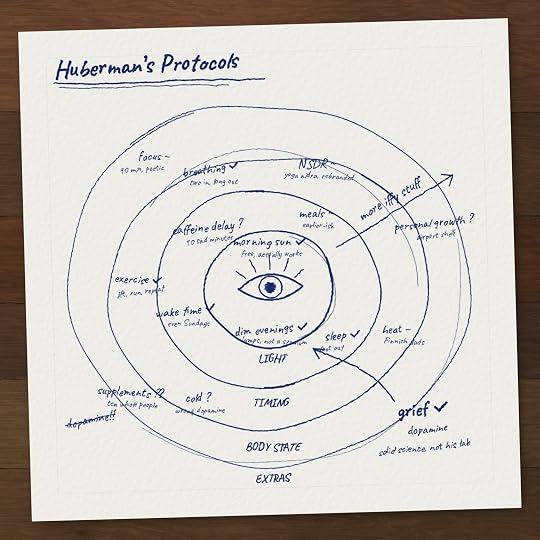
Protocols on a napkin

So, there are cells in the retina that don't help you see at all, they are there to act like your built in patents. Or not - I don't really get the science. Get outside in the morning, sleep dark and cold, screens off at night, keep the lamps low at night. It's all free and easy stuff. Regular wake times and the basic sleep advice - all reasonable. Then there's the ninety minute wait before coffee and a lot about cold plunges - this is more along the lines of 'it works for me so try it' stuff. The breathing exercise stuff seems useful, but who can ever tell with breathing? I'm convinced any intentional breathing confuses the soul and we get random results.

The books is pretty big on NSDR but also tries to say it's not yoga nidra. Why? Cos this ain't that kind of book. Also if cold is not your thing, sauna is as helpful. You can pick your poison.

There's a whole chapter on focus that might be really good for students but unfortunately I've no intentions of focusing so intently ever again.

Then there are the supplements. Oh and are there supplements! From rare elements to tart juice, we really could have three full meals on them. But more than that it's the conflict of interest for someone with so much reach that's staggering. How did a publisher or editor allow this? Anyone who follows the podcast knows how he can go on about the products he endorses, and the book is no different. I have never read a book with this many product endorsements (or any really, come to think of it). He can't go two paragraphs without recommending a brand, and a book that keeps saying the protocols are free also recommends what seems like 1000s of dollars worth of all kinds of stuff, almost all from companies he has ties to. Rebecca Onion in Slate called the book "a fire hose that's impossible to drink from." For me it was a fire hose of ads as well.

What I didn't expect to be so so good though was the part on grief. It's the best thing in the book. The idea is that the brain keeps a map of the people we love, where they are, when, how close, and keeps predicting them even after they are gone from our map/life. Like missing furniture. Each time they aren't there, the same dopamine prediction system he talks about everywhere else registers the miss, and grieving is that system slowly relearning. I'd heard him talk about dopamine for years in the context of motivation and ice baths. I'd never thought of it as the reason loss hurts the way it does. It's also the one section you can't turn into a protocol, which might be why it worked.

Still, four stars from me. I don't think the fully protocoled life is the best one. The optimised life is a full time firehose drinking job, and it leaves little room for actually living. But a few of these, picked carefully and kept up, can make a real difference to how your days feel. And Huberman himself is a phenomenon that needs studying, a scientific podcaster became millions of people's guide to how to live. The book is as interesting as a record of that as it is as a manual.
Profile Image for Lindsay.
90 reviews12 followers
Review of advance copy received from NetGalley
September 10, 2026
Thank you Simon and Schuster Canada and NetGalley for this ARC.

One of the things I appreciated most about Protocols is that it doesn’t necessarily need to be read cover to cover. You can easily skip ahead to the topics that interest you most or return to certain chapters when they become relevant to you. That said, I loved that the author explains early on that each chapter is intended to be a building block, with the recommendations presented in order of importance. This gives the book a clear structure while still allowing readers to approach it in whichever way works best for them.

I also really enjoyed the personal elements woven throughout the book. In each chapter, the author shares what led him to research that particular area, making the information feel more engaging and accessible. The scientific evidence behind each recommendation is thoroughly explained, including why it may be helpful rather than simply telling readers what they “should” be doing.

Of course, not every recommendation will work for every person, and it is important to consider your own body, circumstances, and individual needs. However, as far as health and self-improvement books go, I found this one informative, practical, and easy to navigate.

If you enjoyed the structured, actionable approach of Atomic Habits, I think this may appeal to you as well. The books cover different subjects, but they share a similar focus on making meaningful improvements through realistic, intentional changes.
7 reviews
September 20, 2026
Andrew Huberman is an absolute machine of a man. It takes a special kind of person to manage running a successful podcast, being a tenured professor at Stanford, being a social media celebrity on top of a rotation of sexual partners at his old age. They even tried to cancel him for having too much motion few years back, but it didn't work and probably barely effected his sleep score. While many critics will point out how his personal flaws detract from his overall philosophy (telling his followers to dopamine detox while sleeping with multiple women for example) they cannot deny that it is impressive and WE would likely all do the same in his position if given that status.

The book contains a good summary of protocols from his podcast over the years and is split into sections related to sleep, nutrition, exercise, learning and mental health. The advice is pretty basic: get sunlight, go to bed on time, exercise, eat your vegetables, etc and it really is the stuff your parents would have told you to do when you were a kid if they actually loved you. The true value is the detail and explanations why these things work. This kind of information does come across better in a book than his podcast I found because its easier to reference back and you really can only listen to so many podcasts about sleep before you realize this dude has just been yapping for three hours just to tell you the same thing he said in the last episode and you begin to fall asleep yourself.

Overall the book is pretty basic but solid. A huge missed opportunity to talk about relationships because I would love to see his autistic optimizing protocol mentality when it comes to dating given his credentials and success but the rizz and bedroom protocol probably could warrant a whole separate 300 page book.
Profile Image for Michelle Fraley.
Author 1 book5 followers
September 30, 2026
2.5 ⭐️ rounded up. As a therapist and coach, much of this information seemed basic and redundant and Huberman is so long winded - the book was much longer than it needed to be. Of course, I cannot fault his research - he does go above and beyond and gives all the facts. Just felt a bit overdone for me. However, my low rating mainly comes from the nutrition and exercise chapters. I understand he is basing his protocols on science, but the protocols he offers are so structured and rigid, it would be difficult for the average person to stick with these protocols for diet and fitness. I wish books like this gave helpful habits and tips for regular people. Not people who do all of their shopping at Whole Foods and only eat non processed foods and have the financial resources to eat in this way. Also, the way he talked about food was just kind of a drag. Seemed like such a boring way to live honestly. The exercise protocols also seemed super rigid with the weekly program for strength and cardio that was totally set in stone - again, just seemed like this chapter was setting the average person up for failure. I’ve been helping people with behavior change for such a long time that I can tell you as a clinician that this is the type of book that people will read or listen to, and generally not follow through with…. It’s just far too inflexible to be practical. Oh…and the amount of time he spent talking about light exposure was enough to make me stare directly at the sun. Lol ok, we get it. Seeing sunlight in the morning is helpful.
Profile Image for Sebastian Gebski.
1,318 reviews1,484 followers
October 4, 2026
I've waiting for "Protocols" approx 15 months, maybe even more. Initially I though it was going to be released Sept 2025, but then to my dismay I've learned that it's actually Sept 2026 ... I got encouraged by Huberman's podcast and recommendation from some people who told my that if I like Attia (his book on longevity was totally awesome), I should go for it.

So, here it is, but I rated it 3 - why so?
1. Let me start with what I liked here most - the "protocols" themselves - short, simple, universal "recipes" that pretty much everyone can apply: the best, the most actionable summary of the chapters one could imagine. They are clear, they are sound, they make sense.
2. The chapters are dedicated to varying topics - VERY varying: starting with sleep or food (understandable), and ending with ... light, stress control and personal growth (hmm ... sounds ... very personal & not always like a strict science). You'll probably enjoy some of them, but some you'll find not-so applicable.
3. Huberman mentions some commercial products and even recommends some of them, but he always says explicitly if he's in any collab with producers - that's a pro.
4. My biggest issue is that contrary to Attia's book or "Why we sleep" ... I've barely learned anything here. And the stuff I did (e.g., about light - I'm a bit skeptical about). So this book is quite good when it comes to reinforcing my knowledge and commitment regarding healthy nutrition and good sleep, but that's pretty much it. No game changer, no wow effect - just a good reference source I will reach to frequently (probably).

Solid 3/5, but I've expected something better.
Profile Image for Rory Saunders.
252 reviews3 followers
September 25, 2026
I am not a podcast guy. I like fitness and health hacks, but god knows I'm not going to sit through 3 hours on the microbiological effects of saffron or whatever. I had been recommended Dr. Huberman ad nauseam by friends and colleagues, but had not found a good way to approach his content. This book resolves that; it seems to condense all of his podcasting and website advice into a single, definitive source that can be easily referenced.

The book itself is great. I found his writing style to be engaging, and the chapters to be interesting. I read it from cover to cover in about a week, excluding the references of course. The tips are relatively easy to implement, the scientific backing is robust, and the book is well organized.

There are a few things that keep it off of a 5 star read for me:
1. It's very, very repetitive. I understand that it is meant to be used as a reference book, so each chapter has to stand for itself more or less, but my god you will read some sentences upwards of 20 times if you read the book sequentially.
2. If you did all of these things, you wouldn't have enough time to hold down a job, maintain a relationship, have children, etc. You definitely have to be selective about how you approach these protocols. If you don't, you'll be the healthiest, loneliest, and poorest person on earth.
Profile Image for Brett Martin.
104 reviews16 followers
October 26, 2026
I’m not a scientist so can’t vouch for everything in the book, however, it seemed very well researched. There are several things outlined in this book that I will incorporate in my every day life with hopes of improving my health and cognitive function.

I bought the book, as a book is easier to bookmark than an audiobook, however, my first run through was done via an audiobook.
1,602 reviews3 followers
September 24, 2026
This book has too much information for me. The advice is backed up by loads of details, which I thought made it cumbersome to read. Maybe if I just kept the book around to look up particular issues it would be very useful. Most of the advice isn't new to me (eat less sugar, limit time on screens, exercise more), but if you like to read why, you will get all the chemical reactions and other scientific evidence you need.
Profile Image for Христо Блажев.
2,746 reviews1,870 followers
November 19, 2026
Протоколи за по-здравословен живот: https://knigolandia.info/protokoli/

„Протокол“ е установена формула, която помага за преодоляването на често срещани пречки, постигане на конкретна здравословна или продуктивна цел, или за цялостно подобряване на общото ви физическо или ментално състояние."

От дълго време чакам тази книга – от мига, в който беше обявена като предстояща преди няколко години. Признавам, в онзи момент не знаех кой е д-р Андрю Хюберман, нито бях чувал за подкаста Huberman Lab, не са моето нещо този тип медии. Но след като ми обясниха, вече знаех, че искам да прочета синтеза на всички знания, които е събрал в своите „Протоколи: Наръчник за работа на човешкото тяло“. Очакването ми беше, че ще чета книгата дълго, ще имам безброй записки и ще пиша поредния километричен текст тук – нищо от това не се оказа вярно. Защото това не е монолитен труд, който всички читатели трябва да пребродят ред по ред, точно обратното – това е фрагментарен пъзел от ключови идеи, през които всеки ще мине по свой собствен маршрут според нуждите и разбиранията си. И не е нужно да се гадае – всеки от протоколите ясно оповестява какво, защо и как трябва да бъде използван.

Ciela Books
https://knigolandia.info/protokoli/
Profile Image for Trevor.
1 review
September 17, 2026
I'm only two hundred or so pages in but I'm finding this book to be helpful. There's lots of in-depth information with plentiful citations from the literature. I'm finding it helpful to bounce around a bit and read deeply about the subjects I'm particularly interested in.

The book is well organized and it's helpful to have a juxtaposition between the science and Andrew's personal experience. I imagine I'll be working through this one for a while, but really happy to have such a practical compendium on my bookshelf.
Profile Image for Trent.
164 reviews1 follower
September 12, 2026
Thank you to Simon & Schuster Canada, the author and NetGalley for providing me with an ARC in exchange for an honest review.

A simple, yet effective book on improving various aspects of your overall health. Huberman presents evidence as to WHY you should consider following these tips in an easily digestible manner. One thing that surprised me was the transparency found in this novel, Huberman wasn’t afraid to share his partnerships with brands, when there wasn’t enough data to support a full conclusion, or even answering frequently asked questions directly in each chapter.

This is a book I’m certain I will be referring back to when needed.

Profile Image for louis barrette.
41 reviews
September 29, 2026
Really wanted to like this :/ each chapter of the book was shallower than the knowledge i came in with - for sleep, this is an inadequate subset of Why We Sleep, for exercise and nutrition, the messaging is more one of personal experience than one based in science (and is still shallow for a guy like me who runs and lifts already), and the other sections also felt obvious. The book also suffers from a lot of repetition across the chapters.

2.5/5
782 reviews6 followers
September 27, 2026
Dr Huberman needs a protocol for brevity. There is far too much repetition in this book, even within the same protocol points are laboured to death and many of them have nothing new to say. Disappointing.
Profile Image for Amrita Kohli.
9 reviews2 followers
October 1, 2026
Can’t trust a man who says their take on veganism / plant based diet is “I have vegan friends so I know it can work”… like fucking educate yourself on a topic you’re gonna write about. Comparing beans and rice to animal based protein sources is idiotic when there’s tempeh, seitan, TVP, etc.

Author is clearly biased and refuses to educate themselves fully and ignores the cardiovascular / harmful effects of an animal-based diet in the name of protein. Has no credibility on the topic of nutrition as well as several topics in this book
Profile Image for Lyubov.
489 reviews229 followers
November 13, 2026
I am a huge fan of Huberman and specifically his podcast Huberman Lab. Been listening to him avidly for years, so naturally I got the book (as B-day present thanks to a dear friend of mine).
It is a little bit Captain Obvious read and is heavily based on the topics of the podcast but all in all includes some very valuable information. I have applied the NSDR protocol for example and it helped me tremendously in a hard time for my nervous system.
Surprisingly for me the most interesting chapter of the book turned out to be Protocols for Focus, Motivation and Learning.
It can be read in any order of the chapters or alternatively you can read only the chapters that's topic is interesting for you.
And if you have not listened to Huberman Lab podcast you will find even more fascinating facts and practical science based protocols in the book.
Bonus tip: go find his shirtless picture on a hike on Internet. Thank me later.
If he comes by any chance to Bulgaria I am back stage no matter what 😏
Profile Image for Emily.
1,481 reviews101 followers
November 3, 2026
I like books on health and personal growth, so this may interest me more than most. However, because I’ve read many books in this genre, there are several areas that were repeat info for me (mainly the movement and nutrition parts). Overall, I appreciated the reminders and motivation to encourage good habits, and there was plenty of new information to make this book valuable and worthwhile to me. A few parts that stood out were on NSDR (non-sleep deep rest), light protocols, and mental contrasting. NSDR can “replenish your mental and physical energy, offset many of the effects of sleep deprivation, improve the depth and continuity of your sleep at night, and buffers you against the harmful effects of both acute and chronic stress.” Definitely something I'm excited to try. This book has fueled several changes in my daily habits, as well as lots of unsolicited advice for my husband.

1-Sleep protocols
-view sunlight as soon as possible after waking
-sunlight in late afternoon/evening
-avoid bright lights in the evening
-constant sleep and wake schedule - your body thrives on consistency
-lower your core temperature at night room (65-68 degrees); warm your extremities before bed (hot bath, shower, sauna, wash face with warm water)
-increase core body temperature 1-2 hours before you wake up
-nap correctly (20 minutes midafternoon)
-use non sleep deep rest (NSDR) or yoga nidra to offset sleep deficits and get better at falling and staying asleep at night (10-60min); guided meditation practice done while lying down that places the body into a state of conscious deep relaxation; NSDR asks that you shift from thinking, doing, and planning to being and feeling”
-consider supplements that support sleep (145-250mg magnesium, chamomile, 100-200mg theanine, 250-500mg gabba, 1-2g glycine)
-avoid caffeine 8-10 hours before bed
-don’t drink or use cannabis
-avoid screens 1 hour before bed
-jet lag tips (light, temperature, mealtimes, exercise, social factors)

2-Exercise protocols
-progressive overload
-walk as much as possible each day (prioritize walking after meals, walk for 5 minutes for every 30 minutes of sitting)
-resistance training three times a week; track progress; 5 minute warm up
-cardio and mobility exercises

3-Stress control protocols
-resilience is our ability to control stress
-inhale deeply through your nose twice until your lungs are full and then exhale slowly through your mouth. Repeat up to 3 times to quickly reduce stress
-use cold exposure to raise your stress threshold
-use non sleep deep (NSDR or yoga nidra or yoga sleep); rest 10-30 minutes (a guided meditation practice that places you in a state of conscious awareness between wakefulness and deep sleep)
-do a 5 min micro meditation immediately after waking up
-strive to get your morning cortisol high and night cortisol low—get sunlight for 10 minutes as soon as possible after waking; hydrate with 16-32oz water; caffeine; exercise within the first 2 hours of waking
-consider supplements - ashwaganda, L-theanine, Rhodiola rosea

4-Nutrition protocols
-at least 90% of the food you eat should be non or minimally processed
-stay hydrated (18-20oz water upon waking and 80oz over the first 10 hours of the day)
-aim to eat high complete protein to calorie ratio at every meal (30-50g protein per meal)
-choose fibrous vegetables and some fruit as your major sources of carbs (25g women and 35g men)
-consume healthy fats as part of most meals and snacks
-consume low sugar fermented foods
-consume fatty ocean fish or omega 3 supplements

5-Light protocols
-“Whether light exposure is harmful, beneficial, or benign depends on the type, intensity, duration, and timing of exposure.”
-view sunlight soon after waking to increase morning cortisol levels (you wake up because cortisol is released…cortisol is not just a stress hormone, it’s an energy releasing hormone; improved mood, focus, and energy)
-view sunlight for 5-30 minutes in the late afternoon/early evening to help buffer against the negative effects of artificial light at night
-avoid bright light 1 hour before bedtime
-expose your upper and lower body skin to sunlight 20-30 min a day, 3-7 days a week
-expose your skin and eyes to long wave length light (red, near infrared red, and infrared red light) for 10-30 minutes 3-7 times a week (skin and organ mitochondria health); can improve vision of those older than 40; for vision – expose your face to long wave length light from a concentrated red light source for 5-10 minutes 1-2 times per week within 3 hours of waking (can close your eyes); the effects of long wave length light in improving vision were only observed in people 40 and older and only if was done withing 1-3 hours of waking

6-Focus, Motivation, and Learning protocols
-Self-directed adaptive plasticity – get alert, get and stay focused, maintain a state of urgency, embrace errors that arise from genuine attempts, rest, repeat your performance
-shift into a state of alertness and focus (put your phone in another room, social media on computer not phone, count 10 focused breaths or 5 minute meditation every morning, 10 deep breaths before focused session); “whatever stimulant you take every day (caffeine) will soon be needed to merely reach your baseline levels of alertness” (so it’s better to use stimulants as an augmentation, not a requirement for achieving focus and energy)
-use mental contrasting to achieve a state of urgency and reach your goals (strive to achieve a state of urgency than a state of motivation; a mindset is a setting for your brain (a mindset is a psychological stance that makes certain thoughts and actions easier to access and other thoughts and actions harder to access); growth mindset; mental contrasting—WOOP - wish, outcome, obstacles, plan (define the goal, what you want to feel from having achieve the goal, get clear about roadblocks you might face, if/then statements to address the obstacles you anticipated; imagine your goals and the obstacles to achieving them in a structured way
-embrace errors to improve your performance - strive to perform at a level of difficulty just beyond your current ability to strengthen plasticity
-prioritize sleep the night after a learning bout
-incorporate micro rests into your learning bouts
-increase retention of new skills and learn information with mental rehearsal; learning is anti-forgetting

7-Personal growth protocols
-replace mind wandering with present tethered awareness (use your senses to help); causative link between mind wandering and unhappiness—“when we are focused on the present moment, we are happier”; make the effort to be present in your daily activities, tasks, and relationships. Doing so provides an actionable way to improve your mental and your physical health, and potentially your lifespan; list your concerns, divide into things you can and can’t control, then list all the things you can do to directly impact your life for the better right now
-every day apply the shut up, suit up, show up motto (don’t wine/daily gratitude practice, use a specific task specific protocol to move between tasks associated with your outward roles, fulfill your outward roles to progress); Allow your internal maps to update (exit stimulus response mode) by 1-engaging in activities outside your ambitions and outward roles (art, reading, thinking, biking) and 2-Closing your eyes and let your thoughts emerge without action
-Resolve inner pain points through expressive writing
-Reframe loss to effectively move through grief
-“One day you might be walking along and remember someone you lost and you might experience that person, not just the memory of them, but them, as a completely positive presence that somehow, and I don’t have any science to explain this, is fully integrated into who and where you are now, right at that moment. Meaning, you know they are gone, and yet, they are still very present. The remapping has occurred. That’s happened in my life many times over. To me, it is the end stage of the grief process, one that fortunately never subsides. It just takes some time to get there.”
Profile Image for Robert Buchanan.
2 reviews1 follower
November 7, 2026
The information shared in Protocols should be taught in every high school across the globe - plain and simple. Dr. Huberman’s Magnum Opus, Protocols compiles not only his life’s work, but countless adjacent discoveries in neuroscience and physiology by others in their fields. The practices in this book I’ve chosen to implement have already had a tangible positive impact on my life and I encourage anyone who will listen to me to try them as well.

In it, you will find practices to improve your sleep, stress management, exercise, nutrition, light exposure practices, focus, and emotional wellbeing. Protocols is written such as there is no need to read them all in order, and you can skip around as you please to learn about what you’re specifically after without sacrificing background info.

For a book on neuroscience, I found the subject matter to be incredibly approachable for someone without a background in science. While the in depth information is certainly in there for the eggheads who can grok it, it isn’t so much to deter the layman like myself.

In a world of ever evolving bro-science and hyper-optimization (some of which Dr. Huberman is guilty of contributing to via his podcast, at times) this book is a breath of fresh air. Everything in this book is backed by peer-reviewed research and the mechanisms behind every protocol are explained in depth if you’re a natural skeptic like me.

Stop what you’re doing and read this book now, it will improve your life.
1 review
September 30, 2026
3.5/5.
It was pretty motivating and I learnt a fair few things, particularly in the middle chapters.
However, I felt like every protocol was longer than it needed to be (except for the exercise ones in chapter 2) and the audiobook sound quality was poor for some reason.
Profile Image for Anne Susko .
174 reviews1 follower
October 25, 2026
I found this book repetitive and too much like a textbook, even via audiobook. There were a few good sections of information about light, habits, and learning that I may try to implement in my life.
22 reviews2 followers
October 5, 2026
This book is kind of wellness/"life hacking" slop, generally I do not like that he continues to tout his own branded products despite his disclaimers, I find him to be talking too much in his own voice and overlaying his own opinions in a casual manner, and really the book seems to be a lot of .... fluff. I know this is probably to make it read for a larger audience, but it reads as cheap advertising rather than a thoughtful book.
Profile Image for The Bookish Elf.
3,458 reviews552 followers
October 6, 2026
Within an hour of waking, go outside and get daylight into your eyes. Ten minutes if the sky is clear, roughly twice that if it is partly cloudy, half an hour if it is heavily overcast. Not through a window, not through sunglasses, not under a brimmed hat, and never by staring at the sun itself. If you wake before dawn, sit near a bright lamp until it rises. That is the first instruction in Protocols: An Operating Manual for the Human Body by Andrew D. Huberman, and it shows you exactly what kind of book this is: a manual that gives you the minutes, the conditions and the exceptions, then spends several pages explaining the cells in your retina that make it work.

How An Operating Manual for the Human Body Works

Huberman is a Stanford neuroscientist whose podcast, Huberman Lab, became one of the most listened-to health shows in the world. This book distils that catalogue into seven chapters: sleep, exercise, stress control, nutrition, light, focus and learning, and personal growth. Together they hold forty-seven protocols, ranked within each chapter by impact.

Every protocol follows the same template. A box of bolded steps tells you what to do. A section explains the physiology behind it. A question-and-answer section handles the objections readers actually raise, such as what to do on a cloudy day or whether a late espresso really matters. You can read it cover to cover, but it is built to be dipped into, and the steps are skimmable in seconds.

The introduction is part memoir. Huberman grew up around physicists, spent his teenage years skateboarding through some rough scenes, and found his way into neuroscience through a college lecturer who made the brain feel urgent. The most charming story belongs to the exercise chapter: at sixteen he cold-called the bodybuilder Mike Mentzer, who rang back, coached him by phone for months and charged him most of his savings for the privilege.

The nutrition chapter is the clearest example of the method. Instead of a named diet, Protocols: An Operating Manual for the Human Body by Andrew D. Huberman offers a ratio: how much complete protein a food delivers per calorie. Chicken and scallops sit at the top, beans and rice near the bottom, and grains and nuts are reclassified as carbohydrates and fats rather than protein sources. From there come plate thirds of protein, vegetables and starch, at least nine-tenths of food unprocessed, a modest fruit allowance and one treat a week. He refuses to call sugar poison and argues that eating windows work mainly by cutting calories, which puts him on the sensible side of several diet wars. Not every reader will accept his protein target of a gram per pound of body weight, which sits above what most research says muscle needs.

What Protocols: An Operating Manual for the Human Body Gets Right

The quiet thesis of Protocols: An Operating Manual for the Human Body by Andrew D. Huberman is that the most powerful levers are free. He says plainly that no pill replaces sleep, exercise or stress control, and he usually offers the zero-cost version of a tool before the device.

What works
The numbers are real numbers. A bedroom at 65 to 68°F. Caffeine stopped eight to ten hours before bed. A weekly training split of three lifting days and three cardio days with set ranges, rest times and heart-rate formulas. Very little is left vague.
The sleep chapter is the book's backbone. Fifteen protocols, built on Huberman's own field of circadian vision science, explain why light timing, temperature and consistency matter. Anyone fighting sleep deprivation will find a usable plan here before they reach a single supplement.
He admits gaps. He concedes that his famous advice to delay morning caffeine has no clinical trial behind it, that supplement studies are small and conflicting, and that rest techniques do not replace sleep. That candour is rarer in this genre than it should be.
Conflicts are disclosed. The front matter states he is a paid advisor to AG1, Eight Sleep, Function Health, Reveri and WHOOP, and he flags financial ties again at the point of use.
Where the Operating Manual for the Human Body Gives Ground
Weak evidence still gets strong language. The tone of Protocols: An Operating Manual for the Human Body by Andrew D. Huberman is confident throughout. Some scientists have criticised his podcast for overselling thin findings, and the book is better than that reputation suggests, but not immune. Mouse studies, single small trials and correlational cohorts are sometimes narrated as settled. The sleep chapter's claim that chronotypes split neatly into three equal groups, and the exercise chapter's insistence on taking every working set to failure, are stated with more certainty than the research supports.
The commercial ties are disclosed but not neutralised. Products he advises, part-owns or helped design turn up inside the recommendations. Disclosure is honest. It does not make the conflict disappear.
It is long and repetitive. More than five hundred pages of main text, frequent repeats of the same rules, and an admission at the start of one chapter that its first three protocols largely re-run earlier ones. The editing shows strain elsewhere too: the exercise chapter promises five protocols and delivers four, and a promised sugar-craving tool never arrives.
The notes are vast but uneven. Roughly eleven hundred endnotes, mostly peer-reviewed, sit alongside his own podcast episodes and lower-tier open-access journals. It reads as a bibliography assembled to support claims rather than a weighing of them.
Read It If / Skip It If

Who gets the most from Protocols: An Operating Manual for the Human Body by Andrew D. Huberman, and who should pass:

Read it if:

You want a single reference shelf for sleep, training and focus, with exact numbers.
You already follow the podcast and want the essentials organised and searchable.
You prefer to understand the mechanism before you change a habit.

Skip it if:

You want a short, simple plan; this is a reference work, not a weekend read.
You need advice for a diagnosed medical condition, which this is not. Talk to your doctor before trying the supplement or drug sections.
You are wary of health advice from someone with product ties, however well disclosed.

Worth Your Shelf

As a reference, yes. Protocols: An Operating Manual for the Human Body by Andrew D. Huberman is the most organised, actionable version of his advice you will find, and its free core of light, sleep, training and calm is sound enough to change an ordinary week. Read it with a pencil and a little scepticism, start with the morning walk, and treat the supplement pages as the last chapter of the conversation rather than the first.

The sun is free. Most of what matters in this book is too.
Profile Image for Theodora Girgis.
42 reviews
September 24, 2026
This book was written for my EXACT personality type - it is a literal reference book for health, perfect for the Type A person who just wants to clearly understand what to do, how to do it, and what the science says.

I used to watch Andrew Huberman's videos over COVID then fell off the YouTube fitness scene for years, I've been in a real lifestyle funk lately though and when I saw that he was releasing his first book, I had it pre-saved and immediately began listening to the audiobook the day it was released. I finished listening to all 18 hours in exactly one week over my long (and miserable) commute + daily dog walks. Huberman has a great voice, so it was easy to stay focused. On top of that, I appreciated the content so much that I've now also bought a physical copy of the book to easily reference in the future (despite it being a THICK book and me having ZERO space left on my bookshelf... oops).

The book is split up into seven sections: 1. Sleep, 2. Exercise, 3. Stress Control, 4. Nutrition, 5. Light, 6. Focus, Motivation, and Learning, and 7. Personal Growth. All important things that I've been struggling with lately. I've seen some reviews and articles that describe the tips as way too overwhelming and full of recommendations for (expensive) products from Huberman's many sponsors. As a perfectionist and a completionist, I also felt overwhelmed trying, at first, to FIX my life all at once and I do agree that the frequent "sponsored product" plug could be off-putting at times (sorry Andrew... I'm not inclined to spent $125 on blue + green light blocking glasses right now), but something that Huberman emphasizes in his introduction and repeats throughout the book is that you're not meant to take everything in the book and change your whole life or even follow it down to a T. Rather, he wants the book to serve as a catalogue of recommendations. Struggling with your sleep lately? Look through the listed protocols and implement one of them. Do some self-experimentation. Find what works. Adopt it as part of your lifestyle. Move onto the next thing. Same goes for nutrition, stress, focus, etc. If you are constantly seeking to improve your wellbeing, there will always be something else you can try.

Since listening to the book, my biggest lifestyle shifts have been around sleep, light exposure, and exercise. I've started using my 10,000 lux happy light (which I got during my COVID seasonal depression) again in the mornings and its really improved my ability to feel awake and not miserable when the day starts. I've also cracked down on my evening phone use (it helps that my phone is on its last legs and the battery doesn't last longer than an hour at a time anymore lol) and I started using a warmer coloured lamp rather than overhead bright lights in my room once the sun has set outside - both tips have definitely improved my sleep quality. The biggest shift for me has been exercise - I've been walking every chance I get and I started doing my strength training in the mornings rather than after work which has helped with my motivation, consistency, and sleep. Another thing, which I hadn't thought of much before, has been breathing - when I'm stressed or anxious, the physiological sigh is now my go-to breath technique to immediately calm down, and when I'm unfocused, a few deep diaphragm breaths can usually help me lock in again.

There's a lot more that I can and will do, but I'm taking it one step at a time. Do I feel like my life has been fixed? No, very far from it. But I do feel a bit less directionless now that the engineer in me has finally found an operating manual for myself.
Profile Image for Kevin.
1,708 reviews105 followers
October 4, 2026
This book is straight up amazing! To feel the author’s deep love for science and to bask in his incredible knowledge was the best reading experience.

I was listening and then having to write so many notes I just bought the book on iBooks so I could highlight effectively.

The book goes through an incredible list of things we can do to improve our sleep, our health, our function and our longevity.

Ranging from hydrating effectively to the best nutrition, exercise to light therapy, focusing on our learning and growth. The author backs all of these with science.

I highly recommend this one for anyone who likes to read about becoming more healthy.
Profile Image for Lewis Crowther.
31 reviews
October 24, 2026
Enjoyed leaning all about biological processes and how to best use certain protocols to improve wellbeing and health.

A well researched and written book which was engaging the whole way though

Only downside was a lot of product placement/recommendations (the majority of which were sponsors) that made some sections feel like ads
Profile Image for Ajit.
32 reviews
October 30, 2026
Potentially beginner-friendly, might round up to 3 out of pity. This book could have been an email.
Profile Image for Lisa Harker.
258 reviews2 followers
October 22, 2026
I appreciate and believe in many of the principles in this book but it was very science-laden, which made a non-science girly like me a little bored.
Displaying 1 - 30 of 273 reviews