Finalist for the Edgar® Award in Best Fact Crime. Nominee for Foreword Reviews INDIEFAB Book of the Year Award in True Crime. A New York Post Favorite Books of 2015 honoree. A Suspense Magazine Best True Crime Books of 2015. The king of the Florida pill mills was American Pain, a mega-clinic expressly created to serve addicts posing as patients. From a fortress-like former bank building, American Pain's doctors distributed massive quantities of oxycodone to hundreds of customers a day, mostly traffickers and addicts who came by the vanload. Inked muscle-heads ran the clinic's security. Former strippers operated the pharmacy, counting out pills and stashing cash in garbage bags. Under their lab coats, the doctors carried guns and it was all legal sort of. American Pain was the brainchild of Chris George, a 27-year-old convicted drug felon. The son of a South Florida home builder, Chris George grew up in ultra-rich Wellington, where Bill Gates, Springsteen, and Madonna kept houses. Thick-necked from weightlifting, he and his twin brother hung out with mobsters, invested in strip clubs, brawled with cops, and grinned for their mug shots. After the housing market stalled, a local doctor clued in the brothers to the burgeoning underground market for lightly regulated prescription painkillers. In Florida, pain clinics could dispense the meds, and no one tracked the patients. Seizing the opportunity, Chris George teamed up with the doctor, and word got out. Just two years later Chris had raked in $40 million, and 90 percent of the pills his doctors prescribed flowed north to feed the rest of the country's insatiable narcotics addiction. Meanwhile, hundreds more pain clinics in the mold of American Pain had popped up in the Sunshine State, creating a gigantic new drug industry. American Pain chronicles the rise and fall of this game-changing pill mill, and how it helped tip the nation into its current opioid crisis, the deadliest drug epidemic in American history. The narrative swings back and forth between Florida and Kentucky, and is populated by a gaudy and diverse cast of characters. This includes the incongruous band of wealthy bad boys, thugs and esteemed physicians who built American Pain, as well as penniless Kentucky clans who transformed themselves into painkiller trafficking rings. It includes addicts whose lives were devastated by American Pain's drugs, and the federal agents and grieving mothers who labored for years to bring the clinic's crew to justice."
John Temple is a veteran investigative journalist whose books illuminate significant issues in American life. His forthcoming book, Up in Arms, details Cliven and Ammon Bundy's multiple standoffs with the federal government. It will appear in June 2019. Temple’s last book, American Pain: How a Young Felon and His Ring of Doctors Unleashed America’s Deadliest Drug Epidemic, was named a New York Post “Favorite Book of 2015” and was a 2016 Edgar Allan Poe Award nominee. American Pain chronicles how two young felons built the largest pill mill in the United States and also explains the roots of the opioid epidemic. Temple also wrote The Last Lawyer: The Fight to Save Death Row Inmates (2009) and Deadhouse: Life in a Coroner’s Office (2005). The Last Lawyer won the Scribes Book Award from the American Society of Legal Writers. Temple is a tenured journalism professor at the Reed College of Media at West Virginia University. He holds an MFA in nonfiction writing from the University of Pittsburgh. Prior to academia, Temple worked as a newspaper reporter. He currently lives in Morgantown, West Virginia with his wife and two sons. More information can be found at www.johntemplebooks.com.
Americans have a pain problem. As does healthcare. We might be at an impasse: patients and federal dollars both demand pain control, and yet narcotic deaths continue to exponentially rise, with most users reporting their gateway drug was a prescribed painkiller. Personally, I'm in the Dread Pirate Roberts school of philosophy: "Life is pain, Highness! Anyone who says differently is selling something." I do believe we are in pain, but I think instead of attempting to interpret the signals, we're trying to silence the noise. Narcotics are the physiological equivalent of telling someone to "shut up." Don't get me wrong; they absolutely have their use and as a cancer nurse, I see first hand why they are needed. But I also know that some people will experience pain no matter how many narcotics are pushed in them, and I've come to believe 'pain' is more than a reflection of a noxious nerve stimulus.
I picked up American Pain thinking I was going to get a medical/drug exposé along the lines of Martin Shkreli, the pharmaceutical-company C.E.O., who boosted a HIV drug over 5,000 percent, from $13.50 a tablet to $750. Alas, what it is about is two brothers, Chris and Jeff George, and their friend, Derik Nolan, opening a pain clinic in Florida in the late 2000 and making a ton of money selling oxycodone and Xanax. It reads like this:
Still, there was about a twenty page section that panned some informational gold. Oxycontin is the long-acting form of an older drug, and an enterprising drug company was seeking to capitalize on their expiring patent. Heavy "educational" campaigns helped doctors and consumers know their pain was being under-treated. Strategic differentiation between 'psychological addiction' and 'physical dependence' was propagated. And, quite shockingly, the revelation that the DEA met with drug companies to decide and approve the amount of narcotics allowed to be manufactured annually. The end result was overdose deaths quadrupling in eight years and killing more people than cocaine and heroin combined. All this is truly fascinating stuff, but it's over quickly so that Temple can return to the drama of the American Pain Clinic.
I take issue with his approach, because though Temple relates a FBI agent is told to, "follow the money," this journalism fails to do the same thing. Sure, these owners of the clinic were getting rich--Chris George had 4 million in cash stashed at his mom's house when he was busted--but you know who else was getting rich? A lot of people. Strangely, the tale leaves that out. Manufacturers. The pharmaceutical company. Lawyers. Bankers. Corporations that rented space to the clinics. No doubt the lobbyists. Governments--these clinics were legal and paid taxes. The lawmakers that didn't regulate clinics or create patient drug registries as their state dispensed more oxycodone than the rest of the nation combined. There's a whole lot of people complicit in this racket, and I don't think the Kentucky "hillbillies," as Nolan and Temple so generously call them, are the ones making the real dough--though they are the ones paying the price for overdoses.
Still, this might have been an interesting tale. However, sentence construction is staccato-like, resulting in a narrative that jars. Sentences are mostly factual statements strung together, with insight only from Derik, and that limited--and I mean that in the psychological sense as well as all the commentary that comes from him only emphasizes his good-time attitude and willful ignorance. While I suppose it is technically a more honest journalism, the author then relies on prejudices of the reader to draw assumptions, courtesy of class prejudices. Anecdotes like Nolan's father killing his mother and step mother, Florida construction boom, stripper-junkie girlfriends, homemade fireworks, etc. seek to drive the point home. Nuance is not Temple's forte.
This is a topic worthy of some serious journalism, but instead it's caught up in the tale of some young, canny dudes out to make serious bucks. Worse, instead of really investigating the true crime--a manufactured epidemic of pain and the addictive drugs to 'cure' it--it settles for self-righteous judgement and economic prejudices. I can't honestly recommend it, as only the factual sections saved it from the DNF pile.
They had a license to deal drugs. No one was watching. It couldn't be this easy, could it?
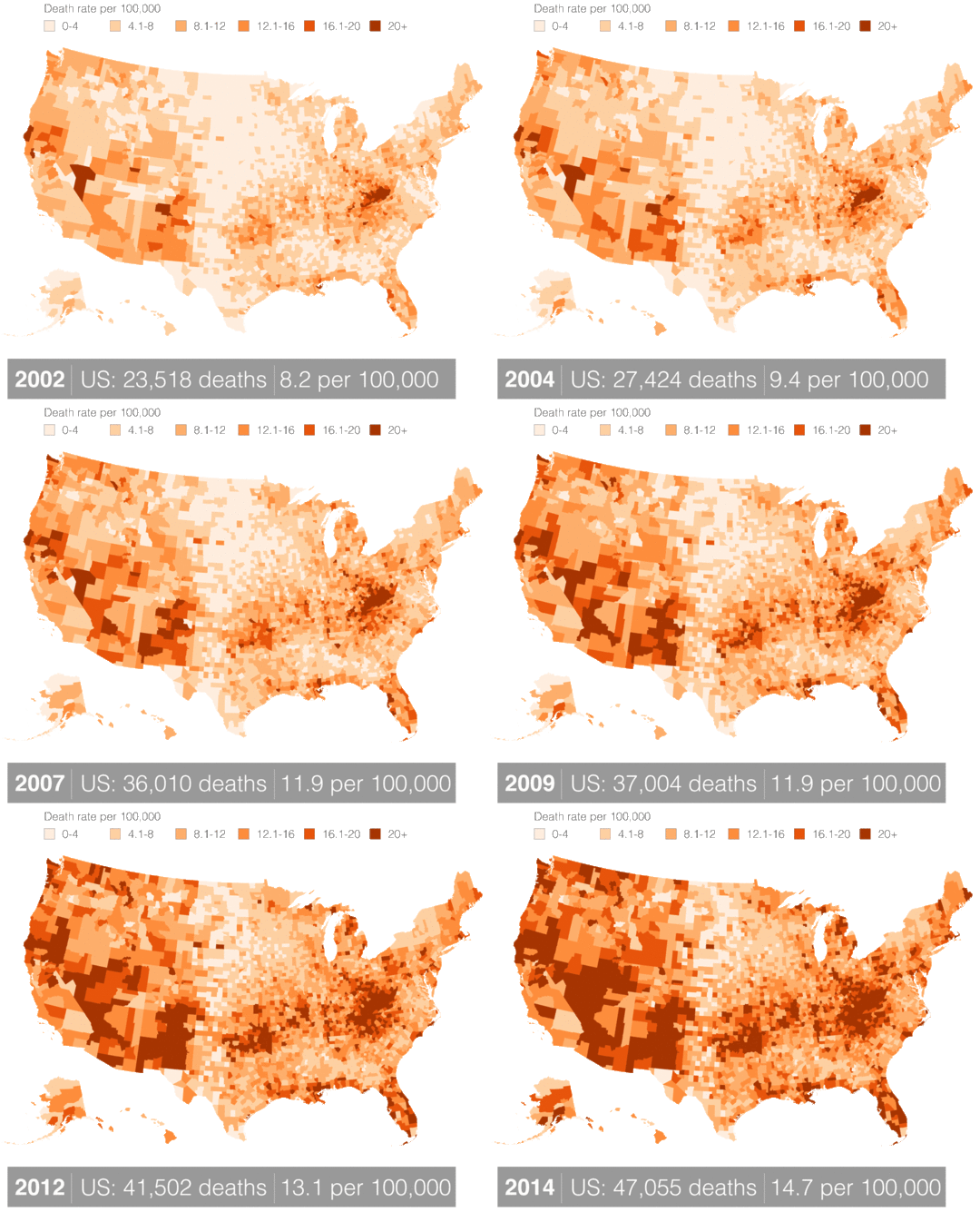
From the CDC, drug-overdose deaths from 2002 to 2014.
From late 2007 to the spring of 2010, Chris George, his twin brother Jeff, and his friend Derik Nolan ran a string of pain clinics in Florida and set off a wave of oxycodone prescribing, selling, and abuse that was entirely unprecedented. Together with several unscrupulous doctors, strippers, and homeless security guards, the story of American Pain (formerly South Florida Pain) is unexpected, horrifying, and thrilling - everything a great nonfiction should be.
"The fucked-up thing is that we were allowed to do it. That they let us do it. Why were two guys like me and Chris allowed to set up a business like this?...When we said we wanted to order $100,000 worth of pain medication, they shoulda said no.” - Derik Nolan
For those who don't know, I've worked in pharmacy for going on five years now. (see Dreamland: The True Tale of America's Opiate Epidemic). I see addicts and those in legitimate pain on a daily basis. And sadly, there's a lot of overlap between those two categories.
I've had addicts try to climb over the counter at me. Call and pretend to be their doctor. Steal their child's medication. Rip the dates off of prescriptions. "Lose" prescriptions every month. Call threatening to slit their wrists. Get better. Get worse. Overdose and make it. Overdose and not.
Addicts aren't easy people to deal with, even in a professional capacity. I know it must be much harder when that addict isn't just someone who calls or comes by your work a couple times a week; when it's your friend or family. And I can't even imagine getting the call that your family member is dead because some fucking quack of a doctor four states away wrote him scripts for enough narcotics to kill an elephant.
"They'll hand you 240 30mgs and 120 15mgs and 90 Xanax bars" - from the documentary The Oxycontin Express
Just five doctors in this one clinic in Florida alone prescribed over fourteen million oxycodone pills.
The people John Temple writes about had a license to pump massive amounts of narcotics out with almost zero oversight and negligent patient care. Some days they saw over 700 patients. 80% of these patients were from out of state, 43% from my Kentucky.
They knew their patients were either addicts or selling their pills to those who were. People shot up in the parking lot. Used fake urine to pass drug screens. Had seizures in the waiting room. The clinic was raking in so much cash they just raked it into garbage cans, ended up storing millions in an attic because they couldn't find a bank to take it.
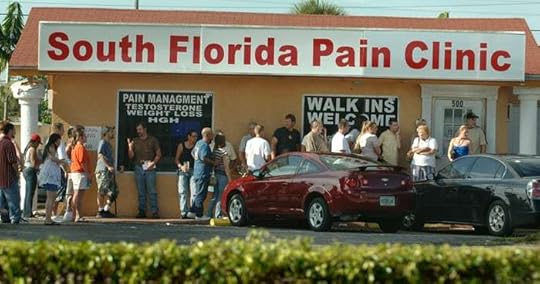
Outside, it looked like a bustling doctor’s office, or the DMV. Inside, Derik Nolan’s crew of heavily inked muscle-heads and ex-strippers operated the office and pharmacy, counting out pills and stashing cash in garbage bags. Under their white lab coats, the doctors carried guns.
It's easy to read this and wonder "HOW? HOW THE FUCK WAS THIS ALLOWED TO HAPPEN?" And the author does a great job in his interviews with those involved, with Derik Nolan in particular in conveying the very WTFness of the whole situation. They really couldn't believe it was legal either! It was a perfect storm of entrepreneurial ex-felons, a loophole in the law, and a whole shit-ton of drugs.
So if you're into nonfiction, I'd say give this a shot. It's MILES better than Dreamland: The True Tale of America's Opiate Epidemic if you happen to be debating between the two. The writing is great and the story is crazy without being sensationalized or falsely dramatic. It's got enough crazy all on it's own.
I'd recommend it. You know, if y'all care about my recommendations. Which if you do, I also recommend Nutella toast and this perfect video
However you feel about drug policy in America, this book is pretty instructive about the regulatory and legal environment that allowed so many Americans to have continued access to, and thus deepen their addictions to, narcotics like OxyContin. The book centers around a specific case of especially egregious pill-pushing: American Pain, a notorious clinic operating in late-2000s Florida that was at one point the most prolific distributor of OxyContin in the U.S. Bizarrely, lack of regulation in Florida in the 2000s allowed people who had no business opening or operating any kind of medical facility--ex-cons with no previous experience in the medical field--to open pain clinics at which doctors, driven by their desire for large amounts of money in very short and comfortable hours, majorly overprescribed OxyContin and similar opiates to patients who were clearly more motivated by drug-seeking than anything else. Many people died, the clinic gained a reputation with law enforcement several states away, yet it took months and months to bring its operations to a halt, largely because there wasn't a precedent for going after clinic operators and unscrupulous doctors legally.
Personally, I am in favor of major drug policy reform, including hard drugs like heroin, but I still found this book fascinating and relatively objective. Even if, theoretically, such drugs were available for addicts, and in places in which this has already occurred where opiate addicts are able to get legal prescriptions, they could never be distributed in the great quantities, and with the extremely remiss oversight, that the doctors at American Pain practiced. It is frankly astonishing that doctors and pain clinic operators had such wide latitude in pain management only a few years ago as they showed in this book, but it is not calling addicts evil.
I did want to get a perspective on the clinic's operation that was not Derek's, since clearly the author relied primarily on his perspective, which, while interesting, was not as fleshed out as would have been interesting to hear (most of the other information seemed to come from court testimony), but thought this was fascinating and bizarre enough overall to easily hold my attention. It would have been interesting to have a longer book that went beyond a case study to chase the sources of the medication, and Purdue Pharmaceuticals, to look at everything that's happened with it. This shows why so many people had the means to get addicted to legal opiates, and then turned to heroin within the last few years. I feel better educated about the topic of pill mills as a result.
legal drug dealing is a topic of interest, and it's obscene how big pharma pushed sales of high power painkillers leading to heroin addiction when the pill heads realize it's cheaper/easier. obscene too how people in pain have to jump thru hoops now because of the backlash. you know where i stand: LEGALIZE IT. fiends gonna fiend and prohibition has been and continues to be a massive boondoggle ruining our police, filling up our prisons, and fueling an unending epidemic of torture murder and corruption from mexico to africa to vancouver to myanmar to anywhere you can think of
that said... this book was a slog. just couldnt get into to it. it's verbose, poorly structured and just not that compelling of a read.
LEGALIZE. TREAT IT AS PUBLIC HEALTH ISSUE. SILK ROAD = LESS VIOLENCE. PROHIBITION IS NOT WORKING AND NEVER WILL
Having navigated the waters of the pain world since someone severely injured my lower back (I now have an intrathecal Dilaudid pump), I was looking forward to this book. Plus, I enjoy investigative journalism. I started American Pain last week and could not put it down. Not only is it fascinating, provocative subject matter, it is information that all Americans should know about their "health care" system. It is written in the urgent style of Richard Preston (The Hot Zone) or the late David Halberstam (The Best and the Brightest in particular). Like the Preston and Halberstam books, American Pain unfolds like a Hitchcock thriller. Bravo.
This is an important book. It chronicles a "pill mill" in Florida that in the absence of oversight, was able to hire willing physicians and distribute vast quantities of opiates and benzodiazepams. As a physician who vividly remembers a conference sponsored by our state attorney general, to inform us that pain was a vital sign and vastly under-treated, and opiates were safer than we knew, and now sees the end result of the opiate epidemic, I never knew that the DEA allows the drug companies to produce massive quantities of opiates and could cut off the supply if they wanted, and that manufacturers of oxycontin were so successful at starting this epidemic, as they marketed their product. The felons who ran American Pain were told it was legal. The doctors who were employed there made a lot of money. As a central character said--someone should have said "no". The governor of Florida obstructed a prescription monitoring program, despite widespread abuse and patient deaths. If only this was remote history. Greed and lack of oversight started this, and the DEA keeps letting the companies manufacture the drugs. The story is both fascinating and horrifying and the problem is no where near to being solved.
Florida corruption runs deep! This book highlights how a group of young men in Florida set up pill mills that fed into the opioid epidemic. Living in Florida, nothing in this book surprised me except that they were eventually stopped. Overall, I enjoyed this book. It presents like an investigative report. None of the characters are very likeable but you follow along to see how they are caught.
"Between 1998 and 2001, a cluster of nine counties on both sides of the Kentucky/West Virginia border received more prescription narcotics per capita than anywhere else in the country." This stat, carrying serious local implications, is only one of the many sad situations detailed in American Pain. The book is an easy read, explaining the growth of pill mills in Florida, the ease of access to opioids in America, the lack of concern of government and medical staff (big money in pharmaceutical companies!) and the havoc reeked on families and small town communities. The book concludes by describing the legal ramifications for those involved with this problem's genesis. An interesting work of non-fiction regarding a national epidemic but written poorly.
Super interesting story specifically about the rise and fall of largest "pill mill" in the country but also more generally about the prescription opiod epidemic in the U.S. It was eye opening but also well written and a page turning story.
OxyContin and related pain relief pharmaceuticals are a horrible scourge on society. Sure, there’s a proper medical role for these powerful drugs but, sadly, their widespread abuse rips apart communities, individuals and families powerless against their addictive claws.
I’ve read several books on this topic - Empire of Pain and Dreamland are two good ones - and I always find myself shaking my head throughout. So many sad stories. Whatever happened to simply enjoying a cold beer and maybe a little weed? I know two families whose beautiful young boys with a world of promise in front of them are now buried in the ground because of this high octane stuff. Terrible.
What I liked about this book is that it tells both sides of the issue: the story of the get rich quick drug dealers in “legal” pill mills who make loads of money and buy fast cars, as well as many sorrowful tales of the addicted victims they felt no remorse for. Good account of the law enforcement investigation as well.
Well researched and written. Very interesting on many levels. A true American tale of greed and the desperate soul-filling sought by too many people through pain pills.
I really liked this one! It was non-fiction, yet READ like a crazy suspense novel. Some of the persons and situations seemed 'larger than life' and I actually loved the narration. I had this book on Kindle AND also listened to the Audible audio version. Some ppl have complained about the narrator, stating he over-emphasized the Kentucky accents, but I am from Canada and wouldn't know if he did or not- in fact, I LIKED the different accents used in the book, it helped keep the settings straight. This is not the omnibus on the painkiller epidemic some people might think it is based on its title- 'American Pain' is actually the name of ONE Pain Clinic in Florida, and the story focuses on this ONE operation in the one state, and the effects that this ONE clinic has on the population...I can see how some readers might think this book will be dealing with the entire country. Still, this one pain clinic has far reaching implications, as patients from 4 different states wind up regularly driving 1000s of miles to Florida to get easy access to pain meds, due to the lack of laws in Florida. I thought this was well written and (sad to say) entertaining as well as informative. --Jen from Quebec :0)
I agree with Publishers Weekly: "This exhilarating blow-by-blow account details how brothers Chris and Jeff George and their sidekick, Derik Nolan, steroids-fueled collaborators with no prior medical experience, exploited Florida's lax prescription drug laws to operate the largest pain clinic in the United States, from 2008 until a raid brought it all crashing down in 2010. ... Journalism professor Temple (The Last Lawyer) dissects the Georges' criminal operation and documents the rise and fall of American Pain with precision and authority in this highly readable true crime account."
American Pain is an award-winning true crime book. If you haven't read this yet, you're missing out on a truly unbelievable tale, a must read if you are at all interested in events that led to the addiction epidemic in our country. Not only is it one of the best true crime books I've read, it is even one of the best nonfiction books I've read. Better yet, the audiobook is excellent, narrated by Charlie Thurston. A great listen on what is behind the addiction epidemic and the untold suffering and death it has wrought.
American Pain: How a Young Felon and His Ring of Doctors Unleashed America’s Deadliest Drug Epidemic by John Temple
“American Pain” is an eye-opening account of the oxycodone drug epidemic in America. Author and professor John Temple, provides readers with a real American greed story as he follows the rise and fall of Chris George and Derik Nolan and their multi-million-pain management business. This insightful 321-page book includes eleven unnamed chapters broken out into three parts.
Positives: 1. A well-written, well-researched book that reads like a true crime novel. 2. A fascinating topic, the unleashing of a drug epidemic. 3. Explains within the narrative what oxycodone is. “To understand oxycodone, imagine everything that makes a man or woman feel good, all the preoccupations and pastimes we are programmed to enjoy. Sex, love, food. Money, power, health. Synthesize all of that pleasure-kindling potency, and multiply by ten. Then cram it all into a pebble-sized blue pill. That’s oxycodone—one of the most irresistible opioid narcotics ever cooked up in the six-thousand-year history of dope. Crush and snort a 30-milligram pill, known as an oxy 30, and feel the euphoria bloom in your limbs, the ecstatic warmth settle in the depths of your belly. It’s an interlude of bliss. It’s basically heroin, only synthetic and FDA-approved.” 4. This book follows the king of “pill mills”, a company called American Pain. 5. The author does a wonderful job of capturing the story from beginning to end. “Chris told Derik about his new venture. He and Jeff were going to open a chain of small pain clinics. Jeff had recently bought a second steroid clinic, and a doctor there, a guy named Mike Overstreet, had worked briefly at a pain clinic called One Stop Medical. Steroids were small potatoes, Dr. Overstreet had told Jeff. The real money was in painkillers like oxycodone.” 6. The heart of the matter. “It hadn’t taken Chris long to realize that South Florida Pain had more potential than his other business, South Beach Rejuvenation. More people wanted painkillers than steroids, and the buying power of addicts was greater than Chris had ever imagined.” 7. How opioids work. “Opioids subdue pain. They work beautifully, blocking electrical and chemical signals before they can leap the synapse from one nerve cell to the next. In six thousand years, we’ve never found another painkiller that works as well. They don’t cure anything; they simply mute sensations. They also change the way the brain perceives the nerve signals. Suddenly, pain doesn’t cause as much panic or stress. It becomes tolerable.” “But opioids produce a number of additional effects. They slow the pump of heart and lungs. Bowels grow sluggish too, causing constipation. They galvanize the brain’s pleasure centers, causing joy.” “Another thing about opioids: Nerve cells become desensitized to them more quickly than any other group of drugs. Higher and higher doses are necessary to produce the same impact.” 8. The marketing spin behind the painkiller. “Purdue leaders borrowed a page from the advertising industry: problem-solution marketing. They would market and publicize the problem of untreated pain. Then they’d promote the solution: OxyContin.” 9. The selling of a lie!! “Purdue leaders borrowed a page from the advertising industry: problem-solution marketing. They would market and publicize the problem of untreated pain. Then they’d promote the solution: OxyContin.” 10. Some fascinating facts. “But deaths involving prescription narcotics continued to mount, until the trend was impossible to dismiss. Overdose deaths involving prescription opioids quadrupled between 1999 and 2007, from about three thousand to twelve thousand per year. By contrast, cocaine killed about six thousand users in 2007, heroin about two thousand. Prescription narcotics were now killing more Americans than all illegal drugs combined.” 11. There is plenty of blame to pass around. “In 2007, the DEA signed off on the production of seventy thousand kilograms of oxycodone. Almost twenty times the amount manufactured just fourteen years earlier.” “According to the International Narcotics Control Board, the US had consumed 83 percent of the global supply of oxyco-done in 2007. And 99 percent of the world’s hydrocodone. No one believed that the US was in that much more pain than the rest of the world.” 12. The evolution of the pain management business. “New location, new rules. From now on, Chris said, every patient had to have a valid MRI report that was less than two years old, and every patient had to take a drug test before seeing a doctor. No exceptions.” 13. An interesting look at the customers. “Derik, on the other hand, was no longer naive. The relationship had taught him one thing: No matter what they looked or acted like, all the patients were junkies—and junkies cared about one thing only.” “What some patients never grasped was that the staff at South Florida Pain was on their side, that Derik and Chris wanted them to get their drugs. All the patients had to do was follow the official rules. Don’t doctor shop. Don’t sell pills in the parking lot. Don’t let track marks fester. Don’t come in high. Don’t be too obvious about smuggling in urine, and make sure it’s not suspiciously clean or suspiciously dirty. And don’t behave like a drug addict—acting desperate or begging to have your dosages “upped”—because that might make the doctors feel like drug dealers.” 14. Provides plenty of sad stories of drug addiction. “Heavy, congested lungs are the hallmark of respiratory depression caused by opioid overdose. High doses of opioids mute pain, and they also mute the psychological discomfort caused by carbon dioxide buildup, the useful rush of panic you feel after too long underwater. Carbon dioxide is produced by the body’s metabolic processes, and it’s flushed out of the blood with each pump of the lungs. When the lungs slow, receptors in the brainstem detect higher levels of the chemical and trigger a breathing reflex. That’s why you can’t kill yourself by holding your breath. Even if you managed to hold it long enough to pass out, the breathing reflex would kick in.” 15. Some facts are hard to ignore. “OxyContin abuse didn’t spread like a product. It spread like an idea: in conversations, over the Internet and the phone, and face-to-face.” “Between 1998 and 2001, a cluster of nine counties on both sides of the Kentucky/West Virginia border received more prescription narcotics per capita than anywhere else in the country.” 16. Describes the doctors involved. 17. Florida at the heart of the problem. “By the height of the state’s pill mill rush, Florida doctors were purchasing nine times more oxycodone than doctors in other states. That’s nine times more than the other forty-nine states combined. In one six-month period, according to DEA records, Florida doctors bought 41.2 million doses while every other physician in the country collectively purchased 4.8 million doses.” 18. Explains the loopholes that would allow opportunists like Chris George to make it in the pain management business. “The third loophole that led to the oxycodone rush was that Florida law allowed doctors to sell narcotics themselves, no pharmacist needed.” 19. Describes the fall with plenty of details. “According to her plan, more than four hundred officers and agents would hit American Pain and six other locations and fan out across South Florida to track down and interrogate approximately fifty associates of Chris George. The goal of the onslaught would be the immediate shutdown of the nation’s largest pain clinic, plus two others, and the seizure of any documents, drugs, and money inside.” 20. Provides a satisfactory conclusion to what happens to each player in the game.
Negatives: 1. I would have given readers more technical information about Oxycodone in a separate Appendix. 2. I would have added more factoids in the form of charts, timeline, and diagrams. 3. I would have added at the beginning of the book versus the middle. It helps readers have an accurate picture of the key players. 4. I wanted to know more about the power of the pharmaceutical lobby and the politicians that supported them. The book is very light on that angle of the story.
In summary, if you want to know how the opioid crisis took off in America this is an excellent book to discover that. John Temple did a wonderful job of putting this story together and did the story and the crisis justice. Lacks some supporting technical material that would have benefitted the reader but overall a very satisfactory and eye-opening account. I recommend it!
Further recommendations: “Dreamland: The True Tale of America’s Opiate Epidemic” by Sam Quinones, “Pain Killer” by Barry Meier, “When Painkillers Become Dangerous” by Drew Pinsky, and “Opium: A History” by Martin Booth.
Oh man, oh man! This book just killed me! It angered me, infuriated me, and it frustrated me to the point of despair! Some frightfully stupid greedy people latched onto the addictive property of Oxycodone and wreaked havoc on a whole nation, completely trampling people with real chronic pain and murdering people with the sickness of addiction, destroying families in their wake. Purdue Pharmaceuticals either turned a blind eye or chose not to foresee possible future complications, aided by rogue doctors who could easily be (seemingly) railroaded into prescribing enormous amounts of these potentially deadly drugs!
I don’t know why I found it hard to believe that there could be “bad” doctors. It’s common sense that evil exists in every profession and the Hippocratic oath means nothing to some. My righteous naïveté was followed by righteous indignation and anger after reading this book.
I couldn’t understand how Dr. Cynthia Cadet compartmentalized the fact or didn’t comprehend that she was operating in a Pill Mill. Really? How do such people get through medical training in which you’re supposed to engage multiple parts of your brain to study medicine and then apply your knowledge via individualizing your care. How?
As for Chris George, Derik Nolan and the rest, they were plain old criminals but I doubt they understood the extent of destruction they caused. Their frivolity will stay with me as a patient of chronic pain and a physician who sees such patients. I cannot find an iota of forgiveness for any of them.
The book narration is good in my opinion. Easy to read and follow, also gripping in it’s character but there’s nothing literary about it. It’s abrupt and it’s mostly from the point of view of Derik Nolan. Also missing are the big fish behind the whole saga. Why was DEA and Purdue and many more not called upon and held responsible for a racket of this scale? They got away with evildoing and they got away with big money. Nothing touched them! Will it ever change?
Also please read the review by Carol. She summed it up very pragmatically and insightfully!
An up-close look at one particular pill mill in Florida at the height of the prescription opioid crisis. The subtitle is maybe a bit of hyperbole, but the harm done by this one particular business is still heartbreakingly widespread. Worst of all, it was legal, at least until the crackdown, so the disingenuous attempts of the owners and doctors to shrug off accusations is hard to read about as well. Fascinating all around.
John Temple’s American Pain describes the rise and fall of America’s largest pill mill. A pill mill, in case you didn’t know, is a medical practice set up specifically to dispense narcotic pain killers. Patient appointments typically last only a few minutes, just long enough for doctor to write the prescription.
Chris George, the wealthy son of a successful South Florida builder, was running a semi-successful shop selling anabolic steroids when he started seeing pain clinics pop up all over Broward County around 2008. If he made decent money selling steroids, he figured, why not take a shot at selling opioids?
Chris was in his late twenties, and with one felony conviction under his belt, he wasn’t sure he’d be allowed to open a medical practice. When he looked into Florida’s regulatory codes, he learned that all he needed to legally sell OxyContin and other narcotics was a business license and a doctor. He filled out a one-page business license application and put out an ad for doctors on Craigslist. In a few weeks, he opened the South Florida Pain Clinic in a strip mall on Oakland Park Boulevard near Fort Lauderdale.
Unlike the founders of competing pain clinics, Chris had a strong business background. He had managed many aspects of his father’s construction company, including marketing, logistics, supplies, and personnel management. He had a natural talent for bringing in new business, and for managing a growing enterprise. (If you’ve ever worked at a fast-growing startup, you’ll know how difficult it can be to manage growth, and to find a person who’s actually good at it.)
Chris advertised aggressively, running ads in local papers and putting billboards on the highways. The business grew beyond his wildest expectations. He had tapped into a market of desperate addicts far larger than he or anyone else knew existed. Patients came by the van load from Kentucky, West Virginia, Ohio, and other states. In the clinic’s crowded waiting room, they bribed their way to the front of the line, got their prescriptions, filled them right there at the front desk, then went out to the parking lot, crushed their pills and injected them. Some of them died on the car ride home.
The clinic moved twice as it outgrew its facilities. Along the way, it changed its name to American Pain, in an attempt to outrun the bad press that local media had attached to The South Florida Pain Clinic.
As the number of patients outgrew the waiting room at each location, junkies waiting for pills would loiter in the parking lot, angering neighbors and local businesses. Chris hired his friend Derik Nolan, another tattooed weightlifter with a penchant for steroids, to act as bouncer and get rid of the most problematic clients. Over time, Derik was pulling in five thousands dollars a week, all cash, in bribes from desperate patients who wanted to jump the line and get to the doctor ASAP.
Temple paints a portrait of the clinic that seems like something from the imagination of Carl Hiaasen. The doctors carried guns beneath their lab coats. Chris and Derik hired strippers to run the reception desk and collect payments. Chris paid for their breast implants. There was so much cash running through the clinic each day, the strippers collected it in garbage bags beneath the desk. Before Chris and his managers discovered the cash counting machines used by banks, the spent six hours a day just counting the bills they collected. One by one, the local banks stopped doing business with them, because they were uncomfortable seeing Chris and his managers walk in each day with a duffel bag full of cash.
If Hiaasen had written a novel about American Pain, his editor might have rejected it as over the top. But the story Temple tells is real, the details backed up by evidence collected by South Florida police, the FBI, and the DEA. The book relies heavily on interviews with Derik Nolan, the clinic’s enforcer, now serving a lengthy sentence in federal prison.
While the clinic’s tacky and outrageous excess comes off as a South Florida version of The Wolf of Wall Street, Temple dedicates several chapters to its victims. They are young or middle-aged, dead of overdoses or from collisions caused by driving under the influence of the pills.
The author also does a good job of tracing the enablers of the opioid crisis, from the clinic back up the chain to the truly powerful players. He looks at the prescription drug wholesalers who supplied American Pain, pumping millions of pills through a practice of five full-time doctors, and pretending there was nothing unusual about that. Temple notes that among all US states in 2010, Ohio had the second-highest number of OxyContin/oxycodone prescriptions–over a million pills in a single year. To illustrate the scale of Chris George’s enterprise, he notes that a single doctor at American Pain out-prescribed the entire state of Ohio.
Going further up the chain, Temple examines the pharmaceutical manufacturers who produce the pills. He describes Perdue Pharma’s long, coordinated campaign to convince America that chronic pain was a silent, under-treated disease to which OxyContin was the answer. Perdue spent an enormous amount of time and money persuading doctors to liberally prescribe their pills, producing misleading articles that showed opioids were not addictive.
At the top of the narcotic supply chain, Temple reports, is the DEA, which each year, in closed-door meetings, sets a limit on the total amount of opioids US pharmaceutical companies can legally produce. That number skyrocketed through the 1990s and early 2000s, as the pharmaceutical industry convinced the DEA of the soaring need for their product. Even now, as states have imposed tighter regulations and shut down mills like American Pain, the DEA continues to approve ever higher amounts of oxycodone production.
In 2014, as the number of opioid-related deaths in the US surpassed the number of deaths from motor vehicle accidents and the Centers for Disease Control declared opioid abuse a national epidemic, the DEA increased the production limit on legal opioids to almost 150,000 kilograms. That’s forty-two times the amount produced in 1993, when Perdue was preparing to launch its campaign to push OxyContin to the masses.
The DEA’s job, Temple reminds readers, is not only to stop the flow of illegal drugs, but to stop the diversion of legal controlled substances. The hundred and fifty thousand kilos that Big Pharma produces is still going somewhere, Temple notes. There simple aren’t enough patients in the terminal cancer and post-op wards to soak up that amount of narcotics.
If you don’t already know about the opioid crisis, this book will open your eyes. If you do know about it, this will sharpen your knowledge. As a tale of excess, American Pain is an easy read: fascinating, shocking, and cringingly entertaining. As a tale of individual and family devastation replicated on a vast scale throughout the country, it’s a tragedy. As a tale of greed, malpractice, and misgovernment, it’s an outrage.
Kudos to John Temple for putting this out there. Let’s hope this book pushes us toward a solution to a problem that we allowed to be manufactured.
How do I rate this book? Do I give it 5 stars because it read like a movie that kept me on the edge of my seat, informed me about pill mills, and was a page turner? Or do I give it one star because the author is racist? It isn't possible for me to give a good rating to someone who wrote one of the most racist statements I had ever read, without even qualifying the statement in any way. When talking about the delivery of pills to the clinic, the author stated a black guy (yes, "black guy") pulled up. "How could a guy who looks like this," be a legitimate drug distributor? Who looks like what? The only thing the reader has been told is that the guy is black. The clinic usually received drugs from white delivery drivers I guess? The author then went on to state that when they walked through the waiting room and all the drug addicts looked at the black guy and the boxes of drug, the owner of the clinic finally realized he was nothing more than a glorified drug dealer. So when a black guy (literally the only thing we know about the guy) is holding the boxes of drugs, then you know you are a drug dealer? Because the owner of the clinic didn't realize he was a drug dealer when junkies came to his clinic, he hired doctors who didn't ask questions, and helped the junkies pass the urine test, and had white people deliver his drugs? It was only when a black guy delivered them? If the author thought this, then the author is one racist MF. If the author included this because he confirmed this was something the owner said, then he should have qualified his statement. That is Writing 101 buddy.
Short review: this is an outstanding true crime book about two young men in Florida who started a chain of pain clinics during the height of the OxyContin prescription craze between 2005 and 2011. The flagship clinic, known as American Pain, was merely a front for legalized drug dealing. The two men hired unscrupulous doctors who were either strapped for cash or looking for quick pay and proceeded to dispense millions of prescription opioids to out-of-state addicts over a period of about two years.
How does this book fit into the broader literature on the heroin and opioid epidemic in America? Primarily by illustrating just how difficult it is to prosecute negligent doctors who are skirting the lines of legality in overprescribing pills. This is a topic that most other books like Dreamland, Chasing the Scream, Dopesick, and others do not really touch on in a major way.
This was a mistake. I was looking for non-fiction coverage of opioid addiction and this was recommended to me by the library. The review did not make it clear it is just a crime novel, although it does deal with subject I am looking for actual real material on. I mistook it to be about real people. NOTE: I AM AMENDING THIS REVIEW: The author contacted me to say this work is non-fiction, written in the form of a novel. I still fail to see how the author could possibly know the level of detail expressed if this is completely non-fiction. I must also say it is not in the form of clinical detail I am seeking about the opioid crisis.
Traded sleep to finish this hard-to-believe-it’s-real story of how an ex-con, some flunkies, and doctors with stamps to speed up pain med scrips, built a massive business fueling the rise of America’s prescription opioid crisis - along with the government and policy making that enabled it - and the law enforcement officials who finally intervened. Reads like a great crime novel.
I’ve always found the topic of the opioid epidemic interesting after taking psychology of addiction in college. American Pain goes into how two brothers and their friend were able to establish a franchise of pill mill clinics in South Florida during the hight of the OxyContin boom in the US.
Having previously read Dopesick by Beth Macy, I knew the background on Purdue Pharma and the creation of OxyContin. This was focused on the State of Florida and how it became an oasis for those in Appalachia who became addicted to opioids.
I didn’t really care of the dialogue and quotes between the brothers and their staff. It was mind-numbingly annoying. The writing itself was interesting and well done. It felt a little rushed at the end with the trials. I would’ve loved to know more details of the trials.
Overall, a good read into a pill mill and how it flew under radar for so long due to lax legislation and government oversight. If you’re looking for a read about the background of OxyContin and how it over took the country, this ain’t it. But if you’re interested into a deep dive into the largest pain clinic in Florida during the mist of the OxyContin boom, this is it.
This is a book about the beginning of the opioid crisis in America. I learned so much about the big players in this cultural phenomenon and how the were intertwined--fascinating. There is clearly not one "culprit" to blame, there are many....from pharmaceutical companies, to prescribers, to the dealers, to the addicted, etc and the list goes on and on. This is exactly why when Chris fractured his collar bone while snowboarding that I kept his painkillers in my bra at all times!! An addiction can begin so innocently---"I was legally prescribed these meds by my Dr and I thought I was fine" very sad. These drugs such as oxycodone are highly addictive. New directives have begun though, from the ground up that will hopefully start a decline in the deaths caused by opioid addiction. I would encourage everyone to read this book. Amazing.
This book describes very important events surrounding the current opioid crisis in the US. It's definitely interesting and very well researched but the writing could be better. In view of how interesting the story is, I feel that the telling of it could have been done in a more compelling way. It's clear that one party in the story cooperated and he gets a lot of "air time," the problem is he's kind of dolt and isn't very interesting. Compared to something like Kurt Eichenwald's The Insider, this book fell short in terms of the narrative but it did definitely deliver in terms of conveying factual information
The stories of people’s lives destroyed using opioids are rampant throughout the country. How did such a crisis happen? I learned the details listening to this audiobook AMERICAN PAIN. Using well-written nonfiction storytelling, this book tells the story of how two Florida young men with zero medical background started one of the largest pain clinics in the country. The fact they could do it in such a short time seems horrifying but they hired doctors, built offices and made millions of dollars. The storytelling includes some profanity but I found the audiobook compelling and a story that others need to hear. I recommend AMERICAN PAIN.
Interesting well written book about one of America’s largest pain clinics issuing prescriptions for OxyContin, the people who started and ran it, as well as the FBI investigation that brought it down. However it was published in 2015, by which time the Florida issued prescriptions had gone down, but the American prescription opioid epidemic is still on the rise. I would have liked to learn more about why the laws are so hard to change and why the DEA has increased the amount of oxy legally manufactured and sold in the us by 42x between 1992-2014. It’s completely insane.
The actual reporting/story in this is absolutely fascinating and depressing and reinforces that everyone at Purdue pharma involved in the marketing of OxyContin should be in a literal jail cell for life. But the way the author talks about addicts and the psychology of addiction..........lacks empathy, to put it politely, so just brace yourself for that. Nothing super offensive but lots of dismissive language about “junkies”, etc