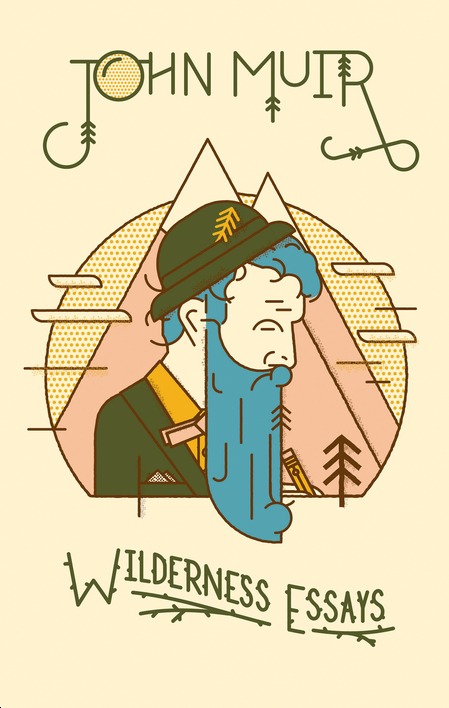
John Muir was one of our first and finest writers on the wilderness of the American West. Part of Muir's attractiveness to modern readers is the fact that he was an activist. He not only explored the West and wrote about its beauties-- he fought for their preservation. His successes dot the landscape in all the natural features that bear his name: forests, lakes, trails, glaciers. Here collected are some of his finest wilderness essays, ranging from Alaska to Yellowstone, from Oregon to the Range of Light-- the High Sierra. This series celebrates the tradition of literary naturalists-- writers who embrace the natural world as the setting for some of our most euphoric and serious experiences. Their literary terrain maps the intimate connections between the human and natural worlds, a subject defined by Mary Austin in 1920 as "a third thing... the sum of what passed between me and the Land." Literary naturalists transcend political boundaries, social concerns, and historical milieus; they speak for what Henry Beston called the "other nations" of the planet. Their message acquires more weight and urgency as wild places become increasingly scarce. This series, then, celebrates both a wonderful body of work and a fundamental truth: that nature counts as a model, a guide to how we can live in the world.
John Muir (1838 – 1914) was a Scottish-American naturalist, author, and early advocate of preservation of wilderness in the United States. His letters, essays, and books telling of his adventures in nature, especially in the Sierra Nevada mountains of California, have been read by millions. His activism helped to preserve the Yosemite Valley, Sequoia National Park and other wilderness areas. The Sierra Club, which he founded, is now one of the most important conservation organizations in the United States. One of the best-known hiking trails in the U.S., the 211-mile (340 km) John Muir Trail, was named in his honor. Other such places include Muir Woods National Monument, Muir Beach, John Muir College, Mount Muir, Camp Muir and Muir Glacier.
In his later life, Muir devoted most of his time to the preservation of the Western forests. He petitioned the U.S. Congress for the National Park bill that was passed in 1890, establishing Yosemite and Sequoia National Parks. The spiritual quality and enthusiasm toward nature expressed in his writings inspired readers, including presidents and congressmen, to take action to help preserve large nature areas. He is today referred to as the "Father of the National Parks" and the National Park Service has produced a short documentary about his life.
Muir's biographer, Steven J. Holmes, believes that Muir has become "one of the patron saints of twentieth-century American environmental activity," both political and recreational. As a result, his writings are commonly discussed in books and journals, and he is often quoted by nature photographers such as Ansel Adams. "Muir has profoundly shaped the very categories through which Americans understand and envision their relationships with the natural world," writes Holmes. Muir was noted for being an ecological thinker, political spokesman, and religious prophet, whose writings became a personal guide into nature for countless individuals, making his name "almost ubiquitous" in the modern environmental consciousness. According to author William Anderson, Muir exemplified "the archetype of our oneness with the earth".
Muir was extremely fond of Henry David Thoreau and was probably influenced more by him than even Ralph Waldo Emerson. Muir often referred to himself as a "disciple" of Thoreau. He was also heavily influenced by fellow naturalist John Burroughs.
During his lifetime John Muir published over 300 articles and 12 books. He co-founded the Sierra Club, which helped establish a number of national parks after he died and today has over 1.3 million members. Author Gretel Ehrlich states that as a "dreamer and activist, his eloquent words changed the way Americans saw their mountains, forests, seashores, and deserts." He not only led the efforts to protect forest areas and have some designated as national parks, but his writings gave readers a conception of the relationship between "human culture and wild nature as one of humility and respect for all life," writes author Thurman Wilkins.
His philosophy exalted wild nature over human culture and civilization. Turner describes him as "a man who in his singular way rediscovered America. . . . an American pioneer, an American hero." Wilkins adds that a primary aim of Muir’s nature philosophy was to challenge mankind’s "enormous conceit," and in so doing, he moved beyond the Transcendentalism of Emerson and Thoreau to a "biocentric perspective on the world."
In the months after his death, many who knew Muir closely wrote about his influences.
I may have finished reading this collection of essays, but, now that I have found him, I will never stop reading John Muir. Muir takes you deep into nature, deep into glaciers, deep into the wonders of Yosemite, deep into the glories of Yellowstone, and you don't want to return to 2019. His essays, unexpectedly, are not dated at all; the essays could have been written today, as the lands he writes about are still (many, thanks to his efforts) kept as holy ground. Muir writes like no other nature writer I've ever read, with the factual detail of a scientist and the eloquence of a poet.
My first time reading Muir. Such a remarkable eye for nature. Oh to see like that!
Note to my Lit Life friends completing the 2022 reading challenge: This book only has 10 essays. I got my 11th by reading Muir's "Yosemite Glaciers" online.
(The Literary Life Podcast’s 2 for '22 Reading Challenge: Essays – Essays from past decades or centuries)
This is an excellent compilation of writings by John Muir - essential reading for anyone fascinated by the wildness to be found in Alaska and the Sierras. My favorite essays in this volume were "The Discovery of Glacier Bay" "Among the Animals of the Yosemite" and "The Yellowstone National Park".
I enjoyed the Discovery of Glacier Bay particularly because I have not been there at all, and with Muir's writings so vivid and descriptive, I could just about see it, in all it's grandeur, and hear the thundering of the calving glaciers, too. I hope that I will be fortunate enough to get to visit it myself.
Among the Animals of the Yosemite was also wonderful because Muir does such an excellent job of painting the character of each animal he has encountered. There is not a bad side to any animal, and he argues most admirably and effectively for the perfection of nature as we find it - undisturbed by our civilized influences.
Finally, I thoroughly enjoyed The Yellowstone National Park; he makes references to it's initial name of "Coulter's Hell" and his descriptions of the effects of the geysers on curious tourists are quite amusing. Again, his descriptions of the beauty are vivid, and can be appreciated by anyone who has visited Yellowstone for their veracity and accuracy.
Even though it took me a while to get through this book, I am so glad that I did; it is truly something special to see these places through the eyes of someone who knew it so well, and was able to see things as we will never see them again, and who valued them so highly. Perhaps in the future, I will seek out more of Muir's writings.
I read this book while weekend camping in Sequoia. It’s a short journal about some of Muir’s travels in 1880s through Yosemite, Alaska, Yellowstone. There’s a lot of unnecessary detail but if you dig deeper you’ll find vivid description of California scenery and survival encounters, from facing off with bears to scaling glaciers.
Muir’s most plain and simple lesson is on why we explore. The darkness of the forest we fear is ignorance. To learn the wild is to not fear it. While reading the excerpt on wild animals, I felt a prior fear of the forest animals and foreign lands disappear, with knowledge comes a greater respect for the land, and our ability to live in harmony with it improves.
The next frontier will be space. Why do we want to see stars and explore the galaxy? Sure, we want to see what’s out there. But with this knowledge of what’s there we also need to use it to improve how we live. To be less afraid and live more wildly, freely, is the entire goal.
“The clearest way into the Universe is through a forest wilderness.”
I know that this man is a product of his time but he wrote about Native Americans in a way that villainized them and failed to acknowledge that they were fighting to protect the same land that he was exploring and writing about. In one of the essays he wrote about how the national park was no longer inhabited by them, which at first was great because I thought maybe he would acknowledge that they had been forcibly removed, which he did, but in his eyes it seemed to be a good thing.
I know that John Muir did a lot for federal lands, which I visit and enjoy often, but like the national parks continue to do, he ignored who was on the land before he got there and as far as I know, never did or said anything to apologize for it. I think it's time to move on to more diverse environmentalists.
As a collection, I really enjoyed this. I picked this up in the Muir Woods gift shop, because I felt I couldn't leave without it. I worried about whether or not I would enjoy it since I'm not really the target audience, but I largely enjoyed the experience. While it was often too detailed for my personal tastes, I think this is a wonderful collection for those interested in forestry and nature.
On a publication level, the book is stunning. I love how Gibbs Smith merges the old with the new. The cover/jacket (Seth Lucas) immediately brings Muir to the current century. It feels at once "hipster" and "wild" and the two aesthetics could not be more effective. Inside, the font feels old and outdated, which is perfect for the antiquity of Muir. I appreciated the essay heading illustrations, but wished there was a different one for each chapter, instead of alternating. This is a minor detail though. Publishers should take note - this is the best product I've ever held.
As per usual, please see below for short, individual essay reviews.
Discovery of Glacier Bay - 3/5 - Good description and a good intro for the collection as it introduces themes. Too scientific for me and just not enough for my tastes.
The Alaska Trip - 4/5 - I really enjoyed the descriptions in this one. I loved this and felt immediately sucked into the Alaskan wilderness.
Twenty Hill Hollow - 5/5 - My favorite essay so far, I was immediately sucked into this world and, with two hands clenched, held on.
The Snow - 2/5 - Nothing about this interested me, sadly.
A Near High View of the High Sierra - 3/5 - Because I'm not the target reader for this book, I thought this was too long but I loved the sunset and scenery depictions.
The Animals of the Yosemite - 5/5 - Such fun!! Loved the breadth and depth discussed here. Muir has a great eye and passion.
Yellowstone National Park - 3/5 - See my review for A Near High View... I did like the overemphasized portions on conservation, however.
A Great Storm in Utah - 4/5 - As someone who has lived through many snow and ice storms, I really loved this one. Again, a bit to technical for my particular tastes.
Wild Wool - N/A - I didn't fully get this one, DNF'd and don't feel comfortable leaving a review.
The Forests of Oregon and Their Inhabitants - 2/5 - Again, I'm not the target audience for this so I didn't personally enjoy this one. I also understand that this is an old text, so the majority of racist ideas and language I swept largely under the rug. Not until this essay did Muir feel like a typical white colonialist of the era. Part of me appreciated this, as a window into history, but another part felt uncomfortable supporting someone with questionable if not unforgivable morals. I'm interested to hear other readers' thoughts on this, so by all means feel free to comment if you have an opinion.
This was my first time making it all the way through an audio book. It was good, but I definitely prefer actually reading. The narrator was Scottish, which helped immensely. As for the book itself, a wonderful insight into the journeys of Muir and his role in the parks and mountains I love and hold dear. 10/10
How can you not enjoy reading an essay by a person who loves nature this much? It makes you want to find your hiking shoes and get out into the forest.
First of all, I did not realize that John Muir was born in Scotland and then immigrated to Wisconsin with his father. This was fascinating and so the slight Scottish accent of the reader was an added plus to the essays.
The essays cover his travels to Alaska, Yellowstone, and to the Sierra Nevadas, up into Canada and in Oregon and Washington. It would be an excellent companion to anyone also reading The Burgess Book of Animals. Many of the animals he writes about and sees are animals we have covered so far in school. I can't imagine what it was like to see Alaska, Yellowstone and mostly California before there were lots of people living there or traveling there. It would have been amazing! I really liked all his observations. I also found it very interesting that sheep herders were put out with the wolves and how they all got together to kill bears, wolves and panthers. It's too bad because I can completely understand the need to keep their herds alive, but also Muir's point of view at trying to save all of those beautiful creatures.
I also think it was so fascinating how he talked to the American Indians about the species of bears, etc. Tons of fascinating interactions. I look forward to reading more of his works.
john muir was an actual saint who graced the earth in the 19th century to preach the spirit of conservation to the settlers of the american west. i will never see another national park, or tree, or critter, or lake, or storm, the same ever again.
before this book, i knew nothing about him except that there are forests and trails named after him. how did i not know he was a mystic?
he saw God in everything, but not in the eastern all-is-one-consciousness brand of spirituality academics and scientists feel comfortable flirting with when they come against true wonder.
i believe that at the very bottom of muir's mountaineering adventures was a love for creation--not just nature as a chaotic force but nature as a lovingly crafted gift from God. his essays are less musings on scientific discoveries than they are invitations: he wanted everyone to see, and feel, God's creative vision for life on earth. this stroke of divine inspiration gave him his will and purpose and genius, imo!
there is a lot of poetry in this book. muir was an amazing literary lyricist. unsurprising since he read so much during his long-term remote expeditions which made up the bulk of his life.
these essays should be required readings for anyone wanting to visit the great parks of the west in alaska, california, wyoming, utah, and oregon, or anywhere.
This was my first time reading more than a quote by John Muir. His writing is engaging and enjoyable. He describes landscapes with beautiful, oftentimes poetic, language. His admiration for nature and his attention to detail is so plainly obvious. His writing can help soothe the soul.
Muir sure does have a knack for words. He is very articulate and so passionate in his description and love for nature that it captures you attention, holding you hostage as you envision the scenery he is describing.
Best sipped slowly. Each chapter is a new essay, and each essay should be enjoyed separately as its own book.
One of the first things we learn about John Muir in his Wilderness Essays is that his father didn't think any other books were necessary besides the Christian Bible. While we inherit certain things from our family, I am certainly glad that John Muir decided to reject this specific teaching, at least in part. Carried with him through his travels was a copy of Milton's Paradise Lost, and the heavy religious overtones that carry through his life are also abundantly present in his writing. Those tones create a beautiful parallel between what Muir sees in the physical world as a sort of heaven on earth, and uses sometimes direct Bible verses to describe the wilderness he wanders: for example, when future generations view the wilderness via a protected private park: "They will rise up and call them blessed" - which is directly quoted from Proverbs 31. I am sure that to Muir, the awestruck nature walks he aspired to were direct confirmations of his father's teachings.
I think we can all agree that when we view something as awe-inspiring or out-of-our world as a mountain peak or a Yellowstone geyser, at least, out of our corporate or city or suburban world, we feel something inspiring. Something tells us - This is important, put down your phone. It awakens a deep sense of recognition, something ancient that is finally being known. A way for the galaxy to know itself, as Carl Sagan would put it over 100 years after Muir wrote.
I think this gap in writing is what separates 21st century me from 19th century John Muir - His way of writing is still a bit reserved from more modern authors. His work walks between a memoir and poetry, while the two can be related and live together, one does suffer the other to pass. While poetry does fill the lines of Muir's work, I thought it was, by comparison, wasteful to describe the reactions of the Inuits he meets in Alaska, and other incomparable storylines when in the presence of such poetry as quotes below.
I will continue to read Muir, if not to just set a baseline for myself as to what men of his time were capable of versus the work of today, and even far into the past with Charles Darwin or Aristotle.
~~~~ Alaska trip Seward expected Alaska to become the shipyard of the world, and so perhaps it may. In the meantime, as good or better timber for every use still abounds in California, Oregon, Washington, and British Columbia; and let us hope that under better management the waste and destruction that have hitherto prevailed in our forests will cease, and the time be long before our Northern reserves need to be touched. In the hands of nature these Alaska tribes of conifers are increasing from century to century as the glaciers are withdrawn. May they be saved until wanted for worthy use - so worthy that we may imagine the trees themselves willing to come down the mountains to their fate!
The Snow One of the most striking effects of the snow on the mountains is the burial of the rivers and small lakes. "As the snaw fa's in the river A moment white, then lost forever," sang Burns, in illustrating the fleeting character of human pleasure. The first snowflakes that fall into the Sierra rivers vanish thus suddenly; but in great storms, when the temperature is low, the abundance of the snow at length chills the water nearly to the freezing-point, and then, of course, it ceases to melt and consume the snow so suddenly. The falling flakes and crystals form cloud-like masses of blue sludge, which are swept forward with the current and carried down to warmer climates many miles distant, while some are lodged against logs and rocks and projecting points of the banks, and last for days, piled high above the level of the water, and show white again, instead of being at once "lost forever," while the rivers themselves are at length lost for months during the snowy period.
A Near View of the High Sierra How glorious a greeting the sun gives the mountains! To behold this alone is worth the pains of any excursion a thousand times over. The highest peaks burned like islands in a sea of liquid shade. The the lower peaks and spires caught the glow, and long lances of light, streaming through many a notch and pass, fell thick on the frozen meadows.
Yellowstone Glacier meadows and beaver meadows are outspread with charming effect along the banks of the streams, parklike expanses in the woods, and innumerable small gardens in the lakes and streams! Insect swarms are dancing in the sunbeams, burrowing in the ground, diving, swimming - a cloud of witnesses telling Nature's joy. The plants are as busy as the animals, ever cell in a swirl of enjoyment, humming like a hive, singing the old new song of creation. A few columns and puffs of steam are seen rising above the treetops, some near, but most of them far off, indicating geysers and hot springs, a gentle-looking and noiseless as downy clouds, softly hinting the reaction going on between the surface and the hot interior. From here you see them better than when you are standing beside them, frightened and confused, regarding them as lawless cataclysms. The shocks and outbursts of earthquakes, volcanoes, geysers, storms, the pounding of waves, the uprush of sap in plants, each and all tell the orderly love-beats of Nature's heart.
Wild Wool
Moral improvers have calls to preach. I have a friend who has a call to plough, and woe to the daisy sod or azalea thicket that falls under the savage redemption of his keen steel shares. Not content with the so-called subjugation of every terrestrial bog, rock, and moorland, he would fain discover some method of reclamation applicable to the ocean and the sky, that in due calendar time they might be brought to bud and blossom as the rose. Our efforts are of no avail when we seek to turn his attention to wild roses, or to the fact that both ocean and sky are already about as rosy as possible -- the one with stars, the other with and foam, and wild light. The practical developments of his culture are orchards and clover-fields wearing a smiling, benevolent aspect, truly excellent in their way, though a near view discloses something barbarous in them all. Wildness charms not my friend, charm it never so wisely: and whatsoever may be the character of his heaven, his earth seems only a chaos of agricultural possibilities calling for grubbing-hoes and manures. Sometimes I venture to approach him with a plea for wildness, when he good-naturedly shakes a big mellow apple in my face, reiterating his favorite aphorism, "Culture is an orchard apple; Nature is a crab." Not all culture, however, is equally destructive and inappreciative. Azure skies and crystal waters find loving recognition, and few there be who would welcome the axe among mountain pines, or would care to apply any correction to the tones and costumes of mountain waterfalls. Nevertheless, the barbarous notion is almost universally entertained by civilized man, that there is in all the manufactures of Nature something essentially coarse which can and must be eradicated by human culture. I was, therefore, delighted in finding that the wild wool growing upon mountain sheep in the neighborhood of Mount Shasta was much finer than the average grades of cultivated wool. This fine discovery was made some three months ago, while hunting among the Shasta sheep between Shasta and Lower Klamath Lake. Three fleeces were obtained -- one that belonged to a large ram about four years old, another to a ewe about the same age, and another to a yearling lamb. After parting their beautiful wool on the side and many places along the back, shoulders, and hips, and examining it closely with my lens, I shouted: "Well done for wildness! Wild wool is finer than tame!"
In the making of every animal, the presence of every other animal has been recognized. Indeed, every atom in creation may be said to be acquainted with and married to every other. But with universal union, there is a division sufficient in degree for the purposes of the most intense individuality. No matter, therefore, what may be the note which any creature forms in the song of existence, it is made first for itself and then more remotely for all the world and worlds. Were it not for the exercise of individualizing cares on the part of nature, the universe would be felted together like a fleece of tame wool. But we are governed more than we know, and most when we are wildest. Plants, animals, and stars are all kept in place, bridled along appointed ways, with one another, and through the midst of one another - killing and being killed, eating and being eaten, in harmonious proportions and quantities.
The Forests of Oregon and their Inhabitants
Happy will be the men who, having the power and the love and the benevolent forecast to [create a park], will do it. They will not be forgotten. The trees and their lovers will sing their praises, and generations yet unborn will rise up and call them blessed.
Since first stepping foot in Muir Woods in 1997, I have long wanted to read John Muir. So many books, so little time as the saying goes, and so twenty-three years passed until I finally did — and largely because it was impossible for me to get the next book I’d planned to read from the library due to Covid-19 closures. Still, one missed opportunity is an opening for another, and “Wilderness Essays” was waiting for me on the shelf of one of my employer’s vacation rentals (an impeccably restored 1930s Tudor Revival adjacent to the K-State campus in Manhattan, Kansas) that I happened to be occupying while there on work.
The book, which at first I imagined would serve as something of a “greatest hits” collection, is anything but. No, “Wilderness Essays” isn’t so much a deck-stacking, mind-blowing blast of the best of Muir as it is a sampler showcasing the diversity of his writing as an adventurer and a naturalist. For the neophyte, this is useful in getting a fuller picture of the man but ultimately frustrating because some essays are bound to be far more interesting than others. Which is which, of course, depends on the reader.
To me, the adventure pieces were the most compelling. Muir is an enthusiastic tour guide with a keen eye, wonderful grasp of words and language, abundant sense of awe, and can-do attitude that is both reckless and exhilarating. As a hiker, cyclist, and outdoor enthusiast, it was impossible not to be swept along with him — and impossible not to want to be there myself. His musings, particularly the one in which he debates the merits of wild versus domesticated wool, were entertaining if slight. Lastly, I found the “inventory” essays, those in which he lists in varying degrees of detail, the flora, fauna, natural features, and sights of a given locale, least interesting. They no doubt served their intended purpose for the audience and publication in which they were originally featured, and while they highlight Muir’s powers of observation, there is, aside from the tantalizing abundance and array contained within, nothing compelling whatsoever about their presentation.
What is most striking, however, is the timelessness of many of these pieces. That is, nature, though ever-changing, is eternal. So, too, is — or can be or should be — the way in which we interact and connect with the natural world. Instagram filters, selfies, GoPro videos, and all the rest aside, an experience in nature is an inspirational one, a spiritual one, a transformative one, one that transcends the self and the physical world. Muir understood this, knew this, felt this — deeply, passionately, fervently — and, within his means, he did everything he could to spread the gospel to the people. The words are there. More crucially, the destinations are there. It’s time for an adventure. Nirvana is waiting … go find it.
Muir writes with a simple enthusiasm that makes me want to immediately go outside and flee civilization for a more wholesome environment in the wilderness, and I am not the first to think so. Dotted all across the US there are parks, streams, trails, and parks named in his honor. Few naturalists have done more to preserve the wild than he, and it was largely done through his writings. Reading a few of Muir’s essays will make a conservationist out of us all.
Observing the potency of his descriptions, one comes to the realization that Muir was a “sensor” in the Myers-Briggs classification scheme. He describes things literally and often. If you find endless description of flora and fauna to be somewhat boring, then so you will find his writings. I admit to struggling through some parts myself. As he described on and on I kept thinking, “when will he get to the point?”. Little did I realize, the descriptions themselves were the point. This was trying to my less “sensor” brain.
On a historical note, it is interesting to read about the “wild west” of a hundred plus years ago. Some historical places I was saddened to look up and find no longer exist (Excelsior Geyser). Some of the fantastically wild places have paved roads leading to them now (Mt. Washburn). Yet some things have noticeably improved, like the cleanliness of Salt Lake City and the prevalence of wildlife almost hunted to extinction in Muir’s time (buffalo, antelope, and grizzly bear). Not all progress has been backwards. Perhaps that is in part due to Muir’s influence. I like to think so. 7/10
I’ve been reading this fairly short book of essays for *actual* years as calm, lull-myself-to-sleep, cozy nature writing, something that these essays are perfect for. Engaging but also sometimes slow in the detailed descriptions of glaciers, trees, specific geysers at Yellowstone, etc., it’s the perfect book to read a few pages right before bed. This isn’t to say that it’s boring, his writing just has the sort of accidental ASMR vibe of a beloved professor’s lecture putting you to sleep.
Muir’s descriptions of plants, animals, and the ecosystems they inhabit surprised me with how emotional and endearing they were. On lizards, “Small fellow mortals, gentle and guileless, they are easily tamed and have beautiful eyes, expressing the clearest innocence, so that, in spite of prejudices brought from cool, lizardless countries, one must soon learn to like them.” I mean, 🥺, come on. His love of all denizens of nature comes across so clearly throughout these essays.
Not quite as awe inspiring as being in these actual locations (I can imagine), but the next best thing. The descriptions Muir gives are as vivid as anyone could give and build excitement for a return to nature. Also, WHAT a great time to be considering the wilderness as we venture onward into a brave new world of technology. In spite of our technology, we will always be animals; it would do us well to remember this. I admit I didn’t approach this as I would normally approach a book of essays, but instead used this as an opportunity to immerse myself in the descriptions and wonder of nature that Muir is able to channel. Considering the historical import of this man and his writings within the context he lived, his writings are important; while reading I felt honored to be a part of his inner thoughts. A great introduction to Muir and a quick overview of the majesty of nature.
“You are a guest of nature. Behave.” -Friedensreich Hundertwasser
A wonderful collection of essays written by someone who very clearly loves the outdoors. Muir's descriptive writing style is very reminiscent of JRR Tolkein and CS Lewis, and he takes you directly to these beautiful location and immerses you in the wonder of nature. Sometimes a little challenging to read, given that they were written 150 years ago. But a wonderful peak into what some of the USA's most beautiful national parks looked like in the late 1800's, as described by someone who loved them more than life.
A glimpse into the mind of John Muir through his observations. This type of writing may not be for everyone but through his raw observations you get a true feeling of being in the wilderness. The Alaska stories are particularly detailed to the point where you feel the surroundings. I felt Yellowstone was a bit forced and that Muir spent far too little time there compared to his other adventures and was my least favorite essay. When he writes as a journal he is at his best.
I really enjoyed this book of John Muir's descriptions of and musings about nature. It took me a while to get through it, because my brain often couldn't slow down from its frantic everyday pace to slow and and process what he wrote. I guess I am one of the "weary civilized people" he looked upon with pity. I especially enjoyed the essay "Wild Wool," where he advocates that the wild form of things is just a valuable as the cultivated, "improved" form.
1. Not what I was expecting 2. There are so many other fantastic nature/wilderness writers out there that John Muir does not need to be at the top of the list. I would much rather read something written by an indigenous or female author. 3. Some of his descriptions were okay? And sometimes I got pulled into it but that feeling he was trying to capture and put in to words just did not move me.
An enjoyable audiobook describing the origins of John Muir and some of his adventures and observation in Yosemite, Glacier, Yellowstone and many other Natural Wonders.