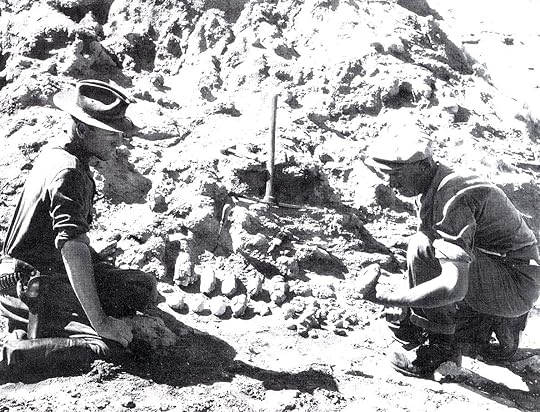
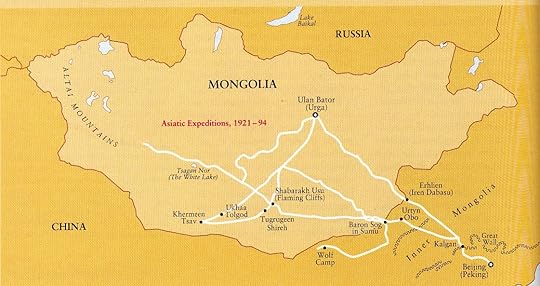
Under a Lucky Star is the autobiography-the lifetime of adventure-of the explorer and archaeologist Roy Chapman Andrews. Adored by the public and pursued by the press, Andrews came as close to superstar status in the 1920s as any explorer of the twentieth century. Much of Under a Lucky Star focuses on his grandest adventure, the Central Asiatic Expeditions, a series of five daring journeys into uncharted expanses of the Gobi Desert that produced a previously unknown treasure-trove of dinosaur remains. The Gobi region explored by Andrews and his team of scientists proved to be one of the most fruitful sites on earth for late dinosaurs and it continues to yield extraordinary paleontological discoveries.
Roy Chapman Andrews was an American explorer, adventurer and naturalist who became the director of the American Museum of Natural History. He is primarily known for leading a series of expeditions in China in the early 20th century into the Gobi Desert and Mongolia. The expeditions made important discoveries and brought the first-known fossil dinosaur eggs to the museum. His popular writings about his adventures made him famous.
I thoroughly enjoyed this. The author lived at a time when exploration was at it's height. There were unexplored regions, not-so-rigid boundaries and less red tape, marvels never before seen or even thought of, a time of wonder.
Mr Chapman was the guy who actually found and brought home the specimens that we all gape at in the museum. The first to photograph and study the habits of whales in their habits (not just how much oil they produce) but how they give birth etc, transporting huge skeletons of the various species.
The first to discover certain species of dinosaurs and find out that dinosaurs actually laid EGGS and bring home the proof.
Amazing stuff! He let the life that most boys could only dream of and how he even got in that position is a story itself.
The lesson: follow your dreams and don't let the lure of money or security stop you from doing what you really want to do most: live.
Roy Chapman Andrews has been cited as the inspiration for the character of Indiana Jones but his true life story is more interesting. This explorer went into the Gobi desert to excavate dinosaur fossils and dinosaur eggs which made him an international celebrity. Andrews worked for New York's Museum of Natural history and studied many other forms of animal life besides fossils. The author traveled through Asia making many observations about the people he encountered like the Japanese and their currently colonized Korean subjects. I once read about how the Imperial Japanese flooded China with narcotics before and after WWII and the writer has confirmed this. He has observed that Japan's military dictatorship was influenced by the Germans that were the model for much of their war machine. There are many people famous in his day that he knew that are forgotten today like movie star Douglas Fairbanks and the marine commander Smedley Butler. I liked this book because Roy Chapman Andrews lived a life of danger and exploration that is still worth reading about.
“Such is a kaleidoscopic picture of my life … Always there has been an adventure just around the corner-and the world is still full of corners!”
What a dive into the world of an amazing human. Under a Lucky Star is written like a love story to a lifetime of exploration. Possibly the inspiration for the character of Indiana Jones, Andrews tells His life’s tale more like a genius Forrest Gump.
Almost every page has Andrews shaking hands, dining, or sitting down with some notable names like Teddy Roosevelt, J.P. Morgan, John D. Rockefeller along with fellow naturalists, Generals, Emperors, aristocrats and countless everyday people.
As a smooth talking schemer Andrews willed his way from mopping the floors of, to becoming Director of the American Museum of Natural History. The story in between these two points of his life would be too much for Hollywood to ever do justice. Rediscovering extinct species, discovering new ones, hunting man eating tigers, changing paleontological history seemingly by accident, digging up bones in between gunfights with bandits, zooming through a war zone to make good time to a wedding, OH and he may have also been a spy!
Roy Chapman Andrews was an early 20th century explorer and adventurer who would eventually become director of the American Museum of Natural History. In his adventures he would discover new dinosaur species and was one of the first to discover fossilized dinosaur eggs. Many believe he is the inspiration for Indiana Jones and I can see that being the case. He wrote many books about his adventures through China and the Gobi desert. This book, Under a Lucky Star is his autobiography on his life and explorations. Published in 1943 and out of print for many decades, it was recently put back into circulation with the blessing of Mr. Andrews’ family.
There is no doubt that this man lived an interesting life. He traveled and discovered many things – one of the last to be able to travel through the unknown and even he knew it. He traveled in a time of huge changes through WWI and WWII. There is a lot of fascinating parts in this book. The only reason this book didn’t get a higher rating from me is he sometimes went on tangents which made me go “what does that have to do with anything?!” and his political rants became a bit much for me (but remember, he was writing this right in the midst of WWII and shortly after Pearl Harbor – he wasn’t the only one with less than fond thoughts).
I'm torn about this book. It's an autobiography of Roy Chapman Andrews, who is described as being a real-life Indiana Jones. I found an old copy of this book in a used book store in Vermont, and while I was reading it, I felt like I was reading an old journal of sorts, a rather stream of thought remembrance of adventures around Asia. That was wonderful, and although Chapman himself admits he is not a great writer, his travels are fascinating in themselves.
That said, the first half of the book is spent describing killing whales and frequent racist remarks about the people he meets on his trips. I can put some of this off to being a man of his times and ignorance, but I definitely found myself shaking my head at some passages, mainly about Japan. And though I know his work brought about a major influx of knowledge of the world, it wasn't easy reading about how many whales where killed in that time, before people realized they were wiping them out.
The second half of the book was more interesting, when he finds dinosaur bones and eggs, and other fossils in the desert, and he tones down the political fever/racist commentary.
All in all, it was an easy read, and extremely interesting to look at a world gone by, when the world was mostly unknown and one man was determined to explore it to allow us a glimpse into our past and future.
Always there has been an adventure just around the corner - and the world is still full of corners!
Awesome book and fantastic life!
Not only for personal anecdotes and more paleontological info, but mainly because it give a fresh and personal view on the lifestyle of far east of early '900 and Russia pre-revolution.
In almost each phrase it is possible to feel the childish curiosity of Roy Chapman Andrews for the entire world.
Occasionally interesting, a lot of bureaucracy for being the inspiration for Indiana Jones. It's amusing reading Andrews' amateurish and intellectually racist prose, which is no doubt a product of a bygone era.
A beautiful autobiography covering a lifetime of adventure and exploration. Perfect for any traveler or anyone interested in history or the great unknown.
Published in 1943, this is the autobiography of Roy Chapman Andrews; naturalist, photographer, explorer, collector of animal, bird, fish and insect specimens, paleontologist and later in life, President of the Explorers Club and Director of the American Museum of Natural History. For the better part of four decades, Chapman Andrews lived an exciting life, centered on his many adventures while collecting specimens for the American Museum of Natural History in remote parts of Canada, Alaska, Japan, Korea, China, the Philippines, the Dutch East Indies, Formosa, Burma, Mongolia and Russia. He felt “at home” in Asia and lived for a number of years in Japan and China, learned both of these languages and adapted somewhat to local customs. A number of his Asian “social adventures” are recounted in this book. With his expeditions to Mongolia and the Gobi desert in the 1920s (resulting in the discovery of fossilized dinosaur skeletons and eggs) Chapman Andrews became a popular American celebrity and an increasingly important fund-raiser for the Museum of Natural History.
The autobiography is written in an upbeat, conversational style that reflects the energy, enthusiasm and optimism of the author and, in some ways, the prevailing mindset of many Americans during those times. Chapman Andrews presents most of his undertakings (either in the field, in museum work or in the realm of fundraising) as brash, innovative, “first of their kind” approaches that produced successful results. Through luck or good planning this was usually true. He complemented his field work with books and magazine articles on his experiences and conducted extensive lecture tours across the U.S. to publicize his findings and to fundraise for his next expedition or for improvements to the Museum of Natural History. The man was a whirlwind of energy and an increasingly recognized part of popular American culture.
The book is relatively fast paced, often chatty and flows smoothly from one anecdote to the next without getting bogged down in details or lengthy personal reflections. It’s a read that offers exotic locations, natural science, some hunting, lots of adventure and an entertaining array of people and unusual events. In short, it's a good, uncomplicated read. Out of curiosity, I looked up Roy Chapman Andrews on Wikipedia and found a few interesting differences between their version of his biography and this one. I'd rate this one somewhere between 3 and 4 stars
Roy Chapman Andrews has been long suspected of being the inspiration behind Indiana Jones, and after reading this book, I think that sells Andrews short. And despite my best effort to summarize his eventful life here, I'm not even close to doing it justice. The matter-of-fact way he relates his spine-tingling adventures, as if his latest brush with death was just Tuesday, puts what an incredible character he was into sharp relief. Read this if you want the autobiography of the real deal, someone who lived life to the fullest and lived to tell about it.
Roy Chapman Andrews (a man fairly well known to dinosaur enthusiasts, although dinosaurs get limited focus in this book) says in this book that he’s not a great writer, but I actually liked his straightforward style, and he certainly has plenty of globe-trotting adventures of scientific exploration to write about, and musings on the world to share. The only real negative about this book is that, given the time period in which he’s writing, one must be prepared for a lot of racism and a casual attitude toward animal cruelty.
This was a difficult book to rate in stars: flawed in so many ways for my 21st century mores. Even when Andrews wrote it, the early pre-WWI concept on how to study animals by killing and collecting their bones was horribly outdated. His word choice when describing inhabitants of the countries he worked in, the lack of any women in his professional sphere so complete, his casual mention of servants and polo matches comes from a time I am glad is gone. I accepted that it is a snapshot of that time and let Andrews' easygoing memoir of an extraordinary life entertain and teach me.
Since it was written seventy years ago, the science and attitudes have changed significantly but the joy and excitement that Chapman brought to his work is evident (and engaging).
Nice overview of Andrews' life, but the name-dropping, casual racism, and blatant disregard of a clear timeline (or actual information) in regards to his personal life cost him a star.
Overall I really enjoyed this book. It really delivers on the “adventure” – following his journey from boyhood in Wisconsin to New York City, where he worked toward his dream of becoming an explorer for the American Museum of Natural History. Then it was onto whaling ships in the Arctic and Japan, surviving like Robinson Crusoe on an uninhabited island, exploring untouched jungles and mountains of Korea, tiger hunts, hobnobbing with Wall Street elites, his world-famous Central Asiatic Expeditions in the Gobi (where the first dinosaur eggs were found), brushes with political turmoil in China, and finally his retirement at Pondwood Farm.
He isn’t a great writer (as he says himself in the book, “I realized before long that it was fun to relate my experiences but that I’d never be a great writer; I couldn’t produce literature. All I could do was set down whatever story I had to tell as simply as possible. That is all I have tried to do ever since.”), but there’s a simplicity and sincerity to his style that I really liked. I never felt like he had exaggerated anything in the story–not that he needed too, he had quite an exciting life!–and approached all of his topics with honesty and humor.
The time period and some of the people that he associated with during his life were really interesting too. At one point he calls President Roosevelt “Ted” and he worked with some other important names while obtaining funding for the museum and his expeditions. It was such a different era back then – and with that came a few things that wouldn’t pass for politically correct today. A few of his descriptions of Asian people (especially the Japanese) are a bit off-putting, but it was somewhat understandable as he was writing this memoir in the midst of World War II.
One thing that surprised me a bit about this book was how bittersweet reading it was, and the fact that it made me a bit sad. I definitely feel like Roy Chapman Andrews was sort of the “last of his kind”… His spirit reminded me the great Victorian-era explorers, but by the time he retired there weren’t very many unknown places left in the world. He makes several comments to that himself in the book – “Each trip around the world seemed to reduce the globe in size.” He also says,
As I read of the present war, I realize that no unknown corners of the world remain. What were the ends of the earth years ago appear suddenly in the headlines of every newspaper. The jungles of New Guinea, Borneo, and the Salween valley were mysterious and unknown. Today, they are the battlefronts of the world. Truly the romance and adventure of exploration are gone forever! As I said, reading passages like that made me feel sad and maybe even a bit jealous – that the world when he knew it was a more exciting place than it is now. With satellite imagery everywhere has been mapped, and with the advent of air travel there’s almost nowhere left that really needs “exploring”! However, he does end on a bit happier note with his final quote, ensuring us that, “always there has been an adventure just around the corner — and the world is still full of corners.” Overall I’d recommend this book as a fun read about a really interesting (and somewhat lesser known) American adventurer!
Not only a lucky star, but a flexible mind, a well-oiled tongue and a reasonably egoistic mindset. Alone, it's a biobraphy of an adventure of the time of the Great Game, a real-life Indiana Jones, together with other biographical notes and the literature on life in the colonies it's an invaluable insight into the functioning of the financial and research world of yesteryear colonialism and a precious image of the practicality of cognitive dissonance in a person, who by his functions and passion must continue his mission regardless of his volatile, and I may say explosive environment .
One must first become proficient in destroying something to be able to understand it - that's what happened to several populations of whales, and that's what comes away as a general human moral.
Thus "The industrious, gentle and curious Japanese", "People with a lively mind who would stop me and ask me about my work and everything", "insatiable minds" would turn into "bloodthirsty and concealed Japanese, a nation which, unlike all Asian nations was showing their conceitedness since the beginning" - a phrase regarding the Japanese response to the American and international help during the Great Kanto Earthquake of 1923 - response to a convoy of military ships coming from the Colonized Philippines and other European Colonies of the Far East. No wonder the Japanese expected a knife in the back, because all the nations of the South East Asia and the Far East got a knife in the back from the Great Powers of the day.
So - the "Poor Manchu aristocracy .... the remaining honorable few... who impressed me" and the "brave chinese" turn into "ferocious and bloodthirsty chinese", "bloodthirsty horde" as soon as an independence movement gains traction and they start expelling and executing the Europeans who lived in the Legates of the big cities(extrateritorial parts of the Chinese colonies), boy are the Europeans happy to see those bloodthirsty Chinese decimated, whether by the hand of the British and American fleet or by the hand of the Japanese. That is a reaction of a scholar. It's not hard to understand why the media or society didn't much care about the ongoing genocide of the Chinese by the Japanese, until Pearl Harbor.
Same in Mongolia - 'the free-riding days of the past were over for Mongol' once the "evil" (competing) Russians came, turning them "into puppets behind whom stood Russian advisors". The same Mongols who were described as "robbers, and soldiers; which in those times were indistingushable, ......but thankfully bad shots" in preceding text.
The second biggest moral lesson here is the lesson is absence of morality - just do what you like doing best and be on the lookout for yourself.
Andrews was the real deal; exactly the kind of over-the-top scientist/adventurer you would expect him to be as the true life inspiration for Indiana Jones.
But while that's all terribly romantic and gripping, you wonder how well he does as a writer, especially when telling his own life story. Well that's one of the best parts. The book is a complete hoot. Andrews is humble, except when he isn't. He's restrained, except when he's not. He is modest about his actual life details, (his youth, his connection to the Museum), but he delivers on the matter of his grand adventures. There's a bit of stiff upper lip and a certain manly sang froid, but the things he did were too cool to be tamped down and turned into just a bland travelogue. And sometimes his deadpan delivery and understatement make an adventure even more compelling.
This is full bore "Boys Own" adventure, and the fact that it is real just adds an extra dimension. Roy Chapman Andrews was a rare character, and this is a rare book. Well worth searching out.
"Always there has been an adventure just around the corner--and the world is still full of corners!" This is the autobiography of an explorer, naturalist, museum director and author, full of observations, stories and anecdotes, particularly about his adventures in Peking and the Gobi Desert and life in New York City at the Natural History Museum. Since I loved his books as a young girl, it was interesting to get an adult view of the author.
Dudes a bit of a racist but hey they made a few movies about this guy, and THERE CALLED INDIANA JONES! We'll just chalk up Indy 4 to the racist part. I like this book because it makes me want to work at a mesume.